

Cosmic Query
 |
Description
Book Introduction
“How was the universe born, and how old is it?” “What is the universe made of?”
“How did life originate in the universe?” “Are we the only living things in the universe?”
“How on earth did we come to know all this!”
『Cosmos』 Carl Sagan's successor
Neil deGrasse Tyson, one of the most beloved science communicators of our time,
The great secret in the vast and wondrous world of the universe he speaks of!
Neil deGrasse Tyson, the delightful astrophysicist, a giant in astrophysics, Carl Sagan's successor to Cosmos, and one of our generation's most beloved science communicators, returns with his new book, The Cosmic Query.
Leveraging his unique talents, Tyson once again answers the world's most difficult questions and curiosities, armed with wit, wisdom, and cutting-edge science, in the world's easiest language.
Humanity's curiosity toward the endless expanse of space has continued since ancient times.
The universe has stimulated humanity's boundless imagination since time immemorial.
But the human brain is too small and lifespan is only a moment to unlock the secrets of the vast and distant universe.
Nevertheless, mankind, who never gave up, began to find ways to prove the reality of the universe that they could only simply look at, and even succeeded in landing on the moon.
"Cosmic Query" fascinatingly captures the long history of the universe from the Big Bang to the multiverse, the discovery of the telescope and the invention of space probes, the origin of life, and the possibility of extraterrestrial life, along with humanity's endless efforts to bridge the vast gap between curiosity and ignorance.
Filled with groundbreaking discoveries that have shaped the paradigms underlying the foundations and building blocks of cosmology and astrophysics, this book will offer readers of all ages and generations a new window into the intricacies of the universe, offering them endless inspiration about the universe.
If you're a novice space explorer just becoming interested in space travel and are worried about not having enough scientific knowledge, including cosmology, astronomy, and astrophysics, don't be.
All you need is a willingness to dive into the wonders of space and beyond with "Cosmic Query."
“How did life originate in the universe?” “Are we the only living things in the universe?”
“How on earth did we come to know all this!”
『Cosmos』 Carl Sagan's successor
Neil deGrasse Tyson, one of the most beloved science communicators of our time,
The great secret in the vast and wondrous world of the universe he speaks of!
Neil deGrasse Tyson, the delightful astrophysicist, a giant in astrophysics, Carl Sagan's successor to Cosmos, and one of our generation's most beloved science communicators, returns with his new book, The Cosmic Query.
Leveraging his unique talents, Tyson once again answers the world's most difficult questions and curiosities, armed with wit, wisdom, and cutting-edge science, in the world's easiest language.
Humanity's curiosity toward the endless expanse of space has continued since ancient times.
The universe has stimulated humanity's boundless imagination since time immemorial.
But the human brain is too small and lifespan is only a moment to unlock the secrets of the vast and distant universe.
Nevertheless, mankind, who never gave up, began to find ways to prove the reality of the universe that they could only simply look at, and even succeeded in landing on the moon.
"Cosmic Query" fascinatingly captures the long history of the universe from the Big Bang to the multiverse, the discovery of the telescope and the invention of space probes, the origin of life, and the possibility of extraterrestrial life, along with humanity's endless efforts to bridge the vast gap between curiosity and ignorance.
Filled with groundbreaking discoveries that have shaped the paradigms underlying the foundations and building blocks of cosmology and astrophysics, this book will offer readers of all ages and generations a new window into the intricacies of the universe, offering them endless inspiration about the universe.
If you're a novice space explorer just becoming interested in space travel and are worried about not having enough scientific knowledge, including cosmology, astronomy, and astrophysics, don't be.
All you need is a willingness to dive into the wonders of space and beyond with "Cosmic Query."
- You can preview some of the book's contents.
Preview
index
Author's Note
Introduction
Recommendation
Chapter 1.
Where is our place in the universe?
Is Earth a Planet? | Astronomy with Sticks | Parallax Solutions | How Big is the Solar System? | Henrietta Leavitt and the Standard Candle | Galaxies | 100 Billion × 100 Billion | Conclusion
Chapter 2.
How were the facts known today discovered?
Naked-Eye Astronomy | Galileo and the Telescope | The Electromagnetic Spectrum | The Universe in Radio Waves | From Astronomy to Astrophysics | Knowledge from Beyond the Atmosphere | Opening a New Window on the Universe | Current Observatories | Looking Ahead
Chapter 3.
Why did the universe evolve as it did?
Big Bang | A Universe Made of Atomic Materials | Creating a Friendly Universe | Nebular Hypothesis | Freeze Line | Cosmic Billiards Hall | Planetary Migration | The End of the Solar System
Chapter 4.
How old is the universe?
Amazing Fact 1.
Cosmic Microwave Background Radiation | Amazing Fact 2.
Messages in Microwaves | Amazing Facts 3.
The Inflationary Universe | Amazing Facts 4.
Temperature Differences in the Cosmic Microwave Background | The Cosmic Distance Ladder | 5 Amazing Facts
Dark Energy | Tension and Reconciliation | 6 Amazing Facts
Dark Matter | The Formation of the Universe
Chapter 5.
What is the universe made of?
The Birth of Chemistry | Where Do the Elements Come From? | A New Atom Theory | Splitting the Atom | Who Ordered That? | The Age of Accelerators | The Rise of Quarks | Particle Physics Terminology | Can We Split It Further?
Chapter 6.
What is life?
The Experiment That Changed Everything | The Seeds of Life on Earth Delivered from Space | The Origin of Life, RNA | Natural Selection | Is Complexity Inevitable? | Intelligence and Technology | Fake Life | Other Kinds of Life | Extremophiles
Chapter 7.
Are we the only life forms in the universe?
Strange Ideas | A Single Case | The Search for Extraterrestrial Intelligence | The Drake Equation | Is Technology Inevitable? | SETI: The Search for Extraterrestrial Intelligence | The Habitable Zone | The Fermi Paradox | The Ranks of Civilizations
Chapter 8.
How did the universe begin?
The Smallest Unit of All Things | Quantum Mechanics 101 | Simplification and Unification | Quark Binding | Unification of the Strong Force | Unification of the Antimatter Problem | Grand Scenario | The End of Knowledge
Chapter 9.
How will the universe end?
Earth's End | Unpredictable Disasters: Volcanoes | Unpredictable Disasters: Collisions | Colliding Galaxies | Open, Closed, or Flat Universe | The Ratio of the Universe's Elements | End-of-the-World Scenarios | The Edge of the Time Map | Watch the End of the Universe
Chapter 10.
What is the relationship between everything and nothingness?
The Shifting Concept of Nothingness | Could the Entire Universe Be a Quantum Fluctuation? | The Origin of the Universe | Before the Big Bang | The Multiverse | The Fine-Tuning Problem | Types of the Multiverse | Is This Really Science?
Acknowledgements
Translator's Note
A good story to read together
Image source
Search
Introduction
Recommendation
Chapter 1.
Where is our place in the universe?
Is Earth a Planet? | Astronomy with Sticks | Parallax Solutions | How Big is the Solar System? | Henrietta Leavitt and the Standard Candle | Galaxies | 100 Billion × 100 Billion | Conclusion
Chapter 2.
How were the facts known today discovered?
Naked-Eye Astronomy | Galileo and the Telescope | The Electromagnetic Spectrum | The Universe in Radio Waves | From Astronomy to Astrophysics | Knowledge from Beyond the Atmosphere | Opening a New Window on the Universe | Current Observatories | Looking Ahead
Chapter 3.
Why did the universe evolve as it did?
Big Bang | A Universe Made of Atomic Materials | Creating a Friendly Universe | Nebular Hypothesis | Freeze Line | Cosmic Billiards Hall | Planetary Migration | The End of the Solar System
Chapter 4.
How old is the universe?
Amazing Fact 1.
Cosmic Microwave Background Radiation | Amazing Fact 2.
Messages in Microwaves | Amazing Facts 3.
The Inflationary Universe | Amazing Facts 4.
Temperature Differences in the Cosmic Microwave Background | The Cosmic Distance Ladder | 5 Amazing Facts
Dark Energy | Tension and Reconciliation | 6 Amazing Facts
Dark Matter | The Formation of the Universe
Chapter 5.
What is the universe made of?
The Birth of Chemistry | Where Do the Elements Come From? | A New Atom Theory | Splitting the Atom | Who Ordered That? | The Age of Accelerators | The Rise of Quarks | Particle Physics Terminology | Can We Split It Further?
Chapter 6.
What is life?
The Experiment That Changed Everything | The Seeds of Life on Earth Delivered from Space | The Origin of Life, RNA | Natural Selection | Is Complexity Inevitable? | Intelligence and Technology | Fake Life | Other Kinds of Life | Extremophiles
Chapter 7.
Are we the only life forms in the universe?
Strange Ideas | A Single Case | The Search for Extraterrestrial Intelligence | The Drake Equation | Is Technology Inevitable? | SETI: The Search for Extraterrestrial Intelligence | The Habitable Zone | The Fermi Paradox | The Ranks of Civilizations
Chapter 8.
How did the universe begin?
The Smallest Unit of All Things | Quantum Mechanics 101 | Simplification and Unification | Quark Binding | Unification of the Strong Force | Unification of the Antimatter Problem | Grand Scenario | The End of Knowledge
Chapter 9.
How will the universe end?
Earth's End | Unpredictable Disasters: Volcanoes | Unpredictable Disasters: Collisions | Colliding Galaxies | Open, Closed, or Flat Universe | The Ratio of the Universe's Elements | End-of-the-World Scenarios | The Edge of the Time Map | Watch the End of the Universe
Chapter 10.
What is the relationship between everything and nothingness?
The Shifting Concept of Nothingness | Could the Entire Universe Be a Quantum Fluctuation? | The Origin of the Universe | Before the Big Bang | The Multiverse | The Fine-Tuning Problem | Types of the Multiverse | Is This Really Science?
Acknowledgements
Translator's Note
A good story to read together
Image source
Search
Detailed image

Into the book
If Earth were not a special planet and humans were merely a part of nature, then the laws we discovered on Earth would have no special corners.
This also means that exoplanets on the other side of the universe (and any extraterrestrial life that might exist there) are not much different from us.
If so, our desire to transcend time and space and understand all of the universe, its past and future, will never end in vain.
There is no room for disagreement here.
The more pride is hurt, the more science advances.
--- p.48~49, 「Chapter 1.
From "Where is our place in the universe?"
If the universe is truly expanding, then the universe in the past must have been smaller than it is now, and if we go back in time, there must have been a point in time when the size of the universe converged to zero.
Therefore, the Big Bang theory, which states that the universe began from a single point, is a natural consequence of the theory of cosmic expansion, and is the first clue to why our universe evolved into its current form.
--- p.95, Chapter 3.
From "Why did the universe evolve as it did?"
Our universe has been expanding without stopping since its birth, and as a result, all galaxies are constantly moving away from us.
(…) “What percentage of the observable universe is the whole?” If, as some theorists claim, the observable universe is only a tiny fraction of the whole, then the end of the universe is a mirage, forever unreachable.
Let alone the age of the universe, who knows what might be lurking beyond the cosmic horizon?
--- p.125~126, 「Chapter 4.
From "How old is the universe?"
If we want to find life elsewhere than Earth, we must first understand life on Earth.
You know the gist of it, right? It's not that simple.
Even the best biologists have difficulty answering the question, “What is life?”
Life is a constantly changing concept, and so it still remains on the periphery of science, not at the center.
--- p.189, Chapter 6.
From "What is life?"
“What is life?” “Are we alone in the universe?” Anyone who delves into these questions inevitably encounters limitations.
As far as we know, life seems to exist only on Earth.
If you hope to find life on exoplanets, you'd better give up hope that they'll be similar to ours.
Since all we have seen is life on Earth, we may have unconsciously developed some preconceived notions.
--- p.219, Chapter 7.
Are we the only life forms in the universe?
How many types of forces would be needed to construct a universe? In a universe where no forces act, nothing would happen, but our universe is not like that.
Building a universe requires more than one force.
So, two? Three? No.
The simplest universe requires only one force to operate.
If the universe becomes simpler as we go back in time, we will eventually reach a point where the forces are reduced to one.
(…) Theoretical physicists, fascinated by the idea of unifying all forces into one, are struggling to achieve the greatest unification in the history of science, even calling it a “grand unification theory.”
--- p.266, Chapter 8.
From "How did the universe begin?"
The disappearance of stars from the sky means that distant galaxies will also disappear.
Dark energy is accelerating the overall expansion of the universe and increasing the distance between galaxies.
Then, when the distance between the Earth observer and the galaxy exceeds a certain limit, the light emitted from the galaxy cannot reach Earth.
Not only stars, but also galaxies are disappearing one by one.
In the end, the immortal observer left alone on Earth will be surrounded by a cold, dark universe, a collapsing black hole, and a thin soup of elementary particles, crying out quietly.
“Please, let me disappear with them!”
This also means that exoplanets on the other side of the universe (and any extraterrestrial life that might exist there) are not much different from us.
If so, our desire to transcend time and space and understand all of the universe, its past and future, will never end in vain.
There is no room for disagreement here.
The more pride is hurt, the more science advances.
--- p.48~49, 「Chapter 1.
From "Where is our place in the universe?"
If the universe is truly expanding, then the universe in the past must have been smaller than it is now, and if we go back in time, there must have been a point in time when the size of the universe converged to zero.
Therefore, the Big Bang theory, which states that the universe began from a single point, is a natural consequence of the theory of cosmic expansion, and is the first clue to why our universe evolved into its current form.
--- p.95, Chapter 3.
From "Why did the universe evolve as it did?"
Our universe has been expanding without stopping since its birth, and as a result, all galaxies are constantly moving away from us.
(…) “What percentage of the observable universe is the whole?” If, as some theorists claim, the observable universe is only a tiny fraction of the whole, then the end of the universe is a mirage, forever unreachable.
Let alone the age of the universe, who knows what might be lurking beyond the cosmic horizon?
--- p.125~126, 「Chapter 4.
From "How old is the universe?"
If we want to find life elsewhere than Earth, we must first understand life on Earth.
You know the gist of it, right? It's not that simple.
Even the best biologists have difficulty answering the question, “What is life?”
Life is a constantly changing concept, and so it still remains on the periphery of science, not at the center.
--- p.189, Chapter 6.
From "What is life?"
“What is life?” “Are we alone in the universe?” Anyone who delves into these questions inevitably encounters limitations.
As far as we know, life seems to exist only on Earth.
If you hope to find life on exoplanets, you'd better give up hope that they'll be similar to ours.
Since all we have seen is life on Earth, we may have unconsciously developed some preconceived notions.
--- p.219, Chapter 7.
Are we the only life forms in the universe?
How many types of forces would be needed to construct a universe? In a universe where no forces act, nothing would happen, but our universe is not like that.
Building a universe requires more than one force.
So, two? Three? No.
The simplest universe requires only one force to operate.
If the universe becomes simpler as we go back in time, we will eventually reach a point where the forces are reduced to one.
(…) Theoretical physicists, fascinated by the idea of unifying all forces into one, are struggling to achieve the greatest unification in the history of science, even calling it a “grand unification theory.”
--- p.266, Chapter 8.
From "How did the universe begin?"
The disappearance of stars from the sky means that distant galaxies will also disappear.
Dark energy is accelerating the overall expansion of the universe and increasing the distance between galaxies.
Then, when the distance between the Earth observer and the galaxy exceeds a certain limit, the light emitted from the galaxy cannot reach Earth.
Not only stars, but also galaxies are disappearing one by one.
In the end, the immortal observer left alone on Earth will be surrounded by a cold, dark universe, a collapsing black hole, and a thin soup of elementary particles, crying out quietly.
“Please, let me disappear with them!”
--- p.312, Chapter 9.
From "How Will the Universe End?"
From "How Will the Universe End?"
Publisher's Review
“13.8 billion years ago, how was the universe born?
How did the origin of life take root 3.8 billion years ago?
“Are we really the only living creatures in the universe?”
From the Big Bang to the Multiverse, from the Origin of Life to Extraterrestrial Life
A delightful Q&A that reveals the great secrets of the universe, humanity, and the history of all creation.
“A hymn to humanity’s indomitable will and to scientists to lift the veil of the unknown!”
_Orbit (Science Communicator, Distinguished Professor at DGIST, Author of "Time for Science")
“A book that will make you feel confident that it can tell you all the answers about the universe.”
_Space Dust Ji Woong-bae (Science Communicator, Assistant Professor at Sejong University, Operator of YouTube Channel 'Space Dust's Sage Times')
★ A new work from the delightful astrophysicist Neil deGrasse Tyson! ★
★ Highly recommended by Science Communicator Orbit and Space Dust! ★
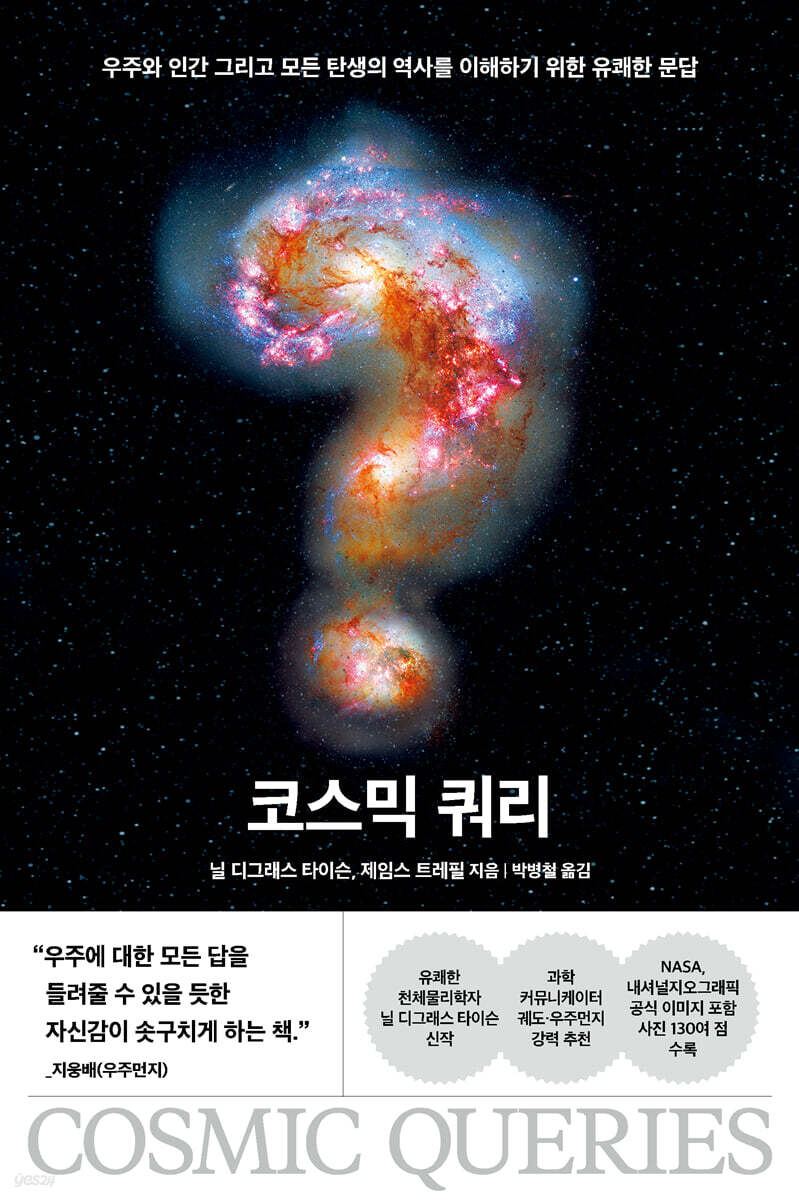
★ Includes over 130 photos, including official images from NASA and National Geographic ★
“Where is our place in the universe?”
I wanted to understand the universe, the world, and even humanity through the language of astronomy.
Ten Scientific and Philosophical Questions for Humanity
Neil deGrasse Tyson has long been beloved for his signature wit, clarity, and ability to explain complex concepts in a way that anyone can easily understand.
This new book, "Cosmic Query," makes full use of the content from the "Cosmic Questions" segment of his podcast "Star Talk," which he has been hosting since 2015, to provide useful and well-organized answers to questions about the mysteries and curiosities of the universe.
The primary purpose of this book is to delve into the profound questions readers have about the universe, ultimately offering the most plausible answers to the perplexing questions humanity has posed: "Who are we? And why are we here?"
Tyson, along with renowned physicist and science popularizer James Trefill, selects ten of the many questions humanity has pondered about the universe for millennia and provides relevant answers based on various theories, observations, and the latest data.
The ten carefully selected questions may seem philosophical at first glance, but the process of finding the answers is profoundly scientific.
Here, 130 dazzling and intuitive photographs that will catch your eye, along with Tyson's witty Twitter (now X) posts inserted here and there, help you understand the story of the universe more easily and conveniently.
Starting with 'Where is our place in the universe?' and ending with 'How were the facts we know now discovered?', 'Why did the universe evolve as it is?', 'How old is the universe?', 'What is the universe made of?', 'What is life?', 'Are we the only life forms in the universe?', 'How did the universe begin?', 'How will the universe end?', and 'What is the relationship between everything and nothing?', these basic and fundamental questions about the universe examine how the universe, which was nothing more than a world of the smallest particles, became such a vast space, and look ahead to the universe's distant past and distant future.
Building on the brilliant wisdom of our ancestors from Eratosthenes to Galileo, we explore the dazzling world of astrophysics, from the birth and evolution of the universe, including the Big Bang, dark matter, quantum mechanics, and the multiverse, to cutting-edge scientific theories and technologies, including observatories, radio telescopes, particle accelerators, and spacecraft.
“Sometimes, raise your head and look at the sky.”
Questions about the universe that came to mind while looking up at the night sky,
As we understand the universe, our world expands along with it.
Just like Ptolemy's 'geocentric model', which believed that the Earth was the center of the universe, humans also once considered themselves to be the center of the universe.
However, just as Copernicus's 'sun-centered model' became the center of cosmology with the development of astronomical observation and telescopes, the questions about the universe that came to mind while looking up at the night sky and the process of finding answers to them soon led to the realization that humans are not the center of the universe.
But Homo sapiens, the thinking human beings, did not stop here and went one step further.
“Who are we, how did we get here, and where are we going?” This question, directed at the universe and at oneself, leads to serious contemplation and reflection on the philosophical meaning of not only the universe but also human existence.
Since ancient times, mankind has repeatedly asked questions to the universe and sought answers.
Curiosity and aspiration toward the inaccessible universe have laid the foundation for scientific discovery and advancement surrounding the universe, fueling the growth of astronomy into astrophysics, and ultimately leading to a philosophical exploration of the reason and value of human existence.
In this way, within a short lifespan of less than 100 years, humanity has continuously asked, answered, and systematized questions that were previously unimaginable. Along with the remarkable advancement of science, humanity has also achieved philosophical growth, obtaining sufficient answers to existential questions.
As we understand the universe, our world expands along with it.
“Do you feel insignificant every time you look up at the night sky? You don’t have to.
No matter what anyone says, you are a huge being.
Why? Because every atom that makes up your body came from a star.
Yes, that's right.
We are descendants of the stars.
This is not a metaphor, it is a fact.
“We are in the universe, and the universe is in us.” _Neil deGrasse Tyson
With "Cosmic Queries," a thought-provoking and insightful compilation of cosmic questions and insightful answers, Neil deGrasse Tyson uses astrophysics as a tool to answer the ultimate question: "Who am I?" in a way that is lighthearted, entertaining, yet scientifically sound and objective.
He earnestly hopes that his dear readers will continue to take an interest in space and the night sky and ask questions in a universe where unsolved problems still abound.
As we understand the universe, our world expands along with it, and the process of asking and answering questions about the universe will soon gift us with precious time to explore the meaning of our existence.
So, following his advice, “Let’s take a break from our suffocatingly busy daily lives and look up at the sky every now and then.”
How did the origin of life take root 3.8 billion years ago?
“Are we really the only living creatures in the universe?”
From the Big Bang to the Multiverse, from the Origin of Life to Extraterrestrial Life
A delightful Q&A that reveals the great secrets of the universe, humanity, and the history of all creation.
“A hymn to humanity’s indomitable will and to scientists to lift the veil of the unknown!”
_Orbit (Science Communicator, Distinguished Professor at DGIST, Author of "Time for Science")
“A book that will make you feel confident that it can tell you all the answers about the universe.”
_Space Dust Ji Woong-bae (Science Communicator, Assistant Professor at Sejong University, Operator of YouTube Channel 'Space Dust's Sage Times')
★ A new work from the delightful astrophysicist Neil deGrasse Tyson! ★
★ Highly recommended by Science Communicator Orbit and Space Dust! ★
★ Includes over 130 photos, including official images from NASA and National Geographic ★
“Where is our place in the universe?”
I wanted to understand the universe, the world, and even humanity through the language of astronomy.
Ten Scientific and Philosophical Questions for Humanity
Neil deGrasse Tyson has long been beloved for his signature wit, clarity, and ability to explain complex concepts in a way that anyone can easily understand.
This new book, "Cosmic Query," makes full use of the content from the "Cosmic Questions" segment of his podcast "Star Talk," which he has been hosting since 2015, to provide useful and well-organized answers to questions about the mysteries and curiosities of the universe.
The primary purpose of this book is to delve into the profound questions readers have about the universe, ultimately offering the most plausible answers to the perplexing questions humanity has posed: "Who are we? And why are we here?"
Tyson, along with renowned physicist and science popularizer James Trefill, selects ten of the many questions humanity has pondered about the universe for millennia and provides relevant answers based on various theories, observations, and the latest data.
The ten carefully selected questions may seem philosophical at first glance, but the process of finding the answers is profoundly scientific.
Here, 130 dazzling and intuitive photographs that will catch your eye, along with Tyson's witty Twitter (now X) posts inserted here and there, help you understand the story of the universe more easily and conveniently.
Starting with 'Where is our place in the universe?' and ending with 'How were the facts we know now discovered?', 'Why did the universe evolve as it is?', 'How old is the universe?', 'What is the universe made of?', 'What is life?', 'Are we the only life forms in the universe?', 'How did the universe begin?', 'How will the universe end?', and 'What is the relationship between everything and nothing?', these basic and fundamental questions about the universe examine how the universe, which was nothing more than a world of the smallest particles, became such a vast space, and look ahead to the universe's distant past and distant future.
Building on the brilliant wisdom of our ancestors from Eratosthenes to Galileo, we explore the dazzling world of astrophysics, from the birth and evolution of the universe, including the Big Bang, dark matter, quantum mechanics, and the multiverse, to cutting-edge scientific theories and technologies, including observatories, radio telescopes, particle accelerators, and spacecraft.
“Sometimes, raise your head and look at the sky.”
Questions about the universe that came to mind while looking up at the night sky,
As we understand the universe, our world expands along with it.
Just like Ptolemy's 'geocentric model', which believed that the Earth was the center of the universe, humans also once considered themselves to be the center of the universe.
However, just as Copernicus's 'sun-centered model' became the center of cosmology with the development of astronomical observation and telescopes, the questions about the universe that came to mind while looking up at the night sky and the process of finding answers to them soon led to the realization that humans are not the center of the universe.
But Homo sapiens, the thinking human beings, did not stop here and went one step further.
“Who are we, how did we get here, and where are we going?” This question, directed at the universe and at oneself, leads to serious contemplation and reflection on the philosophical meaning of not only the universe but also human existence.
Since ancient times, mankind has repeatedly asked questions to the universe and sought answers.
Curiosity and aspiration toward the inaccessible universe have laid the foundation for scientific discovery and advancement surrounding the universe, fueling the growth of astronomy into astrophysics, and ultimately leading to a philosophical exploration of the reason and value of human existence.
In this way, within a short lifespan of less than 100 years, humanity has continuously asked, answered, and systematized questions that were previously unimaginable. Along with the remarkable advancement of science, humanity has also achieved philosophical growth, obtaining sufficient answers to existential questions.
As we understand the universe, our world expands along with it.
“Do you feel insignificant every time you look up at the night sky? You don’t have to.
No matter what anyone says, you are a huge being.
Why? Because every atom that makes up your body came from a star.
Yes, that's right.
We are descendants of the stars.
This is not a metaphor, it is a fact.
“We are in the universe, and the universe is in us.” _Neil deGrasse Tyson
With "Cosmic Queries," a thought-provoking and insightful compilation of cosmic questions and insightful answers, Neil deGrasse Tyson uses astrophysics as a tool to answer the ultimate question: "Who am I?" in a way that is lighthearted, entertaining, yet scientifically sound and objective.
He earnestly hopes that his dear readers will continue to take an interest in space and the night sky and ask questions in a universe where unsolved problems still abound.
As we understand the universe, our world expands along with it, and the process of asking and answering questions about the universe will soon gift us with precious time to explore the meaning of our existence.
So, following his advice, “Let’s take a break from our suffocatingly busy daily lives and look up at the sky every now and then.”
GOODS SPECIFICS
- Date of issue: November 6, 2025
- Page count, weight, size: 372 pages | 690g | 152*228*23mm
- ISBN13: 9791141174569
- ISBN10: 1141174561
You may also like
카테고리
korean


korean

![GQ KOREA Mark (Monthly): December [2025]](http://librairie.coreenne.fr/cdn/shop/files/8ef265dbbfbf186523ed75ba7319009d.jpg?v=1765340328&width=3840)


