

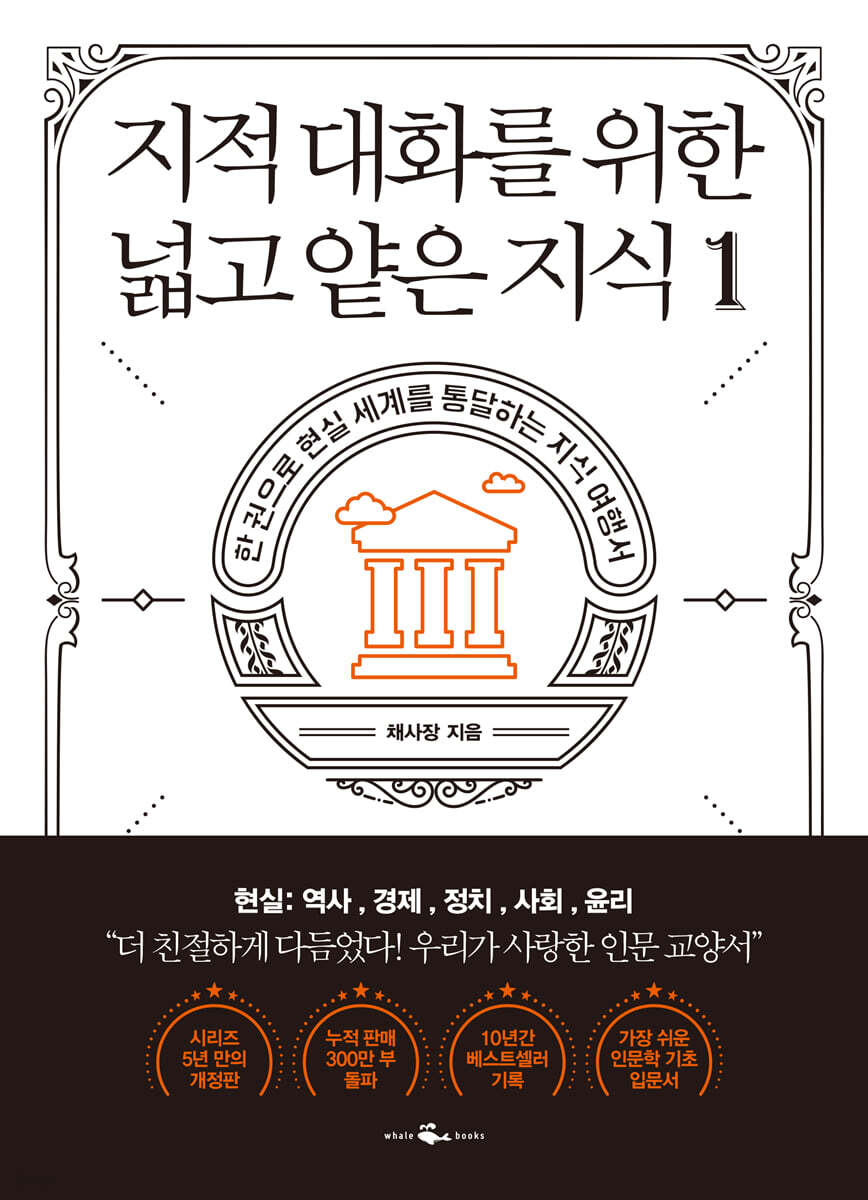
Broad and shallow knowledge for intellectual conversation 1
 |
Description
Book Introduction
“To have intellectual conversations with others
“The most basic knowledge you must have”
The first revised and expanded edition of [The Wide and Shallow], a representative humanities textbook of our time.
Read and enthusiastically received by millions of readers, it has been a must-read for humanities students for many years.
The iconic humanities series returns with a new look.
A book that changed the landscape of the difficult and rigid humanities field.
This book became a bestseller immediately after its publication, and went on to sell over 2 million copies, becoming a double million seller, remaining a steady seller for a full five years.
A book that popularized the unfamiliar and difficult to pronounce phrase "지대NPYAP" and even spawned a TV program with a similar concept; a book that allowed ordinary people who were thirsty for basic common sense to discuss things without hesitation, view the news proactively, and take an opinion in elections; a book that was evaluated as being written in an easy and fun way for people of all ages to read, such as a book that started an 80-year-old reader to start self-studying, a middle school student reader to read humanities, and an office worker to form a book club.
All of this is an explanation of 『Broad and Shallow Knowledge for Intellectual Conversation』.
Following the new edition [Zero], a revised and expanded edition has been published for the first time in five years.
The rough and insufficient parts were gently smoothed and filled in.
Old stories have been updated to fit the times.
The stories that author Cha Sa-jang shared with many readers after the book was published helped in revising the book.
The moment you read this meticulously revised edition, you will understand why this book has remained unbroken for the past five years.
“The most basic knowledge you must have”
The first revised and expanded edition of [The Wide and Shallow], a representative humanities textbook of our time.
Read and enthusiastically received by millions of readers, it has been a must-read for humanities students for many years.
The iconic humanities series returns with a new look.
A book that changed the landscape of the difficult and rigid humanities field.
This book became a bestseller immediately after its publication, and went on to sell over 2 million copies, becoming a double million seller, remaining a steady seller for a full five years.
A book that popularized the unfamiliar and difficult to pronounce phrase "지대NPYAP" and even spawned a TV program with a similar concept; a book that allowed ordinary people who were thirsty for basic common sense to discuss things without hesitation, view the news proactively, and take an opinion in elections; a book that was evaluated as being written in an easy and fun way for people of all ages to read, such as a book that started an 80-year-old reader to start self-studying, a middle school student reader to read humanities, and an office worker to form a book club.
All of this is an explanation of 『Broad and Shallow Knowledge for Intellectual Conversation』.
Following the new edition [Zero], a revised and expanded edition has been published for the first time in five years.
The rough and insufficient parts were gently smoothed and filled in.
Old stories have been updated to fit the times.
The stories that author Cha Sa-jang shared with many readers after the book was published helped in revising the book.
The moment you read this meticulously revised edition, you will understand why this book has remained unbroken for the past five years.
- You can preview some of the book's contents.
Preview
index
prolog
How to read this book
Warm-up
Structuring the World and Suspension of Judgment
history
Linear and circular time concepts
History begins with time
Means of production and the characteristics of capitalism
Two key concepts for explaining history
primitive communist society
One day the means of production were born.
ancient slave societies
The means of production created kings and slaves.
medieval feudal society
The classes became more subdivided.
modern capitalism
A new power was born
Interim summary
The development of modern capitalism
Oversupply has begun
Imperialist era
They needed a colony
World War I
Oversupply caused war
Great Depression
Price competition led to the Great Depression.
World War II
A second war broke out due to oversupply.
Cold War era
Why Capitalism and Communism Oppose Each Other
The Birth of Neoliberalism
A world of new and unique economic systems
Final Summary
economy
Four economic systems
When the economy changes, everything changes.
Market freedom and government intervention
Which society would you choose?
Capitalism and Communism
I grant you the means of production.
Early capitalism, late capitalism, neoliberalism
How Capitalism Has Changed
early capitalism
The market is free
late capitalism
Government intervention is needed
neoliberalism
Give freedom back to the market
communism
Why Communism Failed
Distinction between communism and socialism
What is communism and what is socialism
Connection with history
The economic system reflects the circumstances of the times.
Interim summary
Growth-oriented policies and distribution-oriented policies
Ultimately, it's a question of growth and distribution.
Final Summary
politics
Conservatism, progressivism, and democracy
What should the economic system be?
Theoretical distinction between conservative and progressive
Are you conservative or progressive?
The realistic distinction between conservative and progressive
How do conservatives and progressives manifest themselves in reality?
Interim summary
FTA, free school meals, privatization
Let's apply conservatism and progressivism to real-world practice.
A Soccer Game Analogy for Conservatives/Progressives
Conservative vs. progressive: Who will you root for?
democracy
How Democracy Gives Birth to Dictatorship
dictatorship, elitism
Are dictatorship and elitism bad?
Comparing Dictatorship and Democracy
What kind of political system do we need now?
liberal democracy, communism, social democracy
How Economics and Politics Interconnect
The formal radicalism and realistic conservatism of democracy
Why Are We Becoming Conservative?
Final Summary
society
Individual and Society
The impact of history, economics, and politics on society
individualism and collectivism
When the interests of individuals and society collide, whose side will you take?
Egoism and totalitarianism
Totalitarianism turns a blind eye to unethical behavior.
natural rights
How to Save the Individual from Totalitarianism
Totalitarianism and Taxes
Is raising taxes on the wealthy totalitarian violence?
Interim summary
What the media says
How the Media Lies
Final Summary
ethic
Ethical situations that put us to the test
Ethical judgments vary depending on the situation.
Definition of ethics
Ethical judgments exist independently of the real world.
Deontology and Teleology
Should we consider the given obligations or the future consequences?
Deontology and categorical imperatives
Find the absolute moral law
Teleology and utilitarianism
Seek the greatest happiness for the greatest number
Interim summary
Hayek and Rawls
Which society is ethical?
Final Summary
Epilogue
How to read this book
Warm-up
Structuring the World and Suspension of Judgment
history
Linear and circular time concepts
History begins with time
Means of production and the characteristics of capitalism
Two key concepts for explaining history
primitive communist society
One day the means of production were born.
ancient slave societies
The means of production created kings and slaves.
medieval feudal society
The classes became more subdivided.
modern capitalism
A new power was born
Interim summary
The development of modern capitalism
Oversupply has begun
Imperialist era
They needed a colony
World War I
Oversupply caused war
Great Depression
Price competition led to the Great Depression.
World War II
A second war broke out due to oversupply.
Cold War era
Why Capitalism and Communism Oppose Each Other
The Birth of Neoliberalism
A world of new and unique economic systems
Final Summary
economy
Four economic systems
When the economy changes, everything changes.
Market freedom and government intervention
Which society would you choose?
Capitalism and Communism
I grant you the means of production.
Early capitalism, late capitalism, neoliberalism
How Capitalism Has Changed
early capitalism
The market is free
late capitalism
Government intervention is needed
neoliberalism
Give freedom back to the market
communism
Why Communism Failed
Distinction between communism and socialism
What is communism and what is socialism
Connection with history
The economic system reflects the circumstances of the times.
Interim summary
Growth-oriented policies and distribution-oriented policies
Ultimately, it's a question of growth and distribution.
Final Summary
politics
Conservatism, progressivism, and democracy
What should the economic system be?
Theoretical distinction between conservative and progressive
Are you conservative or progressive?
The realistic distinction between conservative and progressive
How do conservatives and progressives manifest themselves in reality?
Interim summary
FTA, free school meals, privatization
Let's apply conservatism and progressivism to real-world practice.
A Soccer Game Analogy for Conservatives/Progressives
Conservative vs. progressive: Who will you root for?
democracy
How Democracy Gives Birth to Dictatorship
dictatorship, elitism
Are dictatorship and elitism bad?
Comparing Dictatorship and Democracy
What kind of political system do we need now?
liberal democracy, communism, social democracy
How Economics and Politics Interconnect
The formal radicalism and realistic conservatism of democracy
Why Are We Becoming Conservative?
Final Summary
society
Individual and Society
The impact of history, economics, and politics on society
individualism and collectivism
When the interests of individuals and society collide, whose side will you take?
Egoism and totalitarianism
Totalitarianism turns a blind eye to unethical behavior.
natural rights
How to Save the Individual from Totalitarianism
Totalitarianism and Taxes
Is raising taxes on the wealthy totalitarian violence?
Interim summary
What the media says
How the Media Lies
Final Summary
ethic
Ethical situations that put us to the test
Ethical judgments vary depending on the situation.
Definition of ethics
Ethical judgments exist independently of the real world.
Deontology and Teleology
Should we consider the given obligations or the future consequences?
Deontology and categorical imperatives
Find the absolute moral law
Teleology and utilitarianism
Seek the greatest happiness for the greatest number
Interim summary
Hayek and Rawls
Which society is ethical?
Final Summary
Epilogue
Detailed image

Into the book
“Hey A.
Suddenly, old memories come to mind.
Whenever we wanted to eat meat, I would even lure mammoths.
While we're on the subject, let's eat some grain together to remember old times."
A recalled the past when he lived with B and helped her, and could not refuse B's request.
A said.
“Yeah, it was really fun back then.
There is grain here.
“But I’m a little tired today, so could you please clean the bathroom?”
A directive relationship has occurred.
Now A is in a position to give instructions, and B is in a position to follow instructions.
Let's think again.
How can A, who is seemingly no different from B, give instructions to B? It is because of the product that A has.
So where did A's product come from? It came from the means of production that A possessed.
In other words, if you own the means of production, you own the products, and by using those products, you gain power.
It's funny.
The means of production and the products are simple matter.
But such material things gave rise to power relations as immaterial social relations.
---From "Primitive Communist Society"
'God' is requested.
The ruler calls on God.
It doesn't matter whether God actually answers or not.
The question of whether God exists or not is not a matter of concern to the rulers.
All that is needed is a language called 'God' that the ruler himself can call.
Because God grants rulers the right to rule society.
The more one desires to rule unilaterally, the more desperate his faith appears.
---From "Ancient Slave Societies"
In order for the bourgeoisie to reject the king, they had to overcome the god who justified the king's authority.
In other words, we had to find something that could take the place of God.
To conclude, the bourgeoisie has completely replaced the role of God with human 'reason'.
Reason could fully take over the two roles previously monopolized by God.
First of all, reason answers practical questions.
We have come here through the process of evolution, and we are biological beings no different from other species.
The reason we stand on the ground is because of a force called gravity, and that force can be expressed as the product of mass and acceleration.
This gravity is another expression of universal gravitation, which is the operating principle of the entire universe.
In this way, reason could explain everything in reality without God being involved.
Next, reason also explains the afterlife of humans.
There is no afterlife.
We can talk about consciousness and mind, but we cannot talk about soul.
Talking about an afterlife is an unscientific attitude without any empirical basis, and is nothing more than a delusion steeped in religious fantasy.
There is no soul or afterlife.
Death is nothing but the cessation of bodily functions.
In the end, the bourgeoisie successfully introduced into the world a reason that justified them, replacing the God who justified the king.
---From "Medieval Feudal Society"
'Country' is requested.
The concept of the state, like the concept of God, serves to justify the ruling system.
And it especially serves the rulers' convenience by forcing 'patriotism' on them.
So patriotism is encouraged and taught at the national level.
National support is provided for procedures to reward and commemorate patriots and national benefactors, and society censors and corrects the vocabulary used to refer to them.
Conversely, those who are far from patriotic are subject to overt political and social pressure, and the vocabulary used to refer to them is harsh, insulting, and exclusive.
But the demand for the state is not unique to capitalism.
Any ruling power that cannot invoke God promotes patriotism.
Anyone who has received a reasonable education, or who wishes to engage in intellectual conversation, needs to think objectively about God and the state.
Thinking objectively about God and the state here does not mean denying their existence.
We need to carefully examine whether we have been imposing upon ourselves a socially and politically exaggerated and packaged meaning that transcends the objective meaning of God and the state.
Suddenly, old memories come to mind.
Whenever we wanted to eat meat, I would even lure mammoths.
While we're on the subject, let's eat some grain together to remember old times."
A recalled the past when he lived with B and helped her, and could not refuse B's request.
A said.
“Yeah, it was really fun back then.
There is grain here.
“But I’m a little tired today, so could you please clean the bathroom?”
A directive relationship has occurred.
Now A is in a position to give instructions, and B is in a position to follow instructions.
Let's think again.
How can A, who is seemingly no different from B, give instructions to B? It is because of the product that A has.
So where did A's product come from? It came from the means of production that A possessed.
In other words, if you own the means of production, you own the products, and by using those products, you gain power.
It's funny.
The means of production and the products are simple matter.
But such material things gave rise to power relations as immaterial social relations.
---From "Primitive Communist Society"
'God' is requested.
The ruler calls on God.
It doesn't matter whether God actually answers or not.
The question of whether God exists or not is not a matter of concern to the rulers.
All that is needed is a language called 'God' that the ruler himself can call.
Because God grants rulers the right to rule society.
The more one desires to rule unilaterally, the more desperate his faith appears.
---From "Ancient Slave Societies"
In order for the bourgeoisie to reject the king, they had to overcome the god who justified the king's authority.
In other words, we had to find something that could take the place of God.
To conclude, the bourgeoisie has completely replaced the role of God with human 'reason'.
Reason could fully take over the two roles previously monopolized by God.
First of all, reason answers practical questions.
We have come here through the process of evolution, and we are biological beings no different from other species.
The reason we stand on the ground is because of a force called gravity, and that force can be expressed as the product of mass and acceleration.
This gravity is another expression of universal gravitation, which is the operating principle of the entire universe.
In this way, reason could explain everything in reality without God being involved.
Next, reason also explains the afterlife of humans.
There is no afterlife.
We can talk about consciousness and mind, but we cannot talk about soul.
Talking about an afterlife is an unscientific attitude without any empirical basis, and is nothing more than a delusion steeped in religious fantasy.
There is no soul or afterlife.
Death is nothing but the cessation of bodily functions.
In the end, the bourgeoisie successfully introduced into the world a reason that justified them, replacing the God who justified the king.
---From "Medieval Feudal Society"
'Country' is requested.
The concept of the state, like the concept of God, serves to justify the ruling system.
And it especially serves the rulers' convenience by forcing 'patriotism' on them.
So patriotism is encouraged and taught at the national level.
National support is provided for procedures to reward and commemorate patriots and national benefactors, and society censors and corrects the vocabulary used to refer to them.
Conversely, those who are far from patriotic are subject to overt political and social pressure, and the vocabulary used to refer to them is harsh, insulting, and exclusive.
But the demand for the state is not unique to capitalism.
Any ruling power that cannot invoke God promotes patriotism.
Anyone who has received a reasonable education, or who wishes to engage in intellectual conversation, needs to think objectively about God and the state.
Thinking objectively about God and the state here does not mean denying their existence.
We need to carefully examine whether we have been imposing upon ourselves a socially and politically exaggerated and packaged meaning that transcends the objective meaning of God and the state.
---From "The Cold War Era"
Publisher's Review
The first revised and expanded edition of the 2 million-copy bestseller "The Land is Wide and Shallow."
Broad and Shallow Knowledge for Intellectual Conversation 1
[Real World] Section: History / Economics / Politics / Society / Ethics
The easiest introduction to the humanities to help you discuss any issue.
The basic common sense that modern people must know is presented in one story.
The complex structure of knowledge is now simply connected!
If the Zero volume of 『Broad and Shallow Knowledge for Intellectual Conversation』 deals with knowledge from before ancient times and knowledge that must be known before all other knowledge, Volumes 1 and 2 deal with knowledge from a time closer to us, from ancient times to the present.
Since ancient times were an era dominated by dualism, the structure of the book follows this dichotomy.
It divides the real world into rulers and ruled, and reorganizes difficult and complex knowledge into a simple structure.
Readers were enthusiastic about the unprecedented way in which author Cha Sa-jang penetrated the entire story.
From the vast amount of history to Marx, capitalism, neoliberalism, conservatism and progressivism, and various political and social issues, the basic knowledge that must be known for conversation, and the detailed knowledge that was only encountered in fragments and not connected, the intellectual experience of organizing it into a single, large framework was only possible through [Jidaebangyap].
For the past five years, author Cha Sa-jang has focused solely on writing and lecturing, gradually building his skills as a writer.
As the book's purpose suggests, I continued to have 'intellectual conversations' with various people.
Meanwhile, the writer's knowledge became more organized and his thoughts became deeper.
In this way, the big picture that the author himself wanted to convey was completed in the series zero volume, the first volume, reality volume, and the second volume, beyond reality volume.
Through this series, readers will now be able to acquire knowledge ranging from essential knowledge for real-world situations to fundamental knowledge about themselves and their lives.
Broad and Shallow Knowledge for Intellectual Conversation 1
[Real World] Section: History / Economics / Politics / Society / Ethics
The easiest introduction to the humanities to help you discuss any issue.
The basic common sense that modern people must know is presented in one story.
The complex structure of knowledge is now simply connected!
If the Zero volume of 『Broad and Shallow Knowledge for Intellectual Conversation』 deals with knowledge from before ancient times and knowledge that must be known before all other knowledge, Volumes 1 and 2 deal with knowledge from a time closer to us, from ancient times to the present.
Since ancient times were an era dominated by dualism, the structure of the book follows this dichotomy.
It divides the real world into rulers and ruled, and reorganizes difficult and complex knowledge into a simple structure.
Readers were enthusiastic about the unprecedented way in which author Cha Sa-jang penetrated the entire story.
From the vast amount of history to Marx, capitalism, neoliberalism, conservatism and progressivism, and various political and social issues, the basic knowledge that must be known for conversation, and the detailed knowledge that was only encountered in fragments and not connected, the intellectual experience of organizing it into a single, large framework was only possible through [Jidaebangyap].
For the past five years, author Cha Sa-jang has focused solely on writing and lecturing, gradually building his skills as a writer.
As the book's purpose suggests, I continued to have 'intellectual conversations' with various people.
Meanwhile, the writer's knowledge became more organized and his thoughts became deeper.
In this way, the big picture that the author himself wanted to convey was completed in the series zero volume, the first volume, reality volume, and the second volume, beyond reality volume.
Through this series, readers will now be able to acquire knowledge ranging from essential knowledge for real-world situations to fundamental knowledge about themselves and their lives.
GOODS SPECIFICS
- Date of issue: February 1, 2020
- Page count, weight, size: 388 pages | 554g | 152*210*30mm
- ISBN13: 9791190313186
- ISBN10: 1190313189
You may also like
카테고리
korean


korean

![GQ KOREA Mark (Monthly): December [2025]](http://librairie.coreenne.fr/cdn/shop/files/8ef265dbbfbf186523ed75ba7319009d.jpg?v=1765340328&width=3840)


