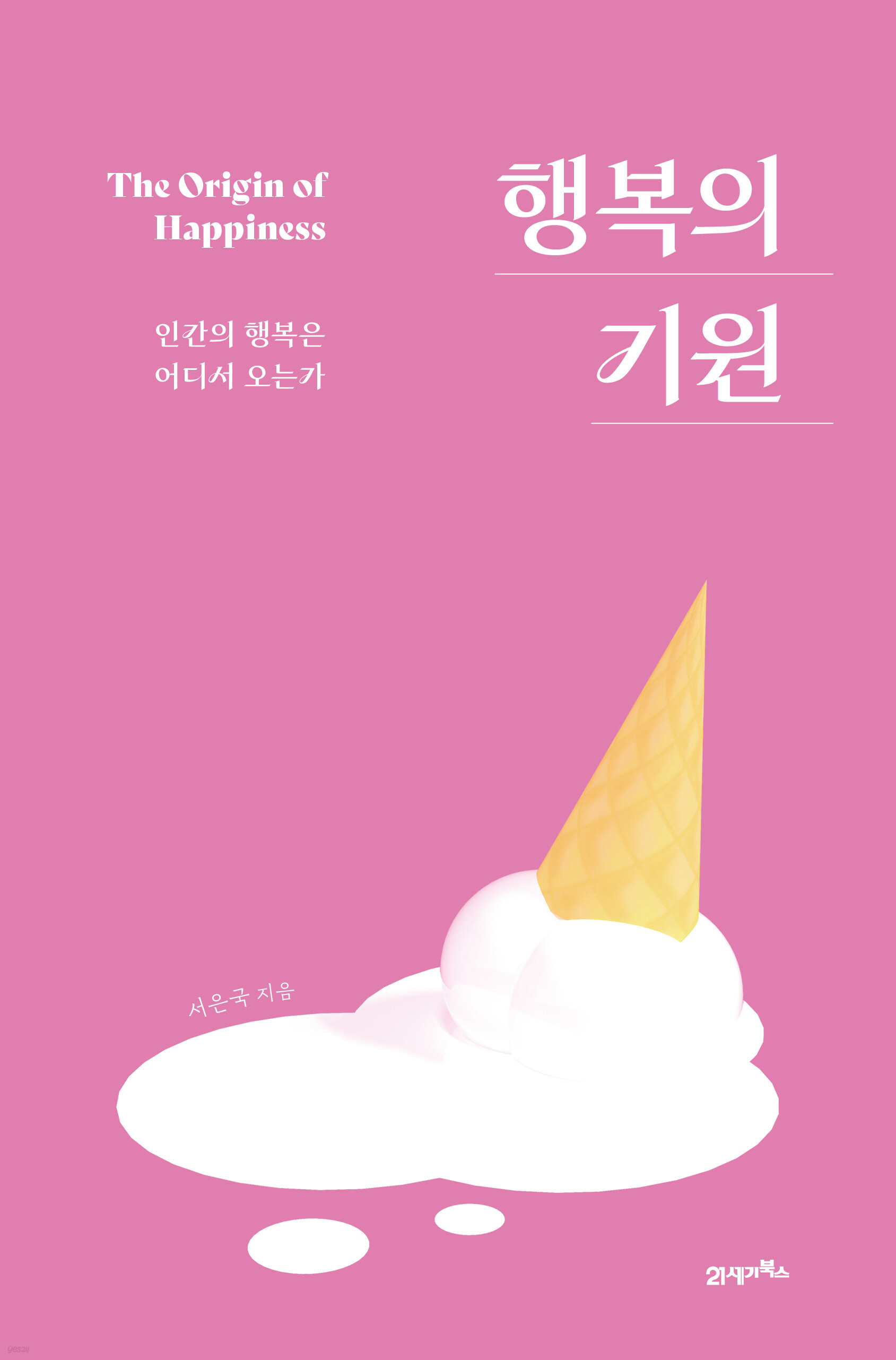
![[Yesuri Cover] The Origin of Happiness](http://librairie.coreenne.fr/cdn/shop/files/546cd5739fc632ee9cefa76f2389bbfd.jpg?v=1765356556&width=3840)

[Yesuri Cover] The Origin of Happiness
 |
Description
Book Introduction
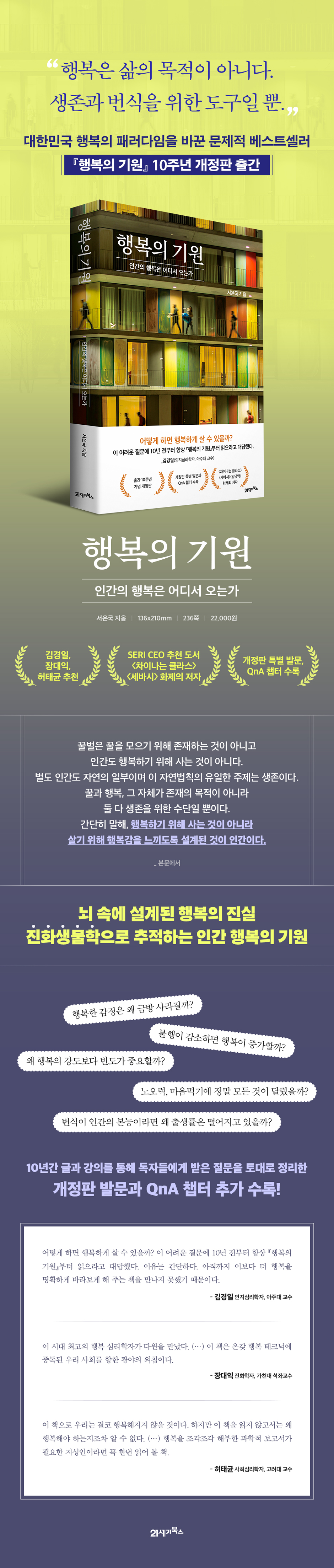
People do not live to be happy, but feel happy in order to live. ★ Revised edition commemorating the 10th anniversary of the controversial bestseller in psychology, "The Origin of Happiness" ★ The Origins of Human Happiness: Tracing It Through Evolutionary Biology How can I live happily? For the past ten years, I have always answered this difficult question by telling people to start with The Origin of Happiness. - Kim Kyung-il (cognitive psychologist, professor at Ajou University) The problematic bestseller, "The Origin of Happiness," which brought about a paradigm shift in the concept of happiness, has been published in a revised edition to commemorate its 10th anniversary. Since its publication in 2014, "The Origin of Happiness" has been loved by over 110,000 readers and featured in leading media outlets, making it a true must-read on happiness. In his book, “The Origin of Happiness,” world-renowned psychologist Professor Eun-Guk Seo dissects the common belief that happiness is the ultimate goal of life. His argument, armed with the razor-sharp edge of Darwin's theory of evolution, is blunt and his conclusions are clear. Humans are essentially animals, no different from dogs or peacocks, and happiness is not the purpose of life, but rather a means for 'survival' and 'reproduction', a product of evolution. The revised edition of "The Origin of Happiness" includes a preface and Q&A section based on questions the author received from readers through his writings and lectures over the past ten years. Is happiness truly a matter of mindset? If survival and reproduction are the ultimate goals of humankind, why does the birth rate continue to decline? How can we experience greater happiness in our daily lives? As long as we live, we cannot help but constantly ponder the question of happiness. However, a life where the worry stops at 'how' and a life where the worry is 'why' are clearly different. Through this book, which shatters conventional wisdom about happiness, readers will discover the cold truth about happiness. |
- You can preview some of the book's contents.
Preview
index
Recommendation
Preface to the Revised Edition
introduction
Chapter 1.
Is happiness a thought?
Chapter 2.
Humans are 100 percent animals
Chapter 3.
Darwin, Aristotle, and Happiness
Chapter 4.
Finding Happiness with a Coin Detector
Chapter 5.
In the end, it's people
Chapter 6.
Happiness is ice cream
Chapter 7.
People-oriented personality
Chapter 8.
Korean people's happiness
Chapter 9.
Harvest happiness with Occam's Day
Additional manuscript for the revised edition.
Happiness is not the work of a ghost.
QnA
References
Preface to the Revised Edition
introduction
Chapter 1.
Is happiness a thought?
Chapter 2.
Humans are 100 percent animals
Chapter 3.
Darwin, Aristotle, and Happiness
Chapter 4.
Finding Happiness with a Coin Detector
Chapter 5.
In the end, it's people
Chapter 6.
Happiness is ice cream
Chapter 7.
People-oriented personality
Chapter 8.
Korean people's happiness
Chapter 9.
Harvest happiness with Occam's Day
Additional manuscript for the revised edition.
Happiness is not the work of a ghost.
QnA
References
Detailed image
Into the book
Thinking rationally is certainly one of the most remarkable human abilities.
But that's not our only role, nor is its role as absolute as we might think.
But because only consciousness is visible to us, we mistakenly believe that our thoughts always dictate our actions and decisions.
Why is overestimating our rational capacity problematic for understanding happiness? It's not a problem; it's a hindrance.
Because it blinds us to the more important causes.
---「Chapter 1.
From "Is Happiness a Thought"
Picasso didn't live to be creative.
A more evolutionary interpretation is that a creature called Picasso used the tool of creativity to achieve its essential purpose: to leave behind its genes.
The mental products of the mind are in fact tools for the flourishing of the body.
---「Chapter 3.
From "Darwin, Aristotle, and Happiness"
I think it's time to ask the question 'why' about happiness.
Why do humans feel happiness? The answer to this question is, in fact, the core of this book.
(...) To conclude, humans are not born to be happy, but are animals created to survive.
To put it a little more bluntly, humans are "biological machines" designed to maximize their chances of survival, and happiness plays a crucial role in this blueprint.
---「Chapter 4.
From "Finding Happiness with a Coin Detector"
Extreme sociality.
Edward O. Wilson of Harvard University
This is the conclusion reached by Professor Wilson in his recent book.
The animals with the best survival success stories on Earth are ants and humans.
A common trait between the two creatures is that they are both remarkably social.
Although they may not have exceptional abilities as individuals, their complex social abilities to help, share, and utilize each other have enabled them to write a success story unprecedented on Earth.
So Wilson described human conquest of the Earth as 'social conquest'.
---「Chapter 5.
From "In the end, it's all about people"
It is not the great joy that is important, but the joy that is often given.
Objective conditions of life have a fatal limitation in that, although there may be joy in the moment of achievement, small pleasures cannot be continuously obtained thereafter.
---「Chapter 6.
From "Happiness is Ice Cream"
Why is happiness so important to people? Lighting up the brain's happiness lightbulb is like eating a Saewookkang (shrimp cracker) that makes a dog surf.
The brain has no interest in our happiness.
Our brains are designed to help us find what matters most to us.
It is a 'person' that is directly related to survival.
So the brain is designed to turn on a lightbulb of pleasure when we talk to, hold hands with, and love a human being, a necessity for survival.
In this way, happiness can be seen as a kind of 'byproduct' that automatically occurs when interacting with others.
---「Chapter 7.
Among the "people-oriented" personalities
If happiness were sold at a butcher's shop, the meats currently on the market would have too much fat.
Occam's blade is needed.
After removing the fat with that blade, what remains as the flesh of happiness is subjective pleasure and joy.
---「Chapter 9.
From "Happiness on Occam's Day"
Happiness is essentially a product of this emotional system.
Therefore, it is necessary to understand how the emotions just mentioned work.
It is evolutionary psychology that makes this concise explanation possible.
This new perspective is clearing away the cobwebs that clung to classical theories.
And it makes you see people with new eyes.
Why do human emotions and thoughts, including happiness, exist? They are, in fact, "tools"—like the eyes and the heart—for solving the fundamental tasks of life: survival and reproduction.
This is the essence of evolutionary psychology.
But that's not our only role, nor is its role as absolute as we might think.
But because only consciousness is visible to us, we mistakenly believe that our thoughts always dictate our actions and decisions.
Why is overestimating our rational capacity problematic for understanding happiness? It's not a problem; it's a hindrance.
Because it blinds us to the more important causes.
---「Chapter 1.
From "Is Happiness a Thought"
Picasso didn't live to be creative.
A more evolutionary interpretation is that a creature called Picasso used the tool of creativity to achieve its essential purpose: to leave behind its genes.
The mental products of the mind are in fact tools for the flourishing of the body.
---「Chapter 3.
From "Darwin, Aristotle, and Happiness"
I think it's time to ask the question 'why' about happiness.
Why do humans feel happiness? The answer to this question is, in fact, the core of this book.
(...) To conclude, humans are not born to be happy, but are animals created to survive.
To put it a little more bluntly, humans are "biological machines" designed to maximize their chances of survival, and happiness plays a crucial role in this blueprint.
---「Chapter 4.
From "Finding Happiness with a Coin Detector"
Extreme sociality.
Edward O. Wilson of Harvard University
This is the conclusion reached by Professor Wilson in his recent book.
The animals with the best survival success stories on Earth are ants and humans.
A common trait between the two creatures is that they are both remarkably social.
Although they may not have exceptional abilities as individuals, their complex social abilities to help, share, and utilize each other have enabled them to write a success story unprecedented on Earth.
So Wilson described human conquest of the Earth as 'social conquest'.
---「Chapter 5.
From "In the end, it's all about people"
It is not the great joy that is important, but the joy that is often given.
Objective conditions of life have a fatal limitation in that, although there may be joy in the moment of achievement, small pleasures cannot be continuously obtained thereafter.
---「Chapter 6.
From "Happiness is Ice Cream"
Why is happiness so important to people? Lighting up the brain's happiness lightbulb is like eating a Saewookkang (shrimp cracker) that makes a dog surf.
The brain has no interest in our happiness.
Our brains are designed to help us find what matters most to us.
It is a 'person' that is directly related to survival.
So the brain is designed to turn on a lightbulb of pleasure when we talk to, hold hands with, and love a human being, a necessity for survival.
In this way, happiness can be seen as a kind of 'byproduct' that automatically occurs when interacting with others.
---「Chapter 7.
Among the "people-oriented" personalities
If happiness were sold at a butcher's shop, the meats currently on the market would have too much fat.
Occam's blade is needed.
After removing the fat with that blade, what remains as the flesh of happiness is subjective pleasure and joy.
---「Chapter 9.
From "Happiness on Occam's Day"
Happiness is essentially a product of this emotional system.
Therefore, it is necessary to understand how the emotions just mentioned work.
It is evolutionary psychology that makes this concise explanation possible.
This new perspective is clearing away the cobwebs that clung to classical theories.
And it makes you see people with new eyes.
Why do human emotions and thoughts, including happiness, exist? They are, in fact, "tools"—like the eyes and the heart—for solving the fundamental tasks of life: survival and reproduction.
This is the essence of evolutionary psychology.
---From "Preface to the Revised Edition: Happiness is not the work of a 'ghost'"
Publisher's Review
“The greatest happiness psychologist of our time met Darwin!”
Recommended by cognitive psychologist Kim Kyung-il, evolutionary biologist Jang Dae-ik, and social psychologist Heo Tae-gyun!
★ Revised edition commemorating the 10th anniversary of the controversial bestseller in psychology, "The Origin of Happiness" ★
Most of us believe that the ultimate goal of life is happiness, that happiness is a matter of our minds, and that we live our lives making rational choices to become happy.
But is that really true? What if this unwavering belief, unquestioned by anyone, is nothing more than an illusion?
The psychology bestseller "The Origin of Happiness," which has been loved by over 110,000 readers since its publication in 2014, has been published in a revised edition to commemorate its 10th anniversary in 2024.
"The Origin of Happiness" is a true must-read in the field of happiness, as it brings about a Copernican shift in the concept of happiness through Darwin's theory of evolution.
This book was selected as the 2014 Sejong Book of the Year, receiving praise from leading media outlets as “a book that shatters conventional wisdom about happiness,” and was also selected as a book recommended by the CEO of Samsung Economic Research Institute SERI. It was also covered in various media outlets, including “China Class” and “Sebashi.”
Even now, ten years after its publication, this book continues to be loved by readers and is scheduled to be translated and published in China in 2025.
The 10th anniversary revised edition of "The Origin of Happiness" not only features a new, contemporary cover, but also includes additional explanatory notes and Q&A articles based on questions the author has received from readers over the past 10 years through his writings and lectures.
Is happiness truly a matter of mindset? If survival and reproduction are the ultimate goals of humanity, why does the birth rate continue to decline? How can we experience greater happiness in our daily lives? And is happiness truly the ultimate, eternal concern of humanity?
As long as we live, we cannot help but constantly think about happiness.
However, a life where the worry stops at 'how' and a life where the worry is 'why' are clearly different.
This book shatters conventional wisdom by delving into the essence of happiness from an evolutionary psychology perspective, allowing readers to discover the "cold" truth about happiness, which is designed into our brains.
“Happiness is not the purpose of life.
“It’s just a tool for survival and reproduction.”
The Truth About Happiness Designed in the Brain
The Origins of Human Happiness: Tracing It Through Evolutionary Biology
There are romantic but unscientific ideas that mankind has believed in.
The universe revolves around the Earth, the sky doesn't fall because it's supported by giants, and people get sick because they're possessed by evil spirits.
So what about the idea that "the purpose of life is happiness"? Is this widely held, hopeful proposition about happiness actually scientifically true?
Professor Seo Eun-guk of Yonsei University's Department of Psychology, author of "The Origin of Happiness," is a world-renowned happiness scholar who leads happiness research in the field of psychology.
Having studied psychology under Professor Ed Diener, the founder of happiness psychology, he received a tenured professorship in the Department of Psychology at the University of California, Irvine (UC, Irvine). The approximately 100 papers he has published on happiness have been cited over 90,000 times in academic circles.
He advises the International Happiness Organization under the United Nations, Statistics Korea, and the National Assembly Future Research Institute, and was selected as one of the “100 Happiness Scholars in the World” and contributed to the “World Book of Happiness.”
Professor Seo Eun-guk has also been studying happiness for over 20 years from the Aristotelian perspective that “humans are higher-dimensional beings who pursue happiness.”
What poured cold water on his head was Darwin's theory of evolution.
The author's conclusion, after much thought and research, is that humans are "100 percent animals," essentially no different from dogs or peacocks, except for their higher intelligence, and that animals evolved not to be happy, but to survive and reproduce.
Let's think about why we eat, wear clothes, and meet people every day.
It's not because there's some grand philosophical reason.
This is because we feel happy when we fill our hungry stomachs, when we thaw our frozen bodies, and when we interact with people.
And when we do this, our brains are wired to be happy, because the owner is repeatedly feeding us, maintaining body temperature, and forming relationships.
'Survival' and 'reproduction'.
This is the reason and purpose of existence of all living things.
In other words, happiness is not the purpose of life, but rather a tool for survival and a product of evolution.
『The Origin of Happiness』 asserts that happiness is not the 'purpose' of life, but rather a 'means'.
It is a paradox and a welcome sign of the truth of happiness, overturning the conventional wisdom that humans live to be happy.
Bees do not exist to collect honey, and humans do not live to be happy.
Both bees and humans are part of nature, and the sole subject of this natural law is survival.
Honey and happiness are not the purpose of existence in themselves, but are both merely means to survival.
Simply put, humans are designed not to live to be happy, but to feel happy in order to live.
- In the text
Ten Years After the Publication of "The Origin of Happiness," Why Are We Still Unhappy?
Happiness is a frequency, not an intensity.
Why You Shouldn't Aim for a Happy "One Room"
Ten years after the publication of "The Origin of Happiness," are we happier now than we were a decade ago? While national interest and research on happiness have increased, Koreans' happiness index remains at the bottom of the OECD. Mark Manson, a YouTuber with 1.4 million followers and a renowned author, even called Korea "the most depressing country in the world."
We need to refocus on "The Origin of Happiness" to understand why Koreans still feel unhappy despite their national income having increased several times.
The reason we can't easily become happy is because we still don't know what happiness is.
Only by knowing 'why' you experience happiness can you know 'how' you can be happy.
For example, happiness is not easily achieved through external factors such as a high salary, a fancy university sign, or a large house.
Once basic necessities are met, money soon becomes empty, the new home soon becomes dull, and you want new stimulation.
This is because our brains have evolved to quickly 'adapt' to stimuli or changes, in order to repeatedly pursue happiness that helps us survive and reproduce.
So happiness isn't achieved with a single, huge hit like winning the lottery.
Since all pleasures soon disappear, it is absolutely better to experience small pleasures several times than to experience great pleasures once.
In other words, happiness is the frequency, not the intensity, of positive affect.
Many happiness guides also advise changing your mindset, saying that everything depends on your mindset, but the author points out that the power of your thoughts is overrated.
Just as you need to wear clothes when you're cold and eat when you're hungry, to be happy you need to create experiential situations that elicit happiness.
There's no great secret here.
Even though we live buried in civilization, there are two things that still excite and delight our primitive brains the most.
Food, and people.
It is important to eat well and surround my life with good people.
If you still can't easily answer the question, "Are you happy?", the simple, scientific truths revealed in "The Origin of Happiness" will serve as a good guide to happiness.
If you could capture the essence of happiness in a single photo, what would it look like? Considering the content of this book and the various research findings to date, it would be a scene of eating food with someone you love.
(…)
Happiness is not something grand.
If you strip away all the layers, happiness ultimately boils down to this one picture.
Happiness and unhappiness are the differences between a life full of these scenes and a life without them.
If I may add one word, “The rest are details”, the rest are just notes.
- In the text
Recommended by cognitive psychologist Kim Kyung-il, evolutionary biologist Jang Dae-ik, and social psychologist Heo Tae-gyun!
★ Revised edition commemorating the 10th anniversary of the controversial bestseller in psychology, "The Origin of Happiness" ★
Most of us believe that the ultimate goal of life is happiness, that happiness is a matter of our minds, and that we live our lives making rational choices to become happy.
But is that really true? What if this unwavering belief, unquestioned by anyone, is nothing more than an illusion?
The psychology bestseller "The Origin of Happiness," which has been loved by over 110,000 readers since its publication in 2014, has been published in a revised edition to commemorate its 10th anniversary in 2024.
"The Origin of Happiness" is a true must-read in the field of happiness, as it brings about a Copernican shift in the concept of happiness through Darwin's theory of evolution.
This book was selected as the 2014 Sejong Book of the Year, receiving praise from leading media outlets as “a book that shatters conventional wisdom about happiness,” and was also selected as a book recommended by the CEO of Samsung Economic Research Institute SERI. It was also covered in various media outlets, including “China Class” and “Sebashi.”
Even now, ten years after its publication, this book continues to be loved by readers and is scheduled to be translated and published in China in 2025.
The 10th anniversary revised edition of "The Origin of Happiness" not only features a new, contemporary cover, but also includes additional explanatory notes and Q&A articles based on questions the author has received from readers over the past 10 years through his writings and lectures.
Is happiness truly a matter of mindset? If survival and reproduction are the ultimate goals of humanity, why does the birth rate continue to decline? How can we experience greater happiness in our daily lives? And is happiness truly the ultimate, eternal concern of humanity?
As long as we live, we cannot help but constantly think about happiness.
However, a life where the worry stops at 'how' and a life where the worry is 'why' are clearly different.
This book shatters conventional wisdom by delving into the essence of happiness from an evolutionary psychology perspective, allowing readers to discover the "cold" truth about happiness, which is designed into our brains.
“Happiness is not the purpose of life.
“It’s just a tool for survival and reproduction.”
The Truth About Happiness Designed in the Brain
The Origins of Human Happiness: Tracing It Through Evolutionary Biology
There are romantic but unscientific ideas that mankind has believed in.
The universe revolves around the Earth, the sky doesn't fall because it's supported by giants, and people get sick because they're possessed by evil spirits.
So what about the idea that "the purpose of life is happiness"? Is this widely held, hopeful proposition about happiness actually scientifically true?
Professor Seo Eun-guk of Yonsei University's Department of Psychology, author of "The Origin of Happiness," is a world-renowned happiness scholar who leads happiness research in the field of psychology.
Having studied psychology under Professor Ed Diener, the founder of happiness psychology, he received a tenured professorship in the Department of Psychology at the University of California, Irvine (UC, Irvine). The approximately 100 papers he has published on happiness have been cited over 90,000 times in academic circles.
He advises the International Happiness Organization under the United Nations, Statistics Korea, and the National Assembly Future Research Institute, and was selected as one of the “100 Happiness Scholars in the World” and contributed to the “World Book of Happiness.”
Professor Seo Eun-guk has also been studying happiness for over 20 years from the Aristotelian perspective that “humans are higher-dimensional beings who pursue happiness.”
What poured cold water on his head was Darwin's theory of evolution.
The author's conclusion, after much thought and research, is that humans are "100 percent animals," essentially no different from dogs or peacocks, except for their higher intelligence, and that animals evolved not to be happy, but to survive and reproduce.
Let's think about why we eat, wear clothes, and meet people every day.
It's not because there's some grand philosophical reason.
This is because we feel happy when we fill our hungry stomachs, when we thaw our frozen bodies, and when we interact with people.
And when we do this, our brains are wired to be happy, because the owner is repeatedly feeding us, maintaining body temperature, and forming relationships.
'Survival' and 'reproduction'.
This is the reason and purpose of existence of all living things.
In other words, happiness is not the purpose of life, but rather a tool for survival and a product of evolution.
『The Origin of Happiness』 asserts that happiness is not the 'purpose' of life, but rather a 'means'.
It is a paradox and a welcome sign of the truth of happiness, overturning the conventional wisdom that humans live to be happy.
Bees do not exist to collect honey, and humans do not live to be happy.
Both bees and humans are part of nature, and the sole subject of this natural law is survival.
Honey and happiness are not the purpose of existence in themselves, but are both merely means to survival.
Simply put, humans are designed not to live to be happy, but to feel happy in order to live.
- In the text
Ten Years After the Publication of "The Origin of Happiness," Why Are We Still Unhappy?
Happiness is a frequency, not an intensity.
Why You Shouldn't Aim for a Happy "One Room"
Ten years after the publication of "The Origin of Happiness," are we happier now than we were a decade ago? While national interest and research on happiness have increased, Koreans' happiness index remains at the bottom of the OECD. Mark Manson, a YouTuber with 1.4 million followers and a renowned author, even called Korea "the most depressing country in the world."
We need to refocus on "The Origin of Happiness" to understand why Koreans still feel unhappy despite their national income having increased several times.
The reason we can't easily become happy is because we still don't know what happiness is.
Only by knowing 'why' you experience happiness can you know 'how' you can be happy.
For example, happiness is not easily achieved through external factors such as a high salary, a fancy university sign, or a large house.
Once basic necessities are met, money soon becomes empty, the new home soon becomes dull, and you want new stimulation.
This is because our brains have evolved to quickly 'adapt' to stimuli or changes, in order to repeatedly pursue happiness that helps us survive and reproduce.
So happiness isn't achieved with a single, huge hit like winning the lottery.
Since all pleasures soon disappear, it is absolutely better to experience small pleasures several times than to experience great pleasures once.
In other words, happiness is the frequency, not the intensity, of positive affect.
Many happiness guides also advise changing your mindset, saying that everything depends on your mindset, but the author points out that the power of your thoughts is overrated.
Just as you need to wear clothes when you're cold and eat when you're hungry, to be happy you need to create experiential situations that elicit happiness.
There's no great secret here.
Even though we live buried in civilization, there are two things that still excite and delight our primitive brains the most.
Food, and people.
It is important to eat well and surround my life with good people.
If you still can't easily answer the question, "Are you happy?", the simple, scientific truths revealed in "The Origin of Happiness" will serve as a good guide to happiness.
If you could capture the essence of happiness in a single photo, what would it look like? Considering the content of this book and the various research findings to date, it would be a scene of eating food with someone you love.
(…)
Happiness is not something grand.
If you strip away all the layers, happiness ultimately boils down to this one picture.
Happiness and unhappiness are the differences between a life full of these scenes and a life without them.
If I may add one word, “The rest are details”, the rest are just notes.
- In the text
GOODS SPECIFICS
- Date of issue: May 22, 2024
- Format: Hardcover book binding method guide
- Page count, weight, size: 236 pages | 404g | 136*210*20mm
- ISBN13: 9791171175864
- ISBN10: 1171175868
You may also like
카테고리
korean


korean

![ELLE 엘르 스페셜 에디션 A형 : 12월 [2025]](http://librairie.coreenne.fr/cdn/shop/files/b8e27a3de6c9538896439686c6b0e8fb.jpg?v=1766436872&width=3840)


