

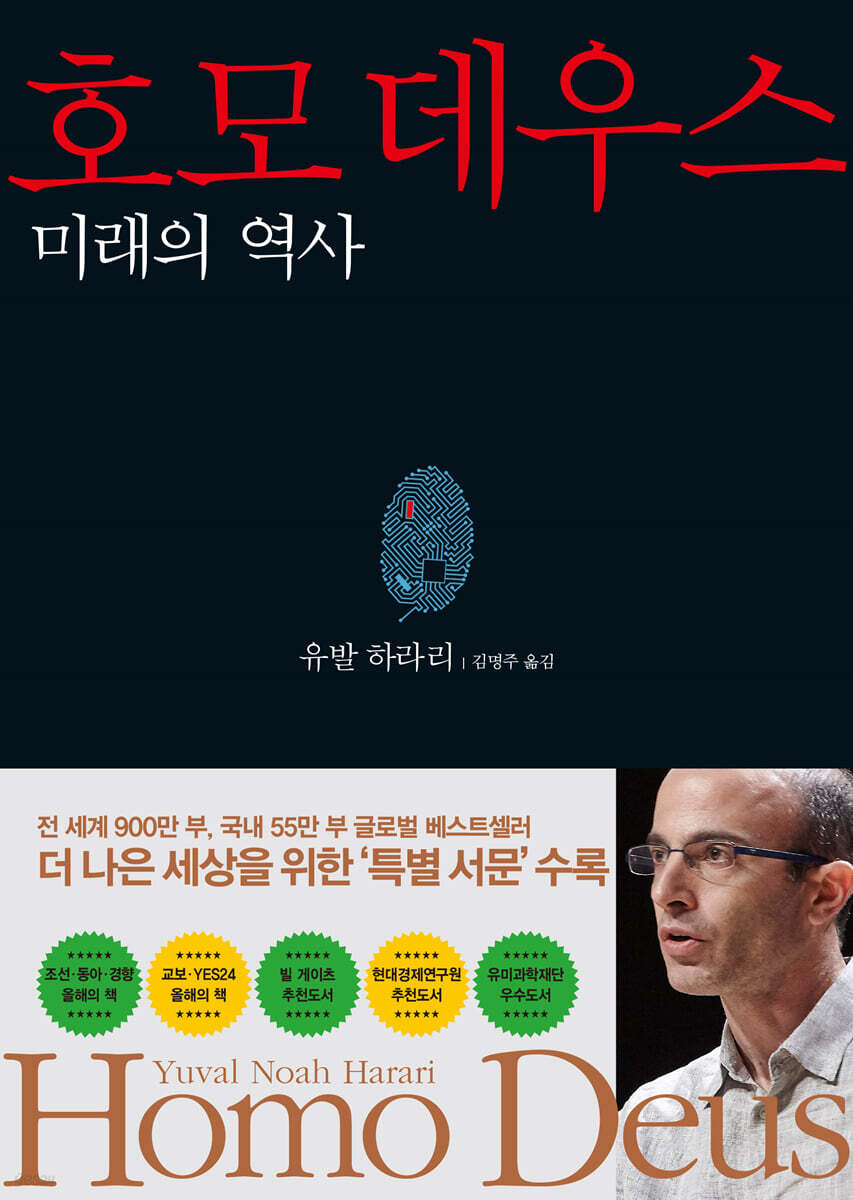
Homo Deus
 |
Description
Book Introduction
“Homo Deus, this is the next step in evolution!”
The final epic unfolds as the old myths of politics, religion, and culture meet the new gods of artificial intelligence and genetic engineering.
Sapiens tells us where we came from, and Homo Deus tells us where we are going.
Confirmed for publication in 40 countries, including the US, UK, France, Germany, China, and Japan!
The final epic, "Homo Deus: A Brief History of Tomorrow," unfolds as the old myths of politics, religion, and culture collide with the new gods of artificial intelligence and genetic engineering.
What has replaced hunger, disease, and war, humanity's greatest challenges throughout history? What destiny will humans, who conquer the Earth and become gods, create? Where did humanity come from, and where will it go? What will the world look like in 100 years, and what will be the pinnacle of the scientific revolution that is galloping forward?
A controversial narrative about the utopia or nightmare that humans will create.
Will humans evolve or become useless?
A unique historical exploration of the 21st century that overturns the beliefs of Homo sapiens that have persisted for 100,000 years.
You will encounter a terrifying insight that redefines the categories of history and sucks you into a vast and profound vortex of discourse.
The final epic unfolds as the old myths of politics, religion, and culture meet the new gods of artificial intelligence and genetic engineering.
Sapiens tells us where we came from, and Homo Deus tells us where we are going.
Confirmed for publication in 40 countries, including the US, UK, France, Germany, China, and Japan!
The final epic, "Homo Deus: A Brief History of Tomorrow," unfolds as the old myths of politics, religion, and culture collide with the new gods of artificial intelligence and genetic engineering.
What has replaced hunger, disease, and war, humanity's greatest challenges throughout history? What destiny will humans, who conquer the Earth and become gods, create? Where did humanity come from, and where will it go? What will the world look like in 100 years, and what will be the pinnacle of the scientific revolution that is galloping forward?
A controversial narrative about the utopia or nightmare that humans will create.
Will humans evolve or become useless?
A unique historical exploration of the 21st century that overturns the beliefs of Homo sapiens that have persisted for 100,000 years.
You will encounter a terrifying insight that redefines the categories of history and sucks you into a vast and profound vortex of discourse.
- You can preview some of the book's contents.
Preview
index
Preface_Again, to the Korean readers
1.
A new agenda for humanity
Part 1: Homo sapiens Conquer the World
2.
Anthropocene
3.
human splendor
Part 2: Giving Meaning to the World of Homo Sapiens
4.
storyteller
5.
An unexpected couple
6.
Modern contracts
7.
humanist revolution
Part 3: Homo sapiens loses its dominance
8.
Time bomb in the laboratory
9.
significant separation
10.
Sea of Consciousness
11.
Data Bridge
Translator's Note
References
1.
A new agenda for humanity
Part 1: Homo sapiens Conquer the World
2.
Anthropocene
3.
human splendor
Part 2: Giving Meaning to the World of Homo Sapiens
4.
storyteller
5.
An unexpected couple
6.
Modern contracts
7.
humanist revolution
Part 3: Homo sapiens loses its dominance
8.
Time bomb in the laboratory
9.
significant separation
10.
Sea of Consciousness
11.
Data Bridge
Translator's Note
References
Detailed image
.jpg)
Into the book
Success breeds ambition.
Humanity will build on its achievements to date and move forward toward even bolder goals.
Having achieved unprecedented levels of prosperity, health, and peace, humanity's next goals, considering past records and present values, will be immortality, happiness, and divinity.
After reducing deaths from hunger, disease, and violence, the next step is to overcome aging and death itself.
After saving people from extreme misery, the next thing to do is to make them happier.
The next step after rescuing humanity from the beast-level struggle for survival is to upgrade humanity into gods, transforming 'Homo sapiens' into 'Homo deus'.
--- p.47
There are many wise answers to the question, "What would people like us do with biotechnology?"
But there is no useful answer to the question, "What would a being with a mind entirely different from ours do with biotechnology?"
All we can say is that people like us will rewire their minds with biotechnology, and what happens next is beyond our current understanding.
--- p.73~74
As science rises, at least some myths and religions will become stronger than ever.
To understand why, and to face the challenges of the 21st century, we need to reexamine a very difficult question.
What is the relationship between modern science and religion? Over the years, people have offered hundreds of answers to this question.
But science and religion are like a husband and wife who, after 500 years of couples counseling, still don't know each other very well.
Husbands still expect Cinderella-like wives, and wives continue to yearn for the perfect husband, all while fighting over whose turn it is to take out the trash.
--- p.250
Is it really rational to stake the future of humanity on the assumption that future scientists will make discoveries that will save the planet? Most presidents, prime ministers, and CEOs who run the world are quite rational people.
(…) If by any chance the situation worsens and science fails to stem the flood, engineers can build a high-tech Noah's Ark for the rich, whether billions drown or not.
Belief in such a high-tech ark is one of the greatest dangers currently threatening not only the future of humanity but also the future of the entire Earth's ecosystem.
For the same reason that we shouldn't give nuclear weapons to people who believe in heaven, we shouldn't give the Earth's ecosystem to people who believe in high-tech arks.
--- p.300
It was evolution that nailed freedom into the coffin.
Evolution does not accept the concept of free will, just as it does not accept the concept of an immortal soul.
If humans possess free will, how could natural selection have shaped our appearance? According to evolutionary theory, every choice animals make—whether it's about habits, food, or mates—reflects their genetic code.
--- p.389
The majority of men and women in the 21st century will lose their military and economic value.
There will be no more mass conscription like in the two world wars, and the most advanced armies of the 21st century will rely on far more advanced technology than they do today.
Instead of countless bullet shields, you only need a handful of highly trained soldiers, a smaller number of special forces super warriors, and a few specialists who know how to produce and utilize sophisticated technology.
Advanced units equipped with unmanned drones and cyber viruses are replacing the massive armies of the 20th century, and generals are increasingly delegating crucial decisions to algorithms.
Humanity will build on its achievements to date and move forward toward even bolder goals.
Having achieved unprecedented levels of prosperity, health, and peace, humanity's next goals, considering past records and present values, will be immortality, happiness, and divinity.
After reducing deaths from hunger, disease, and violence, the next step is to overcome aging and death itself.
After saving people from extreme misery, the next thing to do is to make them happier.
The next step after rescuing humanity from the beast-level struggle for survival is to upgrade humanity into gods, transforming 'Homo sapiens' into 'Homo deus'.
--- p.47
There are many wise answers to the question, "What would people like us do with biotechnology?"
But there is no useful answer to the question, "What would a being with a mind entirely different from ours do with biotechnology?"
All we can say is that people like us will rewire their minds with biotechnology, and what happens next is beyond our current understanding.
--- p.73~74
As science rises, at least some myths and religions will become stronger than ever.
To understand why, and to face the challenges of the 21st century, we need to reexamine a very difficult question.
What is the relationship between modern science and religion? Over the years, people have offered hundreds of answers to this question.
But science and religion are like a husband and wife who, after 500 years of couples counseling, still don't know each other very well.
Husbands still expect Cinderella-like wives, and wives continue to yearn for the perfect husband, all while fighting over whose turn it is to take out the trash.
--- p.250
Is it really rational to stake the future of humanity on the assumption that future scientists will make discoveries that will save the planet? Most presidents, prime ministers, and CEOs who run the world are quite rational people.
(…) If by any chance the situation worsens and science fails to stem the flood, engineers can build a high-tech Noah's Ark for the rich, whether billions drown or not.
Belief in such a high-tech ark is one of the greatest dangers currently threatening not only the future of humanity but also the future of the entire Earth's ecosystem.
For the same reason that we shouldn't give nuclear weapons to people who believe in heaven, we shouldn't give the Earth's ecosystem to people who believe in high-tech arks.
--- p.300
It was evolution that nailed freedom into the coffin.
Evolution does not accept the concept of free will, just as it does not accept the concept of an immortal soul.
If humans possess free will, how could natural selection have shaped our appearance? According to evolutionary theory, every choice animals make—whether it's about habits, food, or mates—reflects their genetic code.
--- p.389
The majority of men and women in the 21st century will lose their military and economic value.
There will be no more mass conscription like in the two world wars, and the most advanced armies of the 21st century will rely on far more advanced technology than they do today.
Instead of countless bullet shields, you only need a handful of highly trained soldiers, a smaller number of special forces super warriors, and a few specialists who know how to produce and utilize sophisticated technology.
Advanced units equipped with unmanned drones and cyber viruses are replacing the massive armies of the 20th century, and generals are increasingly delegating crucial decisions to algorithms.
--- p.423
Publisher's Review
Yuval Harari again speaks to Korean readers
Artificial intelligence is rapidly catching up with our cognitive abilities.
Last year, AlphaGo defeated Lee Sedol, a 9-dan player in the game of Go, using a strategy that no human had ever thought of.
Soon, computers will be better than humans at driving cars, diagnosing diseases, and even understanding human emotions.
What will happen to the welfare state when computers push humans out of the job market and create a massive "useless class"? What will happen to democracy when Google and Facebook know our likes and political preferences better than we do?
Meanwhile, biotechnology will dramatically extend human lifespan and upgrade the human body and mind.
Will the benefits of these technological advancements be shared equally by everyone, or will we witness an unprecedented biological divide? The gap between enhanced superhumans and ordinary humans will likely be even greater than that between Homo sapiens and Neanderthals.
There is another scenario.
North Korea is making great technological strides, becoming the first country in the world to have all its vehicles self-driving.
There are advantages to being a centralized, underdeveloped dictatorship.
Consider what would happen if South Korea tried to ban human drivers altogether and transition to a fully autonomous transportation system.
With millions of South Koreans owning private cars, many would object to losing their freedom and property.
Taxi drivers, bus drivers, truck drivers, and even traffic police will oppose it.
Because they will all lose their jobs.
Strikes and protests will follow.
Legal and philosophical challenges will also hinder this plan.
If a self-driving car causes an accident, who should be sued? Imagine a situation where a self-driving car must choose between a malfunctioning brake failure, killing five innocent pedestrians, or swerving, endangering the passengers in the car.
What should I do with this vehicle?
In a free-market democracy like South Korea, addressing these challenges one by one is no easy task.
Then what about North Korea?
It's a place where cars aren't plentiful, taxi drivers can't protest, truck drivers can't strike, and all legal and philosophical conundrums can be solved with a stroke of a pen in one afternoon.
If we could convince just one person, the country could transition to a fully autonomous transportation system overnight.
In conclusion, humanity now has access to unprecedented technological power, but we don't quite know what to do with it.
In the coming decades, we will be able to build heaven or hell using genetic engineering, artificial intelligence, and nanotechnology.
While the benefits of wise choices are enormous, the price of unwise decisions could be the extinction of humanity itself.
It is up to us to make wise choices or not.
Sapiens tells us where we came from, and Homo Deus tells us where we are going.
Confirmed for publication in 40 countries, including the US, UK, France, Germany, China, and Japan! An Amazon bestseller immediately after release!
Yuval Noah Harari (Professor of History, Hebrew University of Israel), author of the mega-bestseller 『Sapiens』, which has been published in 45 countries around the world and sold over 5 million copies, has returned with a new book, 『Homo Deus: A Brief History of Tomorrow』.
Why did this book receive such attention and enthusiastic recommendations from not only prominent international figures like Barack Obama, Bill Gates, Mark Zuckerberg, Jared Diamond, and Daniel Kahneman, but also Korean authors like Yoo Si-min, Kim Dae-sik, and Jeon Byeong-geun? "Sapiens," a book that sparked the "Sapiens Syndrome" and sparked an explosive global response?
The influence this one book had on our society was powerful.
Since its domestic publication in November 2015, it has been intertwined with the 'AlphaGo' issue, sending a shocking message to Korean society that 'a future dominated by science and technology', and has heated up discussions about Big History.
It was selected as the book of the year by various media outlets, including the JoongAng Ilbo, Dong-A Ilbo, Hankyoreh, Kyunghyang Shinmun, and Korea Economic Daily, as well as online bookstores. It also won awards such as the Hyundai Economic Research Institute's Recommended Book Award and the Yumi Science Foundation's Science Book Award, fully demonstrating its true potential for insight that encompasses history, society, and science.
Parents who read this book began to ponder what kind of education they should give their children, and our society began to discuss a future in which humans would become useless.
Through deep thought and reasoning
A utopia or dystopia, a future we've already visited
Yuval Harari, who has emerged as a world-renowned young scholar and bestselling author by delivering new and provocative messages, demonstrates an upgraded perspective and writing skills in this book, Homo Deus.
His ability to weave together vast amounts of data and knowledge, crossing the boundaries of science, philosophy, religion, history, economics, biology, and other academic disciplines, is truly astonishing.
I want to turn my head away because it's uncomfortable, but I can't take my eyes off the vivid future of humanity that unfolds, fully armed with the logic of various disciplines.
"Homo Deus" tells the story of what humanity, which has finally conquered the Earth after 70,000 years of history, should pursue and where it should go next.
Because this book contains a vision for the future, it is more important than any other book to be persuasive, based on scientific evidence and philosophical reflection. If it loses its focus, it can easily be read as exaggeration or fiction.
In that respect, Yuval Harari shows a unique side.
With a firm foundation in history, he is exceptionally adept at using every field, from psychology and religion to engineering and life sciences, as a basis for his future outlook.
Just as Sapiens formed groups using cooperation as a tool and formed a society with the ability to believe in fiction, the future in which the meaning of humanism fades due to the advancement of science and the value of God or human-centered ideology disappears is also depicted quite convincingly.
So why should we read "Homo Deus" now? The author argues that 21st-century humans have been able to control famine, epidemics, and war thanks to economic growth.
“The next step after rescuing humanity from the beast-level struggle for survival is to upgrade humanity into a god, and change ‘Homo sapiens’ into ‘Homo deus’” (p. 39).
Humanity dreams of 'immortality, happiness, and divinity' in the following order.
But pursuing these goals will ultimately render most people redundant.
So what should we do?
We need to open our eyes wide and see where the choices we make today are leading us.
Because while we cannot change the course of history through our own individual power, we can influence its direction.
“When faced with a choice between economic growth and ecological stability, politicians, CEOs, and voters overwhelmingly favor growth.
“If we continue like this in the 21st century, we will not be able to avoid catastrophe.” (p. 38) “No one knows where the brakes are” to prevent this catastrophe (p. 80), and “if we somehow step on the brakes, the economy will collapse, and with it, society.
(…) If growth were to stop, the economy would not settle into a cozy equilibrium but would crash and shatter.
“This is why capitalism pushes us to pursue immortality, happiness, and divinity.” (pp. 80-81) If you want to survive in this unstable dark age, you must not ignore these chilling warnings today.
A human who became a god,
What do we really want!
'Homo' in 'Homo Deus' is a scientific name meaning 'human', and 'Deus' is a word derived from Latin and means 'god'.
That is, 'Homo Deus' can be translated as 'human who became a god'.
This can be said to be a concise statement that shows the main keywords that the author wants to show in this book.
God has immortality and the power of creation.
Humanity, with the wings of Icarus, wants to take one step further into the realm of the gods, towards the sun.
Yuval Harari says that we are now successfully suppressing the 'hunger, plague, and war' that have plagued humanity in the past, and approaching the realm of 'immortality, happiness, and divinity' that were previously considered the realm of the gods.
The speed is too fast, and the waves are too strong to be stopped by individual strength.
Now we stand at a crossroads where we must seriously discuss, at the species level, 'what do we call human, how far should we compromise, and how far should we go?'
The structure of this book is unique.
Apart from the preface addressed to Korean readers, there is no preface in particular, and we go straight to Chapter 1, which summarizes the overall content of the book and serves as an introduction.
In the following parts 1, 2, and 3, the author expands on the content of Chapter 1 and goes into specifics.
Chapter 1 explains how humanity conquered famine, plague, and war, and discusses humanity's pursuit of immortality, happiness, and divinity.
The definition of death and human efforts to overcome death are philosophical.
The topic of 'death' is the most fundamental problem and starting point of humanity, so if death were to disappear (not completely, but even if the average lifespan were to more than double), a drastic, revolutionary change would be inevitable not only in the external conditions of human society and politics, but also in internal issues such as psychology and religion.
Humans who have overcome death and achieved supreme happiness ultimately want to become gods.
“There are three ways to upgrade a human being into a god.
“Biotechnology, cyborg engineering (creating artificial humans), and inorganic synthesis” (p. 69) The future in which biotechnology creates beings that transcend even death, cyborg engineering creates superhumans who surpass innate human abilities, and the connection of brains and computers allows for the synthesis of inorganic substances does not seem so far away.
Who can guarantee that these things will not happen in our lifetime?
Part 1 examines the relationship between Homo sapiens and other animals to discuss human wisdom, knowledge, and the uniqueness of existence.
“Because the relationship between humans and animals is the best model for predicting the future relationship between superhumans and the rest of humanity.” (p. 101) What warning does the rise in the population of Sapiens and the animals we have domesticated, and the rapid decline of large wild fauna, signal? What grounds led our animistic ancestors to exploit animals? Do humans alone possess an eternal “soul” or “mind” that neither dies nor disappears? The relationship between animals and humans and the development of human society demonstrate how flawed our hope that we will all progress equally and benefit equally from scientific advancement is.
Part 2 explores the extraordinary world humanity has created over the past millennium and the path that has brought us to the crossroads we face today.
“How did Homo sapiens come to embrace the humanist creed that the universe revolves around humans and that all meaning and authority derive from humanism? What are the economic, social, and political implications of this creed?” (p. 102) This book traces the footsteps of humans who, with their ability to create imagination and fiction, created societies, kings, religions, and nations, and shows how religion, liberalism, and humanist ideologies were subdivided across eras, ethnicities, and regions, dominating human behavior and society.
“Auschwitz should not be a black curtain obscuring the horizon of humanity, but a red warning light stained with blood.
“Evolutionary humanism has played a significant role in shaping modern culture, and it will play an even greater role in shaping the 21st century.” (p. 356)
Part 3 discusses specifically the environment we face in the early 21st century and our possible future.
"Rather than simply speculating or blindly predicting the future, it delves into smartphones, dating practices, and even the job market for clues about what lies ahead" (p. 102). In a future where advances in biotechnology and artificial intelligence require us to redefine humanity, will we continue to dominate the planet? And what new religion will suddenly emerge to replace the outdated and outdated humanism?
In Part 3, the author not only discusses how we should cope with the rapidly changing military, political, and economic landscapes, but also devotes many pages to more fundamental issues such as free will and the decline of humanism and individualism.
If humans were organisms that evolved by natural selection, free will would hold back the pace of evolution.
This book delves deeply into the profound topic of what humanity will mean in a future where even human will can be manipulated by manipulating the brain.
Until now, when we have lived for at most 80 years, mankind has not been able to feel the speed of evolution.
Throughout history, evolution, whether in biology or sociology, has occurred at a pace that cannot be measured in a single lifetime.
But in the future, we may not be able to keep up with that pace.
If combining with an inorganic substance or taking a pill could suddenly make you speak English fluently like a native speaker, who would confidently say, “I will neither combine with a foreign substance nor take this pill”?
Even if I hadn't taken the drug, if everyone else took it and dramatically improved their abilities, I would definitely be the only one eliminated.
If I could manipulate or control my mind by stimulating my brain or injecting substances, what would I truly desire? And wouldn't some external force control my mind? "Homo Deus" cautiously predicts the future by reflecting on humanity's past.
The author's tone is cautious and occasionally humorous, but his predictions are chilling and controversial: the advent of superhumans, the decline of humanism, and the dominance of dataism.
Artificial intelligence is rapidly catching up with our cognitive abilities.
Last year, AlphaGo defeated Lee Sedol, a 9-dan player in the game of Go, using a strategy that no human had ever thought of.
Soon, computers will be better than humans at driving cars, diagnosing diseases, and even understanding human emotions.
What will happen to the welfare state when computers push humans out of the job market and create a massive "useless class"? What will happen to democracy when Google and Facebook know our likes and political preferences better than we do?
Meanwhile, biotechnology will dramatically extend human lifespan and upgrade the human body and mind.
Will the benefits of these technological advancements be shared equally by everyone, or will we witness an unprecedented biological divide? The gap between enhanced superhumans and ordinary humans will likely be even greater than that between Homo sapiens and Neanderthals.
There is another scenario.
North Korea is making great technological strides, becoming the first country in the world to have all its vehicles self-driving.
There are advantages to being a centralized, underdeveloped dictatorship.
Consider what would happen if South Korea tried to ban human drivers altogether and transition to a fully autonomous transportation system.
With millions of South Koreans owning private cars, many would object to losing their freedom and property.
Taxi drivers, bus drivers, truck drivers, and even traffic police will oppose it.
Because they will all lose their jobs.
Strikes and protests will follow.
Legal and philosophical challenges will also hinder this plan.
If a self-driving car causes an accident, who should be sued? Imagine a situation where a self-driving car must choose between a malfunctioning brake failure, killing five innocent pedestrians, or swerving, endangering the passengers in the car.
What should I do with this vehicle?
In a free-market democracy like South Korea, addressing these challenges one by one is no easy task.
Then what about North Korea?
It's a place where cars aren't plentiful, taxi drivers can't protest, truck drivers can't strike, and all legal and philosophical conundrums can be solved with a stroke of a pen in one afternoon.
If we could convince just one person, the country could transition to a fully autonomous transportation system overnight.
In conclusion, humanity now has access to unprecedented technological power, but we don't quite know what to do with it.
In the coming decades, we will be able to build heaven or hell using genetic engineering, artificial intelligence, and nanotechnology.
While the benefits of wise choices are enormous, the price of unwise decisions could be the extinction of humanity itself.
It is up to us to make wise choices or not.
Sapiens tells us where we came from, and Homo Deus tells us where we are going.
Confirmed for publication in 40 countries, including the US, UK, France, Germany, China, and Japan! An Amazon bestseller immediately after release!
Yuval Noah Harari (Professor of History, Hebrew University of Israel), author of the mega-bestseller 『Sapiens』, which has been published in 45 countries around the world and sold over 5 million copies, has returned with a new book, 『Homo Deus: A Brief History of Tomorrow』.
Why did this book receive such attention and enthusiastic recommendations from not only prominent international figures like Barack Obama, Bill Gates, Mark Zuckerberg, Jared Diamond, and Daniel Kahneman, but also Korean authors like Yoo Si-min, Kim Dae-sik, and Jeon Byeong-geun? "Sapiens," a book that sparked the "Sapiens Syndrome" and sparked an explosive global response?
The influence this one book had on our society was powerful.
Since its domestic publication in November 2015, it has been intertwined with the 'AlphaGo' issue, sending a shocking message to Korean society that 'a future dominated by science and technology', and has heated up discussions about Big History.
It was selected as the book of the year by various media outlets, including the JoongAng Ilbo, Dong-A Ilbo, Hankyoreh, Kyunghyang Shinmun, and Korea Economic Daily, as well as online bookstores. It also won awards such as the Hyundai Economic Research Institute's Recommended Book Award and the Yumi Science Foundation's Science Book Award, fully demonstrating its true potential for insight that encompasses history, society, and science.
Parents who read this book began to ponder what kind of education they should give their children, and our society began to discuss a future in which humans would become useless.
Through deep thought and reasoning
A utopia or dystopia, a future we've already visited
Yuval Harari, who has emerged as a world-renowned young scholar and bestselling author by delivering new and provocative messages, demonstrates an upgraded perspective and writing skills in this book, Homo Deus.
His ability to weave together vast amounts of data and knowledge, crossing the boundaries of science, philosophy, religion, history, economics, biology, and other academic disciplines, is truly astonishing.
I want to turn my head away because it's uncomfortable, but I can't take my eyes off the vivid future of humanity that unfolds, fully armed with the logic of various disciplines.
"Homo Deus" tells the story of what humanity, which has finally conquered the Earth after 70,000 years of history, should pursue and where it should go next.
Because this book contains a vision for the future, it is more important than any other book to be persuasive, based on scientific evidence and philosophical reflection. If it loses its focus, it can easily be read as exaggeration or fiction.
In that respect, Yuval Harari shows a unique side.
With a firm foundation in history, he is exceptionally adept at using every field, from psychology and religion to engineering and life sciences, as a basis for his future outlook.
Just as Sapiens formed groups using cooperation as a tool and formed a society with the ability to believe in fiction, the future in which the meaning of humanism fades due to the advancement of science and the value of God or human-centered ideology disappears is also depicted quite convincingly.
So why should we read "Homo Deus" now? The author argues that 21st-century humans have been able to control famine, epidemics, and war thanks to economic growth.
“The next step after rescuing humanity from the beast-level struggle for survival is to upgrade humanity into a god, and change ‘Homo sapiens’ into ‘Homo deus’” (p. 39).
Humanity dreams of 'immortality, happiness, and divinity' in the following order.
But pursuing these goals will ultimately render most people redundant.
So what should we do?
We need to open our eyes wide and see where the choices we make today are leading us.
Because while we cannot change the course of history through our own individual power, we can influence its direction.
“When faced with a choice between economic growth and ecological stability, politicians, CEOs, and voters overwhelmingly favor growth.
“If we continue like this in the 21st century, we will not be able to avoid catastrophe.” (p. 38) “No one knows where the brakes are” to prevent this catastrophe (p. 80), and “if we somehow step on the brakes, the economy will collapse, and with it, society.
(…) If growth were to stop, the economy would not settle into a cozy equilibrium but would crash and shatter.
“This is why capitalism pushes us to pursue immortality, happiness, and divinity.” (pp. 80-81) If you want to survive in this unstable dark age, you must not ignore these chilling warnings today.
A human who became a god,
What do we really want!
'Homo' in 'Homo Deus' is a scientific name meaning 'human', and 'Deus' is a word derived from Latin and means 'god'.
That is, 'Homo Deus' can be translated as 'human who became a god'.
This can be said to be a concise statement that shows the main keywords that the author wants to show in this book.
God has immortality and the power of creation.
Humanity, with the wings of Icarus, wants to take one step further into the realm of the gods, towards the sun.
Yuval Harari says that we are now successfully suppressing the 'hunger, plague, and war' that have plagued humanity in the past, and approaching the realm of 'immortality, happiness, and divinity' that were previously considered the realm of the gods.
The speed is too fast, and the waves are too strong to be stopped by individual strength.
Now we stand at a crossroads where we must seriously discuss, at the species level, 'what do we call human, how far should we compromise, and how far should we go?'
The structure of this book is unique.
Apart from the preface addressed to Korean readers, there is no preface in particular, and we go straight to Chapter 1, which summarizes the overall content of the book and serves as an introduction.
In the following parts 1, 2, and 3, the author expands on the content of Chapter 1 and goes into specifics.
Chapter 1 explains how humanity conquered famine, plague, and war, and discusses humanity's pursuit of immortality, happiness, and divinity.
The definition of death and human efforts to overcome death are philosophical.
The topic of 'death' is the most fundamental problem and starting point of humanity, so if death were to disappear (not completely, but even if the average lifespan were to more than double), a drastic, revolutionary change would be inevitable not only in the external conditions of human society and politics, but also in internal issues such as psychology and religion.
Humans who have overcome death and achieved supreme happiness ultimately want to become gods.
“There are three ways to upgrade a human being into a god.
“Biotechnology, cyborg engineering (creating artificial humans), and inorganic synthesis” (p. 69) The future in which biotechnology creates beings that transcend even death, cyborg engineering creates superhumans who surpass innate human abilities, and the connection of brains and computers allows for the synthesis of inorganic substances does not seem so far away.
Who can guarantee that these things will not happen in our lifetime?
Part 1 examines the relationship between Homo sapiens and other animals to discuss human wisdom, knowledge, and the uniqueness of existence.
“Because the relationship between humans and animals is the best model for predicting the future relationship between superhumans and the rest of humanity.” (p. 101) What warning does the rise in the population of Sapiens and the animals we have domesticated, and the rapid decline of large wild fauna, signal? What grounds led our animistic ancestors to exploit animals? Do humans alone possess an eternal “soul” or “mind” that neither dies nor disappears? The relationship between animals and humans and the development of human society demonstrate how flawed our hope that we will all progress equally and benefit equally from scientific advancement is.
Part 2 explores the extraordinary world humanity has created over the past millennium and the path that has brought us to the crossroads we face today.
“How did Homo sapiens come to embrace the humanist creed that the universe revolves around humans and that all meaning and authority derive from humanism? What are the economic, social, and political implications of this creed?” (p. 102) This book traces the footsteps of humans who, with their ability to create imagination and fiction, created societies, kings, religions, and nations, and shows how religion, liberalism, and humanist ideologies were subdivided across eras, ethnicities, and regions, dominating human behavior and society.
“Auschwitz should not be a black curtain obscuring the horizon of humanity, but a red warning light stained with blood.
“Evolutionary humanism has played a significant role in shaping modern culture, and it will play an even greater role in shaping the 21st century.” (p. 356)
Part 3 discusses specifically the environment we face in the early 21st century and our possible future.
"Rather than simply speculating or blindly predicting the future, it delves into smartphones, dating practices, and even the job market for clues about what lies ahead" (p. 102). In a future where advances in biotechnology and artificial intelligence require us to redefine humanity, will we continue to dominate the planet? And what new religion will suddenly emerge to replace the outdated and outdated humanism?
In Part 3, the author not only discusses how we should cope with the rapidly changing military, political, and economic landscapes, but also devotes many pages to more fundamental issues such as free will and the decline of humanism and individualism.
If humans were organisms that evolved by natural selection, free will would hold back the pace of evolution.
This book delves deeply into the profound topic of what humanity will mean in a future where even human will can be manipulated by manipulating the brain.
Until now, when we have lived for at most 80 years, mankind has not been able to feel the speed of evolution.
Throughout history, evolution, whether in biology or sociology, has occurred at a pace that cannot be measured in a single lifetime.
But in the future, we may not be able to keep up with that pace.
If combining with an inorganic substance or taking a pill could suddenly make you speak English fluently like a native speaker, who would confidently say, “I will neither combine with a foreign substance nor take this pill”?
Even if I hadn't taken the drug, if everyone else took it and dramatically improved their abilities, I would definitely be the only one eliminated.
If I could manipulate or control my mind by stimulating my brain or injecting substances, what would I truly desire? And wouldn't some external force control my mind? "Homo Deus" cautiously predicts the future by reflecting on humanity's past.
The author's tone is cautious and occasionally humorous, but his predictions are chilling and controversial: the advent of superhumans, the decline of humanism, and the dominance of dataism.
GOODS SPECIFICS
- Date of issue: May 15, 2017
- Page count, weight, size: 630 pages | 988g | 140*210*35mm
- ISBN13: 9788934977841
- ISBN10: 8934977841
You may also like
카테고리
korean


korean

![GQ KOREA Mark (Monthly): December [2025]](http://librairie.coreenne.fr/cdn/shop/files/8ef265dbbfbf186523ed75ba7319009d.jpg?v=1765340328&width=3840)


