

Astronomy class finally here
 |
Description
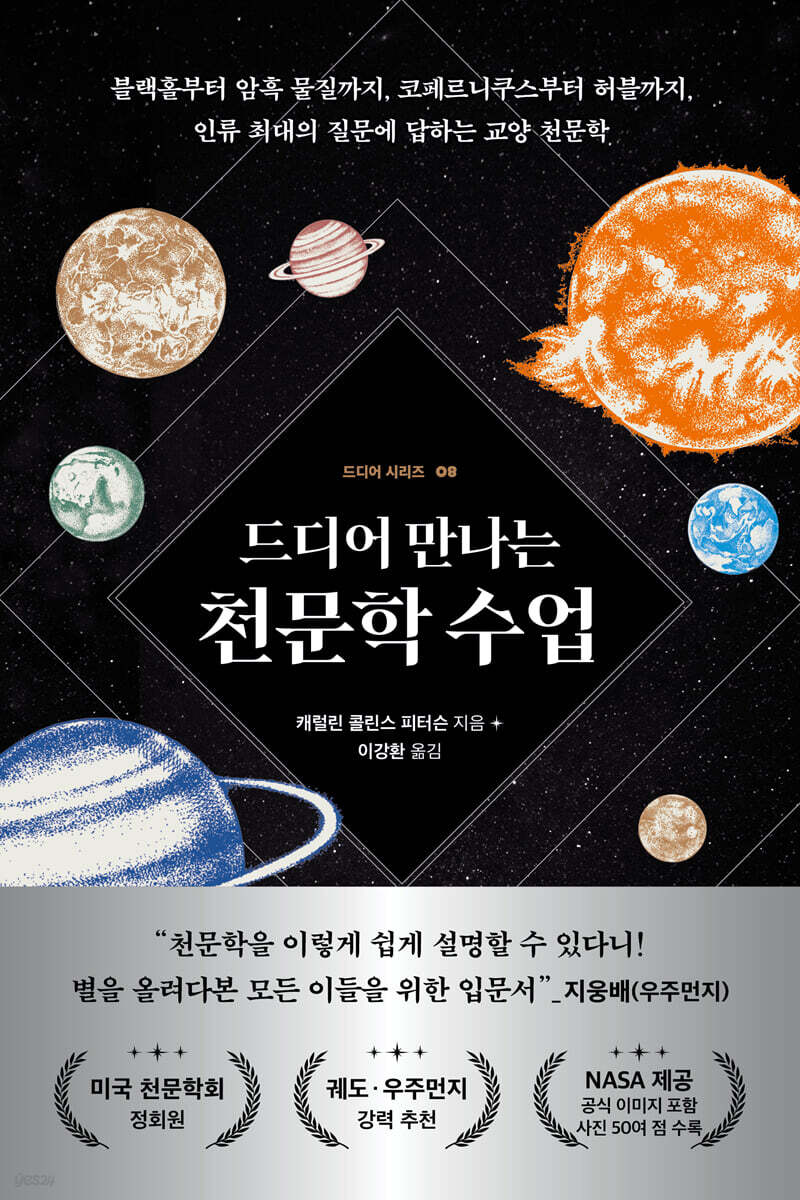
Book Introduction
Kinder than a science documentary, more fun than a textbook!
The classic 'introductory book to space' recognized even by astronomers!
We look up at the sky every day.
However, not many people know about the 'real universe'.
"Astronomy Class, Finally Encountered" is the book that opens the door to the universe for you for the first time.
This book is not just a collection of information.
From solar systems, stars, black holes, galaxies, extraterrestrial life, dark matter, and even Big Bang cosmology… this is an accessible yet dense introductory book that systematically and popularly covers the core topics of astronomy.
It unfolds in an engaging way, as if traveling through the vast flow of space, answering all our questions in scientific yet poetic language, from the nearest planet to the furthest galaxy.
The author, who has been working to popularize astronomy for decades, is a full member of the American Astronomical Society and the Society of Science Writers. Under the philosophy that "science is about loving things first," he explains the universe like poetry and unfolds science like a story.
Designed to help you understand astronomy without complicated formulas, this book features over 50 photographs, including official NASA images, and practical observation tips, so you'll be looking up at the stars the moment you close the book.
As your intellectual curiosity deepens, the night sky becomes more impressive.
If you've ever been curious about space, this book is the perfect starting point.
The classic 'introductory book to space' recognized even by astronomers!
We look up at the sky every day.
However, not many people know about the 'real universe'.
"Astronomy Class, Finally Encountered" is the book that opens the door to the universe for you for the first time.
This book is not just a collection of information.
From solar systems, stars, black holes, galaxies, extraterrestrial life, dark matter, and even Big Bang cosmology… this is an accessible yet dense introductory book that systematically and popularly covers the core topics of astronomy.
It unfolds in an engaging way, as if traveling through the vast flow of space, answering all our questions in scientific yet poetic language, from the nearest planet to the furthest galaxy.
The author, who has been working to popularize astronomy for decades, is a full member of the American Astronomical Society and the Society of Science Writers. Under the philosophy that "science is about loving things first," he explains the universe like poetry and unfolds science like a story.
Designed to help you understand astronomy without complicated formulas, this book features over 50 photographs, including official NASA images, and practical observation tips, so you'll be looking up at the stars the moment you close the book.
As your intellectual curiosity deepens, the night sky becomes more impressive.
If you've ever been curious about space, this book is the perfect starting point.
- You can preview some of the book's contents.
Preview
index
Recommendation
To you who came from the stars and will return to the stars:
The first guide to reading astronomy
Part 1: The first space we encounter, the solar system
What makes up our solar system: one star and eight planets
It all began with the Sun: the only star in the solar system.
There's Weather in Space, Too: The Curtain of Light Drawn by the Aurora
The smallest planet in the solar system: Mercury, the hottest
Earth's Sparkling Twin: Carbon Dioxide-Filled Venus
Pale Blue Dot: Our Home, a Life-Blooming Planet
The only other world visited by humans: Earth's only satellite, the Moon
Are There Aliens on Mars?: Exploring Mars to Find Space Life
The largest planet in the solar system: Jupiter, the king of the planets
The Planet with the Beautiful Hat: Saturn, the Second Largest Planet in the Solar System
The Tilted Planet: Uranus's Unique Axis
A remote, turquoise planet: Neptune, the youngest planet in the solar system.
No longer a 'planet': Pluto's new name
A streak of light across the sky: A comet long observed
Will Wishing on a Shooting Star Come True?: Cosmic Artifacts: Meteorites and Meteors
Tiny pieces of debris floating around the solar system: fragments of early nebulae, planets, and asteroids.
Part 2: The Vast and Amazing World Beyond the Solar System
Other Suns Outside Our Solar System?: Self-Illuminating Stars
Where Are Stars Born?: Interstellar Clouds and the Secrets of Star Birth
How Stars Age and Die: Supernova, the Final Moment of a Star
The Secret of Black Holes: A Star Graveyard Created by Powerful Gravity
Beautiful clusters of stars that decorate the sky: globular clusters and open clusters
Cities and Towns Where Stars Live: Galaxies That Create the Universe
Will Galaxies Last Forever?: From the Birth of the Universe to the Formation of Star Clusters
A Closer Look at Our Galaxy: Our Unique Home in the Universe
A monster boasting tremendous activity: a quasar emitting powerful light.
The Most Mysterious Undiscovered Substance: The Amazing World of Dark Matter
How to measure distances between celestial bodies: Hold a reference star and compare its brightness.
Nature's Distorted Telescope: How Gravitational Lensing Works
Everything began with a big bang: the birth of the universe
Do Wormholes Really Exist?: Science Fiction Imagination vs. Reality in the Structure of the Universe
The Probability of Encountering Aliens in Space: The Drake Equation and the SETI Institute
Part 3: People Who Changed the Flow of Astronomy and Made Amazing Achievements
How Astronomy Began: Humanity's Endless Passion for the Universe
Copernicus, the Father of Astronomy: Turning the World's Truth Upside Down
Galileo Galilei, the genius of observation: discovering Jupiter's moons
The Laws of Planetary Motion and Johannes Kepler: The Genius Scientist Who Created a Catalog of Stars
Isaac Newton, the Giant of Science: The Genius Who Changed the World of Physics and Astronomy
The Herschels: A Life of Astronomy: The Lives of William, Caroline, and John Herschel
Henrietta Swan-Levitt, a Variable Star Studyer: Finding Clues to Distance Measurement
Albert Einstein's Gravity Research: The Founder of the Theory of Relativity
Edwin Hubble, the father of the inflationary theory of the universe: Laying the foundations of the Big Bang theory.
Clyde Tombaugh, the Discoverer of Pluto: A Dreamer Who Dreamed of the Stars
Vera Rubin, who studied galaxy rotation: Finding evidence of dark matter
Jocelyn Bell Burnell, the discoverer of pulsars: The radio astronomer who missed out on the Nobel Prize.
Pluto Killer, Mike Brown: Resetting the Planetary Standard
Part 4: Floating Telescopes and the Ever-Changing Future of Astronomy
Two Branches of Astronomy: Observational Astronomy vs. Astrophysics
Astrobiology: In Search of Our Possible Neighbors
The Amazing World of Planetary Science: How Did Other Planets Evolve?
Can You See the Past with a Telescope?: The Cosmic Time Machine: The Evolution of the Telescope
The Hubble Space Telescope, a cornerstone of cosmic observation: A journey that has continued since 1990.
The 'Shining' Chandra X-ray Observatory: Precisely Observing the Cosmic X-rays
Infrared detector, Spitzer Space Telescope: Our red-glowing universe
The Super-Powerful Fermi Gamma-ray Space Telescope: Honoring a Pioneer in High-Energy Astronomy
Searching for Alien Earths: Kepler Space Telescope: Searching for Planets with Life
Astronomy: A Journey of Endless Possibilities and Exploration
Going out: Anyone who looks at the stars is an astronomer.
Image source
To you who came from the stars and will return to the stars:
The first guide to reading astronomy
Part 1: The first space we encounter, the solar system
What makes up our solar system: one star and eight planets
It all began with the Sun: the only star in the solar system.
There's Weather in Space, Too: The Curtain of Light Drawn by the Aurora
The smallest planet in the solar system: Mercury, the hottest
Earth's Sparkling Twin: Carbon Dioxide-Filled Venus
Pale Blue Dot: Our Home, a Life-Blooming Planet
The only other world visited by humans: Earth's only satellite, the Moon
Are There Aliens on Mars?: Exploring Mars to Find Space Life
The largest planet in the solar system: Jupiter, the king of the planets
The Planet with the Beautiful Hat: Saturn, the Second Largest Planet in the Solar System
The Tilted Planet: Uranus's Unique Axis
A remote, turquoise planet: Neptune, the youngest planet in the solar system.
No longer a 'planet': Pluto's new name
A streak of light across the sky: A comet long observed
Will Wishing on a Shooting Star Come True?: Cosmic Artifacts: Meteorites and Meteors
Tiny pieces of debris floating around the solar system: fragments of early nebulae, planets, and asteroids.
Part 2: The Vast and Amazing World Beyond the Solar System
Other Suns Outside Our Solar System?: Self-Illuminating Stars
Where Are Stars Born?: Interstellar Clouds and the Secrets of Star Birth
How Stars Age and Die: Supernova, the Final Moment of a Star
The Secret of Black Holes: A Star Graveyard Created by Powerful Gravity
Beautiful clusters of stars that decorate the sky: globular clusters and open clusters
Cities and Towns Where Stars Live: Galaxies That Create the Universe
Will Galaxies Last Forever?: From the Birth of the Universe to the Formation of Star Clusters
A Closer Look at Our Galaxy: Our Unique Home in the Universe
A monster boasting tremendous activity: a quasar emitting powerful light.
The Most Mysterious Undiscovered Substance: The Amazing World of Dark Matter
How to measure distances between celestial bodies: Hold a reference star and compare its brightness.
Nature's Distorted Telescope: How Gravitational Lensing Works
Everything began with a big bang: the birth of the universe
Do Wormholes Really Exist?: Science Fiction Imagination vs. Reality in the Structure of the Universe
The Probability of Encountering Aliens in Space: The Drake Equation and the SETI Institute
Part 3: People Who Changed the Flow of Astronomy and Made Amazing Achievements
How Astronomy Began: Humanity's Endless Passion for the Universe
Copernicus, the Father of Astronomy: Turning the World's Truth Upside Down
Galileo Galilei, the genius of observation: discovering Jupiter's moons
The Laws of Planetary Motion and Johannes Kepler: The Genius Scientist Who Created a Catalog of Stars
Isaac Newton, the Giant of Science: The Genius Who Changed the World of Physics and Astronomy
The Herschels: A Life of Astronomy: The Lives of William, Caroline, and John Herschel
Henrietta Swan-Levitt, a Variable Star Studyer: Finding Clues to Distance Measurement
Albert Einstein's Gravity Research: The Founder of the Theory of Relativity
Edwin Hubble, the father of the inflationary theory of the universe: Laying the foundations of the Big Bang theory.
Clyde Tombaugh, the Discoverer of Pluto: A Dreamer Who Dreamed of the Stars
Vera Rubin, who studied galaxy rotation: Finding evidence of dark matter
Jocelyn Bell Burnell, the discoverer of pulsars: The radio astronomer who missed out on the Nobel Prize.
Pluto Killer, Mike Brown: Resetting the Planetary Standard
Part 4: Floating Telescopes and the Ever-Changing Future of Astronomy
Two Branches of Astronomy: Observational Astronomy vs. Astrophysics
Astrobiology: In Search of Our Possible Neighbors
The Amazing World of Planetary Science: How Did Other Planets Evolve?
Can You See the Past with a Telescope?: The Cosmic Time Machine: The Evolution of the Telescope
The Hubble Space Telescope, a cornerstone of cosmic observation: A journey that has continued since 1990.
The 'Shining' Chandra X-ray Observatory: Precisely Observing the Cosmic X-rays
Infrared detector, Spitzer Space Telescope: Our red-glowing universe
The Super-Powerful Fermi Gamma-ray Space Telescope: Honoring a Pioneer in High-Energy Astronomy
Searching for Alien Earths: Kepler Space Telescope: Searching for Planets with Life
Astronomy: A Journey of Endless Possibilities and Exploration
Going out: Anyone who looks at the stars is an astronomer.
Image source
Detailed image

Into the book
It's a romantic, poetic, and astonishing thought that the atoms that make up all life on Earth came from space, and that we evolved looking up at the starlight that helped create other planets and, by extension, life itself.
Our curiosity and love for the stars is deeply engraved in our genes.
The universe and our DNA are connected.
This is because all life on Earth, including us, is made up of elements that were created during the Big Bang, the moment when the vast universe was formed, and when stars collided, were created, and were destroyed.
In other words, we are all beings from the stars, children of the stars.
--- p.15 "Introduction"
Some scholars believe that Venus had a relatively stable environment during its early stages of formation, with a warm and humid climate.
However, Venus changed over time and became a barren land.
The most likely theory is that Venus heated up as the Sun began radiating heat energy.
The oceans of Venus boiled and all the water vapor evaporated into space.
From this time on, only the carbon dioxide atmosphere and sulfuric acid clouds remained, obscuring the surface of Venus.
--- p.55 "Earth's Twinkling Twin: Carbon Dioxide-Filled Venus"
Comets travel long distances along their orbits.
Some comets fly towards Earth from very far away in the solar system.
Occasionally, a comet is born when strong gravity forces push the nucleus of a comet out of its stable orbit in the Oort cloud.
These clumps of ice and dust sometimes move close to nearby Kuiper Belt objects and Neptune.
The gravity of the planets is strong enough to change the orbit or period of a comet.
Especially in the case of Jupiter and Saturn, their strong gravity often shortens the orbits of comets.
--- p.116 "A ray of light across the sky: A comet observed for a long time"
About 4.5 billion years ago, a small cloud that was part of a molecular cloud began to collapse on its own.
This cloud also contained material scattered from the destruction of other stars.
Some of these elements were created in at least one, or perhaps several, massive explosions.
As the gravity of the hydrogen molecular cloud collapsed, the sun was born.
Astronomers believe that strong stellar winds from a nearby aging star or shock waves from an explosion caused the newborn sun to spin and clump together with surrounding debris.
--- p.140 "Where Are Stars Born?: The Secret of Interstellar Clouds and Star Birth"
But how did astronomers discover the existence of dark matter, when it's invisible? The story dates back to the early 20th century.
In 1933, Swiss astrophysicist Fritz Zwicky, who was studying a galaxy cluster called Coma at the California Institute of Technology in the United States, claimed that the galaxy cluster contained invisible matter.
Because the gravity of the visible galaxies alone could not have caused the galaxy cluster to orbit so quickly.
More mass and gravitational forces, undetected, were influencing the galaxy's motion.
--- p.181 "The Most Mysterious Undiscovered Substance: The Amazing World of 'Dark Matter'"
William Herschel studied ways to safely observe sunspots, which are cooler areas than their surroundings and away from the sun's rays.
He obtained interesting results from his experiments with sunlight using a red filter.
When they shined the light through a filter into a spectroscope, they could feel the heat even though the light was invisible, and a thermometer revealed that this 'invisible' light was quite warm.
Because this light lies beyond the red end of the spectrum, it is called 'infrared'.
--- p.251 "The Herschels: A Life of Astronomy: The Lives of William, Caroline, and John Herschel"
Astrobiology, from a different perspective, is the study of 'extremophiles', microorganisms that live in extreme environments.
There are microorganisms that survive underwater volcanic eruptions and high water pressure in the deep sea.
There are also very small creatures that live in places where water is extremely scarce or temperatures are extremely cold.
There are also mysterious, simple, worm-like creatures that live deep in the ocean, buried in methane ice deposits.
The existence of life forms surviving in such extreme environments offers a glimmer of hope that life may be emerging and thriving in extreme environments elsewhere in the solar system.
--- p.304 "Unknown Territory, Astrobiology: In Search of Neighbors Who Might Exist"
You can't suddenly turn off the lights and live in the dark to observe the night sky.
If necessary, lights and streetlights should be turned on at night.
It just means that you don't have to go overboard.
Another way is to only turn on lights where necessary and turn off streetlights on deserted streets.
When you turn off unnecessary lights, you will notice new lights shining beautifully on us from far away.
It is the oldest light that has illuminated human history.
Remember, we all come from stars.
Our curiosity and love for the stars is deeply engraved in our genes.
The universe and our DNA are connected.
This is because all life on Earth, including us, is made up of elements that were created during the Big Bang, the moment when the vast universe was formed, and when stars collided, were created, and were destroyed.
In other words, we are all beings from the stars, children of the stars.
--- p.15 "Introduction"
Some scholars believe that Venus had a relatively stable environment during its early stages of formation, with a warm and humid climate.
However, Venus changed over time and became a barren land.
The most likely theory is that Venus heated up as the Sun began radiating heat energy.
The oceans of Venus boiled and all the water vapor evaporated into space.
From this time on, only the carbon dioxide atmosphere and sulfuric acid clouds remained, obscuring the surface of Venus.
--- p.55 "Earth's Twinkling Twin: Carbon Dioxide-Filled Venus"
Comets travel long distances along their orbits.
Some comets fly towards Earth from very far away in the solar system.
Occasionally, a comet is born when strong gravity forces push the nucleus of a comet out of its stable orbit in the Oort cloud.
These clumps of ice and dust sometimes move close to nearby Kuiper Belt objects and Neptune.
The gravity of the planets is strong enough to change the orbit or period of a comet.
Especially in the case of Jupiter and Saturn, their strong gravity often shortens the orbits of comets.
--- p.116 "A ray of light across the sky: A comet observed for a long time"
About 4.5 billion years ago, a small cloud that was part of a molecular cloud began to collapse on its own.
This cloud also contained material scattered from the destruction of other stars.
Some of these elements were created in at least one, or perhaps several, massive explosions.
As the gravity of the hydrogen molecular cloud collapsed, the sun was born.
Astronomers believe that strong stellar winds from a nearby aging star or shock waves from an explosion caused the newborn sun to spin and clump together with surrounding debris.
--- p.140 "Where Are Stars Born?: The Secret of Interstellar Clouds and Star Birth"
But how did astronomers discover the existence of dark matter, when it's invisible? The story dates back to the early 20th century.
In 1933, Swiss astrophysicist Fritz Zwicky, who was studying a galaxy cluster called Coma at the California Institute of Technology in the United States, claimed that the galaxy cluster contained invisible matter.
Because the gravity of the visible galaxies alone could not have caused the galaxy cluster to orbit so quickly.
More mass and gravitational forces, undetected, were influencing the galaxy's motion.
--- p.181 "The Most Mysterious Undiscovered Substance: The Amazing World of 'Dark Matter'"
William Herschel studied ways to safely observe sunspots, which are cooler areas than their surroundings and away from the sun's rays.
He obtained interesting results from his experiments with sunlight using a red filter.
When they shined the light through a filter into a spectroscope, they could feel the heat even though the light was invisible, and a thermometer revealed that this 'invisible' light was quite warm.
Because this light lies beyond the red end of the spectrum, it is called 'infrared'.
--- p.251 "The Herschels: A Life of Astronomy: The Lives of William, Caroline, and John Herschel"
Astrobiology, from a different perspective, is the study of 'extremophiles', microorganisms that live in extreme environments.
There are microorganisms that survive underwater volcanic eruptions and high water pressure in the deep sea.
There are also very small creatures that live in places where water is extremely scarce or temperatures are extremely cold.
There are also mysterious, simple, worm-like creatures that live deep in the ocean, buried in methane ice deposits.
The existence of life forms surviving in such extreme environments offers a glimmer of hope that life may be emerging and thriving in extreme environments elsewhere in the solar system.
--- p.304 "Unknown Territory, Astrobiology: In Search of Neighbors Who Might Exist"
You can't suddenly turn off the lights and live in the dark to observe the night sky.
If necessary, lights and streetlights should be turned on at night.
It just means that you don't have to go overboard.
Another way is to only turn on lights where necessary and turn off streetlights on deserted streets.
When you turn off unnecessary lights, you will notice new lights shining beautifully on us from far away.
It is the oldest light that has illuminated human history.
Remember, we all come from stars.
--- p.362 "Going Out"
Publisher's Review
“A book that is like a well-made documentary!”
★★ Orbit (Science Communicator)
“I can’t believe astronomy can be explained so easily!
“A primer for everyone who has ever looked up at the stars”
★★ Ji Woong-bae (YouTube "Space Dust's Sage Times")
13.8 billion years of time and 93 billion light-years of space,
An introductory book to astronomy that tells all this in a story.
“We are made of the remains of stars,” said Carl Sagan, author of Cosmos.
All life on Earth is composed of elements created in stars, and our bodies are also connected to the history of stars.
"Astronomy Class: Finally Encountered" explains this wondrous fact in language anyone can understand, without complex formulas.
This book goes beyond simple conceptual explanations to tell a fascinating story about why humanity has gazed into the sky and pondered the meaning of existence, and how it has asked questions of the universe and sought answers.
The author helps us feel closer to the unfamiliar discipline of astronomy, covering not only the fundamental concepts of astronomy but also the moment of the Big Bang, the birth of black holes, the evolution and death of stars, the invention of the telescope and the advancement of observational technology, and the surprising insights of astronomers who turned the academic world upside down.
The composition that delivers news from the forefront of modern space exploration is also notable.
Contemporary stories such as SpaceX, the James Webb Space Telescope, and the establishment of the Korea Aerospace Science and Technology Institute are naturally incorporated, allowing us to see not only astronomy as a space science that simply studies the night sky, but also 'what kind of future are we heading towards'.
The question posed by SF,
Science Answers
“Are we the only life in the universe?”
This question, which everyone has asked at least once, is no longer confined to the realm of imagination or fantasy.
Astronomers' exploration and research to uncover the existence of extraterrestrial life is currently at the forefront of real science.
This book follows the decades-long scientific journey toward extraterrestrial life, from the SETI project to the Drake equation, astrobiology, and the Kepler mission, with vivid examples.
It clearly shows that the age-old question in astronomy, the existence of aliens, is not just a topic of curiosity, but a realistic task that is still being seriously explored.
It also revisits familiar concepts from science fiction, such as wormholes, time travel, and the multiverse, through the language of science, and presents scientific 'standards' to answer the question, "How far is possible, and where does fantasy begin?"
Readers who enjoy science fiction will find this book a fascinating thought experiment that unfolds on the border between imagination and science.
Each question we ask now may become a topic of conversation with some intelligent life form in the distant universe in the near future.
This book will expand our imagination further and deeper through the lens of 'astronomy.'
If you look at the night sky and feel curious,
You are an astronomer
"Astronomy Class: Finally Encountered" dispels the preconception that space is a distant and difficult realm, and guides readers through the joys of observation that can be initiated simply through curiosity.
The practical part presents observation tips that you can try right away, even if you don't have a telescope.
It contains detailed instructions on how to find Venus in the daytime sky, tips for observing the rings and satellites of Jupiter and Saturn with a beginner's telescope, and an easy way to check the schedules for meteor showers, solar eclipses, and lunar eclipses that can be observed in the constellations Quadrantids, Gemini, and Perseus.
It logically explains why a telescope is a 'time machine of the universe' and intuitively impresses upon us that the more distant celestial bodies we observe, the more we can look into the distant past.
In addition, it classifies stars by color, temperature, and brightness, and helps you understand the life cycle of a star at a glance using the Hertzsprung-Russell diagram.
The explanations are brief but do not miss the key points, so even beginners to complex astronomical knowledge can learn them naturally.
This book will help readers quickly understand cosmic distances and stellar classifications, equip them with the background knowledge to enjoy the sky without equipment, and plan their seasonal stargazing trips in advance.
Above all, the book reminds us, at the beginning and end, that we are beings made of the remnants of stars, that is, 'children of stars.'
The message that the starlight that has illuminated humanity since ancient times still illuminates our lives brings new wonder to the readers' daily lives.
Tonight, look up and see the stars.
The author says:
Stars are the oldest lights that have illuminated humanity, and anyone who looks at the stars is an astronomer.
Translator's Note
Space travel without a telescope
The recent challenges of SpaceX and the launch of the Korea Aerospace Research Institute are not just news, but a signal that humanity is entering a new space age in earnest.
Space is no longer the domain of a few scientists or dreamers, but is becoming the stage of our future lives.
The more we turn our gaze to the sky, the wider the world we encounter, and the more fundamental and profound the questions we ask.
Beyond our solar system, our curiosity about the universe grows bolder with each passing year, from exoplanets and galaxies, to black holes and dark matter, to the origin and end of the universe.
"Astronomy Class: Finally Encountered" concisely and concisely covers a wide range of topics, from our solar system to black holes and the Andromeda Galaxy, deep space, and the history of astronomy to modern, cutting-edge space telescopes.
This is a friendly guide and travel book perfect for readers who are just beginning to be curious about space.
Well then, shall we go further into space with this book?
★★ Orbit (Science Communicator)
“I can’t believe astronomy can be explained so easily!
“A primer for everyone who has ever looked up at the stars”
★★ Ji Woong-bae (YouTube "Space Dust's Sage Times")
13.8 billion years of time and 93 billion light-years of space,
An introductory book to astronomy that tells all this in a story.
“We are made of the remains of stars,” said Carl Sagan, author of Cosmos.
All life on Earth is composed of elements created in stars, and our bodies are also connected to the history of stars.
"Astronomy Class: Finally Encountered" explains this wondrous fact in language anyone can understand, without complex formulas.
This book goes beyond simple conceptual explanations to tell a fascinating story about why humanity has gazed into the sky and pondered the meaning of existence, and how it has asked questions of the universe and sought answers.
The author helps us feel closer to the unfamiliar discipline of astronomy, covering not only the fundamental concepts of astronomy but also the moment of the Big Bang, the birth of black holes, the evolution and death of stars, the invention of the telescope and the advancement of observational technology, and the surprising insights of astronomers who turned the academic world upside down.
The composition that delivers news from the forefront of modern space exploration is also notable.
Contemporary stories such as SpaceX, the James Webb Space Telescope, and the establishment of the Korea Aerospace Science and Technology Institute are naturally incorporated, allowing us to see not only astronomy as a space science that simply studies the night sky, but also 'what kind of future are we heading towards'.
The question posed by SF,
Science Answers
“Are we the only life in the universe?”
This question, which everyone has asked at least once, is no longer confined to the realm of imagination or fantasy.
Astronomers' exploration and research to uncover the existence of extraterrestrial life is currently at the forefront of real science.
This book follows the decades-long scientific journey toward extraterrestrial life, from the SETI project to the Drake equation, astrobiology, and the Kepler mission, with vivid examples.
It clearly shows that the age-old question in astronomy, the existence of aliens, is not just a topic of curiosity, but a realistic task that is still being seriously explored.
It also revisits familiar concepts from science fiction, such as wormholes, time travel, and the multiverse, through the language of science, and presents scientific 'standards' to answer the question, "How far is possible, and where does fantasy begin?"
Readers who enjoy science fiction will find this book a fascinating thought experiment that unfolds on the border between imagination and science.
Each question we ask now may become a topic of conversation with some intelligent life form in the distant universe in the near future.
This book will expand our imagination further and deeper through the lens of 'astronomy.'
If you look at the night sky and feel curious,
You are an astronomer
"Astronomy Class: Finally Encountered" dispels the preconception that space is a distant and difficult realm, and guides readers through the joys of observation that can be initiated simply through curiosity.
The practical part presents observation tips that you can try right away, even if you don't have a telescope.
It contains detailed instructions on how to find Venus in the daytime sky, tips for observing the rings and satellites of Jupiter and Saturn with a beginner's telescope, and an easy way to check the schedules for meteor showers, solar eclipses, and lunar eclipses that can be observed in the constellations Quadrantids, Gemini, and Perseus.
It logically explains why a telescope is a 'time machine of the universe' and intuitively impresses upon us that the more distant celestial bodies we observe, the more we can look into the distant past.
In addition, it classifies stars by color, temperature, and brightness, and helps you understand the life cycle of a star at a glance using the Hertzsprung-Russell diagram.
The explanations are brief but do not miss the key points, so even beginners to complex astronomical knowledge can learn them naturally.
This book will help readers quickly understand cosmic distances and stellar classifications, equip them with the background knowledge to enjoy the sky without equipment, and plan their seasonal stargazing trips in advance.
Above all, the book reminds us, at the beginning and end, that we are beings made of the remnants of stars, that is, 'children of stars.'
The message that the starlight that has illuminated humanity since ancient times still illuminates our lives brings new wonder to the readers' daily lives.
Tonight, look up and see the stars.
The author says:
Stars are the oldest lights that have illuminated humanity, and anyone who looks at the stars is an astronomer.
Translator's Note
Space travel without a telescope
The recent challenges of SpaceX and the launch of the Korea Aerospace Research Institute are not just news, but a signal that humanity is entering a new space age in earnest.
Space is no longer the domain of a few scientists or dreamers, but is becoming the stage of our future lives.
The more we turn our gaze to the sky, the wider the world we encounter, and the more fundamental and profound the questions we ask.
Beyond our solar system, our curiosity about the universe grows bolder with each passing year, from exoplanets and galaxies, to black holes and dark matter, to the origin and end of the universe.
"Astronomy Class: Finally Encountered" concisely and concisely covers a wide range of topics, from our solar system to black holes and the Andromeda Galaxy, deep space, and the history of astronomy to modern, cutting-edge space telescopes.
This is a friendly guide and travel book perfect for readers who are just beginning to be curious about space.
Well then, shall we go further into space with this book?
GOODS SPECIFICS
- Date of issue: July 7, 2025
- Page count, weight, size: 368 pages | 140*210*30mm
- ISBN13: 9791139725391
- ISBN10: 1139725394
You may also like
카테고리
korean


korean

![GQ KOREA Mark (Monthly): December [2025]](http://librairie.coreenne.fr/cdn/shop/files/8ef265dbbfbf186523ed75ba7319009d.jpg?v=1765340328&width=3840)


