

Mathematics in Real Life
 |
Description
Book Introduction
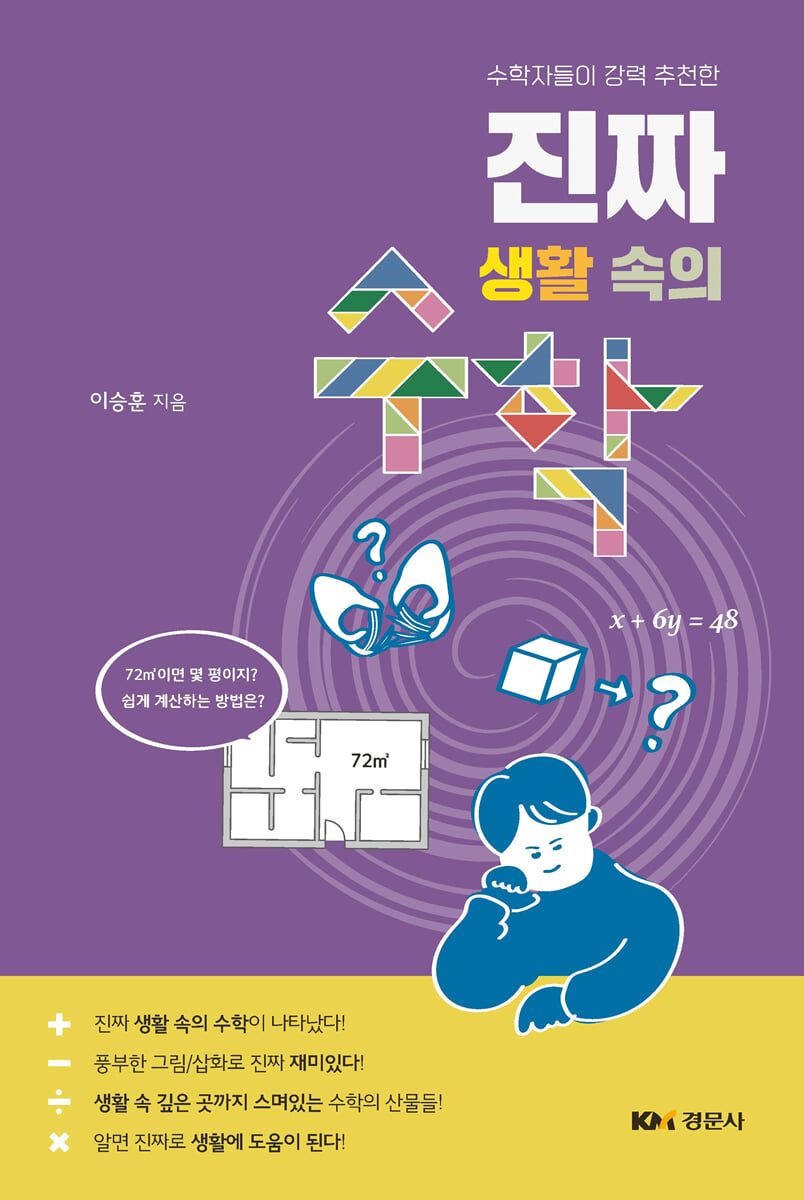
Real, real-life math stories from the author who led the Korean Mathematical Olympiad.
This book presents important topics in five chapters, covering more in-depth mathematics related to real life, how mathematics is used and how important it is in the era of the Fourth Industrial Revolution, and each chapter is divided into three sections to advance the story.
At the beginning of each section, there is a “I wonder” that corresponds to the core motivation of the section.
By reading "I'm Curious," you can understand the author's reasons and motivations for writing this book, and it will serve as a compass for you as you read the book.
The author hopes that this will lead to an understanding of mathematical content, its application in real life, and ultimately, an improvement in one's attitude toward life.
As with all academic disciplines, the purpose of studying mathematics is not solely to acquire knowledge.
Through the process of acquiring knowledge, one's attitude toward life should improve, ultimately leading to a happy life.
This book presents important topics in five chapters, covering more in-depth mathematics related to real life, how mathematics is used and how important it is in the era of the Fourth Industrial Revolution, and each chapter is divided into three sections to advance the story.
At the beginning of each section, there is a “I wonder” that corresponds to the core motivation of the section.
By reading "I'm Curious," you can understand the author's reasons and motivations for writing this book, and it will serve as a compass for you as you read the book.
The author hopes that this will lead to an understanding of mathematical content, its application in real life, and ultimately, an improvement in one's attitude toward life.
As with all academic disciplines, the purpose of studying mathematics is not solely to acquire knowledge.
Through the process of acquiring knowledge, one's attitude toward life should improve, ultimately leading to a happy life.
- You can preview some of the book's contents.
Preview
index
PART 1: MATH FOR TRANSFORMERS
01.
Chilgyo board game
02.
Can one polygon transform into another polygon?
03.
Can one polyhedron transform into another polyhedron?
PART 2 Math is Life
01.
Math is convenience
02.
Where are the best seats in the movie theater?
03.
When you are diagnosed with a disease, what are the chances that you actually have the disease?
PART 3 Math for the Gambler
01.
How to play Go-Stop with 4 people without selling cards
02.
Card shuffling and math
03.
Gambler's Success Strategy
PART 4 Unraveling the Mysteries of Social Phenomena with Numbers
01.
Pareto's law
02.
Jeep's Law
03.
Benford's Law
PART 5 Mathematics for the Fourth Industrial Revolution
01.
How do we know how old an excavated artifact is?
02.
How do you predict the speed at which an infectious disease like COVID-19 will spread?
03.
Mathematics required for artificial intelligence
01.
Chilgyo board game
02.
Can one polygon transform into another polygon?
03.
Can one polyhedron transform into another polyhedron?
PART 2 Math is Life
01.
Math is convenience
02.
Where are the best seats in the movie theater?
03.
When you are diagnosed with a disease, what are the chances that you actually have the disease?
PART 3 Math for the Gambler
01.
How to play Go-Stop with 4 people without selling cards
02.
Card shuffling and math
03.
Gambler's Success Strategy
PART 4 Unraveling the Mysteries of Social Phenomena with Numbers
01.
Pareto's law
02.
Jeep's Law
03.
Benford's Law
PART 5 Mathematics for the Fourth Industrial Revolution
01.
How do we know how old an excavated artifact is?
02.
How do you predict the speed at which an infectious disease like COVID-19 will spread?
03.
Mathematics required for artificial intelligence
Publisher's Review
Math for Transformers
In the movie Transformers, the main robot has the amazing ability to instantly transform into various shapes, such as a helicopter or a car.
It may be a documentary about entertainment, but it makes you wonder if it is actually possible for robots to transform into various shapes like in the movies.
That is, the question is whether it is possible to cut a shape into several pieces and then reassemble the pieces to create another shape.
Let's look at this question separately for plane figures and (three-dimensional) solid figures.
Mathematics is life
Math isn't just for taking exams or studying difficult theories.
Mathematics is used in many areas, big and small, in our daily lives, and can make our daily lives more convenient.
You can easily convert how many square meters are in how many pyeong is an apartment, how many pounds are in how many kilograms, where the best seats are in a movie theater, and where to get the best view of the statue of Admiral Yi Sun-sin in Gwanghwamun.
And when you get tested for a disease and the result is positive, you can also find out what the probability is that you actually have that disease.
Math for Tazza
The history of gambling is very old, and many people enjoy playing cards or playing cards in their daily lives.
Many questions related to Hwatu, card games, and gambling can be answered with mathematics.
Let's learn about useful things to know, such as how to play Go-Stop with 4 people without losing money, how many times to shuffle the cards or Hwatu cards to make sure they are well mixed, and whether it is better to bet big or small when playing against an opponent who is better than you.
Unraveling the mysteries of social phenomena with numbers
Natural phenomena can often be explained by the laws of natural sciences such as physics, chemistry, and biology.
However, it seems difficult to have any laws for social phenomena because people act individually according to their own free will.
However, surprisingly, it has been empirically proven that there are certain laws in social phenomena, and much research has been conducted.
It turns out that there are surprisingly certain patterns in many things in our daily lives: the distribution of property owned by people, the population of a city, the words we frequently use, the numbers in a company's accounting books, and so on.
Mathematics for the Fourth Industrial Revolution
Mathematics is an essential basic tool for research and development in science, engineering, and technology.
Mathematics plays a key role in policy decisions to address the COVID-19 pandemic, which emerged in late 2019 and profoundly changed the lives of people around the world, as well as in the development of core technologies of the Fourth Industrial Revolution, such as artificial intelligence, robotics, and 3D printing.
In addition, it provides crucial assistance in the study of human history by dating excavated artifacts.
Let's find out how mathematics is used in these fields.
In the movie Transformers, the main robot has the amazing ability to instantly transform into various shapes, such as a helicopter or a car.
It may be a documentary about entertainment, but it makes you wonder if it is actually possible for robots to transform into various shapes like in the movies.
That is, the question is whether it is possible to cut a shape into several pieces and then reassemble the pieces to create another shape.
Let's look at this question separately for plane figures and (three-dimensional) solid figures.
Mathematics is life
Math isn't just for taking exams or studying difficult theories.
Mathematics is used in many areas, big and small, in our daily lives, and can make our daily lives more convenient.
You can easily convert how many square meters are in how many pyeong is an apartment, how many pounds are in how many kilograms, where the best seats are in a movie theater, and where to get the best view of the statue of Admiral Yi Sun-sin in Gwanghwamun.
And when you get tested for a disease and the result is positive, you can also find out what the probability is that you actually have that disease.
Math for Tazza
The history of gambling is very old, and many people enjoy playing cards or playing cards in their daily lives.
Many questions related to Hwatu, card games, and gambling can be answered with mathematics.
Let's learn about useful things to know, such as how to play Go-Stop with 4 people without losing money, how many times to shuffle the cards or Hwatu cards to make sure they are well mixed, and whether it is better to bet big or small when playing against an opponent who is better than you.
Unraveling the mysteries of social phenomena with numbers
Natural phenomena can often be explained by the laws of natural sciences such as physics, chemistry, and biology.
However, it seems difficult to have any laws for social phenomena because people act individually according to their own free will.
However, surprisingly, it has been empirically proven that there are certain laws in social phenomena, and much research has been conducted.
It turns out that there are surprisingly certain patterns in many things in our daily lives: the distribution of property owned by people, the population of a city, the words we frequently use, the numbers in a company's accounting books, and so on.
Mathematics for the Fourth Industrial Revolution
Mathematics is an essential basic tool for research and development in science, engineering, and technology.
Mathematics plays a key role in policy decisions to address the COVID-19 pandemic, which emerged in late 2019 and profoundly changed the lives of people around the world, as well as in the development of core technologies of the Fourth Industrial Revolution, such as artificial intelligence, robotics, and 3D printing.
In addition, it provides crucial assistance in the study of human history by dating excavated artifacts.
Let's find out how mathematics is used in these fields.
GOODS SPECIFICS
- Date of issue: July 1, 2023
- Page count, weight, size: 272 pages | 153*225*20mm
- ISBN13: 9791160734652
- ISBN10: 1160734658
You may also like
카테고리
korean


korean

![GQ KOREA Mark (Monthly): December [2025]](http://librairie.coreenne.fr/cdn/shop/files/8ef265dbbfbf186523ed75ba7319009d.jpg?v=1765340328&width=3840)


