

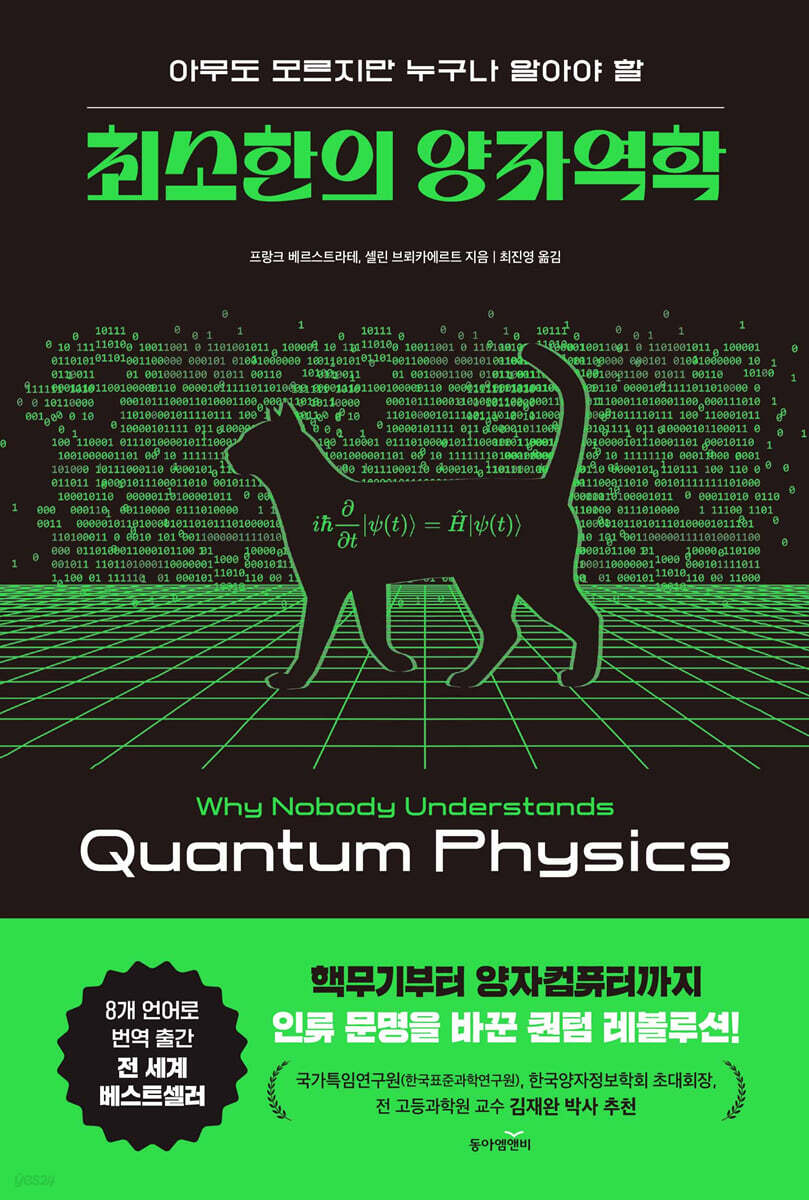
minimal quantum mechanics
 |
Description
Book Introduction
Quantum mechanics, the subject of the 2025 Nobel Prize in Physics
A truly comprehensive quantum mechanics textbook written by a world-renowned authority!
From the origins of quantum computing in the 16th century to quantum computers in the 21st century
A quantum epic that will overwhelm both beginners and experts.
A book about quantum mechanics and its origins, which emerged in the early 20th century.
We summarize how quantum mechanics became the greatest revolution in understanding all matter on Earth and in the universe, and how it shaped much of modern technology.
The United Nations and UNESCO designated 2025, the 100th anniversary of Werner Heisenberg's announcement of matrix mechanics in 1925, as the "Year of Quantum Science and Technology," considering it the birth of quantum mechanics. However, this book begins with Simon Stevin in the 16th century and looks back on the 500 years of history surrounding quantum mechanics since then.
Part 1 of the two-part series examines the achievements of scientists who transformed physics into the language of mathematics.
Following Stevin, the story of Galileo, who is called the father of modern science through 'Falling Experiment 2.0'; Newton, who invented calculus while trying to find a way to explain the orbits of planets; Lord Hamilton, who laid the mathematical foundation for quantum mechanics through quaternions; and Emmy Noether, who made great achievements in physics regarding symmetry, are also told.
Focuses on the scientists and their achievements who laid the foundations of quantum mechanics from the 16th to the 19th centuries.
Part 2 covers the full-blown quantum era, focusing on scientists and their achievements who have earned their place in the hall of fame of quantum mechanics from the 20th century to the present day in the 21st century.
Part 2 begins with Planck and Einstein, who first established quantum theory starting with quanta of light (photons); de Broglie, who discovered that all particles are bundles of waves and invented a formula to calculate the wavelength of each particle; Schrödinger, who opened a whole new era of quantum mechanics by inventing the quantum wave equation; and Heisenberg, who published a paper called 'Matrix Mechanics' and made 1925 a groundbreaking year for quantum mechanics.
Theories supporting quantum mechanics, such as qubits, field theory, entanglement, and the EPR paradox, are introduced in Chapter 5 of Part 2 under the title “Quantum Philosophy.”
Schrödinger's famous cat experiment also appears here, and is introduced as an example to easily explain 'superposition,' an important concept in quantum mechanics.
Chapter 6 explains the groundbreaking impact of quantum mechanics on physics and chemistry, including Feynman's diagrams and Mendeleev's periodic table.
Chapter 7 also contains stories about the inventions of lasers, nuclei and neutrons, the atomic bomb, quantum electrodynamics (QED), and quantum chromodynamics, all of which are products of quantum mechanics.
You can also see research on the origins of the Earth and the universe.
If Heisenberg's invention of matrix mechanics is considered the first quantum revolution, then the birth of the Bosch-Einstein condensate on June 5, 1995, is considered the beginning of the second quantum revolution.
The product unfolds the principles of quantum cryptography and quantum computers.
This will be followed by ongoing quantum research, including the development of future quantum computers and quantum error correction.
It is a collaborative work between a world-renowned researcher in the field of quantum mechanics and his wife, a writer and linguist.
Countless scholars, including physicists, chemists, and even humanists like Voltaire and Goethe, appear in the book as sources of quantum mechanics.
Quantum mechanics is not a discipline invented by a genius physicist in a flash of inspiration, but rather a discipline born from the combined efforts of giants standing on each other's shoulders.
Dr. Jae-Wan Kim, a former professor at the Korea Institute for Advanced Study and the first president of the Korean Quantum Information Society, said, “This book explains the hidden meaning behind the mathematics used to properly express quantum mechanics,” and John Preskill, the Feynman Professor of Theoretical Physics at Caltech, strongly recommended this book, saying, “This book is incomparable to any other physics book.”
A truly comprehensive quantum mechanics textbook written by a world-renowned authority!
From the origins of quantum computing in the 16th century to quantum computers in the 21st century
A quantum epic that will overwhelm both beginners and experts.
A book about quantum mechanics and its origins, which emerged in the early 20th century.
We summarize how quantum mechanics became the greatest revolution in understanding all matter on Earth and in the universe, and how it shaped much of modern technology.
The United Nations and UNESCO designated 2025, the 100th anniversary of Werner Heisenberg's announcement of matrix mechanics in 1925, as the "Year of Quantum Science and Technology," considering it the birth of quantum mechanics. However, this book begins with Simon Stevin in the 16th century and looks back on the 500 years of history surrounding quantum mechanics since then.
Part 1 of the two-part series examines the achievements of scientists who transformed physics into the language of mathematics.
Following Stevin, the story of Galileo, who is called the father of modern science through 'Falling Experiment 2.0'; Newton, who invented calculus while trying to find a way to explain the orbits of planets; Lord Hamilton, who laid the mathematical foundation for quantum mechanics through quaternions; and Emmy Noether, who made great achievements in physics regarding symmetry, are also told.
Focuses on the scientists and their achievements who laid the foundations of quantum mechanics from the 16th to the 19th centuries.
Part 2 covers the full-blown quantum era, focusing on scientists and their achievements who have earned their place in the hall of fame of quantum mechanics from the 20th century to the present day in the 21st century.
Part 2 begins with Planck and Einstein, who first established quantum theory starting with quanta of light (photons); de Broglie, who discovered that all particles are bundles of waves and invented a formula to calculate the wavelength of each particle; Schrödinger, who opened a whole new era of quantum mechanics by inventing the quantum wave equation; and Heisenberg, who published a paper called 'Matrix Mechanics' and made 1925 a groundbreaking year for quantum mechanics.
Theories supporting quantum mechanics, such as qubits, field theory, entanglement, and the EPR paradox, are introduced in Chapter 5 of Part 2 under the title “Quantum Philosophy.”
Schrödinger's famous cat experiment also appears here, and is introduced as an example to easily explain 'superposition,' an important concept in quantum mechanics.
Chapter 6 explains the groundbreaking impact of quantum mechanics on physics and chemistry, including Feynman's diagrams and Mendeleev's periodic table.
Chapter 7 also contains stories about the inventions of lasers, nuclei and neutrons, the atomic bomb, quantum electrodynamics (QED), and quantum chromodynamics, all of which are products of quantum mechanics.
You can also see research on the origins of the Earth and the universe.
If Heisenberg's invention of matrix mechanics is considered the first quantum revolution, then the birth of the Bosch-Einstein condensate on June 5, 1995, is considered the beginning of the second quantum revolution.
The product unfolds the principles of quantum cryptography and quantum computers.
This will be followed by ongoing quantum research, including the development of future quantum computers and quantum error correction.
It is a collaborative work between a world-renowned researcher in the field of quantum mechanics and his wife, a writer and linguist.
Countless scholars, including physicists, chemists, and even humanists like Voltaire and Goethe, appear in the book as sources of quantum mechanics.
Quantum mechanics is not a discipline invented by a genius physicist in a flash of inspiration, but rather a discipline born from the combined efforts of giants standing on each other's shoulders.
Dr. Jae-Wan Kim, a former professor at the Korea Institute for Advanced Study and the first president of the Korean Quantum Information Society, said, “This book explains the hidden meaning behind the mathematics used to properly express quantum mechanics,” and John Preskill, the Feynman Professor of Theoretical Physics at Caltech, strongly recommended this book, saying, “This book is incomparable to any other physics book.”
- You can preview some of the book's contents.
Preview
index
Preface by a Physicist
Author's Preface
How to read this book
Part 1 | Mathematics
Chapter 1: The Unreasonable Efficiency of Mathematics
1.1 How Aristotle's Throne Fell
1.2 Galileo Galilei's discoveries
1.3 A lion can be recognized by its claws.
1.4 Calculus of Mathematical Mathematical Calculus
Chapter 2 Symmetry
2.1 Order of Symmetry
2.2 When symmetry is broken
2.3 Groups behind the symmetric structure
2.4 Drums and Atoms
Part 2 | Quantum
Chapter 3: The (Im)possibility of Particles
3.1 Finding the answer
3.2 Light, both wave and particle
3.3 The first atomic models
3.4 Particle and wave bundles
3.5 Quantum mechanics as seen through the double-slit experiment
3.6 Heisenberg's microscope
Chapter 4: The First Quantum Revolution
4.1 Accepting the Wave
4.2 Information Waves
4.3 Theoretical explanation of two slits
4.4 Quantum Tunneling
4.5 Matrix Mechanics
4.6 Beauty is truth, and truth is beauty.
Spin Stern with 4.7 qubits
Chapter 5: Quantum Philosophy
5.1 Quantum Nonsense
5.2 Entanglement
5.3 Bohr vs. Einstein
5.4 EPR paradox
5.5 Schrödinger sends his cat
5.6 Who will bell the cat?
5.7 Context
Chapter 6 One, Two, Many
6.1 Indistinguishability of particles
6.2 Hotel Hilbert
6.3 Atoms and Molecules
6.4 Solid Materials
6.5 Quantum Color
6.6 Boss, Einstein, and Laser
Chapter 7 Pudding and Curd
7.1 Experiments in subatomic physics
7.2 Theories of Subatomic Physics
7.3 We all come from stars
Chapter 8: Anderson steps forward
8.1 Creation
8.2 Renormalization
8.3 Superconductivity
8.4 The Discovery of Perfection
Chapter 9: The Second Quantum Revolution
9.1 Quantum Measurement Technologies
9.2 Quantum Simulation
9.3 Quantum Information
9.4 Quantum Complexity
9.5 Quantum Computers
9.6 Quantum Errors
9.7 Quantum Reconstruction and Entangled Particles
Epilogue
Acknowledgements
Glossary of Terms
Search
Author's Preface
How to read this book
Part 1 | Mathematics
Chapter 1: The Unreasonable Efficiency of Mathematics
1.1 How Aristotle's Throne Fell
1.2 Galileo Galilei's discoveries
1.3 A lion can be recognized by its claws.
1.4 Calculus of Mathematical Mathematical Calculus
Chapter 2 Symmetry
2.1 Order of Symmetry
2.2 When symmetry is broken
2.3 Groups behind the symmetric structure
2.4 Drums and Atoms
Part 2 | Quantum
Chapter 3: The (Im)possibility of Particles
3.1 Finding the answer
3.2 Light, both wave and particle
3.3 The first atomic models
3.4 Particle and wave bundles
3.5 Quantum mechanics as seen through the double-slit experiment
3.6 Heisenberg's microscope
Chapter 4: The First Quantum Revolution
4.1 Accepting the Wave
4.2 Information Waves
4.3 Theoretical explanation of two slits
4.4 Quantum Tunneling
4.5 Matrix Mechanics
4.6 Beauty is truth, and truth is beauty.
Spin Stern with 4.7 qubits
Chapter 5: Quantum Philosophy
5.1 Quantum Nonsense
5.2 Entanglement
5.3 Bohr vs. Einstein
5.4 EPR paradox
5.5 Schrödinger sends his cat
5.6 Who will bell the cat?
5.7 Context
Chapter 6 One, Two, Many
6.1 Indistinguishability of particles
6.2 Hotel Hilbert
6.3 Atoms and Molecules
6.4 Solid Materials
6.5 Quantum Color
6.6 Boss, Einstein, and Laser
Chapter 7 Pudding and Curd
7.1 Experiments in subatomic physics
7.2 Theories of Subatomic Physics
7.3 We all come from stars
Chapter 8: Anderson steps forward
8.1 Creation
8.2 Renormalization
8.3 Superconductivity
8.4 The Discovery of Perfection
Chapter 9: The Second Quantum Revolution
9.1 Quantum Measurement Technologies
9.2 Quantum Simulation
9.3 Quantum Information
9.4 Quantum Complexity
9.5 Quantum Computers
9.6 Quantum Errors
9.7 Quantum Reconstruction and Entangled Particles
Epilogue
Acknowledgements
Glossary of Terms
Search
Into the book
This experiment was brutally clear.
Scientists who came after Aristotle had been mistaken for about two thousand years, but it is now clearly and forever proven that heavy objects fall at the same speed as light objects.
This is where our story begins.
Since Simon Stevin, over 300 years have passed, reason has been enlightened, and emotion has been on a straight path to the birth of quantum mechanics.
--- p.20
How on earth is this possible? How can a single droplet be defined as a single wave? To understand this, we must temporarily suspend intuitive thinking and embrace quantum logic.
By doing so, you will understand that the energy levels of quantum particles are quantized (this is where the name 'quantum mechanics' comes from), that quantum particles have both particle-like and wave-like properties, and that, like strings, they can exist in a superposition of multiple waves and even be in multiple locations at the same time.
--- p.40~41
De Broglie started from Bohr's work, but came up with a completely different interpretation.
If waves are particles, then particles must also be waves.
That is, all particles are waves.
Electrons, protons, even golf balls—they are all ultimately made of waves.
More precisely, it is a wave bundle (wave bundle, wave packet), which is a collection of waves.
A wave packet is a piece of wave that is confined to a specific location.
It is a collection (superposition) of waves with different frequencies.
--- p.105
Like a bit, a qubit is an abstraction of a quantum system that can have two distinct states and can represent any possible superposition of the two.
For example, an electron can have both spin-up and spin-down simultaneously.
Another example is the polarization of light.
Light can rotate to the right or left, or in a superposition of the two.
Or, as an example, a non-classical relationship, a romantic relationship that can be ongoing or over, or an ambiguous state that cannot be determined by one or the other.
--- p.149~150
Quantum contextuality was not fully mathematically formulated until 30 years later by Simon Kochen (1934~) and Ernst Specker (1920~2011).
Cohen and Speker refuted Einstein's realism, which states that systems have intrinsic properties independent of observation.
The two created a very specific and complex structure that could perform a wide variety of measurements.
Some of these measurements could be performed simultaneously quantum mechanically (exchangeable observables), and some could not.
--- p.182
The Feynman diagram, with its simple yet ingenious design, reveals one of the most striking features of quantum mechanics.
This diagram can teach us about particles that have not yet been discovered, particles that we cannot even see, because they exist virtually on the diagram.
Feynman diagrams also have remarkable predictive power.
For example, this diagram predicted the existence and even the mass of a new kind of fundamental particle, the charm quark.
--- p.202
Why should Marie Curie be enshrined in the pantheon of quantum scientists? Because her experiments directly led to the following key questions:
“What exactly are atoms made of?” “What is their structure like?” “How can radioactivity be explained by the process of creating new particles?” In addition, Marie Curie was a major supplier of radioactive materials.
She provided radioactive material to Ernest Rutherford, a daring and unique scientist from New Zealand who turned the established framework of physics upside down.
Marie Curie paved the way for some of the most important discoveries in subatomic physics.
--- p.250~251
In Anderson's most famous essay, "More is Different," he points out that completely different organizational principles and laws apply depending on the scale of the operation.
This phenomenon has a name: 'emergence'.
While it is perfectly possible to understand one atom or three quarks, it is impossible to predict how many atoms or quarks will behave together.
A large number of particles requires a different approach than a single particle.
The real question is this:
“How do we deal with systems composed of many particles?” We don’t need to delve deeper into a single particle; instead, we need to look at many particles.
Here, 'many' really means a lot.
For example, it is about 10 to the 24th power.
--- p.305
On June 5, 1995, the beginning of the second quantum revolution was officially marked.
On that day, the first Bose-Einstein condensate was born in a laboratory in Boulder, Colorado.
This was a huge event.
“Yes,” muttered the mathematicians, who had never thought this experiment was possible.
“It’s really amazing.” In the same year, in the same city, less than a month later, the first quantum computer prototype was built.
It consisted of just two qubits.
A new era has begun.
The whole world suddenly fell under the spell of quantum.
--- p.331
Now that it's clear (for some) what quantum tensor networks are, we can move on to the really difficult topic.
The question is how to integrate quantum mechanics and general relativity.
There is probably no physics student who would not like to find an answer to this question.
Unfortunately, no scientist knows how to actually solve this problem.
The biggest obstacle is that general relativity still cannot be quantized.
The reason is that general relativity cannot be renormalized.
That is because it cannot handle infinity.
It was thought (or 'still', depending on who you ask) that string theory might solve this problem.
Scientists who came after Aristotle had been mistaken for about two thousand years, but it is now clearly and forever proven that heavy objects fall at the same speed as light objects.
This is where our story begins.
Since Simon Stevin, over 300 years have passed, reason has been enlightened, and emotion has been on a straight path to the birth of quantum mechanics.
--- p.20
How on earth is this possible? How can a single droplet be defined as a single wave? To understand this, we must temporarily suspend intuitive thinking and embrace quantum logic.
By doing so, you will understand that the energy levels of quantum particles are quantized (this is where the name 'quantum mechanics' comes from), that quantum particles have both particle-like and wave-like properties, and that, like strings, they can exist in a superposition of multiple waves and even be in multiple locations at the same time.
--- p.40~41
De Broglie started from Bohr's work, but came up with a completely different interpretation.
If waves are particles, then particles must also be waves.
That is, all particles are waves.
Electrons, protons, even golf balls—they are all ultimately made of waves.
More precisely, it is a wave bundle (wave bundle, wave packet), which is a collection of waves.
A wave packet is a piece of wave that is confined to a specific location.
It is a collection (superposition) of waves with different frequencies.
--- p.105
Like a bit, a qubit is an abstraction of a quantum system that can have two distinct states and can represent any possible superposition of the two.
For example, an electron can have both spin-up and spin-down simultaneously.
Another example is the polarization of light.
Light can rotate to the right or left, or in a superposition of the two.
Or, as an example, a non-classical relationship, a romantic relationship that can be ongoing or over, or an ambiguous state that cannot be determined by one or the other.
--- p.149~150
Quantum contextuality was not fully mathematically formulated until 30 years later by Simon Kochen (1934~) and Ernst Specker (1920~2011).
Cohen and Speker refuted Einstein's realism, which states that systems have intrinsic properties independent of observation.
The two created a very specific and complex structure that could perform a wide variety of measurements.
Some of these measurements could be performed simultaneously quantum mechanically (exchangeable observables), and some could not.
--- p.182
The Feynman diagram, with its simple yet ingenious design, reveals one of the most striking features of quantum mechanics.
This diagram can teach us about particles that have not yet been discovered, particles that we cannot even see, because they exist virtually on the diagram.
Feynman diagrams also have remarkable predictive power.
For example, this diagram predicted the existence and even the mass of a new kind of fundamental particle, the charm quark.
--- p.202
Why should Marie Curie be enshrined in the pantheon of quantum scientists? Because her experiments directly led to the following key questions:
“What exactly are atoms made of?” “What is their structure like?” “How can radioactivity be explained by the process of creating new particles?” In addition, Marie Curie was a major supplier of radioactive materials.
She provided radioactive material to Ernest Rutherford, a daring and unique scientist from New Zealand who turned the established framework of physics upside down.
Marie Curie paved the way for some of the most important discoveries in subatomic physics.
--- p.250~251
In Anderson's most famous essay, "More is Different," he points out that completely different organizational principles and laws apply depending on the scale of the operation.
This phenomenon has a name: 'emergence'.
While it is perfectly possible to understand one atom or three quarks, it is impossible to predict how many atoms or quarks will behave together.
A large number of particles requires a different approach than a single particle.
The real question is this:
“How do we deal with systems composed of many particles?” We don’t need to delve deeper into a single particle; instead, we need to look at many particles.
Here, 'many' really means a lot.
For example, it is about 10 to the 24th power.
--- p.305
On June 5, 1995, the beginning of the second quantum revolution was officially marked.
On that day, the first Bose-Einstein condensate was born in a laboratory in Boulder, Colorado.
This was a huge event.
“Yes,” muttered the mathematicians, who had never thought this experiment was possible.
“It’s really amazing.” In the same year, in the same city, less than a month later, the first quantum computer prototype was built.
It consisted of just two qubits.
A new era has begun.
The whole world suddenly fell under the spell of quantum.
--- p.331
Now that it's clear (for some) what quantum tensor networks are, we can move on to the really difficult topic.
The question is how to integrate quantum mechanics and general relativity.
There is probably no physics student who would not like to find an answer to this question.
Unfortunately, no scientist knows how to actually solve this problem.
The biggest obstacle is that general relativity still cannot be quantized.
The reason is that general relativity cannot be renormalized.
That is because it cannot handle infinity.
It was thought (or 'still', depending on who you ask) that string theory might solve this problem.
--- p.369~370
Publisher's Review
Quantum mechanics is understandable
This is an area that everyone should understand!
The famous physicist Feynman once declared, “No one will ever understand quantum mechanics” (during a lecture at Cornell University in 1964).
However, a book has been published that challenges Feynman's statement, saying that quantum mechanics is not incomprehensible at all.
It is 『Minimal Quantum Mechanics』 written by a Belgian physicist and his wife.
“Anyone can connect with the atomic world by understanding a few basic ideas, such as symmetry, the exclusion principle, or the uncertainty principle.
(…) Quantum mechanics is a difficult and counterintuitive discipline, but this should not be exploited to sacralize it, and popular books have a duty to prevent such sacralization,” says the author, a physicist, about the background of the book.
Another co-author says that one reason we must understand quantum mechanics is that “quantum mechanics is already an undeniable part of culture, just like literature, music, theater, and film.”
The lasers placed in front of supermarket self-checkout counters, the MRIs essential for cancer treatment, and Skype, which allows us to communicate with neighbors across the continent, are all products of quantum mechanics.
Just as “music can be enjoyed even if one cannot fully understand it,” he tells readers to enjoy this book, saying, “quantum physicists, too, learn to work and live with quantum mechanics even if they do not fully understand it.”
The radical spirit that gave birth to quantum mechanics
The first episode that begins the text is Simon Stevin's dropping experiment in the 16th century.
The experiment involved simultaneously dropping one lead ball and another lead ball 10 times heavier from a height of 9 meters.
The two balls definitely landed simultaneously with a single 'thud', and Stevin concluded, "Aristotle's theory was wrong."
The author sees this as a bold and radical event that shatters two thousand years of misconceptions since Aristotle, and says, “If we are to explore quantum mechanics, we must emulate Stevin’s radical spirit.”
The author argues that it was thanks to Stevin's legacy of spirit that Werner Heisenberg and Erwin Schrödinger were able to become pioneers of quantum mechanics and completely shake up the world of classical physics.
Galileo, the scholar most influenced by Stevin, conducted the 'Fall Experiment 2.0' and discovered mathematics as the key to explaining nature.
This was a revolutionary insight at the time, as it was thanks to mathematics that science finally achieved objectivity and immutability.
“Galileo transformed physics into mathematics and separated it from philosophy and religion, which incurred the wrath of the Church and other skeptics.
Centuries later, quantum mechanics has taken its application to the extreme,” the author says.
Based on this achievement, Newton invented the calculus formula, which finally opened the way to quantum research by making it possible to know the past and future of particles.
What are the two quantum revolutions?
The present changed by quantum, the future changed by quantum
The first quantum revolution was 'matrix mechanics', invented by Werner Heisenberg in 1925.
Matrix mechanics is a very important discovery because it forms the mathematical foundation of quantum mechanics.
Heisenberg's inventions, quaternions and matrix mechanics, play a key role in today's smartphones, game consoles, and digital screen processing technology.
This technology is also used in Google's page link algorithm, algorithms used by hedge funds, Chat GPT, weather forecasting, and Google Maps.
What made Heisenberg's research possible was the wave function discovered by Schrödinger, also known as the Schrödinger equation.
“The Schrödinger equation opened the door to a whole new era.
Everything covered in this book, at least from a mathematical point of view, is, directly or indirectly, an application of this one equation.
What Schrödinger himself did not know was that others (soon to be) would be able to use his magical equations to perfectly explain all of matter.
“Superconductivity, nuclear forces, and virtually all matter,” the author says.
The beginning of the second quantum revolution was officially marked by the creation of the first Bose-Einstein condensate in a laboratory in Boulder, Colorado, on June 5, 1995.
Soon after, the first quantum computer prototype was built, consisting of just two qubits.
From then on, the author says, “the whole world was captivated by the allure of quantum mechanics.”
“Atomic clocks are 100% quantum,” the authors say. “If satellites didn’t have atomic clocks on board, GPS wouldn’t work at all.”
The author cites Richard Feynman as “the first person to constructively approach quantum effects, which were seen as a nuisance arising from the ever-shrinking size of computer transistors.”
In his lecture, “There’s Plenty of Room at the Bottom,” Feynman emphasized the importance of miniaturization and all the obstacles and opportunities it brings.
Next, we will present a challenge to chip manufacturers facing the limits of shrinkage and quantum limitations.
The revolutionary technology that allows us to dream of room-temperature superconductors is also based on quantum mechanics.
In addition, innovations in information technology and computing are emerging through the use of quantum systems.
What exactly is a quantum computer? This book provides a precise definition of a quantum computer from a technical perspective.
Furthermore, it explains in technical detail why quantum computers have an advantage in efficiency over classical computers.
As we live in the era of the second quantum revolution, IT giants such as Google, Amazon, Microsoft, Intel, and IBM are making significant investments in the design and development of systems that will actually create quantum computers.
As of now, it is still a distant dream that quantum computers can actually solve meaningful problems.
This is because there are still technological limitations in making many qubits interact.
The book explains in detail the limitations and breakthroughs.
“What would it mean for physics if quantum computers, despite all the hype and astronomical investments, never materialized?” asks the author, going on to describe the biggest challenge in implementing quantum computers.
This naturally leads to the concept of error correction.
Explain the exact meaning of error correction as simply and in detail as possible.
The remaining challenge is to integrate this error-correction system into a quantum system, a hurdle we will discuss in technical detail.
It also explains two possibilities to resolve the error.
Also very interesting is Stephen Hawking's speech on black holes, one of the most famous paradoxes that arises when quantum mechanics and gravity meet.
“Hawking was convinced that something irreversible happened inside a black hole.
Once you get in, it's over.
Gone forever.
The evaporation of black holes was thought to be incompatible with the principles of quantum mechanics and gravitational physics generally accepted at the time.
From his perspective, the very foundations of quantum mechanics needed a thorough reexamination,” he says, continuing the story with a bet between Hawking and John Preskill.
Preskill's view was very quantum, and therefore his position was diametrically opposed to Hawking's.
Who will win this bet? Chapter 9 provides the answer.
No reader will understand everything in the book, and there is no need for them to.
Although some parts cover very specialized topics, much of it is written in a way that even the general reader can easily understand.
The structure and content are sufficient to satisfy both beginners and experts.
This book will help you realize that our present is already heavily dependent on quantum mechanics, and that our future also depends largely on research in quantum mechanics.
Dr. Jae-Wan Kim, a former professor at the Korea Institute for Advanced Study and the first president of the Korean Quantum Information Society, said, “This book explains the hidden meaning behind the mathematics used to properly express quantum mechanics,” and John Preskill, the Feynman Professor of Theoretical Physics at Caltech, strongly recommended this book, saying, “This book is incomparable to any other physics book.”
This is an area that everyone should understand!
The famous physicist Feynman once declared, “No one will ever understand quantum mechanics” (during a lecture at Cornell University in 1964).
However, a book has been published that challenges Feynman's statement, saying that quantum mechanics is not incomprehensible at all.
It is 『Minimal Quantum Mechanics』 written by a Belgian physicist and his wife.
“Anyone can connect with the atomic world by understanding a few basic ideas, such as symmetry, the exclusion principle, or the uncertainty principle.
(…) Quantum mechanics is a difficult and counterintuitive discipline, but this should not be exploited to sacralize it, and popular books have a duty to prevent such sacralization,” says the author, a physicist, about the background of the book.
Another co-author says that one reason we must understand quantum mechanics is that “quantum mechanics is already an undeniable part of culture, just like literature, music, theater, and film.”
The lasers placed in front of supermarket self-checkout counters, the MRIs essential for cancer treatment, and Skype, which allows us to communicate with neighbors across the continent, are all products of quantum mechanics.
Just as “music can be enjoyed even if one cannot fully understand it,” he tells readers to enjoy this book, saying, “quantum physicists, too, learn to work and live with quantum mechanics even if they do not fully understand it.”
The radical spirit that gave birth to quantum mechanics
The first episode that begins the text is Simon Stevin's dropping experiment in the 16th century.
The experiment involved simultaneously dropping one lead ball and another lead ball 10 times heavier from a height of 9 meters.
The two balls definitely landed simultaneously with a single 'thud', and Stevin concluded, "Aristotle's theory was wrong."
The author sees this as a bold and radical event that shatters two thousand years of misconceptions since Aristotle, and says, “If we are to explore quantum mechanics, we must emulate Stevin’s radical spirit.”
The author argues that it was thanks to Stevin's legacy of spirit that Werner Heisenberg and Erwin Schrödinger were able to become pioneers of quantum mechanics and completely shake up the world of classical physics.
Galileo, the scholar most influenced by Stevin, conducted the 'Fall Experiment 2.0' and discovered mathematics as the key to explaining nature.
This was a revolutionary insight at the time, as it was thanks to mathematics that science finally achieved objectivity and immutability.
“Galileo transformed physics into mathematics and separated it from philosophy and religion, which incurred the wrath of the Church and other skeptics.
Centuries later, quantum mechanics has taken its application to the extreme,” the author says.
Based on this achievement, Newton invented the calculus formula, which finally opened the way to quantum research by making it possible to know the past and future of particles.
What are the two quantum revolutions?
The present changed by quantum, the future changed by quantum
The first quantum revolution was 'matrix mechanics', invented by Werner Heisenberg in 1925.
Matrix mechanics is a very important discovery because it forms the mathematical foundation of quantum mechanics.
Heisenberg's inventions, quaternions and matrix mechanics, play a key role in today's smartphones, game consoles, and digital screen processing technology.
This technology is also used in Google's page link algorithm, algorithms used by hedge funds, Chat GPT, weather forecasting, and Google Maps.
What made Heisenberg's research possible was the wave function discovered by Schrödinger, also known as the Schrödinger equation.
“The Schrödinger equation opened the door to a whole new era.
Everything covered in this book, at least from a mathematical point of view, is, directly or indirectly, an application of this one equation.
What Schrödinger himself did not know was that others (soon to be) would be able to use his magical equations to perfectly explain all of matter.
“Superconductivity, nuclear forces, and virtually all matter,” the author says.
The beginning of the second quantum revolution was officially marked by the creation of the first Bose-Einstein condensate in a laboratory in Boulder, Colorado, on June 5, 1995.
Soon after, the first quantum computer prototype was built, consisting of just two qubits.
From then on, the author says, “the whole world was captivated by the allure of quantum mechanics.”
“Atomic clocks are 100% quantum,” the authors say. “If satellites didn’t have atomic clocks on board, GPS wouldn’t work at all.”
The author cites Richard Feynman as “the first person to constructively approach quantum effects, which were seen as a nuisance arising from the ever-shrinking size of computer transistors.”
In his lecture, “There’s Plenty of Room at the Bottom,” Feynman emphasized the importance of miniaturization and all the obstacles and opportunities it brings.
Next, we will present a challenge to chip manufacturers facing the limits of shrinkage and quantum limitations.
The revolutionary technology that allows us to dream of room-temperature superconductors is also based on quantum mechanics.
In addition, innovations in information technology and computing are emerging through the use of quantum systems.
What exactly is a quantum computer? This book provides a precise definition of a quantum computer from a technical perspective.
Furthermore, it explains in technical detail why quantum computers have an advantage in efficiency over classical computers.
As we live in the era of the second quantum revolution, IT giants such as Google, Amazon, Microsoft, Intel, and IBM are making significant investments in the design and development of systems that will actually create quantum computers.
As of now, it is still a distant dream that quantum computers can actually solve meaningful problems.
This is because there are still technological limitations in making many qubits interact.
The book explains in detail the limitations and breakthroughs.
“What would it mean for physics if quantum computers, despite all the hype and astronomical investments, never materialized?” asks the author, going on to describe the biggest challenge in implementing quantum computers.
This naturally leads to the concept of error correction.
Explain the exact meaning of error correction as simply and in detail as possible.
The remaining challenge is to integrate this error-correction system into a quantum system, a hurdle we will discuss in technical detail.
It also explains two possibilities to resolve the error.
Also very interesting is Stephen Hawking's speech on black holes, one of the most famous paradoxes that arises when quantum mechanics and gravity meet.
“Hawking was convinced that something irreversible happened inside a black hole.
Once you get in, it's over.
Gone forever.
The evaporation of black holes was thought to be incompatible with the principles of quantum mechanics and gravitational physics generally accepted at the time.
From his perspective, the very foundations of quantum mechanics needed a thorough reexamination,” he says, continuing the story with a bet between Hawking and John Preskill.
Preskill's view was very quantum, and therefore his position was diametrically opposed to Hawking's.
Who will win this bet? Chapter 9 provides the answer.
No reader will understand everything in the book, and there is no need for them to.
Although some parts cover very specialized topics, much of it is written in a way that even the general reader can easily understand.
The structure and content are sufficient to satisfy both beginners and experts.
This book will help you realize that our present is already heavily dependent on quantum mechanics, and that our future also depends largely on research in quantum mechanics.
Dr. Jae-Wan Kim, a former professor at the Korea Institute for Advanced Study and the first president of the Korean Quantum Information Society, said, “This book explains the hidden meaning behind the mathematics used to properly express quantum mechanics,” and John Preskill, the Feynman Professor of Theoretical Physics at Caltech, strongly recommended this book, saying, “This book is incomparable to any other physics book.”
GOODS SPECIFICS
- Date of issue: October 20, 2025
- Page count, weight, size: 400 pages | 604g | 152*225*25mm
- ISBN13: 9791163639855
- ISBN10: 1163639850
You may also like
카테고리
korean


korean

![ELLE 엘르 스페셜 에디션 A형 : 12월 [2025]](http://librairie.coreenne.fr/cdn/shop/files/b8e27a3de6c9538896439686c6b0e8fb.jpg?v=1766436872&width=3840)


