

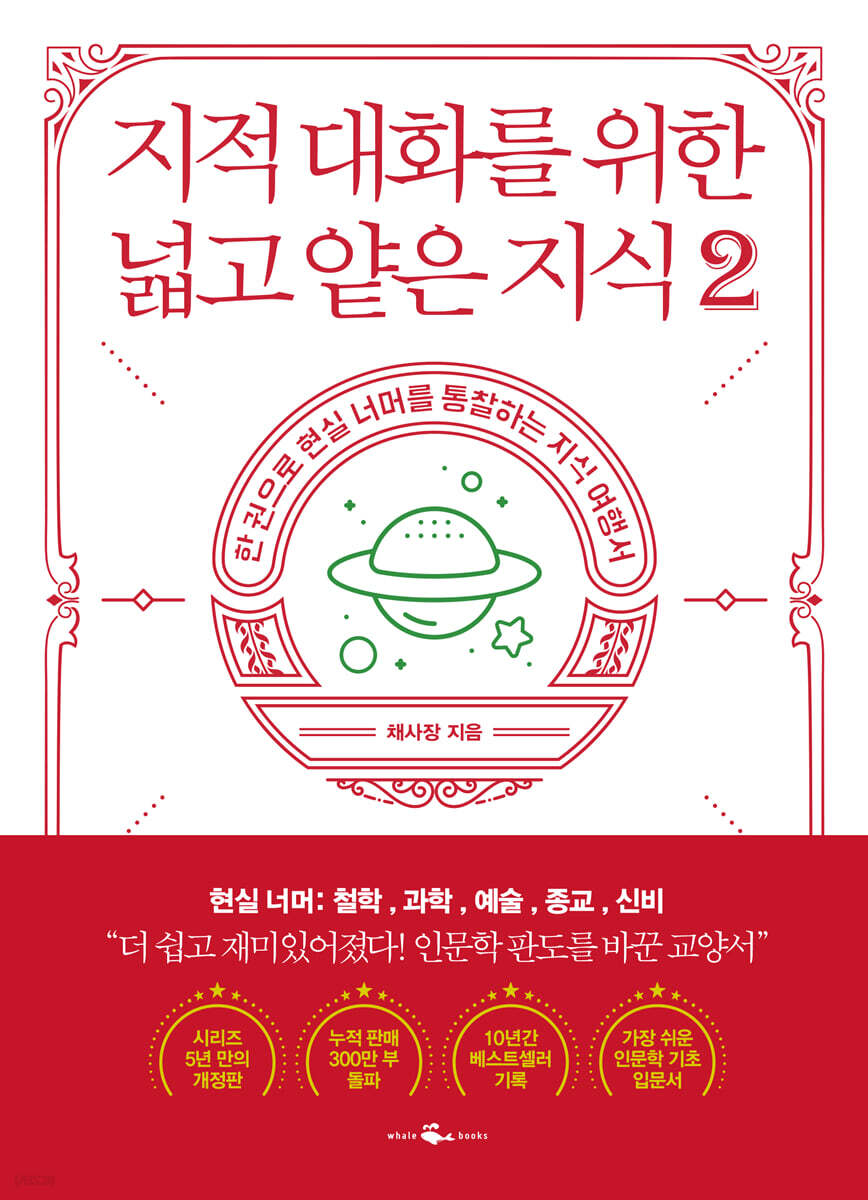
Broad and shallow knowledge for intellectual conversation 2
 |
Description
Book Introduction
“To have intellectual conversations with others
“The most basic knowledge you must have”
The first revised and expanded edition of "The Wide and Shallow", a representative humanities textbook of our time.
Read and enthusiastically received by millions of readers, it has been a must-read for humanities students for many years.
The iconic humanities series returns with a new look.
A book that changed the landscape of the difficult and rigid humanities field.
This book became a bestseller immediately after its publication, and went on to sell over 2 million copies, becoming a double million seller, remaining a steady seller for a full five years.
A book that popularized the unfamiliar and difficult to pronounce phrase "지대NPYAP" and even spawned a TV program with a similar concept; a book that allowed ordinary people who were thirsty for basic common sense to discuss things without hesitation, view the news proactively, and take an opinion in elections; a book that was evaluated as being written in an easy and fun way for people of all ages to read, such as a book that started an 80-year-old reader to start self-studying, a middle school student reader to read humanities, and an office worker to form a book club.
All of this is an explanation of 『Broad and Shallow Knowledge for Intellectual Conversation』.
Following the new edition [Zero], a revised and expanded edition has been published for the first time in five years.
The rough and insufficient parts were gently smoothed and filled in.
Old stories have been updated to fit the times.
The stories that author Cha Sa-jang shared with many readers after the book was published helped in revising the book.
The moment you read this meticulously revised edition, you will understand why this book has remained unbroken for the past five years.
“The most basic knowledge you must have”
The first revised and expanded edition of "The Wide and Shallow", a representative humanities textbook of our time.
Read and enthusiastically received by millions of readers, it has been a must-read for humanities students for many years.
The iconic humanities series returns with a new look.
A book that changed the landscape of the difficult and rigid humanities field.
This book became a bestseller immediately after its publication, and went on to sell over 2 million copies, becoming a double million seller, remaining a steady seller for a full five years.
A book that popularized the unfamiliar and difficult to pronounce phrase "지대NPYAP" and even spawned a TV program with a similar concept; a book that allowed ordinary people who were thirsty for basic common sense to discuss things without hesitation, view the news proactively, and take an opinion in elections; a book that was evaluated as being written in an easy and fun way for people of all ages to read, such as a book that started an 80-year-old reader to start self-studying, a middle school student reader to read humanities, and an office worker to form a book club.
All of this is an explanation of 『Broad and Shallow Knowledge for Intellectual Conversation』.
Following the new edition [Zero], a revised and expanded edition has been published for the first time in five years.
The rough and insufficient parts were gently smoothed and filled in.
Old stories have been updated to fit the times.
The stories that author Cha Sa-jang shared with many readers after the book was published helped in revising the book.
The moment you read this meticulously revised edition, you will understand why this book has remained unbroken for the past five years.
- You can preview some of the book's contents.
Preview
index
prolog
How to read this book
truth
What is truth
Absolute, universal, and unchanging
History of Truth
From Nature God to Fortsmodern
philosophy
Three central concepts
absolutism, relativism, skepticism
ancient philosophy
Sophists, Plato, Aristotle
medieval philosophy
Patristic philosophy, scholastic philosophy
modern philosophy
Descartes, Bacon, Kant, Nietzsche
Interim summary
Modern philosophy
Heidegger, Wittgenstein, existentialism
Final Summary
science
History of Science
Optimism about absolutism
ancient science
Ptolemy's geocentrism
medieval science
The Latency of Science and Occam
modern science
Galileo's heliocentric theory and its mathematical basis
Newton
From Being to Relationship: The Extension of Physics
Einstein
Special and general relativity
Interim summary
modern science
The Undecided Future of the Universe
Philosophy of science
Science does not progress
Final Summary
art
Classification of art
Art that follows the form of time and art that follows the form of space
Position on artistic truth
Which painting is good?
antique
Greek, Hellenistic, and Roman art
medieval art
Early Christian art, Romanesque, Gothic
Early modern art
Neoclassicism and Romanticism
Late modern art
Realism and Impressionism
contemporary art
Cubism and abstract art
Art of today
Shaking the subject of art
Interim summary
religion
The truth of religion
Direct answers to humanity's most important questions
Religious distinction
Absolute monotheism and relative polytheism
Absolute monotheism
Judaism, Christianity, Islam
Interim summary
relative polytheism
Hinduism, Buddhism, Tibetan Buddhism
Final Summary
mystery
The Last Journey, Mystery
About what cannot be said
The moment of death
Research and Philosophical Positions on Near-Death Experiences
After death
Four Possibilities After Death
life
Life in the diachronic aspect and consciousness in the synchronic aspect
Interim summary
consciousness
Is what we are seeing real?
The World Beyond Consciousness
An unknown and unreachable world
Final Summary
Epilogue
How to read this book
truth
What is truth
Absolute, universal, and unchanging
History of Truth
From Nature God to Fortsmodern
philosophy
Three central concepts
absolutism, relativism, skepticism
ancient philosophy
Sophists, Plato, Aristotle
medieval philosophy
Patristic philosophy, scholastic philosophy
modern philosophy
Descartes, Bacon, Kant, Nietzsche
Interim summary
Modern philosophy
Heidegger, Wittgenstein, existentialism
Final Summary
science
History of Science
Optimism about absolutism
ancient science
Ptolemy's geocentrism
medieval science
The Latency of Science and Occam
modern science
Galileo's heliocentric theory and its mathematical basis
Newton
From Being to Relationship: The Extension of Physics
Einstein
Special and general relativity
Interim summary
modern science
The Undecided Future of the Universe
Philosophy of science
Science does not progress
Final Summary
art
Classification of art
Art that follows the form of time and art that follows the form of space
Position on artistic truth
Which painting is good?
antique
Greek, Hellenistic, and Roman art
medieval art
Early Christian art, Romanesque, Gothic
Early modern art
Neoclassicism and Romanticism
Late modern art
Realism and Impressionism
contemporary art
Cubism and abstract art
Art of today
Shaking the subject of art
Interim summary
religion
The truth of religion
Direct answers to humanity's most important questions
Religious distinction
Absolute monotheism and relative polytheism
Absolute monotheism
Judaism, Christianity, Islam
Interim summary
relative polytheism
Hinduism, Buddhism, Tibetan Buddhism
Final Summary
mystery
The Last Journey, Mystery
About what cannot be said
The moment of death
Research and Philosophical Positions on Near-Death Experiences
After death
Four Possibilities After Death
life
Life in the diachronic aspect and consciousness in the synchronic aspect
Interim summary
consciousness
Is what we are seeing real?
The World Beyond Consciousness
An unknown and unreachable world
Final Summary
Epilogue
Detailed image

Into the book
A and B are playing chess under a tree.
A listens and puts it down in B's camp.
“It’s Jang-iya.” B is flustered.
A continues speaking politely.
“To win in chess, you have to use your head.
You have to close your eyes, concentrate intensely, and logically predict the horses' next movements.
“The problem is that you don’t use your head.”
B, who had been staring intently at the long board, moves a piece and speaks.
“It’s a bruise.”
A frowns and looks at the chess board.
A's important pieces are in danger because of B's words.
B says.
“You only know one thing and not two.
There are things you can't achieve no matter how much you rack your brain.
Life experiences cannot be gained through thought alone.
The only way to really win in long-term is to just keep trying.
“Through countless mistakes, we learn to master the board.” As B finished speaking, C, who had been sleeping with his back turned near A and B, suddenly woke up.
A and B were surprised.
C turned his face.
I was angry.
A and B were more surprised.
In that state, C walked towards the two and shouted.
"It's so noisy I can't sleep at all! Are you guys playing chess with words? Just don't do it!"
Then he overturned the chess board.
From ancient times to the present, A, B, and C have always been present in the history of philosophy.
There were times when A was dominant, times when B was dominant, or times when C was dominant, but either way, they were always there.
They are the protagonists of philosophy, and at the same time, the protagonists of this entire book, which we will discuss from now on.
Introducing them.
A is absolutism, B is relativism, and C is skepticism.
---From "Three Central Concepts"
Now that we've come to the topic of epistemology, let's first briefly distinguish between ontology and epistemology, which are two very important fields in Western philosophy, and then continue the discussion of modern philosophy.
Ontology and epistemology differ in that they ask different questions about truth and provide their own answers to them.
If ontology asks and answers the question, "What is truth?", epistemology asks and attempts to answer the question, "How do we arrive at truth?"
Let's take an example.
P and Q are talking about aliens now.
P: Are aliens real?
Q: Then, yes.
The conversation between P and Q now is an 'ontological' conversation.
Ontology is a field that discusses the existence or nonexistence of specific beings and their modes of existence.
The important thing here is how you ask the question.
Ontology is expressed in terms of the predicates ‘Is there something?’ and ‘There is something.’
In the history of philosophy, specific topics have been discussed, such as 'Is there God?', 'Is there reason?', 'What is the soul?', 'What is freedom?', 'What is the mode of God's existence?', and 'What is the nature of reason?'
Let's continue listening to the conversation between P and Q.
P: Huh? There are aliens? How did you know?
Q: If you think about it rationally, since the universe is infinite, there must be planets with physical conditions similar to Earth, and if the physical conditions are the same, the conditions for the birth of life must have been similar.
The current conversation is an 'epistemological' conversation.
Epistemology, like ontology, does not ask whether something exists or not, but rather how we can know it.
It is expressed as a predicate of 'How can we know ~?'
Questions such as 'How can we know God's will?', 'How can we arrive at the truth?', and 'How can we prove the existence of the soul?' have been discussed.
A listens and puts it down in B's camp.
“It’s Jang-iya.” B is flustered.
A continues speaking politely.
“To win in chess, you have to use your head.
You have to close your eyes, concentrate intensely, and logically predict the horses' next movements.
“The problem is that you don’t use your head.”
B, who had been staring intently at the long board, moves a piece and speaks.
“It’s a bruise.”
A frowns and looks at the chess board.
A's important pieces are in danger because of B's words.
B says.
“You only know one thing and not two.
There are things you can't achieve no matter how much you rack your brain.
Life experiences cannot be gained through thought alone.
The only way to really win in long-term is to just keep trying.
“Through countless mistakes, we learn to master the board.” As B finished speaking, C, who had been sleeping with his back turned near A and B, suddenly woke up.
A and B were surprised.
C turned his face.
I was angry.
A and B were more surprised.
In that state, C walked towards the two and shouted.
"It's so noisy I can't sleep at all! Are you guys playing chess with words? Just don't do it!"
Then he overturned the chess board.
From ancient times to the present, A, B, and C have always been present in the history of philosophy.
There were times when A was dominant, times when B was dominant, or times when C was dominant, but either way, they were always there.
They are the protagonists of philosophy, and at the same time, the protagonists of this entire book, which we will discuss from now on.
Introducing them.
A is absolutism, B is relativism, and C is skepticism.
---From "Three Central Concepts"
Now that we've come to the topic of epistemology, let's first briefly distinguish between ontology and epistemology, which are two very important fields in Western philosophy, and then continue the discussion of modern philosophy.
Ontology and epistemology differ in that they ask different questions about truth and provide their own answers to them.
If ontology asks and answers the question, "What is truth?", epistemology asks and attempts to answer the question, "How do we arrive at truth?"
Let's take an example.
P and Q are talking about aliens now.
P: Are aliens real?
Q: Then, yes.
The conversation between P and Q now is an 'ontological' conversation.
Ontology is a field that discusses the existence or nonexistence of specific beings and their modes of existence.
The important thing here is how you ask the question.
Ontology is expressed in terms of the predicates ‘Is there something?’ and ‘There is something.’
In the history of philosophy, specific topics have been discussed, such as 'Is there God?', 'Is there reason?', 'What is the soul?', 'What is freedom?', 'What is the mode of God's existence?', and 'What is the nature of reason?'
Let's continue listening to the conversation between P and Q.
P: Huh? There are aliens? How did you know?
Q: If you think about it rationally, since the universe is infinite, there must be planets with physical conditions similar to Earth, and if the physical conditions are the same, the conditions for the birth of life must have been similar.
The current conversation is an 'epistemological' conversation.
Epistemology, like ontology, does not ask whether something exists or not, but rather how we can know it.
It is expressed as a predicate of 'How can we know ~?'
Questions such as 'How can we know God's will?', 'How can we arrive at the truth?', and 'How can we prove the existence of the soul?' have been discussed.
---From "Modern Philosophy"
Publisher's Review
The first revised and expanded edition of the 2 million-copy bestseller "The Land is Wide and Shallow."
Broad and Shallow Knowledge for Intellectual Conversation 2
Beyond Reality: Philosophy / Science / Art / Religion / Mystery
The easiest introduction to the humanities to help you discuss any issue.
As a cultured person, the basic knowledge that you must know is connected into one structure.
The vast structure of knowledge is easily and three-dimensionally connected!
If the Zero volume of 『Broad and Shallow Knowledge for Intellectual Conversation』 deals with knowledge from before ancient times and knowledge that must be known before all other knowledge, Volumes 1 and 2 deal with knowledge from a time closer to us, from ancient times to the present.
Since ancient times were an era dominated by dualism, the structure of the book follows this dichotomy.
Philosophical and scientific knowledge, which were difficult to access and understand, are now clearly structured around simple criteria of absolutism and relativism.
Readers were enthusiastic about the unprecedented way in which author Cha Sa-jang penetrated the entire story.
The intellectual experience of organizing knowledge that was difficult to understand or had not been organized, such as the words of obscure philosophers or theories that were passed around like common sense but were difficult to understand, or scientific common sense that is essential to know today, into a single, large framework was possible only through [Jidaebangyap].
For the past five years, author Cha Sa-jang has focused solely on writing and lecturing, gradually building his skills as a writer.
As the book's purpose suggests, I continued to have 'intellectual conversations' with various people.
Meanwhile, the writer's knowledge became more organized and his thoughts became deeper.
In this way, the big picture that the author himself wanted to convey was completed in the series zero volume, the first volume, reality volume, and the second volume, beyond reality volume.
Through this series, readers will now be able to acquire knowledge ranging from essential knowledge for real-world situations to fundamental knowledge about themselves and their lives.
Broad and Shallow Knowledge for Intellectual Conversation 2
Beyond Reality: Philosophy / Science / Art / Religion / Mystery
The easiest introduction to the humanities to help you discuss any issue.
As a cultured person, the basic knowledge that you must know is connected into one structure.
The vast structure of knowledge is easily and three-dimensionally connected!
If the Zero volume of 『Broad and Shallow Knowledge for Intellectual Conversation』 deals with knowledge from before ancient times and knowledge that must be known before all other knowledge, Volumes 1 and 2 deal with knowledge from a time closer to us, from ancient times to the present.
Since ancient times were an era dominated by dualism, the structure of the book follows this dichotomy.
Philosophical and scientific knowledge, which were difficult to access and understand, are now clearly structured around simple criteria of absolutism and relativism.
Readers were enthusiastic about the unprecedented way in which author Cha Sa-jang penetrated the entire story.
The intellectual experience of organizing knowledge that was difficult to understand or had not been organized, such as the words of obscure philosophers or theories that were passed around like common sense but were difficult to understand, or scientific common sense that is essential to know today, into a single, large framework was possible only through [Jidaebangyap].
For the past five years, author Cha Sa-jang has focused solely on writing and lecturing, gradually building his skills as a writer.
As the book's purpose suggests, I continued to have 'intellectual conversations' with various people.
Meanwhile, the writer's knowledge became more organized and his thoughts became deeper.
In this way, the big picture that the author himself wanted to convey was completed in the series zero volume, the first volume, reality volume, and the second volume, beyond reality volume.
Through this series, readers will now be able to acquire knowledge ranging from essential knowledge for real-world situations to fundamental knowledge about themselves and their lives.
GOODS SPECIFICS
- Date of issue: February 1, 2020
- Page count, weight, size: 334 pages | 542g | 152*210*30mm
- ISBN13: 9791190313193
- ISBN10: 1190313197
You may also like
카테고리
korean


korean

![GQ KOREA Mark (Monthly): December [2025]](http://librairie.coreenne.fr/cdn/shop/files/8ef265dbbfbf186523ed75ba7319009d.jpg?v=1765340328&width=3840)


