

THE ONE THING
 |
Description
Book Introduction
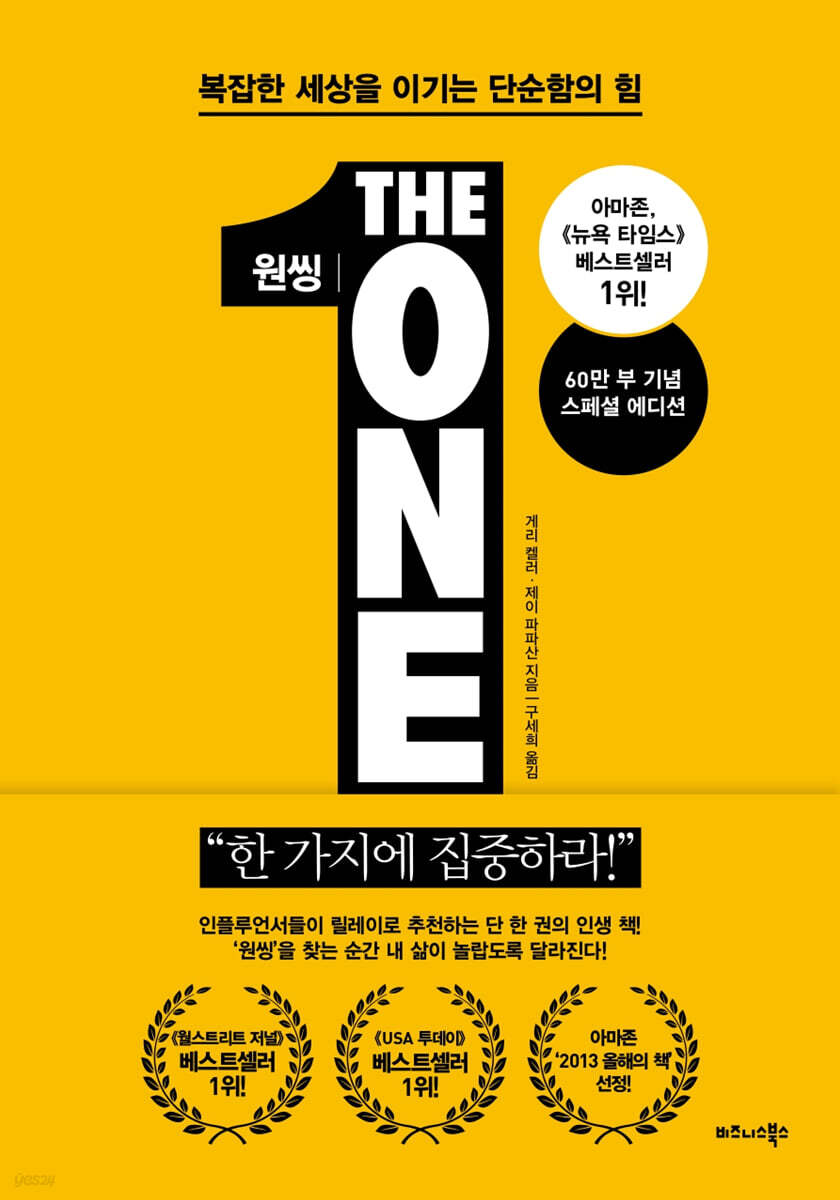
A new self-development classic! 2023 Comprehensive Bestseller List for All Online Bookstores! “This book contains weapons that will bring you ‘wealth’ and ‘success’!” A life-changing book highly recommended by influencers like Ja-cheong and Shin Saimdang! "One Thing," a comprehensive bestseller in both 2022 and 2023, has been reissued as a special edition to commemorate sales of 600,000 copies in Korea! Why are countless media outlets, influencers, and readers revisiting "One Thing" and recommending it so strongly? Today, many people harbor the fantasy of multitasking and strive to do multiple things at once. But when you listen to the stories of those who have actually achieved wealth and success, it's different. Influencer Shin Saimdang, who volunteered to be an influencer, chose "One Thing" as the book that made her 10 billion won on a broadcast, and revealed that the path to success began when she started thinking about what the "one thing" was that could help her achieve what she truly wanted. In a society that expects us to do everything simultaneously, the special lessons of "One Thing" give us the strength to move forward toward our goals without getting tired or giving up. Success works like dominoes. Successful people figure out what they need to do to succeed and then do that one thing in order. If you get the first thing right, the dominoes will fall and lead to greater success. If you do this ‘one thing’ step by step, you will soon achieve greater and greater success. Anyone can achieve wealth and success if they can just find the 'one thing' in their life, the 'one thing' this book talks about. This book helps everyone find their own "one thing," and provides tips on how to draw a blueprint for the future and make plans to achieve their goals. In particular, this hardcover edition will be a very special gift for readers who wish to preserve the message of "One Thing." |
- You can preview some of the book's contents.
Preview
index
To Korean readers
Chapter 1: What is the 'one thing' that is most important to you?
Chapter 2 The Domino Effect
Chapter 3: Success Always Leaves Clues
Part 1: Lies: Six Beliefs About Success You Should Question
Chapter 4: Everything Matters
Chapter 5: Multitasking is a skill
Chapter 6: Success Comes from Thorough Self-Management
Chapter 7: If you have the will, there is nothing you cannot do.
Chapter 8: The Need for Work-Life Balance
Chapter 9: Big Things Are Dangerous
Part 2: Truth: How to Stay Centered in a Complex World
Chapter 10: Focusing Questions that Change the Size of Your Future
Chapter 11: Build a Domino
Chapter 12: The Path to Life's Answers
Part 3: Great Results: Simple Truths That Turn Your Life Around
Chapter 13: Live with a Sense of Purpose
Chapter 14: Live by Priorities
Chapter 15: Live for Productivity
Chapter 16: Three Promises
Chapter 17: Four Kinds of Thieves
Chapter 18: The Beginning of a Transformation to Greatness
Appendix_ How to apply just one thing to real life
Acknowledgements
Chapter 1: What is the 'one thing' that is most important to you?
Chapter 2 The Domino Effect
Chapter 3: Success Always Leaves Clues
Part 1: Lies: Six Beliefs About Success You Should Question
Chapter 4: Everything Matters
Chapter 5: Multitasking is a skill
Chapter 6: Success Comes from Thorough Self-Management
Chapter 7: If you have the will, there is nothing you cannot do.
Chapter 8: The Need for Work-Life Balance
Chapter 9: Big Things Are Dangerous
Part 2: Truth: How to Stay Centered in a Complex World
Chapter 10: Focusing Questions that Change the Size of Your Future
Chapter 11: Build a Domino
Chapter 12: The Path to Life's Answers
Part 3: Great Results: Simple Truths That Turn Your Life Around
Chapter 13: Live with a Sense of Purpose
Chapter 14: Live by Priorities
Chapter 15: Live for Productivity
Chapter 16: Three Promises
Chapter 17: Four Kinds of Thieves
Chapter 18: The Beginning of a Transformation to Greatness
Appendix_ How to apply just one thing to real life
Acknowledgements
Detailed image
.jpg)
Into the book
The time and energy given to us are limited.
If you try to spread it too wide, your efforts will become as thin as paper.
People expect their accomplishments to pile up as they work, but that requires subtraction, not addition.
If you want to get more results, you need to reduce the number of things you do.
Trying to do too much at once, even if it's effective, will only lead to negative results as you keep adding work without reducing anything.
We often miss deadlines, experience unsatisfactory results, feel more stressed, work longer hours, sleep less, eat poorly, exercise less, and spend less time with family and friends.
This is because we have wasted our efforts in pursuing things that were easier to obtain than we thought.
Digging in is a simple way to achieve extraordinary results.
Plus, it's effective.
It works anytime, anywhere, in any case.
Why? Because it gives you a single sense of purpose, a single goal: ultimately, to reach your desired destination.
--- p.19~20, from “Chapter 1, What is the ‘one thing’ that is most important to you?”
Because great success doesn't happen all at once, it happens sequentially.
What starts out linear becomes exponential.
Make the right decision, and then make another right decision.
As time goes by and these accumulate, the potential for success bursts forth like a flood.
The domino effect applies to big-picture tasks like your job or business, and it also applies to the tiny moments in your day when you make decisions like what to do next.
Success builds on success, and when this happens repeatedly, you can move towards the highest levels of success.
--- p.26, from “Chapter 2, The Domino Effect”
So he and his fellow researchers gave questionnaires to 262 students to find out how often they multitasked.
Then, they divided the students into two groups: those who were good at multitasking (i.e., did it often) and those who were bad at it, and began an experiment based on the assumption that those who multitasked often would perform better.
But their thinking turned out to be wrong.
“I thought they had some kind of secret power.
However, it has been observed that people who are good at multitasking end up wasting time on unrelated tasks,” says Nas.
Their performance was inferior in every way.
To themselves and the world, they seemed to be very good at multitasking, but there was one problem.
In Nas's words, "multitaskers were just terrible at everything."
Multitasking is an illusion.
--- p.58~59, Chapter 5, Multitasking is a skill)
I want to tell you the story of a man named Scott Forstall.
He told applicants at a recruiting event for his new team that if they took on this top-secret project, they would “make a lot of mistakes and struggle, but ultimately, there would be endless opportunities to do something they would remember for the rest of their lives.”
He spread this cryptic message to talent across the company, and only recruited those who immediately took on the challenge.
As he later told her after reading Dweck's book, he was looking for people with a "growth mindset."
Why is this story important? Even if you've never heard of Scott Forstall, you can't help but recognize the results of the teams he assembled.
Forstall was a senior vice president at Apple, and the team he chose to create was the iPhone.
--- p.124, from “Chapter 9, Big Things Are Dangerous”
Connect 'today' to 'all the tomorrows' you have.
There are also research results that support this.
A total of 262 students were studied to see how visualization affected the results.
Students were divided into two groups. One group visualized a desired outcome (e.g., getting an A on a test), while the other group visualized the steps needed to achieve that outcome (e.g., the study process needed to get an A on a test).
In conclusion, students who visualized the process achieved better results overall.
Students who started studying earlier and studied more frequently achieved higher grades than those who only visualized the results.
If you try to spread it too wide, your efforts will become as thin as paper.
People expect their accomplishments to pile up as they work, but that requires subtraction, not addition.
If you want to get more results, you need to reduce the number of things you do.
Trying to do too much at once, even if it's effective, will only lead to negative results as you keep adding work without reducing anything.
We often miss deadlines, experience unsatisfactory results, feel more stressed, work longer hours, sleep less, eat poorly, exercise less, and spend less time with family and friends.
This is because we have wasted our efforts in pursuing things that were easier to obtain than we thought.
Digging in is a simple way to achieve extraordinary results.
Plus, it's effective.
It works anytime, anywhere, in any case.
Why? Because it gives you a single sense of purpose, a single goal: ultimately, to reach your desired destination.
--- p.19~20, from “Chapter 1, What is the ‘one thing’ that is most important to you?”
Because great success doesn't happen all at once, it happens sequentially.
What starts out linear becomes exponential.
Make the right decision, and then make another right decision.
As time goes by and these accumulate, the potential for success bursts forth like a flood.
The domino effect applies to big-picture tasks like your job or business, and it also applies to the tiny moments in your day when you make decisions like what to do next.
Success builds on success, and when this happens repeatedly, you can move towards the highest levels of success.
--- p.26, from “Chapter 2, The Domino Effect”
So he and his fellow researchers gave questionnaires to 262 students to find out how often they multitasked.
Then, they divided the students into two groups: those who were good at multitasking (i.e., did it often) and those who were bad at it, and began an experiment based on the assumption that those who multitasked often would perform better.
But their thinking turned out to be wrong.
“I thought they had some kind of secret power.
However, it has been observed that people who are good at multitasking end up wasting time on unrelated tasks,” says Nas.
Their performance was inferior in every way.
To themselves and the world, they seemed to be very good at multitasking, but there was one problem.
In Nas's words, "multitaskers were just terrible at everything."
Multitasking is an illusion.
--- p.58~59, Chapter 5, Multitasking is a skill)
I want to tell you the story of a man named Scott Forstall.
He told applicants at a recruiting event for his new team that if they took on this top-secret project, they would “make a lot of mistakes and struggle, but ultimately, there would be endless opportunities to do something they would remember for the rest of their lives.”
He spread this cryptic message to talent across the company, and only recruited those who immediately took on the challenge.
As he later told her after reading Dweck's book, he was looking for people with a "growth mindset."
Why is this story important? Even if you've never heard of Scott Forstall, you can't help but recognize the results of the teams he assembled.
Forstall was a senior vice president at Apple, and the team he chose to create was the iPhone.
--- p.124, from “Chapter 9, Big Things Are Dangerous”
Connect 'today' to 'all the tomorrows' you have.
There are also research results that support this.
A total of 262 students were studied to see how visualization affected the results.
Students were divided into two groups. One group visualized a desired outcome (e.g., getting an A on a test), while the other group visualized the steps needed to achieve that outcome (e.g., the study process needed to get an A on a test).
In conclusion, students who visualized the process achieved better results overall.
Students who started studying earlier and studied more frequently achieved higher grades than those who only visualized the results.
--- p.193~194, from “Chapter 14, Live by Priorities”
Publisher's Review
#1 Amazon Comprehensive Bestseller!
A bestseller with over 3 million copies sold worldwide!
#1 Wall Street Journal Bestseller!
A New York Times, USA Today, and Washington Post bestseller!
The power of simplicity to turn your life around
Break free from the illusion of multitasking that consumes your life!
Published in 2013 and selling over 3 million copies worldwide, The One Thing is a groundbreaking self-help book that overturns conventional wisdom, written by Gary Keller and Jay Papasan, the heads of the largest investment and development company in the United States and bestselling authors.
The simple truth about life's success and happiness that this book speaks of is 'The One Thing': focus and delve into the one thing that is most important to you, the one thing that matters most.
Modern people, who live busy lives trying to squeeze more work into the same amount of time, want to do more.
But trying to do everything well at once can cause you to miss out on what you really need to focus on.
If you truly want to achieve your goals, you need to focus on one thing that will lead you to success and start there.
This is why everyone needs to find their own 'one thing'.
So, in this book, the author continues to ask the question, “What’s your ONE Thing?”
Throw away what is not important.
Focus your energy on just one thing!
This book is divided into three parts.
First, in Part 1, we will criticize the illusion of six claims that everyone has believed to be the principles of success.
Have you heard the following? "Everything is important," "Multitasking is a skill," "Success comes from thorough self-management," "With determination, there's nothing you can't do," "A balanced life is beautiful," "Big endeavors are risky." These misconceptions lead us to believe that being busy is the only way to excel, and we try to juggle multiple tasks at once to excel at everything.
But if you do that, you will end up exhausted and unable to do anything properly.
The author points out that the self-blame that leads people to believe they lack self-management and willpower when they fail to accomplish various tasks is nothing more than a lie created by various media and self-help books.
All we need is a 'habit' that will allow us to continue doing important things.
This book provides practical guidance on how to create these habits.
Parts 2 and 3 guide us to break free from the illusions surrounding success and set our own big goals.
The first step is the 'focusing question'.
Just as the saying goes, "No matter how strong the sunlight is, it can never burn a piece of paper until it is focused," in order to reach the ultimate goal of "one thing," you must focus on "one thing" that needs to be done right now.
After the focus questions, we explore what we need to do to create dominoes that lead to greater success.
This process ultimately teaches us that the key to success is not doing everything well, but doing the most crucial things at the most "right" moments.
And it helps you set priorities that need to be kept first to achieve your goals.
Life also requires subtraction.
Now let's look back on today.
Have you done anything today that brought you even half a step closer to achieving your ultimate life goal? Or have you sacrificed a precious day for something you didn't want to do?
What is the most important "one thing" in your life? Is what you're doing now one of the domino blocks on the road to that "one thing"? If you can't confidently answer these two questions, you need to listen to the story in this book right now.
Never try to be good at everything.
The winner isn't the one who accomplishes too many things at once, but the one who does one thing right! Let's prioritize the scattered dominoes and knock over the first one.
As you knock down the long chain of dominoes that leads to success, one by one, you will soon find yourself achieving your goals.
A bestseller with over 3 million copies sold worldwide!
#1 Wall Street Journal Bestseller!
A New York Times, USA Today, and Washington Post bestseller!
The power of simplicity to turn your life around
Break free from the illusion of multitasking that consumes your life!
Published in 2013 and selling over 3 million copies worldwide, The One Thing is a groundbreaking self-help book that overturns conventional wisdom, written by Gary Keller and Jay Papasan, the heads of the largest investment and development company in the United States and bestselling authors.
The simple truth about life's success and happiness that this book speaks of is 'The One Thing': focus and delve into the one thing that is most important to you, the one thing that matters most.
Modern people, who live busy lives trying to squeeze more work into the same amount of time, want to do more.
But trying to do everything well at once can cause you to miss out on what you really need to focus on.
If you truly want to achieve your goals, you need to focus on one thing that will lead you to success and start there.
This is why everyone needs to find their own 'one thing'.
So, in this book, the author continues to ask the question, “What’s your ONE Thing?”
Throw away what is not important.
Focus your energy on just one thing!
This book is divided into three parts.
First, in Part 1, we will criticize the illusion of six claims that everyone has believed to be the principles of success.
Have you heard the following? "Everything is important," "Multitasking is a skill," "Success comes from thorough self-management," "With determination, there's nothing you can't do," "A balanced life is beautiful," "Big endeavors are risky." These misconceptions lead us to believe that being busy is the only way to excel, and we try to juggle multiple tasks at once to excel at everything.
But if you do that, you will end up exhausted and unable to do anything properly.
The author points out that the self-blame that leads people to believe they lack self-management and willpower when they fail to accomplish various tasks is nothing more than a lie created by various media and self-help books.
All we need is a 'habit' that will allow us to continue doing important things.
This book provides practical guidance on how to create these habits.
Parts 2 and 3 guide us to break free from the illusions surrounding success and set our own big goals.
The first step is the 'focusing question'.
Just as the saying goes, "No matter how strong the sunlight is, it can never burn a piece of paper until it is focused," in order to reach the ultimate goal of "one thing," you must focus on "one thing" that needs to be done right now.
After the focus questions, we explore what we need to do to create dominoes that lead to greater success.
This process ultimately teaches us that the key to success is not doing everything well, but doing the most crucial things at the most "right" moments.
And it helps you set priorities that need to be kept first to achieve your goals.
Life also requires subtraction.
Now let's look back on today.
Have you done anything today that brought you even half a step closer to achieving your ultimate life goal? Or have you sacrificed a precious day for something you didn't want to do?
What is the most important "one thing" in your life? Is what you're doing now one of the domino blocks on the road to that "one thing"? If you can't confidently answer these two questions, you need to listen to the story in this book right now.
Never try to be good at everything.
The winner isn't the one who accomplishes too many things at once, but the one who does one thing right! Let's prioritize the scattered dominoes and knock over the first one.
As you knock down the long chain of dominoes that leads to success, one by one, you will soon find yourself achieving your goals.
GOODS SPECIFICS
- Date of publication: August 30, 2013
- Format: Hardcover book binding method guide
- Page count, weight, size: 280 pages | 148*210*20mm
- ISBN13: 9788997575169
- ISBN10: 8997575163
You may also like
카테고리
korean


korean

![GQ KOREA Mark (Monthly): December [2025]](http://librairie.coreenne.fr/cdn/shop/files/8ef265dbbfbf186523ed75ba7319009d.jpg?v=1765340328&width=3840)


