

Schopenhauer's Theory of Happiness and Philosophy of Life
 |
Description
Book Introduction
A realist who enjoyed life and was the teacher of Nietzsche, Freud, and Chaplin.
Life lessons that capture the essence of Schopenhauer's philosophy
Following the publication of the comprehensively revised edition of the Eulyu Classics of Thought series, 『The World as Will and Representation』 in 2019, 『Schopenhauer's Theory of Happiness and Theory of Life』 is being introduced as a revised and expanded edition 10 years later.
This edition includes eight additional chapters, more detailed and enriched commentary, and the first domestic translation of "Color Theory."
This book, which Schopenhauer published under the title "Etude and Appendix," was a selection of writings that he could not include in his main work, "The World as Will and Representation," and it was the work that brought him the most popular success.
It contains insights and life advice on the essence of Schopenhauer's philosophy so that even the general public can clearly understand it.
To help readers understand, aphorisms for life wisdom are presented as 'Theory of Happiness', and profound and beneficial writings related to life are presented as 'Theory of Life'.
Schopenhauer's logic and tone, which hit the nail on the head, are full of humor and sarcasm, and his proverbs, which penetrate the essence of the world and humanity, can be said to be meaningful wisdom and a guide to life for us living today.
Life lessons that capture the essence of Schopenhauer's philosophy
Following the publication of the comprehensively revised edition of the Eulyu Classics of Thought series, 『The World as Will and Representation』 in 2019, 『Schopenhauer's Theory of Happiness and Theory of Life』 is being introduced as a revised and expanded edition 10 years later.
This edition includes eight additional chapters, more detailed and enriched commentary, and the first domestic translation of "Color Theory."
This book, which Schopenhauer published under the title "Etude and Appendix," was a selection of writings that he could not include in his main work, "The World as Will and Representation," and it was the work that brought him the most popular success.
It contains insights and life advice on the essence of Schopenhauer's philosophy so that even the general public can clearly understand it.
To help readers understand, aphorisms for life wisdom are presented as 'Theory of Happiness', and profound and beneficial writings related to life are presented as 'Theory of Life'.
Schopenhauer's logic and tone, which hit the nail on the head, are full of humor and sarcasm, and his proverbs, which penetrate the essence of the world and humanity, can be said to be meaningful wisdom and a guide to life for us living today.
- You can preview some of the book's contents.
Preview
index
Translator's Preface
Part 1: Happiness: Aphorisms for Life's Wisdom
preface
Chapter 1 Basic Classification
Chapter 2: On What Makes a Human Being
Chapter 3: On What Humans Have
Chapter 4: On what humans reveal to others
Chapter 5: Admonitions and Proverbs
1.
General 2.
Our attitude towards ourselves 3.
Our attitude towards others
4.
About our attitude toward the state of the world and our destiny
Chapter 6: On Age Differences
Part 2: Theory of Life
Chapter 1: Some Thoughts on the Opposition between Things-in-Themselves and Phenomenons
Chapter 2: A Few Words on Pantheism
Chapter 3: The Theory That Our True Nature Is Not Destroyed by Death
Chapter 4: Some Additional Notes on the Theory of the Emptiness of Survival
Chapter 5: Some Additional Notes on the Theory of Suffering in the World
Chapter 6: On Suicide
Chapter 7: Some Additional Notes on the Theory of the Affirmation and Denial of the Will to Live
Chapter 8: On Religion
1.
Faith and Knowledge 2.
Revelation 3.
About Christianity 4.
5. On theism
Old and New Testaments
Chapter 9: On Knowledge and Scholarship
Chapter 10 Thinking for Yourself
Chapter 11: On Writing and Style
Chapter 12: On Reading and Books
Chapter 13: On Logic and Dialectics
Chapter 14: Some Thoughts on Mythology
Chapter 15 Psychological Findings
Chapter 16: On Women
Chapter 17: On Education
Chapter 18: Physiognomy
Chapter 19: On Noise and Noise
Chapter 20: Parables, Parabels, and Allegories
Chapter 21: A Few Poems
References: On Color Theory
Release - A realistic theory of happiness that tells us to enjoy life, as told by the pessimist Schopenhauer. Hong Seong-gwang
Arthur Schopenhauer Chronology
Search
Part 1: Happiness: Aphorisms for Life's Wisdom
preface
Chapter 1 Basic Classification
Chapter 2: On What Makes a Human Being
Chapter 3: On What Humans Have
Chapter 4: On what humans reveal to others
Chapter 5: Admonitions and Proverbs
1.
General 2.
Our attitude towards ourselves 3.
Our attitude towards others
4.
About our attitude toward the state of the world and our destiny
Chapter 6: On Age Differences
Part 2: Theory of Life
Chapter 1: Some Thoughts on the Opposition between Things-in-Themselves and Phenomenons
Chapter 2: A Few Words on Pantheism
Chapter 3: The Theory That Our True Nature Is Not Destroyed by Death
Chapter 4: Some Additional Notes on the Theory of the Emptiness of Survival
Chapter 5: Some Additional Notes on the Theory of Suffering in the World
Chapter 6: On Suicide
Chapter 7: Some Additional Notes on the Theory of the Affirmation and Denial of the Will to Live
Chapter 8: On Religion
1.
Faith and Knowledge 2.
Revelation 3.
About Christianity 4.
5. On theism
Old and New Testaments
Chapter 9: On Knowledge and Scholarship
Chapter 10 Thinking for Yourself
Chapter 11: On Writing and Style
Chapter 12: On Reading and Books
Chapter 13: On Logic and Dialectics
Chapter 14: Some Thoughts on Mythology
Chapter 15 Psychological Findings
Chapter 16: On Women
Chapter 17: On Education
Chapter 18: Physiognomy
Chapter 19: On Noise and Noise
Chapter 20: Parables, Parabels, and Allegories
Chapter 21: A Few Poems
References: On Color Theory
Release - A realistic theory of happiness that tells us to enjoy life, as told by the pessimist Schopenhauer. Hong Seong-gwang
Arthur Schopenhauer Chronology
Search
Detailed image
Into the book
The best and most desirable things are those that exist and can exist for themselves.
But the more of these things a man has, and therefore the more sources of enjoyment he finds within himself, the happier he becomes.
Therefore, Aristotle's words, "Happiness belongs to those who are content with themselves," are truly right.
(…) The world is full of poverty and suffering.
For those who have escaped it, free time is waiting for them from all sides.
Besides, the world is dominated by evil, and foolishness is making a loud noise.
Fate is cruel and humans are pitiful.
To those who are rich in this world is like celebrating Christmas in a bright, warm, and cheerful room on a snowy and icy December night.
--- pp.37~38
Our real, real lives become boring and dull if they are not driven by passion.
But if you are driven by passion, it soon becomes painful.
So only he who is endowed with more intelligence than is necessary to serve his will is happy.
Because they can lead an intellectual life in addition to their real life.
An intellectual life allows them to continue to work energetically and without any pain.
It is not enough to have leisure, that is, to have the intellect not engaged in tasks that serve the will; there must actually be a surplus of strength.
Only then can we do purely mental work without serving the will.
(…) For that reason, for example, my philosophy has not brought me anything, but it has saved me from a great deal of trouble.
--- p.43
We must begin by teaching that the phrase 'living happily' simply means 'living less unhappily', that is, living somehow.
Of course, life is not about enjoying pleasures, but about overcoming and dealing with pain.
In Latin, this can be expressed as 'getting by, getting through life', in Italian as 'get by somehow!', and in German as 'one must find a way out' or 'one will somehow make his way through the world'.
Yes, it is a comfort in old age to be free from the toils of life.
In this sense, the people who are born with the happiest fate are those who have lived without experiencing great pain, both mentally and physically, and not those who have experienced great joy or immense pleasure.
--- p.116
I see survival itself as nothing more than a kind of loss.
Awareness of survival is what keeps us from such loss.
As long as humans exist and are human, they are already 'wrong'.
Therefore, it is natural that every individual, when looking back on his or her life, finds that it is largely in a 'wrong' state.
Human salvation is a general insight into one's own life.
To do this, we must begin by recognizing life in individual cases, that is, in the context of our own personal life journey.
--- pp.294~295
Ovid's words, "Life is not so important," are a good expression.
But perhaps Plato's words, "Human work is not worth too much trouble," are a better expression.
(…) The first position stems from the fact that in consciousness the cognitive function Erkennen has the upper hand.
Here, awareness moves beyond simply serving the will to objectively grasp the phenomena of life, and now we can clearly see the emptiness and meaninglessness of life.
From another point of view, on the contrary, the will is dominant, and perception merely serves to illuminate the objects of the will and light the way to them.
A man is either great or not depending on which of the two outlooks on life dominates.
But the more of these things a man has, and therefore the more sources of enjoyment he finds within himself, the happier he becomes.
Therefore, Aristotle's words, "Happiness belongs to those who are content with themselves," are truly right.
(…) The world is full of poverty and suffering.
For those who have escaped it, free time is waiting for them from all sides.
Besides, the world is dominated by evil, and foolishness is making a loud noise.
Fate is cruel and humans are pitiful.
To those who are rich in this world is like celebrating Christmas in a bright, warm, and cheerful room on a snowy and icy December night.
--- pp.37~38
Our real, real lives become boring and dull if they are not driven by passion.
But if you are driven by passion, it soon becomes painful.
So only he who is endowed with more intelligence than is necessary to serve his will is happy.
Because they can lead an intellectual life in addition to their real life.
An intellectual life allows them to continue to work energetically and without any pain.
It is not enough to have leisure, that is, to have the intellect not engaged in tasks that serve the will; there must actually be a surplus of strength.
Only then can we do purely mental work without serving the will.
(…) For that reason, for example, my philosophy has not brought me anything, but it has saved me from a great deal of trouble.
--- p.43
We must begin by teaching that the phrase 'living happily' simply means 'living less unhappily', that is, living somehow.
Of course, life is not about enjoying pleasures, but about overcoming and dealing with pain.
In Latin, this can be expressed as 'getting by, getting through life', in Italian as 'get by somehow!', and in German as 'one must find a way out' or 'one will somehow make his way through the world'.
Yes, it is a comfort in old age to be free from the toils of life.
In this sense, the people who are born with the happiest fate are those who have lived without experiencing great pain, both mentally and physically, and not those who have experienced great joy or immense pleasure.
--- p.116
I see survival itself as nothing more than a kind of loss.
Awareness of survival is what keeps us from such loss.
As long as humans exist and are human, they are already 'wrong'.
Therefore, it is natural that every individual, when looking back on his or her life, finds that it is largely in a 'wrong' state.
Human salvation is a general insight into one's own life.
To do this, we must begin by recognizing life in individual cases, that is, in the context of our own personal life journey.
--- pp.294~295
Ovid's words, "Life is not so important," are a good expression.
But perhaps Plato's words, "Human work is not worth too much trouble," are a better expression.
(…) The first position stems from the fact that in consciousness the cognitive function Erkennen has the upper hand.
Here, awareness moves beyond simply serving the will to objectively grasp the phenomena of life, and now we can clearly see the emptiness and meaninglessness of life.
From another point of view, on the contrary, the will is dominant, and perception merely serves to illuminate the objects of the will and light the way to them.
A man is either great or not depending on which of the two outlooks on life dominates.
--- p.445
Publisher's Review
The most popular representative work that introduced Schopenhauer to the world
A book that has gone from being a must-read for educated German citizens to a must-read for people all over the world.
『Schopenhauer's Theory of Happiness and Life』 is a Korean translation of 『Parerga und Paralipomena』, which brought Schopenhauer worldly success. It contains aphorisms for the wisdom of life in the 'Parerga und Paralipomena' and various useful writings related to life in the 'Appendix'.
The two parts are called 'Theory of Happiness' and 'Theory of Life' for easy understanding.
It was originally intended to be included as a later addition to his major work, The World as Will and Representation (1819), but as there seemed to be no opportunity to print a new edition of the work, it was published separately in 1851.
As this book was widely loved by educated German citizens at the time, 『The World as Will and Representation』, which had been published some 30 years earlier, began to be belatedly be re-examined.
As a result, people became more enthusiastic about him, and eventually he went from being an unknown philosopher to a world-renowned philosopher.
How should we view the world and live?
: The art of happiness and life advice containing Schopenhauer's unique philosophy of life
In Part 1, On Happiness, Schopenhauer defines 'Happiness' as a guideline that teaches the skills for a happy life, and expresses his views by moving away from metaphysical and ethical discussions and focusing on everyday and realistic experiences.
The conditions for happiness he proposes are divided into three.
First, it refers to what makes a human being, that is, personality in the broadest sense, which includes health, strength, beauty, temperament, morality, and wisdom.
Second, it refers to what humans possess, that is, property and possessions.
Thirdly, what a person reveals to others, that is, what others think, is divided into honor, status, and reputation.
In particular, a separate chapter called 'Admonitions and Proverbs' explains how our attitude toward ourselves, our attitude toward others, the state of the world and our destiny are all related to happiness.
Part 2, Theory of Life, deals with a wide range of topics in life, including the true nature of human beings, the futility of survival, the suffering of the world, suicide, the will to live, religion, erudition and scholarship, independent thinking, reading and books, women, and education.
In particular, the newly added chapters in this edition discuss the opposition between things in themselves and phenomena, pantheism, writing and style, dialectics, psychology, mythology, physiognomy, noise and noise, etc., and continue with sharp diagnoses and biting satire.
'Color Theory', translated and introduced for the first time in Korea, is a work that refutes the color theories of Goethe and Newton, and provides a glimpse into Schopenhauer's previously unknown side as a natural scientist.
Schopenhauer, the spiritual mentor of Tolstoy, Borges, and Einstein
Schopenhauer's "On Happiness and Life" became widely known to the world in 1853 thanks to the introduction titled "Iconoclasm in German Philosophy" by the British translator Oxenford, published in the Westminster Review.
The Danish philosopher Kierkegaard, who had been captivated by Schopenhauer's work, wrote in 1854 that "literary gossips, journalists and writers are busy with Schopenhauer."
With this book, Schopenhauer's philosophy finally came to dominate Europe in the mid-19th century, and had a great influence on Nietzsche, Freud, and Chaplin.
Einstein, who had a clear understanding of Schopenhauer's philosophy from an early age, is said to have been inspired by his book to devise the theory of relativity.
It is also said that Tolstoy, who succeeded Pushkin, who had many similarities in spirit to Schopenhauer, had only a portrait of Schopenhauer hanging in his study.
Nietzsche said that Schopenhauer would one day become more famous than Hegel, and he expressed his respect for Schopenhauer with the following response to Schopenhauer's poem "Finale":
“What he taught has passed away,/but what he lived will remain.
Look at this man! / He yielded to no one!” (Nietzsche's response poem, 1888)
Reviving Schopenhauer's famous quotes full of wit, humor, and sarcasm.
The definitive translation of "Props and Appendices"
This edition is published as part of the revised Eulyu Thought Classics series, and is lighter and more convenient than the previous edition, features PUR binding for easy opening, a text design that enhances readability, and includes over 30 illustrations, making it more accessible to readers.
Following the first edition, German literature scholar Dr. Hong Seong-gwang supplemented and revised the translation and significantly enhanced the commentary.
Additionally, eight chapters from 『Props and Appendix』 have been translated to present content that is even closer to and more faithful to the original text.
Schopenhauer cynically stated that “humans are nothing more than a speck in nature” and that “the course of human life is largely a mockery of hope and a dance in the embrace of death.” However, he also suggested a way to overcome the emptiness of life by saying that “the power of the intellect can be the light and guide of the will.”
These famous passages are further enhanced by the meticulous and detailed translation by Dr. Hong Seong-gwang, a Schopenhauer expert.
“In Schopenhauer’s writings we find a witty, sometimes sarcastic, even angry humor, and a pleasant arrogance.
There are countless things he says that make us smile.
“His sharp wit, the occasional sarcastic metaphor, and the blatant satire—all of these are aspects of him that are completely different from the cynical person the world calls him.” (Hong Seong-gwang, from “Commentary”)
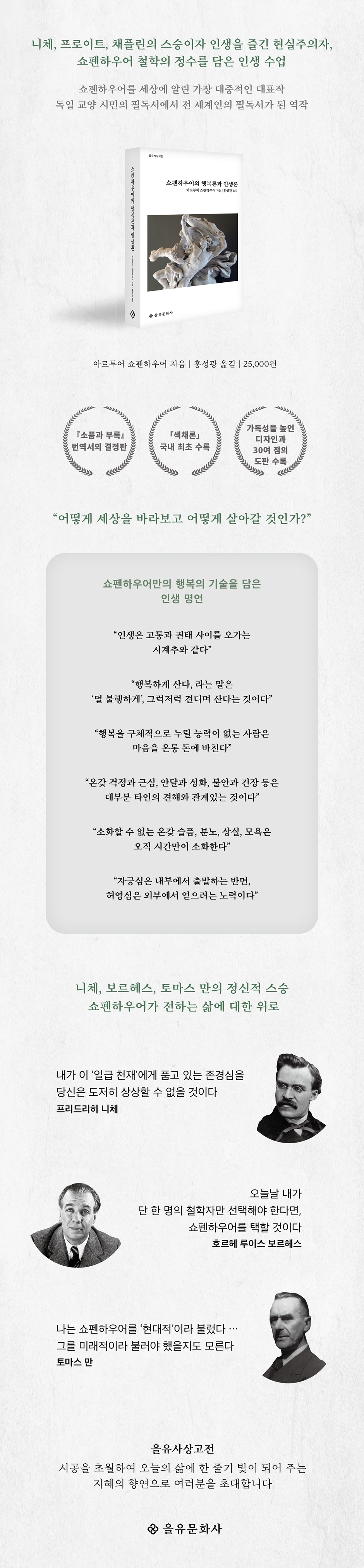
You can't possibly imagine the respect I have for this 'first-class genius'.
- Friedrich Nietzsche
If I had to choose just one philosopher today, it would be Schopenhauer.
- Jorge Luis Borges
I called Schopenhauer 'modern'... maybe I should have called him futuristic.
- Thomas Mann
Schopenhauer's ideas are infinitely realistic.
…his philosophy perfectly expresses what young people are anticipating today.
- Max Horkheimer
A book that has gone from being a must-read for educated German citizens to a must-read for people all over the world.
『Schopenhauer's Theory of Happiness and Life』 is a Korean translation of 『Parerga und Paralipomena』, which brought Schopenhauer worldly success. It contains aphorisms for the wisdom of life in the 'Parerga und Paralipomena' and various useful writings related to life in the 'Appendix'.
The two parts are called 'Theory of Happiness' and 'Theory of Life' for easy understanding.
It was originally intended to be included as a later addition to his major work, The World as Will and Representation (1819), but as there seemed to be no opportunity to print a new edition of the work, it was published separately in 1851.
As this book was widely loved by educated German citizens at the time, 『The World as Will and Representation』, which had been published some 30 years earlier, began to be belatedly be re-examined.
As a result, people became more enthusiastic about him, and eventually he went from being an unknown philosopher to a world-renowned philosopher.
How should we view the world and live?
: The art of happiness and life advice containing Schopenhauer's unique philosophy of life
In Part 1, On Happiness, Schopenhauer defines 'Happiness' as a guideline that teaches the skills for a happy life, and expresses his views by moving away from metaphysical and ethical discussions and focusing on everyday and realistic experiences.
The conditions for happiness he proposes are divided into three.
First, it refers to what makes a human being, that is, personality in the broadest sense, which includes health, strength, beauty, temperament, morality, and wisdom.
Second, it refers to what humans possess, that is, property and possessions.
Thirdly, what a person reveals to others, that is, what others think, is divided into honor, status, and reputation.
In particular, a separate chapter called 'Admonitions and Proverbs' explains how our attitude toward ourselves, our attitude toward others, the state of the world and our destiny are all related to happiness.
Part 2, Theory of Life, deals with a wide range of topics in life, including the true nature of human beings, the futility of survival, the suffering of the world, suicide, the will to live, religion, erudition and scholarship, independent thinking, reading and books, women, and education.
In particular, the newly added chapters in this edition discuss the opposition between things in themselves and phenomena, pantheism, writing and style, dialectics, psychology, mythology, physiognomy, noise and noise, etc., and continue with sharp diagnoses and biting satire.
'Color Theory', translated and introduced for the first time in Korea, is a work that refutes the color theories of Goethe and Newton, and provides a glimpse into Schopenhauer's previously unknown side as a natural scientist.
Schopenhauer, the spiritual mentor of Tolstoy, Borges, and Einstein
Schopenhauer's "On Happiness and Life" became widely known to the world in 1853 thanks to the introduction titled "Iconoclasm in German Philosophy" by the British translator Oxenford, published in the Westminster Review.
The Danish philosopher Kierkegaard, who had been captivated by Schopenhauer's work, wrote in 1854 that "literary gossips, journalists and writers are busy with Schopenhauer."
With this book, Schopenhauer's philosophy finally came to dominate Europe in the mid-19th century, and had a great influence on Nietzsche, Freud, and Chaplin.
Einstein, who had a clear understanding of Schopenhauer's philosophy from an early age, is said to have been inspired by his book to devise the theory of relativity.
It is also said that Tolstoy, who succeeded Pushkin, who had many similarities in spirit to Schopenhauer, had only a portrait of Schopenhauer hanging in his study.
Nietzsche said that Schopenhauer would one day become more famous than Hegel, and he expressed his respect for Schopenhauer with the following response to Schopenhauer's poem "Finale":
“What he taught has passed away,/but what he lived will remain.
Look at this man! / He yielded to no one!” (Nietzsche's response poem, 1888)
Reviving Schopenhauer's famous quotes full of wit, humor, and sarcasm.
The definitive translation of "Props and Appendices"
This edition is published as part of the revised Eulyu Thought Classics series, and is lighter and more convenient than the previous edition, features PUR binding for easy opening, a text design that enhances readability, and includes over 30 illustrations, making it more accessible to readers.
Following the first edition, German literature scholar Dr. Hong Seong-gwang supplemented and revised the translation and significantly enhanced the commentary.
Additionally, eight chapters from 『Props and Appendix』 have been translated to present content that is even closer to and more faithful to the original text.
Schopenhauer cynically stated that “humans are nothing more than a speck in nature” and that “the course of human life is largely a mockery of hope and a dance in the embrace of death.” However, he also suggested a way to overcome the emptiness of life by saying that “the power of the intellect can be the light and guide of the will.”
These famous passages are further enhanced by the meticulous and detailed translation by Dr. Hong Seong-gwang, a Schopenhauer expert.
“In Schopenhauer’s writings we find a witty, sometimes sarcastic, even angry humor, and a pleasant arrogance.
There are countless things he says that make us smile.
“His sharp wit, the occasional sarcastic metaphor, and the blatant satire—all of these are aspects of him that are completely different from the cynical person the world calls him.” (Hong Seong-gwang, from “Commentary”)
You can't possibly imagine the respect I have for this 'first-class genius'.
- Friedrich Nietzsche
If I had to choose just one philosopher today, it would be Schopenhauer.
- Jorge Luis Borges
I called Schopenhauer 'modern'... maybe I should have called him futuristic.
- Thomas Mann
Schopenhauer's ideas are infinitely realistic.
…his philosophy perfectly expresses what young people are anticipating today.
- Max Horkheimer
GOODS SPECIFICS
- Date of issue: January 10, 2023
- Page count, weight, size: 664 pages | 540g | 125*200*32mm
- ISBN13: 9788932440095
- ISBN10: 8932440093
You may also like
카테고리
korean


korean

![ELLE 엘르 스페셜 에디션 A형 : 12월 [2025]](http://librairie.coreenne.fr/cdn/shop/files/b8e27a3de6c9538896439686c6b0e8fb.jpg?v=1766436872&width=3840)


