

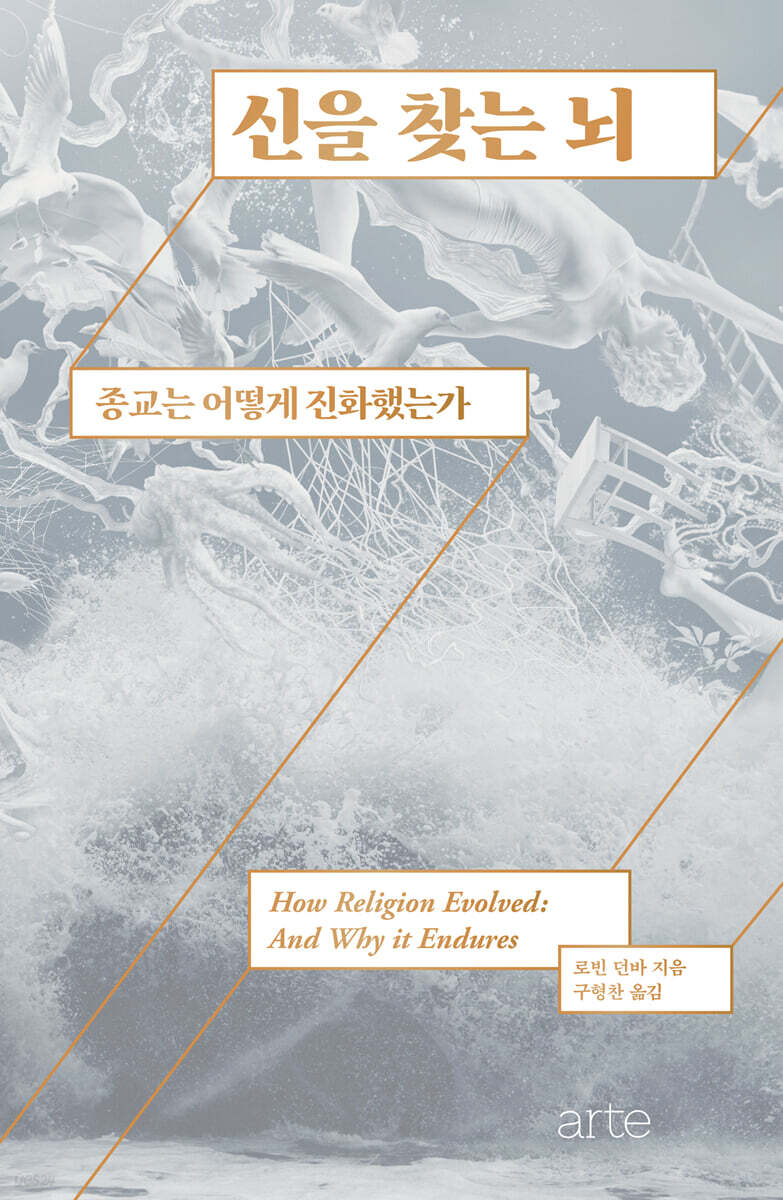
The brain that seeks God
 |
Description
Book Introduction
Why doesn't religion disappear?
Why are humans drawn to religion?
Robin Dunbar, a leading figure in social studies, 'Dunbar's number' and 'social brain'
The definitive edition of 20 years of scientific research on religion
Richard Dawkins' Definitive Refutation of "The God Delusion"
“A truly groundbreaking study that focuses on religion from a scientific perspective!”
- Richard Sosis (Professor of Humanistic Anthropology, University of Connecticut), recommended by the Financial Times and the Guardian
Throughout history, most of humanity has lived with religion, and religion has functioned as a very important element of social culture.
From ethnographic records or archaeological evidence, no culture is known that did not have some form of religion.
However, it is not easy to find results that study religion from an 'integrated scientific perspective'.
Since the modern scientific revolution, religion has been separated from scientific methodology, and Richard Dawkins's book, The God Delusion, sharply criticizes religious beliefs, deeming them delusional.
So how can science answer the following question?
“How should we study and explain religion, which is an indispensable feature of human life?”
Robin Dunbar, an evolutionary anthropologist, cognitive scientist, and leading social studies expert known for his 'Dunbar's number' and 'social brain' hypotheses, answers this question through interdisciplinary research.
In The Brain's Search for God: How Religion Evolved (Philos Series No. 38), Robin Dunbar astutely traces the evolutionary purpose of religion.
Richard Sosis (Professor at the University of Connecticut), Dylan Belton (Professor at the University of Notre Dame), and other prominent media outlets, including the Financial Times and the Guardian, recommended it as “a groundbreaking study that turns a scientific lens on religion.”
This book, the fruit of a 20-year project across diverse fields including brain cognitive science, evolutionary anthropology, neurobiology, and the sociology of religion, will mark a new milestone in the scientific study of religion.
Translator Ku Hyeong-chan, a cognitive religion scholar, emphasized the value of this book by pointing out the limitations of religious studies.
“In reality, it is not easy to study religion in an integrated scientific manner.
“Religious studies experts have little experience utilizing the achievements of other academic fields, and experts who are actively researching in other academic fields tend to become more cautious when they encounter the topic of ‘religion.’”
This book poses the following questions and offers a fascinating exploration of why religion has exerted such profound influence, from ancient shamanic societies to today's secularized societies.
* Why are people so religious?
* Is belief in a transcendent world and religious ritual universal to humanity?
* What is the reason for the formation of a social and communal religion beyond personal belief?
* Why do all world religions constantly split into various sects?
Robin Dunbar does not take a specific religious perspective, but rather studies the universal religious experience of humanity to illuminate the origins and evolution of religion.
Drawing on field research and clinical evidence from around the world, archaeological records, profiles of cult, sect, and charismatic religious leaders, and psychological analyses of their followers, this book offers a comprehensive analysis of human beliefs.
This book offers profound insights to those exploring the roots of humanity's religiosity and sociality, and clear answers to those curious about why people believe in religion.
Why are humans drawn to religion?
Robin Dunbar, a leading figure in social studies, 'Dunbar's number' and 'social brain'
The definitive edition of 20 years of scientific research on religion
Richard Dawkins' Definitive Refutation of "The God Delusion"
“A truly groundbreaking study that focuses on religion from a scientific perspective!”
- Richard Sosis (Professor of Humanistic Anthropology, University of Connecticut), recommended by the Financial Times and the Guardian
Throughout history, most of humanity has lived with religion, and religion has functioned as a very important element of social culture.
From ethnographic records or archaeological evidence, no culture is known that did not have some form of religion.
However, it is not easy to find results that study religion from an 'integrated scientific perspective'.
Since the modern scientific revolution, religion has been separated from scientific methodology, and Richard Dawkins's book, The God Delusion, sharply criticizes religious beliefs, deeming them delusional.
So how can science answer the following question?
“How should we study and explain religion, which is an indispensable feature of human life?”
Robin Dunbar, an evolutionary anthropologist, cognitive scientist, and leading social studies expert known for his 'Dunbar's number' and 'social brain' hypotheses, answers this question through interdisciplinary research.
In The Brain's Search for God: How Religion Evolved (Philos Series No. 38), Robin Dunbar astutely traces the evolutionary purpose of religion.
Richard Sosis (Professor at the University of Connecticut), Dylan Belton (Professor at the University of Notre Dame), and other prominent media outlets, including the Financial Times and the Guardian, recommended it as “a groundbreaking study that turns a scientific lens on religion.”
This book, the fruit of a 20-year project across diverse fields including brain cognitive science, evolutionary anthropology, neurobiology, and the sociology of religion, will mark a new milestone in the scientific study of religion.
Translator Ku Hyeong-chan, a cognitive religion scholar, emphasized the value of this book by pointing out the limitations of religious studies.
“In reality, it is not easy to study religion in an integrated scientific manner.
“Religious studies experts have little experience utilizing the achievements of other academic fields, and experts who are actively researching in other academic fields tend to become more cautious when they encounter the topic of ‘religion.’”
This book poses the following questions and offers a fascinating exploration of why religion has exerted such profound influence, from ancient shamanic societies to today's secularized societies.
* Why are people so religious?
* Is belief in a transcendent world and religious ritual universal to humanity?
* What is the reason for the formation of a social and communal religion beyond personal belief?
* Why do all world religions constantly split into various sects?
Robin Dunbar does not take a specific religious perspective, but rather studies the universal religious experience of humanity to illuminate the origins and evolution of religion.
Drawing on field research and clinical evidence from around the world, archaeological records, profiles of cult, sect, and charismatic religious leaders, and psychological analyses of their followers, this book offers a comprehensive analysis of human beliefs.
This book offers profound insights to those exploring the roots of humanity's religiosity and sociality, and clear answers to those curious about why people believe in religion.
- You can preview some of the book's contents.
Preview
index
preface
Chapter 1 How to Study Religion?
Chapter 2 Mystical Position
Chapter 3: Why It's Good to Believe
Chapter 4 Community and Congregation
Chapter 5: Social Brain, Religious Mind
Chapter 6 Ritual and Synchronicity
Chapter 7 Prehistoric Religion
Chapter 8: The Neolithic Crisis
Chapter 9: Cults, Sects, and Charisma
Chapter 10 Division and Faction
annotation
Acknowledgements
Translator's Note
List of pictures
References
Search
Chapter 1 How to Study Religion?
Chapter 2 Mystical Position
Chapter 3: Why It's Good to Believe
Chapter 4 Community and Congregation
Chapter 5: Social Brain, Religious Mind
Chapter 6 Ritual and Synchronicity
Chapter 7 Prehistoric Religion
Chapter 8: The Neolithic Crisis
Chapter 9: Cults, Sects, and Charisma
Chapter 10 Division and Faction
annotation
Acknowledgements
Translator's Note
List of pictures
References
Search
Detailed image
.jpg)
Into the book
A minimal definition of religion might be the belief in some kind of transcendent world (which may or may not coincide with the observable physical world) inhabited by spiritual beings (who may or may not be interested in and influence the physical world we inhabit).
The definition is broad enough to encompass all world religions, including those that do not formally believe in God, such as Buddhism.
--- p.15
The point of this chapter was to briefly outline the existence of an undercurrent of belief in a spirit world (a mystical stance) that has a very long history and is still widely observed in the modern world.
It seems to induce an element of 'raw feels' in the human psyche that is very difficult to describe in words, although its impact on people can be overwhelming.
I propose that these mystical elements, with their powerful emotional resonance, underlie all religious practice, with or without the aid of psychotropic drugs.
Here, it doesn't matter how sophisticated the religion is.
It is the driving force of religiosity, and everything that comes out of this experience is ultimately colored by religion.
--- p.83
Ultimately, this explicitly demonstrates that the primary function of religion is community cohesion. … … As religion evolves, it provides direct health benefits and an enhanced understanding of the world, enabling us to better anticipate and manage the variability of life experiences.
As our understanding of the world improves, we are less susceptible to external threats.
This sets up a self-limiting circuit that dynamically balances the cost of external threats with the size of the social community.
--- p.118
In humans, this primarily operates by drawing on cultural norms that serve as cues for community membership, which in turn leads to trustworthiness.
When we looked at the characteristics people share with their friends and family, we found that these characteristics could be summarized into seven core dimensions, the Seven Pillars of Friendship.
It means sharing the same language, place of origin, educational path, hobbies and interests, worldview (religious, moral, political views), musical taste, sense of humor, etc.
The more people have in common, the stronger their relationships will be and the more willing they will be to act altruistically toward one another.
This applies not only to friends but also to family members.
--- p.161
Religion is a powerful social phenomenon.
It involves a direct interaction between two minds (you and God) at the height of mystery.
--- p.183
Taken together, these studies suggest that rituals play a crucial role in creating a sense of belonging and community bonding by activating the endorphin system.
Synchronization appears to play a particularly powerful role in this regard, exaggerating the magnitude of endorphin effects, although it is not entirely clear how or why it does so.
In this respect, ritual is very similar to laughter, song, and dance in more traditional secular contexts.
The meaning or religious significance of the ritual itself appears to be much less important than we might expect, but when combined with synchronization, it provides additional value and significantly increases the cohesive aspect of the ritual.
--- p.209
Archaic humans may have had language, but it was not as complete or sophisticated as the language of modern humans.
This means that they could not convey their higher religious beliefs to each other.
They could certainly talk to each other about their experiences in a trance state or in a mind-altering environment, such as a deep cave.
This may include fear of spirits or invisible beings occupying natural features such as caves.
But it is highly doubtful that they could have developed any meaningful theory of what all this meant.
--- p.241
When our human ancestors tried to evolve into larger social groups, this process required them to find new forms of community bonding: song, dance, feasting.
And once language evolved, religion evolved.
Nevertheless, these means only created informally organized communities of 100 to 200 people.
For communities to evolve beyond this scale, social structuring and the introduction of more organized forms of religion were necessary.
Doctrinal religion marks the final stage that allowed humans to move beyond small-scale, face-to-face societies and develop the large-scale political systems we still live in today.
Each stage involves increasingly complex secular and judicial mechanisms necessary to maintain law and order.
However, the religious element itself represents a unique characteristic that only humans have.
The moral high gods found in many world religions seem to represent the final stage of development that only appears when the civic unit is very large.
--- pp.283-284
As a species, we are strongly social, as are all of our primate relatives.
This sociality has not only been the driving force behind our evolutionary success, but also the driving force behind everything we are and do.
Religion is just part of that mixture.
Of course, this is not to say that religion is merely a context for sexual opportunity.
Most people who belong to major religions do so for traditional, honest motives related to belief in a transcendent world.
But beneath that bubble lie all the dark passions and motivations that make everyday social life what it is.
That bubble is especially likely to appear within the intimate confines of a cult, where there's a powerful mix of charisma, ritual, physical exertion involving song and dance, endorphin activation, and psychoactive drugs.
--- p.321
It is difficult to find convincing evidence that anything can replace religion in human society.
Religion is a thoroughly human trait.
The content of religion will undoubtedly change in the long run, but it is likely to remain with us, whether we like it or not.
The definition is broad enough to encompass all world religions, including those that do not formally believe in God, such as Buddhism.
--- p.15
The point of this chapter was to briefly outline the existence of an undercurrent of belief in a spirit world (a mystical stance) that has a very long history and is still widely observed in the modern world.
It seems to induce an element of 'raw feels' in the human psyche that is very difficult to describe in words, although its impact on people can be overwhelming.
I propose that these mystical elements, with their powerful emotional resonance, underlie all religious practice, with or without the aid of psychotropic drugs.
Here, it doesn't matter how sophisticated the religion is.
It is the driving force of religiosity, and everything that comes out of this experience is ultimately colored by religion.
--- p.83
Ultimately, this explicitly demonstrates that the primary function of religion is community cohesion. … … As religion evolves, it provides direct health benefits and an enhanced understanding of the world, enabling us to better anticipate and manage the variability of life experiences.
As our understanding of the world improves, we are less susceptible to external threats.
This sets up a self-limiting circuit that dynamically balances the cost of external threats with the size of the social community.
--- p.118
In humans, this primarily operates by drawing on cultural norms that serve as cues for community membership, which in turn leads to trustworthiness.
When we looked at the characteristics people share with their friends and family, we found that these characteristics could be summarized into seven core dimensions, the Seven Pillars of Friendship.
It means sharing the same language, place of origin, educational path, hobbies and interests, worldview (religious, moral, political views), musical taste, sense of humor, etc.
The more people have in common, the stronger their relationships will be and the more willing they will be to act altruistically toward one another.
This applies not only to friends but also to family members.
--- p.161
Religion is a powerful social phenomenon.
It involves a direct interaction between two minds (you and God) at the height of mystery.
--- p.183
Taken together, these studies suggest that rituals play a crucial role in creating a sense of belonging and community bonding by activating the endorphin system.
Synchronization appears to play a particularly powerful role in this regard, exaggerating the magnitude of endorphin effects, although it is not entirely clear how or why it does so.
In this respect, ritual is very similar to laughter, song, and dance in more traditional secular contexts.
The meaning or religious significance of the ritual itself appears to be much less important than we might expect, but when combined with synchronization, it provides additional value and significantly increases the cohesive aspect of the ritual.
--- p.209
Archaic humans may have had language, but it was not as complete or sophisticated as the language of modern humans.
This means that they could not convey their higher religious beliefs to each other.
They could certainly talk to each other about their experiences in a trance state or in a mind-altering environment, such as a deep cave.
This may include fear of spirits or invisible beings occupying natural features such as caves.
But it is highly doubtful that they could have developed any meaningful theory of what all this meant.
--- p.241
When our human ancestors tried to evolve into larger social groups, this process required them to find new forms of community bonding: song, dance, feasting.
And once language evolved, religion evolved.
Nevertheless, these means only created informally organized communities of 100 to 200 people.
For communities to evolve beyond this scale, social structuring and the introduction of more organized forms of religion were necessary.
Doctrinal religion marks the final stage that allowed humans to move beyond small-scale, face-to-face societies and develop the large-scale political systems we still live in today.
Each stage involves increasingly complex secular and judicial mechanisms necessary to maintain law and order.
However, the religious element itself represents a unique characteristic that only humans have.
The moral high gods found in many world religions seem to represent the final stage of development that only appears when the civic unit is very large.
--- pp.283-284
As a species, we are strongly social, as are all of our primate relatives.
This sociality has not only been the driving force behind our evolutionary success, but also the driving force behind everything we are and do.
Religion is just part of that mixture.
Of course, this is not to say that religion is merely a context for sexual opportunity.
Most people who belong to major religions do so for traditional, honest motives related to belief in a transcendent world.
But beneath that bubble lie all the dark passions and motivations that make everyday social life what it is.
That bubble is especially likely to appear within the intimate confines of a cult, where there's a powerful mix of charisma, ritual, physical exertion involving song and dance, endorphin activation, and psychoactive drugs.
--- p.321
It is difficult to find convincing evidence that anything can replace religion in human society.
Religion is a thoroughly human trait.
The content of religion will undoubtedly change in the long run, but it is likely to remain with us, whether we like it or not.
--- p.355
Publisher's Review
The source of the most powerful bond in human history
Religion is humanity's survival strategy.
The human brain needs God
- Mystical experiences from a neuropsychological perspective
- A comprehensive understanding of world religions, shamanism, cults, sects, and charisma.
- The fruit of interdisciplinary research in brain cognitive science, evolutionary anthropology, neurobiology, and the sociology of religion.
This book discusses what religion is before exploring it.
The definition of religion is the most hotly debated topic in religious studies.
In "The Brain in Search of God," Robin Dunbar criticizes the limitations of religious studies, which remain as observers and cultural tourists, leading to unproductive solipsism, and begins the discussion by expressing the view that "science" will allow us to take religious phenomena as they are.
Robin Dunbar, in his definition of religion, presents two approaches.
This is an approach that adopts the anthropological perspective of Émile Durkheim and views religion as “something that people do,” that is, “ritual,” an integrated system of practices that people perform.
Another approach is to look at religion from a philosophical and psychological perspective, viewing it as a collection of 'beliefs' and a worldview believed by a community, saying that "religion is something that a group of people believe in."
Psychologist William James distinguished between 'personal religion' and 'institutional religion', while religious historians saw it as a distinction between 'animistic religion' and 'dogmatic religion' or 'world religion'.
Robin Dunbar analyzes that although these two approaches seem to be polar opposites, they actually represent different dimensions of religion, a multidimensional phenomenon, and derives the following minimum common denominator shared by most religions:
This is the “belief in a transcendent world inhabited by spiritual beings” or the “concept of an invisible life force.”
This book begins from a comprehensive perspective and traces the origins of religion by focusing on the "mystical stance," an aspect of human psychology.
The period of study covers a wide range, from the archaeological excavation period before the advent of modern humans, Homo sapiens, to modern new religions and non-mainstream belief systems. It comprehensively reveals the evolution of shamanistic religions into dogmatic religions, and then their differentiation into various sects and cults, along with their characteristics.
This book explores the differences between the small-scale religions practiced in early hunter-gatherer societies and the large-scale doctrinal religions from Judaism, Christianity, and Islam to Hinduism and Buddhism, and argues that the evolution of religion is underpinned by a mystical stance.
It also argues that religion is not a peculiar human trait or an aberration from the efficient evolutionary journey.
Rather, they argue that religion not only contributes to individual health and well-being, but also fosters communal bonds that bind fragmented societies together, and that this "social function" is the starting point of evolution.
“Most evolutionarily minded researchers have argued that religious beliefs, and ultimately religions, are maladaptive byproducts of other psychological mechanisms that exist for perfectly good evolutionary reasons.
It's not an entirely unjust claim.
Many of our biological and psychological traits are accidental byproducts of something that originally evolved for perfectly good reasons, but also left behind some very maladaptive traits.
But in my view, something as time-consuming, emotionally and financially demanding as religion cannot be entirely maladaptive or dysfunctional.
Evolution is simply not that inefficient.
There must be some benefit to religion.
So what does religion do for us?” (p. 87, from “Why It’s Good to Believe”)
New Questions in Religious Studies
1.
“Why, what, and when do you believe?”
An 'Evolutionary Research Methodology' for Religion
“I propose that these mystical elements, with their powerful emotional resonance, underlie all religious practice, with or without the aid of psychotropic drugs.
Here, it doesn't matter how sophisticated the religion is.
This argument provides the basis for the argument I intend to develop.” (p. 83, “The Mystical Position”)
This book focuses on 'religion' from the perspective of belief in a transcendent being, to the mystical elements that encompass shamanic practices, trances such as falling into a state of ecstasy, and various religious rituals.
This element can be used, for example, in the case of shamans to resolve life's uncertainties, such as predicting the future or performing healing, to participate in tribal rites of passage such as birth, death, and war, and to play a leadership role in community management issues.
Despite the cultural differences between numerous tribes and villages, the function of shamanism has remained consistent throughout the world for a very long time.
The belief in the spirit world flows within humans and forms the basis of religious behavior even today.
“It is the driving force of religiosity, and everything that comes out of this experience is ultimately colored by religious behavior.”
This book takes an evolutionary approach to religion, arguing that religion, like other biological and cultural phenomena, should be studied within the framework of an evolutionary process.
Leaving aside questions that have been extensively studied—how does religion develop in children? To what extent is religiosity hardwired into our genes? Is religion learned in childhood?—Robin Dunbar focuses on questions like why we believe, what we believe, and when we believe, within the context of evolutionary theory, from a mystical perspective.
That is, it focuses on more fundamental questions: What is the function of religion? Is it useful? What is its social function? What are the mechanisms that drive religion? Is there a psychological or neurobiological basis? When did religion originate?
2.
"Why Is Belief Good?" The "Social Functionalism" of Religion
This book is part of Robin Dunbar's ongoing research on sociality.
It provides a framework for understanding the human world by expanding religion beyond the level of spirituality or doctrine to the social level.
From an evolutionary perspective, some may view religion as a result of its inability to adapt to society, but Robin Dunbar argues that religion has practical benefits and has been able to persist throughout the world for a long time.
Religion serves as a means of explaining the world, especially in understanding unpredictable events and environmental changes.
There are also health benefits.
William James has already done research on this, and one study actually followed 21,000 American adults for eight years and found that those who never attended religious services had a 19 times higher risk of death than those who went to services at least once a week.
On a personal level, religion can be useful in reducing anxiety and increasing life satisfaction.
Even at a social level, religion has greater benefits.
The more frequently you attend worship, the higher your life satisfaction and the stronger the bond you build with your fellow members.
Religious aspects are often needed to solve village problems.
There are also mountain Bushmen who perform rain rituals, and when conflicts arise between members, all members overcome the crisis through trance dance.
This book presents the results of anthropological studies on small tribes at the village level, as well as behavioral economics experiments such as the 'public goods dilemma' and the 'dictator game'.
By presenting evidence supporting the hypothesis about the function of religion and further demonstrating the causal relationship between them, we approach the benefit of 'community cohesion', which can be said to be the core of the social function of religion.
Furthermore, Dunbar demonstrates that human communities actually form on a very small scale, a natural limit (about 150 people according to 'Dunbar's number'), and tests the hypothesis that this number also affects the size of the church and the cohesion of the community.
This also serves as a very useful reference point for explaining the evolution of religion.
Human religion, which developed from shamanism to dogmatic religion, has gone through countless repetitions of the process of division that gave rise to numerous factions and sects.
In related discussions, it is revealed that language or a higher-level 'mentalization process' is important in the establishment of religiosity, and the 'neurobiological mechanism' of social bonding is also analyzed.
Religious rituals, singing and dancing, and other practices have been shown to be very powerful components in fostering a sense of belonging and connection.
3.
“How did religious orientation evolve?”
From prehistoric shamanistic religions to Neolithic dogmatic religions, the 'history' of religion
This book addresses the historical question of how and when religious tendencies evolved throughout human history, tracing the origins of religion based on archaeological excavations and anthropological findings.
Evidence of this is found in the Shanidar Cave archaeological site in Iraq, the Sima de los Huesos (Bone Pit) in the Atapuerca Cave in northern Spain, the "Magician" cave paintings in the Trois Frères Cave, and the L'Espugue ivory Venus in the Lido Cave in France.
It is also possible that early humans discovered that psychoactive substances such as hallucinogenic plants or alcohol could induce trance states.
Although these evidences reveal a human psychology toward a transcendent world, it seems more likely that they represent an early form of religious inclination.
Robin Dunbar argues that shamanism existed for a long time, but that a dramatic demographic shift around 12,000 years ago (BP) with the advent of the Neolithic Age marked the beginning of its development into a dogmatic religion.
Although it is difficult to determine with certainty when the major elements of a dogmatic religion first emerged, there is evidence of a priestly class in Sumer and the Old Kingdom of Egypt around 2000 BCE.
Formal rituals can also be confirmed through spells and instructions carved into the pyramid walls.
The author examines a wide range of examples, including the early sites of Jericho and Ain Ghazal, evidence of human sacrifice in Britain and Denmark (Lindomen, Swamp People), and the religious solidarity of the American Plains Indians, exploring how the elements that could develop into a dogmatic religion were established.
It also draws on existing research that has illuminated the demographic and economic changes that occurred during the evolution from simple settlements to classical city-states and then to empires, as well as the changing nature of community rituals, and particularly the emergence of a "moral high god" who actively intervened in human behavior.
4.
“Why do religions constantly divide?”
Cults and Sects in Doctrinal Religion: Mechanisms of Religious Division
The author covers extensively the phenomenon of religious dogma failing to maintain stability, the emergence of cults, and the division into hostile sects.
Using various cults and sects as case studies, including the medieval Cathars, Beguines, and Shaker communities, the 20th-century millenarian community Panacea Society founded by Mabel Waltrup, Miki Nakayama's Tenrikyo, Jim Jones's People's Temple, Rochester's Seventh-day Adventist Church, and Heaven's Gate in California, this book examines the tendency of religions to split, the role of charismatic leaders, and the dark nature hidden in their passions and motivations.
Over ten chapters, Robin Dunbar uses a wealth of historical and scientific evidence to explore the evolution of religion, arguing that it is an essential and inseparable feature of human society.
According to his "Seven Pillars of Friendship" (place of birth, current residence, ethnicity, music, politics, morality, and religion), sharing a common religion is a very powerful factor in forming emotional intimacy.
This shows that religion is a very important field in Dunbar's research on primate sociality, which he has been conducting for over 40 years.
Translator's Note (excerpts)
The patterns of behavior, thought, and experience that we now call 'religion' or 'religious', and even the patterns of religious groups and organizations, are extremely diverse and flexible.
And obviously, there are several limitations here too.
While constraints at the social, economic, historical, and cultural levels are certainly important, we cannot rule out biological constraints related to how the body and brain function and operate.
This book provides a wealth of clues that will help us systematically explore the constraints that have influenced the emergence and development of religion.
For example, Dunbar discusses the universality of the 'mystical position,' leaving open the possibility that neurophysiological constraints linked to powerful emotions may have influenced both ancient and modern religions.
The author also reminds us that when explaining the various constraints that affect sociality, we must not lose sight of the issue of the balance between the interests of the individual and the interests of the group.
Neuropsychological constraints on primate sociality, well known as the so-called 'Dunbar's number' and the 'social brain' hypothesis, can also be referenced in exploring the size of religious groups.
Evolutionary psychological constraints on theory of mind and intentionality, and neurophysiological constraints on motivated ritualistic behavior, help explain why religion is so readily observed at the group level.
The author's efforts result in a comprehensive work that covers everything from prehistoric evidence to modern religious groups.
Through this, readers are introduced to the possibility of a new perspective that loosely connects not only the nameless religions of the ancestral era of humanity, but also modern non-mainstream religious phenomena, including 'shamanism' and 'shamanism', various forms of dogmatic religion, and even the dynamic processes of their division.
- Gu Hyeong-chan [cognitive religion scholar, research professor at the K-Academic Research Center for the Diffusion of Religion (ACKR), Sogang University]
Religion is humanity's survival strategy.
The human brain needs God
- Mystical experiences from a neuropsychological perspective
- A comprehensive understanding of world religions, shamanism, cults, sects, and charisma.
- The fruit of interdisciplinary research in brain cognitive science, evolutionary anthropology, neurobiology, and the sociology of religion.
This book discusses what religion is before exploring it.
The definition of religion is the most hotly debated topic in religious studies.
In "The Brain in Search of God," Robin Dunbar criticizes the limitations of religious studies, which remain as observers and cultural tourists, leading to unproductive solipsism, and begins the discussion by expressing the view that "science" will allow us to take religious phenomena as they are.
Robin Dunbar, in his definition of religion, presents two approaches.
This is an approach that adopts the anthropological perspective of Émile Durkheim and views religion as “something that people do,” that is, “ritual,” an integrated system of practices that people perform.
Another approach is to look at religion from a philosophical and psychological perspective, viewing it as a collection of 'beliefs' and a worldview believed by a community, saying that "religion is something that a group of people believe in."
Psychologist William James distinguished between 'personal religion' and 'institutional religion', while religious historians saw it as a distinction between 'animistic religion' and 'dogmatic religion' or 'world religion'.
Robin Dunbar analyzes that although these two approaches seem to be polar opposites, they actually represent different dimensions of religion, a multidimensional phenomenon, and derives the following minimum common denominator shared by most religions:
This is the “belief in a transcendent world inhabited by spiritual beings” or the “concept of an invisible life force.”
This book begins from a comprehensive perspective and traces the origins of religion by focusing on the "mystical stance," an aspect of human psychology.
The period of study covers a wide range, from the archaeological excavation period before the advent of modern humans, Homo sapiens, to modern new religions and non-mainstream belief systems. It comprehensively reveals the evolution of shamanistic religions into dogmatic religions, and then their differentiation into various sects and cults, along with their characteristics.
This book explores the differences between the small-scale religions practiced in early hunter-gatherer societies and the large-scale doctrinal religions from Judaism, Christianity, and Islam to Hinduism and Buddhism, and argues that the evolution of religion is underpinned by a mystical stance.
It also argues that religion is not a peculiar human trait or an aberration from the efficient evolutionary journey.
Rather, they argue that religion not only contributes to individual health and well-being, but also fosters communal bonds that bind fragmented societies together, and that this "social function" is the starting point of evolution.
“Most evolutionarily minded researchers have argued that religious beliefs, and ultimately religions, are maladaptive byproducts of other psychological mechanisms that exist for perfectly good evolutionary reasons.
It's not an entirely unjust claim.
Many of our biological and psychological traits are accidental byproducts of something that originally evolved for perfectly good reasons, but also left behind some very maladaptive traits.
But in my view, something as time-consuming, emotionally and financially demanding as religion cannot be entirely maladaptive or dysfunctional.
Evolution is simply not that inefficient.
There must be some benefit to religion.
So what does religion do for us?” (p. 87, from “Why It’s Good to Believe”)
New Questions in Religious Studies
1.
“Why, what, and when do you believe?”
An 'Evolutionary Research Methodology' for Religion
“I propose that these mystical elements, with their powerful emotional resonance, underlie all religious practice, with or without the aid of psychotropic drugs.
Here, it doesn't matter how sophisticated the religion is.
This argument provides the basis for the argument I intend to develop.” (p. 83, “The Mystical Position”)
This book focuses on 'religion' from the perspective of belief in a transcendent being, to the mystical elements that encompass shamanic practices, trances such as falling into a state of ecstasy, and various religious rituals.
This element can be used, for example, in the case of shamans to resolve life's uncertainties, such as predicting the future or performing healing, to participate in tribal rites of passage such as birth, death, and war, and to play a leadership role in community management issues.
Despite the cultural differences between numerous tribes and villages, the function of shamanism has remained consistent throughout the world for a very long time.
The belief in the spirit world flows within humans and forms the basis of religious behavior even today.
“It is the driving force of religiosity, and everything that comes out of this experience is ultimately colored by religious behavior.”
This book takes an evolutionary approach to religion, arguing that religion, like other biological and cultural phenomena, should be studied within the framework of an evolutionary process.
Leaving aside questions that have been extensively studied—how does religion develop in children? To what extent is religiosity hardwired into our genes? Is religion learned in childhood?—Robin Dunbar focuses on questions like why we believe, what we believe, and when we believe, within the context of evolutionary theory, from a mystical perspective.
That is, it focuses on more fundamental questions: What is the function of religion? Is it useful? What is its social function? What are the mechanisms that drive religion? Is there a psychological or neurobiological basis? When did religion originate?
2.
"Why Is Belief Good?" The "Social Functionalism" of Religion
This book is part of Robin Dunbar's ongoing research on sociality.
It provides a framework for understanding the human world by expanding religion beyond the level of spirituality or doctrine to the social level.
From an evolutionary perspective, some may view religion as a result of its inability to adapt to society, but Robin Dunbar argues that religion has practical benefits and has been able to persist throughout the world for a long time.
Religion serves as a means of explaining the world, especially in understanding unpredictable events and environmental changes.
There are also health benefits.
William James has already done research on this, and one study actually followed 21,000 American adults for eight years and found that those who never attended religious services had a 19 times higher risk of death than those who went to services at least once a week.
On a personal level, religion can be useful in reducing anxiety and increasing life satisfaction.
Even at a social level, religion has greater benefits.
The more frequently you attend worship, the higher your life satisfaction and the stronger the bond you build with your fellow members.
Religious aspects are often needed to solve village problems.
There are also mountain Bushmen who perform rain rituals, and when conflicts arise between members, all members overcome the crisis through trance dance.
This book presents the results of anthropological studies on small tribes at the village level, as well as behavioral economics experiments such as the 'public goods dilemma' and the 'dictator game'.
By presenting evidence supporting the hypothesis about the function of religion and further demonstrating the causal relationship between them, we approach the benefit of 'community cohesion', which can be said to be the core of the social function of religion.
Furthermore, Dunbar demonstrates that human communities actually form on a very small scale, a natural limit (about 150 people according to 'Dunbar's number'), and tests the hypothesis that this number also affects the size of the church and the cohesion of the community.
This also serves as a very useful reference point for explaining the evolution of religion.
Human religion, which developed from shamanism to dogmatic religion, has gone through countless repetitions of the process of division that gave rise to numerous factions and sects.
In related discussions, it is revealed that language or a higher-level 'mentalization process' is important in the establishment of religiosity, and the 'neurobiological mechanism' of social bonding is also analyzed.
Religious rituals, singing and dancing, and other practices have been shown to be very powerful components in fostering a sense of belonging and connection.
3.
“How did religious orientation evolve?”
From prehistoric shamanistic religions to Neolithic dogmatic religions, the 'history' of religion
This book addresses the historical question of how and when religious tendencies evolved throughout human history, tracing the origins of religion based on archaeological excavations and anthropological findings.
Evidence of this is found in the Shanidar Cave archaeological site in Iraq, the Sima de los Huesos (Bone Pit) in the Atapuerca Cave in northern Spain, the "Magician" cave paintings in the Trois Frères Cave, and the L'Espugue ivory Venus in the Lido Cave in France.
It is also possible that early humans discovered that psychoactive substances such as hallucinogenic plants or alcohol could induce trance states.
Although these evidences reveal a human psychology toward a transcendent world, it seems more likely that they represent an early form of religious inclination.
Robin Dunbar argues that shamanism existed for a long time, but that a dramatic demographic shift around 12,000 years ago (BP) with the advent of the Neolithic Age marked the beginning of its development into a dogmatic religion.
Although it is difficult to determine with certainty when the major elements of a dogmatic religion first emerged, there is evidence of a priestly class in Sumer and the Old Kingdom of Egypt around 2000 BCE.
Formal rituals can also be confirmed through spells and instructions carved into the pyramid walls.
The author examines a wide range of examples, including the early sites of Jericho and Ain Ghazal, evidence of human sacrifice in Britain and Denmark (Lindomen, Swamp People), and the religious solidarity of the American Plains Indians, exploring how the elements that could develop into a dogmatic religion were established.
It also draws on existing research that has illuminated the demographic and economic changes that occurred during the evolution from simple settlements to classical city-states and then to empires, as well as the changing nature of community rituals, and particularly the emergence of a "moral high god" who actively intervened in human behavior.
4.
“Why do religions constantly divide?”
Cults and Sects in Doctrinal Religion: Mechanisms of Religious Division
The author covers extensively the phenomenon of religious dogma failing to maintain stability, the emergence of cults, and the division into hostile sects.
Using various cults and sects as case studies, including the medieval Cathars, Beguines, and Shaker communities, the 20th-century millenarian community Panacea Society founded by Mabel Waltrup, Miki Nakayama's Tenrikyo, Jim Jones's People's Temple, Rochester's Seventh-day Adventist Church, and Heaven's Gate in California, this book examines the tendency of religions to split, the role of charismatic leaders, and the dark nature hidden in their passions and motivations.
Over ten chapters, Robin Dunbar uses a wealth of historical and scientific evidence to explore the evolution of religion, arguing that it is an essential and inseparable feature of human society.
According to his "Seven Pillars of Friendship" (place of birth, current residence, ethnicity, music, politics, morality, and religion), sharing a common religion is a very powerful factor in forming emotional intimacy.
This shows that religion is a very important field in Dunbar's research on primate sociality, which he has been conducting for over 40 years.
Translator's Note (excerpts)
The patterns of behavior, thought, and experience that we now call 'religion' or 'religious', and even the patterns of religious groups and organizations, are extremely diverse and flexible.
And obviously, there are several limitations here too.
While constraints at the social, economic, historical, and cultural levels are certainly important, we cannot rule out biological constraints related to how the body and brain function and operate.
This book provides a wealth of clues that will help us systematically explore the constraints that have influenced the emergence and development of religion.
For example, Dunbar discusses the universality of the 'mystical position,' leaving open the possibility that neurophysiological constraints linked to powerful emotions may have influenced both ancient and modern religions.
The author also reminds us that when explaining the various constraints that affect sociality, we must not lose sight of the issue of the balance between the interests of the individual and the interests of the group.
Neuropsychological constraints on primate sociality, well known as the so-called 'Dunbar's number' and the 'social brain' hypothesis, can also be referenced in exploring the size of religious groups.
Evolutionary psychological constraints on theory of mind and intentionality, and neurophysiological constraints on motivated ritualistic behavior, help explain why religion is so readily observed at the group level.
The author's efforts result in a comprehensive work that covers everything from prehistoric evidence to modern religious groups.
Through this, readers are introduced to the possibility of a new perspective that loosely connects not only the nameless religions of the ancestral era of humanity, but also modern non-mainstream religious phenomena, including 'shamanism' and 'shamanism', various forms of dogmatic religion, and even the dynamic processes of their division.
- Gu Hyeong-chan [cognitive religion scholar, research professor at the K-Academic Research Center for the Diffusion of Religion (ACKR), Sogang University]
GOODS SPECIFICS
- Date of issue: June 19, 2025
- Format: Hardcover book binding method guide
- Page count, weight, size: 436 pages | 132*204*30mm
- ISBN13: 9791173572845
- ISBN10: 1173572848
You may also like
카테고리
korean


korean

![ELLE 엘르 스페셜 에디션 A형 : 12월 [2025]](http://librairie.coreenne.fr/cdn/shop/files/b8e27a3de6c9538896439686c6b0e8fb.jpg?v=1766436872&width=3840)


