

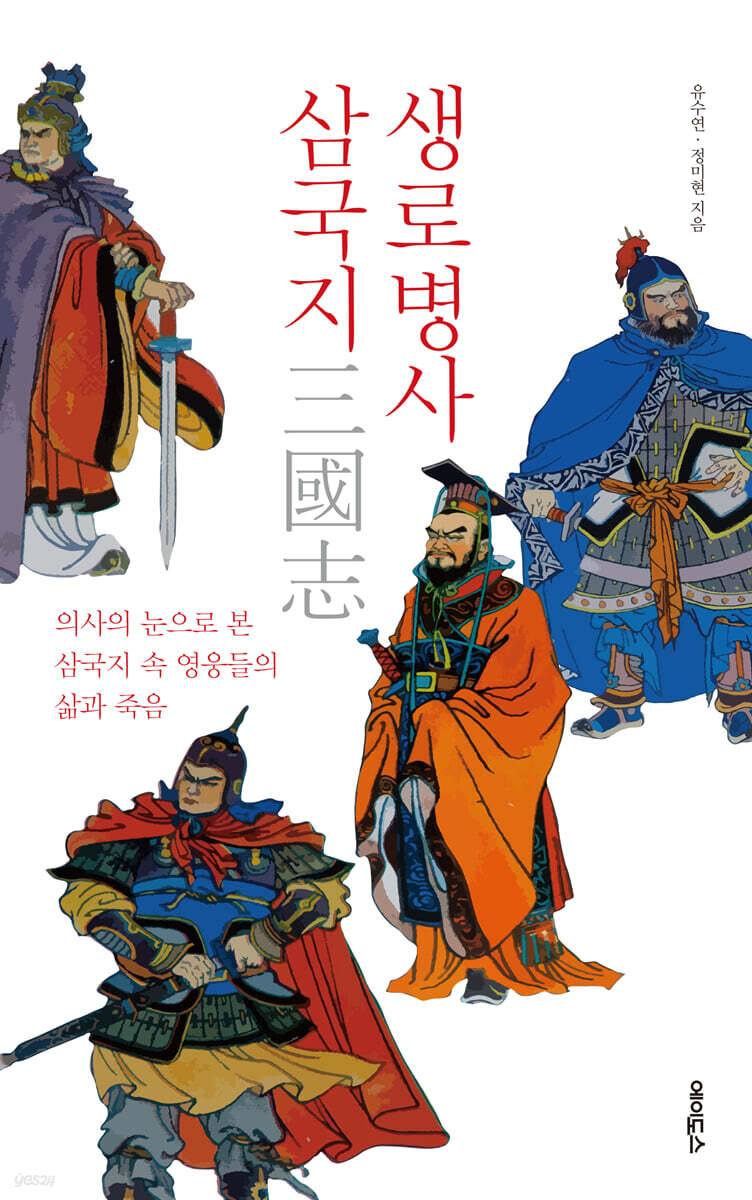
Birth, Aging, Illness, and Death: The Romance of the Three Kingdoms
 |
Description
Book Introduction
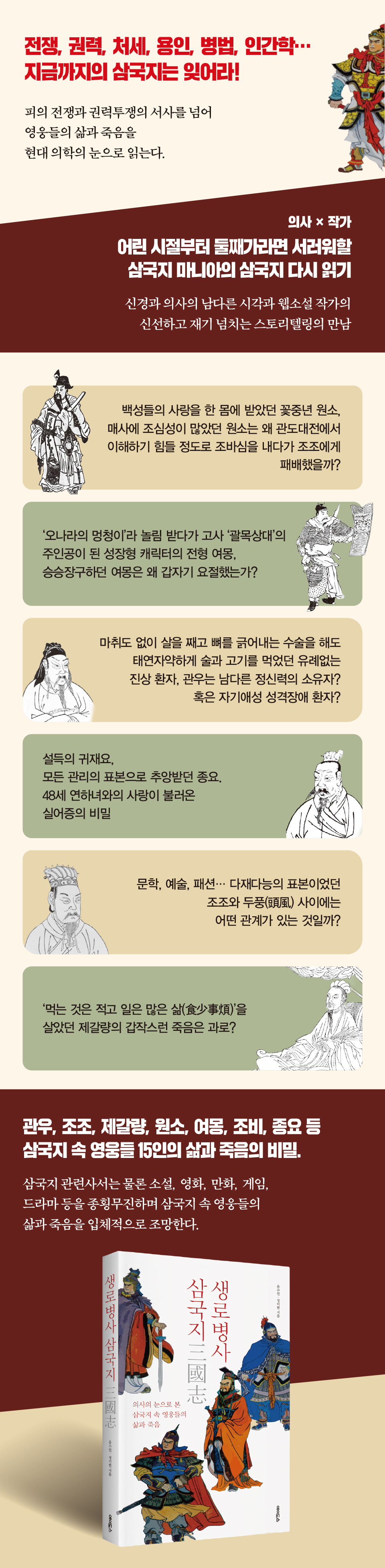
War, power, conduct, tolerance, military strategy, national management, anthropology… .
A look at the Romance of the Three Kingdoms from a completely different perspective than the Romance of the Three Kingdoms books we have known so far.
A neurologist and writer who has been a Three Kingdoms fanatic since childhood and is passionate about stories related to the Three Kingdoms, presents a colorful look at the characters of the Three Kingdoms with a unique perspective and lively storytelling.
Beyond the narrative of bloody war and power struggle, it examines the illness, health, and death of heroes through the eyes of modern medicine.
The lives and deaths of the 15 heroes of the Three Kingdoms, which we are all familiar with, are reconstructed not only through records in historical books but also through a variety of materials such as novels, movies, dramas, comics, and games.
In order to examine the health, illness, and death of a person from a medical perspective, it provides a three-dimensional portrayal of political dynamics, war, socio-cultural background, eating habits, family relationships, lifestyle, personality, and artistic sensibility, offering a unique enjoyment in reading the Romance of the Three Kingdoms.
A look at the Romance of the Three Kingdoms from a completely different perspective than the Romance of the Three Kingdoms books we have known so far.
A neurologist and writer who has been a Three Kingdoms fanatic since childhood and is passionate about stories related to the Three Kingdoms, presents a colorful look at the characters of the Three Kingdoms with a unique perspective and lively storytelling.
Beyond the narrative of bloody war and power struggle, it examines the illness, health, and death of heroes through the eyes of modern medicine.
The lives and deaths of the 15 heroes of the Three Kingdoms, which we are all familiar with, are reconstructed not only through records in historical books but also through a variety of materials such as novels, movies, dramas, comics, and games.
In order to examine the health, illness, and death of a person from a medical perspective, it provides a three-dimensional portrayal of political dynamics, war, socio-cultural background, eating habits, family relationships, lifestyle, personality, and artistic sensibility, offering a unique enjoyment in reading the Romance of the Three Kingdoms.
index
Introduction
1.
Yuan Shao, the Han general, dies coughing up blood: The strongest man who lost everything due to ill health.
A benevolent gentleman who received the love of the people
ㆍTwo three-year mourning periods and an untimely death
ㆍ“He died vomiting blood”
ㆍThe impatience of an incomprehensible element
ㆍWhat if the elements had lived longer?
2.
Wu's Admiral Yeo Mong Dies Young from Illness: Familial Stomach Cancer Burns the Path to Success
ㆍA noteworthy opponent for growth-type heroes
ㆍIt wasn't Guan Yu's vengeful spirit
ㆍThe Silent Assassin: Familial Gastric Cancer
ㆍWhat if Yeomong had lived longer?
3.
Zhong Yao, the third Duke of Wei, is speechless: his meeting with a woman 48 years younger than him leaves him speechless.
ㆍGenius of persuasion
How Aphasia Tied Jongyo's Tongue
ㆍVigorous activities that defy age
4.
Cao Pi, the Emperor of Wei, lost both his hair and his life: Hair loss was sad enough, but he also died young.
ㆍA competent leader or the worst villain?
A son who did not receive his father's approval
Life on thin ice
ㆍ“My hair kept falling out.”
The sudden death of the sweet-loving Jo-bi
ㆍTwo southern expeditions and E. dysenteriae infection
5.
Guan Yu, Marquis of Hanshou Pavilion, Stands on the Boundary Between Pride and Arrogance: Narcissistic Personality Disorder
ㆍUnprecedentedly unusual patient
ㆍThe source of strong mental strength, narcissistic personality disorder
ㆍForeshadowing of death, arrogance
6.
Sun Ce, the Lesser King, Invites Death: Borderline Personality Disorder
Sun Ce's untimely death, foreseen even by enemy strategists
Extreme personality, yet sky-high popularity
"It's hard to square off with a mad dog."
ㆍLow self-esteem leaves aftereffects
“My face is like this…”
7.
Jindeng of the Western Zhou Dynasty, enjoying raw fish: If you eat what you are told not to eat,
What did people eat during the Three Kingdoms period?
ㆍKill Sun Ce, die from fish
ㆍCarp sashimi and liver fluke
ㆍWhat if Jindeung had lived longer?
8.
Cao Cao, King of Wei, Worries: Pursuing Ultimate Efficiency
ㆍA model of versatility
ㆍThe identity of the head wind
ㆍHealth, weight loss, and simple living
9.
Hua Tuo of Peking Becomes a Divine Physician: Hua Tuo's Treatment of Diseases, Interpreted Through Modern Medicine
ㆍActivity regardless of department
A 2nd-century doctor resigns.
10.
Dong Zhuo of the Han Dynasty and Xu Zhu and Cao Zhen of Wei suffered from the chronic diseases of modern people.
ㆍ“The fire in my belly button didn’t go out for days.”
A man with a 43-inch waist
ㆍJo Jin, who was teased for being fat
ㆍModern obesity treatment methods
11.
The above generals Xiahou Dun and Sima Shi, the Marquis of Wuyang, lose their hearts: The man who became cross-eyed.
A general who was good at everything except war
Orbital cellulitis that causes the eye to pop out
12.
Zhuge Liang, the prime minister of Shu Han, dies from overwork: The life force he poured into developing the nation.
A life of eating little and working hard (食少事煩)
ㆍLife-destroying overwork
What if Zhuge Liang had lived longer?
Conclusion
Americas
Image source
1.
Yuan Shao, the Han general, dies coughing up blood: The strongest man who lost everything due to ill health.
A benevolent gentleman who received the love of the people
ㆍTwo three-year mourning periods and an untimely death
ㆍ“He died vomiting blood”
ㆍThe impatience of an incomprehensible element
ㆍWhat if the elements had lived longer?
2.
Wu's Admiral Yeo Mong Dies Young from Illness: Familial Stomach Cancer Burns the Path to Success
ㆍA noteworthy opponent for growth-type heroes
ㆍIt wasn't Guan Yu's vengeful spirit
ㆍThe Silent Assassin: Familial Gastric Cancer
ㆍWhat if Yeomong had lived longer?
3.
Zhong Yao, the third Duke of Wei, is speechless: his meeting with a woman 48 years younger than him leaves him speechless.
ㆍGenius of persuasion
How Aphasia Tied Jongyo's Tongue
ㆍVigorous activities that defy age
4.
Cao Pi, the Emperor of Wei, lost both his hair and his life: Hair loss was sad enough, but he also died young.
ㆍA competent leader or the worst villain?
A son who did not receive his father's approval
Life on thin ice
ㆍ“My hair kept falling out.”
The sudden death of the sweet-loving Jo-bi
ㆍTwo southern expeditions and E. dysenteriae infection
5.
Guan Yu, Marquis of Hanshou Pavilion, Stands on the Boundary Between Pride and Arrogance: Narcissistic Personality Disorder
ㆍUnprecedentedly unusual patient
ㆍThe source of strong mental strength, narcissistic personality disorder
ㆍForeshadowing of death, arrogance
6.
Sun Ce, the Lesser King, Invites Death: Borderline Personality Disorder
Sun Ce's untimely death, foreseen even by enemy strategists
Extreme personality, yet sky-high popularity
"It's hard to square off with a mad dog."
ㆍLow self-esteem leaves aftereffects
“My face is like this…”
7.
Jindeng of the Western Zhou Dynasty, enjoying raw fish: If you eat what you are told not to eat,
What did people eat during the Three Kingdoms period?
ㆍKill Sun Ce, die from fish
ㆍCarp sashimi and liver fluke
ㆍWhat if Jindeung had lived longer?
8.
Cao Cao, King of Wei, Worries: Pursuing Ultimate Efficiency
ㆍA model of versatility
ㆍThe identity of the head wind
ㆍHealth, weight loss, and simple living
9.
Hua Tuo of Peking Becomes a Divine Physician: Hua Tuo's Treatment of Diseases, Interpreted Through Modern Medicine
ㆍActivity regardless of department
A 2nd-century doctor resigns.
10.
Dong Zhuo of the Han Dynasty and Xu Zhu and Cao Zhen of Wei suffered from the chronic diseases of modern people.
ㆍ“The fire in my belly button didn’t go out for days.”
A man with a 43-inch waist
ㆍJo Jin, who was teased for being fat
ㆍModern obesity treatment methods
11.
The above generals Xiahou Dun and Sima Shi, the Marquis of Wuyang, lose their hearts: The man who became cross-eyed.
A general who was good at everything except war
Orbital cellulitis that causes the eye to pop out
12.
Zhuge Liang, the prime minister of Shu Han, dies from overwork: The life force he poured into developing the nation.
A life of eating little and working hard (食少事煩)
ㆍLife-destroying overwork
What if Zhuge Liang had lived longer?
Conclusion
Americas
Image source
Detailed image
Into the book
『Romance of the Three Kingdoms』 has always been reborn in countless ways.
Sometimes it has come to life as a record of 『Authentic History』 that is close to historical facts, sometimes in the form of 『Romance of the Three Kingdoms』 with artistic imagination added, and then again in the form of novels, dramas, movies, and games.
Through repeated reinterpretations, reevaluations, and re-creations, 『Romance of the Three Kingdoms』 continues to breathe with us to this day.
A classic that seems to have been covered, but still has something to talk about.
That is precisely the power of 『Romance of the Three Kingdoms』.
This book is another path we have discovered in that endless story.
I wanted to revisit the classic figures from a contemporary perspective, and through the lens of medicine.
Even the generals who were called heroes and the wise men who were called strategists were ultimately human like us, and because they were human, they became sick and weak, and eventually met death.
Through this book, we wanted to show that even heroes are human beings who cannot help but experience birth, aging, illness, and death.
--- p.4~5
This is when Cao Cao is fighting Yuan Shao.
When Sun Ce's plan to attack Xudao became known, Cao Cao's camp was greatly shaken.
At that time, Guo Jia confidently predicted Sun Ce's death.
The reason is simple.
'He killed many heroes while expanding his territory, and he was frivolous and did not properly prepare for defense.' Even Cao Cao, Guo Jia's superior, was not far behind in killing many heroes.
Did you only kill heroes? You went around slicing people up here and there.
Yet, I never received any such warning.
In fact, I also enjoyed a long life.
However, as Guo Jia had predicted, Sun Ce was assassinated and died young.
To put it another way, it would be, 'I deserved to die, so I died, that is, I brought death upon myself.'
Although he was a person who received a lot of love, he was also a person who received a lot of hate, but he was so confident that you couldn't find any caution in him.
As we follow the trajectory of Sun Ce's life as depicted in the Four Books, we come across one suspected psychiatric disorder.
It is called 'Borderline Personality Disorder'.
Borderline personality disorder is a personality disorder characterized by unstable self-image, interpersonal relationships, and emotions, and impulsiveness.
It is also a personality disorder belonging to Group B, along with the 'narcissistic personality disorder' that appeared in the previous 'Guan Yu Mail'.
--- p.111~112
Unfortunately, in Cao Cao's case, his ability and popularity were not proportional.
In the Cao Cao-centric comic book, "The Blue Sky," Sun Ce describes Cao Cao as "trying to drink the world's wine with the resentment of a million people that will last a hundred years as a side dish."
“Enough resentment for a million people to last a hundred years” – that’s a terrifying expression.
Cao Cao has been hated for so long that such an expression is fitting.
As time went by, this became more severe, and only resentment was emphasized while ability was excluded.
There is a work called 『Romance of the Three Kingdoms』.
It is a comic book based on history and can be said to be the original text of 『Romance of the Three Kingdoms』.
Since it is a folk tale in the form of a comedic talk for the public, it inevitably contains the perception of the common people, the audience.
And in this 『Romance of the Three Kingdoms』, Cao Cao appears as a mean and cruel villain.
He was just a simple villain.
It must have been so bad that an actor who played the role of Cao Cao in a Peking opera was beaten to death by an angry mob.
There is someone who breathed life and three-dimensionality into the once flat villain, Cao Cao.
This is Luo Guanzhong, the author of 『Romance of the Three Kingdoms』.
Sometimes it seems extremely cold, sometimes it's emotional, and sometimes it seems extremely cruel, sometimes it's generous.
However, he is consistently gifted with outstanding abilities and sharp charisma, making him a perfect fit for the role of the final boss of the series.
Sometimes it has come to life as a record of 『Authentic History』 that is close to historical facts, sometimes in the form of 『Romance of the Three Kingdoms』 with artistic imagination added, and then again in the form of novels, dramas, movies, and games.
Through repeated reinterpretations, reevaluations, and re-creations, 『Romance of the Three Kingdoms』 continues to breathe with us to this day.
A classic that seems to have been covered, but still has something to talk about.
That is precisely the power of 『Romance of the Three Kingdoms』.
This book is another path we have discovered in that endless story.
I wanted to revisit the classic figures from a contemporary perspective, and through the lens of medicine.
Even the generals who were called heroes and the wise men who were called strategists were ultimately human like us, and because they were human, they became sick and weak, and eventually met death.
Through this book, we wanted to show that even heroes are human beings who cannot help but experience birth, aging, illness, and death.
--- p.4~5
This is when Cao Cao is fighting Yuan Shao.
When Sun Ce's plan to attack Xudao became known, Cao Cao's camp was greatly shaken.
At that time, Guo Jia confidently predicted Sun Ce's death.
The reason is simple.
'He killed many heroes while expanding his territory, and he was frivolous and did not properly prepare for defense.' Even Cao Cao, Guo Jia's superior, was not far behind in killing many heroes.
Did you only kill heroes? You went around slicing people up here and there.
Yet, I never received any such warning.
In fact, I also enjoyed a long life.
However, as Guo Jia had predicted, Sun Ce was assassinated and died young.
To put it another way, it would be, 'I deserved to die, so I died, that is, I brought death upon myself.'
Although he was a person who received a lot of love, he was also a person who received a lot of hate, but he was so confident that you couldn't find any caution in him.
As we follow the trajectory of Sun Ce's life as depicted in the Four Books, we come across one suspected psychiatric disorder.
It is called 'Borderline Personality Disorder'.
Borderline personality disorder is a personality disorder characterized by unstable self-image, interpersonal relationships, and emotions, and impulsiveness.
It is also a personality disorder belonging to Group B, along with the 'narcissistic personality disorder' that appeared in the previous 'Guan Yu Mail'.
--- p.111~112
Unfortunately, in Cao Cao's case, his ability and popularity were not proportional.
In the Cao Cao-centric comic book, "The Blue Sky," Sun Ce describes Cao Cao as "trying to drink the world's wine with the resentment of a million people that will last a hundred years as a side dish."
“Enough resentment for a million people to last a hundred years” – that’s a terrifying expression.
Cao Cao has been hated for so long that such an expression is fitting.
As time went by, this became more severe, and only resentment was emphasized while ability was excluded.
There is a work called 『Romance of the Three Kingdoms』.
It is a comic book based on history and can be said to be the original text of 『Romance of the Three Kingdoms』.
Since it is a folk tale in the form of a comedic talk for the public, it inevitably contains the perception of the common people, the audience.
And in this 『Romance of the Three Kingdoms』, Cao Cao appears as a mean and cruel villain.
He was just a simple villain.
It must have been so bad that an actor who played the role of Cao Cao in a Peking opera was beaten to death by an angry mob.
There is someone who breathed life and three-dimensionality into the once flat villain, Cao Cao.
This is Luo Guanzhong, the author of 『Romance of the Three Kingdoms』.
Sometimes it seems extremely cold, sometimes it's emotional, and sometimes it seems extremely cruel, sometimes it's generous.
However, he is consistently gifted with outstanding abilities and sharp charisma, making him a perfect fit for the role of the final boss of the series.
--- p.152~153
Publisher's Review
A Neurologist and Web Novel Writer: A Spirited Rereading of the Romance of the Three Kingdoms by Two Romance Fanatics
The Birth, Aging, Illness, and Death of Heroes in the Romance of the Three Kingdoms as Seen Through the Eyes of Modern Medicine
There has never been a Three Kingdoms story like this before.
The Romance of the Three Kingdoms has been interpreted and adapted in various ways, from commentaries and translations by famous authors to novels, movies, dramas, games, and comics.
A true classic of our time, captivating and remembered by countless people.
Is there anything more to say about the Romance of the Three Kingdoms? Passionate about the Three Kingdoms since childhood, and despite moving dozens of times across four countries and three continents, these two aficionados have never been able to discard their books on the story. With a unique perspective and lively, fresh storytelling unlike any other Three Kingdoms-related book, these two authors revisit the characters of the Three Kingdoms through the lens of modern medicine.
While existing stories about the Romance of the Three Kingdoms have been confined to war, power struggles, military strategy, worldly conduct, tolerance, anthropology, and national management, this book provides a three-dimensional analysis of the illnesses, health, and lives and deaths of historical heroes who shaped their eras.
By reconstructing the lives of heroes through related books, novels, movies, comics, games, and dramas, it raises the level of interpretation of the Romance of the Three Kingdoms.
The lives and deaths of 15 heroes from the Romance of the Three Kingdoms, including Guan Yu, Cao Cao, Zhuge Liang, Yuan Shao, Lu Meng, Cao Pi, and Zhong Yao.
Anyone who has read Romance of the Three Kingdoms would have questioned Lu Meng's sudden death.
Likewise, he would have been surprised to learn that the historical records stated that Guan Yu underwent shoulder surgery without anesthesia.
Is it even possible? Why did Lu Meng, the epitome of a successful character who once scorned "the fool of Wu" and then became the protagonist of the classic tale "Gwa Moksangdae," suddenly die young? Guan Yu, who was an unprecedented patient, ate meat and drank alcohol with composure even after undergoing surgery that involved cutting flesh and scraping bone without anesthesia, possess extraordinary mental fortitude? Why did Yuan Shao, who was recognized by the wise men of his time and beloved by the common people despite being born a dwarf, become uncharacteristically impatient at the Battle of Guandu, ultimately leading to his defeat and death by Cao Cao? Why did Zhong Yao, revered as a genius of persuasion and a model for all officials, suffer from aphasia, rendering him speechless? Of course, as a novel, "Romance of the Three Kingdoms" dramatically depicts the lives and deaths of its characters, adding, where necessary, imaginative touches.
It is something like, ‘He died spitting out blood’, ‘He was possessed by Guan Yu’s vengeful spirit and died bleeding from the seven orifices of his body’, or ‘He died suddenly’.
Moreover, the historical materials related to the Three Kingdoms are fragmentary and lack sufficient information to make a diagnosis from a doctor's perspective.
But amidst the scant clues and fragmentary records, this book follows the gaps, gradually lifting the veil of mythical tales added to the stories of heroes we already know.
Instead of relying on the novel 『Romance of the Three Kingdoms』, it traces the lives and deaths of real people, weeding out fictional myths based on historical records, and finding clues that can be interpreted through modern medicine, restoring the human body and the diseases of the times.
It provides a three-dimensional and colorful interpretation of the characters in the Romance of the Three Kingdoms, including their political dynamics, war, socio-cultural background, diet, personality, family history, lifestyle, and artistic tastes.
Classics are interpreted and transformed in various ways depending on the era.
Historical facts and artistic imagination are combined and transformed into various forms such as novels, dramas, movies, and games.
The evaluation of the characters also goes from one extreme to another.
The reason why Romance of the Three Kingdoms is a classic of our time is probably because there are so many variations.
This book is another new path discovered in the endless path of variations on the classics.
By applying the new lens of medical interpretation to the lives of the characters in Romance of the Three Kingdoms, we open the way to a more colorful understanding of the lives and deaths of the heroes.
By tracing various elements such as political dynamics, war, socio-cultural background, as well as eating habits, personality, and lifestyle, it provides a three-dimensional view of the heroes of the Three Kingdoms, offering a unique and enjoyable reading experience.
We read about narcissistic personality disorder in Guan Yu, the embodiment of loyalty who was revered as a god, and we examine the food culture of the people of the time through the life of Chen Teng, who defeated Sun Ce's army but died at the young age of 39 due to his love of raw fish.
Sun Ce, who was loved by the people despite his low self-esteem and extreme personality, is suspected of having borderline personality disorder, and the author points out the connection between Cao Cao, the symbol of the wicked and treacherous, who suffered from headaches, his literary and artistic talents, and his life of pursuing simplicity and extreme efficiency.
In this way, the book breaks away from the previous evaluations of the characters in the Romance of the Three Kingdoms, which were limited to power struggles, worldly conduct, psychology, tolerance, and anthropology, and raises the level of understanding of the Romance of the Three Kingdoms by applying the lens of medicine.
The Birth, Aging, Illness, and Death of Heroes in the Romance of the Three Kingdoms as Seen Through the Eyes of Modern Medicine
There has never been a Three Kingdoms story like this before.
The Romance of the Three Kingdoms has been interpreted and adapted in various ways, from commentaries and translations by famous authors to novels, movies, dramas, games, and comics.
A true classic of our time, captivating and remembered by countless people.
Is there anything more to say about the Romance of the Three Kingdoms? Passionate about the Three Kingdoms since childhood, and despite moving dozens of times across four countries and three continents, these two aficionados have never been able to discard their books on the story. With a unique perspective and lively, fresh storytelling unlike any other Three Kingdoms-related book, these two authors revisit the characters of the Three Kingdoms through the lens of modern medicine.
While existing stories about the Romance of the Three Kingdoms have been confined to war, power struggles, military strategy, worldly conduct, tolerance, anthropology, and national management, this book provides a three-dimensional analysis of the illnesses, health, and lives and deaths of historical heroes who shaped their eras.
By reconstructing the lives of heroes through related books, novels, movies, comics, games, and dramas, it raises the level of interpretation of the Romance of the Three Kingdoms.
The lives and deaths of 15 heroes from the Romance of the Three Kingdoms, including Guan Yu, Cao Cao, Zhuge Liang, Yuan Shao, Lu Meng, Cao Pi, and Zhong Yao.
Anyone who has read Romance of the Three Kingdoms would have questioned Lu Meng's sudden death.
Likewise, he would have been surprised to learn that the historical records stated that Guan Yu underwent shoulder surgery without anesthesia.
Is it even possible? Why did Lu Meng, the epitome of a successful character who once scorned "the fool of Wu" and then became the protagonist of the classic tale "Gwa Moksangdae," suddenly die young? Guan Yu, who was an unprecedented patient, ate meat and drank alcohol with composure even after undergoing surgery that involved cutting flesh and scraping bone without anesthesia, possess extraordinary mental fortitude? Why did Yuan Shao, who was recognized by the wise men of his time and beloved by the common people despite being born a dwarf, become uncharacteristically impatient at the Battle of Guandu, ultimately leading to his defeat and death by Cao Cao? Why did Zhong Yao, revered as a genius of persuasion and a model for all officials, suffer from aphasia, rendering him speechless? Of course, as a novel, "Romance of the Three Kingdoms" dramatically depicts the lives and deaths of its characters, adding, where necessary, imaginative touches.
It is something like, ‘He died spitting out blood’, ‘He was possessed by Guan Yu’s vengeful spirit and died bleeding from the seven orifices of his body’, or ‘He died suddenly’.
Moreover, the historical materials related to the Three Kingdoms are fragmentary and lack sufficient information to make a diagnosis from a doctor's perspective.
But amidst the scant clues and fragmentary records, this book follows the gaps, gradually lifting the veil of mythical tales added to the stories of heroes we already know.
Instead of relying on the novel 『Romance of the Three Kingdoms』, it traces the lives and deaths of real people, weeding out fictional myths based on historical records, and finding clues that can be interpreted through modern medicine, restoring the human body and the diseases of the times.
It provides a three-dimensional and colorful interpretation of the characters in the Romance of the Three Kingdoms, including their political dynamics, war, socio-cultural background, diet, personality, family history, lifestyle, and artistic tastes.
Classics are interpreted and transformed in various ways depending on the era.
Historical facts and artistic imagination are combined and transformed into various forms such as novels, dramas, movies, and games.
The evaluation of the characters also goes from one extreme to another.
The reason why Romance of the Three Kingdoms is a classic of our time is probably because there are so many variations.
This book is another new path discovered in the endless path of variations on the classics.
By applying the new lens of medical interpretation to the lives of the characters in Romance of the Three Kingdoms, we open the way to a more colorful understanding of the lives and deaths of the heroes.
By tracing various elements such as political dynamics, war, socio-cultural background, as well as eating habits, personality, and lifestyle, it provides a three-dimensional view of the heroes of the Three Kingdoms, offering a unique and enjoyable reading experience.
We read about narcissistic personality disorder in Guan Yu, the embodiment of loyalty who was revered as a god, and we examine the food culture of the people of the time through the life of Chen Teng, who defeated Sun Ce's army but died at the young age of 39 due to his love of raw fish.
Sun Ce, who was loved by the people despite his low self-esteem and extreme personality, is suspected of having borderline personality disorder, and the author points out the connection between Cao Cao, the symbol of the wicked and treacherous, who suffered from headaches, his literary and artistic talents, and his life of pursuing simplicity and extreme efficiency.
In this way, the book breaks away from the previous evaluations of the characters in the Romance of the Three Kingdoms, which were limited to power struggles, worldly conduct, psychology, tolerance, and anthropology, and raises the level of understanding of the Romance of the Three Kingdoms by applying the lens of medicine.
GOODS SPECIFICS
- Date of issue: November 11, 2025
- Page count, weight, size: 248 pages | 328g | 135*215*15mm
- ISBN13: 9791185415819
- ISBN10: 1185415815
You may also like
카테고리
korean


korean

![GQ KOREA Mark (Monthly): December [2025]](http://librairie.coreenne.fr/cdn/shop/files/8ef265dbbfbf186523ed75ba7319009d.jpg?v=1765340328&width=3840)


