

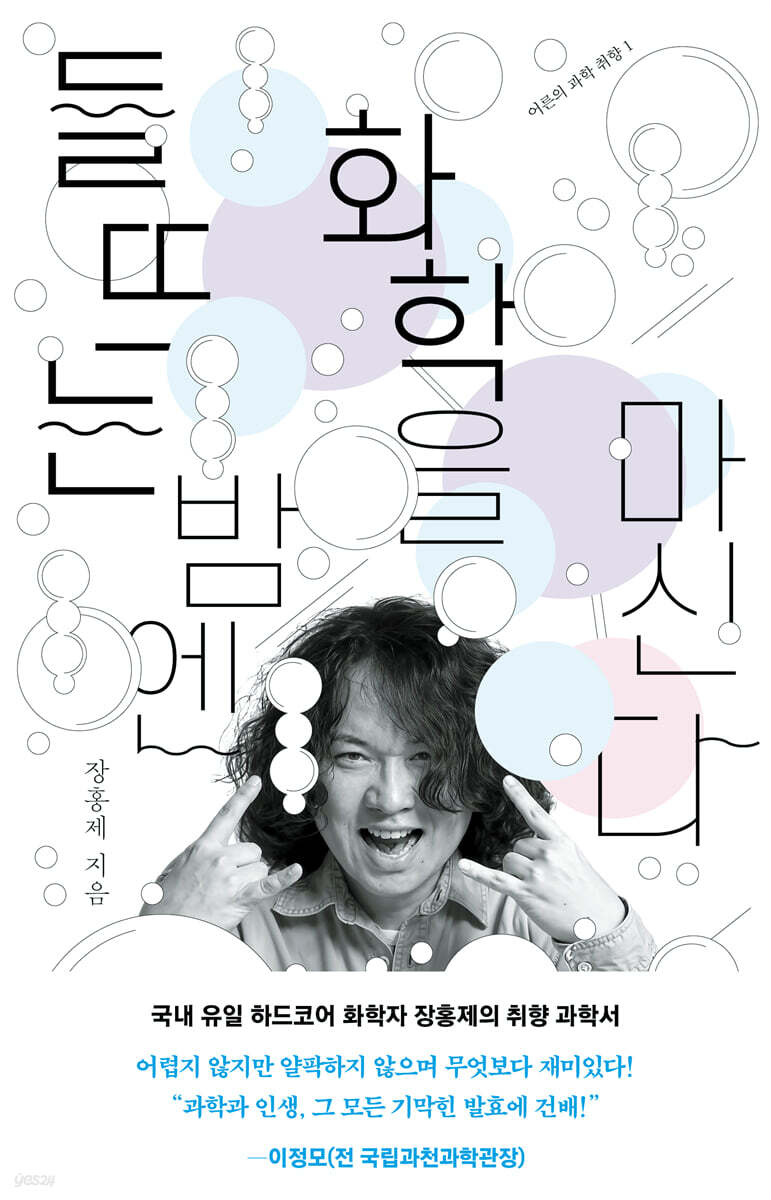
On exciting nights, I drink chemistry
 |
Description
Book Introduction
With Jang Hong-je, Korea's only 'hardcore' chemist
Cheers to all the adults out there who want to get into science!
Why do we still drink alcohol when we've been told that it's like "scraping your frontal lobe with a razor blade"?
With the trend of 'slow aging', health has become an important topic of life regardless of age, and the binge drinking and excessive drinking culture of the 1980s, which encouraged people to 'drink as much as they want', has gradually disappeared.
So has alcohol become a relic of the past?
Ironically, in contrast to the declining mainstream market, the non-alcoholic and non-alcoholic market continues to grow rapidly.
Even if there is no actual alcohol, alcohol, which we continue to seek out to feel good, is still an “object of curiosity” for us and an indispensable part of our lives that “accompanies every moment of youth and memories.”
That's why talking about the romance, atmosphere, and honesty that alcohol brings can be "not the discomfort of knowing something you shouldn't know, but the pleasure" and an important clue to understanding ourselves.
The first volume of Adult Science Preferences, "On Exciting Nights, I Drink Chemistry," is a book in which Hongje Jang, a "hardcore" chemist who is active on YouTube and broadcasting, honestly and humorously explains the contradictory subject of alcohol.
This book explains, in the language of a chemist and with the sincerity of an alcohol-loving drinker, what receptors alcohol triggers in the brain, why we laugh because we are fooled by dopamine, and why we kick the covers and regret it the next day.
Let's naturally encounter the flavor and exciting reactions of chemical knowledge hidden within alcohol, a familiar everyday substance.
As the story progresses, you will feel a little more intoxicated, but you will also understand the science hidden in everyday life with greater clarity. As you drink with the author on each page, you will soon become an intellectual at the drinking party.
Cheers to all the adults out there who want to get into science!
Why do we still drink alcohol when we've been told that it's like "scraping your frontal lobe with a razor blade"?
With the trend of 'slow aging', health has become an important topic of life regardless of age, and the binge drinking and excessive drinking culture of the 1980s, which encouraged people to 'drink as much as they want', has gradually disappeared.
So has alcohol become a relic of the past?
Ironically, in contrast to the declining mainstream market, the non-alcoholic and non-alcoholic market continues to grow rapidly.
Even if there is no actual alcohol, alcohol, which we continue to seek out to feel good, is still an “object of curiosity” for us and an indispensable part of our lives that “accompanies every moment of youth and memories.”
That's why talking about the romance, atmosphere, and honesty that alcohol brings can be "not the discomfort of knowing something you shouldn't know, but the pleasure" and an important clue to understanding ourselves.
The first volume of Adult Science Preferences, "On Exciting Nights, I Drink Chemistry," is a book in which Hongje Jang, a "hardcore" chemist who is active on YouTube and broadcasting, honestly and humorously explains the contradictory subject of alcohol.
This book explains, in the language of a chemist and with the sincerity of an alcohol-loving drinker, what receptors alcohol triggers in the brain, why we laugh because we are fooled by dopamine, and why we kick the covers and regret it the next day.
Let's naturally encounter the flavor and exciting reactions of chemical knowledge hidden within alcohol, a familiar everyday substance.
As the story progresses, you will feel a little more intoxicated, but you will also understand the science hidden in everyday life with greater clarity. As you drink with the author on each page, you will soon become an intellectual at the drinking party.
- You can preview some of the book's contents.
Preview
index
Recommendation
Introduction: The meeting of alcohol and chemistry
First Drink: Why We Drink - Cheers to our great ancestors who discovered alcohol!
Second glass: The Water of Life - A toast to the Water of Life and the Alchemists!
Third Glass: Art of the Five Senses - A toast to the fragrance of nature and the art of humanity!
Fourth Cup: Potion of Courage and Happiness - A toast to our happiness and courage today!
Fifth Glass: Drinking Party Strategy Guide - Cheers to the Sweetness That Wakes You Up!
Sixth glass: Dark liquor causes bad hangovers - Cheers to tomorrow's me who can overcome hangovers!
Seventh Glass: The Water of Life, the Poison of Life - Cheers to the pleasure that makes even hangovers fall in love!
Eighth Glass: The Chemical Recombination of Alcohol - A Cheers to the Future of Alcohol Shaped by Science!
Ninth glass: One more whirlwind of courage for me - a toast to our passion and courage to gather for drinks tomorrow!
The Tenth Glass: The Magic and Tricks of Alcohol - A Cheers to Our Continued Romance!
The Last Drink: Untold Stories About Alcohol - A Cheers to Our Time Together Someday
Americas
Introduction: The meeting of alcohol and chemistry
First Drink: Why We Drink - Cheers to our great ancestors who discovered alcohol!
Second glass: The Water of Life - A toast to the Water of Life and the Alchemists!
Third Glass: Art of the Five Senses - A toast to the fragrance of nature and the art of humanity!
Fourth Cup: Potion of Courage and Happiness - A toast to our happiness and courage today!
Fifth Glass: Drinking Party Strategy Guide - Cheers to the Sweetness That Wakes You Up!
Sixth glass: Dark liquor causes bad hangovers - Cheers to tomorrow's me who can overcome hangovers!
Seventh Glass: The Water of Life, the Poison of Life - Cheers to the pleasure that makes even hangovers fall in love!
Eighth Glass: The Chemical Recombination of Alcohol - A Cheers to the Future of Alcohol Shaped by Science!
Ninth glass: One more whirlwind of courage for me - a toast to our passion and courage to gather for drinks tomorrow!
The Tenth Glass: The Magic and Tricks of Alcohol - A Cheers to Our Continued Romance!
The Last Drink: Untold Stories About Alcohol - A Cheers to Our Time Together Someday
Americas
Detailed image

Into the book
“Chemistry is often said to be the study of matter and the study of change.
Since the universe and everything in it are made of matter with substance, there is no place in our material world where chemistry does not apply.
Naturally, the chemist's interest is directed toward deconstruction, interpretation, and reconstruction.
“What interests me is what the thing in front of us is made of, why it is connected to each other and maintains such an interesting shape, and what process it must go through if it is to be reproduced by my hands.” --- From “Introduction: The Encounter of Alcohol and Chemistry”
“Of course, indiscriminate and excessive drinking is a destructive act that benefits no one, but wouldn’t it make sense to argue that liking and enjoying alcohol is a long history imprinted in our genes and an inevitable choice given to us?” --- From “The First Glass: Reasons for Drinking”
“The alcohol that goes down my throat makes me aware of the location of my digestive system and makes me feel alive, depending on the alcohol content.
“It is as if you belatedly realize that you were alive, hearing the screams of cells that were dehydrated by alcohol.” --- From “The Second Glass: Alcohol is the Water of Life”
“Empirical information is important, but arguments based on scientific principles will also strengthen your speaking skills and authority at drinking parties.
…a few drops of water bring the trapped guaiacol molecules to the surface of the whiskey, quickly releasing the solidified aroma.
“Just as a few drops of sesame oil or truffle oil sprinkled on a dish enhances the overall perfection, a few drops of water touching whiskey before drinking creates the best drink.” --- From “The Third Glass: The Art of the Five Senses”
“The reasons for seeking alcohol are not limited to one direction.
When we are happy or sad, when we need courage or when we want to share happiness, we naturally raise a glass.
Alcohol has a magical effect on melting away the awkwardness of a first meeting, soothing the bitterness of failure, or discussing dreams and making resolutions.
The liquid in this little glass isn't just a collection of alcoholic beverages meant to numb the brain.
It's a kind of magic potion that relaxes you, opens your heart, and sometimes lets you forget the weight of reality for a moment.
I believe you've all experienced the effects of potions, so let's take a step further and delve into the most scientific realm.
“Why does alcohol give us courage and happiness?” --- From “The Fourth Cup: The Potion of Courage and Happiness”
“It can be assumed that the problems caused by repeated drinking are not due to ethanol, but rather due to its metabolic product, acetaldehyde.
“If ethanol were carcinogenic and had severe side effects, it would never have been called the water of life, let alone used in the medical field for disinfection.” --- From “The Fifth Glass: A White Paper on Drinking Party Strategy”
“Still, aspartame is safe.
The idea that drinking artificially sweetened drinks with aspartame can cause a worse hangover is simply a myth.
Aspartame, an amino acid, does not have the effect of promoting the production of acetaldehyde, which is the cause of hangovers. I hope you look back and remember whether you simply drank too much the night before because you couldn't control your excitement." --- From "The Sixth Glass: Dark Alcohol Causes a Worse Hangover"
“We think of alcohol as a simple recreational drug, but there are chemicals that are less addictive than alcohol that we recognize as powerful addictive substances: amphetamines, cannabis, ketamine, and MDMA.
We think we enjoy alcohol lightly and don't show any dependence, but alcohol plays a big role in psychological dependence and pleasure, so anyone may already be potentially addicted to alcohol through memories and recollections." --- From "The Seventh Glass: The Water of Life, the Poison of Life"
“On average, 60 MJ of heat energy is used to produce 1 L of alcohol, which is equivalent to the energy released when exploding 14.34 kg of TNT.
About 10% of Scotland's total energy consumption is used to produce whisky.
The amount of water consumed is also enormous.
Even excluding grain production, large amounts of water are used in the fermentation and cooling processes, and high-quality water is especially required.
As whisky is an energy-intensive industry, the British government has recently been carrying out projects to increase sustainability, such as the 'Green Distilleries Competition'." --- From "The Eighth Glass: The Chemical Recombination of Alcohol"
“Additional options are emerging to delay the onset of intoxication.
These are high-fat foods such as pork belly and large intestine.
As explained earlier, cholecystokinin, which acts when digesting fat, has the effect of closing the pylorus, which prolongs digestion and also delays the absorption of alcohol.
“If we simply compare the speed of alcohol absorption, the effect is clear as it is delayed by about 50%.” --- From “The Ninth Glass: One More Time to Give Me a Storm of Courage”
“The younger you are, the more severe motion sickness you get, and the older you get, the less motion sickness you get. This is because compensation based on experience is involved.
As the senses age, learned predictions about the shaking integrate the images that form in the brain relatively cleanly.
In a way, severe motion sickness means a sensitive sense of balance, or to put it a little more nicely, it could be said to be the gap between the five senses that allow humans to perceive information and the sixth sense that allows us to read proprioceptive elements such as depth, movement, posture, and falling even with our eyes closed.
“Conversely, immunity to motion sickness means that it is possible to have a wealth of experience and precise correction, so it is not a problem that arises from lack or excess.”
Since the universe and everything in it are made of matter with substance, there is no place in our material world where chemistry does not apply.
Naturally, the chemist's interest is directed toward deconstruction, interpretation, and reconstruction.
“What interests me is what the thing in front of us is made of, why it is connected to each other and maintains such an interesting shape, and what process it must go through if it is to be reproduced by my hands.” --- From “Introduction: The Encounter of Alcohol and Chemistry”
“Of course, indiscriminate and excessive drinking is a destructive act that benefits no one, but wouldn’t it make sense to argue that liking and enjoying alcohol is a long history imprinted in our genes and an inevitable choice given to us?” --- From “The First Glass: Reasons for Drinking”
“The alcohol that goes down my throat makes me aware of the location of my digestive system and makes me feel alive, depending on the alcohol content.
“It is as if you belatedly realize that you were alive, hearing the screams of cells that were dehydrated by alcohol.” --- From “The Second Glass: Alcohol is the Water of Life”
“Empirical information is important, but arguments based on scientific principles will also strengthen your speaking skills and authority at drinking parties.
…a few drops of water bring the trapped guaiacol molecules to the surface of the whiskey, quickly releasing the solidified aroma.
“Just as a few drops of sesame oil or truffle oil sprinkled on a dish enhances the overall perfection, a few drops of water touching whiskey before drinking creates the best drink.” --- From “The Third Glass: The Art of the Five Senses”
“The reasons for seeking alcohol are not limited to one direction.
When we are happy or sad, when we need courage or when we want to share happiness, we naturally raise a glass.
Alcohol has a magical effect on melting away the awkwardness of a first meeting, soothing the bitterness of failure, or discussing dreams and making resolutions.
The liquid in this little glass isn't just a collection of alcoholic beverages meant to numb the brain.
It's a kind of magic potion that relaxes you, opens your heart, and sometimes lets you forget the weight of reality for a moment.
I believe you've all experienced the effects of potions, so let's take a step further and delve into the most scientific realm.
“Why does alcohol give us courage and happiness?” --- From “The Fourth Cup: The Potion of Courage and Happiness”
“It can be assumed that the problems caused by repeated drinking are not due to ethanol, but rather due to its metabolic product, acetaldehyde.
“If ethanol were carcinogenic and had severe side effects, it would never have been called the water of life, let alone used in the medical field for disinfection.” --- From “The Fifth Glass: A White Paper on Drinking Party Strategy”
“Still, aspartame is safe.
The idea that drinking artificially sweetened drinks with aspartame can cause a worse hangover is simply a myth.
Aspartame, an amino acid, does not have the effect of promoting the production of acetaldehyde, which is the cause of hangovers. I hope you look back and remember whether you simply drank too much the night before because you couldn't control your excitement." --- From "The Sixth Glass: Dark Alcohol Causes a Worse Hangover"
“We think of alcohol as a simple recreational drug, but there are chemicals that are less addictive than alcohol that we recognize as powerful addictive substances: amphetamines, cannabis, ketamine, and MDMA.
We think we enjoy alcohol lightly and don't show any dependence, but alcohol plays a big role in psychological dependence and pleasure, so anyone may already be potentially addicted to alcohol through memories and recollections." --- From "The Seventh Glass: The Water of Life, the Poison of Life"
“On average, 60 MJ of heat energy is used to produce 1 L of alcohol, which is equivalent to the energy released when exploding 14.34 kg of TNT.
About 10% of Scotland's total energy consumption is used to produce whisky.
The amount of water consumed is also enormous.
Even excluding grain production, large amounts of water are used in the fermentation and cooling processes, and high-quality water is especially required.
As whisky is an energy-intensive industry, the British government has recently been carrying out projects to increase sustainability, such as the 'Green Distilleries Competition'." --- From "The Eighth Glass: The Chemical Recombination of Alcohol"
“Additional options are emerging to delay the onset of intoxication.
These are high-fat foods such as pork belly and large intestine.
As explained earlier, cholecystokinin, which acts when digesting fat, has the effect of closing the pylorus, which prolongs digestion and also delays the absorption of alcohol.
“If we simply compare the speed of alcohol absorption, the effect is clear as it is delayed by about 50%.” --- From “The Ninth Glass: One More Time to Give Me a Storm of Courage”
“The younger you are, the more severe motion sickness you get, and the older you get, the less motion sickness you get. This is because compensation based on experience is involved.
As the senses age, learned predictions about the shaking integrate the images that form in the brain relatively cleanly.
In a way, severe motion sickness means a sensitive sense of balance, or to put it a little more nicely, it could be said to be the gap between the five senses that allow humans to perceive information and the sixth sense that allows us to read proprioceptive elements such as depth, movement, posture, and falling even with our eyes closed.
“Conversely, immunity to motion sickness means that it is possible to have a wealth of experience and precise correction, so it is not a problem that arises from lack or excess.”
--- From "The Tenth Glass: The Magic and Tricks of Wine"
Publisher's Review
It's not difficult, it's not shallow, and above all, it's fun!
Cheers to science, life, and all its wonderful ferments!
- Lee Jeong-mo (former director of the National Science Museum in Gwacheon)
EBS's "Hobby is Science," tvN's "Naked World History,"
Appearance on YouTube's "See Science" and "Science That Won't Work"
1.
Chemist Jang Hong-je pioneers the "science of taste" genre.
─ The first book in the slightly risky "Adult Science Taste" series.
─ A scientist who becomes a storyteller when he drinks alcohol
─ Cheers to the chemist who's fascinated by alcohol!
The author of this book, Professor Jang Hong-je, is a chemist who believes that “romance lives and breathes in science and experimentation.”
He is actively communicating with the public through the only hardcore chemistry YouTube channel in Korea, “Chemical Ark,” and is actively working to popularize chemistry.
He is taking a unique approach by overturning the paradigm of liberal arts chemistry, which primarily conveys practical knowledge, and by revealing the charm of chemistry that can be enjoyed with a sense of humor through a quirky and witty approach.
《Drink Chemistry on Exciting Nights》 is the first book in Professor Jang Hong-je's new series, 《Adults' Taste for Science》.
This series is a molecular life guide for 'adult tastes' that might be a little risky.
This is a new science curriculum that allows you to experience the thrilling knowledge of the world that adults can enjoy, through the eyes of a chemist who deconstructs, interprets, and reconstructs matter in the drama of time where molecules and emotions meet.
The author said, “Although alcohol is ultimately chemistry, I want to be a storyteller rather than a scientist when I drink,” and added, “This book is a trace of the slightly scientific and very human story of alcohol, from how ethanol, the main ingredient in alcohol used as a solution in chemistry, became the solution to life.”
Now, let's hear a toast from a chemist who seems to mercilessly dissect any substance, one by one, leading to a taste rather than an addiction.
“The reason we drink alcohol, no matter what ethanol it is, is simple.
We drink to get drunk.
The word "drunk" seems to symbolize the exhaustion of the next day, as it is difficult to control one's body due to excessive drinking, and the erasure of memories and time, but just as there are expressions of being drunk on music, being drunk on art, and being drunk on each other, being drunk is also a fascination with beauty." - 〈The Second Glass: Alcohol is the Water of Life〉
“I often get asked what my favorite type of beer is.
Many people, judging by my refined appearance, expect to see me enjoying a glass of whiskey and writing a book or paper, but I am very embarrassed to say that I often disappoint them.
“If I had to choose just one favorite spirit, it would definitely be rum.” - The Third Glass: The Art of the Senses
2.
Savor the knowledge cocktail prepared by a chemist
─ A vast narrative contained in a sip of liquid
─ Rich and eloquent discourse that crosses academic disciplines, from human history to physiological responses.
─ Cheers to humanity, who pioneered civilization through alcohol!
"Drink Chemistry on Exciting Nights" covers a wide range of knowledge related to alcohol, from its history to its physiological mechanisms, allowing readers to savor the vast narrative contained in a single sip of liquid.
All of these processes have been carried out through relationships and changes between substances, and chemistry, which explains these processes, becomes a language that can precisely reveal our tastes.
Long ago, humans discovered alcohol, captivated by the sweet aroma of fermented fruit, and used it as a survival strategy, providing high calories, vitamins, and essential amino acids.
The discovery of calcium oxalate, formed during the beer brewing process, at the ancient temple of Göbekli Tepe approximately 11,700 years ago suggests that the creation of alcohol was the cornerstone of a civilization that preceded agricultural culture.
Coincidentally, ethanol easily crosses the blood-brain barrier, the brain's protective barrier, activates GABA receptors, and induces dopamine secretion through the mesolimbic pathway, thereby amplifying feelings of happiness.
The word 'symposium', which originated from the ancient Greek word meaning 'to drink together', is used today to refer to a place for academic exchange, and reminds us that this drinking culture was the source that led to the development of human civilization.
Ultimately, the chemical substance called alcohol has had a decisive influence on our tastes and lifestyles from the beginning of human civilization to the present day.
Jang Hong-je, a hardcore chemist who freely crosses genres and academic disciplines, demonstrates with his eloquence that chemistry is not limited to the study of substances, but can also offer a new interpretation of our identity through the exploration of human history, culture, and physiological responses.
“What is certain is that the birth of beer preceded agricultural culture.
The interpretation that it was a sacred drink made for rituals in temples is interesting, but the interpretation that agriculture became widespread for the sake of making alcohol, rather than making alcohol using stored excess resources, is thought-provoking.” - 〈The First Drink: Why We Drink Alcohol〉
“Alcohol has already been established as a tool to relieve the burden of the mind throughout the long history of mankind.
We drink alcohol to relieve our immediate worries and to gain the courage to do or say things that would normally be difficult.
Putting aside the aspect of overcoming or improving, alcohol can solve problems (even if temporarily) better than a good psychologist.
This phenomenon cannot be explained simply by psychological comfort or social convention.
“The fundamental cause is the chemical and physiological effects of alcohol on our brain and body.” - The Fourth Glass: The Potion of Courage and Happiness
3.
Enjoy the fun of chemistry beyond its usefulness.
─ From natural fermentation to whiskey aged through audio
─ A science textbook that goes beyond common sense and leads to broad and deep insights.
─ Cheers to our continuing romance!
One glass, two glasses, three glasses, … .
The ten glasses of chemistry shared with the author deepens, extending beyond snack pairings and hangover cures to the future of alcohol and humanity.
Ancient humans used to block oxygen for fermentation, but now, as time goes by, they are shooting out audio to speed up the maturation of alcohol.
It also covers cutting-edge technologies such as synthetic whiskey and AI-powered alcohol production, highlighting the new possibilities presented by 'symbolic' foods.
Starting from a preference rather than a useless one, this book goes beyond simple common sense about alcohol to provide broad and deep insights.
It encompasses tens of thousands of years of evolution and civilization, the intersection of chemical and physiological processes and emotions, and even the power to imagine the future, leading readers to a delightful and clear understanding.
Jang Hong-je's "Adults' Taste for Science" begins with "On Exciting Nights, I Drink Chemistry" and continues until the first half of 2026.
"On a Frustrating Day, I Explode Chemistry," which covers physical and emotional explosions from fuel to ignition, combustion, and byproducts, and "On a Sensitive Day, I Swallow Chemistry," which deals with psychoactive substances as a "medicinal science book," are preparing to meet readers.
Our taste upgrades continue with the sophisticated suggestions that the language of chemistry brings to the adult world.
“As a result, it is said that 30 minutes of sonic treatment can produce a sensuous aging effect equivalent to 20 years.
Sonic treatment significantly shortens aging time by vibrating the whiskey liquid and enhancing its interaction with the oak barrel surface.” - The Eighth Glass: The Chemical Recombination of Alcohol
“Sometimes, you can drink alcohol because it’s fun.
As we've discussed, from the first drink to the last, there's not a single detail that's trivial, from the process of my body and mind changing to the anticipated aftereffects the next day, to the science that controls and regulates it all.
If you look into it a little, you'll find stories as diverse as the types of alcohol, and even at this very moment, the challenge of discovering the delights of combining cocktails and pairing snacks that go well with alcohol continues.
Even now, ten thousand years after alcohol has been with mankind, we still look into this transparent liquid with half-closed eyes, trying to explain many things.” - The Last Glass: Untold Stories About Alcohol
Cheers to science, life, and all its wonderful ferments!
- Lee Jeong-mo (former director of the National Science Museum in Gwacheon)
EBS's "Hobby is Science," tvN's "Naked World History,"
Appearance on YouTube's "See Science" and "Science That Won't Work"
1.
Chemist Jang Hong-je pioneers the "science of taste" genre.
─ The first book in the slightly risky "Adult Science Taste" series.
─ A scientist who becomes a storyteller when he drinks alcohol
─ Cheers to the chemist who's fascinated by alcohol!
The author of this book, Professor Jang Hong-je, is a chemist who believes that “romance lives and breathes in science and experimentation.”
He is actively communicating with the public through the only hardcore chemistry YouTube channel in Korea, “Chemical Ark,” and is actively working to popularize chemistry.
He is taking a unique approach by overturning the paradigm of liberal arts chemistry, which primarily conveys practical knowledge, and by revealing the charm of chemistry that can be enjoyed with a sense of humor through a quirky and witty approach.
《Drink Chemistry on Exciting Nights》 is the first book in Professor Jang Hong-je's new series, 《Adults' Taste for Science》.
This series is a molecular life guide for 'adult tastes' that might be a little risky.
This is a new science curriculum that allows you to experience the thrilling knowledge of the world that adults can enjoy, through the eyes of a chemist who deconstructs, interprets, and reconstructs matter in the drama of time where molecules and emotions meet.
The author said, “Although alcohol is ultimately chemistry, I want to be a storyteller rather than a scientist when I drink,” and added, “This book is a trace of the slightly scientific and very human story of alcohol, from how ethanol, the main ingredient in alcohol used as a solution in chemistry, became the solution to life.”
Now, let's hear a toast from a chemist who seems to mercilessly dissect any substance, one by one, leading to a taste rather than an addiction.
“The reason we drink alcohol, no matter what ethanol it is, is simple.
We drink to get drunk.
The word "drunk" seems to symbolize the exhaustion of the next day, as it is difficult to control one's body due to excessive drinking, and the erasure of memories and time, but just as there are expressions of being drunk on music, being drunk on art, and being drunk on each other, being drunk is also a fascination with beauty." - 〈The Second Glass: Alcohol is the Water of Life〉
“I often get asked what my favorite type of beer is.
Many people, judging by my refined appearance, expect to see me enjoying a glass of whiskey and writing a book or paper, but I am very embarrassed to say that I often disappoint them.
“If I had to choose just one favorite spirit, it would definitely be rum.” - The Third Glass: The Art of the Senses
2.
Savor the knowledge cocktail prepared by a chemist
─ A vast narrative contained in a sip of liquid
─ Rich and eloquent discourse that crosses academic disciplines, from human history to physiological responses.
─ Cheers to humanity, who pioneered civilization through alcohol!
"Drink Chemistry on Exciting Nights" covers a wide range of knowledge related to alcohol, from its history to its physiological mechanisms, allowing readers to savor the vast narrative contained in a single sip of liquid.
All of these processes have been carried out through relationships and changes between substances, and chemistry, which explains these processes, becomes a language that can precisely reveal our tastes.
Long ago, humans discovered alcohol, captivated by the sweet aroma of fermented fruit, and used it as a survival strategy, providing high calories, vitamins, and essential amino acids.
The discovery of calcium oxalate, formed during the beer brewing process, at the ancient temple of Göbekli Tepe approximately 11,700 years ago suggests that the creation of alcohol was the cornerstone of a civilization that preceded agricultural culture.
Coincidentally, ethanol easily crosses the blood-brain barrier, the brain's protective barrier, activates GABA receptors, and induces dopamine secretion through the mesolimbic pathway, thereby amplifying feelings of happiness.
The word 'symposium', which originated from the ancient Greek word meaning 'to drink together', is used today to refer to a place for academic exchange, and reminds us that this drinking culture was the source that led to the development of human civilization.
Ultimately, the chemical substance called alcohol has had a decisive influence on our tastes and lifestyles from the beginning of human civilization to the present day.
Jang Hong-je, a hardcore chemist who freely crosses genres and academic disciplines, demonstrates with his eloquence that chemistry is not limited to the study of substances, but can also offer a new interpretation of our identity through the exploration of human history, culture, and physiological responses.
“What is certain is that the birth of beer preceded agricultural culture.
The interpretation that it was a sacred drink made for rituals in temples is interesting, but the interpretation that agriculture became widespread for the sake of making alcohol, rather than making alcohol using stored excess resources, is thought-provoking.” - 〈The First Drink: Why We Drink Alcohol〉
“Alcohol has already been established as a tool to relieve the burden of the mind throughout the long history of mankind.
We drink alcohol to relieve our immediate worries and to gain the courage to do or say things that would normally be difficult.
Putting aside the aspect of overcoming or improving, alcohol can solve problems (even if temporarily) better than a good psychologist.
This phenomenon cannot be explained simply by psychological comfort or social convention.
“The fundamental cause is the chemical and physiological effects of alcohol on our brain and body.” - The Fourth Glass: The Potion of Courage and Happiness
3.
Enjoy the fun of chemistry beyond its usefulness.
─ From natural fermentation to whiskey aged through audio
─ A science textbook that goes beyond common sense and leads to broad and deep insights.
─ Cheers to our continuing romance!
One glass, two glasses, three glasses, … .
The ten glasses of chemistry shared with the author deepens, extending beyond snack pairings and hangover cures to the future of alcohol and humanity.
Ancient humans used to block oxygen for fermentation, but now, as time goes by, they are shooting out audio to speed up the maturation of alcohol.
It also covers cutting-edge technologies such as synthetic whiskey and AI-powered alcohol production, highlighting the new possibilities presented by 'symbolic' foods.
Starting from a preference rather than a useless one, this book goes beyond simple common sense about alcohol to provide broad and deep insights.
It encompasses tens of thousands of years of evolution and civilization, the intersection of chemical and physiological processes and emotions, and even the power to imagine the future, leading readers to a delightful and clear understanding.
Jang Hong-je's "Adults' Taste for Science" begins with "On Exciting Nights, I Drink Chemistry" and continues until the first half of 2026.
"On a Frustrating Day, I Explode Chemistry," which covers physical and emotional explosions from fuel to ignition, combustion, and byproducts, and "On a Sensitive Day, I Swallow Chemistry," which deals with psychoactive substances as a "medicinal science book," are preparing to meet readers.
Our taste upgrades continue with the sophisticated suggestions that the language of chemistry brings to the adult world.
“As a result, it is said that 30 minutes of sonic treatment can produce a sensuous aging effect equivalent to 20 years.
Sonic treatment significantly shortens aging time by vibrating the whiskey liquid and enhancing its interaction with the oak barrel surface.” - The Eighth Glass: The Chemical Recombination of Alcohol
“Sometimes, you can drink alcohol because it’s fun.
As we've discussed, from the first drink to the last, there's not a single detail that's trivial, from the process of my body and mind changing to the anticipated aftereffects the next day, to the science that controls and regulates it all.
If you look into it a little, you'll find stories as diverse as the types of alcohol, and even at this very moment, the challenge of discovering the delights of combining cocktails and pairing snacks that go well with alcohol continues.
Even now, ten thousand years after alcohol has been with mankind, we still look into this transparent liquid with half-closed eyes, trying to explain many things.” - The Last Glass: Untold Stories About Alcohol
GOODS SPECIFICS
- Date of issue: July 28, 2025
- Page count, weight, size: 240 pages | 340g | 135*210*14mm
- ISBN13: 9791170873532
You may also like
카테고리
korean


korean

![ELLE 엘르 스페셜 에디션 A형 : 12월 [2025]](http://librairie.coreenne.fr/cdn/shop/files/b8e27a3de6c9538896439686c6b0e8fb.jpg?v=1766436872&width=3840)


