

Statistics 101 x Data Analysis for Proper Insights in the Big Data Era
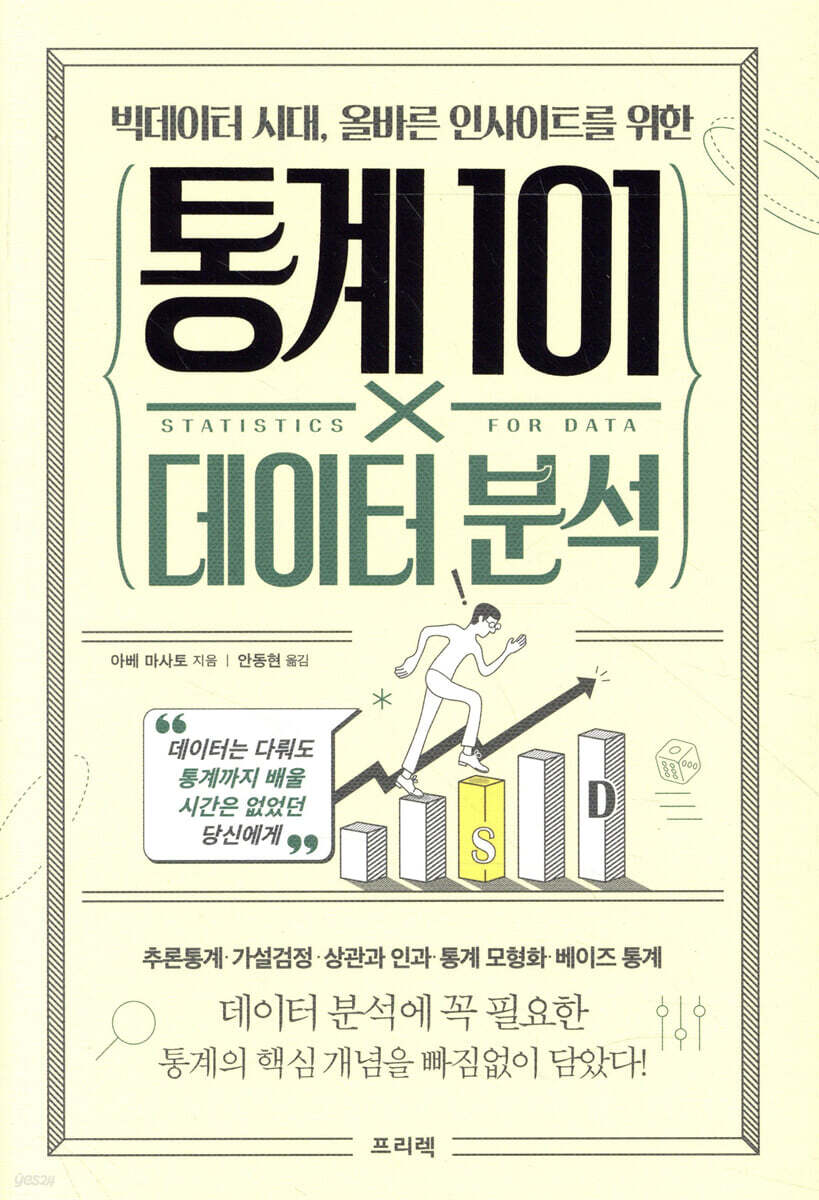 |
Description
Book Introduction
A solid foundation of statistics becomes the cornerstone of my data analysis!
Why should we understand statistics before handling data?
There are many different ways to analyze and interpret data, but they all share a common foundation in statistical thinking.
Therefore, in order to analyze data in earnest, you must first acquire proper knowledge and perspectives in the field of statistics.
This book is written for those who frequently encounter data and want to acquire systematic statistical knowledge that can be applied in their work, but find it difficult to invest substantial time and effort into it.
It covers a wide range of topics, from inferential statistics essential for data analysis to hypothesis testing, correlation and causation, statistical modeling, Bayesian statistics, machine learning, and mathematical models, all at just the right level.
The concept introduction was as simple as possible, with as few mathematical formulas or explanations as possible.
Meanwhile, we have included as many example pictures and graphs as possible, and have also introduced several familiar cases.
I am confident that with just this book, “Statistics 101 x Data Analysis,” you will be able to sufficiently learn various basic statistical concepts and perspectives necessary for practical data analysis.
Why should we understand statistics before handling data?
There are many different ways to analyze and interpret data, but they all share a common foundation in statistical thinking.
Therefore, in order to analyze data in earnest, you must first acquire proper knowledge and perspectives in the field of statistics.
This book is written for those who frequently encounter data and want to acquire systematic statistical knowledge that can be applied in their work, but find it difficult to invest substantial time and effort into it.
It covers a wide range of topics, from inferential statistics essential for data analysis to hypothesis testing, correlation and causation, statistical modeling, Bayesian statistics, machine learning, and mathematical models, all at just the right level.
The concept introduction was as simple as possible, with as few mathematical formulas or explanations as possible.
Meanwhile, we have included as many example pictures and graphs as possible, and have also introduced several familiar cases.
I am confident that with just this book, “Statistics 101 x Data Analysis,” you will be able to sufficiently learn various basic statistical concepts and perspectives necessary for practical data analysis.
- You can preview some of the book's contents.
Preview
index
To begin with
Chapter 1: What is Statistics?: The Role of Statistics in Data Analysis
1.1 Analyzing the data
Data and Statistics
Purpose of data analysis
1.2 The Role of Statistics
Statistics is more powerful when the data is spread out.
A phenomenon in which data spread is small
1.3 The Whole Picture of Statistics
Descriptive and inferential statistics
Various analysis methods
Chapter 2 Population and Sample: Setting the Purpose and Target of Data Analysis
2.1 Purpose of data analysis and target audience
Purpose of data analysis
Object of interest
2.2 Population
Think of the population
population size
2.3 Knowing the properties of the population
Nature of the population
comprehensive survey
sample survey
sample size
Chapter 3: Fundamentals of Statistical Analysis: Data Types, Statistics, and Probability
3.1 Data Types
Population and sample
variable
Various types of data
3.2 Data distribution
Representing data distribution in a graphic
A histogram is just a graphic representation.
3.3 Statistics
Characterizing data
Various descriptive statistics
Box and whisker plots to check variance
Outliers
3.4 Probability
Before learning probability
Basic thinking about probability
Inferential statistics and probability distributions
When there are two random variables
3.5 Theoretical probability distribution
Probability distributions and parameters
normal distribution
standardization
Various probability distributions
Chapter 4: Inferential Statistics - Confidence Intervals: Estimating Population Properties Using Data
4.1 Before learning inferential statistics
Census and sample surveys
Getting data
random sampling
Understanding inferential statistics intuitively
4.2 Sampling error and confidence intervals
Considering the error between the population and the data
sampling error
Probability distribution of sampling error
What is a confidence interval?
t distribution and 95% confidence interval
Confidence intervals and hypothesis testing
Chapter 5 Hypothesis Testing: Hypothesis Testing and p-Values
5.1 Principles of Hypothesis Testing
Another inferential statistics method
In statistics, what is a hypothesis?
p-value
Summary of home inspection flow
5.2 Hypothesis testing
Specific calculations for hypothesis testing
Rejection threshold and p-value
The relationship between confidence intervals and hypothesis testing
Specific examples of hypothesis testing
5.3 Hypothesis Testing Related Graphs
Error bars
Notation indicating “statistically significant”
5.4 Type I and Type II Errors
Four Patterns of Truth and Judgment
α and β are in a trade-off relationship
α and β when the effect size is different
Chapter 6: Various Hypothesis Tests: From t-tests to ANOVA and Chi-square tests
6.1 Various hypothesis tests
Distinguish between hypothesis testing methods
6.2 Comparison of representative values
Comparison of mean values of parameter tests
Comparison of representative values of nonparametric tests
Analysis of variance (comparing means of three or more groups)
multiple comparison test
6.3 Ratio Comparison
categorical data
binomial test
Chi-square test: goodness-of-fit test
Chi-square test: test of independence
Chapter 7: Correlation and Regression: Analyzing the Relationship Between Two Quantitative Variables
7.1 Revealing the Relationship Between Quantitative Variables
Data consisting of two quantitative variables
Scatterplot
concern
return
7.2 Correlation
Pearson correlation coefficient
Nonparametric correlation coefficient
Correlation coefficient and hypothesis
nonlinear correlation
7.3 Linear regression
What is regression analysis?
Regression coefficient
coefficient of determination
Homovariance and normality of errors
explanatory variables and response variables
Chapter 8 Statistical Modeling: From Linear Regression to Generalized Linear Models
8.1 Extension of the linear regression principle
Linear regression is the basis for various interpretation methods.
multiple regression
Partial regression coefficient
Categorical variables as explanatory variables
Analysis of covariance
High-dimensional data problems
multicollinearity
8.2 Changing the form of the regression model
Interaction
Two-way ANOVA
nonlinear regression
8.3 Concept of generalized linear model
Extending the linear regression principle
Likelihood and maximum likelihood methods
logistic regression
Poisson regression
Various generalized linear models
8.4 Evaluation and Comparison of Statistical Models
World Black
likelihood ratio test
AIC
BIC
Other information criteria
Chapter 9: Precautions in Hypothesis Testing: Reproducibility and p-hacking
9.1 Reproducibility
Hypothesis testing: difficult to understand but simple to implement.
Reproducibility crisis
What causes the irreproducibility?
Scientific Paper Publication Process
9.2 Problems with hypothesis testing
Understanding Hypothesis Testing
Looking back at p-values
Fisher-type test and Neyman-Pearson-type test
effect size
Bayesian argument
The probability that the paper is incorrect
Developing a good hypothesis
9.3 p Hacking
What is p-hacking?
Efforts to prevent p-hacking
Things to check when understanding hypothesis testing
Chapter 10: Cause and Effect: A Way of Thinking to Avoid Misinterpretations
10.1 Causation and Correlation
Uncovering causality
Causality and Correlation
Various examples of causality and correlation
10.2 Randomized controlled trials
To clarify the causal relationship
randomized controlled trials
10.3 Statistical Causal Inference
Another way to estimate causal effects
Chapter 11 Bayesian Statistics: Toward Flexible Analysis
11.1 Bayesian Statistics Thinking
Two streams of statistics
Image of Bayesian statistics
statistical model
Bayesian statistics mindset
Advantages of Bayesian Statistics
11.2 Bayesian statistical algorithm
MCMC method
Examples of MCMC methods
11.3 Bayesian Statistics Examples
Comparison of sample means
Example of Poisson regression
Hierarchical Bayesian model
Chapter 12: Other Statistical Analysis Methods: From Principal Component Analysis to Machine Learning
12.1 Principal component analysis
Dimension of variables
principal component analysis
Factor analysis
12.2 Introduction to Machine Learning
What is machine learning?
The Difference Between Statistics and Machine Learning
12.3 Unsupervised Learning
What is unsupervised learning?
12.4 Supervised Learning
What is supervised learning?
Prediction Performance Measurement ①: Binary Classification
Prediction Performance Measurement ②: Regression
Chapter 13: Models: Statistical Models, Machine Learning Models, and Mathematical Models
13.1 What is a model?
Statistical models, machine learning models, and mathematical models
Models are tools for understanding phenomena.
What is a repair model?
13.2 Mathematical Models: Differential Equations
Differential equations and difference equations
Repair Model Case ①: Modeling the Change in Numbers
Case Study of a Repair Model ②: Infectious Disease Model
With a complex model
13.3 Mathematical Models: Probabilistic Models
Probabilistic model
The role of repair models
In conclusion
Search
Chapter 1: What is Statistics?: The Role of Statistics in Data Analysis
1.1 Analyzing the data
Data and Statistics
Purpose of data analysis
1.2 The Role of Statistics
Statistics is more powerful when the data is spread out.
A phenomenon in which data spread is small
1.3 The Whole Picture of Statistics
Descriptive and inferential statistics
Various analysis methods
Chapter 2 Population and Sample: Setting the Purpose and Target of Data Analysis
2.1 Purpose of data analysis and target audience
Purpose of data analysis
Object of interest
2.2 Population
Think of the population
population size
2.3 Knowing the properties of the population
Nature of the population
comprehensive survey
sample survey
sample size
Chapter 3: Fundamentals of Statistical Analysis: Data Types, Statistics, and Probability
3.1 Data Types
Population and sample
variable
Various types of data
3.2 Data distribution
Representing data distribution in a graphic
A histogram is just a graphic representation.
3.3 Statistics
Characterizing data
Various descriptive statistics
Box and whisker plots to check variance
Outliers
3.4 Probability
Before learning probability
Basic thinking about probability
Inferential statistics and probability distributions
When there are two random variables
3.5 Theoretical probability distribution
Probability distributions and parameters
normal distribution
standardization
Various probability distributions
Chapter 4: Inferential Statistics - Confidence Intervals: Estimating Population Properties Using Data
4.1 Before learning inferential statistics
Census and sample surveys
Getting data
random sampling
Understanding inferential statistics intuitively
4.2 Sampling error and confidence intervals
Considering the error between the population and the data
sampling error
Probability distribution of sampling error
What is a confidence interval?
t distribution and 95% confidence interval
Confidence intervals and hypothesis testing
Chapter 5 Hypothesis Testing: Hypothesis Testing and p-Values
5.1 Principles of Hypothesis Testing
Another inferential statistics method
In statistics, what is a hypothesis?
p-value
Summary of home inspection flow
5.2 Hypothesis testing
Specific calculations for hypothesis testing
Rejection threshold and p-value
The relationship between confidence intervals and hypothesis testing
Specific examples of hypothesis testing
5.3 Hypothesis Testing Related Graphs
Error bars
Notation indicating “statistically significant”
5.4 Type I and Type II Errors
Four Patterns of Truth and Judgment
α and β are in a trade-off relationship
α and β when the effect size is different
Chapter 6: Various Hypothesis Tests: From t-tests to ANOVA and Chi-square tests
6.1 Various hypothesis tests
Distinguish between hypothesis testing methods
6.2 Comparison of representative values
Comparison of mean values of parameter tests
Comparison of representative values of nonparametric tests
Analysis of variance (comparing means of three or more groups)
multiple comparison test
6.3 Ratio Comparison
categorical data
binomial test
Chi-square test: goodness-of-fit test
Chi-square test: test of independence
Chapter 7: Correlation and Regression: Analyzing the Relationship Between Two Quantitative Variables
7.1 Revealing the Relationship Between Quantitative Variables
Data consisting of two quantitative variables
Scatterplot
concern
return
7.2 Correlation
Pearson correlation coefficient
Nonparametric correlation coefficient
Correlation coefficient and hypothesis
nonlinear correlation
7.3 Linear regression
What is regression analysis?
Regression coefficient
coefficient of determination
Homovariance and normality of errors
explanatory variables and response variables
Chapter 8 Statistical Modeling: From Linear Regression to Generalized Linear Models
8.1 Extension of the linear regression principle
Linear regression is the basis for various interpretation methods.
multiple regression
Partial regression coefficient
Categorical variables as explanatory variables
Analysis of covariance
High-dimensional data problems
multicollinearity
8.2 Changing the form of the regression model
Interaction
Two-way ANOVA
nonlinear regression
8.3 Concept of generalized linear model
Extending the linear regression principle
Likelihood and maximum likelihood methods
logistic regression
Poisson regression
Various generalized linear models
8.4 Evaluation and Comparison of Statistical Models
World Black
likelihood ratio test
AIC
BIC
Other information criteria
Chapter 9: Precautions in Hypothesis Testing: Reproducibility and p-hacking
9.1 Reproducibility
Hypothesis testing: difficult to understand but simple to implement.
Reproducibility crisis
What causes the irreproducibility?
Scientific Paper Publication Process
9.2 Problems with hypothesis testing
Understanding Hypothesis Testing
Looking back at p-values
Fisher-type test and Neyman-Pearson-type test
effect size
Bayesian argument
The probability that the paper is incorrect
Developing a good hypothesis
9.3 p Hacking
What is p-hacking?
Efforts to prevent p-hacking
Things to check when understanding hypothesis testing
Chapter 10: Cause and Effect: A Way of Thinking to Avoid Misinterpretations
10.1 Causation and Correlation
Uncovering causality
Causality and Correlation
Various examples of causality and correlation
10.2 Randomized controlled trials
To clarify the causal relationship
randomized controlled trials
10.3 Statistical Causal Inference
Another way to estimate causal effects
Chapter 11 Bayesian Statistics: Toward Flexible Analysis
11.1 Bayesian Statistics Thinking
Two streams of statistics
Image of Bayesian statistics
statistical model
Bayesian statistics mindset
Advantages of Bayesian Statistics
11.2 Bayesian statistical algorithm
MCMC method
Examples of MCMC methods
11.3 Bayesian Statistics Examples
Comparison of sample means
Example of Poisson regression
Hierarchical Bayesian model
Chapter 12: Other Statistical Analysis Methods: From Principal Component Analysis to Machine Learning
12.1 Principal component analysis
Dimension of variables
principal component analysis
Factor analysis
12.2 Introduction to Machine Learning
What is machine learning?
The Difference Between Statistics and Machine Learning
12.3 Unsupervised Learning
What is unsupervised learning?
12.4 Supervised Learning
What is supervised learning?
Prediction Performance Measurement ①: Binary Classification
Prediction Performance Measurement ②: Regression
Chapter 13: Models: Statistical Models, Machine Learning Models, and Mathematical Models
13.1 What is a model?
Statistical models, machine learning models, and mathematical models
Models are tools for understanding phenomena.
What is a repair model?
13.2 Mathematical Models: Differential Equations
Differential equations and difference equations
Repair Model Case ①: Modeling the Change in Numbers
Case Study of a Repair Model ②: Infectious Disease Model
With a complex model
13.3 Mathematical Models: Probabilistic Models
Probabilistic model
The role of repair models
In conclusion
Search
Detailed image

Publisher's Review
From research to business, anytime, anywhere
'Statistics 101', a personalized liberal arts statistics course for anyone who works with data!
In the era of big data, where records and data accumulate just by breathing, more and more people are beginning to handle data.
Collecting data, analyzing it here and there, and looking at numbers, tables, and graphs is becoming more and more familiar day by day.
Because data analysis can provide reliable evidence and convincing predictions of future conditions, it is widely used in various fields of study, including natural science, psychology, economics, and social science, as well as in business settings.
The foundation of data science lies in ‘statistics.’
Statistics is the fruit of a long-standing quest for "quantitative descriptions of phenomena or data."
Therefore, only by thoroughly embodying the principles, perspectives, and mindset can we truly derive the right insights from numbers and data.
This is similar to the idea that just because you can write all the letters doesn't mean you can use sentences well.
To properly collect data, choose the right analysis method, and avoid misinterpreting the results, it's essential to first understand statistics.
But we are busy.
Even just looking at the data right now, it's literally a huge pile.
There is also so much to do, experiment and research on your own.
On the other hand, you also need to learn how to use statistical software, but that is not easy either.
If you focus so much on 'data analysis' itself, 'statistics', which are truly important for gaining the right insights from data, tend to take a back seat.
Sometimes, when I feel the need to learn statistics, I think back to the 'Probability and Statistics' course I briefly learned in high school, but concepts like distribution and confidence intervals remain in fragments and are not easily systematized.
If I wanted to read a book in earnest, it was either 'an overly difficult technical book full of formulas' or 'an essay full of interesting anecdotes with a hint of statistical concepts', so it wasn't easy to acquire the exact amount of statistical knowledge I wanted.
If this is your story, you've come to the right place.
This book is a liberal arts statistics course tailored to data analysis, 'Statistics 101.'
From populations and samples to correlation and causation, from descriptive statistics to machine learning.
It contains all the essential statistics I need right now, in a colorful and detailed format!
To avoid spending too much time and effort on statistics and burnout, and to help you focus on your core work/research, welcome to the "Statistics 101" classroom! In this book, "Statistics 101 x Data Analysis," author Masato Abe aims to introduce the statistical thinking and various statistical analysis methods essential for full-scale data analysis in the easiest-to-understand way possible, without omission.
He leveraged his experience teaching introductory statistics to students from various majors, including biology, psychology, and agriculture, as well as to college students who had never studied statistics before, to refine sentences to make them as readable as possible, and to minimize mathematical explanations as much as possible while striving for the most accurate explanations.
The book is particularly considerate and helpful, explaining in detail the points where beginners are particularly prone to making mistakes.
Among them, the best are the nearly 200 pictures.
By including numerous unique diagrams (pictures) that help readers understand complex concepts at a glance and with clarity, the book is carefully arranged so that even readers without a mathematical foundation or lacking confidence can read it completely.
《Statistics 101 x Data Analysis》 consists of 13 chapters.
Chapters 1-3 provide a comprehensive overview of the purpose of data analysis and the basic knowledge and concepts required for statistical analysis.
Chapters 4 and 5 cover the concept of inferential statistics, which is a full-fledged statistical analysis, and Chapters 6 to 8 examine various inferential statistical analysis methods according to data type or purpose.
Chapter 9 examines the recent hot topics of hypothesis testing usage and reproducibility, while Chapter 10 focuses on the important difference between correlation and causation when interpreting results.
If this chapter covers 'frequency statistics', the remaining three chapters cover more diverse application areas.
Chapter 11 explains Bayesian statistics, a statistical technique that forms the twin pillars of frequentist statistics, and leads to more flexible data analysis.
In Chapters 12 and 13, we will explore machine learning and mathematical models, which are closely related to statistics.
In particular, Chapter 13 features an infectious disease transmission model as a case study in mathematical modeling, creating a structure that keeps you interested until the very end.
As such, 《Statistics 101 x Data Analysis》 is fully filled with the knowledge essential for modern data analysis.
The topics are truly diverse, ranging from basic statistical concepts to hypothesis testing, statistical modeling, and even causal inference, Bayesian statistics, machine learning, and mathematical modeling.
This one book will give you a bird's eye view of statistics and statistical data analysis methods, and lay the foundation for practical data analysis.
[Highly recommended for these people!]
● People who have encountered statistics but find them difficult or do not yet understand them clearly
● People who want to start studying data science in earnest from now on
● A person who conducts various surveys or studies and conducts data analysis as part of the process.
● People who want to get the overall picture because there are too many statistical analysis methods and it is confusing
'Statistics 101', a personalized liberal arts statistics course for anyone who works with data!
In the era of big data, where records and data accumulate just by breathing, more and more people are beginning to handle data.
Collecting data, analyzing it here and there, and looking at numbers, tables, and graphs is becoming more and more familiar day by day.
Because data analysis can provide reliable evidence and convincing predictions of future conditions, it is widely used in various fields of study, including natural science, psychology, economics, and social science, as well as in business settings.
The foundation of data science lies in ‘statistics.’
Statistics is the fruit of a long-standing quest for "quantitative descriptions of phenomena or data."
Therefore, only by thoroughly embodying the principles, perspectives, and mindset can we truly derive the right insights from numbers and data.
This is similar to the idea that just because you can write all the letters doesn't mean you can use sentences well.
To properly collect data, choose the right analysis method, and avoid misinterpreting the results, it's essential to first understand statistics.
But we are busy.
Even just looking at the data right now, it's literally a huge pile.
There is also so much to do, experiment and research on your own.
On the other hand, you also need to learn how to use statistical software, but that is not easy either.
If you focus so much on 'data analysis' itself, 'statistics', which are truly important for gaining the right insights from data, tend to take a back seat.
Sometimes, when I feel the need to learn statistics, I think back to the 'Probability and Statistics' course I briefly learned in high school, but concepts like distribution and confidence intervals remain in fragments and are not easily systematized.
If I wanted to read a book in earnest, it was either 'an overly difficult technical book full of formulas' or 'an essay full of interesting anecdotes with a hint of statistical concepts', so it wasn't easy to acquire the exact amount of statistical knowledge I wanted.
If this is your story, you've come to the right place.
This book is a liberal arts statistics course tailored to data analysis, 'Statistics 101.'
From populations and samples to correlation and causation, from descriptive statistics to machine learning.
It contains all the essential statistics I need right now, in a colorful and detailed format!
To avoid spending too much time and effort on statistics and burnout, and to help you focus on your core work/research, welcome to the "Statistics 101" classroom! In this book, "Statistics 101 x Data Analysis," author Masato Abe aims to introduce the statistical thinking and various statistical analysis methods essential for full-scale data analysis in the easiest-to-understand way possible, without omission.
He leveraged his experience teaching introductory statistics to students from various majors, including biology, psychology, and agriculture, as well as to college students who had never studied statistics before, to refine sentences to make them as readable as possible, and to minimize mathematical explanations as much as possible while striving for the most accurate explanations.
The book is particularly considerate and helpful, explaining in detail the points where beginners are particularly prone to making mistakes.
Among them, the best are the nearly 200 pictures.
By including numerous unique diagrams (pictures) that help readers understand complex concepts at a glance and with clarity, the book is carefully arranged so that even readers without a mathematical foundation or lacking confidence can read it completely.
《Statistics 101 x Data Analysis》 consists of 13 chapters.
Chapters 1-3 provide a comprehensive overview of the purpose of data analysis and the basic knowledge and concepts required for statistical analysis.
Chapters 4 and 5 cover the concept of inferential statistics, which is a full-fledged statistical analysis, and Chapters 6 to 8 examine various inferential statistical analysis methods according to data type or purpose.
Chapter 9 examines the recent hot topics of hypothesis testing usage and reproducibility, while Chapter 10 focuses on the important difference between correlation and causation when interpreting results.
If this chapter covers 'frequency statistics', the remaining three chapters cover more diverse application areas.
Chapter 11 explains Bayesian statistics, a statistical technique that forms the twin pillars of frequentist statistics, and leads to more flexible data analysis.
In Chapters 12 and 13, we will explore machine learning and mathematical models, which are closely related to statistics.
In particular, Chapter 13 features an infectious disease transmission model as a case study in mathematical modeling, creating a structure that keeps you interested until the very end.
As such, 《Statistics 101 x Data Analysis》 is fully filled with the knowledge essential for modern data analysis.
The topics are truly diverse, ranging from basic statistical concepts to hypothesis testing, statistical modeling, and even causal inference, Bayesian statistics, machine learning, and mathematical modeling.
This one book will give you a bird's eye view of statistics and statistical data analysis methods, and lay the foundation for practical data analysis.
[Highly recommended for these people!]
● People who have encountered statistics but find them difficult or do not yet understand them clearly
● People who want to start studying data science in earnest from now on
● A person who conducts various surveys or studies and conducts data analysis as part of the process.
● People who want to get the overall picture because there are too many statistical analysis methods and it is confusing
GOODS SPECIFICS
- Publication date: October 31, 2022
- Page count, weight, size: 400 pages | 686g | 152*225*24mm
- ISBN13: 9788965403388
- ISBN10: 8965403383
You may also like
카테고리
korean


korean

![GQ KOREA Mark (Monthly): December [2025]](http://librairie.coreenne.fr/cdn/shop/files/8ef265dbbfbf186523ed75ba7319009d.jpg?v=1765340328&width=3840)


