

between humans
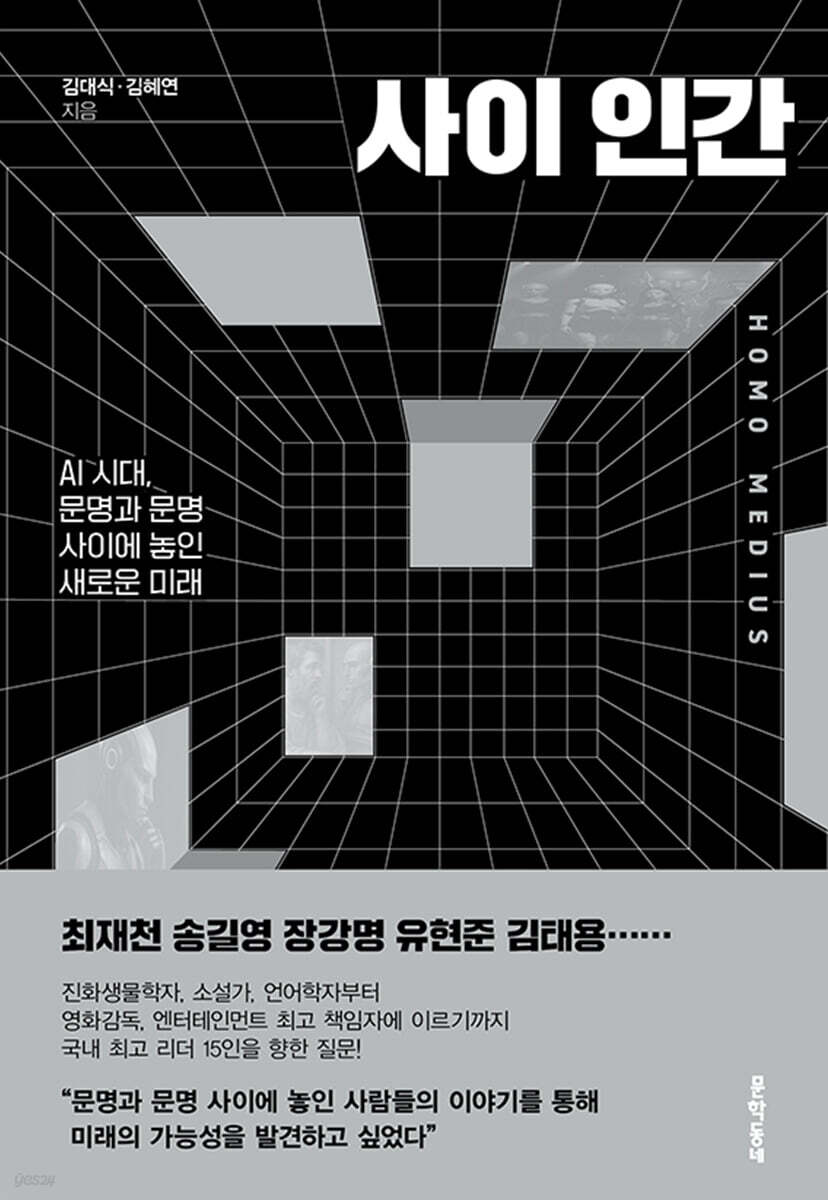 |
Description
Book Introduction
“Through the stories of people caught between civilizations,
“I wanted to discover the possibilities of the future.”
Modern civilization achieved by Homo sapiens
"In-Between Humans": People Standing Between Civilizations Transformed by AI
In a changing era, uncomfortable questions about the new humanity
Provocative imagination diagnosed by 15 of the country's top leaders
Bound together in just one book!
★★★ Choi Jae-cheon, Song Gil-young, Jang Kang-myeong, Yoo Hyeon-jun, Kim Tae-yong… Hear from experts in various fields about how AI will transform the world.
★★★ New questions for us and the next generation from neuroscientist Daesik Kim and choreographer Hyeyeon Kim.
★★★ A humanities book that presents realistic directions for the future of work, the future of industry, and the future of humanity.
Humans are moving towards a newer future from the civilization achieved by Homo sapiens.
Homo sapiens, having gained wisdom through experience, are now moving toward a new kind of human, Homopromptus, dependent on input. Neuroscientist Kim Dae-sik, who passionately explores the future of AI and humanity, and choreographer Kim Hye-yeon, who creates works using generative AI, predict that humanity, which has enjoyed modern civilization to date, will come to an end.
And today's humanity, standing before a civilization that is being transformed by AI, is called 'cyber humans.'
What kind of world will we, as inter-humans, face in the age of AI, facing both fear and anticipation? This book, through interviews with 15 of Korea's top leaders in fields such as humanities, social sciences, culture, arts, engineering, and language, explores what we, as inter-humans, must consider and remember.
In particular, it transforms vague fears about the unknown into clear possibilities through future projections based on concrete examples and evidence.
“I wanted to discover the possibilities of the future.”
Modern civilization achieved by Homo sapiens
"In-Between Humans": People Standing Between Civilizations Transformed by AI
In a changing era, uncomfortable questions about the new humanity
Provocative imagination diagnosed by 15 of the country's top leaders
Bound together in just one book!
★★★ Choi Jae-cheon, Song Gil-young, Jang Kang-myeong, Yoo Hyeon-jun, Kim Tae-yong… Hear from experts in various fields about how AI will transform the world.
★★★ New questions for us and the next generation from neuroscientist Daesik Kim and choreographer Hyeyeon Kim.
★★★ A humanities book that presents realistic directions for the future of work, the future of industry, and the future of humanity.
Humans are moving towards a newer future from the civilization achieved by Homo sapiens.
Homo sapiens, having gained wisdom through experience, are now moving toward a new kind of human, Homopromptus, dependent on input. Neuroscientist Kim Dae-sik, who passionately explores the future of AI and humanity, and choreographer Kim Hye-yeon, who creates works using generative AI, predict that humanity, which has enjoyed modern civilization to date, will come to an end.
And today's humanity, standing before a civilization that is being transformed by AI, is called 'cyber humans.'
What kind of world will we, as inter-humans, face in the age of AI, facing both fear and anticipation? This book, through interviews with 15 of Korea's top leaders in fields such as humanities, social sciences, culture, arts, engineering, and language, explores what we, as inter-humans, must consider and remember.
In particular, it transforms vague fears about the unknown into clear possibilities through future projections based on concrete examples and evidence.
- You can preview some of the book's contents.
Preview
index
prolog
To those who stand between Homo sapiens and Machina Deus: Dae-sik Kim (neuroscientist, KAIST professor)?
Part 1: Uncomfortable Questions - Questions for Survival
Beyond Fear to Coexistence: Evolutionary Biologist Choi Jae-cheon
Sell Your Abilities, Not Your Potential: Mindminer and Author Song Gil-young
The Paradox of Weakness: Novelist Jang Kang-myeong
Design of Relationships: Architect Hyunjun Yoo
Aura: The Axis of Time: Film Director Kim Tae-yong
COLUMN | Are We Really Living in a Simulation?
Part 2: Dangerous Thoughts - Are Humans Still Real?
What to Create vs. How to Empathize: SM Entertainment CAO Lee Seong-su
A World Where Truth and Lies Disappear: Documentary PD Han Sang-ho
AI, Beyond a Tool, Becoming a Philosophy: Artistic Director Lee Dae-hyung
Does Theater Still Direct Humans?: Director Lee Dae-woong
What AI Can Never Imitate: Indologist Kang Sung-yong
| COLUMN | So that humans can still be human
Part 3: Provocative Imaginations - Five Ways to Redefine Humanity
The Intellectual Diligence of Inventing Yourself: Philosopher Choi Jin-seok
The Ability to Define and Solve New Problems: Park Sung-hyun, CEO of an AI Semiconductor Startup
The Power of Creativity Through the Body: Literary Critic Lee Gwang-ho
Recording Emotions, Not Moments: Photographer Kim Yong-ho
The Emergence of Homopromptus: The Art of Questioning and Commanding: Linguist Shin Ji-young
| COLUMN | The Future of Humans and AI
Epilogue
We ask each other: Kim Hye-yeon (choreographer, CEO of Yeonist)?
To those who stand between Homo sapiens and Machina Deus: Dae-sik Kim (neuroscientist, KAIST professor)?
Part 1: Uncomfortable Questions - Questions for Survival
Beyond Fear to Coexistence: Evolutionary Biologist Choi Jae-cheon
Sell Your Abilities, Not Your Potential: Mindminer and Author Song Gil-young
The Paradox of Weakness: Novelist Jang Kang-myeong
Design of Relationships: Architect Hyunjun Yoo
Aura: The Axis of Time: Film Director Kim Tae-yong
COLUMN | Are We Really Living in a Simulation?
Part 2: Dangerous Thoughts - Are Humans Still Real?
What to Create vs. How to Empathize: SM Entertainment CAO Lee Seong-su
A World Where Truth and Lies Disappear: Documentary PD Han Sang-ho
AI, Beyond a Tool, Becoming a Philosophy: Artistic Director Lee Dae-hyung
Does Theater Still Direct Humans?: Director Lee Dae-woong
What AI Can Never Imitate: Indologist Kang Sung-yong
| COLUMN | So that humans can still be human
Part 3: Provocative Imaginations - Five Ways to Redefine Humanity
The Intellectual Diligence of Inventing Yourself: Philosopher Choi Jin-seok
The Ability to Define and Solve New Problems: Park Sung-hyun, CEO of an AI Semiconductor Startup
The Power of Creativity Through the Body: Literary Critic Lee Gwang-ho
Recording Emotions, Not Moments: Photographer Kim Yong-ho
The Emergence of Homopromptus: The Art of Questioning and Commanding: Linguist Shin Ji-young
| COLUMN | The Future of Humans and AI
Epilogue
We ask each other: Kim Hye-yeon (choreographer, CEO of Yeonist)?
Detailed image

Into the book
Today's humanity lies between the modern civilization achieved by Homo sapiens and the 'unknown world Terra incognita' that AI will create in the future.
That last generation also needed a name to call them.
We are preparing for the future with both fear and anticipation between humans and artificial intelligence.
We decided to name this Homo Medius, or 'human in between'.
--- From the "Prologue"
I think coexistence is the answer.
The reason we continue to fear AI from an adversarial perspective is because of the fear we feel.
I believe it's time to quickly dispel these fears and consider how we can coexist with AI, or perhaps utilize it more wisely.
--- From "Beyond Fear to Coexistence: Evolutionary Biologist Choi Jae-cheon"
They say that in this era, the 'selection' is coming to an end.
The old system was about choice.
In just one day, an individual's 'success' or 'failure' is decided, and if they fail here, they are immediately chosen to do something else.
(…) But not anymore.
(…) Instead of living in the old way, as a set character, I am moving in the direction of proving my own life.
--- From "Sell Abilities, Not Potentials: Mindminer, Author Song Gil-young"
Humans are imperfect, and within that imperfection, we understand and empathize with each other.
Technology can enhance human capabilities, but I believe that in the process, we must not lose our humanity.
(…) No matter how much technology advances, the purpose of our use of technology is ultimately to live a better life.
--- From "The Paradox of Weakness: Novelist Jang Kang-myeong"
Even tasks like generating initial ideas or suggesting intuitive shapes, once considered the exclusive domain of architects, are now handled by AI at a much faster pace, with hundreds or thousands of them processed.
(…) You become the person who chooses which of those numerous suggestions to make, explains why you chose it, and convinces others.
--- From "Design of Relationships: Architect Hyunjun Yoo"
In an age where machines can replicate works of art, the concept of 'aura' is said to be important.
I feel like ChatGPT's answer lacks this aura.
I think that aura is ultimately the axis of time.
--- From "Aura, the Axis of Time: Film Director Kim Tae-yong"
Ultimately, the cultural technology pursued by SM Entertainment laid the foundation for K-pop as a fusion of music, visuals, and technology through a scientific and systematic approach, and this philosophy continues to evolve and open up new possibilities to this day.
--- From "What to Create vs. How to Empathize: SM Entertainment CAO Lee Seong-su"
The paradigm itself will change in every aspect.
In the past, choreography required the expertise of a choreographer, CG required the expertise of a CG expert, and movies required the expertise of a film director, but now, any task can be accomplished by one person.
--- From "A World Where Truth and Lies Disappear: Documentary PD Han Sang-ho"
Going forward, I believe social physicality will become a more important topic than biological physicality. In the AI era, big data will be crucial, and in the age of connectivity, "quantity" will overwhelm "quality."
--- From "AI, Beyond a Tool, Becoming a Philosophy: Artistic Director Daehyung Lee"
I don't want to see AI as just a tool.
(…) Instead, I want to see AI as a being with a fun attitude, a friend or companion with whom I can learn and travel.
--- From "Does Theatre Still Direct Humans: Director Lee Dae-woong"
We need to abandon the preconception that first-person experiences, perceptions, and explanations have less information value, and face the world we actually experience.
We must understand and accept that cognitive processes are complex, involving not only information but also emotions.
--- From "What AI Can Never Imitate: Indologist Kang Seong-yong"
In an age where biological and physical barriers are collapsing, I believe that the dichotomy between humans and machines is meaningless.
Therefore, I think it is time to rediscover humanity as a constantly changing being and ponder how to accept and interpret the newly emerging civilization.
--- From "Intellectual Diligence to Invent Oneself: Philosopher Jinseok Choi"
In the end, what matters is the process of experiencing difficulties, confronting them, and solving them.
The same goes for actual AI research.
What is needed is not the ability to solve problems with established answers, but the ability to define and solve new problems.
--- From "The Ability to Define and Solve New Problems: Entrepreneur Park Seong-hyeon"
AI learns information without learning physically.
(…) So, what I am saying is that the creative language of a person who learned through the body will be different from the creativity of an AI that has learned a wide range of information but does not have a body.
--- From "The Power of Creativity Through the Body: Cultural Critic Lee Gwang-ho"
Now, we are simulating scenes with AI during the planning stage.
I believe that if we continue to utilize it, a new creative method that naturally fuses analog sensibility and AI technology will emerge someday.
--- From "Recording Emotions, Not Moments: Photographer Kim Yong-ho"
The most important skill for preparing for the AI era is not developing the ability to handle technology, but learning how to connect more deeply with people.
--- "The Emergence of Homopromptus: The Art of Questioning and Commanding: Linguist Shin Ji-young"
As technology surpasses human speed and art must rewrite its meaning, how should we live? (…) These are records that strive to keep the direction of the question open.
Perhaps we are living in an age where 'what we continue to ask' is more important than 'what we know'.
That last generation also needed a name to call them.
We are preparing for the future with both fear and anticipation between humans and artificial intelligence.
We decided to name this Homo Medius, or 'human in between'.
--- From the "Prologue"
I think coexistence is the answer.
The reason we continue to fear AI from an adversarial perspective is because of the fear we feel.
I believe it's time to quickly dispel these fears and consider how we can coexist with AI, or perhaps utilize it more wisely.
--- From "Beyond Fear to Coexistence: Evolutionary Biologist Choi Jae-cheon"
They say that in this era, the 'selection' is coming to an end.
The old system was about choice.
In just one day, an individual's 'success' or 'failure' is decided, and if they fail here, they are immediately chosen to do something else.
(…) But not anymore.
(…) Instead of living in the old way, as a set character, I am moving in the direction of proving my own life.
--- From "Sell Abilities, Not Potentials: Mindminer, Author Song Gil-young"
Humans are imperfect, and within that imperfection, we understand and empathize with each other.
Technology can enhance human capabilities, but I believe that in the process, we must not lose our humanity.
(…) No matter how much technology advances, the purpose of our use of technology is ultimately to live a better life.
--- From "The Paradox of Weakness: Novelist Jang Kang-myeong"
Even tasks like generating initial ideas or suggesting intuitive shapes, once considered the exclusive domain of architects, are now handled by AI at a much faster pace, with hundreds or thousands of them processed.
(…) You become the person who chooses which of those numerous suggestions to make, explains why you chose it, and convinces others.
--- From "Design of Relationships: Architect Hyunjun Yoo"
In an age where machines can replicate works of art, the concept of 'aura' is said to be important.
I feel like ChatGPT's answer lacks this aura.
I think that aura is ultimately the axis of time.
--- From "Aura, the Axis of Time: Film Director Kim Tae-yong"
Ultimately, the cultural technology pursued by SM Entertainment laid the foundation for K-pop as a fusion of music, visuals, and technology through a scientific and systematic approach, and this philosophy continues to evolve and open up new possibilities to this day.
--- From "What to Create vs. How to Empathize: SM Entertainment CAO Lee Seong-su"
The paradigm itself will change in every aspect.
In the past, choreography required the expertise of a choreographer, CG required the expertise of a CG expert, and movies required the expertise of a film director, but now, any task can be accomplished by one person.
--- From "A World Where Truth and Lies Disappear: Documentary PD Han Sang-ho"
Going forward, I believe social physicality will become a more important topic than biological physicality. In the AI era, big data will be crucial, and in the age of connectivity, "quantity" will overwhelm "quality."
--- From "AI, Beyond a Tool, Becoming a Philosophy: Artistic Director Daehyung Lee"
I don't want to see AI as just a tool.
(…) Instead, I want to see AI as a being with a fun attitude, a friend or companion with whom I can learn and travel.
--- From "Does Theatre Still Direct Humans: Director Lee Dae-woong"
We need to abandon the preconception that first-person experiences, perceptions, and explanations have less information value, and face the world we actually experience.
We must understand and accept that cognitive processes are complex, involving not only information but also emotions.
--- From "What AI Can Never Imitate: Indologist Kang Seong-yong"
In an age where biological and physical barriers are collapsing, I believe that the dichotomy between humans and machines is meaningless.
Therefore, I think it is time to rediscover humanity as a constantly changing being and ponder how to accept and interpret the newly emerging civilization.
--- From "Intellectual Diligence to Invent Oneself: Philosopher Jinseok Choi"
In the end, what matters is the process of experiencing difficulties, confronting them, and solving them.
The same goes for actual AI research.
What is needed is not the ability to solve problems with established answers, but the ability to define and solve new problems.
--- From "The Ability to Define and Solve New Problems: Entrepreneur Park Seong-hyeon"
AI learns information without learning physically.
(…) So, what I am saying is that the creative language of a person who learned through the body will be different from the creativity of an AI that has learned a wide range of information but does not have a body.
--- From "The Power of Creativity Through the Body: Cultural Critic Lee Gwang-ho"
Now, we are simulating scenes with AI during the planning stage.
I believe that if we continue to utilize it, a new creative method that naturally fuses analog sensibility and AI technology will emerge someday.
--- From "Recording Emotions, Not Moments: Photographer Kim Yong-ho"
The most important skill for preparing for the AI era is not developing the ability to handle technology, but learning how to connect more deeply with people.
--- "The Emergence of Homopromptus: The Art of Questioning and Commanding: Linguist Shin Ji-young"
As technology surpasses human speed and art must rewrite its meaning, how should we live? (…) These are records that strive to keep the direction of the question open.
Perhaps we are living in an age where 'what we continue to ask' is more important than 'what we know'.
--- From "Epilogue"
Publisher's Review
In an era where 'what you ask' is more important than 'what you know',
Directly delivered to 15 top experts in each field
A concrete diagnosis of the present and future of work and humanity
Our daily lives are already changing. AI technology is permeating our lives at a breakneck pace, serving as a perfect tool.
But people don't see the AI era as a utopia. AI is both a solution that frees humans from endless labor and a unique threat to humanity.
'In an era where artificial general intelligence (AGI) is no longer a science fiction film but a reality, we may be the last generation of humans to live as masters of the Earth.'
However, this book is neither optimistic nor pessimistic about the AI era that has already begun.
However, it faces the present day where humans and AI live together, and asks questions about humans still surviving in the future.
Additionally, we will hear from top leaders who have made their mark in various fields of society, providing diagnoses of the changing times and realistic guidance and advice on what we, as humans, should consider and prepare for.
“Now everyone is starting to feel that the individual is more important than the organization.
(…) It has become meaningless to structure one’s life solely by changing jobs, and how a person has worked has become more important.”_From the text
“These days, my friends worry about what they can become in the future and whether they will have a job based on what they are doing now.
What is really important is that through that process, you learn ‘how to think, how to organize, and how to speak.’” - From the text
The book consists of three chapters.
Focusing on key topics for human survival, we predict the future through examples of AI utilization in each industry and examine humanity in the new era of humanity.
In Part 1, “Uncomfortable Questions,” evolutionary biologist Choi Jae-cheon, Mindminer and writer Song Gil-young, novelist Jang Kang-myeong, architect Yoo Hyun-jun, and film director Kim Tae-yong participate in interviews to discuss the role of humans in changing social and professional realms.
We gain insight into the changing human race through the evolutionary process of living organisms, and explore the capabilities we must possess in an era where individuals are becoming more important than organizations.
We also explore changes and possibilities in various industries, including writing, architecture, and film, and envision a future where humans and AI coexist.
“In the world of SMCU and aespa, this music becomes a medium that evokes deep empathy with fans in the real world, while also providing AI, a digital being, with an opportunity to learn human senses and emotions.”_From the text
"At the corporate level, AI should be used not simply as a tool for efficiency, but as a complement to humans, freeing them to play more creative and strategic roles. Creating a structure where AI and humans develop together will ensure future competitiveness." - Excerpt from the text
In Part 2, "Dangerous Thoughts," you can hear the stories of people who are using AI in their actual work to create new projects through interviews with SM Entertainment CEO Lee Sung-soo, documentary producer Han Sang-ho, art director Lee Dae-hyung, director Lee Dae-woong, and Indologist Kang Sung-yong.
We will examine specific examples of AI technology integrating into today's cultural industry, such as the worldview connecting K-pop idol group Aespa and virtual idol Navis, and the documentary "The Great India," which utilizes generative AI.
Through this, we look at the current state of the AI era that has already arrived and the future of the industry.
Part 3, "Provocative Imaginations," examines the philosophical thinking necessary for the new humanity that will survive in the AI era.
Through interviews with philosopher Jinseok Choi, AI semiconductor startup Rebellion CEO Seonghyeon Park, literary critic Gwangho Lee, photographer Yongho Kim, and linguist Jiyoung Shin, we define humans in this age of civilizational transition and explore what human abilities are from the perspectives of philosophy, engineering, literature, art, and language.
Furthermore, beyond interviews with experts, this book highlights various attempts at collaboration with AI.
By teaching generative AI the interview content, we created intuitive images, and by simultaneously publishing the answers of the generative AI that learned the interviewee's information and the actual interviewee's answers, we enabled readers to directly compare and analyze the differences between humans and AI.
Additionally, we aimed to increase understanding of the AI era through a column by neuroscientist Daesik Kim in each chapter.
What capabilities will humanity need in the future, and what qualities should we possess now? This book provides the simplest and most realistic answers to these questions.
This will deliver a meaningful message not only to adult readers who use AI in their daily lives and ponder its future, but also to young people who will truly live in the AI era.
Directly delivered to 15 top experts in each field
A concrete diagnosis of the present and future of work and humanity
Our daily lives are already changing. AI technology is permeating our lives at a breakneck pace, serving as a perfect tool.
But people don't see the AI era as a utopia. AI is both a solution that frees humans from endless labor and a unique threat to humanity.
'In an era where artificial general intelligence (AGI) is no longer a science fiction film but a reality, we may be the last generation of humans to live as masters of the Earth.'
However, this book is neither optimistic nor pessimistic about the AI era that has already begun.
However, it faces the present day where humans and AI live together, and asks questions about humans still surviving in the future.
Additionally, we will hear from top leaders who have made their mark in various fields of society, providing diagnoses of the changing times and realistic guidance and advice on what we, as humans, should consider and prepare for.
“Now everyone is starting to feel that the individual is more important than the organization.
(…) It has become meaningless to structure one’s life solely by changing jobs, and how a person has worked has become more important.”_From the text
“These days, my friends worry about what they can become in the future and whether they will have a job based on what they are doing now.
What is really important is that through that process, you learn ‘how to think, how to organize, and how to speak.’” - From the text
The book consists of three chapters.
Focusing on key topics for human survival, we predict the future through examples of AI utilization in each industry and examine humanity in the new era of humanity.
In Part 1, “Uncomfortable Questions,” evolutionary biologist Choi Jae-cheon, Mindminer and writer Song Gil-young, novelist Jang Kang-myeong, architect Yoo Hyun-jun, and film director Kim Tae-yong participate in interviews to discuss the role of humans in changing social and professional realms.
We gain insight into the changing human race through the evolutionary process of living organisms, and explore the capabilities we must possess in an era where individuals are becoming more important than organizations.
We also explore changes and possibilities in various industries, including writing, architecture, and film, and envision a future where humans and AI coexist.
“In the world of SMCU and aespa, this music becomes a medium that evokes deep empathy with fans in the real world, while also providing AI, a digital being, with an opportunity to learn human senses and emotions.”_From the text
"At the corporate level, AI should be used not simply as a tool for efficiency, but as a complement to humans, freeing them to play more creative and strategic roles. Creating a structure where AI and humans develop together will ensure future competitiveness." - Excerpt from the text
In Part 2, "Dangerous Thoughts," you can hear the stories of people who are using AI in their actual work to create new projects through interviews with SM Entertainment CEO Lee Sung-soo, documentary producer Han Sang-ho, art director Lee Dae-hyung, director Lee Dae-woong, and Indologist Kang Sung-yong.
We will examine specific examples of AI technology integrating into today's cultural industry, such as the worldview connecting K-pop idol group Aespa and virtual idol Navis, and the documentary "The Great India," which utilizes generative AI.
Through this, we look at the current state of the AI era that has already arrived and the future of the industry.
Part 3, "Provocative Imaginations," examines the philosophical thinking necessary for the new humanity that will survive in the AI era.
Through interviews with philosopher Jinseok Choi, AI semiconductor startup Rebellion CEO Seonghyeon Park, literary critic Gwangho Lee, photographer Yongho Kim, and linguist Jiyoung Shin, we define humans in this age of civilizational transition and explore what human abilities are from the perspectives of philosophy, engineering, literature, art, and language.
Furthermore, beyond interviews with experts, this book highlights various attempts at collaboration with AI.
By teaching generative AI the interview content, we created intuitive images, and by simultaneously publishing the answers of the generative AI that learned the interviewee's information and the actual interviewee's answers, we enabled readers to directly compare and analyze the differences between humans and AI.
Additionally, we aimed to increase understanding of the AI era through a column by neuroscientist Daesik Kim in each chapter.
What capabilities will humanity need in the future, and what qualities should we possess now? This book provides the simplest and most realistic answers to these questions.
This will deliver a meaningful message not only to adult readers who use AI in their daily lives and ponder its future, but also to young people who will truly live in the AI era.
GOODS SPECIFICS
- Date of issue: August 18, 2025
- Page count, weight, size: 268 pages | 538g | 145*210*20mm
- ISBN13: 9791141611231
- ISBN10: 1141611236
You may also like
카테고리
korean


korean

![GQ KOREA Mark (Monthly): December [2025]](http://librairie.coreenne.fr/cdn/shop/files/8ef265dbbfbf186523ed75ba7319009d.jpg?v=1765340328&width=3840)


