

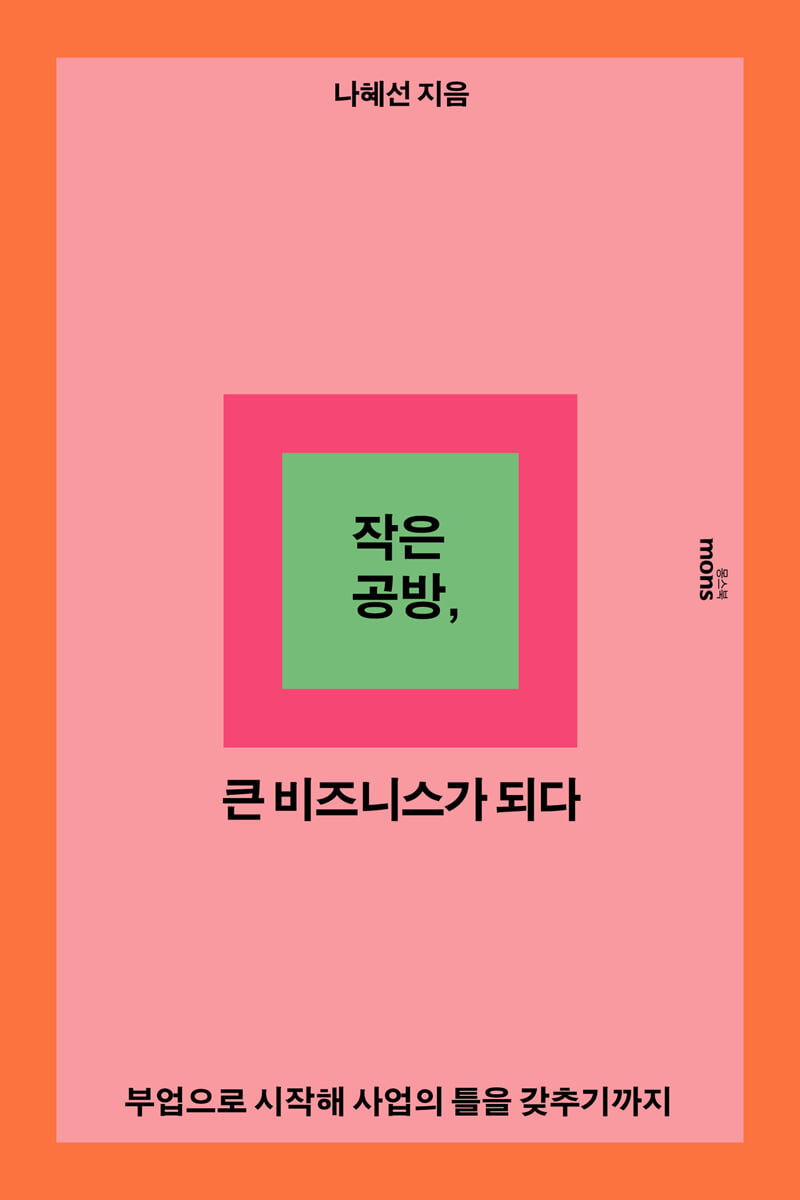
From a small workshop to a big business
 |
Description
Book Introduction
From a hobby workshop to a brand!
From content planning to distribution and marketing…
I poured everything I learned through real-life experience into one book.
This book isn't simply a formula for success, but rather a guide to how one entrepreneur created his own brand structure and the criteria he used to create content and build his brand.
It's okay for a brand to start with a sense.
But to last, it must ultimately be operated as a structure.
- In the text
“This is a small brand textbook created from the author’s lived experience.”
- Lee Geun-sang (brand expert, author of "This is a book for small brands")
From content planning to distribution and marketing…
I poured everything I learned through real-life experience into one book.
This book isn't simply a formula for success, but rather a guide to how one entrepreneur created his own brand structure and the criteria he used to create content and build his brand.
It's okay for a brand to start with a sense.
But to last, it must ultimately be operated as a structure.
- In the text
“This is a small brand textbook created from the author’s lived experience.”
- Lee Geun-sang (brand expert, author of "This is a book for small brands")
- You can preview some of the book's contents.
Preview
index
Prologue 5
PART 1 From Side Hustle to Entrepreneurship
I, Assistant Manager 13, quit my job after secretly working a side job.
My first business venture, starting with no money or connections. 18
Selling products I made with my own hands 22
The moment I became a teacher from a substitute 27
32 Inconvenient Truths No One Tells You
39 Moments I Most Regret Resigning
43 Things I Want to Tell Myself During the Early Days of Starting a Business, When I Was Feeling Anxious
PART 2: Even a One-Person Business Can Become a Business: The SOLID Growth Formula
51 Misconceptions and Prejudices About Workshops
Step 1.
Structure: Building a Brand Foundation (1) - Half the Market 55
Structure: Building a Brand Foundation (2) - 60 CEOs Talking to Themselves
Step 2.
Opportunity: Creating various opportunities - Customers want me
How to Make It Discoverable 65
Step 3.
Leverage: Expanding Your Revenue Model
How much can you earn on your own? 72
Step 4.
Impact: Connecting with Customers
-Customers who buy based on emotion 89
Step 5.
Dominate: Differentiation Strategy
-Pioneering a Market Without Competition 95
PART 3: What Happens When a Brand Grows Big
12:00 AM, Call 107 from Customer
When to Hire Staff 114
Starting with a 5-pyeong store, 123 overseas
Beyond Flowers to Culture 132
PART 4: Don't Start a One-Person Business Without Social Media
How to Maximize Sales with Zero Advertising Spend 139
Pigeon Trigger Stage 1: Discovery
-146 Ways to 'Make People See You Again' Among the Numerous Feeds
Pigeon Trigger Stage 2: Inflow
- Account design that inspires trust just by looking at the profile 152
Pigeon Trigger Stage 3: Trust
- A structure that allows customers to trust and make their first payment 157
Pigeon Trigger Step 4: Drive Purchase
How to Win Over Hesitant Customers 163
Pigeon Trigger Stage 5: Switch to Fan
-Creating a Structure That Will Recur Voluntarily 169
175 Platforms You Must Have for Doing Business in Korea
Do I have to do this? 194
208 Things I Learned from Earning 10 Million Won a Month
The person who changed me, even though I didn't know the basics of marketing. 215
PART 5 How to Work Without Losing Myself
I want to live in a world without social media 229
The Difference Between Ordinary and Extraordinary People 235
What did we come here for? 239
When neither works, try 100 times 242
PART 6 People Who Make Their Own Path
249 To You Who Are Lost and Wandering
The Road I Thought I Walked Alone 256
It's impossible for me to succeed alone 260
3G Formula 266: Creating Opportunities
Epilogue 273
PART 1 From Side Hustle to Entrepreneurship
I, Assistant Manager 13, quit my job after secretly working a side job.
My first business venture, starting with no money or connections. 18
Selling products I made with my own hands 22
The moment I became a teacher from a substitute 27
32 Inconvenient Truths No One Tells You
39 Moments I Most Regret Resigning
43 Things I Want to Tell Myself During the Early Days of Starting a Business, When I Was Feeling Anxious
PART 2: Even a One-Person Business Can Become a Business: The SOLID Growth Formula
51 Misconceptions and Prejudices About Workshops
Step 1.
Structure: Building a Brand Foundation (1) - Half the Market 55
Structure: Building a Brand Foundation (2) - 60 CEOs Talking to Themselves
Step 2.
Opportunity: Creating various opportunities - Customers want me
How to Make It Discoverable 65
Step 3.
Leverage: Expanding Your Revenue Model
How much can you earn on your own? 72
Step 4.
Impact: Connecting with Customers
-Customers who buy based on emotion 89
Step 5.
Dominate: Differentiation Strategy
-Pioneering a Market Without Competition 95
PART 3: What Happens When a Brand Grows Big
12:00 AM, Call 107 from Customer
When to Hire Staff 114
Starting with a 5-pyeong store, 123 overseas
Beyond Flowers to Culture 132
PART 4: Don't Start a One-Person Business Without Social Media
How to Maximize Sales with Zero Advertising Spend 139
Pigeon Trigger Stage 1: Discovery
-146 Ways to 'Make People See You Again' Among the Numerous Feeds
Pigeon Trigger Stage 2: Inflow
- Account design that inspires trust just by looking at the profile 152
Pigeon Trigger Stage 3: Trust
- A structure that allows customers to trust and make their first payment 157
Pigeon Trigger Step 4: Drive Purchase
How to Win Over Hesitant Customers 163
Pigeon Trigger Stage 5: Switch to Fan
-Creating a Structure That Will Recur Voluntarily 169
175 Platforms You Must Have for Doing Business in Korea
Do I have to do this? 194
208 Things I Learned from Earning 10 Million Won a Month
The person who changed me, even though I didn't know the basics of marketing. 215
PART 5 How to Work Without Losing Myself
I want to live in a world without social media 229
The Difference Between Ordinary and Extraordinary People 235
What did we come here for? 239
When neither works, try 100 times 242
PART 6 People Who Make Their Own Path
249 To You Who Are Lost and Wandering
The Road I Thought I Walked Alone 256
It's impossible for me to succeed alone 260
3G Formula 266: Creating Opportunities
Epilogue 273
Detailed image

Into the book
When the small seed of 'starting a flower shop' began to grow in my mind, I hastily registered a business.
From then on, I rented a pretty studio and gathered my acquaintances to hold flower classes.
I go to work during the weekdays and open classes for my office friends on Friday evenings and weekends.
--- p.14, from “I, the manager, quit my job after secretly doing a side job”
Nevertheless, I say, “If I could go back in time, I would start a business again.”
The biggest reason is the sense of accomplishment. Although I have to make all the decisions on my own, I can see the results of my work right before my eyes, which is different from my work life.
Although there were responsibilities when performance was poor, the process of supplementing and improving it was also enjoyable.
--- p.38, from “The Moment I Most Regret Resigning”
So how should a workshop make money? As it turns out, there are various revenue models for workshops beyond sales.
You can secure long-term customers by running subscription-based classes, and you can also expand into other forms such as corporate lectures and online courses.
Selling kit products that can be linked to classes is much more stable than selling products alone.
You can also generate additional revenue by participating in flea markets, collaborating with other brands, and renting out space.
--- p.52, from “Misunderstandings and Prejudices About Workshops”
Many brands want and wait for partnerships, but successful brands create them themselves.
Think about which companies can create synergy with your brand, why their customers might need your product, and what value you can provide to them.
When proposing a partnership, it is most important to clearly communicate the value the other party will gain.
Through this partnership, we must convey the value that both parties and their customers can obtain.
It is also important to prepare a portfolio and case studies that can inspire trust.
--- p.71, 「Step 2.
Opportunity: Creating Diverse Opportunities - How to Make Customers Discover Me
Ultimately, branding and marketing are two essential axes for small brands to grow.
If you want to increase sales in the short term, you can do it with marketing alone.
However, branding is essential to ensure that customers believe in the value of the brand and come back to it in the long run.
Conversely, no matter how good your branding is, if your marketing is lacking, you won't be able to reach your customers.
Especially for one-person brands or small businesses, it's important to share your brand's story and connect emotionally with your customers, rather than simply "selling" a product.
--- p.93, 「Step 4.
Impact: Connecting with Customers - Customers Who Buy with Emotion
Consumers are generally wary and suspicious of individuals or brands.
It means that you don't like someone from the beginning.
However, depending on how I position myself on social media and what devices I install, customers who used to look at me coldly could become my fans.
The Pigeon Trigger is a strategic way to unleash this flow.
--- p.144, from “How to Maximize Sales with 0 Won in Advertising”
Consumers search to find information that will solve their problems.
That's why blog posts shouldn't be about introducing your brand, but about raising issues that consumers can relate to and presenting clear solutions.
A piece of writing structured this way is not just a one-time read, but it also serves to gain the trust of consumers and encourage them to take the next action.
--- p.185, from “A platform you must have if you want to do business in Korea”
I no longer compare my speed with others.
I care more about how I am going at my own pace and in accordance with my own heart than how far someone else has gone.
Going forward, I want to run a brand that resonates with people, create content that isn't consumed quickly, and create a structure that moves slowly so that those walking alongside don't tire.
That's the life I really wanted, the way I was happiest, and the direction I want to continue to lead.
--- p.241, from “What Did We Come Here For?”
I've learned from experience how having only one direction in business can slow down growth.
So I hope you don't make the same mistakes I did in the past.
When Samsung first started out, it sold noodles, and CJ sold sugar.
Netflix was a DVD rental company, and Tiffany & Co., surprisingly, was a stationery store.
If you think about what these companies are today, their initial business models are hard to imagine.
--- p.253, from “To You Who Are Lost and Wandering”
If you decide to become a giver, there is one thing you must be careful about: don't give unconditionally.
It is confusing to say that a giver is someone who gives and shares, but then to say that you should not give.
We must become 'balanced givers', not just givers.
Adam Grant writes in Give and Take, “Successful givers know how to look after their own interests as well as those of others.
“They are interested in benefiting others, but they also set ambitious goals for their own benefit,” he said.
From then on, I rented a pretty studio and gathered my acquaintances to hold flower classes.
I go to work during the weekdays and open classes for my office friends on Friday evenings and weekends.
--- p.14, from “I, the manager, quit my job after secretly doing a side job”
Nevertheless, I say, “If I could go back in time, I would start a business again.”
The biggest reason is the sense of accomplishment. Although I have to make all the decisions on my own, I can see the results of my work right before my eyes, which is different from my work life.
Although there were responsibilities when performance was poor, the process of supplementing and improving it was also enjoyable.
--- p.38, from “The Moment I Most Regret Resigning”
So how should a workshop make money? As it turns out, there are various revenue models for workshops beyond sales.
You can secure long-term customers by running subscription-based classes, and you can also expand into other forms such as corporate lectures and online courses.
Selling kit products that can be linked to classes is much more stable than selling products alone.
You can also generate additional revenue by participating in flea markets, collaborating with other brands, and renting out space.
--- p.52, from “Misunderstandings and Prejudices About Workshops”
Many brands want and wait for partnerships, but successful brands create them themselves.
Think about which companies can create synergy with your brand, why their customers might need your product, and what value you can provide to them.
When proposing a partnership, it is most important to clearly communicate the value the other party will gain.
Through this partnership, we must convey the value that both parties and their customers can obtain.
It is also important to prepare a portfolio and case studies that can inspire trust.
--- p.71, 「Step 2.
Opportunity: Creating Diverse Opportunities - How to Make Customers Discover Me
Ultimately, branding and marketing are two essential axes for small brands to grow.
If you want to increase sales in the short term, you can do it with marketing alone.
However, branding is essential to ensure that customers believe in the value of the brand and come back to it in the long run.
Conversely, no matter how good your branding is, if your marketing is lacking, you won't be able to reach your customers.
Especially for one-person brands or small businesses, it's important to share your brand's story and connect emotionally with your customers, rather than simply "selling" a product.
--- p.93, 「Step 4.
Impact: Connecting with Customers - Customers Who Buy with Emotion
Consumers are generally wary and suspicious of individuals or brands.
It means that you don't like someone from the beginning.
However, depending on how I position myself on social media and what devices I install, customers who used to look at me coldly could become my fans.
The Pigeon Trigger is a strategic way to unleash this flow.
--- p.144, from “How to Maximize Sales with 0 Won in Advertising”
Consumers search to find information that will solve their problems.
That's why blog posts shouldn't be about introducing your brand, but about raising issues that consumers can relate to and presenting clear solutions.
A piece of writing structured this way is not just a one-time read, but it also serves to gain the trust of consumers and encourage them to take the next action.
--- p.185, from “A platform you must have if you want to do business in Korea”
I no longer compare my speed with others.
I care more about how I am going at my own pace and in accordance with my own heart than how far someone else has gone.
Going forward, I want to run a brand that resonates with people, create content that isn't consumed quickly, and create a structure that moves slowly so that those walking alongside don't tire.
That's the life I really wanted, the way I was happiest, and the direction I want to continue to lead.
--- p.241, from “What Did We Come Here For?”
I've learned from experience how having only one direction in business can slow down growth.
So I hope you don't make the same mistakes I did in the past.
When Samsung first started out, it sold noodles, and CJ sold sugar.
Netflix was a DVD rental company, and Tiffany & Co., surprisingly, was a stationery store.
If you think about what these companies are today, their initial business models are hard to imagine.
--- p.253, from “To You Who Are Lost and Wandering”
If you decide to become a giver, there is one thing you must be careful about: don't give unconditionally.
It is confusing to say that a giver is someone who gives and shares, but then to say that you should not give.
We must become 'balanced givers', not just givers.
Adam Grant writes in Give and Take, “Successful givers know how to look after their own interests as well as those of others.
“They are interested in benefiting others, but they also set ambitious goals for their own benefit,” he said.
--- p.262, from “It is impossible for only me to succeed”
Publisher's Review
From a hobby workshop to a brand
Would you believe that a small flower shop that started as a side job for an office worker has grown into a business with monthly sales of 100 million won?
"From Small Workshop to Big Business" is not just a simple success story, but a vivid account of a female entrepreneur who turned "what she loves" into a "sustainable structure."
The author has compiled, without reservation, the experiences and realizations she has had throughout her journey, from working as an employee at a fashion company, to learning about flowers, to opening a small workshop, and then growing that workshop into a brand.
He redefined the brand by embodying the simple truth that “a sense is just a sense, and a brand needs structure.”
This book is not simply a manual that says, “If you do it this way, it will work out well.”
This is the story of one entrepreneur overcoming emotional anxiety and growing into a 'brand with a system.'
He started his workshop as a small hobby and built a brand ecosystem encompassing education, content, distribution, and planning.
“It’s okay for a brand to start with a sense.
But to last, you have to operate with structure.” This sentence serves as a realistic guideline for all solo entrepreneurs who work with emotion but must survive with structure.
A realistic methodology for one-person brands to grow.
The book presents the "SOLID Growth Formula," a realistic methodology for one-person brands to grow like businesses.
Structure (building a brand foundation), Opportunity (creating opportunities), Leverage (expanding the revenue model), Impact (emotionally connecting with customers), Dominate (differentiation strategy).
These five steps are the core roadmap for emotional brands to simultaneously achieve sales and structure.
“It’s not that workshops don’t make money.
“You can’t run a business in a way that doesn’t make money.” This one sentence provides a turning point in ‘strategic management’ to all individual entrepreneurs who started out as a hobby.
The author's philosophy of "run like a business, even if you're alone" expands into a practical strategy applicable across all emotional industries, including crafts, design, and education.
Pigeon Trigger: Maximize Sales with Zero Advertising Costs
One of the interesting concepts featured in this book is the 'Pigeon Trigger', developed by the author himself.
This structure is a marketing formula that scientifically analyzes the five-step journey that customers take: discovering a brand → attracting customers → trusting customers → purchasing customers → becoming fans.
The author realized this one day when a man came up to him through a crack in the door during class and asked, “Do you need a pigeon?”
“If that person had been an influencer with 300,000 followers, I would have accepted him as a ‘necessary person’ rather than a ‘weird person.’” This anecdote is the background of the birth of Pigeon Trigger.
She emphasizes:
“We remember brands very differently depending on who says it and how it looks.” This insight encapsulates his marketing philosophy of designing brands to be “discoverable” without spending money on advertising.
Two hours after work can change your life.
Many workers dream of quitting their jobs, but most of them remain as an 'emotional decision.'
This book firmly states that 'preparation is more important than quitting a job.'
The author recalls his days of working at a company and running a side job, writing:
“What’s more important than quitting a job is preparation.
“Leaving a job without preparation can be unsettling, but leaving after thorough preparation can be an exciting first step.”
He spent two hours after work repeatedly simulating his side job.
We calculated based on 'profit' rather than 'sales', checked our stamina and sustainability, and made a realistic retirement plan.
As a result, I was able to transition from an anxious resignation to a 'prepared entrepreneurship'.
This simple and easy message that two hours after work can change your life is a powerful and realistic piece of advice for anyone who is hesitating to quit their job or take on a challenge, even at this very moment.
Would you believe that a small flower shop that started as a side job for an office worker has grown into a business with monthly sales of 100 million won?
"From Small Workshop to Big Business" is not just a simple success story, but a vivid account of a female entrepreneur who turned "what she loves" into a "sustainable structure."
The author has compiled, without reservation, the experiences and realizations she has had throughout her journey, from working as an employee at a fashion company, to learning about flowers, to opening a small workshop, and then growing that workshop into a brand.
He redefined the brand by embodying the simple truth that “a sense is just a sense, and a brand needs structure.”
This book is not simply a manual that says, “If you do it this way, it will work out well.”
This is the story of one entrepreneur overcoming emotional anxiety and growing into a 'brand with a system.'
He started his workshop as a small hobby and built a brand ecosystem encompassing education, content, distribution, and planning.
“It’s okay for a brand to start with a sense.
But to last, you have to operate with structure.” This sentence serves as a realistic guideline for all solo entrepreneurs who work with emotion but must survive with structure.
A realistic methodology for one-person brands to grow.
The book presents the "SOLID Growth Formula," a realistic methodology for one-person brands to grow like businesses.
Structure (building a brand foundation), Opportunity (creating opportunities), Leverage (expanding the revenue model), Impact (emotionally connecting with customers), Dominate (differentiation strategy).
These five steps are the core roadmap for emotional brands to simultaneously achieve sales and structure.
“It’s not that workshops don’t make money.
“You can’t run a business in a way that doesn’t make money.” This one sentence provides a turning point in ‘strategic management’ to all individual entrepreneurs who started out as a hobby.
The author's philosophy of "run like a business, even if you're alone" expands into a practical strategy applicable across all emotional industries, including crafts, design, and education.
Pigeon Trigger: Maximize Sales with Zero Advertising Costs
One of the interesting concepts featured in this book is the 'Pigeon Trigger', developed by the author himself.
This structure is a marketing formula that scientifically analyzes the five-step journey that customers take: discovering a brand → attracting customers → trusting customers → purchasing customers → becoming fans.
The author realized this one day when a man came up to him through a crack in the door during class and asked, “Do you need a pigeon?”
“If that person had been an influencer with 300,000 followers, I would have accepted him as a ‘necessary person’ rather than a ‘weird person.’” This anecdote is the background of the birth of Pigeon Trigger.
She emphasizes:
“We remember brands very differently depending on who says it and how it looks.” This insight encapsulates his marketing philosophy of designing brands to be “discoverable” without spending money on advertising.
Two hours after work can change your life.
Many workers dream of quitting their jobs, but most of them remain as an 'emotional decision.'
This book firmly states that 'preparation is more important than quitting a job.'
The author recalls his days of working at a company and running a side job, writing:
“What’s more important than quitting a job is preparation.
“Leaving a job without preparation can be unsettling, but leaving after thorough preparation can be an exciting first step.”
He spent two hours after work repeatedly simulating his side job.
We calculated based on 'profit' rather than 'sales', checked our stamina and sustainability, and made a realistic retirement plan.
As a result, I was able to transition from an anxious resignation to a 'prepared entrepreneurship'.
This simple and easy message that two hours after work can change your life is a powerful and realistic piece of advice for anyone who is hesitating to quit their job or take on a challenge, even at this very moment.
GOODS SPECIFICS
- Date of issue: November 5, 2025
- Page count, weight, size: 276 pages | 360g | 140*210*16mm
- ISBN13: 9791199539211
- ISBN10: 119953921X
You may also like
카테고리
korean


korean

![GQ KOREA Mark (Monthly): December [2025]](http://librairie.coreenne.fr/cdn/shop/files/8ef265dbbfbf186523ed75ba7319009d.jpg?v=1765340328&width=3840)


