

Psychopathic Neuroscientist
 |
Description
Book Introduction
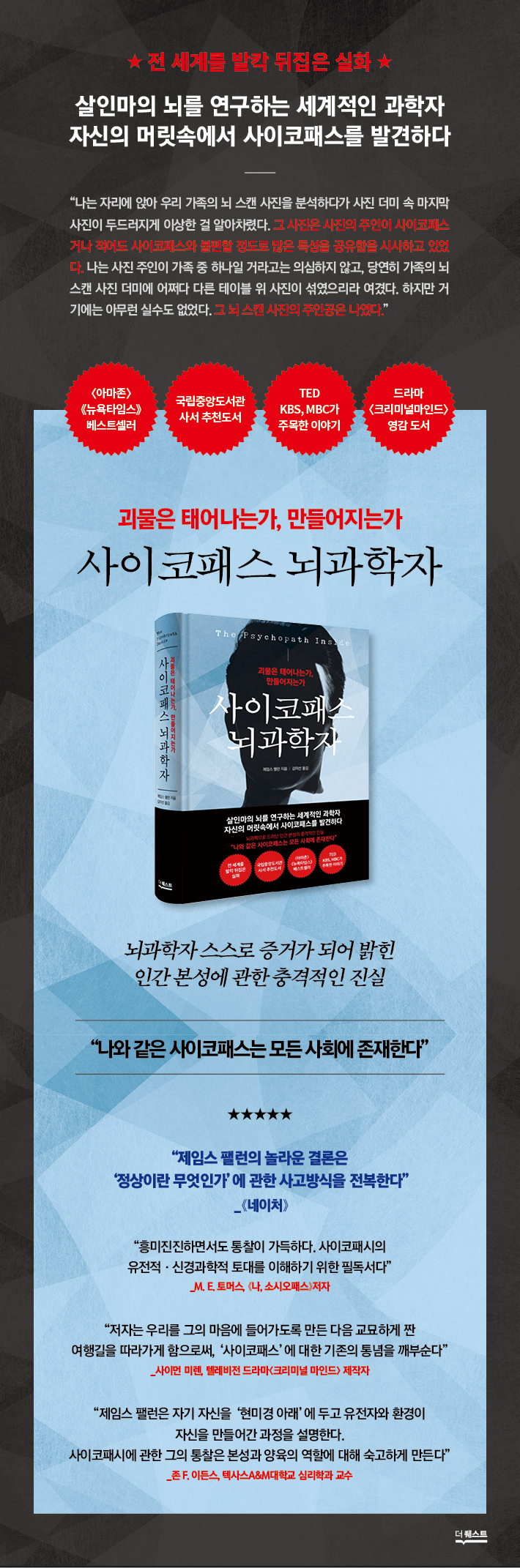
A world-renowned scientist studying the brains of murderers
Discovering the Psychopath in Your Own Head
“I was sitting there analyzing my family’s brain scans when I noticed something particularly odd about the last one in the pile.
The photo suggested that the owner of the photo was a psychopath, or at least shared an uncomfortably high number of traits with a psychopath.
I had no doubt that the photo belonged to a family member, and I assumed that the photo on the table had just happened to be mixed in with the pile of family brain scans.
But there was no mistake there.
“I was the subject of that brain scan.”
"Psychopathic Neuroscientist" begins with James Fallon, a world-renowned scientist who studies the brains of murderers, discovering the characteristics of a psychopath in his own brain scan.
His story was first revealed to the world through TED in 2008, and it caused a huge stir, including being used as material for the American drama series [Criminal Minds] and being featured on the front page of the Wall Street Journal.
The true story of this world-changing scientist raises profound and fascinating questions about humanity.
"How did I, born a typical psychopath, not become a criminal?" "Why does nature continue to allow psychopaths to be born?" "Can psychopaths love?" "Are psychopaths born or made?" "Psychopath Neuroscientist" contains a self-exploration by a scientist with a psychopath's brain, as well as philosophical and scientific questions and reflections on humanity.
Discovering the Psychopath in Your Own Head
“I was sitting there analyzing my family’s brain scans when I noticed something particularly odd about the last one in the pile.
The photo suggested that the owner of the photo was a psychopath, or at least shared an uncomfortably high number of traits with a psychopath.
I had no doubt that the photo belonged to a family member, and I assumed that the photo on the table had just happened to be mixed in with the pile of family brain scans.
But there was no mistake there.
“I was the subject of that brain scan.”
"Psychopathic Neuroscientist" begins with James Fallon, a world-renowned scientist who studies the brains of murderers, discovering the characteristics of a psychopath in his own brain scan.
His story was first revealed to the world through TED in 2008, and it caused a huge stir, including being used as material for the American drama series [Criminal Minds] and being featured on the front page of the Wall Street Journal.
The true story of this world-changing scientist raises profound and fascinating questions about humanity.
"How did I, born a typical psychopath, not become a criminal?" "Why does nature continue to allow psychopaths to be born?" "Can psychopaths love?" "Are psychopaths born or made?" "Psychopath Neuroscientist" contains a self-exploration by a scientist with a psychopath's brain, as well as philosophical and scientific questions and reflections on humanity.
- You can preview some of the book's contents.
Preview
index
Entering: Are monsters born or made?
Chapter 1 ◆ What is a Psychopath?
The PCL-R: A Psychopath Diagnostic Tool That's Not Perfect | Am I Really a Psychopath?
Chapter 2 ◆ Ominous Signs of Growth
A Teenager with Obsessive-Compulsive Disorder | The Beginning of Panic Attacks | The Monster Seen in Others' Eyes
Chapter 3 ◆ There's a monster living in my head
What the Left and Right Brain Concepts Don't Tell You | The Psychopath's Brain | Finally Discovered
Chapter 4 ◆ My Ancestors Were Murderers
The Secret Behind 95 Percent of Mystery | The Complex Labyrinth of Psychopathy Genetics | A Genetic Phonebook Full of Codes
Chapter 5 ◆ Conditions of a Psychopath
The Interplay of Environment and Genetics: Epigenetics | How Psychopathy Develops | Indigo and Orchid Children | Three Factors That Make You a Psychopathy
Chapter 6 ◆ The Monster Finally Reveals Itself to the World
The World Is Taking Notice of My Brain | What's Different About My Brain? | Smooth vs. Difficult Interaction Between Circuits | Even Torture Porn Experts Might Not Be Psychopaths
Chapter 7: Can Psychopaths Love?
There's Something About Weight | Empathy and Mirror Neurons | Even Psychopaths Can Love | A Life-Risking Adventure | Bill Clinton is a Psychopath | Saints and Hypocrisy | I Gained Enlightenment from an Intense Dream
Chapter 8 ◆ The Abyss of Monsters
Suspecting Bipolar Disorder | The Link Between Depression and Bipolar Disorder | Falling into a Black Hole
Chapter 9: Can Psychopaths Change?
Me as Seen Through Others' Eyes | Two Heartbreaking Letters | Those Who Leave and Those Who Stay | Can I Change? | I Will Keep Trying
Chapter 10: Psychopaths Exist in Every Society
2% of any group is psychopathic | Psychopaths perpetuate humanity | Proper parenting is essential
Chapter 1 ◆ What is a Psychopath?
The PCL-R: A Psychopath Diagnostic Tool That's Not Perfect | Am I Really a Psychopath?
Chapter 2 ◆ Ominous Signs of Growth
A Teenager with Obsessive-Compulsive Disorder | The Beginning of Panic Attacks | The Monster Seen in Others' Eyes
Chapter 3 ◆ There's a monster living in my head
What the Left and Right Brain Concepts Don't Tell You | The Psychopath's Brain | Finally Discovered
Chapter 4 ◆ My Ancestors Were Murderers
The Secret Behind 95 Percent of Mystery | The Complex Labyrinth of Psychopathy Genetics | A Genetic Phonebook Full of Codes
Chapter 5 ◆ Conditions of a Psychopath
The Interplay of Environment and Genetics: Epigenetics | How Psychopathy Develops | Indigo and Orchid Children | Three Factors That Make You a Psychopathy
Chapter 6 ◆ The Monster Finally Reveals Itself to the World
The World Is Taking Notice of My Brain | What's Different About My Brain? | Smooth vs. Difficult Interaction Between Circuits | Even Torture Porn Experts Might Not Be Psychopaths
Chapter 7: Can Psychopaths Love?
There's Something About Weight | Empathy and Mirror Neurons | Even Psychopaths Can Love | A Life-Risking Adventure | Bill Clinton is a Psychopath | Saints and Hypocrisy | I Gained Enlightenment from an Intense Dream
Chapter 8 ◆ The Abyss of Monsters
Suspecting Bipolar Disorder | The Link Between Depression and Bipolar Disorder | Falling into a Black Hole
Chapter 9: Can Psychopaths Change?
Me as Seen Through Others' Eyes | Two Heartbreaking Letters | Those Who Leave and Those Who Stay | Can I Change? | I Will Keep Trying
Chapter 10: Psychopaths Exist in Every Society
2% of any group is psychopathic | Psychopaths perpetuate humanity | Proper parenting is essential
Detailed image
Into the book
While the very existence of psychopathy is a matter of debate, psychiatrists generally agree that one defining characteristic of those we call psychopaths is a lack of interpersonal empathy.
(…) Even the most dangerous psychopaths may at times appear cheerful, carefree, and sociable, but eventually they will reveal a marked distance, a quiet coldness, and an indifference to others.
Psychopaths are often impulsive but lack guilt or remorse, meaning they'll drag you into reckless and even dangerous pranks, only to shrug their shoulders if someone gets hurt.
--- From "Chapter 1, What is a Psychopath"
All of this is lumped into the limbic cortex, the cortex associated with processing and elaborating emotions.
This region is crucial for understanding the brains of psychopaths because the limbic cortex, as well as the orbitofrontal cortex and ventromedial prefrontal cortex, have been found to be maldeveloped or damaged early on.
This finding was not surprising, as all of these brain regions have already been linked to individual syndromes that contribute to impaired inhibition, hypersexuality, and difficulties with moral reasoning.
Surprisingly, while all psychopaths had reduced activity in these brain regions, other types of criminals, such as common murderers, showed a different pattern.
In the typical killer, one of these areas often exhibits dysfunction, but not all at once.
--- From "Chapter 3, There's a Monster Living in My Head"
The Rebecca Cornell case was one of the first matricides to occur in the American colonies.
(…) Rebecca was also a direct ancestor of Lizzie Borden, who was convicted of murdering her father and stepmother with an axe in 1892.
Rebecca's descendant, Alvin Cornell, murdered his wife Hannah in 1843 by beating her with an iron spade handle and then slitting her throat with a razor blade.
Perhaps the Cornell family's penchant for murder, killing their own clan, wasn't a damned part of our family's history.
--- From "Chapter 4, My Ancestors Were Murderers"
Almost everyone in my family had the warrior gene.
Some also had other aggressive genes.
I was the same way.
(…) Nike's article, featuring my brain scans and genetic test results, appeared on the front page of the Wall Street Journal on November 30, 2009, under the provocative headline, "What's Going on in Jim Fallon's Mind? A Family Secret Destined to Be Revealed: What Happened to a Scientist Studying a Killer."
--- From "Chapter 6, The Monster Finally Reveals Itself to the World"
What was most disconcerting wasn't that the whole world knew I was the descendant of a long line of deranged gangsters.
The fact that I myself was a walking, talking piece of evidence refuting my own theory that 'we live as we are born'.
(…) I was someone who spent decades preaching genetic determinism.
So the fact that I was supposed to be a very violent person based on my genes and my brain's temperament, but I wasn't, meant I was in for a huge humiliation in front of my neuroscience colleagues who insisted on a 50/50 nature-nurture ratio.
--- From "Chapter 6, The Monster Reveals Itself to the World"
I knew that even when people around me were crying over tragic or sad events, I wouldn't shed a tear or my heart wouldn't beat.
The reason I remember when John F. Kennedy was shot is because the people around me were shaken, and I was more interested in the circumstances of the incident.
One day while working at the University of Nairobi, I walked into the morgue and saw a girl in a white dress lying on a metal morgue.
I saw the child and said a word to the bereaved family.
“The dress is nice.”
--- From "Chapter 7, Can Psychopaths Love?"
While I can't diagnose Clinton as a psychopath, he seems to have several key traits and would probably score at least a 15 on the PCL-R.
(…) Clinton was a master of mimicry, such as raising his hand and saluting the troops, feigning humility when receiving applause, and appearing slightly somber at funerals, then acting profoundly sad the next.
People who aren't psychopaths can make up stories, but only those with true psychopathic traits can repeatedly perform such high-stakes, high-difficulty acts.
--- From "Chapter 7, Can Psychopaths Love?"
Psychopaths can be capable leaders.
A recent study from the California Institute of Technology found that people with the warrior gene make better decisions even in risky situations.
While most people can't move in stressful situations, psychopaths are willing to gamble.
Even in uncertain times, we will enter new markets, move our armies, or lead our tribes across mountains.
As a result, the group he is in charge of may or may not do well.
But in the long run, encouraging groups to take risks is beneficial to civilization.
This means that although most mutations have negative consequences, some mutations provide significant benefits.
--- From "Chapter 10, Psychopaths Exist in Every Society"
I don't think we should eliminate psychopathy and its genes from society.
If we do that, humanity will eventually disappear.
We need to identify people with psychopathic traits early in life and keep them out of trouble.
Even people who are awkward at empathy and prone to aggression can have a positive impact if handled well.
(…) Even the most dangerous psychopaths may at times appear cheerful, carefree, and sociable, but eventually they will reveal a marked distance, a quiet coldness, and an indifference to others.
Psychopaths are often impulsive but lack guilt or remorse, meaning they'll drag you into reckless and even dangerous pranks, only to shrug their shoulders if someone gets hurt.
--- From "Chapter 1, What is a Psychopath"
All of this is lumped into the limbic cortex, the cortex associated with processing and elaborating emotions.
This region is crucial for understanding the brains of psychopaths because the limbic cortex, as well as the orbitofrontal cortex and ventromedial prefrontal cortex, have been found to be maldeveloped or damaged early on.
This finding was not surprising, as all of these brain regions have already been linked to individual syndromes that contribute to impaired inhibition, hypersexuality, and difficulties with moral reasoning.
Surprisingly, while all psychopaths had reduced activity in these brain regions, other types of criminals, such as common murderers, showed a different pattern.
In the typical killer, one of these areas often exhibits dysfunction, but not all at once.
--- From "Chapter 3, There's a Monster Living in My Head"
The Rebecca Cornell case was one of the first matricides to occur in the American colonies.
(…) Rebecca was also a direct ancestor of Lizzie Borden, who was convicted of murdering her father and stepmother with an axe in 1892.
Rebecca's descendant, Alvin Cornell, murdered his wife Hannah in 1843 by beating her with an iron spade handle and then slitting her throat with a razor blade.
Perhaps the Cornell family's penchant for murder, killing their own clan, wasn't a damned part of our family's history.
--- From "Chapter 4, My Ancestors Were Murderers"
Almost everyone in my family had the warrior gene.
Some also had other aggressive genes.
I was the same way.
(…) Nike's article, featuring my brain scans and genetic test results, appeared on the front page of the Wall Street Journal on November 30, 2009, under the provocative headline, "What's Going on in Jim Fallon's Mind? A Family Secret Destined to Be Revealed: What Happened to a Scientist Studying a Killer."
--- From "Chapter 6, The Monster Finally Reveals Itself to the World"
What was most disconcerting wasn't that the whole world knew I was the descendant of a long line of deranged gangsters.
The fact that I myself was a walking, talking piece of evidence refuting my own theory that 'we live as we are born'.
(…) I was someone who spent decades preaching genetic determinism.
So the fact that I was supposed to be a very violent person based on my genes and my brain's temperament, but I wasn't, meant I was in for a huge humiliation in front of my neuroscience colleagues who insisted on a 50/50 nature-nurture ratio.
--- From "Chapter 6, The Monster Reveals Itself to the World"
I knew that even when people around me were crying over tragic or sad events, I wouldn't shed a tear or my heart wouldn't beat.
The reason I remember when John F. Kennedy was shot is because the people around me were shaken, and I was more interested in the circumstances of the incident.
One day while working at the University of Nairobi, I walked into the morgue and saw a girl in a white dress lying on a metal morgue.
I saw the child and said a word to the bereaved family.
“The dress is nice.”
--- From "Chapter 7, Can Psychopaths Love?"
While I can't diagnose Clinton as a psychopath, he seems to have several key traits and would probably score at least a 15 on the PCL-R.
(…) Clinton was a master of mimicry, such as raising his hand and saluting the troops, feigning humility when receiving applause, and appearing slightly somber at funerals, then acting profoundly sad the next.
People who aren't psychopaths can make up stories, but only those with true psychopathic traits can repeatedly perform such high-stakes, high-difficulty acts.
--- From "Chapter 7, Can Psychopaths Love?"
Psychopaths can be capable leaders.
A recent study from the California Institute of Technology found that people with the warrior gene make better decisions even in risky situations.
While most people can't move in stressful situations, psychopaths are willing to gamble.
Even in uncertain times, we will enter new markets, move our armies, or lead our tribes across mountains.
As a result, the group he is in charge of may or may not do well.
But in the long run, encouraging groups to take risks is beneficial to civilization.
This means that although most mutations have negative consequences, some mutations provide significant benefits.
--- From "Chapter 10, Psychopaths Exist in Every Society"
I don't think we should eliminate psychopathy and its genes from society.
If we do that, humanity will eventually disappear.
We need to identify people with psychopathic traits early in life and keep them out of trouble.
Even people who are awkward at empathy and prone to aggression can have a positive impact if handled well.
--- From "Chapter 10, Psychopaths Exist in Every Society"
Publisher's Review
★A true story that shook the world★
"James Fallon's surprising conclusion overturns our thinking about what is normal." _Nature
A shocking confession from a world-renowned scientist
“My ancestors were murderers, and I am a psychopath.”
James Fallon, a successful neuroscientist and medical school professor, one day discovers the characteristics of a psychopath in a picture of his own brain.
He half-believes and half-doubts as he examines his family tree, and he also discovers that many of his ancestors are murderers.
Thomas Cornell, the perpetrator of the first matricide in the American colonies, Alvin Cornell, who murdered his wife by beating her with an iron spade, and even going back further, King John Lackland, known for being one of the most brutal men in British history, are all notorious and suspected psychopaths.
Moreover, genetic analysis reveals that he and his family members carry a variant of the MAOA gene, also known as the warrior gene, which is linked to aggressive behavior.
There's no doubt that James Fallon was born a psychopath.
However, Fallon grew up in a warm home, is the father of three children, and is a sociable person with many friends.
In 2000, he discovered the first evidence of the possibility of using adult stem cells to treat various neurodegenerative diseases, including Parkinson's disease and stroke, and his company, NeuroRepair, achieved great success both academically and commercially, including being selected by the National Biotechnology Association.
How can this caring father, who has no violent record and is externally successful, be a psychopath?
Not all psychopaths become criminals?
The "Conditions of a Psychopath" Revealed by Neuroscientists
In early 2020, the Nth Room and Doctor Room incidents were in the news every day.
People were shocked by the brutality of the crime, but they were also shocked by the fact that the perpetrators were seemingly ordinary men in their 20s.
They were all men I would never think of again even if I passed them on the street.
James Fallon says even the most dangerous psychopaths can sometimes appear cheerful, carefree, and sociable.
It was also believed that even if a person is born a psychopath, psychopathy will not develop unless all three of the following factors are present.
First, unusual hypofunction of the anterior temporal lobe, including the orbitofrontal cortex and amygdala.
Second, several high-risk mutant genes represented by transcription factors.
Third, emotional, physical, and sexual abuse in early childhood.
(Analyzing PET scans of psychopathic killers over a decade) found that the killers' brains commonly had impaired function in certain parts of the frontal and temporal lobes, areas of the brain often associated with self-control and empathy.
I understand that it is a brain that commits inhumane violence.
This is because low activity in these brain regions suggests a lack of normal moral reasoning and impulse control.
Entering, from “Are Monsters Born or Made?”
Kevin Beaver and colleagues at Florida State University found that men with the warrior gene were more likely to join gangs.
They were more violent and twice as likely to use weapons in fights compared to their gang mates.
(…) transcription factors have also been linked to changes in brain structure.
A study by Andreas Mayer-Lindenberg and colleagues at the National Institutes of Health found that the transcription factor reduced the volume of the amygdala, anterior cingulate cortex, and orbital cortex—all regions associated with antisocial behavior and psychopathy—by 8 percent.
Chapter 4, from “My Ancestors Were Murderers”
Several studies have shown that many incarcerated psychopaths have suffered physical, emotional, or sexual abuse in childhood.
A survey of 35 juvenile psychopathic offenders found that 70 percent reported experiencing severe abuse throughout their childhood.
(…) I deduced that if we add the psychopaths who protect the abusers to this, the percentage of psychopaths who were abused in childhood could be close to 99 percent.
Chapter 5, from “The Condition of a Psychopath”
If you don't fit any of these criteria, you're more likely to not become a psychopath, even if you were born with one.
In fact, James Fallon did not experience any of these three factors: "childhood abuse."
So, even though I was born a psychopath, I was able to grow up to be a self-proclaimed 'pro-social psychopath'.
This 'three-legged stool' theory, espoused by James Fallon, raises a classic question:
'What determines a human being, genes or environment?' Originally, James Fallon believed that genes determine about 80 percent and environment only determines 20 percent.
But after seeing his own brain scan, he realizes that humans are far more complex than he thought.
“Humans are not evil if they are not good, wrong if they are not right, cruel if they are not kind, and dangerous if they are not harmless.
It is not simply a product of biology, and science tells us only part of the story.”
In this way, “Psychopathic Neuroscientist” is a book in which a world-renowned neuroscientist presents a new theory of psychopathy, using himself as evidence.
Furthermore, it is also a memoir in which he bends his insistence on genetic determinism and accepts the complexity of human beings.
Why There Are 2 Percent Psychopaths in Every Population
"Every society needs psychopaths like me."
James Fallon scientifically demonstrates that psychopaths don't necessarily become notorious criminals.
On the one hand, it is said that there are people around us who are suspected of being psychopaths even if they are not criminals.
Examples include Bill Clinton, who repeatedly performed high-level acting and appeared to lack empathy, and Bernie Madoff, known as the poster child for Ponzi schemes.
I believe there are many psychopaths, especially in the financial and economic world. Isn't there a reason why psychopaths persist and remain at a certain rate?
The fact that psychopathy exists in about 2 percent of all cultures suggests that psychopathy, or at least the alleles associated with the traits found in psychopaths, are somehow 'desirable' in humanity.
Otherwise, psychopathy should have been eliminated during evolution, or at least its numbers should have decreased long ago.
(…) Perhaps the gene itself or the psychopathic traits associated with the gene provide some survival advantage.
Chapter 10, from “Psychopaths Exist in Every Society”
James Fallon believes that psychopathy, which involves lying, feeling less anxious, and appearing more attractive to the opposite sex, may have been evolutionarily advantageous for survival.
Furthermore, he argues that humanity survives thanks to psychopaths.
For example, people with the warrior gene are good at making decisions even in urgent situations, and it is thought that some of the decisions made by leaders with that gene may have advanced civilization.
Additionally, because psychopaths are good at separating their emotions and actions, they are more likely to survive combat and suffer less from post-traumatic stress disorder, which is likely why they led large-scale wars to victory and created turning points in history.
In other words, historically, psychopathy has benefited society in many ways, including military, political, and economic.
When James Fallon's story first came to light, it was incredibly fascinating to people interested in psychopathy and criminology.
It's a collection of elements that anyone can find interesting, including the fact that it's a true story, the conditions of a psychopath, and the positive effects of psychopathy.
On the one hand, it sparked a debate about 'what is a human being?'
A heated debate ensued, ranging from common sense about psychopaths to questions like, "Which influences humans more, genes or the environment?" and "What exactly is the human condition?"
I hope that through this book, Korean readers will once again experience the charm of the story and gain a new perspective.
"James Fallon's surprising conclusion overturns our thinking about what is normal." _Nature
A shocking confession from a world-renowned scientist
“My ancestors were murderers, and I am a psychopath.”
James Fallon, a successful neuroscientist and medical school professor, one day discovers the characteristics of a psychopath in a picture of his own brain.
He half-believes and half-doubts as he examines his family tree, and he also discovers that many of his ancestors are murderers.
Thomas Cornell, the perpetrator of the first matricide in the American colonies, Alvin Cornell, who murdered his wife by beating her with an iron spade, and even going back further, King John Lackland, known for being one of the most brutal men in British history, are all notorious and suspected psychopaths.
Moreover, genetic analysis reveals that he and his family members carry a variant of the MAOA gene, also known as the warrior gene, which is linked to aggressive behavior.
There's no doubt that James Fallon was born a psychopath.
However, Fallon grew up in a warm home, is the father of three children, and is a sociable person with many friends.
In 2000, he discovered the first evidence of the possibility of using adult stem cells to treat various neurodegenerative diseases, including Parkinson's disease and stroke, and his company, NeuroRepair, achieved great success both academically and commercially, including being selected by the National Biotechnology Association.
How can this caring father, who has no violent record and is externally successful, be a psychopath?
Not all psychopaths become criminals?
The "Conditions of a Psychopath" Revealed by Neuroscientists
In early 2020, the Nth Room and Doctor Room incidents were in the news every day.
People were shocked by the brutality of the crime, but they were also shocked by the fact that the perpetrators were seemingly ordinary men in their 20s.
They were all men I would never think of again even if I passed them on the street.
James Fallon says even the most dangerous psychopaths can sometimes appear cheerful, carefree, and sociable.
It was also believed that even if a person is born a psychopath, psychopathy will not develop unless all three of the following factors are present.
First, unusual hypofunction of the anterior temporal lobe, including the orbitofrontal cortex and amygdala.
Second, several high-risk mutant genes represented by transcription factors.
Third, emotional, physical, and sexual abuse in early childhood.
(Analyzing PET scans of psychopathic killers over a decade) found that the killers' brains commonly had impaired function in certain parts of the frontal and temporal lobes, areas of the brain often associated with self-control and empathy.
I understand that it is a brain that commits inhumane violence.
This is because low activity in these brain regions suggests a lack of normal moral reasoning and impulse control.
Entering, from “Are Monsters Born or Made?”
Kevin Beaver and colleagues at Florida State University found that men with the warrior gene were more likely to join gangs.
They were more violent and twice as likely to use weapons in fights compared to their gang mates.
(…) transcription factors have also been linked to changes in brain structure.
A study by Andreas Mayer-Lindenberg and colleagues at the National Institutes of Health found that the transcription factor reduced the volume of the amygdala, anterior cingulate cortex, and orbital cortex—all regions associated with antisocial behavior and psychopathy—by 8 percent.
Chapter 4, from “My Ancestors Were Murderers”
Several studies have shown that many incarcerated psychopaths have suffered physical, emotional, or sexual abuse in childhood.
A survey of 35 juvenile psychopathic offenders found that 70 percent reported experiencing severe abuse throughout their childhood.
(…) I deduced that if we add the psychopaths who protect the abusers to this, the percentage of psychopaths who were abused in childhood could be close to 99 percent.
Chapter 5, from “The Condition of a Psychopath”
If you don't fit any of these criteria, you're more likely to not become a psychopath, even if you were born with one.
In fact, James Fallon did not experience any of these three factors: "childhood abuse."
So, even though I was born a psychopath, I was able to grow up to be a self-proclaimed 'pro-social psychopath'.
This 'three-legged stool' theory, espoused by James Fallon, raises a classic question:
'What determines a human being, genes or environment?' Originally, James Fallon believed that genes determine about 80 percent and environment only determines 20 percent.
But after seeing his own brain scan, he realizes that humans are far more complex than he thought.
“Humans are not evil if they are not good, wrong if they are not right, cruel if they are not kind, and dangerous if they are not harmless.
It is not simply a product of biology, and science tells us only part of the story.”
In this way, “Psychopathic Neuroscientist” is a book in which a world-renowned neuroscientist presents a new theory of psychopathy, using himself as evidence.
Furthermore, it is also a memoir in which he bends his insistence on genetic determinism and accepts the complexity of human beings.
Why There Are 2 Percent Psychopaths in Every Population
"Every society needs psychopaths like me."
James Fallon scientifically demonstrates that psychopaths don't necessarily become notorious criminals.
On the one hand, it is said that there are people around us who are suspected of being psychopaths even if they are not criminals.
Examples include Bill Clinton, who repeatedly performed high-level acting and appeared to lack empathy, and Bernie Madoff, known as the poster child for Ponzi schemes.
I believe there are many psychopaths, especially in the financial and economic world. Isn't there a reason why psychopaths persist and remain at a certain rate?
The fact that psychopathy exists in about 2 percent of all cultures suggests that psychopathy, or at least the alleles associated with the traits found in psychopaths, are somehow 'desirable' in humanity.
Otherwise, psychopathy should have been eliminated during evolution, or at least its numbers should have decreased long ago.
(…) Perhaps the gene itself or the psychopathic traits associated with the gene provide some survival advantage.
Chapter 10, from “Psychopaths Exist in Every Society”
James Fallon believes that psychopathy, which involves lying, feeling less anxious, and appearing more attractive to the opposite sex, may have been evolutionarily advantageous for survival.
Furthermore, he argues that humanity survives thanks to psychopaths.
For example, people with the warrior gene are good at making decisions even in urgent situations, and it is thought that some of the decisions made by leaders with that gene may have advanced civilization.
Additionally, because psychopaths are good at separating their emotions and actions, they are more likely to survive combat and suffer less from post-traumatic stress disorder, which is likely why they led large-scale wars to victory and created turning points in history.
In other words, historically, psychopathy has benefited society in many ways, including military, political, and economic.
When James Fallon's story first came to light, it was incredibly fascinating to people interested in psychopathy and criminology.
It's a collection of elements that anyone can find interesting, including the fact that it's a true story, the conditions of a psychopath, and the positive effects of psychopathy.
On the one hand, it sparked a debate about 'what is a human being?'
A heated debate ensued, ranging from common sense about psychopaths to questions like, "Which influences humans more, genes or the environment?" and "What exactly is the human condition?"
I hope that through this book, Korean readers will once again experience the charm of the story and gain a new perspective.
GOODS SPECIFICS
- Date of issue: September 23, 2020
- Page count, weight, size: 320 pages | 508g | 149*206*24mm
- ISBN13: 9791165212773
- ISBN10: 1165212773
You may also like
카테고리
korean


korean

![GQ KOREA Mark (Monthly): December [2025]](http://librairie.coreenne.fr/cdn/shop/files/8ef265dbbfbf186523ed75ba7319009d.jpg?v=1765340328&width=3840)


