

More Strange Math Books
 |
Description
Book Introduction
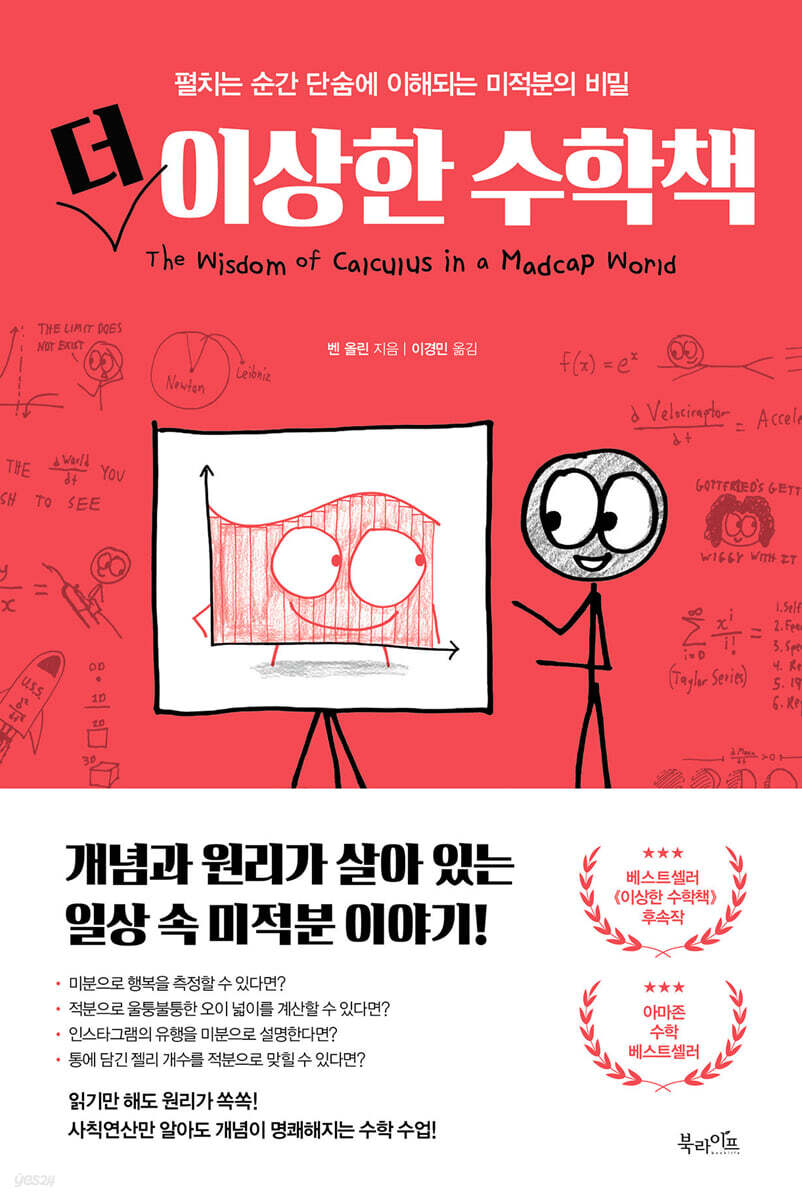
Just read it and you'll understand the principles! A calculus class that makes concepts clear just by knowing the four basic operations. - The sequel to the best-selling book, "The Strange Math Book" - Amazon Math Bestseller The exciting world of calculus that no one has ever taught properly. As you delve into the principles hidden in everyday life, you'll soon become friends with math. Ben Olin, author of "The Strange Book of Math," which was praised as "a delightful math book that deals with math but does not contain a single math problem or explanation," provided the joy of understanding math. As a former math teacher who has been spreading the importance of studying math through lectures across the United States, he has returned to us with "The Stranger Math Book." This time, we will take a step further from the previous work that covered the basic concepts of mathematics and talk about calculus, which is also called the flower and main dish of mathematics. The previous work, "The Strange Math Book," is a book that explains interesting mathematical concepts and principles used in real life, from the basic definitions of mathematics to geometry, probability, and statistics, in an easy-to-understand way using colorful illustrations and humorous jokes drawn by the author himself. As a result of its sincere introduction of how useful and practical mathematics is in real life, it became an Amazon bestseller immediately after publication, and has also received steady interest and love from readers in Korea since its publication in 2020. As he dreamed, it became a book that changed the lives of everyone, from those who loved mathematics to those who were distant from mathematics. This time, he is going to talk about calculus, the most difficult subject in mathematics. Why did I focus specifically on "calculus"? It's because calculus is another language that mathematically expresses the "changes" of everything we encounter in our daily lives: joy, love, popularity, power, wealth, time, and countless other things. It introduces how calculus is used in various fields such as economics, physics, and chemistry, and uses calculus theory to analyze the flaws Sherlock Holmes leaves in Arthur Conan Doyle's novels while investigating cases. It also shows what calculus principles are hidden in trends such as Instagram and Facebook, and emphasizes once again that even mathematics, which was once thought to be difficult, can be learned in a very easy and fun way. The recently published 『The Stranger Math Book』 also retains all the strengths of its predecessor. The author's comical illustrations remain witty, and the book's enjoyment is doubled by the witty humor and richer storytelling that crosses over various fields such as history, literature, and science. Through this book, you can enjoyably explore the intersections and connections between calculus and everyday life, cultivating your mathematical thinking. Even those who haven't yet learned mathematics or have forgotten it will find it fascinating. |
- You can preview some of the book's contents.
Preview
index
preface
Part 1.
moment
Chapter 1: The Elusive Time: Calculus Grants a Wish
Chapter 2: The Ever-Falling Moon: Calculus Explains the Universe
Chapter 3: A Moment of Happiness While Eating Buttered Toast: Calculus Captivates the Mind
Chapter 4: A Global Language: Calculus Made Fun
Chapter 5: If the Mississippi River Flowed 1.6 Million Kilometers: Calculus Plays a Game
Chapter 6: Sherlock Holmes and the Wrong Bicycle: Calculus Solves the Mystery
Chapter 7: An Introduction to Unfounded Epidemiology: Calculus Records Trends
Chapter 8: What the Wind Leaves: Calculus Poses a Puzzle
Chapter 9: Dusty Dance: Calculus Baffles a Botanist
Chapter 10: The Blue-Haired Woman and the Transcendental Vortex: Calculus Replaces the Husband
Chapter 11: The Princess on the Edge of the City: Calculus Claims the Coast
Chapter 12: The Devastation Caused by Paperclips: Calculus Guides Disaster
Chapter 13: The Final Triumph of the Curve: How Calculus Rewrites Tax Policy
Chapter 14: The Dog Knows: Calculus Makes a Dog a Star
Chapter 15: Calculus!: Calculus Solves All Problems Forever
Part 2.
eternity
Chapter 16: Circles, Groups, and Circles: Calculus Cuts a Cucumber
Chapter 17: War and Peace and Integral Calculus: How Calculus Transformed History
Chapter 18: The Leman City Skyline: Calculus Becomes a City Planner
Chapter 19: Integration: A Great Achievement: Calculus Prepares for a Dinner Party
Chapter 20: What Happens Inside the Integral Stays Inside the Integral: Calculus Expands its Toolkit
Chapter 21: A Single Stroke of the Pen and the Vanishing: Calculus Erases 68 Percent of the Universe
Chapter 22: 1994: Calculus is Born: Calculus Measures Blood Sugar Levels
Chapter 23: If You Must Feel Pain: Calculus Measures the Soul
Chapter 24: Fighting the Gods: Calculus Defends the Romans
Chapter 25: From the Invisible Sphere: Calculus Visits the Fourth Dimension
Chapter 26: Baklava, a Master of Abstraction: Calculus Becomes the Americas
Chapter 27: Gabriel, Blow Your Trumpet: Calculus Gives Birth to Heresy
Chapter 28: The Impossible Scene: Calculus Both Irritates and Enthusiastic
Acknowledgements
Lecture notes
References
Part 1.
moment
Chapter 1: The Elusive Time: Calculus Grants a Wish
Chapter 2: The Ever-Falling Moon: Calculus Explains the Universe
Chapter 3: A Moment of Happiness While Eating Buttered Toast: Calculus Captivates the Mind
Chapter 4: A Global Language: Calculus Made Fun
Chapter 5: If the Mississippi River Flowed 1.6 Million Kilometers: Calculus Plays a Game
Chapter 6: Sherlock Holmes and the Wrong Bicycle: Calculus Solves the Mystery
Chapter 7: An Introduction to Unfounded Epidemiology: Calculus Records Trends
Chapter 8: What the Wind Leaves: Calculus Poses a Puzzle
Chapter 9: Dusty Dance: Calculus Baffles a Botanist
Chapter 10: The Blue-Haired Woman and the Transcendental Vortex: Calculus Replaces the Husband
Chapter 11: The Princess on the Edge of the City: Calculus Claims the Coast
Chapter 12: The Devastation Caused by Paperclips: Calculus Guides Disaster
Chapter 13: The Final Triumph of the Curve: How Calculus Rewrites Tax Policy
Chapter 14: The Dog Knows: Calculus Makes a Dog a Star
Chapter 15: Calculus!: Calculus Solves All Problems Forever
Part 2.
eternity
Chapter 16: Circles, Groups, and Circles: Calculus Cuts a Cucumber
Chapter 17: War and Peace and Integral Calculus: How Calculus Transformed History
Chapter 18: The Leman City Skyline: Calculus Becomes a City Planner
Chapter 19: Integration: A Great Achievement: Calculus Prepares for a Dinner Party
Chapter 20: What Happens Inside the Integral Stays Inside the Integral: Calculus Expands its Toolkit
Chapter 21: A Single Stroke of the Pen and the Vanishing: Calculus Erases 68 Percent of the Universe
Chapter 22: 1994: Calculus is Born: Calculus Measures Blood Sugar Levels
Chapter 23: If You Must Feel Pain: Calculus Measures the Soul
Chapter 24: Fighting the Gods: Calculus Defends the Romans
Chapter 25: From the Invisible Sphere: Calculus Visits the Fourth Dimension
Chapter 26: Baklava, a Master of Abstraction: Calculus Becomes the Americas
Chapter 27: Gabriel, Blow Your Trumpet: Calculus Gives Birth to Heresy
Chapter 28: The Impossible Scene: Calculus Both Irritates and Enthusiastic
Acknowledgements
Lecture notes
References
Detailed image
Into the book
I want to make this clear.
The book you hold in your hands “doesn’t teach you calculus.” It’s not a well-organized textbook, but a kind of “folklore” record, with a wide range of humorous illustrations.
That is, it was written in non-technical language for the general reader.
You may be new to calculus, or you may already be familiar with it.
I hope the stories in this book can provide you with a little joy and insight.
This book will never be finished.
This means that Fermat's refraction of light, Newton's cryptography, and Dirac's impossible functions were not included.
In this ever-changing world, no book can cover everything.
Myths never end.
The river continues to flow.
--- p.12~13, from the “Preface”
“This week has been really good.
Well, there are some difficult things, but it's getting better." The thing is, I'm a math teacher first and foremost, and a human being second.
That is, I responded to Mr. James's words as follows:
“Well, then the teacher’s happiness function is showing a middle value that is neither high nor low.
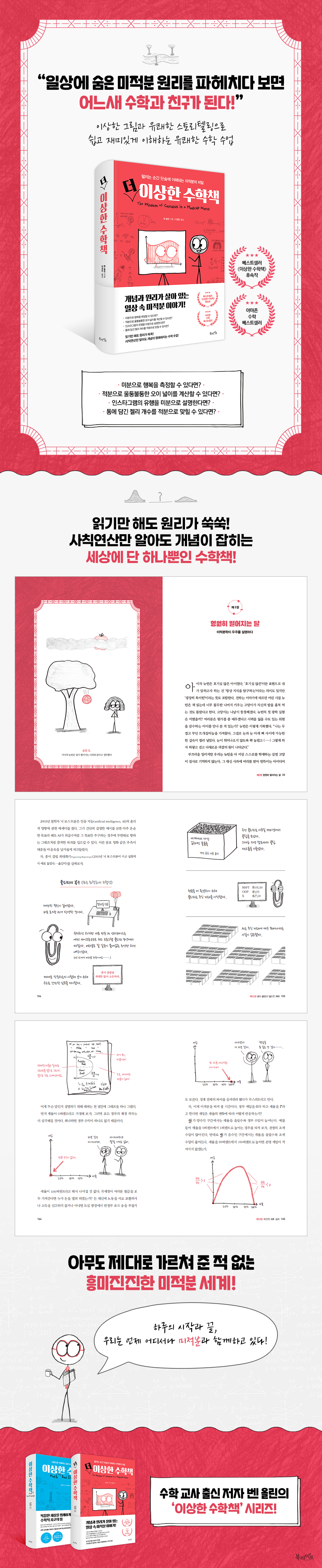
Of course, the first derivative is positive.” (……) “Please draw a graph of your happiness along the time axis.
The teacher function has an intermediate value.
But it's an upward trend.
“That’s the positive derivative,” Mr. James replied.
"all right.
So does a negative derivative mean things are getting worse?”
--- p.46~47, 「Chapter 3.
From "A Moment of Happiness While Eating Buttered Toast"
The curve is like a gentle lamb.
We flatten the curve to put it to sleep.
Next, let's zoom in on the curve.
Then, although the curved part is slightly enlarged, it is still clearly a curve when viewed with the naked eye.
Technically, it's definitely a curve.
Of course, for some practical purposes it would have been better to see it in a straight line.
But if we zoom in to the smallest size we know of, but an infinitesimal size that is not zero, the curve changes to what we are looking for.
That is, at least in our imagination, it becomes a straight line.
So what does this have to do with calculus? It has to do with everything.
--- p.77, Chapter 5.
From "If the Mississippi River Flowed 1.6 Million Kilometers"
Tolstoy's integral seems to have failed as an academic discipline but succeeded as a metaphor.
In the context of humanity as a whole, individuals are so small that they are almost infinitesimal, and their number is infinite.
But if you add up all the individuals, you can get the total population.
According to this logic, history does not belong to just any small group or any single individual.
History isn't made by kings or presidents or Beyoncé or any single lady.
History belongs to every individual.
(……) These facts do not create any scientific predictions or mathematical laws.
Rather, it is a poetic truth.
The truth is that in an all-encompassing integral, each infinitesimal must be treated with equal importance.
--- p.224, Chapter 17.
From "War and Peace" and "Integral Calculus"
Integration isn't just for mathematicians.
Hydrologists use integrals to estimate the flow of pollutants through groundwater.
Bioengineers use integration to test theories about lung function, and economists analyze income distribution and determine deviations from perfect equality.
Integration can be used by anyone in any field or by anyone who wants to measure the area under a curve, whether it's diabetes research, epidemiology, or a crazy Russian novel.
Integration is like a hammer in a world full of nails, and is not just for blacksmiths.
However, math teachers, including myself, who have many shortcomings, sometimes make mistakes.
We emphasize integration as the opposite concept of differentiation.
The book you hold in your hands “doesn’t teach you calculus.” It’s not a well-organized textbook, but a kind of “folklore” record, with a wide range of humorous illustrations.
That is, it was written in non-technical language for the general reader.
You may be new to calculus, or you may already be familiar with it.
I hope the stories in this book can provide you with a little joy and insight.
This book will never be finished.
This means that Fermat's refraction of light, Newton's cryptography, and Dirac's impossible functions were not included.
In this ever-changing world, no book can cover everything.
Myths never end.
The river continues to flow.
--- p.12~13, from the “Preface”
“This week has been really good.
Well, there are some difficult things, but it's getting better." The thing is, I'm a math teacher first and foremost, and a human being second.
That is, I responded to Mr. James's words as follows:
“Well, then the teacher’s happiness function is showing a middle value that is neither high nor low.
Of course, the first derivative is positive.” (……) “Please draw a graph of your happiness along the time axis.
The teacher function has an intermediate value.
But it's an upward trend.
“That’s the positive derivative,” Mr. James replied.
"all right.
So does a negative derivative mean things are getting worse?”
--- p.46~47, 「Chapter 3.
From "A Moment of Happiness While Eating Buttered Toast"
The curve is like a gentle lamb.
We flatten the curve to put it to sleep.
Next, let's zoom in on the curve.
Then, although the curved part is slightly enlarged, it is still clearly a curve when viewed with the naked eye.
Technically, it's definitely a curve.
Of course, for some practical purposes it would have been better to see it in a straight line.
But if we zoom in to the smallest size we know of, but an infinitesimal size that is not zero, the curve changes to what we are looking for.
That is, at least in our imagination, it becomes a straight line.
So what does this have to do with calculus? It has to do with everything.
--- p.77, Chapter 5.
From "If the Mississippi River Flowed 1.6 Million Kilometers"
Tolstoy's integral seems to have failed as an academic discipline but succeeded as a metaphor.
In the context of humanity as a whole, individuals are so small that they are almost infinitesimal, and their number is infinite.
But if you add up all the individuals, you can get the total population.
According to this logic, history does not belong to just any small group or any single individual.
History isn't made by kings or presidents or Beyoncé or any single lady.
History belongs to every individual.
(……) These facts do not create any scientific predictions or mathematical laws.
Rather, it is a poetic truth.
The truth is that in an all-encompassing integral, each infinitesimal must be treated with equal importance.
--- p.224, Chapter 17.
From "War and Peace" and "Integral Calculus"
Integration isn't just for mathematicians.
Hydrologists use integrals to estimate the flow of pollutants through groundwater.
Bioengineers use integration to test theories about lung function, and economists analyze income distribution and determine deviations from perfect equality.
Integration can be used by anyone in any field or by anyone who wants to measure the area under a curve, whether it's diabetes research, epidemiology, or a crazy Russian novel.
Integration is like a hammer in a world full of nails, and is not just for blacksmiths.
However, math teachers, including myself, who have many shortcomings, sometimes make mistakes.
We emphasize integration as the opposite concept of differentiation.
--- p.279, Chapter 22.
From "1994, the Birth of Calculus"
From "1994, the Birth of Calculus"
Publisher's Review
Calculus is with you from the beginning to the end of your day, anytime, anywhere.
From the birth of calculus to its application in real life
The secrets of calculus that you can understand in an instant the moment you open it.
Why do we find mathematics and calculus difficult?
This is because we are accustomed to the math education method of memorizing formulas and repeatedly solving problems without understanding the essence.
Most math classes don't "explain to students why certain equations are important."
It doesn't even tell you where the formula came from or what the key part is." However, this type of study method not only makes students "think they've figured something out" and lose interest in math, but also makes them hit a wall and feel frustrated when they come across even slightly applied problems.
"The Stranger Math Book" is a reader-friendly book that will spark interest in even those who are afraid of mathematics or have distanced themselves from it for various reasons.
Although it deals with the seemingly difficult subject of calculus, it helps to intuitively understand all concepts through visual explanations in the form of pictures and analogies using appropriate objects.
The author introduces differentiation and integration, which deal with 'change in response to change', by dividing them into 'instantaneous' and 'eternal' calculus, respectively.
For example, if differentiation is the encounter with a 'moment' in the flow of time, like the moment of taking a bite of buttered toast, then integration, on the other hand, is said to be the capture of 'eternity', where countless water drops become a single stream.
This method of studying mathematics that cultivates mathematical thinking skills through examples that cleverly delve into life rather than focusing on mathematical formulas or problems helps us, who are tired of spoon-fed studying, approach mathematics more comfortably.
Although you will not directly learn how to differentiate or integrate in this book, you will still have the fascinating experience of understanding the principles of calculus.
In the era after the 4th Industrial Revolution
Enjoying, understanding, and mastering math is essential for preparing for the future.
The author shows how closely mathematics is intertwined with our lives by tracing the chronology of calculus from its birth to its practical application without any mathematical formulas or problem-solving.
The prices of goods are determined by market theory, the government sets appropriate tax rates through tax policy, and the budgets of projects are planned and estimated. This is all a result of the fusion of differentiation and integration with other fields such as economics, physics, art, and technology.
This process of introducing the principles of differentiation and integration hidden in social phenomena that we may have overlooked due to lack of interest or knowledge naturally leads to an answer to the question, “Why should we learn mathematics?”
As of 2021, technological advancements such as artificial intelligence, big data, and autonomous driving, as well as the digitalization of various industries, are driving change at a faster pace than at any other time in history.
The core factor behind this craze is the improvement of logical thinking, application, and critical thinking skills by deciphering meaning from vast amounts of data, repeating the problem-solving process multiple times, and learning the corresponding thinking patterns.
However, this is similar to the 'method of studying math' that the author emphasized.
This is because various mathematical knowledge underlies this huge trend that is taking place in a wide range of fields.
This is a point where we once again realize that mathematics is not something to be learned simply for the sake of mathematics, but rather essential knowledge that we must learn to live more wisely in a changing world.
We rarely solve calculus problems in our daily lives.
But there is a huge difference between knowing that principle and looking at the world and not.
So, through this book, let's break free from the vague fear of mathematics and calculus and become friends with them.
If you understand that mathematics, while somewhat unfamiliar and difficult, is, on the contrary, the most realistic, simple, and clear discipline, it will become a powerful weapon in preparing for the ever-changing modern society and the future to come.
I hope that "The Stranger Math Book" will serve as a guide to enrich the lives of those who love math and those who are afraid of math and wonder why they should learn it.
From the birth of calculus to its application in real life
The secrets of calculus that you can understand in an instant the moment you open it.
Why do we find mathematics and calculus difficult?
This is because we are accustomed to the math education method of memorizing formulas and repeatedly solving problems without understanding the essence.
Most math classes don't "explain to students why certain equations are important."
It doesn't even tell you where the formula came from or what the key part is." However, this type of study method not only makes students "think they've figured something out" and lose interest in math, but also makes them hit a wall and feel frustrated when they come across even slightly applied problems.
"The Stranger Math Book" is a reader-friendly book that will spark interest in even those who are afraid of mathematics or have distanced themselves from it for various reasons.
Although it deals with the seemingly difficult subject of calculus, it helps to intuitively understand all concepts through visual explanations in the form of pictures and analogies using appropriate objects.
The author introduces differentiation and integration, which deal with 'change in response to change', by dividing them into 'instantaneous' and 'eternal' calculus, respectively.
For example, if differentiation is the encounter with a 'moment' in the flow of time, like the moment of taking a bite of buttered toast, then integration, on the other hand, is said to be the capture of 'eternity', where countless water drops become a single stream.
This method of studying mathematics that cultivates mathematical thinking skills through examples that cleverly delve into life rather than focusing on mathematical formulas or problems helps us, who are tired of spoon-fed studying, approach mathematics more comfortably.
Although you will not directly learn how to differentiate or integrate in this book, you will still have the fascinating experience of understanding the principles of calculus.
In the era after the 4th Industrial Revolution
Enjoying, understanding, and mastering math is essential for preparing for the future.
The author shows how closely mathematics is intertwined with our lives by tracing the chronology of calculus from its birth to its practical application without any mathematical formulas or problem-solving.
The prices of goods are determined by market theory, the government sets appropriate tax rates through tax policy, and the budgets of projects are planned and estimated. This is all a result of the fusion of differentiation and integration with other fields such as economics, physics, art, and technology.
This process of introducing the principles of differentiation and integration hidden in social phenomena that we may have overlooked due to lack of interest or knowledge naturally leads to an answer to the question, “Why should we learn mathematics?”
As of 2021, technological advancements such as artificial intelligence, big data, and autonomous driving, as well as the digitalization of various industries, are driving change at a faster pace than at any other time in history.
The core factor behind this craze is the improvement of logical thinking, application, and critical thinking skills by deciphering meaning from vast amounts of data, repeating the problem-solving process multiple times, and learning the corresponding thinking patterns.
However, this is similar to the 'method of studying math' that the author emphasized.
This is because various mathematical knowledge underlies this huge trend that is taking place in a wide range of fields.
This is a point where we once again realize that mathematics is not something to be learned simply for the sake of mathematics, but rather essential knowledge that we must learn to live more wisely in a changing world.
We rarely solve calculus problems in our daily lives.
But there is a huge difference between knowing that principle and looking at the world and not.
So, through this book, let's break free from the vague fear of mathematics and calculus and become friends with them.
If you understand that mathematics, while somewhat unfamiliar and difficult, is, on the contrary, the most realistic, simple, and clear discipline, it will become a powerful weapon in preparing for the ever-changing modern society and the future to come.
I hope that "The Stranger Math Book" will serve as a guide to enrich the lives of those who love math and those who are afraid of math and wonder why they should learn it.
GOODS SPECIFICS
- Date of issue: March 2, 2021
- Format: Hardcover book binding method guide
- Page count, weight, size: 396 pages | 808g | 160*235*27mm
- ISBN13: 9791191013122
- ISBN10: 119101312X
You may also like
카테고리
korean


korean

![GQ KOREA Mark (Monthly): December [2025]](http://librairie.coreenne.fr/cdn/shop/files/8ef265dbbfbf186523ed75ba7319009d.jpg?v=1765340328&width=3840)


