

The imaginative brain
 |
Description
Book Introduction
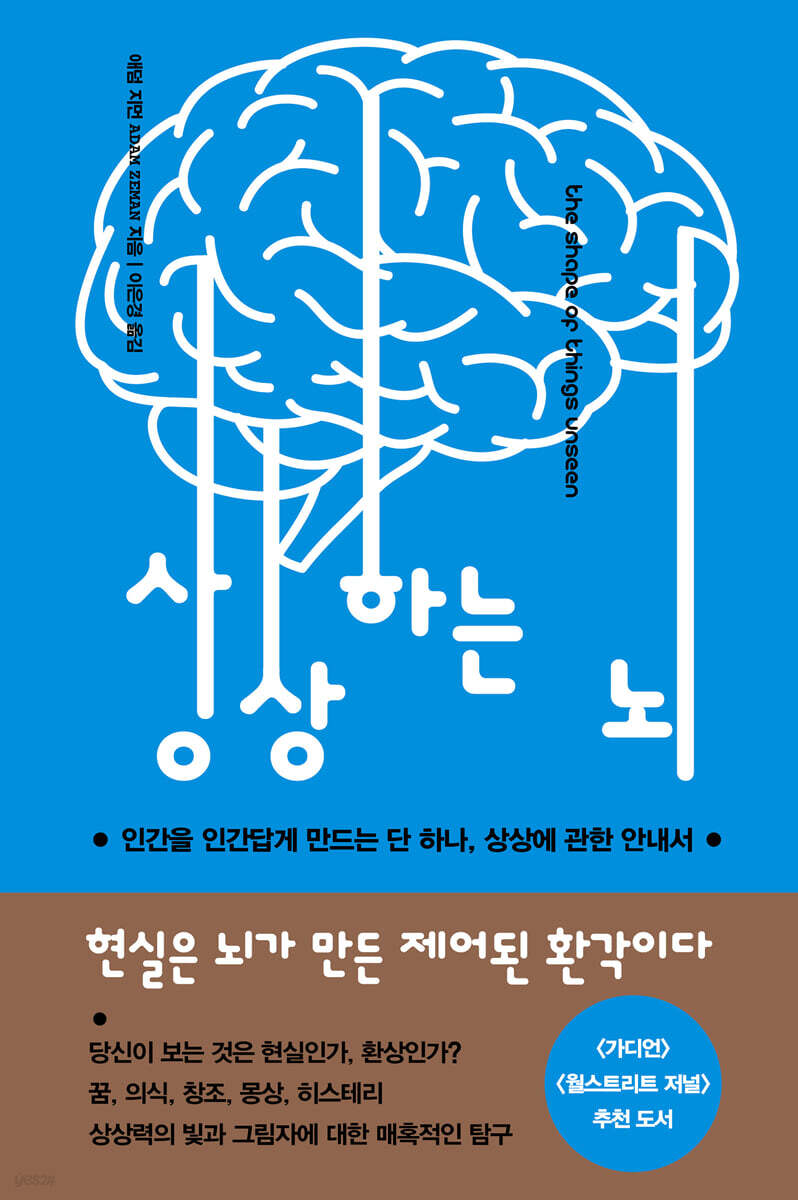
How imagination rules our brain, our consciousness, and our reality.
From dreams, consciousness, and creation to daydreams and hysteria
A fascinating exploration of the light and shadow of imagination
[Guardian] [Wall Street Journal] Recommendations
"The Imaginative Brain" is a book that explores the light and shadow of human imagination from a neuroscientific perspective, based on the research accumulated over 30 years by Adam Zieman, a neuroscientist and professor at the University of Exeter Medical School in the UK, into the neural mechanisms of consciousness, memory, and imagery.
From dreams triggered by imagination, the relationship between consciousness and imagery, and the process of creation to hallucinations, delusions, and trauma, the author meticulously traces how imagination structures and distorts human thought and perception.
Through this, we prove that imagination is not simply a fantasy, but a core element that weaves the world through the brain and forms the 'self', and we explore its origins and evolution in a three-dimensional way through cases and experiments that cross over brain science, philosophy, and art.
This perspective makes us re-examine what we see and hear in the era of AI and deepfakes, where the boundaries between reality and fantasy are faltering, and makes us reconsider the importance of imagination, the final domain that makes humans human.
From dreams, consciousness, and creation to daydreams and hysteria
A fascinating exploration of the light and shadow of imagination
[Guardian] [Wall Street Journal] Recommendations
"The Imaginative Brain" is a book that explores the light and shadow of human imagination from a neuroscientific perspective, based on the research accumulated over 30 years by Adam Zieman, a neuroscientist and professor at the University of Exeter Medical School in the UK, into the neural mechanisms of consciousness, memory, and imagery.
From dreams triggered by imagination, the relationship between consciousness and imagery, and the process of creation to hallucinations, delusions, and trauma, the author meticulously traces how imagination structures and distorts human thought and perception.
Through this, we prove that imagination is not simply a fantasy, but a core element that weaves the world through the brain and forms the 'self', and we explore its origins and evolution in a three-dimensional way through cases and experiments that cross over brain science, philosophy, and art.
This perspective makes us re-examine what we see and hear in the era of AI and deepfakes, where the boundaries between reality and fantasy are faltering, and makes us reconsider the importance of imagination, the final domain that makes humans human.
- You can preview some of the book's contents.
Preview
index
Preface: A Guide for Imaginary Travelers
Part 1.
I imagine.
Therefore, the world is real
Chapter 1.
Imaginative human, Homo imaginans
- We are wandering hearts
- Imagination has texture.
- The eyes of the mind, the ears of the mind, the legs of the mind
- Light and Shadow of Imagination
- Sense precedes reason.
- How to cultivate senses
- “We are made of dreams.”
Chapter 2.
The usefulness of imagination
- Art, the power of inspiration
- Mimesis and the Second Pleasure
- Science, the power of explanation
- Skids, the formula for creativity
Part 2.
How Imagination Rules Consciousness and Reality
Chapter 3.
Reality is a limited illusion
- Image, something that exists without actually existing
- How to measure the image
- The Image Debate: Is Image Image or Language?
- Our brains are geared towards the future.
Chapter 4.
The Origins of Imagination Explained Through Brain Science
- Where is your heart?
- Synapses, the bridges that connect thoughts
- Riding the rhythm of synapses
- Dark energy of the brain
- Spiderweb of the nerves
- How the brain creates
- The brain never sleeps
- The Science of Beauty
Chapter 5.
Evolving Imagination: From Lucy to Sapiens
- We are all children of nature
- A prediction system imprinted in DNA
- Stones, bones, and chromosomes
- Empathy, the competitive edge of Homo sapiens
- Good hands
- The birth of language
- Evolutionary developmental biology
- Cultural organism
Chapter 6.
How do we learn to imagine?
- We were all just one cell.
- In my mother's womb
- Knowledge is life itself.
- shared sense
- Playful human
- Ceausescu's children
Part 3.
Imaginary Shadows, Floating Brains
Chapter 7.
Welcome and Hallucination: So Special Yet Ordinary
- One day, a call from the psychiatric ward
- My dead husband came to visit me.
- The Science of Dreams
- Epilepsy, the song my mother used to sing
- Parkinson's disease, Lewy bodies, delirium
- A bug in my ear
- People trapped in the battlefield
- Lose me
Chapter 8.
Delusions and Hysteria: The Brain's Foul Play
- “My brain is on fire.”
- Schizophrenia, which begins with a prediction error
- Controversies surrounding hysteria
- To have your feet on the ground
Chapter 9.
How to carve a brain
- Just thinking about it makes me gain muscle.
- Brain hacking
- Tetris for PTSD
- Socialized imagination
Chapter 10.
Burning Brain: Aristotle Was Wrong
- Burning Forest
- People without the eye of the heart
Conclusion: Why Do We Imagine?
supplement
Part 1.
I imagine.
Therefore, the world is real
Chapter 1.
Imaginative human, Homo imaginans
- We are wandering hearts
- Imagination has texture.
- The eyes of the mind, the ears of the mind, the legs of the mind
- Light and Shadow of Imagination
- Sense precedes reason.
- How to cultivate senses
- “We are made of dreams.”
Chapter 2.
The usefulness of imagination
- Art, the power of inspiration
- Mimesis and the Second Pleasure
- Science, the power of explanation
- Skids, the formula for creativity
Part 2.
How Imagination Rules Consciousness and Reality
Chapter 3.
Reality is a limited illusion
- Image, something that exists without actually existing
- How to measure the image
- The Image Debate: Is Image Image or Language?
- Our brains are geared towards the future.
Chapter 4.
The Origins of Imagination Explained Through Brain Science
- Where is your heart?
- Synapses, the bridges that connect thoughts
- Riding the rhythm of synapses
- Dark energy of the brain
- Spiderweb of the nerves
- How the brain creates
- The brain never sleeps
- The Science of Beauty
Chapter 5.
Evolving Imagination: From Lucy to Sapiens
- We are all children of nature
- A prediction system imprinted in DNA
- Stones, bones, and chromosomes
- Empathy, the competitive edge of Homo sapiens
- Good hands
- The birth of language
- Evolutionary developmental biology
- Cultural organism
Chapter 6.
How do we learn to imagine?
- We were all just one cell.
- In my mother's womb
- Knowledge is life itself.
- shared sense
- Playful human
- Ceausescu's children
Part 3.
Imaginary Shadows, Floating Brains
Chapter 7.
Welcome and Hallucination: So Special Yet Ordinary
- One day, a call from the psychiatric ward
- My dead husband came to visit me.
- The Science of Dreams
- Epilepsy, the song my mother used to sing
- Parkinson's disease, Lewy bodies, delirium
- A bug in my ear
- People trapped in the battlefield
- Lose me
Chapter 8.
Delusions and Hysteria: The Brain's Foul Play
- “My brain is on fire.”
- Schizophrenia, which begins with a prediction error
- Controversies surrounding hysteria
- To have your feet on the ground
Chapter 9.
How to carve a brain
- Just thinking about it makes me gain muscle.
- Brain hacking
- Tetris for PTSD
- Socialized imagination
Chapter 10.
Burning Brain: Aristotle Was Wrong
- Burning Forest
- People without the eye of the heart
Conclusion: Why Do We Imagine?
supplement
Detailed image

Into the book
Imagination allows us to escape from the 'here and now' and transcend the limitations of time and space.
We recall the past and look forward to the future through imagination.
You can explore fictional worlds created by novelists and filmmakers, traveling from the very first moments of creation to the edges of the universe and even the depths of the atom.
--- 「Chapter 1.
From "Imagining Human, Homo imaginans"
Imagination is one of the greatest human qualities and is essential to all creative acts in science and art.
Imagination draws the forms of the unknown, and the poet's pen gives them form, giving addresses and names to empty objects that are nothing.
Imagination also helps us develop new ideas, explore the unknown, and find solutions to complex problems.
Through imagination, we can reconstruct past experiences, simulate future possibilities, and see the world from another person's perspective.
It played a crucial role in the social and cultural development of mankind.
--- Chapter 2.
From "The Usefulness of Imagination"
The brain interprets signals based on past experiences and knowledge, fills in the gaps, and creates a scene.
That's why neuroscientists call the way we see the world "controlled hallucinations."
The ordered reality we experience is the result of our brain constantly guessing, correcting, and drawing.
An image is a mental representation that comes to mind as if we perceive a sensory stimulus even though it is not actually present.
In this sense, reality can be said to be the most sophisticated and consistent form of imagination that our brain creates.
--- 「Chapter 3.
From "Reality is a limited illusion"
The brain is trapped inside a dark, silent skull.
The brain's role is to understand signals coming from the outside and utilize them to meet the body's needs.
--- Chapter 4.
From “The Origin of Imagination Explained Through Brain Science”
Humans are inherently beings who share the mind.
Humans are often depicted as a hyper-cooperative and hyper-social species.
We maintain and manage groups based on strong sociality.
Our empathy and tolerance are linked not only to social emotions like pride, shame, guilt, and embarrassment, but also to traits that demonstrate cooperative tendencies, such as joint attention and communication skills.
In particular, the blushing reaction of pride, shame, or embarrassment is a uniquely human characteristic, and demonstrates the unique ability of humans to be aware of their own position in the minds of others.
--- 「Chapter 5.
From "Evolving Imagination, From Lucy to Sapiens"
Play performs various functions, which can be summarized in 5Ps.
Play provides pleasure.
(Omitted) You can achieve results through performance.
(Omitted) Play provides opportunities for practice.
(Omitted) Play… supported prediction.
(Omitted) Pretend play is at its peak between the ages of 3 and 6.
The words we pronounce provide us with a sophisticated weapon of communication, harnessing all their potential.
However language emerged or came into being, it would soon find a variety of uses.
As language developed, it became a tool that dramatically expanded the ability to share our thoughts.
--- Chapter 6.
From “How We Learn to Imagine”
Hallucinations demonstrate that the world we experience is normally maintained in a delicate balance between sensory stimulation and the brain's excitation and inhibition systems, ensuring that it matches reality.
Hallucinations are evidence that our brains are constantly engaged in creative and productive activity, that our minds are constantly striving to find meaning.
We can use our imagination to reconstruct the images that torment us.
My dead husband came to visit me.
When we imagine, we use the knowledge and models involved in perception to represent and reconstruct reality offline.
--- Chapter 7.
From "Welcome and Hallucination: So Special, Yet So Ordinary"
Delusions are fixed false beliefs that do not fit with an individual's social and cultural background.
Delusions are 'fixed' in the sense that it is almost impossible to persuade the patient to change their beliefs, even though they appear to be rational in other respects.
Hysteria has been one of medicine's most puzzling mysteries for thousands of years.
This is a disease of the imagination, a phenomenon in which the brain incorrectly predicts that there is a disease.
The delusion is...
It is a necessary condition for insanity.
--- Chapter 8.
From "Delusion and Hysteria: The Brain's Foul Play"
Mental rehearsal is a field of intensive study in sports psychology.
Mental practice is generally more useful for tasks that require more intellectual ability than physical ability, but it helps both.
Imagination is a powerful drug.
Just organizing your thoughts in your mind will give you confidence and lighten your mind.
Mental training can improve not only dexterity but also strength.
The game Tetris helps alleviate PTSD symptoms by interfering with the consolidation of traumatic memories.
--- Chapter 9.
From "How to Carve the Brain"
Aristotle said, "The soul never thinks without images," but he was wrong.
For someone like Einstein, images may come naturally, but thoughts can also take on the guise of other media, like language itself or a mathematician's equations.
People in a state of aphantasia can also display rich creativity.
Imagination is...
It is to express the invisible as visible.
We recall the past and look forward to the future through imagination.
You can explore fictional worlds created by novelists and filmmakers, traveling from the very first moments of creation to the edges of the universe and even the depths of the atom.
--- 「Chapter 1.
From "Imagining Human, Homo imaginans"
Imagination is one of the greatest human qualities and is essential to all creative acts in science and art.
Imagination draws the forms of the unknown, and the poet's pen gives them form, giving addresses and names to empty objects that are nothing.
Imagination also helps us develop new ideas, explore the unknown, and find solutions to complex problems.
Through imagination, we can reconstruct past experiences, simulate future possibilities, and see the world from another person's perspective.
It played a crucial role in the social and cultural development of mankind.
--- Chapter 2.
From "The Usefulness of Imagination"
The brain interprets signals based on past experiences and knowledge, fills in the gaps, and creates a scene.
That's why neuroscientists call the way we see the world "controlled hallucinations."
The ordered reality we experience is the result of our brain constantly guessing, correcting, and drawing.
An image is a mental representation that comes to mind as if we perceive a sensory stimulus even though it is not actually present.
In this sense, reality can be said to be the most sophisticated and consistent form of imagination that our brain creates.
--- 「Chapter 3.
From "Reality is a limited illusion"
The brain is trapped inside a dark, silent skull.
The brain's role is to understand signals coming from the outside and utilize them to meet the body's needs.
--- Chapter 4.
From “The Origin of Imagination Explained Through Brain Science”
Humans are inherently beings who share the mind.
Humans are often depicted as a hyper-cooperative and hyper-social species.
We maintain and manage groups based on strong sociality.
Our empathy and tolerance are linked not only to social emotions like pride, shame, guilt, and embarrassment, but also to traits that demonstrate cooperative tendencies, such as joint attention and communication skills.
In particular, the blushing reaction of pride, shame, or embarrassment is a uniquely human characteristic, and demonstrates the unique ability of humans to be aware of their own position in the minds of others.
--- 「Chapter 5.
From "Evolving Imagination, From Lucy to Sapiens"
Play performs various functions, which can be summarized in 5Ps.
Play provides pleasure.
(Omitted) You can achieve results through performance.
(Omitted) Play provides opportunities for practice.
(Omitted) Play… supported prediction.
(Omitted) Pretend play is at its peak between the ages of 3 and 6.
The words we pronounce provide us with a sophisticated weapon of communication, harnessing all their potential.
However language emerged or came into being, it would soon find a variety of uses.
As language developed, it became a tool that dramatically expanded the ability to share our thoughts.
--- Chapter 6.
From “How We Learn to Imagine”
Hallucinations demonstrate that the world we experience is normally maintained in a delicate balance between sensory stimulation and the brain's excitation and inhibition systems, ensuring that it matches reality.
Hallucinations are evidence that our brains are constantly engaged in creative and productive activity, that our minds are constantly striving to find meaning.
We can use our imagination to reconstruct the images that torment us.
My dead husband came to visit me.
When we imagine, we use the knowledge and models involved in perception to represent and reconstruct reality offline.
--- Chapter 7.
From "Welcome and Hallucination: So Special, Yet So Ordinary"
Delusions are fixed false beliefs that do not fit with an individual's social and cultural background.
Delusions are 'fixed' in the sense that it is almost impossible to persuade the patient to change their beliefs, even though they appear to be rational in other respects.
Hysteria has been one of medicine's most puzzling mysteries for thousands of years.
This is a disease of the imagination, a phenomenon in which the brain incorrectly predicts that there is a disease.
The delusion is...
It is a necessary condition for insanity.
--- Chapter 8.
From "Delusion and Hysteria: The Brain's Foul Play"
Mental rehearsal is a field of intensive study in sports psychology.
Mental practice is generally more useful for tasks that require more intellectual ability than physical ability, but it helps both.
Imagination is a powerful drug.
Just organizing your thoughts in your mind will give you confidence and lighten your mind.
Mental training can improve not only dexterity but also strength.
The game Tetris helps alleviate PTSD symptoms by interfering with the consolidation of traumatic memories.
--- Chapter 9.
From "How to Carve the Brain"
Aristotle said, "The soul never thinks without images," but he was wrong.
For someone like Einstein, images may come naturally, but thoughts can also take on the guise of other media, like language itself or a mathematician's equations.
People in a state of aphantasia can also display rich creativity.
Imagination is...
It is to express the invisible as visible.
--- 「Chapter 10.
From "Burning Brain: Aristotle Was Wrong"
From "Burning Brain: Aristotle Was Wrong"
Publisher's Review
Reality is a controlled illusion created by the brain.
Dreams, consciousness, creation, daydreaming, hysteria
A fascinating exploration of the light and shadow of imagination
Close your eyes for a moment and think about it.
apologize.
The feel of velvet.
The moment I won the lottery.
dinosaur.
The sound of thunder.
What goes through your mind?
It could be a picture, a touch, or an emotion.
The important thing is that 'something clearly comes to mind'.
The signals of the world are always imperfect.
So our brain calls on past experiences and knowledge to fill in the gaps and add meaning to complete the 'here and now.'
It is at this point that imagination and perception become one.
In other words, the reality we see with our eyes and hear with our ears is actually a 'controlled hallucination' created by our brain.
"The Imagining Brain" explores the origins and evolution of imagination, and the light and shadows that unfold within the brain and our society, within this seemingly simple yet complex experience.
Imagination is not a fantasy, but the power of the brain to weave the world and complete 'me'.
The origins, evolution, and errors of imagination unraveled by a world-renowned neuroscientist.
The author of this book is Adam Zieman, a renowned neuroscientist and professor of medicine at the University of Exeter in the UK.
He has been studying the neural mechanisms of consciousness, memory, and imagery for over 30 years.
In 2003, while treating patients who were unable to recall mental images after brain surgery, I discovered that some people were in a state where they could not recall any mental images at all (aphantasia), while others were in a state where the mental images were so vivid and vivid (hyperphantasia).
Zieman scientifically elucidated these two concepts and revealed how imagination is created and transformed in the brain.
His research has changed the paradigm of imagination research, receiving attention from major media outlets such as the BBC, the New York Times, and National Geographic.
Academics have described him as “a bridge between clinical neurology and philosophical inquiry” and “a scholar who has opened new horizons in the study of imagination.”
"The Imagining Brain" is a book that dissects the entirety of human imagination.
It explores the most human of abilities: imagination, across science, philosophy, and evolution.
“Our brains are geared towards the future.
Most of human visual experience exists without actually existing.
In other words, it is a product of imagination.” This declaration by the author runs through the entire book.
Imagination is the central axis of human thought, and perception is not a simple input but an active act of reconstructing reality through experience and knowledge.
The book demonstrates imagination through various experiments and examples.
We explore the uses and creative sources of imagination hidden in our daily lives, culture, and art, and examine the origins, evolution, and development of imagination through neuroscience, psychology, and the structure of the brain.
And it even deals with the shadows of the imagination that sometimes distort reality and cause suffering, such as hallucinations, auditory hallucinations, delusions, trauma, and PTSD.
In today's age, where artificial intelligence and deepfakes blur the lines between imagination and reality, we live in a society where we can no longer accept what we see and hear at face value.
In this context, this book uses scientific language to demonstrate how perception and imagination are formed, expanded, and sometimes distorted, serving as a compass to reestablish the baseline of thought in an era where the boundaries between reality and fantasy are collapsing.
The author's writing combines neuroscientific insights with the depth of philosophy and literature, prompting readers to rethink their own imagination and perception of reality.
He borrows from David Hume, William James, Francis Bacon, and Shakespeare to reexamine the age-old intuition that “sensation is conveyed to the imagination before reason can judge” using the latest neuroscience.
Therefore, The Guardian and The Wall Street Journal praised this book as more than just a simple neuroscience textbook, but as a “reportage on imagination.”
Readers will experience how vivid images will appear in their minds as they turn the pages.
Are you one of those people who has never seen a picture in your head?
Or maybe he is like Jean-Dominique Bauby, trapped in a diving bell, his body locked but his mind free to wander.
"The Imagining Brain" makes us consider how we each experience imagination and what these differences mean for our lives and our perception of reality.
A neuroscience report uncovers the mechanisms of imagination and perception.
"The Imagining Brain" consists of 3 parts and 10 chapters, each of which presents a new landscape surrounding imagination.
Part 1 begins with the fundamental question, “What is imagination?”
Chapter 1 examines how imagination constantly permeates our daily lives, revealing its face in every moment we recall, plan, and fantasize, and how it governs our thoughts and actions.
Chapter 2 explores how imagination operates as a creative source in the worlds of art and science.
This paper examines the role of imagination in the figurative and symbolic language of fiction and art, and in the hypotheses of the laboratory, and illuminates the relationship between creative thinking and imagination.
Part 2 delves into the science of imagination.
Chapter 3 reveals the nature of "representational imagination," which allows us to mentally recreate objects that are not before our eyes, and examines in detail the mechanisms by which our brain recreates and simulates experiences.
Chapter 4 analyzes the neuroscientific process of imagination in the brain, covering how brain networks are activated and how past experiences, memories, and predictions shape imagination.
Chapter 5 explores how imagination has become part of our long evolutionary journey, demonstrating that it is a cultural and biological product that has driven the adaptation and development of the entire human species.
Chapter 6 addresses how imagination emerges and develops throughout childhood development, explaining how children explore the imaginary world to achieve cognitive, linguistic, and social development, and how imagination serves as the foundation for lifelong learning and creativity.
Part 3 confronts the shadow of imagination head-on.
Chapter 7 journeys through the vivid yet terrifying world of hallucinations, exploring how they distort our perception and sometimes even intersect with creativity.
Chapter 8 examines how the "disease of overactive imagination" can take hold of and destroy individuals.
It shows the role of imagination in mental and physical symptoms, and its dangers and possibilities at the same time.
Chapter 9 explores the surprising possibilities and dangers of imagery in therapy, work, and communication.
Chapter 10 explores the spectrum of "extreme imagination," from aphantasia, where images are completely inconceivable, to hyperphantasia, where the intensity rivals actual experience, revealing both the wonders and the fragility of the human mind.
Adam Zieman tells us why we need to understand imagination:
“Imagination is not a fantasy, but the power of the brain to weave the world and complete ‘me.’
If you want to understand me more deeply, you must listen to the imaginary voice in your head.”
This book is a report born from the wondrous intersection of science, art, and philosophy, and will be an intellectual journey for readers, allowing them to revisit "a new perspective on themselves and the world" and "the last remaining domain that makes humans human: imagination."
A brilliant exploration that blurs the lines between perception and imagination.
This book clearly demonstrates that imagination is not just an artist's talent, but is central to human cognition and social life.
― The Guardian
Adam Zieman delves into one of neuroscience's most intriguing mysteries and unravels it in an elegant and compelling narrative.
― The Wall Street Journal
It proves that imagination is not a function separate from reality, but a central ability that permeates our daily lives and dreams.
As the author says, imagination is the key to understanding humanity.
― New Statesman
Dreams, consciousness, creation, daydreaming, hysteria
A fascinating exploration of the light and shadow of imagination
Close your eyes for a moment and think about it.
apologize.
The feel of velvet.
The moment I won the lottery.
dinosaur.
The sound of thunder.
What goes through your mind?
It could be a picture, a touch, or an emotion.
The important thing is that 'something clearly comes to mind'.
The signals of the world are always imperfect.
So our brain calls on past experiences and knowledge to fill in the gaps and add meaning to complete the 'here and now.'
It is at this point that imagination and perception become one.
In other words, the reality we see with our eyes and hear with our ears is actually a 'controlled hallucination' created by our brain.
"The Imagining Brain" explores the origins and evolution of imagination, and the light and shadows that unfold within the brain and our society, within this seemingly simple yet complex experience.
Imagination is not a fantasy, but the power of the brain to weave the world and complete 'me'.
The origins, evolution, and errors of imagination unraveled by a world-renowned neuroscientist.
The author of this book is Adam Zieman, a renowned neuroscientist and professor of medicine at the University of Exeter in the UK.
He has been studying the neural mechanisms of consciousness, memory, and imagery for over 30 years.
In 2003, while treating patients who were unable to recall mental images after brain surgery, I discovered that some people were in a state where they could not recall any mental images at all (aphantasia), while others were in a state where the mental images were so vivid and vivid (hyperphantasia).
Zieman scientifically elucidated these two concepts and revealed how imagination is created and transformed in the brain.
His research has changed the paradigm of imagination research, receiving attention from major media outlets such as the BBC, the New York Times, and National Geographic.
Academics have described him as “a bridge between clinical neurology and philosophical inquiry” and “a scholar who has opened new horizons in the study of imagination.”
"The Imagining Brain" is a book that dissects the entirety of human imagination.
It explores the most human of abilities: imagination, across science, philosophy, and evolution.
“Our brains are geared towards the future.
Most of human visual experience exists without actually existing.
In other words, it is a product of imagination.” This declaration by the author runs through the entire book.
Imagination is the central axis of human thought, and perception is not a simple input but an active act of reconstructing reality through experience and knowledge.
The book demonstrates imagination through various experiments and examples.
We explore the uses and creative sources of imagination hidden in our daily lives, culture, and art, and examine the origins, evolution, and development of imagination through neuroscience, psychology, and the structure of the brain.
And it even deals with the shadows of the imagination that sometimes distort reality and cause suffering, such as hallucinations, auditory hallucinations, delusions, trauma, and PTSD.
In today's age, where artificial intelligence and deepfakes blur the lines between imagination and reality, we live in a society where we can no longer accept what we see and hear at face value.
In this context, this book uses scientific language to demonstrate how perception and imagination are formed, expanded, and sometimes distorted, serving as a compass to reestablish the baseline of thought in an era where the boundaries between reality and fantasy are collapsing.
The author's writing combines neuroscientific insights with the depth of philosophy and literature, prompting readers to rethink their own imagination and perception of reality.
He borrows from David Hume, William James, Francis Bacon, and Shakespeare to reexamine the age-old intuition that “sensation is conveyed to the imagination before reason can judge” using the latest neuroscience.
Therefore, The Guardian and The Wall Street Journal praised this book as more than just a simple neuroscience textbook, but as a “reportage on imagination.”
Readers will experience how vivid images will appear in their minds as they turn the pages.
Are you one of those people who has never seen a picture in your head?
Or maybe he is like Jean-Dominique Bauby, trapped in a diving bell, his body locked but his mind free to wander.
"The Imagining Brain" makes us consider how we each experience imagination and what these differences mean for our lives and our perception of reality.
A neuroscience report uncovers the mechanisms of imagination and perception.
"The Imagining Brain" consists of 3 parts and 10 chapters, each of which presents a new landscape surrounding imagination.
Part 1 begins with the fundamental question, “What is imagination?”
Chapter 1 examines how imagination constantly permeates our daily lives, revealing its face in every moment we recall, plan, and fantasize, and how it governs our thoughts and actions.
Chapter 2 explores how imagination operates as a creative source in the worlds of art and science.
This paper examines the role of imagination in the figurative and symbolic language of fiction and art, and in the hypotheses of the laboratory, and illuminates the relationship between creative thinking and imagination.
Part 2 delves into the science of imagination.
Chapter 3 reveals the nature of "representational imagination," which allows us to mentally recreate objects that are not before our eyes, and examines in detail the mechanisms by which our brain recreates and simulates experiences.
Chapter 4 analyzes the neuroscientific process of imagination in the brain, covering how brain networks are activated and how past experiences, memories, and predictions shape imagination.
Chapter 5 explores how imagination has become part of our long evolutionary journey, demonstrating that it is a cultural and biological product that has driven the adaptation and development of the entire human species.
Chapter 6 addresses how imagination emerges and develops throughout childhood development, explaining how children explore the imaginary world to achieve cognitive, linguistic, and social development, and how imagination serves as the foundation for lifelong learning and creativity.
Part 3 confronts the shadow of imagination head-on.
Chapter 7 journeys through the vivid yet terrifying world of hallucinations, exploring how they distort our perception and sometimes even intersect with creativity.
Chapter 8 examines how the "disease of overactive imagination" can take hold of and destroy individuals.
It shows the role of imagination in mental and physical symptoms, and its dangers and possibilities at the same time.
Chapter 9 explores the surprising possibilities and dangers of imagery in therapy, work, and communication.
Chapter 10 explores the spectrum of "extreme imagination," from aphantasia, where images are completely inconceivable, to hyperphantasia, where the intensity rivals actual experience, revealing both the wonders and the fragility of the human mind.
Adam Zieman tells us why we need to understand imagination:
“Imagination is not a fantasy, but the power of the brain to weave the world and complete ‘me.’
If you want to understand me more deeply, you must listen to the imaginary voice in your head.”
This book is a report born from the wondrous intersection of science, art, and philosophy, and will be an intellectual journey for readers, allowing them to revisit "a new perspective on themselves and the world" and "the last remaining domain that makes humans human: imagination."
A brilliant exploration that blurs the lines between perception and imagination.
This book clearly demonstrates that imagination is not just an artist's talent, but is central to human cognition and social life.
― The Guardian
Adam Zieman delves into one of neuroscience's most intriguing mysteries and unravels it in an elegant and compelling narrative.
― The Wall Street Journal
It proves that imagination is not a function separate from reality, but a central ability that permeates our daily lives and dreams.
As the author says, imagination is the key to understanding humanity.
― New Statesman
GOODS SPECIFICS
- Date of issue: October 1, 2025
- Page count, weight, size: 368 pages | 524g | 146*220*23mm
- ISBN13: 9788965967552
- ISBN10: 8965967554
You may also like
카테고리
korean


korean

![GQ KOREA Mark (Monthly): December [2025]](http://librairie.coreenne.fr/cdn/shop/files/8ef265dbbfbf186523ed75ba7319009d.jpg?v=1765340328&width=3840)


