

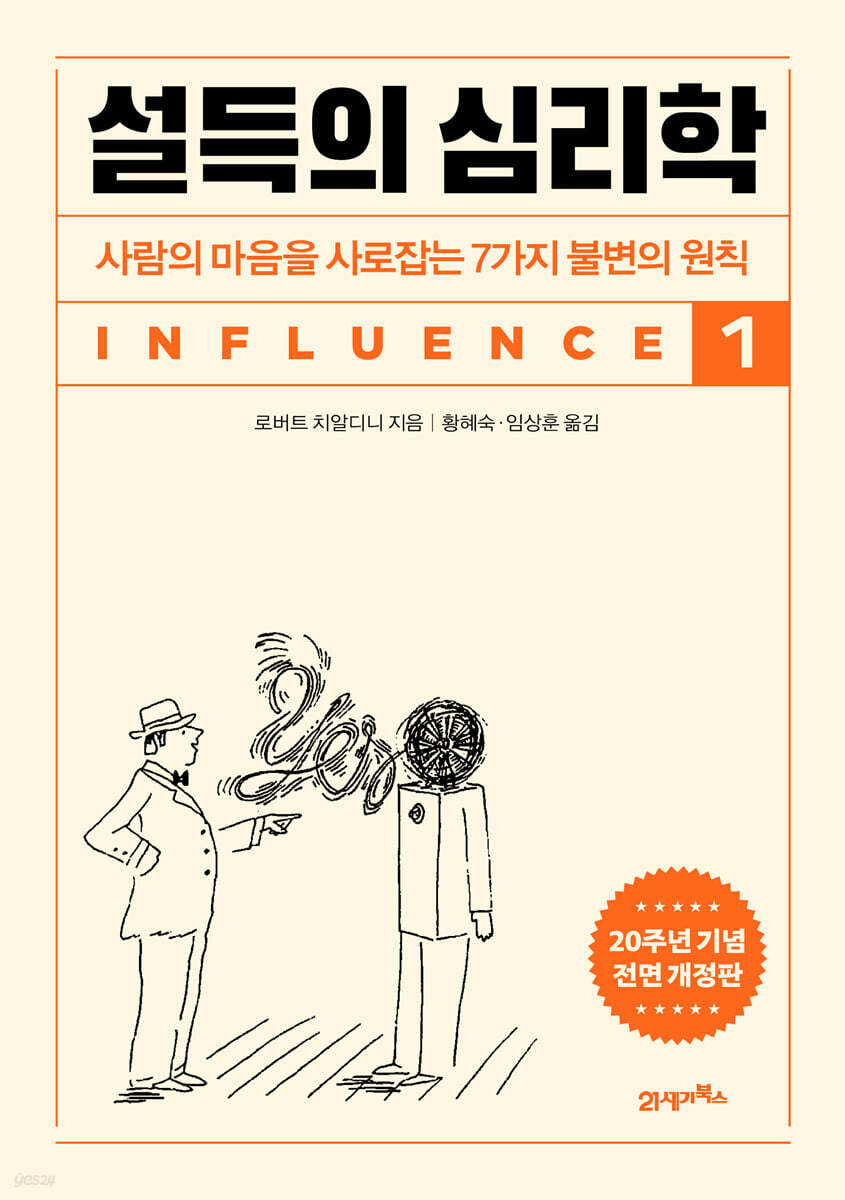
The Psychology of Persuasion 1
 |
Description
Book Introduction
It has been translated into 44 languages over the past 37 years since its first publication.
A business classic that has sold over 5 million copies worldwide.
The best self-help book of our time, one that reads change and engages the mind.
The Psychology of Persuasion returns in a completely revised 20th anniversary edition!
Robert Cialdini, known worldwide as the 'godfather of persuasion,' has released a completely revised edition of his best-selling book, 'The Psychology of Persuasion,' celebrating its 5 millionth copy sold worldwide.
This revised and expanded edition of 『The Psychology of Persuasion』, which has received enthusiastic interest and love from Korean readers for 11 years since its publication in Korea, has been enriched with new content reflecting the trends of the times and technological changes.
It also contains Robert Cialdini's affectionate greetings to his domestic fans, along with the development of research and psychological approaches related to persuasion, acceptance, and change of position.
Research on persuasion has changed completely since the publication of The Psychology of Persuasion.
As the keyword "persuasion" has gained significant attention worldwide, research data and psychological approaches have become broader and more diverse.
Furthermore, new business fields have emerged due to popular culture and technological advancements, persuasive strategies have also advanced rapidly, and cross-cultural social research targeting various cultures has become active.
How are people applying the principles of persuasion in this changing environment? How do they respond to unfair and unjust situations? Is there a way to utilize the weapon of persuasion more effectively? The answers to these questions will not only help you get what you want, but ultimately, they will provide clues to how to captivate others.
This book is structured around seven principles of persuasion.
We explore the function these principles play in society and how masters of persuasion skillfully apply them to wield immense power when asking others for purchases, donations, permission, votes, and agreements.
Also examine how each principle relates to the ability of people to reliably and unconsciously obey it—to respond positively before they have even thought about it deeply.
A business classic that has sold over 5 million copies worldwide.
The best self-help book of our time, one that reads change and engages the mind.
The Psychology of Persuasion returns in a completely revised 20th anniversary edition!
Robert Cialdini, known worldwide as the 'godfather of persuasion,' has released a completely revised edition of his best-selling book, 'The Psychology of Persuasion,' celebrating its 5 millionth copy sold worldwide.
This revised and expanded edition of 『The Psychology of Persuasion』, which has received enthusiastic interest and love from Korean readers for 11 years since its publication in Korea, has been enriched with new content reflecting the trends of the times and technological changes.
It also contains Robert Cialdini's affectionate greetings to his domestic fans, along with the development of research and psychological approaches related to persuasion, acceptance, and change of position.
Research on persuasion has changed completely since the publication of The Psychology of Persuasion.
As the keyword "persuasion" has gained significant attention worldwide, research data and psychological approaches have become broader and more diverse.
Furthermore, new business fields have emerged due to popular culture and technological advancements, persuasive strategies have also advanced rapidly, and cross-cultural social research targeting various cultures has become active.
How are people applying the principles of persuasion in this changing environment? How do they respond to unfair and unjust situations? Is there a way to utilize the weapon of persuasion more effectively? The answers to these questions will not only help you get what you want, but ultimately, they will provide clues to how to captivate others.
This book is structured around seven principles of persuasion.
We explore the function these principles play in society and how masters of persuasion skillfully apply them to wield immense power when asking others for purchases, donations, permission, votes, and agreements.
Also examine how each principle relates to the ability of people to reliably and unconsciously obey it—to respond positively before they have even thought about it deeply.
- You can preview some of the book's contents.
Preview
index
PART 1 Weapons of Persuasion
Press it and it works
Shortcuts to decision-making
People who take unfair advantage
Jiu-Jitsu techniques
PART 2 The Principle of Reciprocity
How Reciprocity Works
The Overwhelming Power of Reciprocity | Politicians' Delusions or Cover-ups | There Are No Free Samples | Personalization Through Customer Customization | Unwanted Favors Must Be Repaid | The Principle of Reciprocity Leads to Unfair Exchanges
mutual concessions
The "Reject and Concede" Strategy | The Mystery of the Watergate Scandal | The Effects and Side Effects of the "Reject and Concede" Strategy | Long-Term Blood Donation Commitment | The Pleasant Side Effects
Self-defense strategies in response to the principle of reciprocity
Distinguish between favors and persuasive tactics | Understand your opponent's true nature.
PART 3 The Principle of Liking
Goodwill for profit
If you want to persuade, be a friend.
Reasons to like someone
Physical attractiveness | Similarity | Compliments | Repeated contact and cooperation | Conditioning and association | Positive relationships are flaunted, negative relationships are concealed
Self-defense strategies in response to the principle of liking
PART 4: THE SOCIAL PROOF PRINCIPLE
The more popular you are, the more popular you become.
95% of Followers | Failed Prophecies, and What Happened Afterward
Optimal conditions for social proof
Uncertainty: When in doubt, look around for answers | A scientific approach | How to eliminate uncertainty | Large numbers: Why the wind-catching business thrives | Why 'large numbers' work | Similarity: Peer persuasion | The Werther effect in suicide reporting | The principle of social proof in isolated groups
The side effects of setting incorrect goals
Social proof of the future
Self-defense strategies that respond to the principle of social proof
Block misinformation | Stop for a moment and look around.
PART 5 AUTHORITY PRINCIPLE
The power of authority
The Allure and Perils of Blind Obedience
Implications over content
Title | Attire | Decoration
Trustworthy authority
Expertise | Reliability
Self-defense strategies in response to the principle of authority
Focus on your true qualifications | Beware of the insidious truth
PART 6 The Scarcity Principle
Shortage is the best, loss is the worst
Limited sale | Limited time
Psychological backlash against infringements on freedom
The Psychological Backlash of the Ugly Two-Year-Old and the Teenager | Rationalizing Desire | The Effects and Reactions of Censorship | Effective Ways to Reduce Backlash
Optimal conditions for the scarcity principle
When what you have is taken away, you feel a greater sense of deprivation | Foolish competition over scarce resources | A differentiation strategy that shows off your uniqueness
Self-defense strategies in response to the scarcity principle
PART 7 Consistency Principle
desire for consistency
Convenient, no-brainer choice | The fortress of self-deception | The toy company's clever marketing strategy
The key to consistency is establishing a position.
The "One-Step-In" Strategy | The Necessities of Effective Position-Making | The Magic of Documentation | Expressing Your Position Publicly | The Effects of the Effortless Position-Making | Voluntary Choice and Inner Responsibility | The "Low-Catch" Strategy
Desirable Uses of the 'Low Ball' Strategy
Sending a signal for consistency
Self-defense strategies in response to the principle of consistency
Respond to the uncomfortable feeling in your stomach | Catch the feeling deep inside | People who are vulnerable to the principle of consistency
PART 8: THE PRINCIPLE OF SOLIDARITY
The relationship called 'us'
The Impact of Solidarity on Business | Solidarity Is More Powerful Than Truth | Team Victory Is My Victory | Solidarity and Relationships
Feeling like you belong to the same group
kinship | place
Acting together
From Similarity to Liking | The Self-Sacrifice of Shared Experience | In the Beginning, There Was Music | Logical Approach vs.
Emotional Approach | Repeated Reciprocity | Suffering Together | Co-creation | Asking for Advice Is the Best Advice
Solidarity for greater unity
Actions for a 'Greater Us'
Self-defense strategies that respond to the principle of solidarity
PART 9 Persuade in an Instant
primitive automatic judgment
Modern automatic judgment
Long live the shortcut to decision-making.
Acknowledgements
main
References
Press it and it works
Shortcuts to decision-making
People who take unfair advantage
Jiu-Jitsu techniques
PART 2 The Principle of Reciprocity
How Reciprocity Works
The Overwhelming Power of Reciprocity | Politicians' Delusions or Cover-ups | There Are No Free Samples | Personalization Through Customer Customization | Unwanted Favors Must Be Repaid | The Principle of Reciprocity Leads to Unfair Exchanges
mutual concessions
The "Reject and Concede" Strategy | The Mystery of the Watergate Scandal | The Effects and Side Effects of the "Reject and Concede" Strategy | Long-Term Blood Donation Commitment | The Pleasant Side Effects
Self-defense strategies in response to the principle of reciprocity
Distinguish between favors and persuasive tactics | Understand your opponent's true nature.
PART 3 The Principle of Liking
Goodwill for profit
If you want to persuade, be a friend.
Reasons to like someone
Physical attractiveness | Similarity | Compliments | Repeated contact and cooperation | Conditioning and association | Positive relationships are flaunted, negative relationships are concealed
Self-defense strategies in response to the principle of liking
PART 4: THE SOCIAL PROOF PRINCIPLE
The more popular you are, the more popular you become.
95% of Followers | Failed Prophecies, and What Happened Afterward
Optimal conditions for social proof
Uncertainty: When in doubt, look around for answers | A scientific approach | How to eliminate uncertainty | Large numbers: Why the wind-catching business thrives | Why 'large numbers' work | Similarity: Peer persuasion | The Werther effect in suicide reporting | The principle of social proof in isolated groups
The side effects of setting incorrect goals
Social proof of the future
Self-defense strategies that respond to the principle of social proof
Block misinformation | Stop for a moment and look around.
PART 5 AUTHORITY PRINCIPLE
The power of authority
The Allure and Perils of Blind Obedience
Implications over content
Title | Attire | Decoration
Trustworthy authority
Expertise | Reliability
Self-defense strategies in response to the principle of authority
Focus on your true qualifications | Beware of the insidious truth
PART 6 The Scarcity Principle
Shortage is the best, loss is the worst
Limited sale | Limited time
Psychological backlash against infringements on freedom
The Psychological Backlash of the Ugly Two-Year-Old and the Teenager | Rationalizing Desire | The Effects and Reactions of Censorship | Effective Ways to Reduce Backlash
Optimal conditions for the scarcity principle
When what you have is taken away, you feel a greater sense of deprivation | Foolish competition over scarce resources | A differentiation strategy that shows off your uniqueness
Self-defense strategies in response to the scarcity principle
PART 7 Consistency Principle
desire for consistency
Convenient, no-brainer choice | The fortress of self-deception | The toy company's clever marketing strategy
The key to consistency is establishing a position.
The "One-Step-In" Strategy | The Necessities of Effective Position-Making | The Magic of Documentation | Expressing Your Position Publicly | The Effects of the Effortless Position-Making | Voluntary Choice and Inner Responsibility | The "Low-Catch" Strategy
Desirable Uses of the 'Low Ball' Strategy
Sending a signal for consistency
Self-defense strategies in response to the principle of consistency
Respond to the uncomfortable feeling in your stomach | Catch the feeling deep inside | People who are vulnerable to the principle of consistency
PART 8: THE PRINCIPLE OF SOLIDARITY
The relationship called 'us'
The Impact of Solidarity on Business | Solidarity Is More Powerful Than Truth | Team Victory Is My Victory | Solidarity and Relationships
Feeling like you belong to the same group
kinship | place
Acting together
From Similarity to Liking | The Self-Sacrifice of Shared Experience | In the Beginning, There Was Music | Logical Approach vs.
Emotional Approach | Repeated Reciprocity | Suffering Together | Co-creation | Asking for Advice Is the Best Advice
Solidarity for greater unity
Actions for a 'Greater Us'
Self-defense strategies that respond to the principle of solidarity
PART 9 Persuade in an Instant
primitive automatic judgment
Modern automatic judgment
Long live the shortcut to decision-making.
Acknowledgements
main
References
Detailed image

Into the book
The odds of success in getting what you want from others through social encounters are dazzling.
The secret to such success lies in how you structure your requests and how you identify and utilize the various persuasive weapons available in society.
Perhaps it's just a matter of finding the right word to trigger a recording device that engages powerful psychological principles and drives our automatic behavior.
The easiest way to take advantage of the human tendency to react automatically according to psychological principles is to look for those who take unfair advantage.
--- p.44 From "PART 1 Weapons of Persuasion"
Of course, we don't always determine our own actions based on the actions of others.
This is especially not the case in important situations where you have to personally weigh the pros and cons one by one, or in your own field of expertise.
However, in a fairly wide range of situations, we use other people's behavior as our most useful information.
In such a situation, if someone deliberately manipulates information to make it unreliable, we too must be prepared to counterattack.
Personally, when I face such a situation, I feel more than just offended; I feel angry.
I'm filled with anger at the thought that they've exploited my last bastion of relief from the burdens of complex modern life to corner me.
It is justifiable to counterattack such people.
If you agree with my thoughts, you too can fight back.
--- p.264 From "PART 4 Social Proof Principle"
As Milgram pointed out, following orders from authority figures is often actually beneficial.
As children, it is certainly beneficial to defer to authority figures who are smarter than us (like parents or teachers).
Because they are wiser and have the power to reward and punish us.
As we become adults, authority figures are replaced by employers, judges, government leaders, and so on, but for the same reasons, it is beneficial to follow these authorities.
Because those in authority have more information and power due to their social status, it is rational to comply with their demands.
However, if we take obedience to authority too seriously, we end up following orders that are completely unreasonable.
--- p.286 From "PART 5 Principle of Authority"
We once distinguished between lies that were well-intentioned and lies that were malicious.
A white lie, also known as a white lie, is a lie told to protect someone else's feelings, such as, "That outfit (or hairstyle) looks good on you."
A malicious lie, also known as a black lie, is a lie intended to harm another person, such as, “If you wear that outfit and date my ex-boyfriend, he’ll love it.”
It is said that a 'blue' lie has emerged recently.
This lie has characteristics of both a white lie and a black lie.
That is, there is an intention to protect someone while simultaneously harming someone else.
Who we protect and who we harm depends on whether they are part of our group.
These intentional lies are usually told by members of the in-group to protect their own group and harm the out-group.
Within a group with a unified identity, maintaining solidarity is more important than truth.
In other words, a lie that helps 'our' group is considered morally superior to a truth that harms the group.
The secret to such success lies in how you structure your requests and how you identify and utilize the various persuasive weapons available in society.
Perhaps it's just a matter of finding the right word to trigger a recording device that engages powerful psychological principles and drives our automatic behavior.
The easiest way to take advantage of the human tendency to react automatically according to psychological principles is to look for those who take unfair advantage.
--- p.44 From "PART 1 Weapons of Persuasion"
Of course, we don't always determine our own actions based on the actions of others.
This is especially not the case in important situations where you have to personally weigh the pros and cons one by one, or in your own field of expertise.
However, in a fairly wide range of situations, we use other people's behavior as our most useful information.
In such a situation, if someone deliberately manipulates information to make it unreliable, we too must be prepared to counterattack.
Personally, when I face such a situation, I feel more than just offended; I feel angry.
I'm filled with anger at the thought that they've exploited my last bastion of relief from the burdens of complex modern life to corner me.
It is justifiable to counterattack such people.
If you agree with my thoughts, you too can fight back.
--- p.264 From "PART 4 Social Proof Principle"
As Milgram pointed out, following orders from authority figures is often actually beneficial.
As children, it is certainly beneficial to defer to authority figures who are smarter than us (like parents or teachers).
Because they are wiser and have the power to reward and punish us.
As we become adults, authority figures are replaced by employers, judges, government leaders, and so on, but for the same reasons, it is beneficial to follow these authorities.
Because those in authority have more information and power due to their social status, it is rational to comply with their demands.
However, if we take obedience to authority too seriously, we end up following orders that are completely unreasonable.
--- p.286 From "PART 5 Principle of Authority"
We once distinguished between lies that were well-intentioned and lies that were malicious.
A white lie, also known as a white lie, is a lie told to protect someone else's feelings, such as, "That outfit (or hairstyle) looks good on you."
A malicious lie, also known as a black lie, is a lie intended to harm another person, such as, “If you wear that outfit and date my ex-boyfriend, he’ll love it.”
It is said that a 'blue' lie has emerged recently.
This lie has characteristics of both a white lie and a black lie.
That is, there is an intention to protect someone while simultaneously harming someone else.
Who we protect and who we harm depends on whether they are part of our group.
These intentional lies are usually told by members of the in-group to protect their own group and harm the out-group.
Within a group with a unified identity, maintaining solidarity is more important than truth.
In other words, a lie that helps 'our' group is considered morally superior to a truth that harms the group.
--- p.487 From "PART 8 Principle of Solidarity"
Publisher's Review
With over 5 million copies sold worldwide, the international bestseller "The Psychology of Persuasion"
A completely revised edition commemorating the 20th anniversary has been published!
Robert Cialdini, known worldwide as the 'godfather of persuasion,' has returned to readers with a revised and expanded edition of his book, 'The Psychology of Persuasion.'
This popular work has sold over 5 million copies worldwide over the past 37 years since its first publication, and has been translated into 44 languages, continuing to be loved by readers around the world.
Research on persuasion has changed completely since the publication of The Psychology of Persuasion.
As the keyword "persuasion" has gained significant attention worldwide, research data and psychological approaches have become broader and more diverse.
Furthermore, new business fields have emerged due to popular culture and technological advancements, persuasive strategies have also advanced rapidly, and cross-cultural social research targeting various cultures has become active.
How are people applying the principles of persuasion in this changing environment? How do they respond to unfair and unjust situations? Is there a way to utilize the weapon of persuasion more effectively? The answers to these questions will not only help you get what you want, but ultimately, they will provide clues to how to captivate others.
In this revised and expanded edition, the order of the principles has been rearranged to allow for the appropriate use of the principles in the appropriate place according to the persuasive motive, thereby enhancing their completeness.
It has been reconstructed based on past research and the desired purpose of persuasion.
When building positive relationships between people is important, the principles of reciprocity, liking, and solidarity are applied; when reducing uncertainty, the principles of social proof and authority are applied; and when stimulating behavior, the principles of consistency and scarcity are applied. These principles are rearranged into a suitable configuration to identify the most effective persuasive tools.
In addition to updating the "Reader Letters" sent directly by readers, the book also includes articles reporting on the role of persuasion in everyday human interactions, encompassing not only research conducted in the laboratory but also the workings of persuasion in everyday life.
Looking at the aspects, we can see how easily we are persuaded by someone in our daily lives, how we are fooled in absurd ways, and how we end up with bad results.
Finally, the most noteworthy aspect of this revised and expanded edition is the addition of 'solidarity,' a universal principle of social persuasion.
Most masters of persuasion build a solid foundation within the relationship of "us."
This is because we tend to say 'yes' more easily to people we perceive as belonging to the same group.
Simply put, 'we' can be defined as a relationship in which we share ourselves.
This includes solidarity between racial, ethnic, national, family, political and religious groups, and even as small as fans of a favorite sports team.
A newly added chapter explores the elements of solidarity that create a sense of "we" in an increasingly individualized and fragmented society, and examines closely how persuasion operates and how it leads to errors in relationships.
"The Psychology of Persuasion," now back with a new, more robust content and structure, will satisfy both existing and new readers.
Why do we easily agree and then regret it later?
To get what you want, you have to capture the other person's heart first!
The power of persuasion to ensure things go smoothly in your desired direction without being taken advantage of by others.
A book that demonstrates the active participation and support of readers, as well as the author's passion for research on persuasive psychology.
The book was inspired by social psychologist Robert Cialdini's own experience of subscribing to unexpected magazines and buying outrageously expensive clothes, only to regret it later.
The many vivid examples in this book are also related to his diverse background.
He even ventured out of the experimental lab at his university and into the world of persuasion professionals—salespeople, fundraisers, advertisers—whose livelihoods depend on their ability to persuade people.
Because he knew better than anyone else how people who couldn't elicit positive responses from others were bound to fall behind, and how persuasion experts persuaded others.
This book is structured around seven principles of persuasion.
We explore the function these principles play in society and how masters of persuasion skillfully apply them to wield immense power when asking others for purchases, donations, permission, votes, and agreements.
We also examine how each principle relates to the ability of people to reliably and automatically obtain their obedience—that is, to say "yes" before they even think deeply about something.
People live their lives meeting countless people.
A person's life begins, is completed, and ends in relationships with family, friends, and coworkers.
There are meetings without any purpose, and there are also meetings that are held to achieve some purpose.
In the competitive business world, if you want to meet someone and negotiate to get what you want, you shouldn't easily give in to their demands.
Masters of persuasion employ thousands of techniques to elicit a "yes" response from their audience.
All of these techniques fall within the seven principles mentioned in this book.
By simply mastering the principles of persuasion discussed in this book, you can achieve your goals by speaking and acting wisely and intelligently in your work life or during important negotiations.
A completely revised edition commemorating the 20th anniversary has been published!
Robert Cialdini, known worldwide as the 'godfather of persuasion,' has returned to readers with a revised and expanded edition of his book, 'The Psychology of Persuasion.'
This popular work has sold over 5 million copies worldwide over the past 37 years since its first publication, and has been translated into 44 languages, continuing to be loved by readers around the world.
Research on persuasion has changed completely since the publication of The Psychology of Persuasion.
As the keyword "persuasion" has gained significant attention worldwide, research data and psychological approaches have become broader and more diverse.
Furthermore, new business fields have emerged due to popular culture and technological advancements, persuasive strategies have also advanced rapidly, and cross-cultural social research targeting various cultures has become active.
How are people applying the principles of persuasion in this changing environment? How do they respond to unfair and unjust situations? Is there a way to utilize the weapon of persuasion more effectively? The answers to these questions will not only help you get what you want, but ultimately, they will provide clues to how to captivate others.
In this revised and expanded edition, the order of the principles has been rearranged to allow for the appropriate use of the principles in the appropriate place according to the persuasive motive, thereby enhancing their completeness.
It has been reconstructed based on past research and the desired purpose of persuasion.
When building positive relationships between people is important, the principles of reciprocity, liking, and solidarity are applied; when reducing uncertainty, the principles of social proof and authority are applied; and when stimulating behavior, the principles of consistency and scarcity are applied. These principles are rearranged into a suitable configuration to identify the most effective persuasive tools.
In addition to updating the "Reader Letters" sent directly by readers, the book also includes articles reporting on the role of persuasion in everyday human interactions, encompassing not only research conducted in the laboratory but also the workings of persuasion in everyday life.
Looking at the aspects, we can see how easily we are persuaded by someone in our daily lives, how we are fooled in absurd ways, and how we end up with bad results.
Finally, the most noteworthy aspect of this revised and expanded edition is the addition of 'solidarity,' a universal principle of social persuasion.
Most masters of persuasion build a solid foundation within the relationship of "us."
This is because we tend to say 'yes' more easily to people we perceive as belonging to the same group.
Simply put, 'we' can be defined as a relationship in which we share ourselves.
This includes solidarity between racial, ethnic, national, family, political and religious groups, and even as small as fans of a favorite sports team.
A newly added chapter explores the elements of solidarity that create a sense of "we" in an increasingly individualized and fragmented society, and examines closely how persuasion operates and how it leads to errors in relationships.
"The Psychology of Persuasion," now back with a new, more robust content and structure, will satisfy both existing and new readers.
Why do we easily agree and then regret it later?
To get what you want, you have to capture the other person's heart first!
The power of persuasion to ensure things go smoothly in your desired direction without being taken advantage of by others.
A book that demonstrates the active participation and support of readers, as well as the author's passion for research on persuasive psychology.
The book was inspired by social psychologist Robert Cialdini's own experience of subscribing to unexpected magazines and buying outrageously expensive clothes, only to regret it later.
The many vivid examples in this book are also related to his diverse background.
He even ventured out of the experimental lab at his university and into the world of persuasion professionals—salespeople, fundraisers, advertisers—whose livelihoods depend on their ability to persuade people.
Because he knew better than anyone else how people who couldn't elicit positive responses from others were bound to fall behind, and how persuasion experts persuaded others.
This book is structured around seven principles of persuasion.
We explore the function these principles play in society and how masters of persuasion skillfully apply them to wield immense power when asking others for purchases, donations, permission, votes, and agreements.
We also examine how each principle relates to the ability of people to reliably and automatically obtain their obedience—that is, to say "yes" before they even think deeply about something.
People live their lives meeting countless people.
A person's life begins, is completed, and ends in relationships with family, friends, and coworkers.
There are meetings without any purpose, and there are also meetings that are held to achieve some purpose.
In the competitive business world, if you want to meet someone and negotiate to get what you want, you shouldn't easily give in to their demands.
Masters of persuasion employ thousands of techniques to elicit a "yes" response from their audience.
All of these techniques fall within the seven principles mentioned in this book.
By simply mastering the principles of persuasion discussed in this book, you can achieve your goals by speaking and acting wisely and intelligently in your work life or during important negotiations.
GOODS SPECIFICS
- Date of issue: April 26, 2023
- Page count, weight, size: 680 pages | 148*210*35mm
- ISBN13: 9788950950002
- ISBN10: 8950950006
You may also like
카테고리
korean


korean

![GQ KOREA Mark (Monthly): December [2025]](http://librairie.coreenne.fr/cdn/shop/files/8ef265dbbfbf186523ed75ba7319009d.jpg?v=1765340328&width=3840)


