

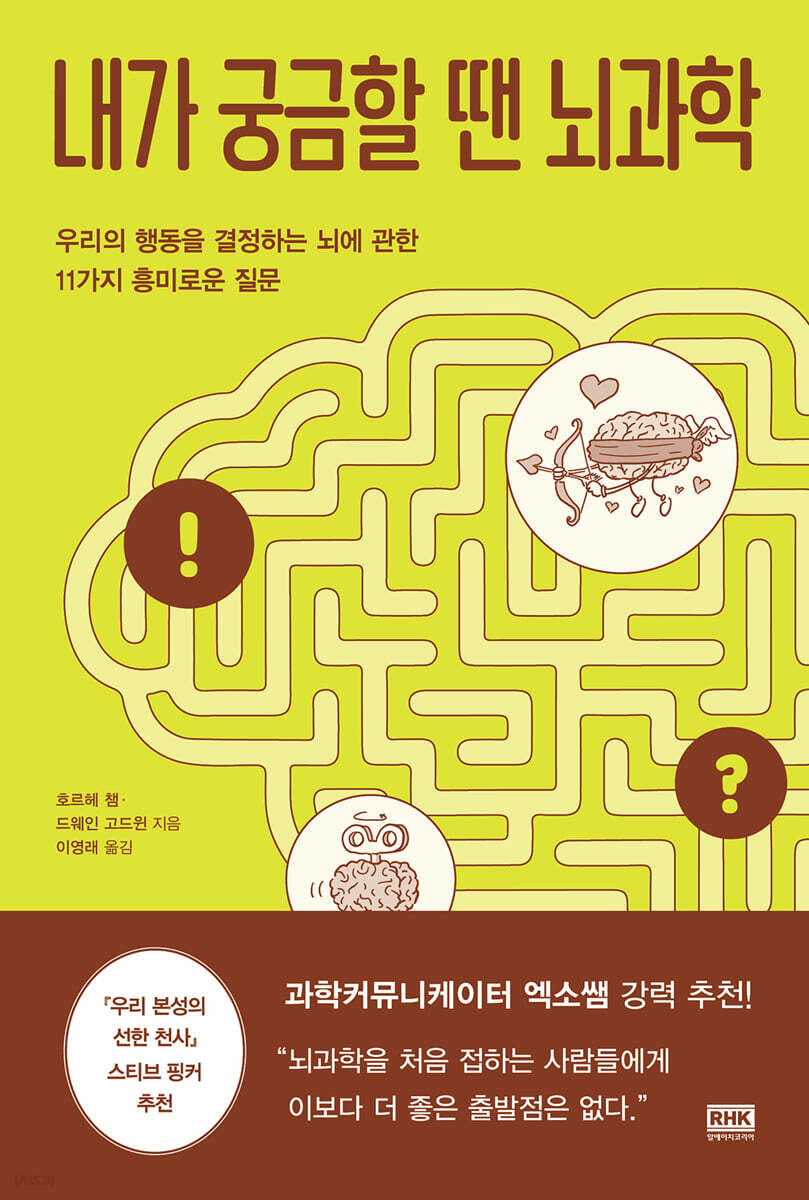
When I'm curious, I think about brain science
 |
Description
Book Introduction
Recommended by American Scientist, Publisher's Weekly, and Kirkus Reviews
The Better Angels of Our Nature, by Steven Pinker
With 200,000 cumulative students, science communicator Exo Teacher (Lee Seon-ho) strongly recommends this course.
How does the brain, the organ that controls our thoughts, emotions, and actions, work?
The most intelligent and entertaining exploration of the brain, the thing that makes us human!
"When I'm Curious, Brain Science" is a popular science book that explains 11 topics closely related to our daily lives, such as love, happiness, disgust, and free will, in an easy-to-understand way through explanations based on brain science research, humorous cartoons, and excellent storytelling.
The author of this book, Jorge Cham, is a robotics engineer and bestselling cartoonist who has written numerous science-related books. This time, he collaborates with neuroscientist Dwayne Godwin to delve into the fascinating world of the human brain.
Jorge Cham, a bestselling cartoonist, has incorporated his signature sense of humor into over 200 cartoons, engaging examples, and exceptional storytelling skills to make neuroscience, which can be considered difficult, accessible to readers without background knowledge.
Steven Pinker, a professor of psychology at Harvard University and author of The Better Angels of Our Nature, praised the book, saying it was “full of wit and useful common sense.” Major overseas media outlets such as [American Scientist], [Publisher’s Weekly], and [Kirkus Review] also praised the book, saying it combines scientific credibility and fun.
Exo Teacher (Lee Seon-ho), a science mentor and science communicator with over 200,000 cumulative students, recommended this book as an introductory book to brain science, saying, “For those who are new to brain science, there is no better starting point.”
If you're interested in brain science but don't know where to start, this book is a great choice.
“This book doesn’t present science as a panacea, but rather shows that science is a process of constantly questioning, experimenting, and refining to get closer to the truth.
As you follow this process, you will gain the perspective of a "hypothesis-building researcher," rather than a mere "answer collector."
In other words, you will gain not only knowledge of brain science, but perhaps even more importantly, a scientific attitude to question and explore yourself.”
- Science communicator Exo Teacher (Lee Seon-ho)
The Better Angels of Our Nature, by Steven Pinker
With 200,000 cumulative students, science communicator Exo Teacher (Lee Seon-ho) strongly recommends this course.
How does the brain, the organ that controls our thoughts, emotions, and actions, work?
The most intelligent and entertaining exploration of the brain, the thing that makes us human!
"When I'm Curious, Brain Science" is a popular science book that explains 11 topics closely related to our daily lives, such as love, happiness, disgust, and free will, in an easy-to-understand way through explanations based on brain science research, humorous cartoons, and excellent storytelling.
The author of this book, Jorge Cham, is a robotics engineer and bestselling cartoonist who has written numerous science-related books. This time, he collaborates with neuroscientist Dwayne Godwin to delve into the fascinating world of the human brain.
Jorge Cham, a bestselling cartoonist, has incorporated his signature sense of humor into over 200 cartoons, engaging examples, and exceptional storytelling skills to make neuroscience, which can be considered difficult, accessible to readers without background knowledge.
Steven Pinker, a professor of psychology at Harvard University and author of The Better Angels of Our Nature, praised the book, saying it was “full of wit and useful common sense.” Major overseas media outlets such as [American Scientist], [Publisher’s Weekly], and [Kirkus Review] also praised the book, saying it combines scientific credibility and fun.
Exo Teacher (Lee Seon-ho), a science mentor and science communicator with over 200,000 cumulative students, recommended this book as an introductory book to brain science, saying, “For those who are new to brain science, there is no better starting point.”
If you're interested in brain science but don't know where to start, this book is a great choice.
“This book doesn’t present science as a panacea, but rather shows that science is a process of constantly questioning, experimenting, and refining to get closer to the truth.
As you follow this process, you will gain the perspective of a "hypothesis-building researcher," rather than a mere "answer collector."
In other words, you will gain not only knowledge of brain science, but perhaps even more importantly, a scientific attitude to question and explore yourself.”
- Science communicator Exo Teacher (Lee Seon-ho)
- You can preview some of the book's contents.
Preview
index
A letter of recommendation.
A wonderful spaceship exploring the universe called the human brain
Opening remarks.
I hope you can look back on your life with brain science.
Chapter 1.
Where is the mind?
Chapter 2.
Why do we love?
Chapter 3.
Why do we hate?
Chapter 4.
Will AI take my job?
Chapter 5.
Is there a limit to memory?
Chapter 6.
What is addiction?
Chapter 7.
What is consciousness?
Chapter 8.
What makes us happy?
Chapter 9.
Do we have free will?
Chapter 10.
What happens when you die?
Chapter 11.
What makes us human?
Conclusion.
Our mind and brain are still vast and unknown areas.
Acknowledgements
main
A wonderful spaceship exploring the universe called the human brain
Opening remarks.
I hope you can look back on your life with brain science.
Chapter 1.
Where is the mind?
Chapter 2.
Why do we love?
Chapter 3.
Why do we hate?
Chapter 4.
Will AI take my job?
Chapter 5.
Is there a limit to memory?
Chapter 6.
What is addiction?
Chapter 7.
What is consciousness?
Chapter 8.
What makes us happy?
Chapter 9.
Do we have free will?
Chapter 10.
What happens when you die?
Chapter 11.
What makes us human?
Conclusion.
Our mind and brain are still vast and unknown areas.
Acknowledgements
main
Detailed image

Into the book
Before you hold Aristotle to a harsh standard of judgment, think about it for a moment.
Wouldn't it have been more logical to put the brain inside the chest? Imagine you were creating a human.
Wouldn't the most crucial organ, the one that makes all decisions, be located at the end of a slender stem at the very top of the body? Wouldn't it be more practical to place the central control center in the center of the body, protected by muscles and the rib cage, flanked by two soft lungs? Aristotle's logic wasn't entirely absurd.
Even today, we associate a variety of emotions with a beating heart.
Think of a time when you felt an intense emotion, such as great joy, surprise, or sadness.
Haven't you ever automatically felt your heart clench or a sinking sensation in your gut? It's a natural reaction to consider the heart as the core of our being.
--- p.26
Therefore, the answer to the question posed at the beginning of Chapter 1, “Where are you?” would be, “You exist, little by little, everywhere.”
One area of the brain is responsible for understanding and combining words, while another area is responsible for sensing the world and moving the body.
If you remove any one of these, you will never be the same person you were before.
Of course, one could argue that your ability to move or speak is not who you are, and that only things like your personality, memories, and tastes truly reveal who you are.
But think about it.
If you didn't have the ability to walk, speak, or listen to music, would you be the person you are today? Wouldn't your personality itself change? If the "mind" is the sum total of how you process information and interact with the world, then any part of your brain that's affected will change you.
Even if it's a very small change.
--- p.47
Your existence is modular.
You are made up of many parts located in different brain regions, and these parts are interconnected.
And it is precisely through these connections and interactions that self-consciousness arises.
You are a collection of different parts, and a vortex of information flowing between those parts.
In the middle of that whirlpool, there is a being called ‘I’.
Unlike Aristotle, if we are to find our true self, we must look within our metaphorical heart, not our physical heart.
--- p.50
Have you noticed that the brain circuit associated with love—the reward system—is also linked to drug addiction? This is because both love and drugs stimulate the reward system to extremes.
Neuroscientists believe that when the reward system becomes overactive, it triggers a feedback loop that begins to change the brain.
This issue will be discussed in more detail in the chapter on addiction, but addiction is when excessive amounts of dopamine imprint the brain with a desire to seek out sources of pleasure.
This is why we crave love, and sometimes even become obsessed with it.
Love is like a drug.
Do you ever feel like you can't live without the person you love? There's a famous lyric from a song by 1980s pop singer Robert Palmer:
“Just accept it.
You are addicted to love.” --- p.74~75
One reason we dislike others may be because our brains are wired to look for things to hate.
In particular, several scientific studies point out that our brains are wired to think in terms of groups, categorizing others as being in the same group as us (in-group) or outside of it (out-group).
--- p.101
Interestingly, the brain has a mechanism to 'wash out' short-term memories.
In memory research, there is a famous phenomenon called the 'doorway effect'.
This refers to a phenomenon where, while thinking about something (for example, looking for keys), you enter a new room and completely forget why you entered that room.
To study this phenomenon, psychologists administered a simple memory recall test to experimental participants.
It was a test where you picked up an object on a table, put it in a box, and later had to remember what was in the box.
There was an important condition in this experiment.
Participants sometimes stayed in the room where they picked up the object, and sometimes moved to another room to conduct the test.
The results were surprising.
Simply entering another room caused participants to forget a significant portion of what was in the box.
Even entering and leaving the same room had the same effect.
--- p.175~176
Neuroscientists debate how much subliminal messages can influence our thinking.
Some believe that the effects of subliminal messages only last for a few seconds because they are not usually stored in long-term memory, while others argue that a lot can happen in those few seconds.
For example, you may make an important decision at that moment, or you may actually make up your mind about something.
Some studies show that subliminal messages can influence voting.
In a 2008 study, scientists showed the word "RATS" for 33 milliseconds before showing a photo of a political candidate (actually a random photo of a man in a suit).
The study found that subjects who were shown the word "rat" evaluated the candidate much more negatively than when they were shown the neutral word.
Wouldn't it have been more logical to put the brain inside the chest? Imagine you were creating a human.
Wouldn't the most crucial organ, the one that makes all decisions, be located at the end of a slender stem at the very top of the body? Wouldn't it be more practical to place the central control center in the center of the body, protected by muscles and the rib cage, flanked by two soft lungs? Aristotle's logic wasn't entirely absurd.
Even today, we associate a variety of emotions with a beating heart.
Think of a time when you felt an intense emotion, such as great joy, surprise, or sadness.
Haven't you ever automatically felt your heart clench or a sinking sensation in your gut? It's a natural reaction to consider the heart as the core of our being.
--- p.26
Therefore, the answer to the question posed at the beginning of Chapter 1, “Where are you?” would be, “You exist, little by little, everywhere.”
One area of the brain is responsible for understanding and combining words, while another area is responsible for sensing the world and moving the body.
If you remove any one of these, you will never be the same person you were before.
Of course, one could argue that your ability to move or speak is not who you are, and that only things like your personality, memories, and tastes truly reveal who you are.
But think about it.
If you didn't have the ability to walk, speak, or listen to music, would you be the person you are today? Wouldn't your personality itself change? If the "mind" is the sum total of how you process information and interact with the world, then any part of your brain that's affected will change you.
Even if it's a very small change.
--- p.47
Your existence is modular.
You are made up of many parts located in different brain regions, and these parts are interconnected.
And it is precisely through these connections and interactions that self-consciousness arises.
You are a collection of different parts, and a vortex of information flowing between those parts.
In the middle of that whirlpool, there is a being called ‘I’.
Unlike Aristotle, if we are to find our true self, we must look within our metaphorical heart, not our physical heart.
--- p.50
Have you noticed that the brain circuit associated with love—the reward system—is also linked to drug addiction? This is because both love and drugs stimulate the reward system to extremes.
Neuroscientists believe that when the reward system becomes overactive, it triggers a feedback loop that begins to change the brain.
This issue will be discussed in more detail in the chapter on addiction, but addiction is when excessive amounts of dopamine imprint the brain with a desire to seek out sources of pleasure.
This is why we crave love, and sometimes even become obsessed with it.
Love is like a drug.
Do you ever feel like you can't live without the person you love? There's a famous lyric from a song by 1980s pop singer Robert Palmer:
“Just accept it.
You are addicted to love.” --- p.74~75
One reason we dislike others may be because our brains are wired to look for things to hate.
In particular, several scientific studies point out that our brains are wired to think in terms of groups, categorizing others as being in the same group as us (in-group) or outside of it (out-group).
--- p.101
Interestingly, the brain has a mechanism to 'wash out' short-term memories.
In memory research, there is a famous phenomenon called the 'doorway effect'.
This refers to a phenomenon where, while thinking about something (for example, looking for keys), you enter a new room and completely forget why you entered that room.
To study this phenomenon, psychologists administered a simple memory recall test to experimental participants.
It was a test where you picked up an object on a table, put it in a box, and later had to remember what was in the box.
There was an important condition in this experiment.
Participants sometimes stayed in the room where they picked up the object, and sometimes moved to another room to conduct the test.
The results were surprising.
Simply entering another room caused participants to forget a significant portion of what was in the box.
Even entering and leaving the same room had the same effect.
--- p.175~176
Neuroscientists debate how much subliminal messages can influence our thinking.
Some believe that the effects of subliminal messages only last for a few seconds because they are not usually stored in long-term memory, while others argue that a lot can happen in those few seconds.
For example, you may make an important decision at that moment, or you may actually make up your mind about something.
Some studies show that subliminal messages can influence voting.
In a 2008 study, scientists showed the word "RATS" for 33 milliseconds before showing a photo of a political candidate (actually a random photo of a man in a suit).
The study found that subjects who were shown the word "rat" evaluated the candidate much more negatively than when they were shown the neutral word.
--- p.260
Publisher's Review
“The surest way to understand myself and others is
“It’s about understanding the little organs in our heads.”
For those who want to live as the master of their thoughts, feelings, and actions.
Useful Brain Science Facts to Know
As we live, we meet people who are very different from us.
At times like that, a question inevitably arises in a corner of your mind: 'Why on earth does that person act like that?'
Sometimes there are moments when it is difficult to understand not only others but even myself.
Why do we become addicted to alcohol, cigarettes, games, and smartphones, repeating the same behaviors even though we know we'll regret them? Why do we vividly remember embarrassing childhood experiences or the plot of a movie we saw long ago, yet can't remember where we put our keys a few minutes ago? Why do people of all ages, from children to adults, so readily reject and take sides with groups different from our own? Have you ever been obsessed with someone you're in love with, unable to shake off thoughts of them no matter how hard you try?
"When I'm Curious, Brain Science" provides the most reliable tool for understanding this incomprehensible human being.
That tool is neuroscience.
This is because thoughts, emotions, and actions all originate from the brain, a small organ in the head.
The author of this book, Jorge Cham, is an engineer who received his Ph.D. in robotics from Stanford University and conducted research at the California Institute of Technology (Caltech).
What makes him even more special is the fact that he is a cartoonist.
He has demonstrated an exceptional ability to make scientific knowledge, which can be perceived as difficult, easily understandable through cartoons.
This time, we delve into the fascinating world of the human brain with neuroscientist Dwayne Godwin.
“If you know how the brain works,
“The world that felt uncertain becomes clearer!”
A book full of sparkling humor, quirky imagination, and intellectual stimulation.
The introduction to "When I'm Curious About Brain Science" begins with the two authors meeting at a sandwich shop.
The conversation there soon expanded into an experiment: "Can the most complex object in the universe (the brain) be explained using the simplest storytelling tools humans have created (comics or illustrations)?"
The result is this book.
The two authors explore questions about topics closely related to our daily lives, such as love, hate, free will, happiness, and death, from a neuroscientific perspective.
While the process of answering these questions utilizes various studies and case studies, it is not a boring, dry book that simply lists facts like a thesis or textbook.
Jorge Cham, a bestselling cartoonist, has incorporated his signature sense of humor into over 200 cartoons, engaging examples, and exceptional storytelling skills to make neuroscience, which can be considered difficult, accessible to readers without background knowledge.
For example, the author says that love is addictive like a drug, and this is not just a metaphor.
When we see someone we love, our brain's 'reward system' is activated.
The reward system is a network of several areas, and when this circuit is activated, dopamine is released, causing a feeling of pleasure, and this experience is imprinted in the memory, making us seek out the same stimulus again and again.
Although most people believe they don't easily hate others, the author explains that hate is an instinct pre-programmed into our brains for survival and reproduction.
What's interesting is that disgust, which at first glance seems like an unpleasant emotion, is actually pleasurable.
When we engage in aggressive behavior, the ventral tegmental area of the brain is activated, and when this area is activated, dopamine, a hormone that makes us feel pleasure, is secreted.
When talking about the human brain, we cannot leave out artificial intelligence, a hot topic in the world.
The author predicts that with the advancement of artificial intelligence, AI may one day acquire a form of consciousness that we are unaware of.
Just as an octopus, with its brain divided into eight legs, or ants, which act as if the entire group has a single consciousness, AI could also develop a form of consciousness completely different from that of humans.
In addition, it covers a variety of topics that stimulate intellectual curiosity.
It explains, based on scientific evidence, where in our bodies does the 'mind' exist that determines our thoughts and actions and distinguishes us from others, what areas of the brain are involved in memory and what the limits are to the capacity of human memory, and that near-death experiences such as out-of-body experiences are not absurd stories, but rather actual phenomena that can occur due to dysfunction related to specific areas of the brain.
“For those who are new to brain science,
“There is no better starting point.”
An introductory book on brain science that explains the complexities of the human mind in an easy and fun way through cartoons.
Knowing how your brain works like this will help you understand yourself better, and based on that understanding, you will be able to control your emotions and behavior better than before.
Even if you can't control it, the anxiety caused by uncertainty will be reduced, and you will be able to look at the same situation from a different perspective than before.
If you're interested in brain science but don't know where to start, this book is a great choice.
Exo Teacher (Lee Seon-ho), a science mentor and science communicator with over 200,000 students, recommends this book as an introductory text for readers who are new to brain science.
After reading this book, you will not only understand the structure and basic workings of the brain, but also gain practical knowledge that will enrich your daily life, such as ways to improve your memory and the secrets to a happy life.
Also, as the author says in the introduction, “As you delve deeply into topics like love, happiness, and death, you cannot help but seriously reflect on your own life.”
This book will guide you on a journey to understand yourself, reflect on yourself, and seek better change.
"Fascinating and accessible without sacrificing accuracy or scientific credibility." - American Scientist
"A book that combines exploration of how the brain works with delightful illustrations." ? 〈Purple Weekly〉
“The two authors make the very complex subject of brain science accessible to the general reader.
“Cham’s paintings transform complexity into playfulness and simplicity.” ? 〈Kirkus Reviews〉
“It’s about understanding the little organs in our heads.”
For those who want to live as the master of their thoughts, feelings, and actions.
Useful Brain Science Facts to Know
As we live, we meet people who are very different from us.
At times like that, a question inevitably arises in a corner of your mind: 'Why on earth does that person act like that?'
Sometimes there are moments when it is difficult to understand not only others but even myself.
Why do we become addicted to alcohol, cigarettes, games, and smartphones, repeating the same behaviors even though we know we'll regret them? Why do we vividly remember embarrassing childhood experiences or the plot of a movie we saw long ago, yet can't remember where we put our keys a few minutes ago? Why do people of all ages, from children to adults, so readily reject and take sides with groups different from our own? Have you ever been obsessed with someone you're in love with, unable to shake off thoughts of them no matter how hard you try?
"When I'm Curious, Brain Science" provides the most reliable tool for understanding this incomprehensible human being.
That tool is neuroscience.
This is because thoughts, emotions, and actions all originate from the brain, a small organ in the head.
The author of this book, Jorge Cham, is an engineer who received his Ph.D. in robotics from Stanford University and conducted research at the California Institute of Technology (Caltech).
What makes him even more special is the fact that he is a cartoonist.
He has demonstrated an exceptional ability to make scientific knowledge, which can be perceived as difficult, easily understandable through cartoons.
This time, we delve into the fascinating world of the human brain with neuroscientist Dwayne Godwin.
“If you know how the brain works,
“The world that felt uncertain becomes clearer!”
A book full of sparkling humor, quirky imagination, and intellectual stimulation.
The introduction to "When I'm Curious About Brain Science" begins with the two authors meeting at a sandwich shop.
The conversation there soon expanded into an experiment: "Can the most complex object in the universe (the brain) be explained using the simplest storytelling tools humans have created (comics or illustrations)?"
The result is this book.
The two authors explore questions about topics closely related to our daily lives, such as love, hate, free will, happiness, and death, from a neuroscientific perspective.
While the process of answering these questions utilizes various studies and case studies, it is not a boring, dry book that simply lists facts like a thesis or textbook.
Jorge Cham, a bestselling cartoonist, has incorporated his signature sense of humor into over 200 cartoons, engaging examples, and exceptional storytelling skills to make neuroscience, which can be considered difficult, accessible to readers without background knowledge.
For example, the author says that love is addictive like a drug, and this is not just a metaphor.
When we see someone we love, our brain's 'reward system' is activated.
The reward system is a network of several areas, and when this circuit is activated, dopamine is released, causing a feeling of pleasure, and this experience is imprinted in the memory, making us seek out the same stimulus again and again.
Although most people believe they don't easily hate others, the author explains that hate is an instinct pre-programmed into our brains for survival and reproduction.
What's interesting is that disgust, which at first glance seems like an unpleasant emotion, is actually pleasurable.
When we engage in aggressive behavior, the ventral tegmental area of the brain is activated, and when this area is activated, dopamine, a hormone that makes us feel pleasure, is secreted.
When talking about the human brain, we cannot leave out artificial intelligence, a hot topic in the world.
The author predicts that with the advancement of artificial intelligence, AI may one day acquire a form of consciousness that we are unaware of.
Just as an octopus, with its brain divided into eight legs, or ants, which act as if the entire group has a single consciousness, AI could also develop a form of consciousness completely different from that of humans.
In addition, it covers a variety of topics that stimulate intellectual curiosity.
It explains, based on scientific evidence, where in our bodies does the 'mind' exist that determines our thoughts and actions and distinguishes us from others, what areas of the brain are involved in memory and what the limits are to the capacity of human memory, and that near-death experiences such as out-of-body experiences are not absurd stories, but rather actual phenomena that can occur due to dysfunction related to specific areas of the brain.
“For those who are new to brain science,
“There is no better starting point.”
An introductory book on brain science that explains the complexities of the human mind in an easy and fun way through cartoons.
Knowing how your brain works like this will help you understand yourself better, and based on that understanding, you will be able to control your emotions and behavior better than before.
Even if you can't control it, the anxiety caused by uncertainty will be reduced, and you will be able to look at the same situation from a different perspective than before.
If you're interested in brain science but don't know where to start, this book is a great choice.
Exo Teacher (Lee Seon-ho), a science mentor and science communicator with over 200,000 students, recommends this book as an introductory text for readers who are new to brain science.
After reading this book, you will not only understand the structure and basic workings of the brain, but also gain practical knowledge that will enrich your daily life, such as ways to improve your memory and the secrets to a happy life.
Also, as the author says in the introduction, “As you delve deeply into topics like love, happiness, and death, you cannot help but seriously reflect on your own life.”
This book will guide you on a journey to understand yourself, reflect on yourself, and seek better change.
"Fascinating and accessible without sacrificing accuracy or scientific credibility." - American Scientist
"A book that combines exploration of how the brain works with delightful illustrations." ? 〈Purple Weekly〉
“The two authors make the very complex subject of brain science accessible to the general reader.
“Cham’s paintings transform complexity into playfulness and simplicity.” ? 〈Kirkus Reviews〉
GOODS SPECIFICS
- Date of issue: October 17, 2025
- Page count, weight, size: 484 pages | 766g | 145*215*30mm
- ISBN13: 9788925573045
- ISBN10: 8925573040
You may also like
카테고리
korean


korean

![GQ KOREA Mark (Monthly): December [2025]](http://librairie.coreenne.fr/cdn/shop/files/8ef265dbbfbf186523ed75ba7319009d.jpg?v=1765340328&width=3840)


