

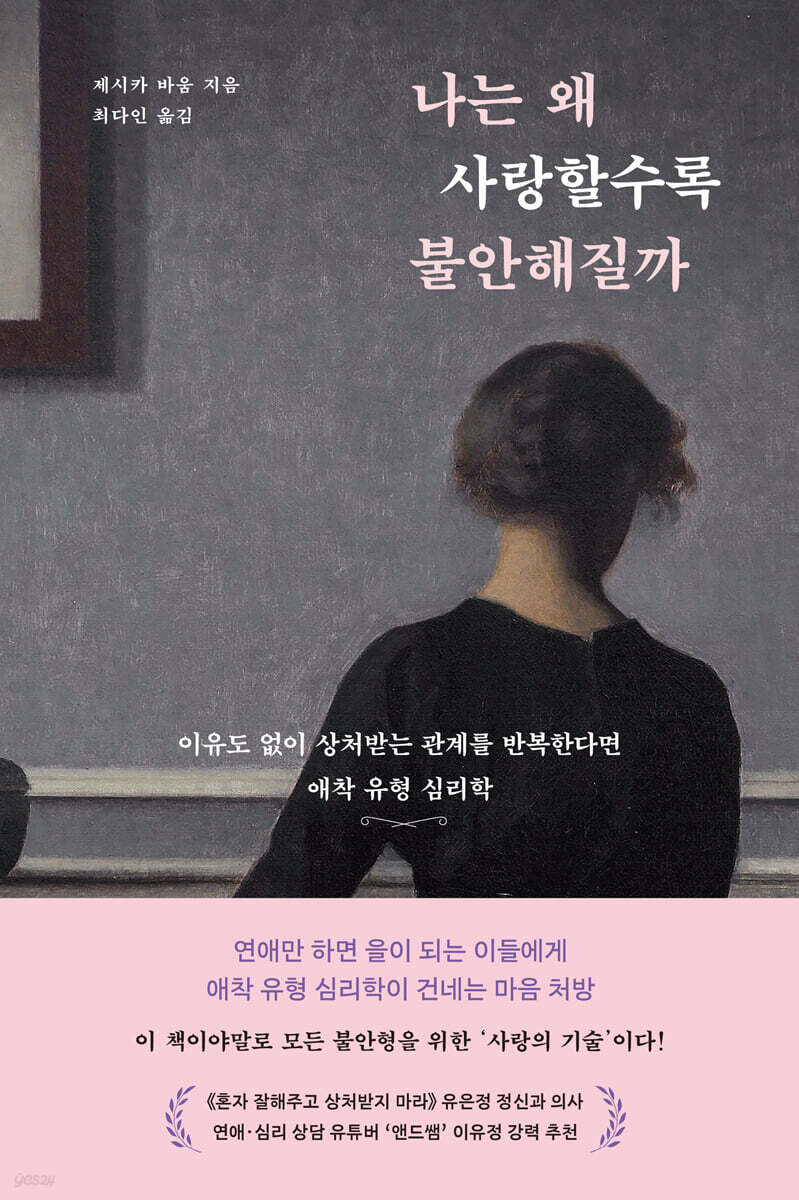
Why do I become more anxious the more I love?
 |
Description
Book Introduction
To those who become 'eul' just by dating Attachment Type Psychology's Prescription for the Heart "Do your best on your own and don't get hurt," says psychiatrist Eun-Jeong Yoo. Love and psychology counseling YouTuber 'And Sam' strongly recommends Lee Yu-jeong. According to the theory of romantic attachment in adults, which can be called the "science of love," the attachment styles that develop in the way we relate to others as infants and toddlers continue to influence our relationships with others as adults. Among them, the anxious type, who craves attention and affection, and the avoidant type, who rejects it, may seem like complete opposites on the outside, but in reality, they are both wounded souls. And the wound may not be from the lover in front of you now, but from your relationship with your caregiver during childhood. This is precisely why, in order to find answers to your current interpersonal and romantic concerns, you need to understand your attachment patterns and the past wounds that cause them. “If you’ve had repeated relationships that ended painfully, it doesn’t mean you chose the wrong person. (…) It means that you need to find out more about who you are, what you need, and where you need healing. (…) If you think about it that way, a fight with a lover or a heartbreaking breakup is like a sign that says, ‘Pause for healing.’” The author of this book is a psychotherapist and couples counselor who has helped thousands of people in the United States find answers to their relationship problems. I wrote the book based not only on the cases of my clients, but also on what I personally realized while going through an unhappy relationship and divorce as an anxious person. From identifying the root causes of problems, practicing how to recognize and heal wounds, and learning how to cope with conflict and build healthy relationships, this book offers practical advice for those currently unhappy in their relationships. In an age overflowing with social media content preaching male-female psychology and relationship advice, this book will serve as a solid running mate for those who drift from place to place, finding no fundamental solutions and only increasing their anxiety. It will help them first cultivate inner self-care and find their path within. |
- You can preview some of the book's contents.
Preview
index
prolog
Part 1 If you are lost and wandering in a relationship
Chapter 1 We Are Born to Love
What is Attachment Theory? · When the Anxious Attachment Switch Turns On · Misconceptions About Romantic Love and Marriage · The Pros and Cons of Empathy · There's No Such Thing as a Wrong Match
Chapter 2 It's Not His Fault That You're Sick
The promise that underlies relationships · The child inside me that I don't even know · The real reason you're hurting · Relationship patterns that repeat when you ignore the wounds · 4 steps to finding the core wound · Enduring doesn't make it better · The same love even when the person changes · The law of attraction in human relationships
Chapter 3: The Dance of Anxiety and Avoidance
The Reality of Magnetic Attraction · The Anxious Type's Pull Strategy · The Avoidant Type's Repulsion Strategy · A Loved But Letting Go of a Relationship · The Eye for Recognizing a Good Person · The Narcissist, the Fatal Lover · The First Step to Healing
Part 2: Practice Filling Me First
Chapter 4: Listening to Your Heart's Message
Knowing with my heart, not my head · A watchman protecting me from pain · The comfort and support I find within myself
[Exercise 1] Listening to Your Heart [Exercise 2] Heart Scan [Exercise 3] Becoming Intimate with Your Inner Watcher [Exercise 4] Becoming Intimate with Your Inner Nurturer
Chapter 5: There Are No Wrong Feelings
How to communicate with your inner child · The hidden healing thread in the painful area · True self-love · Naming emotions · Recognizing autonomic nervous system responses · The effect of rewarding experiences · Relationships are restored when old emotions are released · The right to be loved unconditionally
[Exercise] 5 Creating a safe zone in your heart [Exercise 6] Emergency treatment when emotions run wild [Exercise 7] Accepting yourself completely
Chapter 6: From Self-Sacrifice to Self-Fulfillment
Abandonment Fear and the Fantasy of Salvation · Idealization and Affection Bombing · Idol Deconstruction · Trust and Let Go · Antidote to the Heart
[Exercise 8] Self-Fulfilling Daily Meditation
Part 3: Becoming Your Whole Self and Loving
Chapter 7: Drawing Flexible Lines
Setting Internal Boundaries · Standing Together, Not Alone · Why Anger Matters · People Who Speak Up Are Attractive · If You're Afraid of Rejection · How to Draw Good Lines · When Walls Turn into Doors · Identifying Non-Compromises · Healthy Grief After a Breakup
Chapter 8: Navigating the Waves of Conflict
When the honeymoon period ends · Who's right and who's wrong doesn't matter · Stretching the love muscle · How to use time-outs · Loving just the way you are
[Exercise 9] Building Teamwork [Exercise 10] Feeling Your Partner with Your Heart
Chapter 9: When I'm Ready, Fate Comes
A soul partner who grows together · A relationship that appears when you empty your mind · There is no set path in life or love · The comfort of nature that soothes anxiety · The benefits of anxious attachment · The right to love and be loved
Acknowledgements
main
Part 1 If you are lost and wandering in a relationship
Chapter 1 We Are Born to Love
What is Attachment Theory? · When the Anxious Attachment Switch Turns On · Misconceptions About Romantic Love and Marriage · The Pros and Cons of Empathy · There's No Such Thing as a Wrong Match
Chapter 2 It's Not His Fault That You're Sick
The promise that underlies relationships · The child inside me that I don't even know · The real reason you're hurting · Relationship patterns that repeat when you ignore the wounds · 4 steps to finding the core wound · Enduring doesn't make it better · The same love even when the person changes · The law of attraction in human relationships
Chapter 3: The Dance of Anxiety and Avoidance
The Reality of Magnetic Attraction · The Anxious Type's Pull Strategy · The Avoidant Type's Repulsion Strategy · A Loved But Letting Go of a Relationship · The Eye for Recognizing a Good Person · The Narcissist, the Fatal Lover · The First Step to Healing
Part 2: Practice Filling Me First
Chapter 4: Listening to Your Heart's Message
Knowing with my heart, not my head · A watchman protecting me from pain · The comfort and support I find within myself
[Exercise 1] Listening to Your Heart [Exercise 2] Heart Scan [Exercise 3] Becoming Intimate with Your Inner Watcher [Exercise 4] Becoming Intimate with Your Inner Nurturer
Chapter 5: There Are No Wrong Feelings
How to communicate with your inner child · The hidden healing thread in the painful area · True self-love · Naming emotions · Recognizing autonomic nervous system responses · The effect of rewarding experiences · Relationships are restored when old emotions are released · The right to be loved unconditionally
[Exercise] 5 Creating a safe zone in your heart [Exercise 6] Emergency treatment when emotions run wild [Exercise 7] Accepting yourself completely
Chapter 6: From Self-Sacrifice to Self-Fulfillment
Abandonment Fear and the Fantasy of Salvation · Idealization and Affection Bombing · Idol Deconstruction · Trust and Let Go · Antidote to the Heart
[Exercise 8] Self-Fulfilling Daily Meditation
Part 3: Becoming Your Whole Self and Loving
Chapter 7: Drawing Flexible Lines
Setting Internal Boundaries · Standing Together, Not Alone · Why Anger Matters · People Who Speak Up Are Attractive · If You're Afraid of Rejection · How to Draw Good Lines · When Walls Turn into Doors · Identifying Non-Compromises · Healthy Grief After a Breakup
Chapter 8: Navigating the Waves of Conflict
When the honeymoon period ends · Who's right and who's wrong doesn't matter · Stretching the love muscle · How to use time-outs · Loving just the way you are
[Exercise 9] Building Teamwork [Exercise 10] Feeling Your Partner with Your Heart
Chapter 9: When I'm Ready, Fate Comes
A soul partner who grows together · A relationship that appears when you empty your mind · There is no set path in life or love · The comfort of nature that soothes anxiety · The benefits of anxious attachment · The right to love and be loved
Acknowledgements
main
Detailed image

Into the book
prolog
Codependency is a state in which a person tries to control the emotions and behavior of another person in order to avoid having to deal with their own painful feelings.
Anxious people think like this.
'If I keep you by my side, I won't have to feel the fear of abandonment that lurks inside me.' Conversely, the avoidant type's thinking goes like this:
"If I keep my distance from you, I won't have to experience the vulnerability that makes me feel like an empty black hole inside me." Each person relies on the other for protection, but the more they do, the more they suffer.
--- p.23
Chapter 1 We Are Born to Love
If you've been in a series of painfully ending relationships, it doesn't mean you've chosen the wrong person.
In every relationship, two people choose their partner based on the influence of their 'subconscious', and there is always a good reason for that choice.
(…) All this choice tells us is that we need to look deeper into ourselves.
It means that you need to learn more about who you are, what you need, and where you need healing.
(…) If you think about it that way, a fight with a lover or a heartbreaking breakup is like a sign that says “Pause for healing.”
--- pp.63~64
Chapter 2 It's Not His Fault That You're Sick
Left unexamined, the core wounds formed in childhood and the entrenched relationship patterns connected to them continue to control our behavior behind the scenes in our adult lives.
If there is an unhealed wound, that part will never grow.
We think we start romantic relationships as two fully grown adults, but our wounded inner child usually acts in only one way it knows how.
--- p.77
Chapter 3: The Dance of Anxiety and Avoidance
It's important to remember that these symptoms, which anxious people often mistake for intense attraction, are actually signs of a resurgent attachment wound.
Again, when you really think about it, there are certain characteristics that anxious people who want a long-lasting relationship and true intimacy need in a partner.
That is 'safety'.
You might think safety isn't sexy, but that's not true.
Trust actually develops only when we feel safe in our relationships.
--- pp.123~124
Chapter 4: Listening to Your Heart's Message
Most people think of the heart as a symbol of all kinds of romantic love, rather than the brain.
But new research suggests that the heart does much more than we thought, and even has its own intelligence.
(…) This means that a large part of the work of understanding yourself and healing your emotional life, including your romantic relationships, depends on learning to listen to the messages of your heart.
This method helps us balance the knowledge we 'know' in our heads with the emotions we 'feel' in our hearts.
--- pp.113~114
Chapter 5: There Are No Wrong Feelings
If we quickly brush aside painful emotions, we miss the opportunity to learn how to "work through" them in a healthy and stable way.
This means that we have forgotten the magical cure that can only be found 'inside' pain and complex emotions.
The moment of healing comes when we muster the courage to embrace the wounded parts of ourselves that desperately cry out to be looked at and heard.
--- p.174
Chapter 6: From Self-Sacrifice to Self-Fulfillment
In the [Self-Filling] state, we can effectively fill our needs or ask for them to be filled.
In addition, they feel a stable self-esteem and believe that they are innately worthy of love and worth.
Be ready to accept all parts of yourself and take responsibility for your actions.
Maintain healthy boundaries, both internally and externally, and have the ability to empathize with others without losing yourself.
--- p.219
Chapter 7: Drawing Flexible Lines
People who felt safe being "independent" as children are more likely to be able to set flexible boundaries and form healthy "interdependent" relationships as adults.
(…) In the same vein, the less a person has felt able to rely on their caregivers, the more likely they are to have problems with both separation and communication.
Because we haven't learned how to set internal boundaries and have developed the habit of giving ourselves away for fear of losing the relationship.
So, in order to maintain that feeling of connection, we expend ourselves catering to the feelings and needs of our lover and that person's inner child.
--- pp.256~257
Chapter 8: Navigating the Waves of Conflict
There is no such thing as a 'perfect' relationship in this world.
Because there is no such thing as a 'perfect' person.
Everyone has wounds, and each person seeks to reveal and compensate for those wounds in their own way.
And relationships with others are a stage where these wounds are easily touched.
--- p.292
Conflict is inevitable in relationships, and getting closer to self-fulfillment also means embracing these natural "cracks."
(…) A properly filled crack actually serves to strengthen our connections with others.
--- p.294
Chapter 9: When I'm Ready, Fate Comes
They say that if you take such good care of your inner self, listen to your inner wisdom, and cultivate a life for yourself, you will become a human magnet that will naturally attract love.
Instead of desperately searching for love, like crossing a desert with no oasis in sight, we live a life like a river that endlessly supplies itself with vitality and affection.
You will feel that there is always an abundance of love flowing within you, and this abundance serves as an invitation to bring others to you.
--- p.343
To love and be loved, to feel valued, safe, and supported in our relationships with others, is our natural human right.
Codependency is a state in which a person tries to control the emotions and behavior of another person in order to avoid having to deal with their own painful feelings.
Anxious people think like this.
'If I keep you by my side, I won't have to feel the fear of abandonment that lurks inside me.' Conversely, the avoidant type's thinking goes like this:
"If I keep my distance from you, I won't have to experience the vulnerability that makes me feel like an empty black hole inside me." Each person relies on the other for protection, but the more they do, the more they suffer.
--- p.23
Chapter 1 We Are Born to Love
If you've been in a series of painfully ending relationships, it doesn't mean you've chosen the wrong person.
In every relationship, two people choose their partner based on the influence of their 'subconscious', and there is always a good reason for that choice.
(…) All this choice tells us is that we need to look deeper into ourselves.
It means that you need to learn more about who you are, what you need, and where you need healing.
(…) If you think about it that way, a fight with a lover or a heartbreaking breakup is like a sign that says “Pause for healing.”
--- pp.63~64
Chapter 2 It's Not His Fault That You're Sick
Left unexamined, the core wounds formed in childhood and the entrenched relationship patterns connected to them continue to control our behavior behind the scenes in our adult lives.
If there is an unhealed wound, that part will never grow.
We think we start romantic relationships as two fully grown adults, but our wounded inner child usually acts in only one way it knows how.
--- p.77
Chapter 3: The Dance of Anxiety and Avoidance
It's important to remember that these symptoms, which anxious people often mistake for intense attraction, are actually signs of a resurgent attachment wound.
Again, when you really think about it, there are certain characteristics that anxious people who want a long-lasting relationship and true intimacy need in a partner.
That is 'safety'.
You might think safety isn't sexy, but that's not true.
Trust actually develops only when we feel safe in our relationships.
--- pp.123~124
Chapter 4: Listening to Your Heart's Message
Most people think of the heart as a symbol of all kinds of romantic love, rather than the brain.
But new research suggests that the heart does much more than we thought, and even has its own intelligence.
(…) This means that a large part of the work of understanding yourself and healing your emotional life, including your romantic relationships, depends on learning to listen to the messages of your heart.
This method helps us balance the knowledge we 'know' in our heads with the emotions we 'feel' in our hearts.
--- pp.113~114
Chapter 5: There Are No Wrong Feelings
If we quickly brush aside painful emotions, we miss the opportunity to learn how to "work through" them in a healthy and stable way.
This means that we have forgotten the magical cure that can only be found 'inside' pain and complex emotions.
The moment of healing comes when we muster the courage to embrace the wounded parts of ourselves that desperately cry out to be looked at and heard.
--- p.174
Chapter 6: From Self-Sacrifice to Self-Fulfillment
In the [Self-Filling] state, we can effectively fill our needs or ask for them to be filled.
In addition, they feel a stable self-esteem and believe that they are innately worthy of love and worth.
Be ready to accept all parts of yourself and take responsibility for your actions.
Maintain healthy boundaries, both internally and externally, and have the ability to empathize with others without losing yourself.
--- p.219
Chapter 7: Drawing Flexible Lines
People who felt safe being "independent" as children are more likely to be able to set flexible boundaries and form healthy "interdependent" relationships as adults.
(…) In the same vein, the less a person has felt able to rely on their caregivers, the more likely they are to have problems with both separation and communication.
Because we haven't learned how to set internal boundaries and have developed the habit of giving ourselves away for fear of losing the relationship.
So, in order to maintain that feeling of connection, we expend ourselves catering to the feelings and needs of our lover and that person's inner child.
--- pp.256~257
Chapter 8: Navigating the Waves of Conflict
There is no such thing as a 'perfect' relationship in this world.
Because there is no such thing as a 'perfect' person.
Everyone has wounds, and each person seeks to reveal and compensate for those wounds in their own way.
And relationships with others are a stage where these wounds are easily touched.
--- p.292
Conflict is inevitable in relationships, and getting closer to self-fulfillment also means embracing these natural "cracks."
(…) A properly filled crack actually serves to strengthen our connections with others.
--- p.294
Chapter 9: When I'm Ready, Fate Comes
They say that if you take such good care of your inner self, listen to your inner wisdom, and cultivate a life for yourself, you will become a human magnet that will naturally attract love.
Instead of desperately searching for love, like crossing a desert with no oasis in sight, we live a life like a river that endlessly supplies itself with vitality and affection.
You will feel that there is always an abundance of love flowing within you, and this abundance serves as an invitation to bring others to you.
--- p.343
To love and be loved, to feel valued, safe, and supported in our relationships with others, is our natural human right.
--- p.358
Publisher's Review
Attachment Recovery Exercises: Changing the Structure of Relationships That Are Making Me Difficult
Sam met Mark, the man of her dreams, and immediately fell in love with him. She put aside other things like gatherings with friends and gym classes to devote all her time and energy to dating him.
A couple of months after meeting him, when he was sure that he was his soulmate, Mark started to pull away for some reason.
The person who was so affectionate didn't contact me all day, and said he was meeting a friend on the weekend.
Sam suddenly lost his confidence and became anxious, and seeing him made Mark want to distance himself even more.
Eventually, Mark left Sam.
In this familiar story arc, Sam's intense need to remain connected to others is a hallmark of his anxious attachment system, which developed from a lack of consistent attention and care during childhood.
At the root of their anxiety is usually a core wound called 'fear of abandonment'.
Even as adults, we feel the fear that the same attachment relationship will repeat itself and we will be abandoned, and even the smallest neglect from the other person will cause us to feel that we are not worthy of love.
For example, instead of thinking, "He must be busy with work," when your lover doesn't respond to your texts, you suspect, "He must not love me as much as he used to."
Meanwhile, avoidant people like Mark often experienced emotional neglect while growing up.
To avoid the pain of not having their emotional needs met, which is a natural human need, they grow up to be completely independent.
Even though I love my partner, I feel it is dangerous if we get too close.
So, when Mark felt Sam approaching him, looking only at him, he unconsciously took a step back.
Originally, opposites attract each other.
However, it is unfortunate that the anxious type, who desperately seeks stability, and the avoidant type, who tries to avoid intimacy at all costs, can never give each other what they want.
So, shouldn't we proactively identify our own and our partner's personality types to prevent such misfortune? And if we're already caught in this kind of relationship, how can we escape it?
Fortunately, attachment systems are malleable and, in fact, change throughout life.
The neural circuits involved in our relationships with others are established when we first form attachments with caregivers in childhood, and thanks to a remarkable ability called "neuroplasticity," they can be changed or rebuilt even as adults.
The healing method guided in this book, ‘self-filling,’ is the work of resetting this neural circuit.
In other words, it is an attachment recovery practice to experience and fill in the affection and care that you did not receive in childhood.
To do this exercise, you must first begin by identifying the core wounds connected to your attachment patterns.
Our client, Carrie, was always attracted to successful businessmen who instantly fell in love with her.
But when they got caught up in work and became emotionally neglected, Carrie would soon become lonely and anxious, and would try to win back attention with her attractive appearance.
Looking back, I realized that the attention and compliments that young Carrie received from her parents, who were busy with work, were only about her appearance, and everything else was always ignored.
As a result, Carrie developed a wound inside her that she would be abandoned if she was not loved for her looks.
If we neglect our core wounds, the hardened relationship patterns that develop there continue to control our behavior as adults.
This is why we keep meeting similar people and repeating similar relationships even though we say it's painful.
If you fill me first, the relationship will become easier.
According to this book, there is not only a part of us that is still a child, an inner child, but also a part that protects (the inner watchman) and cares for (the inner nurturer) this child.
If the inner watcher is a common defense mechanism, the inner nurturer is someone who has internalized the person who has given them warm affection and attention in life.
Parents, close friends, and sometimes even pets can be your inner caregivers.
If the inner watchman is the one who steps in to protect ourselves from hurt when danger signals are detected in a relationship, the inner nurturer is the one who helps us heal the wounds and fill the gaps in our attachment circuits.
Because the inner nurturer is based in the heart-brain, often called the third brain after the brain and gut, healing core wounds begins with listening to the messages of your own heart.
The first step is to ‘embrace your emotions.’
It is accepting that all emotions that arise within you, including pain or fear caused by wounds, are okay.
Avoidant people are usually afraid to face their own emotions, while anxious people are so focused on the other person's emotions and needs that they have no time to take care of their own emotions.
These old emotions that were suppressed and ignored build up and finally come crashing down due to one incident.
The pain stored in the heart can only be released when it is properly felt.
If we don't, it will stagnate and harden, eating away at us like poison and becoming a hindrance to our ability to give and receive love.
If you have accepted your feelings as they are, the next step is to fill in what you desperately needed but didn't get when you first experienced those feelings.
If I was afraid, I give myself safety. If I was ashamed, I give myself recognition. If I was in pain, I give myself comfort. If I was abandoned, I give myself a feeling of togetherness. This is ‘self-fulfillment.’
Of course, this process is not easy.
It takes a lot of practice and the help of people who can provide you with strong affection and support, including your inner caregiver.
Even if it's difficult, if you follow the author's step-by-step practice method step by step, you may find that the anxiety that has been shaking you inside gradually disappears and you become much calmer and stronger.
However, those with an activated anxious attachment system are prone to mistaking self-sacrifice, the opposite of self-fulfillment, for love.
Believing that this person is the only one who can understand and fill my heart, that this person is my fateful love, and pouring all my energy into maintaining the relationship with that person soon leads to self-sacrifice, a defense mechanism to avoid being abandoned.
The idea that true love requires sacrifice, and that failing to recognize or suppress your own needs and catering only to the needs of others, is the shortcut to losing yourself in love.
For those who are awkward and anxious in relationships
How to love and be loved without losing yourself
For these people, what is absolutely necessary, not only in love but in all human relationships, is ‘drawing boundaries.’
Both the external boundary of saying 'no' to others' demands and the internal boundary of saying 'yes' to your own desires are important.
Drawing boundaries is like discerning who and what to let into the house of my heart.
Especially for anxious types with developed empathy, if they fail to draw appropriate boundaries, they may become swept away by the other person's emotions or habitually give themselves over to the other person.
If you do that, you will inevitably become tired and anxious in a relationship that should be fun and happy.
The boundary we are talking about here is not a wall, but a door.
The ability to move naturally between 'together' and 'separately' across these doors is the key to a healthy relationship.
The idea that you have to be with someone you love and find everything 'inside' that relationship is a kind of love addiction.
Sometimes it's about spending time alone, looking inside yourself, and then coming back to each other and feeling a deep intimacy with each other as we are.
This is the art of true love.
In this way, arguments and conflicts between couples are a healthy process of establishing each other's boundaries.
There is no perfect relationship in this world.
Because there is no perfect person.
Sometimes couples say they never fight, but in reality, one of them may be unilaterally giving in.
The important thing is to have an "okay" relationship, even if it's not perfect, and that requires both people to be prepared to look at the problem and resolve it when conflict arises.
99 cents of couples who come to the counseling office say they feel like they're talking to a wall, and ask their partner to "see the truth clearly."
But the truth is different for everyone.
The key to resolving the issue lies in slowing down and engaging in open dialogue, rather than asserting each other's truth and engaging in familiar defense mechanisms (avoidance, anger, blame, hiding, controlling, etc.).
When an argument gets heated or it's difficult to control your emotions, you can also use the 'time out' method introduced in the book.
The author believes that there is a reason why someone comes into our lives, and that we can learn and grow from every relationship.
Whether you're single, in an unhappy relationship, or struggling to recover from a breakup, we're all in the right place to heal and grow.
I hope that this book, along with the process of caring for oneself and correcting imbalances in relationships, will help many people find and maintain the stable, long-lasting love they so desperately desire.
Sam met Mark, the man of her dreams, and immediately fell in love with him. She put aside other things like gatherings with friends and gym classes to devote all her time and energy to dating him.
A couple of months after meeting him, when he was sure that he was his soulmate, Mark started to pull away for some reason.
The person who was so affectionate didn't contact me all day, and said he was meeting a friend on the weekend.
Sam suddenly lost his confidence and became anxious, and seeing him made Mark want to distance himself even more.
Eventually, Mark left Sam.
In this familiar story arc, Sam's intense need to remain connected to others is a hallmark of his anxious attachment system, which developed from a lack of consistent attention and care during childhood.
At the root of their anxiety is usually a core wound called 'fear of abandonment'.
Even as adults, we feel the fear that the same attachment relationship will repeat itself and we will be abandoned, and even the smallest neglect from the other person will cause us to feel that we are not worthy of love.
For example, instead of thinking, "He must be busy with work," when your lover doesn't respond to your texts, you suspect, "He must not love me as much as he used to."
Meanwhile, avoidant people like Mark often experienced emotional neglect while growing up.
To avoid the pain of not having their emotional needs met, which is a natural human need, they grow up to be completely independent.
Even though I love my partner, I feel it is dangerous if we get too close.
So, when Mark felt Sam approaching him, looking only at him, he unconsciously took a step back.
Originally, opposites attract each other.
However, it is unfortunate that the anxious type, who desperately seeks stability, and the avoidant type, who tries to avoid intimacy at all costs, can never give each other what they want.
So, shouldn't we proactively identify our own and our partner's personality types to prevent such misfortune? And if we're already caught in this kind of relationship, how can we escape it?
Fortunately, attachment systems are malleable and, in fact, change throughout life.
The neural circuits involved in our relationships with others are established when we first form attachments with caregivers in childhood, and thanks to a remarkable ability called "neuroplasticity," they can be changed or rebuilt even as adults.
The healing method guided in this book, ‘self-filling,’ is the work of resetting this neural circuit.
In other words, it is an attachment recovery practice to experience and fill in the affection and care that you did not receive in childhood.
To do this exercise, you must first begin by identifying the core wounds connected to your attachment patterns.
Our client, Carrie, was always attracted to successful businessmen who instantly fell in love with her.
But when they got caught up in work and became emotionally neglected, Carrie would soon become lonely and anxious, and would try to win back attention with her attractive appearance.
Looking back, I realized that the attention and compliments that young Carrie received from her parents, who were busy with work, were only about her appearance, and everything else was always ignored.
As a result, Carrie developed a wound inside her that she would be abandoned if she was not loved for her looks.
If we neglect our core wounds, the hardened relationship patterns that develop there continue to control our behavior as adults.
This is why we keep meeting similar people and repeating similar relationships even though we say it's painful.
If you fill me first, the relationship will become easier.
According to this book, there is not only a part of us that is still a child, an inner child, but also a part that protects (the inner watchman) and cares for (the inner nurturer) this child.
If the inner watcher is a common defense mechanism, the inner nurturer is someone who has internalized the person who has given them warm affection and attention in life.
Parents, close friends, and sometimes even pets can be your inner caregivers.
If the inner watchman is the one who steps in to protect ourselves from hurt when danger signals are detected in a relationship, the inner nurturer is the one who helps us heal the wounds and fill the gaps in our attachment circuits.
Because the inner nurturer is based in the heart-brain, often called the third brain after the brain and gut, healing core wounds begins with listening to the messages of your own heart.
The first step is to ‘embrace your emotions.’
It is accepting that all emotions that arise within you, including pain or fear caused by wounds, are okay.
Avoidant people are usually afraid to face their own emotions, while anxious people are so focused on the other person's emotions and needs that they have no time to take care of their own emotions.
These old emotions that were suppressed and ignored build up and finally come crashing down due to one incident.
The pain stored in the heart can only be released when it is properly felt.
If we don't, it will stagnate and harden, eating away at us like poison and becoming a hindrance to our ability to give and receive love.
If you have accepted your feelings as they are, the next step is to fill in what you desperately needed but didn't get when you first experienced those feelings.
If I was afraid, I give myself safety. If I was ashamed, I give myself recognition. If I was in pain, I give myself comfort. If I was abandoned, I give myself a feeling of togetherness. This is ‘self-fulfillment.’
Of course, this process is not easy.
It takes a lot of practice and the help of people who can provide you with strong affection and support, including your inner caregiver.
Even if it's difficult, if you follow the author's step-by-step practice method step by step, you may find that the anxiety that has been shaking you inside gradually disappears and you become much calmer and stronger.
However, those with an activated anxious attachment system are prone to mistaking self-sacrifice, the opposite of self-fulfillment, for love.
Believing that this person is the only one who can understand and fill my heart, that this person is my fateful love, and pouring all my energy into maintaining the relationship with that person soon leads to self-sacrifice, a defense mechanism to avoid being abandoned.
The idea that true love requires sacrifice, and that failing to recognize or suppress your own needs and catering only to the needs of others, is the shortcut to losing yourself in love.
For those who are awkward and anxious in relationships
How to love and be loved without losing yourself
For these people, what is absolutely necessary, not only in love but in all human relationships, is ‘drawing boundaries.’
Both the external boundary of saying 'no' to others' demands and the internal boundary of saying 'yes' to your own desires are important.
Drawing boundaries is like discerning who and what to let into the house of my heart.
Especially for anxious types with developed empathy, if they fail to draw appropriate boundaries, they may become swept away by the other person's emotions or habitually give themselves over to the other person.
If you do that, you will inevitably become tired and anxious in a relationship that should be fun and happy.
The boundary we are talking about here is not a wall, but a door.
The ability to move naturally between 'together' and 'separately' across these doors is the key to a healthy relationship.
The idea that you have to be with someone you love and find everything 'inside' that relationship is a kind of love addiction.
Sometimes it's about spending time alone, looking inside yourself, and then coming back to each other and feeling a deep intimacy with each other as we are.
This is the art of true love.
In this way, arguments and conflicts between couples are a healthy process of establishing each other's boundaries.
There is no perfect relationship in this world.
Because there is no perfect person.
Sometimes couples say they never fight, but in reality, one of them may be unilaterally giving in.
The important thing is to have an "okay" relationship, even if it's not perfect, and that requires both people to be prepared to look at the problem and resolve it when conflict arises.
99 cents of couples who come to the counseling office say they feel like they're talking to a wall, and ask their partner to "see the truth clearly."
But the truth is different for everyone.
The key to resolving the issue lies in slowing down and engaging in open dialogue, rather than asserting each other's truth and engaging in familiar defense mechanisms (avoidance, anger, blame, hiding, controlling, etc.).
When an argument gets heated or it's difficult to control your emotions, you can also use the 'time out' method introduced in the book.
The author believes that there is a reason why someone comes into our lives, and that we can learn and grow from every relationship.
Whether you're single, in an unhappy relationship, or struggling to recover from a breakup, we're all in the right place to heal and grow.
I hope that this book, along with the process of caring for oneself and correcting imbalances in relationships, will help many people find and maintain the stable, long-lasting love they so desperately desire.
GOODS SPECIFICS
- Date of issue: April 18, 2023
- Page count, weight, size: 368 pages | 462g | 140*210*20mm
- ISBN13: 9788960519718
- ISBN10: 8960519715
You may also like
카테고리
korean


korean

![GQ KOREA Mark (Monthly): December [2025]](http://librairie.coreenne.fr/cdn/shop/files/8ef265dbbfbf186523ed75ba7319009d.jpg?v=1765340328&width=3840)


