

In search of the meaning of coincidence
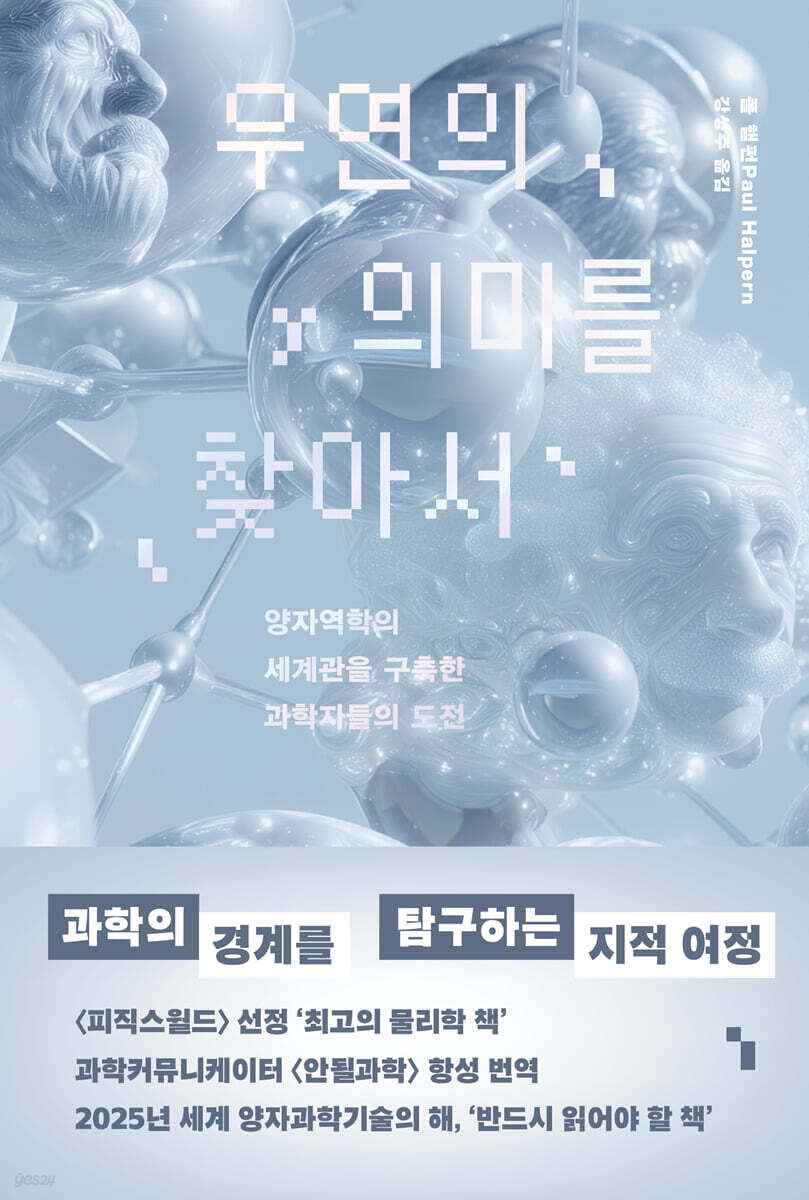 |
Description
Book Introduction
The only theory that science has finally arrived at
Scientists who built the world view of quantum mechanics
A story of endless 'challenge'
A fascinating guide to help you gradually understand quantum mechanics, which has revolutionized our perspective on the world.
From the ancient philosophers' debates about light to Newton's classical mechanics and Einstein and Pauli's modern physics, it depicts the thousands of years of journey scientists have taken in search of a theory that fully explains nature.
And finally, the story unfolds of those who established the worldview of quantum mechanics, the only theory that science has ever achieved.
Scientists who built the world view of quantum mechanics
A story of endless 'challenge'
A fascinating guide to help you gradually understand quantum mechanics, which has revolutionized our perspective on the world.
From the ancient philosophers' debates about light to Newton's classical mechanics and Einstein and Pauli's modern physics, it depicts the thousands of years of journey scientists have taken in search of a theory that fully explains nature.
And finally, the story unfolds of those who established the worldview of quantum mechanics, the only theory that science has ever achieved.
- You can preview some of the book's contents.
Preview
index
Preface_ Nature's Hidden Links
1.
Why does the sun shine?
Ancient philosophers who looked at the heavens
2.
Is the speed of light finite?
The Birth of a New Science: Astronomy
3.
What are the laws that govern movement?
The wave theory of light and Newton's laws of motion
4.
Can cause and effect occur simultaneously?
The different languages of relativity and quantum mechanics
5.
What rules will the two follow?
The inevitable void in the universe brought about by the uncertainty principle
5.
How can distant objects be connected without a causal relationship?
Special relationship between symmetry and conservation laws
6.
Could there be a hidden meaning behind coincidences?
The meeting of Jung's synchronicity and Pauli's quantum mechanics
7.
Perfect symmetry and asymmetry, natural selection?
Parity Violation, Unimaginable Collapse of Order
8.
Do hidden variables really exist?
In search of an ideal theory that explains nature
Going Out_ Unraveling the Cosmic Thread
Acknowledgements
Translator's Note: Crossing the Boundaries of Quantum Mechanics and Psychology
More books worth reading
main
Search
1.
Why does the sun shine?
Ancient philosophers who looked at the heavens
2.
Is the speed of light finite?
The Birth of a New Science: Astronomy
3.
What are the laws that govern movement?
The wave theory of light and Newton's laws of motion
4.
Can cause and effect occur simultaneously?
The different languages of relativity and quantum mechanics
5.
What rules will the two follow?
The inevitable void in the universe brought about by the uncertainty principle
5.
How can distant objects be connected without a causal relationship?
Special relationship between symmetry and conservation laws
6.
Could there be a hidden meaning behind coincidences?
The meeting of Jung's synchronicity and Pauli's quantum mechanics
7.
Perfect symmetry and asymmetry, natural selection?
Parity Violation, Unimaginable Collapse of Order
8.
Do hidden variables really exist?
In search of an ideal theory that explains nature
Going Out_ Unraveling the Cosmic Thread
Acknowledgements
Translator's Note: Crossing the Boundaries of Quantum Mechanics and Psychology
More books worth reading
main
Search
Detailed image

Into the book
Intuition often helps us understand the connections in the world.
But sometimes intuition can lead us down completely the wrong path.
This is true not only in the complex world of physics, but also in the trivial experiences of everyday life.
When human senses accurately capture reality, the moment of enlightenment is truly wondrous.
--- p.18
Figuring out whether the speed of light is finite was key to solving a bigger problem.
This was to understand whether forces or other actions could have effects over long distances and how long it took for those effects to be transmitted.
In particular, to explain how the Sun influences the orbital motions of distant planets, a concept of universal gravity linking celestial bodies across vast expanses of space was needed.
--- p.66
Kepler did not give up and carefully analyzed the data collected from the Sun's perspective.
While analyzing the orbit of Mars, he discovered something surprising.
The orbit of Mars is closer to an ellipse than a perfect circle.
Kepler abandoned the prejudices of Pythagoras, Plato, and Aristotle that had persisted for centuries, and decided to accept the facts as they were shown by observational data, without being bound by ancient misconceptions.
--- p.90
In the late 19th century, many in the scientific community predicted that a complete explanation of the universe and consciousness would eliminate all superstitions.
I thought everything could be explained: ominous signs, ghosts, demons, even divine intervention.
In theory, all natural phenomena could be explained by precise cause-and-effect relationships.
So-called "miracles" were either actually happening for a reason (for example, a previously unknown mechanism of action, like a natural substance discovered to have medicinal properties), or they were just coincidences that people interpreted as they wished.
Physical science seemed to say, 'If you can't prove a precise cause-and-effect relationship, then abandon that belief.'
--- p.134
As scientists, the two men were completely different types.
Einstein was calculating in everything, Rutherford was experimental in everything.
Even his usual appearance was surprisingly different.
Einstein seemed completely unathletic and ordinary, but Rutherford was a big, healthy, energetic New Zealander.
But there is no doubt that Rutherford was a genius as an experimental physicist.
He is considered one of the greatest experimental physicists in history.
He experimented based on his intuition, and every experiment he started led to a surprising discovery.
--- p.173
As a man of exceptional mathematical talent who was able to solve the most profound problems in theoretical physics, it was natural that many of Pauli's dreams contained geometric elements and abstract symbols.
His dreams often featured symmetrical arrangements of circles and lines, which Jung interpreted as his concept of archetypes.
Mathematical physics enriched Pauli's inner world, and Jung connected it with ancient symbolism, so that the two thinkers ultimately created a profound symbolic link between their two realms.
--- p.301
Pauli did not easily give up hope for a unified theory that could explain everything based on symmetry.
Even after it was discovered that parity symmetry was broken in certain weak interactions, there was initially great interest in a unified theory that included this new finding, as proposed by Heisenberg.
However, when other physicists pointed out problems with the theory, he was eventually forced to abandon it.
--- p.333
Quantum entanglement is not only a theoretical puzzle that baffles physicists, it also offers enormous potential for the development of powerful computers.
For example, consider the problem of accurately modeling the caffeine molecule.
Caffeine has a structure of 24 atoms linked by complex chemical bonds.
After a few cups of coffee, analyzing these molecular structures might seem simple, but it's not.
Because all molecules are fundamentally systems that follow the laws of quantum mechanics.
Accurately simulating such systems requires taking into account all quantum properties.
But sometimes intuition can lead us down completely the wrong path.
This is true not only in the complex world of physics, but also in the trivial experiences of everyday life.
When human senses accurately capture reality, the moment of enlightenment is truly wondrous.
--- p.18
Figuring out whether the speed of light is finite was key to solving a bigger problem.
This was to understand whether forces or other actions could have effects over long distances and how long it took for those effects to be transmitted.
In particular, to explain how the Sun influences the orbital motions of distant planets, a concept of universal gravity linking celestial bodies across vast expanses of space was needed.
--- p.66
Kepler did not give up and carefully analyzed the data collected from the Sun's perspective.
While analyzing the orbit of Mars, he discovered something surprising.
The orbit of Mars is closer to an ellipse than a perfect circle.
Kepler abandoned the prejudices of Pythagoras, Plato, and Aristotle that had persisted for centuries, and decided to accept the facts as they were shown by observational data, without being bound by ancient misconceptions.
--- p.90
In the late 19th century, many in the scientific community predicted that a complete explanation of the universe and consciousness would eliminate all superstitions.
I thought everything could be explained: ominous signs, ghosts, demons, even divine intervention.
In theory, all natural phenomena could be explained by precise cause-and-effect relationships.
So-called "miracles" were either actually happening for a reason (for example, a previously unknown mechanism of action, like a natural substance discovered to have medicinal properties), or they were just coincidences that people interpreted as they wished.
Physical science seemed to say, 'If you can't prove a precise cause-and-effect relationship, then abandon that belief.'
--- p.134
As scientists, the two men were completely different types.
Einstein was calculating in everything, Rutherford was experimental in everything.
Even his usual appearance was surprisingly different.
Einstein seemed completely unathletic and ordinary, but Rutherford was a big, healthy, energetic New Zealander.
But there is no doubt that Rutherford was a genius as an experimental physicist.
He is considered one of the greatest experimental physicists in history.
He experimented based on his intuition, and every experiment he started led to a surprising discovery.
--- p.173
As a man of exceptional mathematical talent who was able to solve the most profound problems in theoretical physics, it was natural that many of Pauli's dreams contained geometric elements and abstract symbols.
His dreams often featured symmetrical arrangements of circles and lines, which Jung interpreted as his concept of archetypes.
Mathematical physics enriched Pauli's inner world, and Jung connected it with ancient symbolism, so that the two thinkers ultimately created a profound symbolic link between their two realms.
--- p.301
Pauli did not easily give up hope for a unified theory that could explain everything based on symmetry.
Even after it was discovered that parity symmetry was broken in certain weak interactions, there was initially great interest in a unified theory that included this new finding, as proposed by Heisenberg.
However, when other physicists pointed out problems with the theory, he was eventually forced to abandon it.
--- p.333
Quantum entanglement is not only a theoretical puzzle that baffles physicists, it also offers enormous potential for the development of powerful computers.
For example, consider the problem of accurately modeling the caffeine molecule.
Caffeine has a structure of 24 atoms linked by complex chemical bonds.
After a few cups of coffee, analyzing these molecular structures might seem simple, but it's not.
Because all molecules are fundamentally systems that follow the laws of quantum mechanics.
Accurately simulating such systems requires taking into account all quantum properties.
--- p.384
Publisher's Review
From philosophical debates to scientific proofs to fully explain the world.
★ Physics World's Best Physics Books ★
★ YouTube's "Science That Won't Work" star translation ★
★ 2025: International Year of Quantum Science and Technology ★
What if the reality that sustains us is not always what it appears to be?
There is a possibility that the cause and effect will occur simultaneously,
What if the cause could even occur before the event?
Can we be sure that everything around us right now is truly as it is?
This book traces the thousands of years of journey scientists have taken in search of a theory that fully explains nature, from the ancient philosophers' debates about light to Newton's classical mechanics and Einstein and Pauli's modern physics.
And finally, the story unfolds of those who established the worldview of quantum mechanics, the only theory that science has ever achieved.
This will be an interesting guide to help you gradually understand the science that has revolutionized our perspective on the world.
Quantum mechanics, which recognizes random and sudden changes without direct cause and effect relationships and the interconnectedness of distant objects.
This theory is not something that came from the mind of a single genius scientist, but rather it is the culmination of human science, established through the accumulated time of countless scientists.
Moreover, it does not exist only as a completed theory, but has established itself as a major trend in science and technology that demonstrates practicality.
The advent of quantum computers has sent tech stocks around the world into turmoil, and breakthroughs in life sciences have been made in the study of atomic and molecular structures that follow the rules of the microscopic quantum world.
A quantum entanglement experiment utilizing 'light' that has traveled across the universe for billions of years to reach Earth has won the Nobel Prize in Physics, and great changes await us in the quantum era.
Therefore, it is essential to learn about quantum mechanics as a preparatory exercise for properly understanding the world we live in.
Paul Halpern, a seasoned storyteller and internationally respected physicist, has compiled a wealth of information unlike any other book, drawing on vivid interviews with leading quantum mechanics experts of the day, including Freeman Dyson, as well as meticulously scouring historical documents and scientific records hidden in libraries and museums.
Additionally, the book was translated by Kang Seong-ju (YouTube star of "Unsuccessful Science"), an astronomer and science communicator who is more excellent than anyone at conveying the diverse fields covered in this book, from astronomy to quantum mechanics, philosophy and history, and psychology.
He speaks with sincerity and precision to those who want to understand quantum mechanics.
From the philosophy of light to the science of waves
In search of the beginning and end of quantum mechanics
Why does the sun shine? Is the speed of light infinite?
Are "spooky" quantum leaps real? Do faster-than-light particles exist?
In search of answers to the questions that have captivated this era
The author argues that quantum mechanics did not suddenly emerge with Einstein, but rather, over a long period of time, from ancient times to the present, through interdisciplinary research and exchanges among scholars, knowledge was accumulated and shaped our world's scientific worldview.
Scientists, philosophers, and psychologists exchanged knowledge to build the worldview of modern science, and the two completely different worlds of classical mechanics and quantum mechanics clashed violently.
It all started when mankind began to explore 'light'.
Ancient philosophers (Pythagoras, Empedocles, Aristotle, Plato, etc.) debated for hundreds of years whether the speed of light was infinite or finite.
However, the answer could not be found until scientific experiments developed beyond the ancient myth-centered worldview.
However, this does not mean that their considerations were meaningless.
Aristotle's thought experiments contributed to the discovery of atoms, the existence of gravity, and the reason for motion.
Later, Christiaan Huygens, Isaac Newton, and James Clerk Maxwell conducted scientific experiments that revealed that light had both particle and wave characteristics, laying the foundation for the development of quantum mechanics.
Albert Einstein also laid the foundation for the leap from classical mechanics to modern physics by adding time as another dimension to three-dimensional space.
Starting with Einstein, a revolutionary scientific revolution that shook the world began.
Based on all this knowledge, scientists and theories that illuminated a new era, such as Erwin Schrödinger's 'wave equation', Enrico Fermi's 'discovery of neutrinos', Wolfgang Pauli's 'exclusion principle', and Heisenberg's 'uncertainty principle', appeared one after another, and today's quantum mechanics became the established theory.
We eventually encounter a realm of chance that transcends science.
A journey to reach the deepest truths of the universe
Plato's light, Pythagorean superstition, Newton's motion, Einstein's theory of relativity,
Pauli's neutrino and Jung's unconscious…
An exploration of 'coincidence' brought about by the exchanges between scientists, philosophers, and psychologists.
This book vividly portrays the stories of various people, events, and controversies.
In particular, fascinating episodes that had been hidden for a long time, such as scenes where scientists acted according to their own 'beliefs' rather than proven phenomena, were recorded in detail.
Sometimes, beliefs bordering on pseudoscience and the realm of the supernatural have influenced the direction of 'scientific theory'.
For example, Wolfgang Pauli, who made outstanding achievements in the field of quantum mechanics, had a 20-year relationship with his doctor, psychologist Carl Jung.
Jung, the founder of the concept of 'collective unconsciousness' and 'synchronicity', which is a meaningful coincidence, attached great significance to his encounters with Pauli and Einstein, and applied the theory of relativity and quantum mechanics to his own psychological theories.
Pauli also changed the direction of his thinking by reflecting Jung's synchronicity and expressed it in his own theory.
In addition, facts that have not been shown in textbooks or books before are revealed, such as the Pythagorean school and Johannes Kepler's obsession with perfect numbers, Alfred Russel Wallace's belief in necromancy, the tense debate between Einstein and those who support the supernatural, and the unscientific theories proposed by some scientists.
Ultimately, what these hidden stories, these reflections on coincidence, and the oddities of quantum mechanics tell us is that this world has a mysterious aspect that cannot be explained by simple mechanical causality.
Just as the great physicists of the 20th century, from Einstein to Pauli, explored the fundamental laws of nature and ultimately confronted philosophical and metaphysical questions, so too do we encounter realms of meaning that transcend purely scientific explanations in our lives.
This book will serve as a compass to inspire us on our journey across those boundaries.
Quantum mechanics: an intellectual journey exploring the boundaries between science and philosophy
What questions will tomorrow's science ask?
The advancement of science over thousands of years has challenged our traditional notions of causality.
And over the past 100 years, modern physics has been built by breaking many aspects of classical physics theory.
Scientists study quantum mechanics and have repeatedly demonstrated through experiments that invisible, tiny movements do not follow our expectations.
As long as such robust results are presented, the robust framework of quantum mechanics will not collapse for some time.
However, modern physics clearly has some aspects that are difficult to intuitively explain about the world we experience.
Therefore, physicists try to explain both the human 'macro-world' and the quantum 'micro-world' by integrating them into universal laws.
Great physicists such as Einstein, Heisenberg, and Pauli also worked on this unified theory of nature until the very end.
Through the constant curiosity and effort of scientists, one day, 'the only theory that explains the world' will be realized.
And the conclusion might be something that 21st century science, quantum mechanics, could not have predicted at all.
It invites the public to broaden their understanding of how far scientific explanations can go.
_《Science Magazine》
★ Physics World's Best Physics Books ★
★ YouTube's "Science That Won't Work" star translation ★
★ 2025: International Year of Quantum Science and Technology ★
What if the reality that sustains us is not always what it appears to be?
There is a possibility that the cause and effect will occur simultaneously,
What if the cause could even occur before the event?
Can we be sure that everything around us right now is truly as it is?
This book traces the thousands of years of journey scientists have taken in search of a theory that fully explains nature, from the ancient philosophers' debates about light to Newton's classical mechanics and Einstein and Pauli's modern physics.
And finally, the story unfolds of those who established the worldview of quantum mechanics, the only theory that science has ever achieved.
This will be an interesting guide to help you gradually understand the science that has revolutionized our perspective on the world.
Quantum mechanics, which recognizes random and sudden changes without direct cause and effect relationships and the interconnectedness of distant objects.
This theory is not something that came from the mind of a single genius scientist, but rather it is the culmination of human science, established through the accumulated time of countless scientists.
Moreover, it does not exist only as a completed theory, but has established itself as a major trend in science and technology that demonstrates practicality.
The advent of quantum computers has sent tech stocks around the world into turmoil, and breakthroughs in life sciences have been made in the study of atomic and molecular structures that follow the rules of the microscopic quantum world.
A quantum entanglement experiment utilizing 'light' that has traveled across the universe for billions of years to reach Earth has won the Nobel Prize in Physics, and great changes await us in the quantum era.
Therefore, it is essential to learn about quantum mechanics as a preparatory exercise for properly understanding the world we live in.
Paul Halpern, a seasoned storyteller and internationally respected physicist, has compiled a wealth of information unlike any other book, drawing on vivid interviews with leading quantum mechanics experts of the day, including Freeman Dyson, as well as meticulously scouring historical documents and scientific records hidden in libraries and museums.
Additionally, the book was translated by Kang Seong-ju (YouTube star of "Unsuccessful Science"), an astronomer and science communicator who is more excellent than anyone at conveying the diverse fields covered in this book, from astronomy to quantum mechanics, philosophy and history, and psychology.
He speaks with sincerity and precision to those who want to understand quantum mechanics.
From the philosophy of light to the science of waves
In search of the beginning and end of quantum mechanics
Why does the sun shine? Is the speed of light infinite?
Are "spooky" quantum leaps real? Do faster-than-light particles exist?
In search of answers to the questions that have captivated this era
The author argues that quantum mechanics did not suddenly emerge with Einstein, but rather, over a long period of time, from ancient times to the present, through interdisciplinary research and exchanges among scholars, knowledge was accumulated and shaped our world's scientific worldview.
Scientists, philosophers, and psychologists exchanged knowledge to build the worldview of modern science, and the two completely different worlds of classical mechanics and quantum mechanics clashed violently.
It all started when mankind began to explore 'light'.
Ancient philosophers (Pythagoras, Empedocles, Aristotle, Plato, etc.) debated for hundreds of years whether the speed of light was infinite or finite.
However, the answer could not be found until scientific experiments developed beyond the ancient myth-centered worldview.
However, this does not mean that their considerations were meaningless.
Aristotle's thought experiments contributed to the discovery of atoms, the existence of gravity, and the reason for motion.
Later, Christiaan Huygens, Isaac Newton, and James Clerk Maxwell conducted scientific experiments that revealed that light had both particle and wave characteristics, laying the foundation for the development of quantum mechanics.
Albert Einstein also laid the foundation for the leap from classical mechanics to modern physics by adding time as another dimension to three-dimensional space.
Starting with Einstein, a revolutionary scientific revolution that shook the world began.
Based on all this knowledge, scientists and theories that illuminated a new era, such as Erwin Schrödinger's 'wave equation', Enrico Fermi's 'discovery of neutrinos', Wolfgang Pauli's 'exclusion principle', and Heisenberg's 'uncertainty principle', appeared one after another, and today's quantum mechanics became the established theory.
We eventually encounter a realm of chance that transcends science.
A journey to reach the deepest truths of the universe
Plato's light, Pythagorean superstition, Newton's motion, Einstein's theory of relativity,
Pauli's neutrino and Jung's unconscious…
An exploration of 'coincidence' brought about by the exchanges between scientists, philosophers, and psychologists.
This book vividly portrays the stories of various people, events, and controversies.
In particular, fascinating episodes that had been hidden for a long time, such as scenes where scientists acted according to their own 'beliefs' rather than proven phenomena, were recorded in detail.
Sometimes, beliefs bordering on pseudoscience and the realm of the supernatural have influenced the direction of 'scientific theory'.
For example, Wolfgang Pauli, who made outstanding achievements in the field of quantum mechanics, had a 20-year relationship with his doctor, psychologist Carl Jung.
Jung, the founder of the concept of 'collective unconsciousness' and 'synchronicity', which is a meaningful coincidence, attached great significance to his encounters with Pauli and Einstein, and applied the theory of relativity and quantum mechanics to his own psychological theories.
Pauli also changed the direction of his thinking by reflecting Jung's synchronicity and expressed it in his own theory.
In addition, facts that have not been shown in textbooks or books before are revealed, such as the Pythagorean school and Johannes Kepler's obsession with perfect numbers, Alfred Russel Wallace's belief in necromancy, the tense debate between Einstein and those who support the supernatural, and the unscientific theories proposed by some scientists.
Ultimately, what these hidden stories, these reflections on coincidence, and the oddities of quantum mechanics tell us is that this world has a mysterious aspect that cannot be explained by simple mechanical causality.
Just as the great physicists of the 20th century, from Einstein to Pauli, explored the fundamental laws of nature and ultimately confronted philosophical and metaphysical questions, so too do we encounter realms of meaning that transcend purely scientific explanations in our lives.
This book will serve as a compass to inspire us on our journey across those boundaries.
Quantum mechanics: an intellectual journey exploring the boundaries between science and philosophy
What questions will tomorrow's science ask?
The advancement of science over thousands of years has challenged our traditional notions of causality.
And over the past 100 years, modern physics has been built by breaking many aspects of classical physics theory.
Scientists study quantum mechanics and have repeatedly demonstrated through experiments that invisible, tiny movements do not follow our expectations.
As long as such robust results are presented, the robust framework of quantum mechanics will not collapse for some time.
However, modern physics clearly has some aspects that are difficult to intuitively explain about the world we experience.
Therefore, physicists try to explain both the human 'macro-world' and the quantum 'micro-world' by integrating them into universal laws.
Great physicists such as Einstein, Heisenberg, and Pauli also worked on this unified theory of nature until the very end.
Through the constant curiosity and effort of scientists, one day, 'the only theory that explains the world' will be realized.
And the conclusion might be something that 21st century science, quantum mechanics, could not have predicted at all.
It invites the public to broaden their understanding of how far scientific explanations can go.
_《Science Magazine》
GOODS SPECIFICS
- Date of issue: July 30, 2025
- Page count, weight, size: 460 pages | 636g | 145*215*30mm
- ISBN13: 9791171714575
- ISBN10: 1171714572
You may also like
카테고리
korean


korean

![GQ KOREA Mark (Monthly): December [2025]](http://librairie.coreenne.fr/cdn/shop/files/8ef265dbbfbf186523ed75ba7319009d.jpg?v=1765340328&width=3840)


