

Dr. Park Moon-ho's Study of Big History
 |
Description
Book Introduction
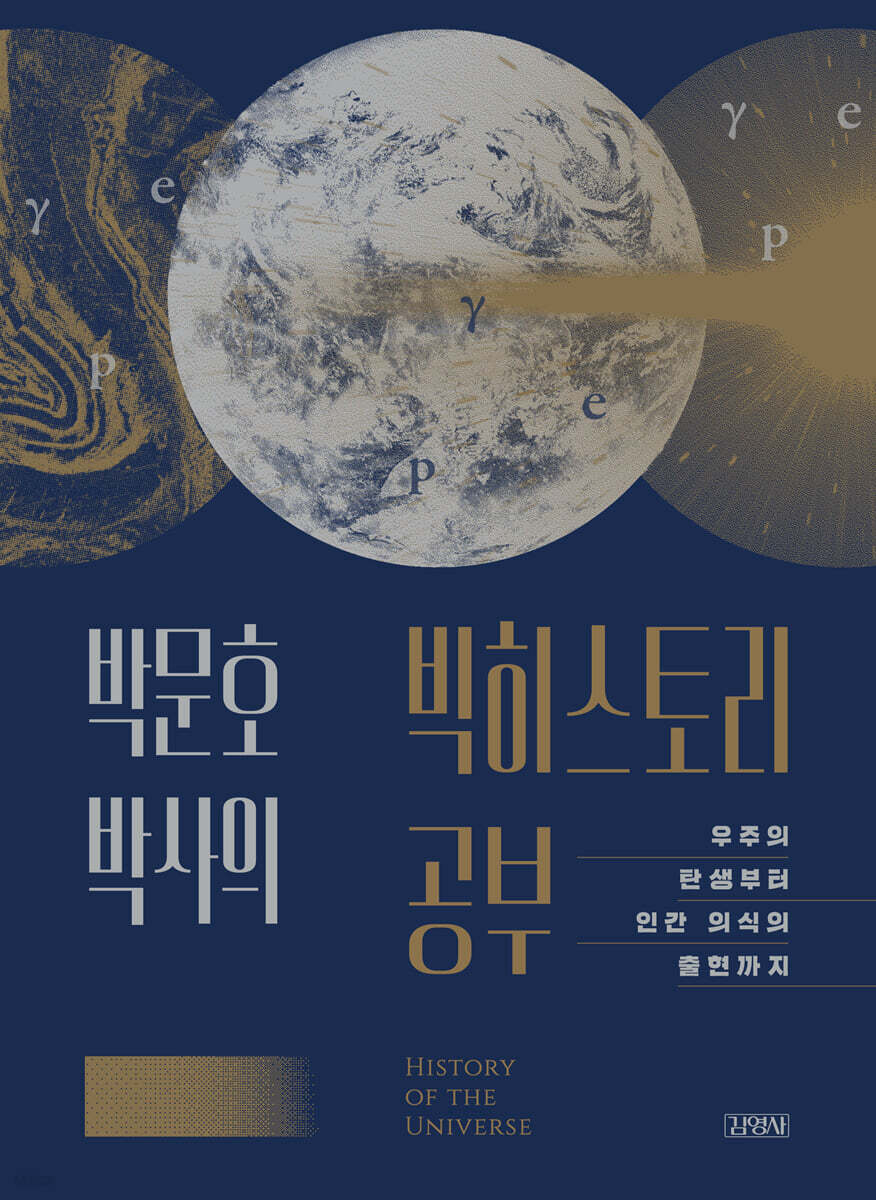
From the Big Bang to the Emergence of Consciousness: A 13.8 Billion-Year History of the Universe in One Volume From stars and wind to flowers and language, encounter a unified perspective that explains the universe, the Earth, life, and humanity. ★ 'Park Mun-ho's World of Natural Science' 14 Years of Lectures Summary ★ [Monthly End Kim Eo-jun] Hot Lectures The challenge of integrated science encompassing space, Earth, life, and consciousness. Dr. Park Moon-ho, who is dedicated to the science movement with the motto of 'popularizing science', has compiled the core of his lectures on '13.7 billion years of evolution of the universe' and 'special brain science' that he has been giving for 14 years in 'Park Moon-ho's World of Natural Science (Park Ja-se)' and organized the big history from the Big Bang to the virtual world of humans. Without going into difficult scientific knowledge, it explains the long history of natural phenomena, from the beginning of the universe to the birth of Earth and life, the co-evolution of minerals and organisms, and the emergence of human consciousness, from the perspective of the interactions of electrons, photons, and protons. |
- You can preview some of the book's contents.
Preview
index
Introduction
Chapter 1: The Big Bang and the Early Universe
1 Everything in the universe is interconnected | 2 Natural phenomena are the interactions of electrons, protons, and photons | 3 Atomic bonds and matter | 4 Molecules are a rare form | 5 The actions of atoms are the actions of electrons | 6 Electrons, the lightest particles that make up matter | 7 The flow and breathing of electrons | 8 The microscopic world is the world of probability | 9 The interactions of electrons, protons, and photons | 10 The microscopic world and quantum mechanics | 11 The emission of photons and lasers | 12 Bosons and the four forces that make up the universe | 13 The principle of charge neutralization | 14 The origin of solar energy | 15 Nuclear fusion and the birth of elements | 16 The life of a star and the fate of the sun
Chapter 2: The Birth of the Earth and Plate Tectonic Movement
1 Earth was formed by the collision of asteroids | 2 Emergence of the granite continents | 3 Superplumes and changes in the surface environment | 4 Protons and acidified Earth's soil | 5 Formation of the supercontinent Pangaea | 6 Division of geologic eras and supercontinents | 7 Geological events of the Cenozoic Era | 8 Climate change and the Milankovitch cycle | 9 Earth's great ice ages | 10 Fluctuating Earth's climate | 11 How are rocks formed? | 12 Coevolution of minerals and organisms | 13 Protons and soil fertilization
Chapter 3: The Evolution of Life
1 The Birth of Metabolism, Respiration, and Photosynthesis | 2 Mitochondria and Eukaryotic Cells | 3 Organisms That Acquired Nitrogen Atoms | 4 Viruses and Bacteria | 5 Eukaryotic Cell Strategies | 6 Life Processes: Molecular Transformation Processes | 7 The First Oxygen Revolution and the Evolution of Eukaryotic Cells | 8 The Second Oxygen Revolution and the Evolution of Multicellular Organisms | 9 The Cambrian Explosion | 10 Corals Create Continents | 11 The Age of Marine Invertebrates | 12 Fish Take to the Land | 13 The Evolution of Mesozoic Dinosaurs and Mammals | 14 Mammals Enter the Night World | 15 The Age of Mammals | 16 Primates Adapting to Tropical Rainforests | 17 Climate and the Evolution of Humans
Chapter 4: The Evolution of Humans and Consciousness
1 Early human evolution and social intelligence | 2 Language and the socialization of Homo sapiens | 3 The volume of the cerebral neocortex determines | 4 The leap forward in human survival | 5 Visual thinking and verbal thinking | 6 The brain tries to connect everything | 7 Brain structure and human evolution | 8 The brain and the birth of consciousness | 9 The world emerges from consciousness
Going out words
Search
Chapter 1: The Big Bang and the Early Universe
1 Everything in the universe is interconnected | 2 Natural phenomena are the interactions of electrons, protons, and photons | 3 Atomic bonds and matter | 4 Molecules are a rare form | 5 The actions of atoms are the actions of electrons | 6 Electrons, the lightest particles that make up matter | 7 The flow and breathing of electrons | 8 The microscopic world is the world of probability | 9 The interactions of electrons, protons, and photons | 10 The microscopic world and quantum mechanics | 11 The emission of photons and lasers | 12 Bosons and the four forces that make up the universe | 13 The principle of charge neutralization | 14 The origin of solar energy | 15 Nuclear fusion and the birth of elements | 16 The life of a star and the fate of the sun
Chapter 2: The Birth of the Earth and Plate Tectonic Movement
1 Earth was formed by the collision of asteroids | 2 Emergence of the granite continents | 3 Superplumes and changes in the surface environment | 4 Protons and acidified Earth's soil | 5 Formation of the supercontinent Pangaea | 6 Division of geologic eras and supercontinents | 7 Geological events of the Cenozoic Era | 8 Climate change and the Milankovitch cycle | 9 Earth's great ice ages | 10 Fluctuating Earth's climate | 11 How are rocks formed? | 12 Coevolution of minerals and organisms | 13 Protons and soil fertilization
Chapter 3: The Evolution of Life
1 The Birth of Metabolism, Respiration, and Photosynthesis | 2 Mitochondria and Eukaryotic Cells | 3 Organisms That Acquired Nitrogen Atoms | 4 Viruses and Bacteria | 5 Eukaryotic Cell Strategies | 6 Life Processes: Molecular Transformation Processes | 7 The First Oxygen Revolution and the Evolution of Eukaryotic Cells | 8 The Second Oxygen Revolution and the Evolution of Multicellular Organisms | 9 The Cambrian Explosion | 10 Corals Create Continents | 11 The Age of Marine Invertebrates | 12 Fish Take to the Land | 13 The Evolution of Mesozoic Dinosaurs and Mammals | 14 Mammals Enter the Night World | 15 The Age of Mammals | 16 Primates Adapting to Tropical Rainforests | 17 Climate and the Evolution of Humans
Chapter 4: The Evolution of Humans and Consciousness
1 Early human evolution and social intelligence | 2 Language and the socialization of Homo sapiens | 3 The volume of the cerebral neocortex determines | 4 The leap forward in human survival | 5 Visual thinking and verbal thinking | 6 The brain tries to connect everything | 7 Brain structure and human evolution | 8 The brain and the birth of consciousness | 9 The world emerges from consciousness
Going out words
Search
Detailed image

Into the book
The process in which photons that make up starlight are absorbed by electrons and protons are released outside the cell is the very phenomenon of life.
Electrons, protons, and photons are the particles that make up nature.
Nature is nothing more than an infinite superposition of interactions between electrons, protons, and photons.
All phenomena in nature, except gravity, are the various interactions of electrons, protons, and photons.
This book attempts to explain the universe, the Earth, life, and consciousness through the actions of electrons, protons, and photons.
--- p.7
Stars and the sun begin as hydrogen atoms.
If you know the hydrogen atom, you can know everything.
Hydrogen atoms are composed of protons and electrons, and when protons and electrons with electric charges accelerate, they emit photons.
Stars are more than 70 percent hydrogen, and they create about 90 different elements through nuclear fusion.
Stars, Earth, and living things all arise from the interactions of electrons, protons, and photons.
--- p.24
All four forces of the universe are carried by boson particles, and the particles that carry the electromagnetic force are photons.
Temporal variations in an electric field create a magnetic field, and temporal variations in a magnetic field create an electric field.
This process of electric and magnetic fields generating each other is expressed by Maxwell in formulas, so it is called Maxwell's equations.
Electrical and magnetic phenomena are expressed by the four equations of electricity and magnetism of Maxwell's equations.
The speed of light formula was derived from Maxwell's electromagnetic equations, clarifying the relationship between electromagnetic phenomena and light.
--- p.67
A massive superplume originating from the outer core began 1.9 billion years ago and played a crucial role in the movement of continents from the Proterozoic to the Cenozoic.
Current Earth science theories combine the theory of plate tectonics, which concerns the movement of continental and oceanic plates, with the theory of super-plumes rising from the outer core to explain the movement of tectonic plates from a global perspective.
It is estimated that the creation and division of supercontinents over a period of approximately 500 million years from the Proterozoic to the Cenozoic era also occurred due to the periodic rising action of superplumes.
--- p.95
Until the 1980s, people were worried about the coming ice age, but in the next 30 years, global warming has significantly changed our perception of climate.
Current global warming is a result of the rapid increase in human use of fossil fuels.
This phenomenon occurred when coal, which was produced on a large scale in the Carboniferous Period of the Paleozoic Era, was burned as an energy source for 300 years after the Industrial Revolution, releasing carbon dioxide into the atmosphere.
…current global warming is not related to the Milankovitch cycles, which repeat glacial and interglacial periods every 100,000 years.
Global warming in recent decades has been rapid and independent of periodic fluctuations in solar irradiance.
This is a man-made phenomenon.
If we do not reduce the rapidly increasing concentration of carbon dioxide in the atmosphere as a result of industrialization, global warming will accelerate uncontrollably.
--- p.130
The process of relating matter and energy in life activities is called metabolism.
Metabolism is the process of oxidation and reduction of molecules within cells.
An atom with a neutral charge becomes a negative ion when it gains electrons, and becomes a positive ion when it releases electrons.
Molecules are formed by covalent bonds, where several atoms share electrons.
When an atom in a molecule gains electrons, the molecule is reduced, and when an atom loses electrons, the molecule is oxidized.
…Life is a process in which tens of thousands of molecules within a cell undergo oxidation and reduction processes repeatedly, and this is called metabolism.
Metabolism, the core of life phenomena, is the process by which biomolecules release or absorb protons and electrons.
--- p.147
Plants release oxygen molecules into the atmosphere when they are alive, but they consume oxygen when they die and decompose.
All the oxygen produced as a result of photosynthesis is used up during the decomposition process of plants.
The decomposition process of plants is a slow combustion process that slowly combines with oxygen, so it consumes oxygen and produces carbon dioxide.
It is the same phenomenon as when wood is burned, oxygen is consumed and carbon dioxide is produced.
--- p.194
The emergence of flowering plants in the Cretaceous period of the Mesozoic Era led to different outcomes in the evolution of dinosaurs and mammals.
Mammals accelerated their brain evolution as they escaped the dinosaur-dominated diurnal environment and moved into the nocturnal world.
Thanks to this accelerated brain evolution, mammals' ability to adapt to the environment was maximized in the Cenozoic era, enabling them to live in diverse regions.
Mammals adapted to the sea, such as whales, also appeared, and by the late Cenozoic Era, about 4,500 species of mammals had flourished.
--- p.212
Humans have been developing long-distance walking skills to track prey for long periods of time by hunting with bows since 60,000 years ago.
A social behavior called 'mealing' emerged, in which people ate together at set times while cooking gathered roots and game.
As the social behavior of eating and self-domestication became a common practice, violence within tribes decreased and social cohesion strengthened.
The power of culture has become a powerful driving force in human evolution.
Animals undergo natural evolution bound by nature, but humans, who use language and symbols, undergo cultural evolution outside of nature.
--- p.232
Thanks to the expansion of the cerebral neocortex, humans can associate senses to create images, plan motor output, and select actions that are appropriate to their purpose.
By categorizing concepts along the evolution of language, humans created an inner world through perception and memory.
The world that the brain constructs through categorization is a virtual world created by the brain, not actual nature.
--- p.256
The human brain creates changing images of the external environment by dynamically changing the spatial arrangement of memory.
By continually rearranging images of objects and events, a sense of time emerges in a limited space.
The number of possible arrangements in memory space is knowledge and consciousness.
The arrangement of image patterns is like entropy in physics.
Ultimately, brain science, which focuses on consciousness, can meet physics through the concept of entropy.
Electrons, protons, and photons are the particles that make up nature.
Nature is nothing more than an infinite superposition of interactions between electrons, protons, and photons.
All phenomena in nature, except gravity, are the various interactions of electrons, protons, and photons.
This book attempts to explain the universe, the Earth, life, and consciousness through the actions of electrons, protons, and photons.
--- p.7
Stars and the sun begin as hydrogen atoms.
If you know the hydrogen atom, you can know everything.
Hydrogen atoms are composed of protons and electrons, and when protons and electrons with electric charges accelerate, they emit photons.
Stars are more than 70 percent hydrogen, and they create about 90 different elements through nuclear fusion.
Stars, Earth, and living things all arise from the interactions of electrons, protons, and photons.
--- p.24
All four forces of the universe are carried by boson particles, and the particles that carry the electromagnetic force are photons.
Temporal variations in an electric field create a magnetic field, and temporal variations in a magnetic field create an electric field.
This process of electric and magnetic fields generating each other is expressed by Maxwell in formulas, so it is called Maxwell's equations.
Electrical and magnetic phenomena are expressed by the four equations of electricity and magnetism of Maxwell's equations.
The speed of light formula was derived from Maxwell's electromagnetic equations, clarifying the relationship between electromagnetic phenomena and light.
--- p.67
A massive superplume originating from the outer core began 1.9 billion years ago and played a crucial role in the movement of continents from the Proterozoic to the Cenozoic.
Current Earth science theories combine the theory of plate tectonics, which concerns the movement of continental and oceanic plates, with the theory of super-plumes rising from the outer core to explain the movement of tectonic plates from a global perspective.
It is estimated that the creation and division of supercontinents over a period of approximately 500 million years from the Proterozoic to the Cenozoic era also occurred due to the periodic rising action of superplumes.
--- p.95
Until the 1980s, people were worried about the coming ice age, but in the next 30 years, global warming has significantly changed our perception of climate.
Current global warming is a result of the rapid increase in human use of fossil fuels.
This phenomenon occurred when coal, which was produced on a large scale in the Carboniferous Period of the Paleozoic Era, was burned as an energy source for 300 years after the Industrial Revolution, releasing carbon dioxide into the atmosphere.
…current global warming is not related to the Milankovitch cycles, which repeat glacial and interglacial periods every 100,000 years.
Global warming in recent decades has been rapid and independent of periodic fluctuations in solar irradiance.
This is a man-made phenomenon.
If we do not reduce the rapidly increasing concentration of carbon dioxide in the atmosphere as a result of industrialization, global warming will accelerate uncontrollably.
--- p.130
The process of relating matter and energy in life activities is called metabolism.
Metabolism is the process of oxidation and reduction of molecules within cells.
An atom with a neutral charge becomes a negative ion when it gains electrons, and becomes a positive ion when it releases electrons.
Molecules are formed by covalent bonds, where several atoms share electrons.
When an atom in a molecule gains electrons, the molecule is reduced, and when an atom loses electrons, the molecule is oxidized.
…Life is a process in which tens of thousands of molecules within a cell undergo oxidation and reduction processes repeatedly, and this is called metabolism.
Metabolism, the core of life phenomena, is the process by which biomolecules release or absorb protons and electrons.
--- p.147
Plants release oxygen molecules into the atmosphere when they are alive, but they consume oxygen when they die and decompose.
All the oxygen produced as a result of photosynthesis is used up during the decomposition process of plants.
The decomposition process of plants is a slow combustion process that slowly combines with oxygen, so it consumes oxygen and produces carbon dioxide.
It is the same phenomenon as when wood is burned, oxygen is consumed and carbon dioxide is produced.
--- p.194
The emergence of flowering plants in the Cretaceous period of the Mesozoic Era led to different outcomes in the evolution of dinosaurs and mammals.
Mammals accelerated their brain evolution as they escaped the dinosaur-dominated diurnal environment and moved into the nocturnal world.
Thanks to this accelerated brain evolution, mammals' ability to adapt to the environment was maximized in the Cenozoic era, enabling them to live in diverse regions.
Mammals adapted to the sea, such as whales, also appeared, and by the late Cenozoic Era, about 4,500 species of mammals had flourished.
--- p.212
Humans have been developing long-distance walking skills to track prey for long periods of time by hunting with bows since 60,000 years ago.
A social behavior called 'mealing' emerged, in which people ate together at set times while cooking gathered roots and game.
As the social behavior of eating and self-domestication became a common practice, violence within tribes decreased and social cohesion strengthened.
The power of culture has become a powerful driving force in human evolution.
Animals undergo natural evolution bound by nature, but humans, who use language and symbols, undergo cultural evolution outside of nature.
--- p.232
Thanks to the expansion of the cerebral neocortex, humans can associate senses to create images, plan motor output, and select actions that are appropriate to their purpose.
By categorizing concepts along the evolution of language, humans created an inner world through perception and memory.
The world that the brain constructs through categorization is a virtual world created by the brain, not actual nature.
--- p.256
The human brain creates changing images of the external environment by dynamically changing the spatial arrangement of memory.
By continually rearranging images of objects and events, a sense of time emerges in a limited space.
The number of possible arrangements in memory space is knowledge and consciousness.
The arrangement of image patterns is like entropy in physics.
Ultimately, brain science, which focuses on consciousness, can meet physics through the concept of entropy.
--- p.266
Publisher's Review
From stars and wind to flowers and language,
Discover a unified perspective that explains the universe, the Earth, life, and humanity.
The challenge of integrated science encompassing space, Earth, life, and consciousness.
Dr. Park Moon-ho, who is dedicated to the science movement with the motto of 'popularizing science', has compiled the core of his lectures on '13.7 billion years of evolution of the universe' and 'special brain science' that he has been giving for 14 years in 'Park Moon-ho's World of Natural Science (Park Ja-se)' and organized the big history from the Big Bang to the virtual world of humans.
Without going into difficult scientific knowledge, it explains the long history of natural phenomena, from the beginning of the universe to the birth of Earth and life, the co-evolution of minerals and organisms, and the emergence of human consciousness, from the perspective of the interactions of electrons, photons, and protons.
From the Big Bang to the emergence of the virtual world of humanity, a 13.8 billion-year history of the universe in one volume.
“The process in which photons that make up starlight are absorbed by electrons and protons are emitted outside the cell is the very phenomenon of life.
Electrons, protons, and photons are the particles that make up nature.
Nature is nothing more than an infinite superposition of interactions between electrons, protons, and photons.
All phenomena in nature, except gravity, are the various interactions of electrons, protons, and photons.
This book attempts to explain the universe, the Earth, life, and consciousness through the actions of electrons, protons, and photons.” (p. 7)
As the author states in the preface, all natural phenomena in the universe converge on the interactions of electrons, protons, and photons.
The universe expanded rapidly after the Big Bang, passing through a bubble of quantum probability time, and the subsequent birth of stars, formation of galaxies, and creation of planets are all similar.
The sun was formed 4.6 billion years ago by the gravitational contraction of an interstellar giant molecular cloud, and the Earth was formed 4.5 billion years ago by the collision of giant planetesimals.
Within 100 million years of Earth's formation, it had differentiated into an atmosphere, oceans, crust, mantle, and core.
Since then, the Earth has continued to experience plate tectonics, in which continents are formed and then broken up through convection.
During the Paleozoic era, the process of forming a supercontinent toward Pangaea was the main event, while during the Mesozoic and Cenozoic eras, the process of Pangaea splitting and forming the current continental form was the main event.
Two billion years ago, when the concentration of oxygen in the atmosphere increased to 1 percent during the first oxygen revolution, approximately 3,000 new minerals emerged through surface oxidation.
Life emerged about 4 billion years ago, but at that time only prokaryotic cells existed that did not breathe oxygen.
Prokaryotic cells generate energy through oxidation-reduction respiration, which involves acquiring electrons and releasing electrons.
2 billion years ago, the first oxygen revolution brought about an increase in oxygen molecules, leading to the emergence of oxygen-breathing bacteria, which evolved into mitochondria as they coexisted within host cells.
In addition to the intracellular symbiosis of mitochondria, host cells with a nuclear membrane become eukaryotic.
Photosynthesis in plants is an oxidation process in which electrons are released from chlorophyll as it absorbs photons, and respiration in animals is a reaction in which oxygen molecules are reduced to water molecules.
Ultimately, respiration and photosynthesis are both oxidation and reduction reactions caused by the movement of protons accompanied by the movement of electrons, with only the direction of movement of oxygen molecules and water molecules being different.
About 700 million years ago, during the Neoproterozoic era, the second oxygen revolution occurred, leading to the emergence of multicellular life.
This second oxygen revolution, which increased the concentration of oxygen in the atmosphere to 20 percent, marked the beginning of the Cambrian period of the Paleozoic Era 540 million years ago.
This became the second driving force behind the evolution of life, making Earth a planet teeming with life.
Human ancestors evolved in Africa.
Australopithecus afarensis, 3.5 million years ago, walked upright, and Homo habilis, 2.5 million years ago, used tools.
Homo ergaster, which evolved from Homo erectus, used fire to cook food about 1.2 million years ago, reducing the energy consumed for digestion.
Protein intake doubled the size of the cerebral neocortex.
Homo sapiens emerged in Africa about 200,000 years ago, migrated north about 60,000 years ago, into Europe about 45,000 years ago, and into East Asia about 40,000 years ago, reaching Siberia.
The human brain has created a new universe called language.
If the universe exists in space and time, language exists in relationships.
The emergence of language is a leap forward through symbols.
Language, which exists only in the relationships between humans, is another nature within nature that does not exist in physical nature.
Humans evolved into intelligent beings who trace the origins of the universe and themselves thanks to the greatly expanded function of the cerebral neocortex, which created memories and concepts.
The most effective way to learn about the evolution of the 13.8 billion-year universe
This book presents a wide range of specialized knowledge from a variety of fields.
It contains knowledge from almost every field of science, from basic physics to electromagnetism, organic and inorganic chemistry, geology, mineralogy, biology, evolutionary biology, and neuroscience.
That is because it contains the entire history of 13.8 billion years, starting from the Big Bang, the birth of the universe, to modern human language and virtual worlds.
In the book, the author explains the process of reaching the symbol of humanity from the universe in four stages: universe, earth, life, and humanity.
A perspective that can be applied to stars, Earth, life, and humans at this time is that the interaction of electrons, photons, and protons is at the basis of all these natural phenomena.
The author proposes three ways to study natural phenomena from this integrated perspective.
First, trace the origin.
All natural phenomena, including the universe, stars, the Earth, and humans, must have an origin.
All we have to do is study all the biochemical initial conditions that lead to atoms and electrons, cells, animals, mammals, and humans.
Second, it is about thinking about space and time.
Nature is a performance unfolding on a stage called time and space.
We must understand that time and space are not separate entities, but rather a dynamic relationship in which energy and matter determine each other.
The interrelationship between space-time and energy is the universe itself.
Third, discover patterns.
The core of biochemistry is the pattern of changes in molecules within cells during oxidation-reduction processes.
Evolution is the pattern of change in molecules, cells, and individuals in space and time.
Nature is the changing patterns of matter and energy unfolding in time and space.
We think that the pattern of atomic arrangement that occurs at the synapse of a nerve cell is changing.
A pattern is an arrangement of atoms, molecules, and objects.
The number of arrangement patterns of entities in nature is entropy.
The property that tends to follow the pattern with the highest probability is natural phenomena.
Presenting a new paradigm for learning through the lens of persistent pursuit and integration.
Dr. Park Moon-ho's research and writing have one consistent characteristic.
After mastering the basic theories of various fields, it is necessary to find a single principle that permeates all of that knowledge.
And to put it in the simplest and most concise language.
The result is a literary yet scientific sentence: “The study of natural science is the process of discovering the interrelationships between electrons, protons, and photons in stars, rocks, and flowers.”
This can also be said to be in line with the life of Dr. Park Moon-ho, who lives with the brain of a scientist and the heart of a poet.
The author's research and activities are close to asceticism.
No one forced me to, but I formed a study group of my own and willingly jumped into a difficult specialized field.
So, I have been giving lectures for 14 years under the title, ‘13.8 Billion Years of Universe Evolution.’
What he pursues is not the ‘popularization of science’ that introduces science in a soft way, but the ‘scientification of the public.’
The goal is to raise the level of public awareness by spreading rigorous science.
And the study method he emphasizes for this is repetition.
Studying a new field of study means learning a new language, and becoming familiar with a new language requires repetition.
“New terms and concepts become easier to understand if you read and write them repeatedly.
“When the foundation is solid, knowledge will accelerate.” This means that even if it is difficult to understand at first, if you study repeatedly until you become familiar with it, the moment of understanding will come.
The author is actively writing and lecturing in the field of brain science, and has completed a trilogy on brain science, starting with “The Brain, the Emergence of Thought,” “Reading Everything About Brain Science in Pictures,” and “Dr. Park Moon-ho’s Study of Brain Science.”
Afterwards, he began to describe the long history of the universe through a scientific lens, and in 2019, he published “How Life Works,” which summarized the “life” section.
Now, as a culmination of that work, I have compiled the core of the lectures on "13.7 Billion Years of Universe Evolution" and "Special Brain Science" that have continued for 14 years, to compile a new Big History that stretches from the Big Bang to the virtual world of humanity.
Discover a unified perspective that explains the universe, the Earth, life, and humanity.
The challenge of integrated science encompassing space, Earth, life, and consciousness.
Dr. Park Moon-ho, who is dedicated to the science movement with the motto of 'popularizing science', has compiled the core of his lectures on '13.7 billion years of evolution of the universe' and 'special brain science' that he has been giving for 14 years in 'Park Moon-ho's World of Natural Science (Park Ja-se)' and organized the big history from the Big Bang to the virtual world of humans.
Without going into difficult scientific knowledge, it explains the long history of natural phenomena, from the beginning of the universe to the birth of Earth and life, the co-evolution of minerals and organisms, and the emergence of human consciousness, from the perspective of the interactions of electrons, photons, and protons.
From the Big Bang to the emergence of the virtual world of humanity, a 13.8 billion-year history of the universe in one volume.
“The process in which photons that make up starlight are absorbed by electrons and protons are emitted outside the cell is the very phenomenon of life.
Electrons, protons, and photons are the particles that make up nature.
Nature is nothing more than an infinite superposition of interactions between electrons, protons, and photons.
All phenomena in nature, except gravity, are the various interactions of electrons, protons, and photons.
This book attempts to explain the universe, the Earth, life, and consciousness through the actions of electrons, protons, and photons.” (p. 7)
As the author states in the preface, all natural phenomena in the universe converge on the interactions of electrons, protons, and photons.
The universe expanded rapidly after the Big Bang, passing through a bubble of quantum probability time, and the subsequent birth of stars, formation of galaxies, and creation of planets are all similar.
The sun was formed 4.6 billion years ago by the gravitational contraction of an interstellar giant molecular cloud, and the Earth was formed 4.5 billion years ago by the collision of giant planetesimals.
Within 100 million years of Earth's formation, it had differentiated into an atmosphere, oceans, crust, mantle, and core.
Since then, the Earth has continued to experience plate tectonics, in which continents are formed and then broken up through convection.
During the Paleozoic era, the process of forming a supercontinent toward Pangaea was the main event, while during the Mesozoic and Cenozoic eras, the process of Pangaea splitting and forming the current continental form was the main event.
Two billion years ago, when the concentration of oxygen in the atmosphere increased to 1 percent during the first oxygen revolution, approximately 3,000 new minerals emerged through surface oxidation.
Life emerged about 4 billion years ago, but at that time only prokaryotic cells existed that did not breathe oxygen.
Prokaryotic cells generate energy through oxidation-reduction respiration, which involves acquiring electrons and releasing electrons.
2 billion years ago, the first oxygen revolution brought about an increase in oxygen molecules, leading to the emergence of oxygen-breathing bacteria, which evolved into mitochondria as they coexisted within host cells.
In addition to the intracellular symbiosis of mitochondria, host cells with a nuclear membrane become eukaryotic.
Photosynthesis in plants is an oxidation process in which electrons are released from chlorophyll as it absorbs photons, and respiration in animals is a reaction in which oxygen molecules are reduced to water molecules.
Ultimately, respiration and photosynthesis are both oxidation and reduction reactions caused by the movement of protons accompanied by the movement of electrons, with only the direction of movement of oxygen molecules and water molecules being different.
About 700 million years ago, during the Neoproterozoic era, the second oxygen revolution occurred, leading to the emergence of multicellular life.
This second oxygen revolution, which increased the concentration of oxygen in the atmosphere to 20 percent, marked the beginning of the Cambrian period of the Paleozoic Era 540 million years ago.
This became the second driving force behind the evolution of life, making Earth a planet teeming with life.
Human ancestors evolved in Africa.
Australopithecus afarensis, 3.5 million years ago, walked upright, and Homo habilis, 2.5 million years ago, used tools.
Homo ergaster, which evolved from Homo erectus, used fire to cook food about 1.2 million years ago, reducing the energy consumed for digestion.
Protein intake doubled the size of the cerebral neocortex.
Homo sapiens emerged in Africa about 200,000 years ago, migrated north about 60,000 years ago, into Europe about 45,000 years ago, and into East Asia about 40,000 years ago, reaching Siberia.
The human brain has created a new universe called language.
If the universe exists in space and time, language exists in relationships.
The emergence of language is a leap forward through symbols.
Language, which exists only in the relationships between humans, is another nature within nature that does not exist in physical nature.
Humans evolved into intelligent beings who trace the origins of the universe and themselves thanks to the greatly expanded function of the cerebral neocortex, which created memories and concepts.
The most effective way to learn about the evolution of the 13.8 billion-year universe
This book presents a wide range of specialized knowledge from a variety of fields.
It contains knowledge from almost every field of science, from basic physics to electromagnetism, organic and inorganic chemistry, geology, mineralogy, biology, evolutionary biology, and neuroscience.
That is because it contains the entire history of 13.8 billion years, starting from the Big Bang, the birth of the universe, to modern human language and virtual worlds.
In the book, the author explains the process of reaching the symbol of humanity from the universe in four stages: universe, earth, life, and humanity.
A perspective that can be applied to stars, Earth, life, and humans at this time is that the interaction of electrons, photons, and protons is at the basis of all these natural phenomena.
The author proposes three ways to study natural phenomena from this integrated perspective.
First, trace the origin.
All natural phenomena, including the universe, stars, the Earth, and humans, must have an origin.
All we have to do is study all the biochemical initial conditions that lead to atoms and electrons, cells, animals, mammals, and humans.
Second, it is about thinking about space and time.
Nature is a performance unfolding on a stage called time and space.
We must understand that time and space are not separate entities, but rather a dynamic relationship in which energy and matter determine each other.
The interrelationship between space-time and energy is the universe itself.
Third, discover patterns.
The core of biochemistry is the pattern of changes in molecules within cells during oxidation-reduction processes.
Evolution is the pattern of change in molecules, cells, and individuals in space and time.
Nature is the changing patterns of matter and energy unfolding in time and space.
We think that the pattern of atomic arrangement that occurs at the synapse of a nerve cell is changing.
A pattern is an arrangement of atoms, molecules, and objects.
The number of arrangement patterns of entities in nature is entropy.
The property that tends to follow the pattern with the highest probability is natural phenomena.
Presenting a new paradigm for learning through the lens of persistent pursuit and integration.
Dr. Park Moon-ho's research and writing have one consistent characteristic.
After mastering the basic theories of various fields, it is necessary to find a single principle that permeates all of that knowledge.
And to put it in the simplest and most concise language.
The result is a literary yet scientific sentence: “The study of natural science is the process of discovering the interrelationships between electrons, protons, and photons in stars, rocks, and flowers.”
This can also be said to be in line with the life of Dr. Park Moon-ho, who lives with the brain of a scientist and the heart of a poet.
The author's research and activities are close to asceticism.
No one forced me to, but I formed a study group of my own and willingly jumped into a difficult specialized field.
So, I have been giving lectures for 14 years under the title, ‘13.8 Billion Years of Universe Evolution.’
What he pursues is not the ‘popularization of science’ that introduces science in a soft way, but the ‘scientification of the public.’
The goal is to raise the level of public awareness by spreading rigorous science.
And the study method he emphasizes for this is repetition.
Studying a new field of study means learning a new language, and becoming familiar with a new language requires repetition.
“New terms and concepts become easier to understand if you read and write them repeatedly.
“When the foundation is solid, knowledge will accelerate.” This means that even if it is difficult to understand at first, if you study repeatedly until you become familiar with it, the moment of understanding will come.
The author is actively writing and lecturing in the field of brain science, and has completed a trilogy on brain science, starting with “The Brain, the Emergence of Thought,” “Reading Everything About Brain Science in Pictures,” and “Dr. Park Moon-ho’s Study of Brain Science.”
Afterwards, he began to describe the long history of the universe through a scientific lens, and in 2019, he published “How Life Works,” which summarized the “life” section.
Now, as a culmination of that work, I have compiled the core of the lectures on "13.7 Billion Years of Universe Evolution" and "Special Brain Science" that have continued for 14 years, to compile a new Big History that stretches from the Big Bang to the virtual world of humanity.
GOODS SPECIFICS
- Date of issue: June 30, 2022
- Format: Hardcover book binding method guide
- Page count, weight, size: 284 pages | 752g | 170*235*20mm
- ISBN13: 9788934961789
- ISBN10: 8934961783
You may also like
카테고리
korean


korean

![GQ KOREA Mark (Monthly): December [2025]](http://librairie.coreenne.fr/cdn/shop/files/8ef265dbbfbf186523ed75ba7319009d.jpg?v=1765340328&width=3840)


