

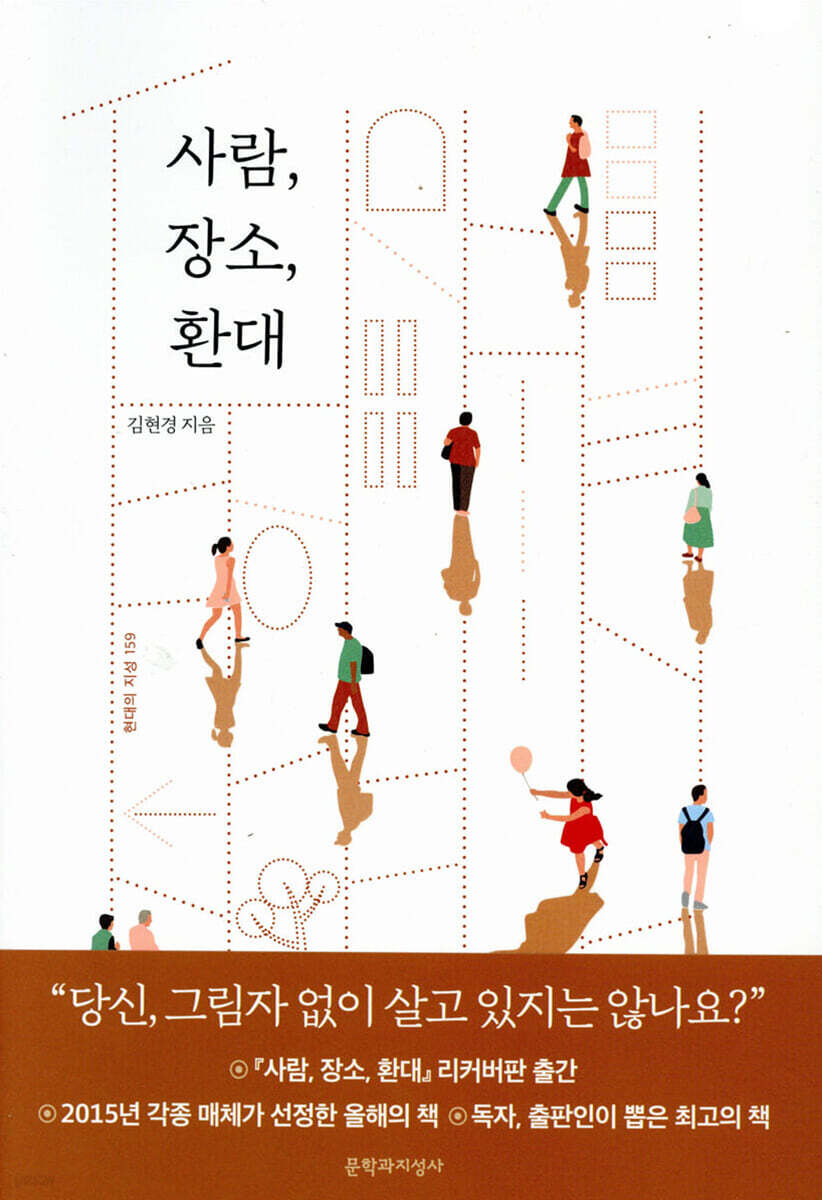
People, places, hospitality
 |
Description
Book Introduction
Centered around three concepts: people, place, and hospitality
Redefine society!
Anthropologist Kim Hyeon-gyeong, who has long studied issues such as ‘social membership rights’ and ‘hospitality,’ has published her first book, ‘People, Places, Hospitality,’ by Munhak-kwa-Jiseongsa.
How do we enter this world and become human? Are we accepted into this world because we are human, or are we human because we are accepted into this world? In other words, is being "human" a status or a condition? Can conditional hospitality also be considered hospitality? If the hospitality we are given can be withdrawn at any time, aren't we truly unwelcome? This book answers these questions, moving beyond structural functionalism, which likens society to a "clock" (i.e., a collection of functional structures) or a "honeycomb" (a structure reproduced by agents engaging in reproductive practices), and aims to redefine society around the three concepts of person, place, and hospitality.
Redefine society!
Anthropologist Kim Hyeon-gyeong, who has long studied issues such as ‘social membership rights’ and ‘hospitality,’ has published her first book, ‘People, Places, Hospitality,’ by Munhak-kwa-Jiseongsa.
How do we enter this world and become human? Are we accepted into this world because we are human, or are we human because we are accepted into this world? In other words, is being "human" a status or a condition? Can conditional hospitality also be considered hospitality? If the hospitality we are given can be withdrawn at any time, aren't we truly unwelcome? This book answers these questions, moving beyond structural functionalism, which likens society to a "clock" (i.e., a collection of functional structures) or a "honeycomb" (a structure reproduced by agents engaging in reproductive practices), and aims to redefine society around the three concepts of person, place, and hospitality.
- You can preview some of the book's contents.
Preview
index
Prologue: The Man Who Sold Shadows
Chapter 1: The Concept of Humanity
fetus
slave
soldier
death row inmate
Chapter 2: The Right to Membership and the Struggle for Recognition
Master and slave
Foreigner's problem
Metaphor of pollution
Chapter 3: Human Performance/Performance
Mask and face
Honor and Dignity
Chapter 4 The Meaning of Insult
Courtesy of personality
Exclusion and stigma
Status and Insult
Discovery of Society
“Be human”
About humiliation
Chapter 5: Conditions of Friendship
Pure friendship and pure gift
A country that complements patriarchy
Gifts and hospitality
Two Imaginaries of Community
Chapter 6: Absolute Hospitality
Hospitality without asking for identity
Hospitality that demands no return
Hospitality without revenge
Chapter 7: The Sacred
The place of the dead
Survival Lottery
Two notes on the appendix location
Meaning of place/seat
Women and places/positions
Acknowledgements
Chapter 1: The Concept of Humanity
fetus
slave
soldier
death row inmate
Chapter 2: The Right to Membership and the Struggle for Recognition
Master and slave
Foreigner's problem
Metaphor of pollution
Chapter 3: Human Performance/Performance
Mask and face
Honor and Dignity
Chapter 4 The Meaning of Insult
Courtesy of personality
Exclusion and stigma
Status and Insult
Discovery of Society
“Be human”
About humiliation
Chapter 5: Conditions of Friendship
Pure friendship and pure gift
A country that complements patriarchy
Gifts and hospitality
Two Imaginaries of Community
Chapter 6: Absolute Hospitality
Hospitality without asking for identity
Hospitality that demands no return
Hospitality without revenge
Chapter 7: The Sacred
The place of the dead
Survival Lottery
Two notes on the appendix location
Meaning of place/seat
Women and places/positions
Acknowledgements
Into the book
Let's take the case of a fetus as an example.
A human fetus is clearly a human being, but because it has not entered society, it is not considered a person.
This is true both legally and customarily.
The law states that human life acquires the status of a person upon birth.
Birth refers to the separation of a fetus from its mother's body by coming out of the womb.
Until then, the fetus is considered a part of the mother's body.
This implies that killing a fetus does not constitute murder.
Custom supports this legal judgment on the status of the fetus.
The fact that no mourning rituals are performed for the aborted fetus is proof of this._Page 32
Modern capital punishment, by contrast, involves taking the offender to an isolated location and quietly euthanizing him under the watchful eye of a small group of witnesses.
The idea that the criminal is already outside of society makes it possible to treat him more 'humanely'.
Because he is not a human being but merely a living being, his suffering has no symbolic value, and the final consideration for him, similar to discussions of 'animal welfare,' focuses on reducing unnecessary suffering. _Page 54
The withdrawal of hospitality towards foreigners is justified by the idea that they 'have somewhere to return to'.
'If you don't like the way you're treated in our country, you can go back to your own country.' However, it's not easy to change your place of living once and then again.
Moreover, the other places implied by the word 'foreigner' often turn out to be fictitious.
I would like to give two examples.
One is the "Joseon" of Koreans in Japan, and the other is Bantustan, the "homeland" of the indigenous people of South Africa. _Page 69
Those in institutions are typically deprived of autonomy, are nagged for trivial matters, and experience a “fear of being irreversibly demoted in the age hierarchy.”
The image of the child here indicates that their body and mind can be more easily invaded.
They have less honor, are more easily insulted, and in doing so, the weight of that insult is underestimated.
They are imperfect people, people who are 'lacking'.
Their shadows are smaller and fainter than others._Page 141
We meet in the market as workers or capitalists, as consumers or producers.
Our relationship is contractual.
In the name of the contract, our inequality is justified.
On the other hand, we are connected as people.
As human beings, we are equal to one another.
The basis of a contractual relationship is equality as a person.
In modern capitalist society, people are formally equal, but in reality, they are unequal.
But here we must ask:
Does our position in the economic order really have no impact on social relations? (Page 162)
Because our place in society is expressed in our rights to places or in the relationships our bodies have with places.
In a physical sense, society is a place, and to be a member of society means to have rights to this place, to have the right to be welcomed as a guest and a host, and to give hospitality.
For example, the homeless people at Seoul Station.
They are there because they have nowhere else to go, and the expression "nowhere to go" reveals the precariousness of their position in society._Page 289
In Rome, infant abandonment was rampant, and those who raised an abandoned child could do whatever they wanted with it, whether they kept it as a slave or sold it (adoption was also possible, but this was rare).
The idea that a child was already “dead” when abandoned justified this practice.
In other words, the idea that a child owes life to the person who took him in, and that this debt of life can only be repaid with life (i.e., by giving one's life).
But this is the logic of donation, not the logic of hospitality.
From the perspective of hospitality, it can be said that abandoned children are not able to enter society even after their lives are saved.
The slave trader who rescued him did not welcome him, but only postponed his death.
What characterizes their relationship is rather a persistent antagonism.
Because the slave trader can kill the child at any time, and by constantly reminding the child of death through beatings and insults, he elicits obedience from the child._216-17
A human fetus is clearly a human being, but because it has not entered society, it is not considered a person.
This is true both legally and customarily.
The law states that human life acquires the status of a person upon birth.
Birth refers to the separation of a fetus from its mother's body by coming out of the womb.
Until then, the fetus is considered a part of the mother's body.
This implies that killing a fetus does not constitute murder.
Custom supports this legal judgment on the status of the fetus.
The fact that no mourning rituals are performed for the aborted fetus is proof of this._Page 32
Modern capital punishment, by contrast, involves taking the offender to an isolated location and quietly euthanizing him under the watchful eye of a small group of witnesses.
The idea that the criminal is already outside of society makes it possible to treat him more 'humanely'.
Because he is not a human being but merely a living being, his suffering has no symbolic value, and the final consideration for him, similar to discussions of 'animal welfare,' focuses on reducing unnecessary suffering. _Page 54
The withdrawal of hospitality towards foreigners is justified by the idea that they 'have somewhere to return to'.
'If you don't like the way you're treated in our country, you can go back to your own country.' However, it's not easy to change your place of living once and then again.
Moreover, the other places implied by the word 'foreigner' often turn out to be fictitious.
I would like to give two examples.
One is the "Joseon" of Koreans in Japan, and the other is Bantustan, the "homeland" of the indigenous people of South Africa. _Page 69
Those in institutions are typically deprived of autonomy, are nagged for trivial matters, and experience a “fear of being irreversibly demoted in the age hierarchy.”
The image of the child here indicates that their body and mind can be more easily invaded.
They have less honor, are more easily insulted, and in doing so, the weight of that insult is underestimated.
They are imperfect people, people who are 'lacking'.
Their shadows are smaller and fainter than others._Page 141
We meet in the market as workers or capitalists, as consumers or producers.
Our relationship is contractual.
In the name of the contract, our inequality is justified.
On the other hand, we are connected as people.
As human beings, we are equal to one another.
The basis of a contractual relationship is equality as a person.
In modern capitalist society, people are formally equal, but in reality, they are unequal.
But here we must ask:
Does our position in the economic order really have no impact on social relations? (Page 162)
Because our place in society is expressed in our rights to places or in the relationships our bodies have with places.
In a physical sense, society is a place, and to be a member of society means to have rights to this place, to have the right to be welcomed as a guest and a host, and to give hospitality.
For example, the homeless people at Seoul Station.
They are there because they have nowhere else to go, and the expression "nowhere to go" reveals the precariousness of their position in society._Page 289
In Rome, infant abandonment was rampant, and those who raised an abandoned child could do whatever they wanted with it, whether they kept it as a slave or sold it (adoption was also possible, but this was rare).
The idea that a child was already “dead” when abandoned justified this practice.
In other words, the idea that a child owes life to the person who took him in, and that this debt of life can only be repaid with life (i.e., by giving one's life).
But this is the logic of donation, not the logic of hospitality.
From the perspective of hospitality, it can be said that abandoned children are not able to enter society even after their lives are saved.
The slave trader who rescued him did not welcome him, but only postponed his death.
What characterizes their relationship is rather a persistent antagonism.
Because the slave trader can kill the child at any time, and by constantly reminding the child of death through beatings and insults, he elicits obedience from the child._216-17
--- From the text
Publisher's Review
Centered around three concepts: people, place, and hospitality
Redefine society!
Anthropologist Kim Hyeon-gyeong, who has long studied issues such as ‘social membership rights’ and ‘hospitality,’ has published her first book, ‘People, Places, Hospitality,’ by Munhak-kwa-Jiseongsa.
How do we enter this world and become human? Are we accepted into this world because we are human, or are we human because we are accepted into this world? In other words, is being "human" a status or a condition? Can conditional hospitality also be considered hospitality? If the hospitality we are given can be withdrawn at any time, aren't we truly unwelcome? This book answers these questions, moving beyond structural functionalism, which likens society to a "clock" (i.e., a collection of functional structures) or a "honeycomb" (a structure reproduced by agents engaging in reproductive practices), and aims to redefine society around the three concepts of person, place, and hospitality.
“To be human is to be recognized as a human being.
“The boundaries of society are constantly being redrawn in the daily struggle for recognition.”
The keywords of this book are people, place, and hospitality.
These three concepts are intertwined and support each other.
Being human is a kind of qualification and requires recognition from others.
We enter society and become human through hospitality.
To be human is to have a place.
Hospitality is the act of giving space.
This approach is similar to Hannah Arendt in that it views people and places as fundamentally related concepts.
According to Arendt, society is not an objective entity with clear physical outlines, but rather a space in which 'I appear to others and others appear to me.'
However, while Arendt's interest was primarily focused on political and legal issues, Kim Hyun-kyung expands her perspective to the symbolic and ritualistic layers that constitute the community and the subject.
People are not only legal subjects, but also objects reproduced through everyday rituals.
Sociologist Erving Goffman's work on 'interaction order' is crucial to this expansion.
Kim Hyun-kyung follows Goffman's dichotomy of interaction order versus social structure, explaining how formal equality in the interaction order and substantive inequality within the structure bring about tensions unique to modern society.
Modern society declares that we are all equal as human beings, regardless of whether we are rich or poor, educated or uneducated.
But what makes us human is not abstract ideas, but the way we are treated by others every day.
Material conditions still play an important role in acting like a human and being treated like a human.
The contradiction of neoliberalism is that while it asserts the dignity of all human beings at the level of the order of interaction, it deprives people of the means to preserve their own dignity at the level of structure.
In this extension, the analysis of how the status-based insults that existed before the modern era emerged in the neoliberal system as a new, more subtle and generalized form of insult, namely humiliation, is very sharp.
People feel humiliated when they are unannounced laid off, when their pay is ridiculously low, and when they can't escape their semi-basement apartment no matter how much they save.
But this is not considered an insult.
In theory, insult is a problem of interaction order, not structure.
Neither the boss who fired me nor the landlady who asked me to raise the rent had any intention of insulting me.
They simply acted according to the laws of the market (i.e., as bearers of the structure, as the structure dictated).
Didn't they express their position very politely, even apologetically? If no one insulted me, then the humiliation I feel is entirely my own fault.
What is friendship?
Is it possible to welcome the enemy?
This book also attempts to resolve the paradox inherent in the concept of hospitality.
Hospitality is the act of giving space to another person, or acknowledging his place in society.
By being welcomed, we become members of society and have rights as human beings.
But can we even welcome hostile others?
Jacques Derrida has argued that such hospitality is impossible.
We can do favors to people we don't know, without even thinking about what's in return.
But is this still the case when that person turns and attempts to harm us? Kim Hyun-kyung argues that Derrida errs by linking hospitality to the issue of individuals opening their private space to other individuals, or by substituting "citizens" for individuals in the role of host.
In this way, hospitality becomes a matter of welcoming outsiders, or opening up the fence.
But how do we know we are "owners"? How do we become citizens, members of a family?
This book proposes to view hospitality as an act of acknowledging that a person belongs to the human community, an act of confirming through gestures and words that he or she is present in society as a human being.
To absolutely welcome someone does not mean not to punish them for whatever they do, but rather not to deny them their humanity under any circumstances.
Even people who commit antisocial acts such as murder continue to be welcomed as members of society.
Creating society is, in this sense, absolute hospitality.
No, perhaps we should say that society is originally established through absolute hospitality.
If absolute hospitality is impossible, the author argues, then society is also impossible.
"People, Places, Hospitality" addresses theoretical issues that have been discussed in various fields, but it does not take the form of a dry thesis according to academic conventions or standards.
While posing weighty questions that reveal the trajectory of thought, the author develops his argument by appropriately utilizing a wide range of references, drawing on extensive research and teaching experience rather than relying on abstract concepts. This approach ensures that even general readers will find intellectual stimulation and interest.
This book is worthy of being called the new author we should pay attention to, as he possesses both a strong sense of problem and a fluent writing style.
Redefine society!
Anthropologist Kim Hyeon-gyeong, who has long studied issues such as ‘social membership rights’ and ‘hospitality,’ has published her first book, ‘People, Places, Hospitality,’ by Munhak-kwa-Jiseongsa.
How do we enter this world and become human? Are we accepted into this world because we are human, or are we human because we are accepted into this world? In other words, is being "human" a status or a condition? Can conditional hospitality also be considered hospitality? If the hospitality we are given can be withdrawn at any time, aren't we truly unwelcome? This book answers these questions, moving beyond structural functionalism, which likens society to a "clock" (i.e., a collection of functional structures) or a "honeycomb" (a structure reproduced by agents engaging in reproductive practices), and aims to redefine society around the three concepts of person, place, and hospitality.
“To be human is to be recognized as a human being.
“The boundaries of society are constantly being redrawn in the daily struggle for recognition.”
The keywords of this book are people, place, and hospitality.
These three concepts are intertwined and support each other.
Being human is a kind of qualification and requires recognition from others.
We enter society and become human through hospitality.
To be human is to have a place.
Hospitality is the act of giving space.
This approach is similar to Hannah Arendt in that it views people and places as fundamentally related concepts.
According to Arendt, society is not an objective entity with clear physical outlines, but rather a space in which 'I appear to others and others appear to me.'
However, while Arendt's interest was primarily focused on political and legal issues, Kim Hyun-kyung expands her perspective to the symbolic and ritualistic layers that constitute the community and the subject.
People are not only legal subjects, but also objects reproduced through everyday rituals.
Sociologist Erving Goffman's work on 'interaction order' is crucial to this expansion.
Kim Hyun-kyung follows Goffman's dichotomy of interaction order versus social structure, explaining how formal equality in the interaction order and substantive inequality within the structure bring about tensions unique to modern society.
Modern society declares that we are all equal as human beings, regardless of whether we are rich or poor, educated or uneducated.
But what makes us human is not abstract ideas, but the way we are treated by others every day.
Material conditions still play an important role in acting like a human and being treated like a human.
The contradiction of neoliberalism is that while it asserts the dignity of all human beings at the level of the order of interaction, it deprives people of the means to preserve their own dignity at the level of structure.
In this extension, the analysis of how the status-based insults that existed before the modern era emerged in the neoliberal system as a new, more subtle and generalized form of insult, namely humiliation, is very sharp.
People feel humiliated when they are unannounced laid off, when their pay is ridiculously low, and when they can't escape their semi-basement apartment no matter how much they save.
But this is not considered an insult.
In theory, insult is a problem of interaction order, not structure.
Neither the boss who fired me nor the landlady who asked me to raise the rent had any intention of insulting me.
They simply acted according to the laws of the market (i.e., as bearers of the structure, as the structure dictated).
Didn't they express their position very politely, even apologetically? If no one insulted me, then the humiliation I feel is entirely my own fault.
What is friendship?
Is it possible to welcome the enemy?
This book also attempts to resolve the paradox inherent in the concept of hospitality.
Hospitality is the act of giving space to another person, or acknowledging his place in society.
By being welcomed, we become members of society and have rights as human beings.
But can we even welcome hostile others?
Jacques Derrida has argued that such hospitality is impossible.
We can do favors to people we don't know, without even thinking about what's in return.
But is this still the case when that person turns and attempts to harm us? Kim Hyun-kyung argues that Derrida errs by linking hospitality to the issue of individuals opening their private space to other individuals, or by substituting "citizens" for individuals in the role of host.
In this way, hospitality becomes a matter of welcoming outsiders, or opening up the fence.
But how do we know we are "owners"? How do we become citizens, members of a family?
This book proposes to view hospitality as an act of acknowledging that a person belongs to the human community, an act of confirming through gestures and words that he or she is present in society as a human being.
To absolutely welcome someone does not mean not to punish them for whatever they do, but rather not to deny them their humanity under any circumstances.
Even people who commit antisocial acts such as murder continue to be welcomed as members of society.
Creating society is, in this sense, absolute hospitality.
No, perhaps we should say that society is originally established through absolute hospitality.
If absolute hospitality is impossible, the author argues, then society is also impossible.
"People, Places, Hospitality" addresses theoretical issues that have been discussed in various fields, but it does not take the form of a dry thesis according to academic conventions or standards.
While posing weighty questions that reveal the trajectory of thought, the author develops his argument by appropriately utilizing a wide range of references, drawing on extensive research and teaching experience rather than relying on abstract concepts. This approach ensures that even general readers will find intellectual stimulation and interest.
This book is worthy of being called the new author we should pay attention to, as he possesses both a strong sense of problem and a fluent writing style.
GOODS SPECIFICS
- Date of issue: March 31, 2015
- Page count, weight, size: 297 pages | 438g | 153*224*20mm
- ISBN13: 9788932027265
- ISBN10: 8932027269
You may also like
카테고리
korean


korean

![GQ KOREA Mark (Monthly): December [2025]](http://librairie.coreenne.fr/cdn/shop/files/8ef265dbbfbf186523ed75ba7319009d.jpg?v=1765340328&width=3840)


