

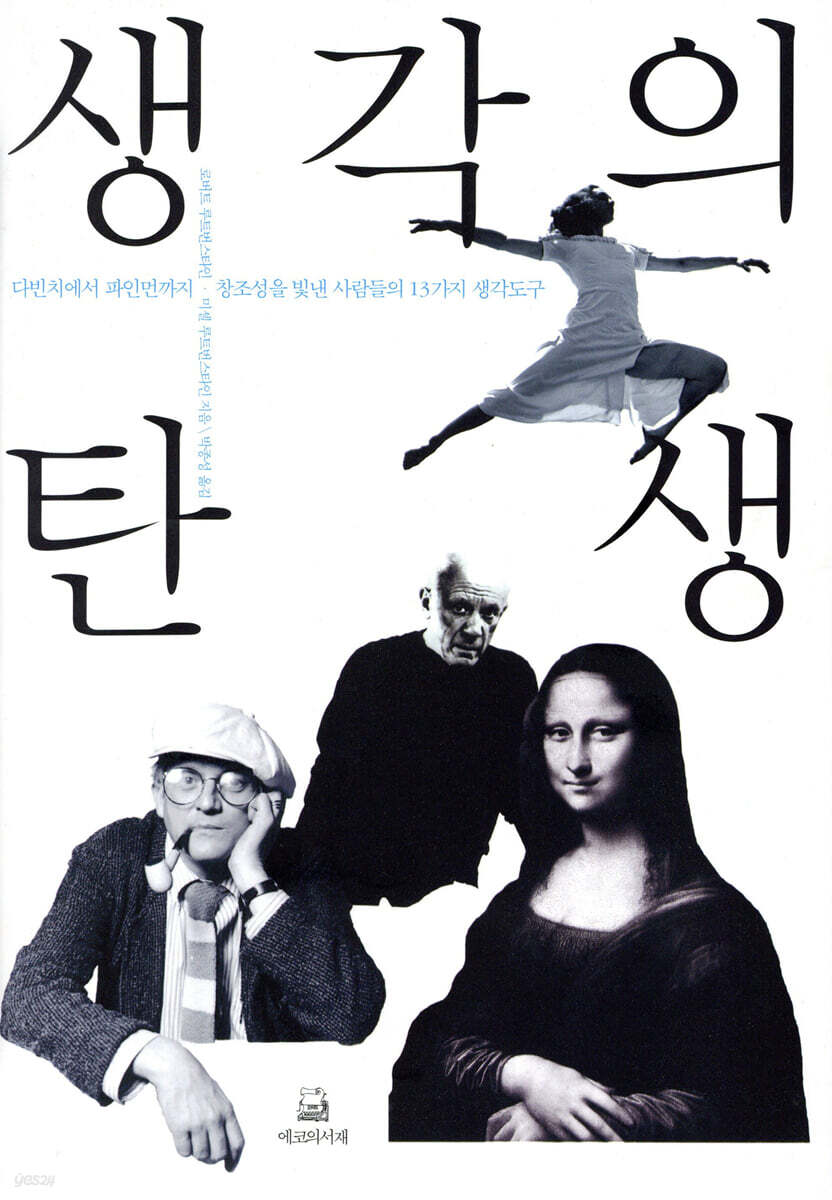
The Birth of an Idea
 |
Description
Book Introduction
|
This book organizes 13 common thinking methods used by people of exceptional creativity throughout history, including Leonardo da Vinci, Einstein, Pablo Picasso, Marcel Duchamp, Richard Feynman, Virginia Woolf, Jane Goodall, Stravinsky, and Martha Graham, in stages of thinking, regardless of the field of science, mathematics, medicine, literature, art, and dance.
It explains in detail how some of the greatest geniuses in history thought about 'thinking' and how they learned to think through their creative experiences. The author logically explains their method of thinking by dividing it into 13 steps: observation, visualization, abstraction, pattern recognition, pattern formation, analogy, body thinking, empathy, dimensional thinking, modeling, play, transformation, and integration. He also presents specific methods for honing intuition and imagination to unleash creativity. Most of us listen to music and look at pictures. But creative geniuses 'hear' the picture and 'see' the music. Luciano Pavarotti is said to have 'pictured' music in his head more often than singing it at the piano. This is called auditory visualization. Leonardo da Vinci used pattern recognition to come up with new ideas. He depicted an infinite variety of subjects from a single image, such as mountains, rivers, and rocks, and conjured up scenes of battle or strange faces. Shadows are observed with the mind's eye, images are drawn in the mind, models are created, and inferences are made to gain integrated insight. But the author says creativity is not the exclusive domain of these few geniuses. Anyone can become a master of creativity by using the 13 creative thinking tools they used. This book, which teaches imagination and awakens the genius within, will help future artists, scientists, humanists, and engineers activate their creative thinking to build the world. index Author's Note
Recommendation Rethinking 'thought' From 'what' you think to 'how' you think Nobel Prize winner who interacted with corn genes Richard Feynman didn't solve the problem; he 'felt' it. Intuition leads to insight through empathy. How to Use Feelings, Emotions, and Intuition 13 Thinking Tools to Learn Imagination The disconnect between 'fantasy' and 'reality' The epitome of a failed intellectual: Virginia Woolf's father An education system that teaches you to memorize rather than understand. Picasso believed that imagination was more truthful than reality. 13 Thinking Tools to Drive Creativity How to Use the Tools of Thinking * Thinking Tool 1 - Observation Active 'observation' rather than passive 'viewing' Observation isn't just about the eyes. The difference between 'just listening' and 'listening carefully' The Values of Everyday Life Rediscovered by Marcel Duchamp Artistic Training for Observation from Goethe to Henry Miller The Grandeur of the Worldly Realized Through Observation * Thinking Tool 2 - Visualization Charles Steinmetz's ability to draw things Figuration recreates the world Can you hear the notes of music in a crowded party? Visual thinkers, non-visual thinkers Einstein 'imagined' physics Various ways to awaken your inner senses * Thinking Tool 3 - Abstraction Picasso painted what he saw with his heart, not his eyes. Abstraction is simplification The essence of abstraction is to capture only one characteristic. Movement can also be abstracted Boundaries between disciplines disappear through abstraction. Abstraction is the process of revealing the essence of something significant and surprising. * Thinking Tool 4 - Pattern Recognition What would you see if you turned Arcimboldo's still life upside down? Da Vinci's ideas started from pattern recognition. Pattern Recognition and the Discovery of Poetry Schoenberg discovered patterns by manipulating pitch arrangements Finding new patterns in nature's chaos Absence of pattern or difference in pattern? Chess masters are masters of pattern recognition. * Thinking Tool 5 - Pattern Formation Moving lines of Knugwareye Bach composed original music using symmetrical patterns From Fourier Analysis to Electronics, the Amazing Transformations of Patterns The combination of the simplest elements creates the complex. The pattern shows that there is more than one right answer. * Thinking Tool 6 - Analogy Similarities Between Quantum Theory and Music How Helen Keller Understood a World Without Seeing or Hearing Analogy and resemblance are different. Newton discovered the law of gravity by observing a falling apple. Art is based on analogy and metaphor. Escher's engravings born from musical analogies If you can't infer, you can't create the world. * Thinking Tool 7 - Thinking with Your Body How Chimpanzees Eat Bananas Hanging from the Ceiling Body movements become thoughts Jackson Pollock's action paintings that you have to 'feel' with your body. Scientists and mathematicians who 'feel' the problem with their whole body Thinking is feeling and feeling is thinking Even after a part of the body is lost, sensation remains. The body knows the answer * Thinking Tool 8 - Empathy Daniel Day-Lewis 'lived' the character's life. The essence of empathy is to become someone else. Historians return to the "scenes of their time" to see things through the eyes of others. To be successful in hunting, think like the prey. Jane Goodall, who studied the complex chimpanzee society with empathy To draw bamboo, first let it grow within you. The most perfect understanding is when it becomes 'what you want to understand'. * Thinking Tool 9 - Dimensional Thinking Think of space three-dimensionally How do we look in a two-dimensional world? The invention of perspective, which allows three-dimensional objects to be drawn on a two-dimensional plane Why Georgia O'Keeffe Painted Large Flowers Is time just one dimension? The emergence of Calder and moving sculptures Shape-blind people who can't see the pieces Geometric models that train dimensional thinking * Thinking Tool 10 - Modeling A war game that serves as a model for military operations The model embodies the essence Seurat's sketch that became the model for the finished painting Chinese noblewomen were treated with naked dolls. A public health model that prevented the spread of infectious diseases A pure model can be obtained by mathematically transforming the model. To understand the world, build a model. * Thinking Tool 11 - Play Play with work Richard Feynman, who studied electron orbits by observing a shaking dish. Calder's circus performances and moving sculptures Lewis Carroll and Moritz Escher, who played with reality How the Chopsticks March Was Born Creative insights come from play. * Thinking Tool 12 - Transformation Discovery and interpretation of the Laetoli footprints The invention of the strobe, which began with a transformation of thought Transformational thinking connects different fields. Problems expressed in language can be converted into equations. 'Musical' urine analysis conducted at Michigan State University Paul Klee, who transformed Bach's polyphonic music into images What we can do to transform our thinking * Thinking Tool 13 - Integration A world of 'cosmic simultaneity' where sense and consciousness intersect Blue is cello, black is bass The essence of thought is to broaden the horizons of the senses. The synesthetic thinking of Evelyn Glennie, the deaf performer Imagine and analyze, be a scientist as well as an artist. Feeling and knowing are one If you don't become 'everything', you won't become 'nothing'. Integrated education that nurtures the whole person Eight basic goals of integrated education Creative people balance work and hobbies. Be a whole person, not a specialist The purpose of education is to develop the whole person. References Search Into the book Rodin drew the subject he wanted to sculpt several times before casting a mold from clay.
By doing so, it was possible to measure to what extent the hand felt what the eye saw. In his memoir, he wrote, “In order to do the work of casting a mold, one must not only have complete ‘knowledge’ of the human body, but also have a profound ‘feeling’ for every part of the body. In other words, I need to integrate the lines that the human body has and make them a part of myself. “Only then can I be sure that I understand,” he says. Rodin's famous sculpture, "The Thinker," gives physical form to his own proprioceptive imagination. A naked man, symbolizing all poets, painters and inventors, in Rodin's words, sits on a rock in a tense pose, lost in thought. Rodin asked, “What makes my work, ‘The Thinker,’ a ‘thinker?’ It is not just his head, his furrowed brow, his flared nostrils, and his pursed lips. “Every muscle in his arms, back, and legs, his clenched fists, his curled toes, all indicate that he is thinking,” he writes. --- From the text
Percussionist Evelyn Glennie describes sound in proprioceptive and tactile terms.
For Glennie, synesthesia was her way of understanding the world. Even after losing his hearing completely, Glennie learned to hear and understand music using his other senses. She and her husband say, “Even if you are completely deaf, you can hear and feel sounds.” In Glennie's case, he is extremely sensitive to the proprioceptive effects of sound. For low notes, she mainly uses her legs or feet to feel them, and for high notes, she uses specific parts of her face, neck, or chest. You'll get a good sense of this if you've ever been to a rock concert or listened to music on a stereo system with a subwoofer. Glennie believes that there is no difference between feeling a sound and hearing a sound, nor is there a difference between reading lip movements and listening to speech. “Usually we say ‘listen,’ but in my case, seeing is listening. Imagine someone drops a pencil on the floor. Looking at it, I guess, 'Oh, that'll make a sound.' It sparks your imagination. And then I 'listen'. You could say that this is the basic principle that makes up my sound world. It's entirely based on imagination, touch and feeling. “I use all my senses.” Glennie’s fusion of sense and thought is as common among creative people as associative synesthesia. Percussionist Evelyn Glennie describes sound in proprioceptive and tactile terms. For Glennie, synesthesia was her way of understanding the world. Even after losing his hearing completely, Glennie learned to hear and understand music using his other senses. She and her husband say, “Even if you are completely deaf, you can hear and feel sounds.” In Glennie's case, he is extremely sensitive to the proprioceptive effects of sound. For low notes, she mainly uses her legs or feet to feel them, and for high notes, she uses specific parts of her face, neck, or chest. You'll get a good sense of this if you've ever been to a rock concert or listened to music on a stereo system with a subwoofer. Glennie believes that there is no difference between feeling a sound and hearing a sound, nor is there a difference between reading lip movements and listening to speech. “Usually we say ‘listen,’ but in my case, seeing is listening. Imagine someone drops a pencil on the floor. Looking at it, I guess, 'Oh, that'll make a sound.' It sparks your imagination. And then I 'listen'. You could say that this is the basic principle that makes up my sound world. It's entirely based on imagination, touch and feeling. “I use all my senses.” Glennie’s fusion of sense and thought is as common among creative people as associative synesthesia. --- From the text
Publisher's Review Samsung Chairman Lee Kun-hee brought up 'creative management' as a topic at a meeting of executives of electronics affiliates last September.
Copying others' work won't get you anywhere, and it's difficult to survive in the competition without being armed with creativity and innovation. This is an extremely theoretical topic, yet it is also abstract, making it difficult to devise a practical strategy that fits reality. The amount of information acquired by modern people is increasing and the speed of specialization is accelerating, but knowledge is actually becoming fragmented. It is no exaggeration to say that modern people are facing a dark age of knowledge despite the abundance of information. In today's knowledge-based society, there is considerable uncertainty and complexity, and the unpredictability of foreseeing even an inch ahead is increasing. This unpredictability is said to be stressful and threatening to many people. But from another perspective, it also means that there are many 'opportunities' for a new world to unfold within it. Seizing these opportunities requires more than just a casual mindset. We must break free from past ways of thinking, frameworks, and customs. The most important element in breaking away from the past is creative thinking. In what is sometimes called the era of knowledge integration, modern society is transitioning from the era of specialists to the era of generalists, requiring a broader understanding of knowledge, and the importance of comprehensive intellectual thinking that integrates and encompasses all fields cannot be overemphasized. Only those who can think creatively in one field can become the future leaders who will change across fields, and this kind of thinking has become a necessity rather than an option. Therefore, this book will answer the call of the times for Renaissance-style individuals capable of creative thinking, and provide answers on how to develop and apply this in practice. GOODS SPECIFICS
- Date of issue: May 2, 2007
- Format: Hardcover book binding method guide
- Page count, weight, size: 455 pages | 912g | 153*224*30mm
- ISBN13: 9788995688991
- ISBN10: 8995688998
|
You may also like
카테고리
korean


korean

![GQ KOREA Mark (Monthly): December [2025]](http://librairie.coreenne.fr/cdn/shop/files/8ef265dbbfbf186523ed75ba7319009d.jpg?v=1765340328&width=3840)


