

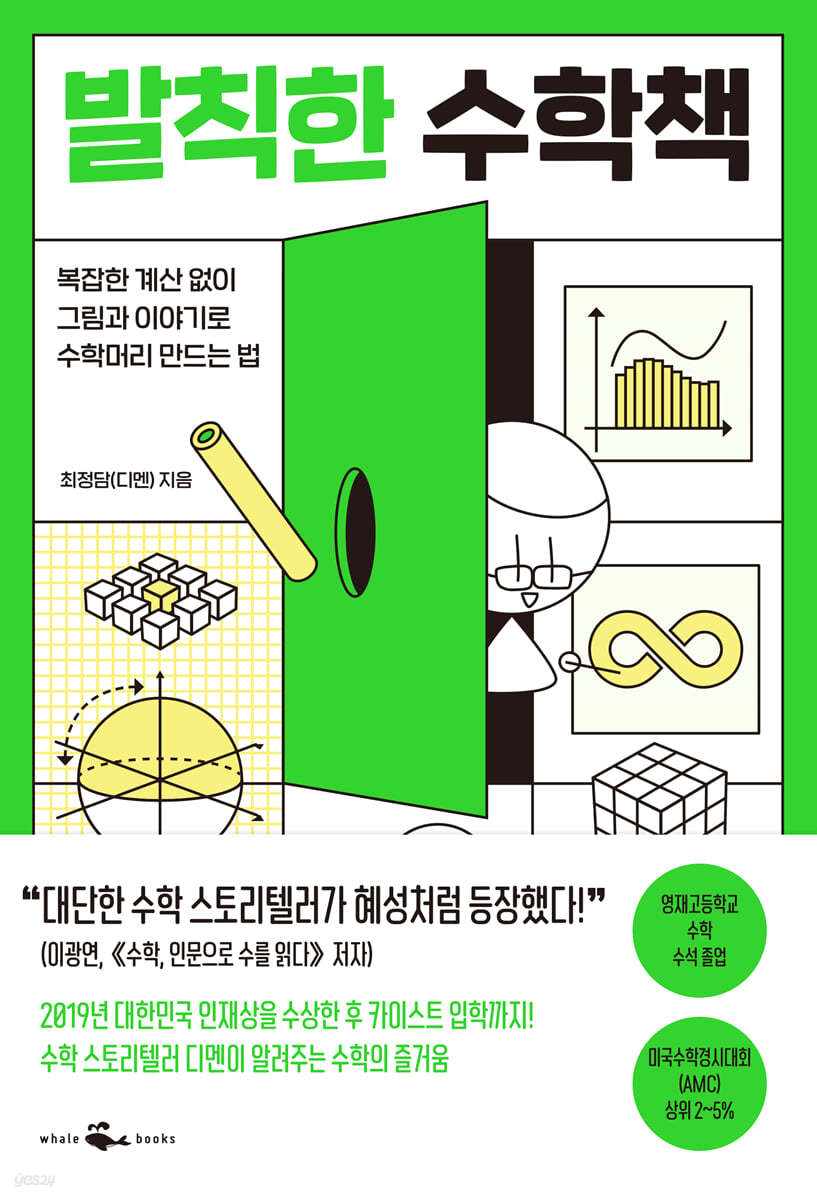
Audacious Math Book
 |
Description
Book Introduction
There has never been a math book this interesting.
Let's start with the simplest mathematical grammar.
A bold story that transcends axioms and probability into higher dimensions.
Reading complex numbers, calculations, and formulas tangled with symbols at a glance is no longer math! The young math storyteller behind "The Cheeky Math Book" has weaved mathematics, often perceived as difficult and tedious, into the world's most entertaining story.
Examining probability through the pigeonhole principle, understanding fixed points with the powder in a mug, wondering whether a straw has 1, 2, or 0 holes, and the fact that 0.9999... and 1 are the same number all become very interesting topics when approached through the story of 'Dimension'.
It stimulates your brain with stories you've never seen before and helps you realize your hidden math skills.
This book explains issues such as "the difference between convex and concave," "why higher dimensions are difficult to understand," and "when calculus is necessary" with clear explanations and easy-to-understand illustrations.
It will open the door to mathematics with its minimal theorem and rigorous standards, and completely change the boring world of mathematics that you knew.
Let's start with the simplest mathematical grammar.
A bold story that transcends axioms and probability into higher dimensions.
Reading complex numbers, calculations, and formulas tangled with symbols at a glance is no longer math! The young math storyteller behind "The Cheeky Math Book" has weaved mathematics, often perceived as difficult and tedious, into the world's most entertaining story.
Examining probability through the pigeonhole principle, understanding fixed points with the powder in a mug, wondering whether a straw has 1, 2, or 0 holes, and the fact that 0.9999... and 1 are the same number all become very interesting topics when approached through the story of 'Dimension'.
It stimulates your brain with stories you've never seen before and helps you realize your hidden math skills.
This book explains issues such as "the difference between convex and concave," "why higher dimensions are difficult to understand," and "when calculus is necessary" with clear explanations and easy-to-understand illustrations.
It will open the door to mathematics with its minimal theorem and rigorous standards, and completely change the boring world of mathematics that you knew.
- You can preview some of the book's contents.
Preview
index
Reviewer's Note_A cheeky math book from a cheeky math storyteller!
Introduction_Misconceptions about Mathematics
Part 1: The Pure Starry Night Sky of Mathematics
1.
The Language and Grammar of Mathematics
Rigor and clarity are the lifeblood of mathematics.
The 12 symbols that form the backbone of mathematics
Let's express concave and convex with logical symbols!
Was Dimen's claim correct?
2.
Does the straw have one hole or two?
Fiddle with the straw
Definition of number of holes
* How many holes does a Möbius strip have?
Definition of 'creating'
3.
The first floor of the tower of mathematics contains axioms.
How to make meaning out of meaningless words
Just hitting the keys doesn't make music.
Euclidean and non-Euclidean geometry
Gödel's incompleteness theorem
* 12 rules of reasoning that express human reason
Part 2: The Field of Mathematics Where Free Clouds Float
1.
Overcoming Dimensional Limits with Mathematics
Stealing Arsene's Treasure
Arsene's Treasure Steal - Sequel
What if a 4-dimensional ball rolled around in 3 dimensions?
How to draw in four dimensions
What is the simplest four-dimensional shape?
Exploring the Shape of the Universe
2.
Beyond infinity, to an infinite infinity
Welcome to the Infinite Hotel
Not all infinities are equal
an uncountably large set
Continuum hypothesis and the Aleph number
How to Cover the Sun with Peas
* The hot potato in the world of mathematics, the axiom of choice
Part 3: The Mathematics Forest Where Treasures Are Hidden
1.
Finding the pigeon hidden in the problem
The Forest of Mathematics Where Treasures Are Hidden
Two problems, one principle
* Probability of there being someone with the same birthday
Square and Pigeon House
* Pythagorean theorem
Second Treasure
2.
Waltz of Cinnamon in a Mug
A small exploration of childhood
Suddenly mood coloring book
Superner's Journey
Climax of Proof
What if the mug was round?
A travelogue written while leaving the coffee forest
3.
Finding a connection on the opposite side of the world
A tunnel through the earth
Arsene the Returned Thief
Could there be two opposite points with the same temperature?
* How to fix a wobbly table
Borsuk-Ulam theorem
Borsuk-Ulam theorem hidden in the necklace problem
* For those who are new to analytical geometry
Again, the climax of the proof
The last hint
Part 4: The World Through the Eyes of Mathematics
1.
Find the most efficient way
Boarding the plane is too slow
You want me to sort 1,000 books?
Split in half, split, split
The fastest way to sort books
P vs. NP problem
Distributing the grass to make others look smaller
2.
Life is a game, and the game is math.
There's a Coffee Bean next to Starbucks.
The Prisoner's Dilemma and the Tobacco Company
Macarons and rice cakes in search of sugar cubes
Building more roads will cause traffic congestion to worsen?
* Things that cannot be found but exist
3.
Calculus, the pinnacle of practical mathematics
Predicting the future from change rates
Core principles of differentiation
* Core principles of integration
Let's predict the virus a little better.
4.
Mathematics: Looking to the Future in Chaos
Neo-Laplace's Demon Created by Mathematics and Physics
Calculate the celestial bodies but not the water flow from the faucet
The Particle That Squeaks and the Probabilistic Universe
About something that can never be predicted
supplement
Introduction_Misconceptions about Mathematics
Part 1: The Pure Starry Night Sky of Mathematics
1.
The Language and Grammar of Mathematics
Rigor and clarity are the lifeblood of mathematics.
The 12 symbols that form the backbone of mathematics
Let's express concave and convex with logical symbols!
Was Dimen's claim correct?
2.
Does the straw have one hole or two?
Fiddle with the straw
Definition of number of holes
* How many holes does a Möbius strip have?
Definition of 'creating'
3.
The first floor of the tower of mathematics contains axioms.
How to make meaning out of meaningless words
Just hitting the keys doesn't make music.
Euclidean and non-Euclidean geometry
Gödel's incompleteness theorem
* 12 rules of reasoning that express human reason
Part 2: The Field of Mathematics Where Free Clouds Float
1.
Overcoming Dimensional Limits with Mathematics
Stealing Arsene's Treasure
Arsene's Treasure Steal - Sequel
What if a 4-dimensional ball rolled around in 3 dimensions?
How to draw in four dimensions
What is the simplest four-dimensional shape?
Exploring the Shape of the Universe
2.
Beyond infinity, to an infinite infinity
Welcome to the Infinite Hotel
Not all infinities are equal
an uncountably large set
Continuum hypothesis and the Aleph number
How to Cover the Sun with Peas
* The hot potato in the world of mathematics, the axiom of choice
Part 3: The Mathematics Forest Where Treasures Are Hidden
1.
Finding the pigeon hidden in the problem
The Forest of Mathematics Where Treasures Are Hidden
Two problems, one principle
* Probability of there being someone with the same birthday
Square and Pigeon House
* Pythagorean theorem
Second Treasure
2.
Waltz of Cinnamon in a Mug
A small exploration of childhood
Suddenly mood coloring book
Superner's Journey
Climax of Proof
What if the mug was round?
A travelogue written while leaving the coffee forest
3.
Finding a connection on the opposite side of the world
A tunnel through the earth
Arsene the Returned Thief
Could there be two opposite points with the same temperature?
* How to fix a wobbly table
Borsuk-Ulam theorem
Borsuk-Ulam theorem hidden in the necklace problem
* For those who are new to analytical geometry
Again, the climax of the proof
The last hint
Part 4: The World Through the Eyes of Mathematics
1.
Find the most efficient way
Boarding the plane is too slow
You want me to sort 1,000 books?
Split in half, split, split
The fastest way to sort books
P vs. NP problem
Distributing the grass to make others look smaller
2.
Life is a game, and the game is math.
There's a Coffee Bean next to Starbucks.
The Prisoner's Dilemma and the Tobacco Company
Macarons and rice cakes in search of sugar cubes
Building more roads will cause traffic congestion to worsen?
* Things that cannot be found but exist
3.
Calculus, the pinnacle of practical mathematics
Predicting the future from change rates
Core principles of differentiation
* Core principles of integration
Let's predict the virus a little better.
4.
Mathematics: Looking to the Future in Chaos
Neo-Laplace's Demon Created by Mathematics and Physics
Calculate the celestial bodies but not the water flow from the faucet
The Particle That Squeaks and the Probabilistic Universe
About something that can never be predicted
supplement
Detailed image

Into the book
What is mathematics? We all studied it in school, but ironically, very few people truly understand what it is.
Too many people have the misconception that mathematics is just about calculating numbers.
This misconception is evident in the media.
Most math geniuses in movies and dramas are portrayed as human computers who can quickly perform complex calculations.
They calculate the mass of the basketball and the acceleration due to gravity in their heads right before throwing it, and they succeed in making a perfect three-point shot.
But the idea that mathematicians are good at calculations is a huge mistake, no different from the idea that pianists are good at building pianos.
In fact, pure mathematics is one of the fields in the natural sciences that requires the least amount of calculation.
This misconception is particularly unfortunate because it leads people to avoid mathematics, thinking of it as a subject filled with tedious calculations and difficult numbers.
Mathematics is absolutely not this kind of subject.
That's why there's no complicated numerical calculations in this book.
--- pp.14~15
All languages are made up of symbols and grammar.
English uses the Latin alphabet, Korean uses Hangul, and Chinese uses Hanja.
By arranging these symbols according to the grammar of each language, a sentence is completed.
Likewise, mathematics is made up of several symbols and grammar.
To be precise, mathematics is a language consisting of only six symbols, twelve rules of inference, and a properly defined set of axioms.
The only thing that distinguishes mathematics from other languages is that it is not a language for communicating with each other in everyday life, but a language for describing logical reasoning.
And for logical reasoning to be possible, we must be able to determine with certainty whether every sentence is true or false.
Without even an inch of ambiguity.
--- pp.24~25
There was a question that once heated up the Internet.
The question was, 'Is there one or two holes in a straw?'
Isn't it common on the Internet to get excited about such meaningless topics?
First, those who claim that there are two holes in the straw say that there is one hole for the drink to go in and one hole for the drink to come out, so there are two holes in total.
Some argue that a straw has only one hole because a straw is just one long hole.
Moreover, there is also a claim that the number of holes is 0.
They say that straws have no holes because they are made by rolling up a rectangle and not by poking holes in the walls with an object like an awl.
Surprisingly, all three claims have some truth to them.
The reason there is controversy over the number of holes in a straw is because everyone has a slightly different definition of a hole.
So what is the correct definition of a hole? From a linguistic perspective, this question is meaningless.
The definition of vocabulary varies slightly from person to person, so it is difficult to say which is better.
All of them are correct.
But the mathematical perspective is different.
Mathematics, which likes to clearly define all its terms, has a strict definition of hole, and only one is accepted as correct.
But before we look at how we define a hole in mathematics, let's try a logical approach.
--- pp.42~43
So what does the universe look like? One way to calculate the curvature of the universe, as discussed earlier, is to draw a large triangle in space and find the sum of its three interior angles.
But since we can't actually draw a large triangle in space, physicists have been analyzing the early appearance of the universe from the cosmic microwave background radiation, and from that, they have been able to derive the spatial relationships of points in the universe.
This data allowed us to find the sum of the three angles of a triangle that would answer the question, "What if you actually drew a large triangle in space?"
As a result, the universe is said to be flat within an error of only ±0.4 percent.
A margin of error of ±0.4 percent could make it flatter than your desk.
It's almost perfectly flat.
The fact that the universe is flat may be a bit disappointing for those who were expecting a universe with a curious structure.
But the fact that the universe is flat is even more shocking.
As mentioned earlier, the structure of the universe is determined by the total amount of matter and energy it contains, and for the universe to be flat, these factors must align perfectly.
Physicists are puzzled by how the universe can have such a perfectly Euclidean structure, despite such a low probability.
It's a chilling thought that perhaps some transcendent being created the universe so perfectly.
--- p.84
The minimum number of directions required to express the position of an object is called the dimension of that space.
On a plane, any position can be expressed in two directions (horizontal/vertical).
If you express it as '+2m horizontally, -1m vertically', you will be able to express all locations on the plane.
So the plane is two-dimensional.
Meanwhile, a solid requires three directions (width/length/height).
Therefore, the solid is three-dimensional.
What do 1D and 0D look like? When we say that an object can only move in one direction, we mean that it moves only in a straight line.
That is, the first dimension is a straight line.
Meanwhile, zero dimensions mean that objects cannot move in any direction.
The 0th dimension is a point, meaning that the object is fixed in one place.
--- pp.108~109
From the perspective of three-dimensional creatures like us, we see the treasure (purple square) along with the alarm device (blue square) as shown in the picture above.
However, for a 2D creature, the treasure will be completely hidden by the alarm device and will not be visible.
If you look at this structure from their perspective, all you will see is the blue line that marks the structure's boundary.
You can't help but be unaware that there is a treasure inside.
However, we can look down on objects in a three-dimensional direction (height) that does not exist in two dimensions, so we can check the outside (frame) and inside (treasure inside) of the alarm device at the same time.
Likewise, while we, as three-dimensional creatures, can only see the outside of the alarm device, a four-dimensional creature looking at the next cube would be able to see both the inside and the outside of the cube at once, in a way that we cannot easily imagine.
Furthermore, to a four-dimensional being, our faces and the organs inside our bodies will be visible all at once, and we will be able to see who lives in which house, and even the structure of the Earth at a glance.
A space where you can take out items trapped inside a box, and even a space where you can see both the inside and outside at the same time.
The fourth dimension exudes a strange sense of mystery and stimulates our imagination of the vastness of space beyond our perception.
If you add a new direction to the fourth dimension, you get the fifth dimension, and you can think of it this way up to the sixth and seventh dimensions, but in this book, we will focus on the fourth dimension.
(It's fun enough in 4 dimensions!)
--- pp.113~114
So far, we have focused on algebraic objects, such as the set of natural numbers or the set of integers.
The set of integers is twice as large as the set of natural numbers, but the bases are the same.
The same logic applies to geometric objects.
For example, two spheres have twice as many points as one sphere, but both two spheres and one sphere have points of base ?1.
Then, wouldn't it be possible to cut a single sphere into several pieces and then reassemble them into two? Just as the Hilbert Hotel, which already has all its rooms occupied, offers an infinite number of additional rooms.
Stefan Banach and Alfred Tarski, who pondered this problem, showed that it was indeed possible.
Banach and Tarski's conclusion was so counterintuitive that it was called a "paradox" even though it was a correct theorem.
--- p.174
Have you ever imagined as a child that if you dug deep into the ground, you'd eventually emerge on the other side of the Earth? Later, as you studied Earth science, you'd learn that such a tunnel was impossible, but it's still a fascinating fantasy.
One of the famous problems in physics is the problem of calculating how long it would take for a package to reach the other side of the Earth if it were dropped into a tunnel that passed through the center of the Earth.
Surprisingly, it only takes 42 minutes, regardless of the weight of the package.
If we can build such a tunnel with incredible technological prowess later on, it will be a revolutionary quick service.
Unfortunately, even if the technology to build such a tunnel were developed, it is unlikely that a trans-Earth quick service would be implemented in Seoul.
Because the opposite side of Seoul is the sea.
Argentina and Uruguay are not far away, but they are unfortunately out of sync.
The only place that has the potential to become Korea's first direct quick service location is Jeju Island.
Jeju Island is located in a very advantageous location because the other side is the border between Brazil and Uruguay.
It is said that when a tunnel is dug through the Earth, the two points at each end of the tunnel are in a relationship of antipodes.
--- pp.229~230
Timo, who loves books, got a job as a librarian.
One day, the library purchased 1,000 new books.
Timo was excited about the prospect of having access to more books, but when the 1,000 volumes actually arrived, he realized the problem.
Now Timo has to sort 1,000 books by library code number.
What algorithm would be the fastest way to sort books?
The first algorithm that came to Timo's mind was:
Compare the code numbers of the first and second books in the stack.
Of these, the book with the lower number is left as is, and the book with the higher number is compared with the third book.
Similarly, we leave the lower-numbered books alone and compare the higher-numbered books with the fourth book.
If you continue like this, the book with the highest number will be moved to the very end.
Repeating this process one more time will move the second-largest book to the second-to-last position, and repeating this process a thousand times will sort all the books.
The sorting algorithm that does this is called bubble sort.
--- pp.276~277
Dimen, who had gone on a trip for the first time in a long time, felt tired while driving and decided to drink some coffee.
But I looked around and couldn't find any cafes.
As I wandered around, I suddenly saw a group of cafes that I hadn't seen before.
Starbucks, Coffee Bean, Tous Les Jours, Ediya… all kinds of cafes are gathered together.
Although it is fortunate that they found a cafe, Dimen's mind becomes dissatisfied.
If cafes are evenly distributed throughout the neighborhood, consumers will be able to find them more easily, and businesses will be able to avoid competition.
Cafes aren't the only industry that likes to be crowded together.
Whether it's restaurants, hospitals, real estate, or hotels, businesses prefer to be clustered in one place rather than spread out evenly.
Why is that?
To answer this question, let's imagine a hypothetical town.
In this village, eight consumers live evenly spaced along a straight road.
If Dimen wanted to sell bungeoppang (fish-shaped bread) in this town, where would be a good location? Obviously, he should choose a central location, closest to the eight customers.
Dimen takes his place in the middle and starts selling bungeoppang diligently.
This is an oligopoly where only one company sells the product to everyone.
--- pp.298~299
It is often said that integration is the inverse operation of differentiation.
Just as division is the inverse operation of multiplication, and subtraction is the inverse operation of addition.
It is not a wrong statement, but it is not a desirable explanation when first explaining integration.
Because the definition of integration itself has nothing to do with differentiation.
The definition of division is the inverse operation of multiplication, and the definition of subtraction is the inverse operation of addition.
This is the very definition of division and subtraction.
However, integration is a concept originally conceived in a very different field from differentiation.
But then I realized that differentiation and integration were inverse operations.
The fact that integration is the inverse operation of differentiation is not a definition of integration, but a theorem that has been proven through mathematical proof.
Integration is a concept designed to find the area and volume of a shape.
We can easily find the area of shapes drawn with straight lines, such as triangles or squares.
Even if the number of sides in a shape increases, you can find the total area by dividing it into several triangles and then adding the areas of each triangle.
--- p.344
Edward Norton Lorenz was a mathematician and meteorologist active in the mid-20th century.
Lorenz's interest was in using data to predict the weather.
One day in 1961, Lorenz was running a computer weather simulation using 12 variables, including temperature and humidity.
After obtaining the results, he ran the simulation again with the same initial values (perhaps to check that there were no errors in the simulation results).
However, unexpectedly, the results of the second simulation were very different from the first simulation.
Even though both simulations started with identical weather conditions, after some time the first simulation outputted a sunny day, while the second outputted a cloudy day.
At first I thought it was a computer malfunction.
But no matter how much I looked, the computer was fine.
Only later did Lorenz realize why these results had occurred.
Lorenz used the report from the first simulation to set the initial values for the second simulation.
However, the internal computer calculations of the simulation program consider up to 6 decimal places, but when outputting, only up to 3 decimal places are output.
The value that Lorenz set as the initial value for the second simulation was 0.506, which was calculated as 0.506127 in the first simulation.
The difference between the two initial values was only 1/4000, but this error grew into a very large difference over time.
Lorenz named this phenomenon, where very small errors develop into large differences, chaos.
--- pp.361~362
Free will is a wonderful optical illusion.
Because so many external factors influence human consciousness (sensory information including sight and smell, the resulting electrical activity of neurons and chemical reactions of hormones in the body, the base pairs written in DNA and the resulting genetic traits, etc.), we simply mistakenly believe that our own decisions come from our own free will.
Even if you choose what to have for dinner tonight by flipping a coin to escape the shackles of determinism, the very idea that you will choose what to have for dinner by flipping a coin is already a decision.
Essentially, we are just protein balls rolling around in a pinball machine called the universe.
On the one hand, this conclusion seems to express a sense of helplessness about life.
So many people try to ignore this fact and live their lives.
But if we pause for a moment and slowly reflect on this fact, we can gain a new perspective on life.
I believe that these values, just as much as traditional values, make life even more beautiful.
Too many people have the misconception that mathematics is just about calculating numbers.
This misconception is evident in the media.
Most math geniuses in movies and dramas are portrayed as human computers who can quickly perform complex calculations.
They calculate the mass of the basketball and the acceleration due to gravity in their heads right before throwing it, and they succeed in making a perfect three-point shot.
But the idea that mathematicians are good at calculations is a huge mistake, no different from the idea that pianists are good at building pianos.
In fact, pure mathematics is one of the fields in the natural sciences that requires the least amount of calculation.
This misconception is particularly unfortunate because it leads people to avoid mathematics, thinking of it as a subject filled with tedious calculations and difficult numbers.
Mathematics is absolutely not this kind of subject.
That's why there's no complicated numerical calculations in this book.
--- pp.14~15
All languages are made up of symbols and grammar.
English uses the Latin alphabet, Korean uses Hangul, and Chinese uses Hanja.
By arranging these symbols according to the grammar of each language, a sentence is completed.
Likewise, mathematics is made up of several symbols and grammar.
To be precise, mathematics is a language consisting of only six symbols, twelve rules of inference, and a properly defined set of axioms.
The only thing that distinguishes mathematics from other languages is that it is not a language for communicating with each other in everyday life, but a language for describing logical reasoning.
And for logical reasoning to be possible, we must be able to determine with certainty whether every sentence is true or false.
Without even an inch of ambiguity.
--- pp.24~25
There was a question that once heated up the Internet.
The question was, 'Is there one or two holes in a straw?'
Isn't it common on the Internet to get excited about such meaningless topics?
First, those who claim that there are two holes in the straw say that there is one hole for the drink to go in and one hole for the drink to come out, so there are two holes in total.
Some argue that a straw has only one hole because a straw is just one long hole.
Moreover, there is also a claim that the number of holes is 0.
They say that straws have no holes because they are made by rolling up a rectangle and not by poking holes in the walls with an object like an awl.
Surprisingly, all three claims have some truth to them.
The reason there is controversy over the number of holes in a straw is because everyone has a slightly different definition of a hole.
So what is the correct definition of a hole? From a linguistic perspective, this question is meaningless.
The definition of vocabulary varies slightly from person to person, so it is difficult to say which is better.
All of them are correct.
But the mathematical perspective is different.
Mathematics, which likes to clearly define all its terms, has a strict definition of hole, and only one is accepted as correct.
But before we look at how we define a hole in mathematics, let's try a logical approach.
--- pp.42~43
So what does the universe look like? One way to calculate the curvature of the universe, as discussed earlier, is to draw a large triangle in space and find the sum of its three interior angles.
But since we can't actually draw a large triangle in space, physicists have been analyzing the early appearance of the universe from the cosmic microwave background radiation, and from that, they have been able to derive the spatial relationships of points in the universe.
This data allowed us to find the sum of the three angles of a triangle that would answer the question, "What if you actually drew a large triangle in space?"
As a result, the universe is said to be flat within an error of only ±0.4 percent.
A margin of error of ±0.4 percent could make it flatter than your desk.
It's almost perfectly flat.
The fact that the universe is flat may be a bit disappointing for those who were expecting a universe with a curious structure.
But the fact that the universe is flat is even more shocking.
As mentioned earlier, the structure of the universe is determined by the total amount of matter and energy it contains, and for the universe to be flat, these factors must align perfectly.
Physicists are puzzled by how the universe can have such a perfectly Euclidean structure, despite such a low probability.
It's a chilling thought that perhaps some transcendent being created the universe so perfectly.
--- p.84
The minimum number of directions required to express the position of an object is called the dimension of that space.
On a plane, any position can be expressed in two directions (horizontal/vertical).
If you express it as '+2m horizontally, -1m vertically', you will be able to express all locations on the plane.
So the plane is two-dimensional.
Meanwhile, a solid requires three directions (width/length/height).
Therefore, the solid is three-dimensional.
What do 1D and 0D look like? When we say that an object can only move in one direction, we mean that it moves only in a straight line.
That is, the first dimension is a straight line.
Meanwhile, zero dimensions mean that objects cannot move in any direction.
The 0th dimension is a point, meaning that the object is fixed in one place.
--- pp.108~109
From the perspective of three-dimensional creatures like us, we see the treasure (purple square) along with the alarm device (blue square) as shown in the picture above.
However, for a 2D creature, the treasure will be completely hidden by the alarm device and will not be visible.
If you look at this structure from their perspective, all you will see is the blue line that marks the structure's boundary.
You can't help but be unaware that there is a treasure inside.
However, we can look down on objects in a three-dimensional direction (height) that does not exist in two dimensions, so we can check the outside (frame) and inside (treasure inside) of the alarm device at the same time.
Likewise, while we, as three-dimensional creatures, can only see the outside of the alarm device, a four-dimensional creature looking at the next cube would be able to see both the inside and the outside of the cube at once, in a way that we cannot easily imagine.
Furthermore, to a four-dimensional being, our faces and the organs inside our bodies will be visible all at once, and we will be able to see who lives in which house, and even the structure of the Earth at a glance.
A space where you can take out items trapped inside a box, and even a space where you can see both the inside and outside at the same time.
The fourth dimension exudes a strange sense of mystery and stimulates our imagination of the vastness of space beyond our perception.
If you add a new direction to the fourth dimension, you get the fifth dimension, and you can think of it this way up to the sixth and seventh dimensions, but in this book, we will focus on the fourth dimension.
(It's fun enough in 4 dimensions!)
--- pp.113~114
So far, we have focused on algebraic objects, such as the set of natural numbers or the set of integers.
The set of integers is twice as large as the set of natural numbers, but the bases are the same.
The same logic applies to geometric objects.
For example, two spheres have twice as many points as one sphere, but both two spheres and one sphere have points of base ?1.
Then, wouldn't it be possible to cut a single sphere into several pieces and then reassemble them into two? Just as the Hilbert Hotel, which already has all its rooms occupied, offers an infinite number of additional rooms.
Stefan Banach and Alfred Tarski, who pondered this problem, showed that it was indeed possible.
Banach and Tarski's conclusion was so counterintuitive that it was called a "paradox" even though it was a correct theorem.
--- p.174
Have you ever imagined as a child that if you dug deep into the ground, you'd eventually emerge on the other side of the Earth? Later, as you studied Earth science, you'd learn that such a tunnel was impossible, but it's still a fascinating fantasy.
One of the famous problems in physics is the problem of calculating how long it would take for a package to reach the other side of the Earth if it were dropped into a tunnel that passed through the center of the Earth.
Surprisingly, it only takes 42 minutes, regardless of the weight of the package.
If we can build such a tunnel with incredible technological prowess later on, it will be a revolutionary quick service.
Unfortunately, even if the technology to build such a tunnel were developed, it is unlikely that a trans-Earth quick service would be implemented in Seoul.
Because the opposite side of Seoul is the sea.
Argentina and Uruguay are not far away, but they are unfortunately out of sync.
The only place that has the potential to become Korea's first direct quick service location is Jeju Island.
Jeju Island is located in a very advantageous location because the other side is the border between Brazil and Uruguay.
It is said that when a tunnel is dug through the Earth, the two points at each end of the tunnel are in a relationship of antipodes.
--- pp.229~230
Timo, who loves books, got a job as a librarian.
One day, the library purchased 1,000 new books.
Timo was excited about the prospect of having access to more books, but when the 1,000 volumes actually arrived, he realized the problem.
Now Timo has to sort 1,000 books by library code number.
What algorithm would be the fastest way to sort books?
The first algorithm that came to Timo's mind was:
Compare the code numbers of the first and second books in the stack.
Of these, the book with the lower number is left as is, and the book with the higher number is compared with the third book.
Similarly, we leave the lower-numbered books alone and compare the higher-numbered books with the fourth book.
If you continue like this, the book with the highest number will be moved to the very end.
Repeating this process one more time will move the second-largest book to the second-to-last position, and repeating this process a thousand times will sort all the books.
The sorting algorithm that does this is called bubble sort.
--- pp.276~277
Dimen, who had gone on a trip for the first time in a long time, felt tired while driving and decided to drink some coffee.
But I looked around and couldn't find any cafes.
As I wandered around, I suddenly saw a group of cafes that I hadn't seen before.
Starbucks, Coffee Bean, Tous Les Jours, Ediya… all kinds of cafes are gathered together.
Although it is fortunate that they found a cafe, Dimen's mind becomes dissatisfied.
If cafes are evenly distributed throughout the neighborhood, consumers will be able to find them more easily, and businesses will be able to avoid competition.
Cafes aren't the only industry that likes to be crowded together.
Whether it's restaurants, hospitals, real estate, or hotels, businesses prefer to be clustered in one place rather than spread out evenly.
Why is that?
To answer this question, let's imagine a hypothetical town.
In this village, eight consumers live evenly spaced along a straight road.
If Dimen wanted to sell bungeoppang (fish-shaped bread) in this town, where would be a good location? Obviously, he should choose a central location, closest to the eight customers.
Dimen takes his place in the middle and starts selling bungeoppang diligently.
This is an oligopoly where only one company sells the product to everyone.
--- pp.298~299
It is often said that integration is the inverse operation of differentiation.
Just as division is the inverse operation of multiplication, and subtraction is the inverse operation of addition.
It is not a wrong statement, but it is not a desirable explanation when first explaining integration.
Because the definition of integration itself has nothing to do with differentiation.
The definition of division is the inverse operation of multiplication, and the definition of subtraction is the inverse operation of addition.
This is the very definition of division and subtraction.
However, integration is a concept originally conceived in a very different field from differentiation.
But then I realized that differentiation and integration were inverse operations.
The fact that integration is the inverse operation of differentiation is not a definition of integration, but a theorem that has been proven through mathematical proof.
Integration is a concept designed to find the area and volume of a shape.
We can easily find the area of shapes drawn with straight lines, such as triangles or squares.
Even if the number of sides in a shape increases, you can find the total area by dividing it into several triangles and then adding the areas of each triangle.
--- p.344
Edward Norton Lorenz was a mathematician and meteorologist active in the mid-20th century.
Lorenz's interest was in using data to predict the weather.
One day in 1961, Lorenz was running a computer weather simulation using 12 variables, including temperature and humidity.
After obtaining the results, he ran the simulation again with the same initial values (perhaps to check that there were no errors in the simulation results).
However, unexpectedly, the results of the second simulation were very different from the first simulation.
Even though both simulations started with identical weather conditions, after some time the first simulation outputted a sunny day, while the second outputted a cloudy day.
At first I thought it was a computer malfunction.
But no matter how much I looked, the computer was fine.
Only later did Lorenz realize why these results had occurred.
Lorenz used the report from the first simulation to set the initial values for the second simulation.
However, the internal computer calculations of the simulation program consider up to 6 decimal places, but when outputting, only up to 3 decimal places are output.
The value that Lorenz set as the initial value for the second simulation was 0.506, which was calculated as 0.506127 in the first simulation.
The difference between the two initial values was only 1/4000, but this error grew into a very large difference over time.
Lorenz named this phenomenon, where very small errors develop into large differences, chaos.
--- pp.361~362
Free will is a wonderful optical illusion.
Because so many external factors influence human consciousness (sensory information including sight and smell, the resulting electrical activity of neurons and chemical reactions of hormones in the body, the base pairs written in DNA and the resulting genetic traits, etc.), we simply mistakenly believe that our own decisions come from our own free will.
Even if you choose what to have for dinner tonight by flipping a coin to escape the shackles of determinism, the very idea that you will choose what to have for dinner by flipping a coin is already a decision.
Essentially, we are just protein balls rolling around in a pinball machine called the universe.
On the one hand, this conclusion seems to express a sense of helplessness about life.
So many people try to ignore this fact and live their lives.
But if we pause for a moment and slowly reflect on this fact, we can gain a new perspective on life.
I believe that these values, just as much as traditional values, make life even more beautiful.
--- p.377
Publisher's Review
“There aren’t many chefs in the world who can make math dishes this delicious!”
From math prodigy to young math storyteller, Dimen discovers math cheat codes.
Laying the foundation for lifelong mathematical skills
The story of a gifted high school math graduate
A Different World of Mathematics
Graduated top of his class in mathematics from Sejong Science and Arts High School, won a silver medal at the Princeton University Physics Competition, and placed in the top 2-5% of the American Mathematical Olympiad! The author's mathematical talent, which often scares away those who have given up on math, isn't limited to difficult exams.
In order to spread the fun of mathematics and awaken interest, he has been using the pen name 'Dimen' to explain various mathematical solutions on Facebook and Tistory, making them easy and simple, and also to show the beautiful properties that only mathematics possesses.
And this book is all about the fun of math!
Math is never difficult.
It is so simple that it can be explained with just six symbols, twelve rules of inference, and a properly defined set of axioms.
However, it is only because of the difference in language for logical reasoning that it is difficult to understand immediately.
This book helps us regain our lost mathematical skills by stimulating logical thinking that has become rigid due to lack of practice.
The ability to infer new facts from given facts, to find connections between various concepts, and to penetrate the core of a problem and find the conditions necessary to solve it.
All of these abilities are what we want to learn through mathematics.
From "Before Beginning the Beautiful Journey of Mathematics"
Mathematics is never a tool for solving difficult problems.
It is about finding the principles hidden in problems that seem complex and difficult.
It allows us to start with small points, lines, and planes and then reason about the larger world.
What if there's a treasure in the center of a 3x3 cube? In the author's story, it's simple.
If you think in higher dimensions, you can take it out.
Also, the reason why a chair has four legs and the fun of straightening a wobbly chair without having to put paper in it are things you can only find in this book.
This book, which allows us to explore the universe further, explains the experiment that proves the Earth is round based on the simple fact that the sum of the three interior angles of a triangle is 180 degrees, and the proof that the universe is flat based on the results.
If you open this book, it will give you a new understanding of mathematics that you will never forget.
It's easy to read without complex calculations or difficult formulas.
Each interesting story
A book magically connected by mathematical logic
Connecting probabilities with the pigeonhole principle and exploring fixed points and Sperner's coloring using the coffee-stirring method.
Imagining a tunnel through the Earth, confirming the existence of antipodes and exploring analytic geometry.
Thinking of efficient algorithms for the fastest way to get on an airplane and the easiest way to organize books in order.
The greatest fun of this book lies in its ability to draw readers into specific situations.
It helps us break free from the misconception that mathematics is boring and difficult by allowing us to expand our logic in a rigorous way, rather than just finding the best solution.
While the first half of this book explores the language of mathematics, the second half contains a delightful story that unfolds the secrets hidden in each forest.
You might find yourself stopping reading at some of the difficult formulas, but the author's easy-to-understand explanations make it no problem.
This explanation of calculus, the most commonly given-up subject, is refreshing! It helps us move beyond the simple definitions that differentiation is about finding slope and integration is about finding area.
Newton, who discovered calculus and the law of universal gravitation, was also able to calculate the speed at which planets orbited and which celestial bodies would be observed at what time.
This book has the power to remind us of the mathematical logic presented in the previous story, then move on to several interesting topics, and ultimately, to penetrate them with a single mathematical logic.
This book is also filled with stories that are often mentioned, such as the Millennium Problem set by the Clay Mathematics Institute, the mathematician Perelman who proved the Poincaré conjecture, the Prisoner's Dilemma, and the Salesman Problem.
Moreover, it delves into the intersection of physics and mathematics to attempt to predict the future, and even into the story of Laplace's demon, a causal determinism, to delve into the story of mathematics, the universe, and the time we live in.
Only when we have completed the entire process prepared by the author will we finally complete our first exploration of the unfamiliar world of mathematics.
Reviewer's Note_A cheeky math book from a cheeky math storyteller!
This book is daring.
The meaning of “something that is very rude, ill-mannered, and offensive in its actions or words” is naturally connected to this book.
The author's skill and thoughts in dealing with mathematics cannot be found in any other mathematics textbook on the market.
It seems like the writing is going here and there without any rules, and it seems like it is introducing completely unrelated mathematical theories haphazardly, but as you turn the pages, you are faced with a deeper aspect of mathematics.
This is because all mathematical content is intricately intertwined like warp and weft.
There is no doubt that it is very creative and convergent.
Readers may often hesitate while reading this book.
'What on earth am I reading?' But if you persevere and keep reading, you will realize that the story the author has unfolded is gradually coming together.
Just as one casts a huge net into the vast ocean and slowly pulls it to catch fish, the author casts a huge net of mathematics into the ocean and then draws readers in with the allure of mathematics.
In fact, when I was first asked to review the manuscript for this book, I hesitated about how to organize the extensive review content, thinking, "Since it was written by a college student, there must be a lot to fix."
But I couldn't help but admit that my thoughts were tilted the moment I read the first chapter of Part 1 of the manuscript.
The writing, like a spaceship launched to explore the world of mathematics, passed through the various planets of mathematics very safely and smoothly, and arrived at the author's thoughts on mathematics with great peace.
Even I, who pride myself on having written quite a few general books on mathematics, found myself questioning myself, "Why couldn't I have thought and explained it this way?" The clear explanations, along with the fun illustrations, made it possible to read the content in one sitting.
The first thought that came to my mind after reading this entire article was, as I said in the beginning, that it was cheeky.
And as I took a moment to catch my breath and write the review, I was overcome with a sense of satisfaction, like after enjoying a well-prepared course meal.
The story, which consisted of four parts, started with a simple drink, continued with an appetizer, and then a main dish full of the chef's sincerity, and ended with a sweet dessert, making me feel like I was treated to a truly happy and satisfying course meal.
So, I dare to strongly recommend this well-prepared course meal to all of you, the readers.
There aren't many chefs in the world who can make math dishes this delicious.
It is truly amazing that a very young mathematician can cook such difficult ingredients with such a level of writing and content.
I can only highly recommend this book, as it is a truly excellent work that leaves me eagerly anticipating future books from the author.
So I hope that I won't spoil anything by explaining what is introduced in this book and how.
However, as the author said, I will only introduce the following: Part 1 mainly defined the language of mathematics, Part 2 dealt with concepts that transcend reality, such as higher dimensions and infinity, through the power of mathematics, Part 3 applied this logical reasoning to various problems, and Part 4 applied it to real life.
I guarantee that when you finish this book, you will realize that a remarkable mathematical storyteller has emerged like a comet, and that you are standing at the threshold of a new era for a very young mathematician.
I hope everyone watches this moment.
― Lee Gwang-yeon, author of "Reading Numbers through Mathematics and Humanities"
From math prodigy to young math storyteller, Dimen discovers math cheat codes.
Laying the foundation for lifelong mathematical skills
The story of a gifted high school math graduate
A Different World of Mathematics
Graduated top of his class in mathematics from Sejong Science and Arts High School, won a silver medal at the Princeton University Physics Competition, and placed in the top 2-5% of the American Mathematical Olympiad! The author's mathematical talent, which often scares away those who have given up on math, isn't limited to difficult exams.
In order to spread the fun of mathematics and awaken interest, he has been using the pen name 'Dimen' to explain various mathematical solutions on Facebook and Tistory, making them easy and simple, and also to show the beautiful properties that only mathematics possesses.
And this book is all about the fun of math!
Math is never difficult.
It is so simple that it can be explained with just six symbols, twelve rules of inference, and a properly defined set of axioms.
However, it is only because of the difference in language for logical reasoning that it is difficult to understand immediately.
This book helps us regain our lost mathematical skills by stimulating logical thinking that has become rigid due to lack of practice.
The ability to infer new facts from given facts, to find connections between various concepts, and to penetrate the core of a problem and find the conditions necessary to solve it.
All of these abilities are what we want to learn through mathematics.
From "Before Beginning the Beautiful Journey of Mathematics"
Mathematics is never a tool for solving difficult problems.
It is about finding the principles hidden in problems that seem complex and difficult.
It allows us to start with small points, lines, and planes and then reason about the larger world.
What if there's a treasure in the center of a 3x3 cube? In the author's story, it's simple.
If you think in higher dimensions, you can take it out.
Also, the reason why a chair has four legs and the fun of straightening a wobbly chair without having to put paper in it are things you can only find in this book.
This book, which allows us to explore the universe further, explains the experiment that proves the Earth is round based on the simple fact that the sum of the three interior angles of a triangle is 180 degrees, and the proof that the universe is flat based on the results.
If you open this book, it will give you a new understanding of mathematics that you will never forget.
It's easy to read without complex calculations or difficult formulas.
Each interesting story
A book magically connected by mathematical logic
Connecting probabilities with the pigeonhole principle and exploring fixed points and Sperner's coloring using the coffee-stirring method.
Imagining a tunnel through the Earth, confirming the existence of antipodes and exploring analytic geometry.
Thinking of efficient algorithms for the fastest way to get on an airplane and the easiest way to organize books in order.
The greatest fun of this book lies in its ability to draw readers into specific situations.
It helps us break free from the misconception that mathematics is boring and difficult by allowing us to expand our logic in a rigorous way, rather than just finding the best solution.
While the first half of this book explores the language of mathematics, the second half contains a delightful story that unfolds the secrets hidden in each forest.
You might find yourself stopping reading at some of the difficult formulas, but the author's easy-to-understand explanations make it no problem.
This explanation of calculus, the most commonly given-up subject, is refreshing! It helps us move beyond the simple definitions that differentiation is about finding slope and integration is about finding area.
Newton, who discovered calculus and the law of universal gravitation, was also able to calculate the speed at which planets orbited and which celestial bodies would be observed at what time.
This book has the power to remind us of the mathematical logic presented in the previous story, then move on to several interesting topics, and ultimately, to penetrate them with a single mathematical logic.
This book is also filled with stories that are often mentioned, such as the Millennium Problem set by the Clay Mathematics Institute, the mathematician Perelman who proved the Poincaré conjecture, the Prisoner's Dilemma, and the Salesman Problem.
Moreover, it delves into the intersection of physics and mathematics to attempt to predict the future, and even into the story of Laplace's demon, a causal determinism, to delve into the story of mathematics, the universe, and the time we live in.
Only when we have completed the entire process prepared by the author will we finally complete our first exploration of the unfamiliar world of mathematics.
Reviewer's Note_A cheeky math book from a cheeky math storyteller!
This book is daring.
The meaning of “something that is very rude, ill-mannered, and offensive in its actions or words” is naturally connected to this book.
The author's skill and thoughts in dealing with mathematics cannot be found in any other mathematics textbook on the market.
It seems like the writing is going here and there without any rules, and it seems like it is introducing completely unrelated mathematical theories haphazardly, but as you turn the pages, you are faced with a deeper aspect of mathematics.
This is because all mathematical content is intricately intertwined like warp and weft.
There is no doubt that it is very creative and convergent.
Readers may often hesitate while reading this book.
'What on earth am I reading?' But if you persevere and keep reading, you will realize that the story the author has unfolded is gradually coming together.
Just as one casts a huge net into the vast ocean and slowly pulls it to catch fish, the author casts a huge net of mathematics into the ocean and then draws readers in with the allure of mathematics.
In fact, when I was first asked to review the manuscript for this book, I hesitated about how to organize the extensive review content, thinking, "Since it was written by a college student, there must be a lot to fix."
But I couldn't help but admit that my thoughts were tilted the moment I read the first chapter of Part 1 of the manuscript.
The writing, like a spaceship launched to explore the world of mathematics, passed through the various planets of mathematics very safely and smoothly, and arrived at the author's thoughts on mathematics with great peace.
Even I, who pride myself on having written quite a few general books on mathematics, found myself questioning myself, "Why couldn't I have thought and explained it this way?" The clear explanations, along with the fun illustrations, made it possible to read the content in one sitting.
The first thought that came to my mind after reading this entire article was, as I said in the beginning, that it was cheeky.
And as I took a moment to catch my breath and write the review, I was overcome with a sense of satisfaction, like after enjoying a well-prepared course meal.
The story, which consisted of four parts, started with a simple drink, continued with an appetizer, and then a main dish full of the chef's sincerity, and ended with a sweet dessert, making me feel like I was treated to a truly happy and satisfying course meal.
So, I dare to strongly recommend this well-prepared course meal to all of you, the readers.
There aren't many chefs in the world who can make math dishes this delicious.
It is truly amazing that a very young mathematician can cook such difficult ingredients with such a level of writing and content.
I can only highly recommend this book, as it is a truly excellent work that leaves me eagerly anticipating future books from the author.
So I hope that I won't spoil anything by explaining what is introduced in this book and how.
However, as the author said, I will only introduce the following: Part 1 mainly defined the language of mathematics, Part 2 dealt with concepts that transcend reality, such as higher dimensions and infinity, through the power of mathematics, Part 3 applied this logical reasoning to various problems, and Part 4 applied it to real life.
I guarantee that when you finish this book, you will realize that a remarkable mathematical storyteller has emerged like a comet, and that you are standing at the threshold of a new era for a very young mathematician.
I hope everyone watches this moment.
― Lee Gwang-yeon, author of "Reading Numbers through Mathematics and Humanities"
GOODS SPECIFICS
- Publication date: June 30, 2021
- Page count, weight, size: 404 pages | 686g | 160*235*25mm
- ISBN13: 9791190313919
- ISBN10: 119031391X
You may also like
카테고리
korean


korean

![GQ KOREA Mark (Monthly): December [2025]](http://librairie.coreenne.fr/cdn/shop/files/8ef265dbbfbf186523ed75ba7319009d.jpg?v=1765340328&width=3840)


