

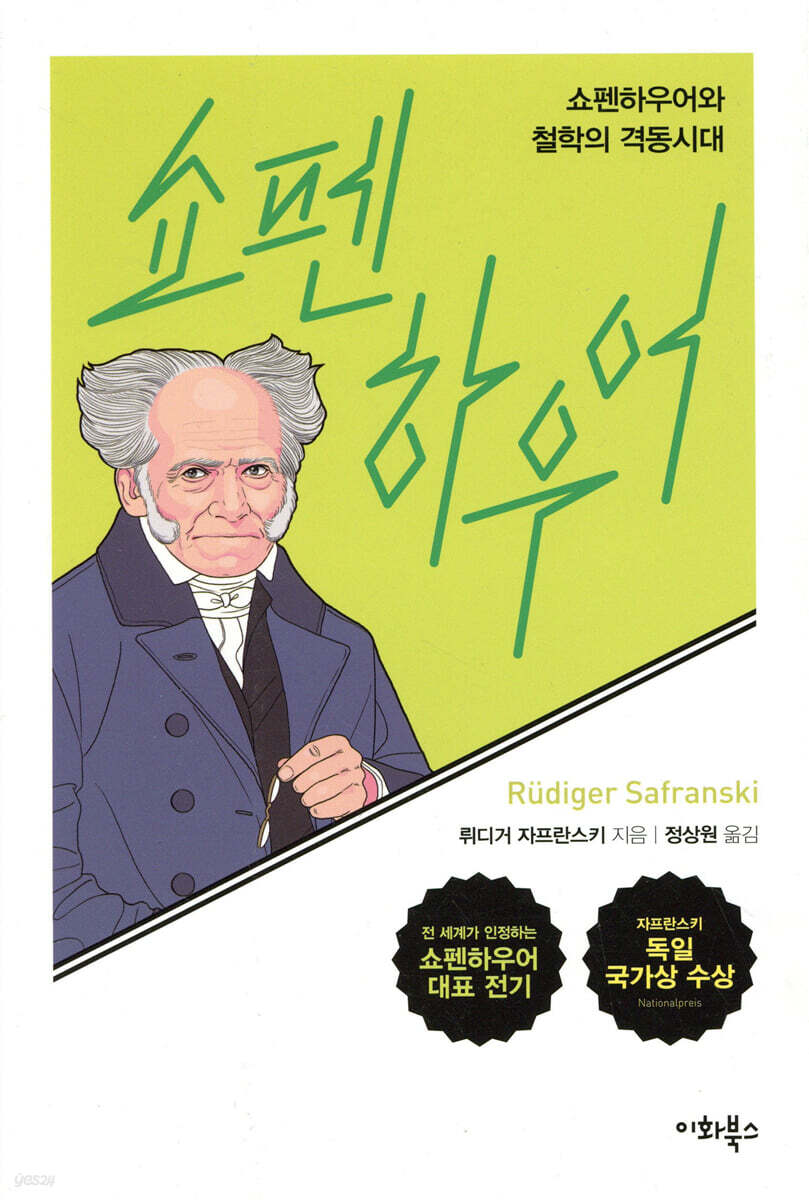
Schopenhauer
 |
Description
Book Introduction
A masterpiece by Rüdiger Safranski, Germany's greatest intellectual biography writer
The world-renowned biography of Schopenhauer!
The masterpiece 『Schopenhauer - Schopenhauer and the Turbulent Age of Philosophy』 by Rüdiger Safranski, Germany's greatest intellectual biography writer, has been published.
Author Safranski, winner of the 2018 German State Prize, has demonstrated his exceptional ability to encompass both life and thought, creating a biography of Schopenhauer that is recognized worldwide as a standard.
The period in which Schopenhauer lived was a turbulent time for German philosophy.
This book covers the great philosophers from Kant to Hegel and Marx, and explains the ideological background in which Schopenhauer's philosophy grew, what ideas it clashed with, and what ideas and art it influenced.
This book is the definitive biography of Schopenhauer and is also the best introduction to the history of German thought, meticulously exploring the turbulent times of German philosophy.
The world-renowned biography of Schopenhauer!
The masterpiece 『Schopenhauer - Schopenhauer and the Turbulent Age of Philosophy』 by Rüdiger Safranski, Germany's greatest intellectual biography writer, has been published.
Author Safranski, winner of the 2018 German State Prize, has demonstrated his exceptional ability to encompass both life and thought, creating a biography of Schopenhauer that is recognized worldwide as a standard.
The period in which Schopenhauer lived was a turbulent time for German philosophy.
This book covers the great philosophers from Kant to Hegel and Marx, and explains the ideological background in which Schopenhauer's philosophy grew, what ideas it clashed with, and what ideas and art it influenced.
This book is the definitive biography of Schopenhauer and is also the best introduction to the history of German thought, meticulously exploring the turbulent times of German philosophy.
- You can preview some of the book's contents.
Preview
index
Author's Note
Part 1
Chapter 1
Danzig.
The story before Arthur was born.
A child born without love.
Experience philosophy at its core for the first time.
Spire Island, like the heart of darkness.
Chapter 2
Hamburg.
Reading the book of life for the first time: Le Havre.
Friendship with Antime.
Arthur receives training as a merchant.
Chapter 3
A difficult choice: Will I go into the world or into books? I chose a long-term European trip and made a pact with the devil: reading the book of life for the second time.
And then fall into hell.
After the mountain climbing experience, crash into the office.
Who will go up and remain silent?
Chapter 4
The father's power remains even after death.
Arthur, melancholic, searches for the other world without his father.
Struggling with transformational issues during puberty.
From Matthias Claudius to Romanticism.
First Philosophical Scenario: Romanticism ascends to the sky at night.
Arthur fears the fall: Oh pleasure, oh hell
Chapter 5
Weimar.
Political catastrophe.
Mother rises through the social ranks.
Goethe is in trouble.
His mother frees Arthur from the Hamburg accounting office.
Arthur cries with happiness.
Chapter 6
Leaving Hamburg, I also say goodbye to Antime.
Anatomy of Friendship.
Gota: Becoming a student again.
Arthur does something that deserves to be hated.
There is an odd current between the hats.
Arthur is an outsider in Weimar.
Mother's Taoism.
Goethe, who cannot be avoided.
Arthur falls in love.
The most important matrix.
Chapter 7
Göttingen.
Study natural science.
Father's Shadow: Prefers solidity.
Between Plato and Kant, between the desire for ecstasy and skepticism.
Second Philosophical Scenario: From Descartes to Kant.
From divine reason to divine reason.
From metaphysics to ethics.
The career of the material itself.
Arthur immerses himself in the allegory of the cave.
Chapter 8
Life in Berlin.
A commotion broke out on a college campus.
The conflict between Schleiermacher and Fichte.
Third Philosophical Scenario: Fichte and Revolutionary Romanticism, The Joy of Being: There is nothing that humans cannot do.
Discover the jungle within.
Arthur is looking forward to the lightning strike that Fichte speaks of.
Chapter 9
Manuscript notes containing Arthur's secret philosophy: A Better Consciousness.
The Holy Spirit descends.
Ecstasy without Apollo or Dionysus
Chapter 10
Arthur listens to Fichte's lecture.
Berlin is embroiled in the war of liberation.
The omnipotence of the political.
Philosophy takes up arms.
Arthur runs away.
Part 2
Chapter 11
A thinker who could not stand on the stage.
Arthur settles in Rudolstadt.
Philosophy first goes into exile.
Doctoral dissertation: On the Fourfold Root of the Principle of Sufficient Reason.
About the grounds and grounds.
The limits of reason.
Arthur does not make his position clear.
Chapter 12
Return to Weimar.
Argument with mother.
Adele is caught between two fighting cocks.
Adele's Secret Romance
Chapter 13
The Great Encounter: Goethe and Schopenhauer.
Two color theorists battle the forces of darkness.
The history of a difficult relationship.
Goethe says that in the end, he could not avoid a kind of divorce.
Chapter 14
Dresden.
Arthur is among people who are different from him.
A time of genius conception.
Boardinghouse Landlady: Doctor, you are blooming.
A philosophical monologue contained in a manuscript notebook.
Arthur discovers a language for a better consciousness.
Discover that will is a thing in itself.
Chapter 15
The World as Will and Representation.
Heaven is missing from Arthur's metaphysics.
On the necessity of the detour called epistemological criticism.
It's not about explaining the world, it's about understanding the world.
Hermeneutics of existence.
The truth is near.
Everything is one.
Hostile to integration.
Way out.
art.
Confronting the world spirit of labor through a contemplative life.
Chapter 16
The World as Will and Representation.
Philosophy of the Body: When Jokes Don't Work.
Asserting oneself and deconstructing oneself.
The power of egoism.
State and rights.
possession.
From compassion to the mystery of unity.
Great negation.
music.
Denial from the perspective of an onlooker.
Second to last and the end.
Chapter 17
Feud with Brockhaus.
My first trip to Italy.
Love affair.
A fight breaks out at Cafe Greco.
Let's kick that guy out! Back to Germany.
Financial crisis and family disputes.
Arthur and Adele.
Chapter 18
Working as a lecturer in Berlin.
He stands up as a punisher of injustice, but no one listens.
Fourth Philosophical Scenario: Hegel and the Spirit of Biedermeier on the Rise.
Why doesn't Arthur succeed?
Chapter 19
Dealing with disappointment with philosophical strategies.
Supplement the hesitation in the manuscript notes.
Lover Caroline Medon.
Quarrel with Make.
Second trip to Italy.
Get sick.
Drifting around.
Back to Berlin.
A farce that occurred at the last minute.
Chapter 20
Escape from Berlin.
Schopenhauer knocks on the furniture.
Frankfurt.
Dealing with everything in a fixed way to overcome anxiety.
A style of life and a style of language.
The death of her mother and Adele's sad fate.
Chapter 21
On the Will in Nature.
To solidify existence and to forget existence.
Fifth Philosophy Scenario: Practical Philosophy.
The philosophy of making and the philosophy of realistic reality.
The Spirit of the March Revolution: From Hegel to Marx.
Mask-peeping fight.
Chapter 22
Sixth Philosophical Scenario: The Mystery of Freedom and Its History.
Two fundamental problems of ethics: the pain of individuation and the sin of individuation.
Schopenhauer at the time of the Revolution of 1848: On the fate of those who live on the interest of property.
Chapter 23
The mountain comes to the prophet.
The apostles and the authors of the Gospels and their large audience.
Schopenhauer's 'Philosophy for the World': Proverbs for Wisdom in Life.
The spirit of realism.
As if…
Praise the not-so-thorough.
Seventh Philosophical Scenario: Schopenhauer and Some Consequences.
Chapter 24
Humanity has learned a few things from me and will not forget them.
Last time.
The comedy of fame.
Death: The Nile reached Cairo.
Americas
Chronology
References
Translator's Note
Search
Part 1
Chapter 1
Danzig.
The story before Arthur was born.
A child born without love.
Experience philosophy at its core for the first time.
Spire Island, like the heart of darkness.
Chapter 2
Hamburg.
Reading the book of life for the first time: Le Havre.
Friendship with Antime.
Arthur receives training as a merchant.
Chapter 3
A difficult choice: Will I go into the world or into books? I chose a long-term European trip and made a pact with the devil: reading the book of life for the second time.
And then fall into hell.
After the mountain climbing experience, crash into the office.
Who will go up and remain silent?
Chapter 4
The father's power remains even after death.
Arthur, melancholic, searches for the other world without his father.
Struggling with transformational issues during puberty.
From Matthias Claudius to Romanticism.
First Philosophical Scenario: Romanticism ascends to the sky at night.
Arthur fears the fall: Oh pleasure, oh hell
Chapter 5
Weimar.
Political catastrophe.
Mother rises through the social ranks.
Goethe is in trouble.
His mother frees Arthur from the Hamburg accounting office.
Arthur cries with happiness.
Chapter 6
Leaving Hamburg, I also say goodbye to Antime.
Anatomy of Friendship.
Gota: Becoming a student again.
Arthur does something that deserves to be hated.
There is an odd current between the hats.
Arthur is an outsider in Weimar.
Mother's Taoism.
Goethe, who cannot be avoided.
Arthur falls in love.
The most important matrix.
Chapter 7
Göttingen.
Study natural science.
Father's Shadow: Prefers solidity.
Between Plato and Kant, between the desire for ecstasy and skepticism.
Second Philosophical Scenario: From Descartes to Kant.
From divine reason to divine reason.
From metaphysics to ethics.
The career of the material itself.
Arthur immerses himself in the allegory of the cave.
Chapter 8
Life in Berlin.
A commotion broke out on a college campus.
The conflict between Schleiermacher and Fichte.
Third Philosophical Scenario: Fichte and Revolutionary Romanticism, The Joy of Being: There is nothing that humans cannot do.
Discover the jungle within.
Arthur is looking forward to the lightning strike that Fichte speaks of.
Chapter 9
Manuscript notes containing Arthur's secret philosophy: A Better Consciousness.
The Holy Spirit descends.
Ecstasy without Apollo or Dionysus
Chapter 10
Arthur listens to Fichte's lecture.
Berlin is embroiled in the war of liberation.
The omnipotence of the political.
Philosophy takes up arms.
Arthur runs away.
Part 2
Chapter 11
A thinker who could not stand on the stage.
Arthur settles in Rudolstadt.
Philosophy first goes into exile.
Doctoral dissertation: On the Fourfold Root of the Principle of Sufficient Reason.
About the grounds and grounds.
The limits of reason.
Arthur does not make his position clear.
Chapter 12
Return to Weimar.
Argument with mother.
Adele is caught between two fighting cocks.
Adele's Secret Romance
Chapter 13
The Great Encounter: Goethe and Schopenhauer.
Two color theorists battle the forces of darkness.
The history of a difficult relationship.
Goethe says that in the end, he could not avoid a kind of divorce.
Chapter 14
Dresden.
Arthur is among people who are different from him.
A time of genius conception.
Boardinghouse Landlady: Doctor, you are blooming.
A philosophical monologue contained in a manuscript notebook.
Arthur discovers a language for a better consciousness.
Discover that will is a thing in itself.
Chapter 15
The World as Will and Representation.
Heaven is missing from Arthur's metaphysics.
On the necessity of the detour called epistemological criticism.
It's not about explaining the world, it's about understanding the world.
Hermeneutics of existence.
The truth is near.
Everything is one.
Hostile to integration.
Way out.
art.
Confronting the world spirit of labor through a contemplative life.
Chapter 16
The World as Will and Representation.
Philosophy of the Body: When Jokes Don't Work.
Asserting oneself and deconstructing oneself.
The power of egoism.
State and rights.
possession.
From compassion to the mystery of unity.
Great negation.
music.
Denial from the perspective of an onlooker.
Second to last and the end.
Chapter 17
Feud with Brockhaus.
My first trip to Italy.
Love affair.
A fight breaks out at Cafe Greco.
Let's kick that guy out! Back to Germany.
Financial crisis and family disputes.
Arthur and Adele.
Chapter 18
Working as a lecturer in Berlin.
He stands up as a punisher of injustice, but no one listens.
Fourth Philosophical Scenario: Hegel and the Spirit of Biedermeier on the Rise.
Why doesn't Arthur succeed?
Chapter 19
Dealing with disappointment with philosophical strategies.
Supplement the hesitation in the manuscript notes.
Lover Caroline Medon.
Quarrel with Make.
Second trip to Italy.
Get sick.
Drifting around.
Back to Berlin.
A farce that occurred at the last minute.
Chapter 20
Escape from Berlin.
Schopenhauer knocks on the furniture.
Frankfurt.
Dealing with everything in a fixed way to overcome anxiety.
A style of life and a style of language.
The death of her mother and Adele's sad fate.
Chapter 21
On the Will in Nature.
To solidify existence and to forget existence.
Fifth Philosophy Scenario: Practical Philosophy.
The philosophy of making and the philosophy of realistic reality.
The Spirit of the March Revolution: From Hegel to Marx.
Mask-peeping fight.
Chapter 22
Sixth Philosophical Scenario: The Mystery of Freedom and Its History.
Two fundamental problems of ethics: the pain of individuation and the sin of individuation.
Schopenhauer at the time of the Revolution of 1848: On the fate of those who live on the interest of property.
Chapter 23
The mountain comes to the prophet.
The apostles and the authors of the Gospels and their large audience.
Schopenhauer's 'Philosophy for the World': Proverbs for Wisdom in Life.
The spirit of realism.
As if…
Praise the not-so-thorough.
Seventh Philosophical Scenario: Schopenhauer and Some Consequences.
Chapter 24
Humanity has learned a few things from me and will not forget them.
Last time.
The comedy of fame.
Death: The Nile reached Cairo.
Americas
Chronology
References
Translator's Note
Search
Detailed image

Into the book
This book is a confession of love for philosophy.
There was a time when I thought about God and the world with a burning heart.
There was a time when I was astonished that something exists and that nothing exists.
This book takes us back to a time when philosophy once again – perhaps for the last time – blossomed in all its splendor and looks into a vanished world.
The so-called turbulent age of philosophy continues from Kant through Fichte and Schelling, Romantic philosophy, Hegel and Feuerbach, and the young Marx.
I have never thought so excitedly and passionately as I did at that moment.
---From the author's note
We entered a room full of servants drinking.
The beastly warmth they exuded was so hot that I couldn't bear it.
The warmth of a group of people gathered together - Arthur Schopenhauer would later compare this scene to hedgehogs, who, cold and anxious, press together, then withdraw when pricked by thorns, and finally maintain a proper distance.
---From Chapter 3
During the tense weeks of mother-son bickering, one of his most memorable arguments probably occurred.
Schopenhauer describes the argument to Wilhelm Gwinner many years later:
The mother holds up Arthur's doctoral thesis, "On the Fourfold Root of the Principle of Sufficient Reason," and says: "This must be a book for pharmacists."
Arthur: Even if my mother's books are no longer found in the barn, my books will be read.
Mother: Not a single book you write will sell.
Both mother and son ended up making the right predictions.
---From Chapter 12
Schopenhauer is distinct from Hegel and from the entire tradition of philosophy that preceded and followed him.
In the philosophical tradition, including Hegel, the conceptual takes the highest position, while in Schopenhauer, intuition takes the highest position.
The philosophical tradition, including Hegel, praises art, but ultimately regards it as nothing more than an inauthentic expression of truth.
On the other hand, Schopenhauer believes that concepts are inauthentic expressions of truth, and that art is closer to truth.
This view played a part in Schopenhauer's influence as a philosopher of artists on later generations, from Richard Wagner and Thomas Mann to Marcel Proust, Franz Kafka and Samuel Beckett, and even Wolfgang Hildesheimer.
---From Chapter 15
Schopenhauer has the audacity to underestimate the power of Hegel's spirit.
While Hegel's lectures attract well over 200 students, only five students in their first semester in Berlin are eager to learn about the essence of the world from Schopenhauer.
Schopenhauer says in his first lecture that philosophy after Kant was mired in paradoxes and was headed for ruin because it used unrefined and ambiguous language.
He declares himself to be a punisher of injustice, saying that he has come to liberate philosophy from those who are strangling it, but it is of little use.
Because the people who heard the message did not trust him.
On the other hand, Hegel, the main target of Schopenhauer's prediction of retribution, is trusted by the people.
---From Chapter 18
In true philosophy, you must be able to feel the tears and cries between the lines.
If you don't hear the sound of teeth grinding and the horrible screams of people dying and being killed, then it's not philosophy.
---From Chapter 21
For a long time, people have looked for the foundation of morality in the intellect, but this is a mistake.
When life becomes serious and desperate, no one cares about such intellectual morality.
Trying to control a powerful will and passion with such morality is like trying to put out a blazing fire with a tweezers.
Kant's practical reason is useless because it is a castle in the air built a priori.
---From Chapter 22
Those who are unwilling to devote themselves wholeheartedly to any project, whether a culture of despair or a culture of progress, are drawn to Schopenhauer.
Schopenhauer's early followers were very honest, upstanding people, and usually averagely successful in life.
So, is Schopenhauer's philosophy for the world ultimately a philosophy of the petty bourgeoisie? If refusing to resolutely and consistently implement a doctrine is to be condemned as petty bourgeois, then his philosophy falls into this category.
But I don't think so.
Nietzsche would later develop the idea that some truths are better left unrealized and unspoken, and should never be established under the precept of consistency.
Why should we insist on consistency?
There was a time when I thought about God and the world with a burning heart.
There was a time when I was astonished that something exists and that nothing exists.
This book takes us back to a time when philosophy once again – perhaps for the last time – blossomed in all its splendor and looks into a vanished world.
The so-called turbulent age of philosophy continues from Kant through Fichte and Schelling, Romantic philosophy, Hegel and Feuerbach, and the young Marx.
I have never thought so excitedly and passionately as I did at that moment.
---From the author's note
We entered a room full of servants drinking.
The beastly warmth they exuded was so hot that I couldn't bear it.
The warmth of a group of people gathered together - Arthur Schopenhauer would later compare this scene to hedgehogs, who, cold and anxious, press together, then withdraw when pricked by thorns, and finally maintain a proper distance.
---From Chapter 3
During the tense weeks of mother-son bickering, one of his most memorable arguments probably occurred.
Schopenhauer describes the argument to Wilhelm Gwinner many years later:
The mother holds up Arthur's doctoral thesis, "On the Fourfold Root of the Principle of Sufficient Reason," and says: "This must be a book for pharmacists."
Arthur: Even if my mother's books are no longer found in the barn, my books will be read.
Mother: Not a single book you write will sell.
Both mother and son ended up making the right predictions.
---From Chapter 12
Schopenhauer is distinct from Hegel and from the entire tradition of philosophy that preceded and followed him.
In the philosophical tradition, including Hegel, the conceptual takes the highest position, while in Schopenhauer, intuition takes the highest position.
The philosophical tradition, including Hegel, praises art, but ultimately regards it as nothing more than an inauthentic expression of truth.
On the other hand, Schopenhauer believes that concepts are inauthentic expressions of truth, and that art is closer to truth.
This view played a part in Schopenhauer's influence as a philosopher of artists on later generations, from Richard Wagner and Thomas Mann to Marcel Proust, Franz Kafka and Samuel Beckett, and even Wolfgang Hildesheimer.
---From Chapter 15
Schopenhauer has the audacity to underestimate the power of Hegel's spirit.
While Hegel's lectures attract well over 200 students, only five students in their first semester in Berlin are eager to learn about the essence of the world from Schopenhauer.
Schopenhauer says in his first lecture that philosophy after Kant was mired in paradoxes and was headed for ruin because it used unrefined and ambiguous language.
He declares himself to be a punisher of injustice, saying that he has come to liberate philosophy from those who are strangling it, but it is of little use.
Because the people who heard the message did not trust him.
On the other hand, Hegel, the main target of Schopenhauer's prediction of retribution, is trusted by the people.
---From Chapter 18
In true philosophy, you must be able to feel the tears and cries between the lines.
If you don't hear the sound of teeth grinding and the horrible screams of people dying and being killed, then it's not philosophy.
---From Chapter 21
For a long time, people have looked for the foundation of morality in the intellect, but this is a mistake.
When life becomes serious and desperate, no one cares about such intellectual morality.
Trying to control a powerful will and passion with such morality is like trying to put out a blazing fire with a tweezers.
Kant's practical reason is useless because it is a castle in the air built a priori.
---From Chapter 22
Those who are unwilling to devote themselves wholeheartedly to any project, whether a culture of despair or a culture of progress, are drawn to Schopenhauer.
Schopenhauer's early followers were very honest, upstanding people, and usually averagely successful in life.
So, is Schopenhauer's philosophy for the world ultimately a philosophy of the petty bourgeoisie? If refusing to resolutely and consistently implement a doctrine is to be condemned as petty bourgeois, then his philosophy falls into this category.
But I don't think so.
Nietzsche would later develop the idea that some truths are better left unrealized and unspoken, and should never be established under the precept of consistency.
Why should we insist on consistency?
---From Chapter 23
Publisher's Review
A masterpiece by Rüdiger Safranski, Germany's greatest intellectual biography writer, winner of the 2018 German National Prize!
The author, Rüdiger Safranski, is Germany's most highly regarded intellectual biographer.
He excellently incorporates his experience introducing philosophy to the public in an easy-to-understand manner on German public broadcasting and his academic skills honed in university lectures into his work.
Safranski received the 2018 German National Prize for his contribution to presenting the luminaries of German cultural history, writers and philosophers, in a way that appeals to the general public.
The definitive biography of Schopenhauer, delving into his life and thought.
The greatest strength of 『Schopenhauer - Schopenhauer and the Turbulent Age of Philosophy』 is that the author completely digests Schopenhauer's thoughts and then unfolds them for the reader.
This book, which is based on Schopenhauer's writings and includes various notes, diaries, and letters exchanged with acquaintances, provides a three-dimensional view of the ideological background in which Schopenhauer's philosophy grew, what ideas it clashed with, and what ideas and art it influenced.
Through this, the various aspects of Schopenhauer's philosophy, which predates 20th-century existentialist philosophy, Sigmund Freud's psychoanalysis, and even 21st-century brain science that views cognitive processes as the function of brain cells, are conveyed in an interesting way.
The definitive biography of Schopenhauer and the best introduction to this turbulent era of German philosophy.
This book vividly depicts the era in which Schopenhauer lived, as if in a genre painting, while tracing the major journeys of his life that played a crucial role in the formation of his philosophy.
Schopenhauer's student days and his time as a merchant's apprentice, his experiences while traveling around Europe, especially the episode with the galley slaves that made him ponder the concept of compassion that later became a pillar of Schopenhauer's philosophy, his conflict with his mother, who was the most popular writer of the time, the tragicomedy of the relationship between mother and son who lived in the same house but corresponded through their maid, his meeting with Goethe, Schopenhauer's response to the revolution of 1848, and the turbulent era of German philosophy from Kant to Schelling, Fichte, Hegel, and the young Marx are unfolded like a panorama.
At a time when the leading philosophers of the turbulent age of philosophy were advocating optimism that the force that moves the world is rationality and that history progresses, Schopenhauer developed extremely pessimistic thoughts.
Author Safranski maintains a balanced perspective by contrasting Schopenhauer, an outsider in the philosophical world, with the leading philosophers of his time.
He clearly analyzes and criticizes thinkers who stand on the side of history of progress and growth, and when necessary, does not hesitate to point out Schopenhauer's biases, errors, and injustices.
We can also get a glimpse into the context in which Schopenhauer's unique insights, which have been introduced in Korea under titles such as "On Life" and "On Happiness," originate.
This is the definitive biography of Schopenhauer, revealing the true face of a philosopher who thought about the irrational in the most rational way possible, and it is no exaggeration to call it the best introduction to the turbulent era of German philosophy.
The author, Rüdiger Safranski, is Germany's most highly regarded intellectual biographer.
He excellently incorporates his experience introducing philosophy to the public in an easy-to-understand manner on German public broadcasting and his academic skills honed in university lectures into his work.
Safranski received the 2018 German National Prize for his contribution to presenting the luminaries of German cultural history, writers and philosophers, in a way that appeals to the general public.
The definitive biography of Schopenhauer, delving into his life and thought.
The greatest strength of 『Schopenhauer - Schopenhauer and the Turbulent Age of Philosophy』 is that the author completely digests Schopenhauer's thoughts and then unfolds them for the reader.
This book, which is based on Schopenhauer's writings and includes various notes, diaries, and letters exchanged with acquaintances, provides a three-dimensional view of the ideological background in which Schopenhauer's philosophy grew, what ideas it clashed with, and what ideas and art it influenced.
Through this, the various aspects of Schopenhauer's philosophy, which predates 20th-century existentialist philosophy, Sigmund Freud's psychoanalysis, and even 21st-century brain science that views cognitive processes as the function of brain cells, are conveyed in an interesting way.
The definitive biography of Schopenhauer and the best introduction to this turbulent era of German philosophy.
This book vividly depicts the era in which Schopenhauer lived, as if in a genre painting, while tracing the major journeys of his life that played a crucial role in the formation of his philosophy.
Schopenhauer's student days and his time as a merchant's apprentice, his experiences while traveling around Europe, especially the episode with the galley slaves that made him ponder the concept of compassion that later became a pillar of Schopenhauer's philosophy, his conflict with his mother, who was the most popular writer of the time, the tragicomedy of the relationship between mother and son who lived in the same house but corresponded through their maid, his meeting with Goethe, Schopenhauer's response to the revolution of 1848, and the turbulent era of German philosophy from Kant to Schelling, Fichte, Hegel, and the young Marx are unfolded like a panorama.
At a time when the leading philosophers of the turbulent age of philosophy were advocating optimism that the force that moves the world is rationality and that history progresses, Schopenhauer developed extremely pessimistic thoughts.
Author Safranski maintains a balanced perspective by contrasting Schopenhauer, an outsider in the philosophical world, with the leading philosophers of his time.
He clearly analyzes and criticizes thinkers who stand on the side of history of progress and growth, and when necessary, does not hesitate to point out Schopenhauer's biases, errors, and injustices.
We can also get a glimpse into the context in which Schopenhauer's unique insights, which have been introduced in Korea under titles such as "On Life" and "On Happiness," originate.
This is the definitive biography of Schopenhauer, revealing the true face of a philosopher who thought about the irrational in the most rational way possible, and it is no exaggeration to call it the best introduction to the turbulent era of German philosophy.
GOODS SPECIFICS
- Date of issue: August 18, 2020
- Page count, weight, size: 742 pages | 974g | 145*215*40mm
- ISBN13: 9791190626033
- ISBN10: 1190626039
You may also like
카테고리
korean


korean

![GQ KOREA Mark (Monthly): December [2025]](http://librairie.coreenne.fr/cdn/shop/files/8ef265dbbfbf186523ed75ba7319009d.jpg?v=1765340328&width=3840)


