

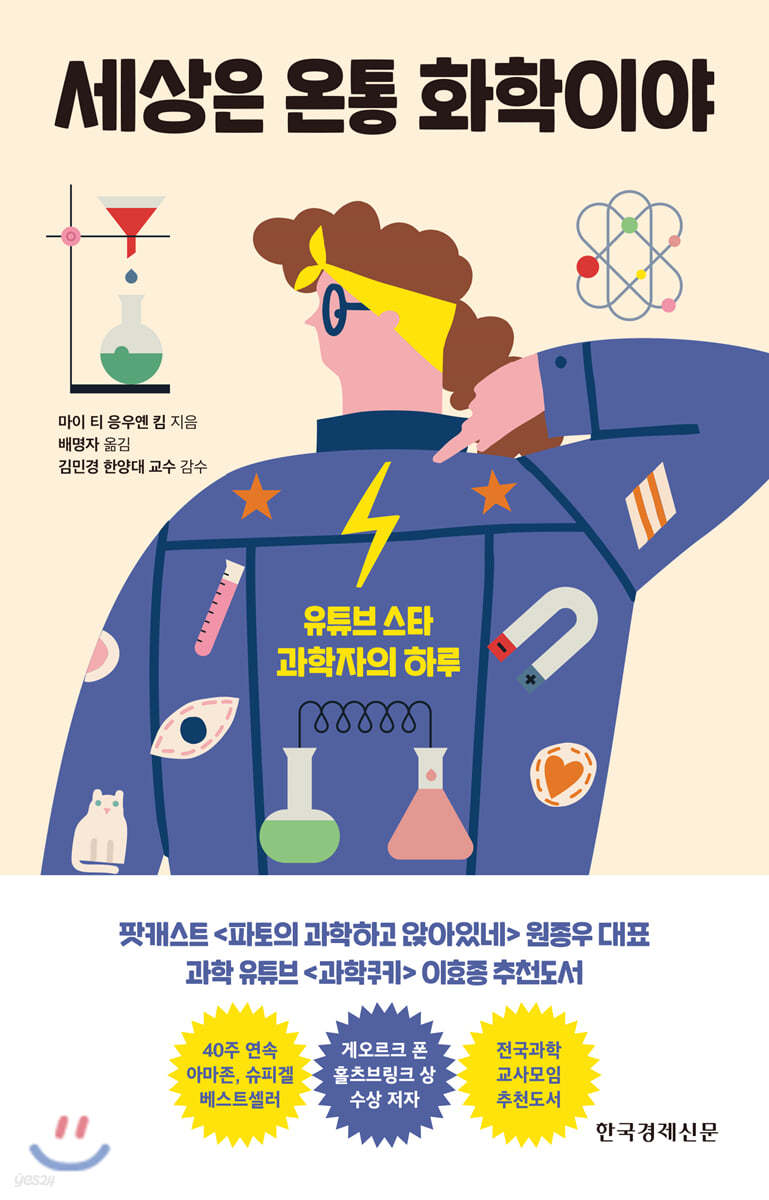
The world is full of chemistry
 |
Description
Book Introduction
Chemistry used to feel difficult and distant, but let's enjoy it as a fun hobby!
With 800,000 subscribers, the star YouTuber scientist's mission to "spread the spirit of chemistry"
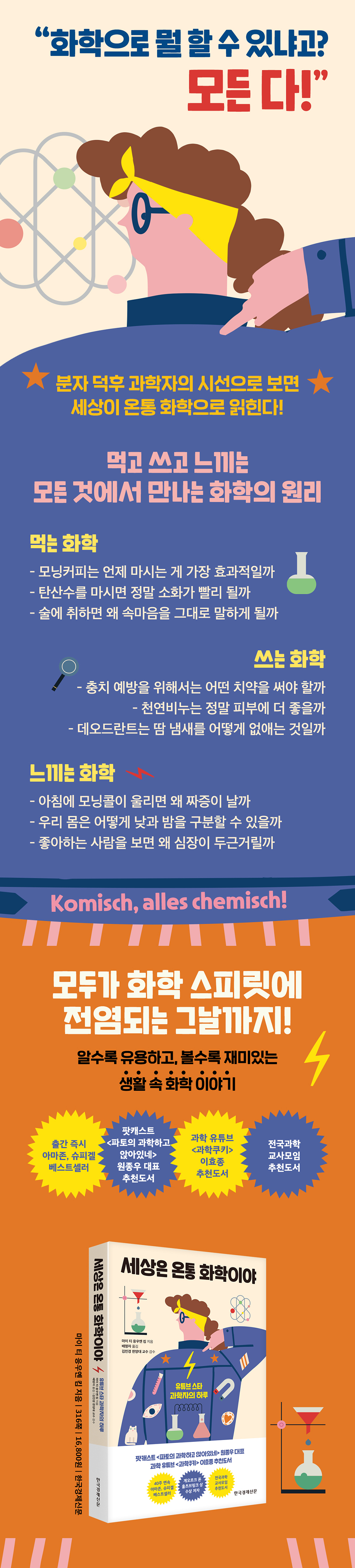
"What can you do with chemistry? Everything!"
For most people, 'chemicals' are associated with things that are harmful, toxic, and artificial.
Even in schools, chemistry is often dismissed as a difficult subject, often because students don't truly understand what it is! Author Dr. Mai Thi Nguyen Kim, inspired by a mother's desire to make her ugly child look as attractive as possible, introduces chemistry to the general reader in an accessible and engaging way.
From waking up to the sound of the morning call until falling asleep after a glass of wine, readers are invited to a novel experience of looking at and solving the daily routine through the eyes of a chemist.
- Why do I get annoyed when the wake-up call rings in the morning?
- When is the most effective time to drink morning coffee?
- What kind of toothpaste should I use to prevent cavities?
- Are natural soaps really better for you?
- Why do people say what's on their mind when they're drunk?
Breaking down everyday phenomena that we've likely wondered about at least once in our lives into chemical elements, it provides a unique and entertaining explanation of what chemical reactions secretly occur within us and around us.
If you follow the author's daily routine and read without thinking, you will soon find yourself enjoying chemistry as a hobby.
"The World is All Chemistry" is a book that compiles the chemistry topics covered on the YouTube channels "The Secret Life of Scientists" and "maiLab" by Dr. Mai Thi Nguyen Kim, a famous German YouTuber, young chemist, and journalist with over 800,000 subscribers, into the author's daily routine.
Dr. Mai Thi Nguyen Kim describes her fascination with the fun of chemistry as “chemical spirit,” and is on a mission to spread this spirit of chemistry to as many people as possible, like an epidemic.
I hope that through this book, you too will be infected with the spirit of chemistry and gain a new perspective on the world.
After reading the book, you will realize that the world is truly full of chemistry!
With 800,000 subscribers, the star YouTuber scientist's mission to "spread the spirit of chemistry"
"What can you do with chemistry? Everything!"
For most people, 'chemicals' are associated with things that are harmful, toxic, and artificial.
Even in schools, chemistry is often dismissed as a difficult subject, often because students don't truly understand what it is! Author Dr. Mai Thi Nguyen Kim, inspired by a mother's desire to make her ugly child look as attractive as possible, introduces chemistry to the general reader in an accessible and engaging way.
From waking up to the sound of the morning call until falling asleep after a glass of wine, readers are invited to a novel experience of looking at and solving the daily routine through the eyes of a chemist.
- Why do I get annoyed when the wake-up call rings in the morning?
- When is the most effective time to drink morning coffee?
- What kind of toothpaste should I use to prevent cavities?
- Are natural soaps really better for you?
- Why do people say what's on their mind when they're drunk?
Breaking down everyday phenomena that we've likely wondered about at least once in our lives into chemical elements, it provides a unique and entertaining explanation of what chemical reactions secretly occur within us and around us.
If you follow the author's daily routine and read without thinking, you will soon find yourself enjoying chemistry as a hobby.
"The World is All Chemistry" is a book that compiles the chemistry topics covered on the YouTube channels "The Secret Life of Scientists" and "maiLab" by Dr. Mai Thi Nguyen Kim, a famous German YouTuber, young chemist, and journalist with over 800,000 subscribers, into the author's daily routine.
Dr. Mai Thi Nguyen Kim describes her fascination with the fun of chemistry as “chemical spirit,” and is on a mission to spread this spirit of chemistry to as many people as possible, like an epidemic.
I hope that through this book, you too will be infected with the spirit of chemistry and gain a new perspective on the world.
After reading the book, you will realize that the world is truly full of chemistry!
- You can preview some of the book's contents.
Preview
index
Prologue: What can you do with chemistry? Anything!
Chapter 1: How a Chemist Starts His Morning
Chemical reactions that create sleep rhythms
Chapter 2 What is that toothpaste!
The three substances that make up the world
Chapter 3: Every Bathroom is a Chemistry Laboratory
Bogus marketing that advertises chemical-free products
Chapter 4 Why is sitting for long periods of time dangerous?
The Dangers of Provocative Science Articles
Chapter 5 The world is originally a mess
Rules Discovered from a Disorganized Desk
Chapter 6: How Cell Phones Work
Making the world a 'slightly better'
Chapter 7 Before You Say Chemistry Is Bad
Enjoy a healthy cup of caffeine and a preservative-free lunch
Chapter 8: The most important thing in chemistry is the interrelationship.
This is what a 'model combination' is
Chapter 9: The stench is terrible, but the odor molecules are attractive.
The molecular structure of a dizzying smell
Chapter 10: There's Something Special About Water
Read ingredient lists to avoid being fooled by supermarket sales pitches.
Chapter 11: Every Chemist Is a Good Cook
A Chemical Recipe in Sweet Desserts
Chapter 12: We Have Chemistry
Chemical reactions between people
Chapter 13 A Dinner Party Where Atoms Vibrate and Molecules Dance
I hope everyone is fascinated by chemistry.
Reviewer's Note _ The World Seen Through the Eyes of a Chemist
References
Chapter 1: How a Chemist Starts His Morning
Chemical reactions that create sleep rhythms
Chapter 2 What is that toothpaste!
The three substances that make up the world
Chapter 3: Every Bathroom is a Chemistry Laboratory
Bogus marketing that advertises chemical-free products
Chapter 4 Why is sitting for long periods of time dangerous?
The Dangers of Provocative Science Articles
Chapter 5 The world is originally a mess
Rules Discovered from a Disorganized Desk
Chapter 6: How Cell Phones Work
Making the world a 'slightly better'
Chapter 7 Before You Say Chemistry Is Bad
Enjoy a healthy cup of caffeine and a preservative-free lunch
Chapter 8: The most important thing in chemistry is the interrelationship.
This is what a 'model combination' is
Chapter 9: The stench is terrible, but the odor molecules are attractive.
The molecular structure of a dizzying smell
Chapter 10: There's Something Special About Water
Read ingredient lists to avoid being fooled by supermarket sales pitches.
Chapter 11: Every Chemist Is a Good Cook
A Chemical Recipe in Sweet Desserts
Chapter 12: We Have Chemistry
Chemical reactions between people
Chapter 13 A Dinner Party Where Atoms Vibrate and Molecules Dance
I hope everyone is fascinated by chemistry.
Reviewer's Note _ The World Seen Through the Eyes of a Chemist
References
Detailed image
Into the book
As a chemist, I sometimes think that my relationship with chemistry is like that between a mother and her ugly baby.
Just as an ugly baby looks infinitely pretty in the eyes of its mother, the baby named Chemistry, who is known to be picky, looks attractive in my eyes.
When people think of chemistry, they usually think of something nasty, toxic, or artificial.
It is also the most hated subject and the first to be dropped from the elective subjects in the school curriculum.
Introducing my baby to these people in a pretty way is a huge mission and can be considered a discipline in itself.
The best condition for my mission is that my opponent knows nothing about chemistry.
When you introduce chemistry babies to such people, they usually ask with wide eyes and a puzzled look on their face.
“What can you do with chemistry?”
At times like that, I want to grab the other person's shoulder, shake it wildly, and shout passionately.
“Everything!! Everything is chemistry!!”
--- p.7, from 'Prologue'
Tiddididit, tiddididit, tiddididit!
I was so surprised that I almost fell out of bed.
My heart was pounding like it was going to burst.
“Matthew!!”
I wanted to scream in anger, but my vocal system hadn't yet woken up.
In a strangely mixed state of half-asleep and close combat, she threw herself toward her husband, snatched his phone, and quickly turned off the vicious alarm.
Damn it, it's 6 o'clock.
6 o'clock in the morning.
My husband, Matthias, has a very terrible habit.
At least two days a week, I wake up in the dark of dawn and go jogging.
The problem is that because of that, I always have to wake up a little earlier than that.
If I don't want to start my day with stress hormones.
[?]I opened the curtains to lower Matthias' melatonin levels.
“Hmm,” the husband mumbles, still half-asleep.
I'm really dumbfounded.
The melatonin molecule is produced in the pineal gland, a small gland located in the center of the brain, and is also affectionately nicknamed the "sleep hormone."
There is a reason why it has this nickname.
Melatonin plays an important role in our circadian rhythm, or sleep-wake rhythm.
The higher our melatonin levels, the more tired we feel.
But conveniently, light blocks the production of melatonin.
The light's effect seems to be gradually reaching Matthias as well.
--- p.14, from 'How a Chemist Starts the Morning'
Toothpaste and mouthwash advertisements boast that their products will prevent plaque.
I don't want to sound like a spoiler, but as a chemist, I have to tell the truth.
We can never be completely free from tartar.
However, you can change the internal conditions of plaque to make it difficult for the bacteria that have settled there to survive.
When we eat sugar, or carbohydrates, bacteria gleefully gobble it up and reward us with sour gas (not the best metaphor, but when I explained this to my friend's five-year-old daughter, the smile vanished from her face).
It is said that after that, the child brushed his teeth very diligently.
So why not use this parable again?)
The bacteria that have eaten the sugar now go through a complex chemical process to digest it.
Bacteria, like us, convert sugar molecules into acid molecules through metabolism.
If the problem is that the metabolism takes place on the surface of our teeth, then that would be a problem.
Tooth enamel is mostly made up of a mineral called hydroxyapatite.
Did you remember that Jonas' toothpaste I mentioned earlier contained this ingredient? It's also found in teeth.
Brushing your teeth with toothpaste? Sounds like a bizarre idea, doesn't it? But not only is it bizarre, it's also not very effective in preventing cavities.
Once you understand exactly what cavities are, you will have a clearer picture.
--- p.59, from 'Every bathroom is a chemical laboratory'
I got off two stops early.
I couldn't stand the stench any longer.
I really didn't want to believe that the mind-numbing smell of sweat was coming from the handsome, attractive man standing next to me.
But when I got off the bus, I was able to clearly see where the stench was coming from.
The man smelled like trans-3-methyl-2-hexenoic acid, or TMHA for short.
It is a relative of caproic acid, a type of fatty acid.
It is called caproic acid after the Latin word capra, meaning goat, because it really does have a very strong goat smell.
Caproic acid is a so-called saturated fatty acid, meaning it has only single bonds and no double bonds in its carbon chain.
If a double bond is added to caproic acid, it becomes an unsaturated fatty acid, and if a methyl group is added to this double bond, a TMHA molecule is created.
It's a powerful molecule that produces a truly suffocating sweat smell, with a distinctive goaty odor.
Maybe you'll just let out a "ugh" and want to hear more about saturated and unsaturated fatty acids rather than the smell of sweat, but let's save that for later over dinner.
Now, let's calm down and take a moment to learn about odor molecules.
I also hate bad smells terribly, but I still find bad smell molecules attractive.
Odor comes from volatile molecules.
Volatile means easily evaporated.
If you smell something bad, it's because molecules that give off that bad smell have entered your nose.
The same goes for the smell of sweat from the man standing next to me on the bus.
Some of the sweat flew from his armpit into my nose.
--- p.196, from 'The stench is terrible, but the stench molecules are attractive'
I now head through the drinks corner to the snack corner.
Because sweet things are delicious after all.
Even I don't think I can ever give up the sweet taste.
But I eat chocolate with much more ease and less guilt than I do cola.
Sugary drinks are so insidious because they are 'empty calories'.
It's just consuming calories without any other nutrients or feeling full.
[?] The reason why smoothies are considered particularly healthy drinks is because they are made with '100 percent fresh fruit'.
But unfortunately, it is not the same as raw fruit.
This is because the peel is often peeled and ground to make it smooth to drink, and fruit juice is added to it.
So, compared to regular fruits that are rich in fiber, they have a higher sugar density.
While you can safely consume a lot of sugar from processed smoothies, you can't consume the same amount from fruit.
Because I'll be full before then.
There is one thing that is particularly interesting.
Even if you grind the whole fruit at home and drink it, it tastes less good than eating it raw.
Also, the hardness of food affects the feeling of fullness, and food that is drunk is less filling than food that is chewed.
So, without a twinge of conscience, I put three hard chocolates in my cart and went to the checkout.
Just as an ugly baby looks infinitely pretty in the eyes of its mother, the baby named Chemistry, who is known to be picky, looks attractive in my eyes.
When people think of chemistry, they usually think of something nasty, toxic, or artificial.
It is also the most hated subject and the first to be dropped from the elective subjects in the school curriculum.
Introducing my baby to these people in a pretty way is a huge mission and can be considered a discipline in itself.
The best condition for my mission is that my opponent knows nothing about chemistry.
When you introduce chemistry babies to such people, they usually ask with wide eyes and a puzzled look on their face.
“What can you do with chemistry?”
At times like that, I want to grab the other person's shoulder, shake it wildly, and shout passionately.
“Everything!! Everything is chemistry!!”
--- p.7, from 'Prologue'
Tiddididit, tiddididit, tiddididit!
I was so surprised that I almost fell out of bed.
My heart was pounding like it was going to burst.
“Matthew!!”
I wanted to scream in anger, but my vocal system hadn't yet woken up.
In a strangely mixed state of half-asleep and close combat, she threw herself toward her husband, snatched his phone, and quickly turned off the vicious alarm.
Damn it, it's 6 o'clock.
6 o'clock in the morning.
My husband, Matthias, has a very terrible habit.
At least two days a week, I wake up in the dark of dawn and go jogging.
The problem is that because of that, I always have to wake up a little earlier than that.
If I don't want to start my day with stress hormones.
[?]I opened the curtains to lower Matthias' melatonin levels.
“Hmm,” the husband mumbles, still half-asleep.
I'm really dumbfounded.
The melatonin molecule is produced in the pineal gland, a small gland located in the center of the brain, and is also affectionately nicknamed the "sleep hormone."
There is a reason why it has this nickname.
Melatonin plays an important role in our circadian rhythm, or sleep-wake rhythm.
The higher our melatonin levels, the more tired we feel.
But conveniently, light blocks the production of melatonin.
The light's effect seems to be gradually reaching Matthias as well.
--- p.14, from 'How a Chemist Starts the Morning'
Toothpaste and mouthwash advertisements boast that their products will prevent plaque.
I don't want to sound like a spoiler, but as a chemist, I have to tell the truth.
We can never be completely free from tartar.
However, you can change the internal conditions of plaque to make it difficult for the bacteria that have settled there to survive.
When we eat sugar, or carbohydrates, bacteria gleefully gobble it up and reward us with sour gas (not the best metaphor, but when I explained this to my friend's five-year-old daughter, the smile vanished from her face).
It is said that after that, the child brushed his teeth very diligently.
So why not use this parable again?)
The bacteria that have eaten the sugar now go through a complex chemical process to digest it.
Bacteria, like us, convert sugar molecules into acid molecules through metabolism.
If the problem is that the metabolism takes place on the surface of our teeth, then that would be a problem.
Tooth enamel is mostly made up of a mineral called hydroxyapatite.
Did you remember that Jonas' toothpaste I mentioned earlier contained this ingredient? It's also found in teeth.
Brushing your teeth with toothpaste? Sounds like a bizarre idea, doesn't it? But not only is it bizarre, it's also not very effective in preventing cavities.
Once you understand exactly what cavities are, you will have a clearer picture.
--- p.59, from 'Every bathroom is a chemical laboratory'
I got off two stops early.
I couldn't stand the stench any longer.
I really didn't want to believe that the mind-numbing smell of sweat was coming from the handsome, attractive man standing next to me.
But when I got off the bus, I was able to clearly see where the stench was coming from.
The man smelled like trans-3-methyl-2-hexenoic acid, or TMHA for short.
It is a relative of caproic acid, a type of fatty acid.
It is called caproic acid after the Latin word capra, meaning goat, because it really does have a very strong goat smell.
Caproic acid is a so-called saturated fatty acid, meaning it has only single bonds and no double bonds in its carbon chain.
If a double bond is added to caproic acid, it becomes an unsaturated fatty acid, and if a methyl group is added to this double bond, a TMHA molecule is created.
It's a powerful molecule that produces a truly suffocating sweat smell, with a distinctive goaty odor.
Maybe you'll just let out a "ugh" and want to hear more about saturated and unsaturated fatty acids rather than the smell of sweat, but let's save that for later over dinner.
Now, let's calm down and take a moment to learn about odor molecules.
I also hate bad smells terribly, but I still find bad smell molecules attractive.
Odor comes from volatile molecules.
Volatile means easily evaporated.
If you smell something bad, it's because molecules that give off that bad smell have entered your nose.
The same goes for the smell of sweat from the man standing next to me on the bus.
Some of the sweat flew from his armpit into my nose.
--- p.196, from 'The stench is terrible, but the stench molecules are attractive'
I now head through the drinks corner to the snack corner.
Because sweet things are delicious after all.
Even I don't think I can ever give up the sweet taste.
But I eat chocolate with much more ease and less guilt than I do cola.
Sugary drinks are so insidious because they are 'empty calories'.
It's just consuming calories without any other nutrients or feeling full.
[?] The reason why smoothies are considered particularly healthy drinks is because they are made with '100 percent fresh fruit'.
But unfortunately, it is not the same as raw fruit.
This is because the peel is often peeled and ground to make it smooth to drink, and fruit juice is added to it.
So, compared to regular fruits that are rich in fiber, they have a higher sugar density.
While you can safely consume a lot of sugar from processed smoothies, you can't consume the same amount from fruit.
Because I'll be full before then.
There is one thing that is particularly interesting.
Even if you grind the whole fruit at home and drink it, it tastes less good than eating it raw.
Also, the hardness of food affects the feeling of fullness, and food that is drunk is less filling than food that is chewed.
So, without a twinge of conscience, I put three hard chocolates in my cart and went to the checkout.
--- p.228, from 'There is something special about water'
Publisher's Review
An introductory book on chemistry that even science-savvy students and science-savvy children can enjoy!
Our behavior, the environment around us, the sensations we feel—it's all related to chemistry.
We invite you to the secret daily life of a chemist.
What would the world look like through the eyes of a chemist? Stepping into a chemist's head and observing everyday life reveals countless unexpected aspects of everyday life, a world filled with fascinating chemical phenomena.
The author guides readers into the world of chemistry by chemically unraveling everyday episodes that anyone would have experienced, from their homes, workplaces, and supermarkets, to their relationships with people like lovers, friends, and bosses, and the reactions occurring within their bodies.
Dr. Mai Thi Nguyen Kim, a molecular chemist, sees everything in the world at a molecular level.
Her day begins with the chemistry of waking up, where stress hormones and sleep hormones battle for control.
The book explains the wonderful chemical molecule called 'melatonin' by linking the chemical reactions in the body at the moment of waking up to the husband's sleeping pattern, and uses the movement of cortisol molecules and particles to explain in a fun way when to drink morning coffee for the most effect and why warm coffee gets cold.
Through a conversation with a friend who is seriously considering breaking up with her boyfriend who uses fluoride-free toothpaste, the role of fluoride in toothpaste is linked to the covalent bonding of non-metallic atoms, and through an episode where the battery dies during a phone call with a friend, the author deals with oxidation-reduction reactions in cell phones and rare earth metals in smartphones.
She points out scientific errors regarding 'absolute zero' in the movie [Star Wars] and finds similarities to chemical bonds in her relationships with her husband and friends.
By the end of the day, which ends with an ethanol-fueled dinner party, you'll realize that nothing you normally pass by is unrelated to chemistry, and you'll find yourself captivated by it.
How to see the world more chemically
'How well do we know chemistry?'
Chemistry is useful when you know it, and the more you look at it, the more fun it is!
Fragmentary scientific knowledge, resulting misunderstandings, and fears have led to the widespread spread of 'chemophobia' (fear of chemicals) among people.
The negative perception of chemistry due to incidents caused by excessive amounts of chemicals has distanced us from chemistry.
In fact, our daily lives are filled with chemistry, an inseparable bond! Through this book, the author aims to address three common misconceptions about chemistry: the vague discomfort associated with the word "chemistry," the fear that scientific background knowledge is difficult, and the skepticism surrounding science encountered through the media.
Many companies are fanning the flames of prejudice against chemicals by using phrases like “chemical-free,” “preservative-free,” and “color-free” in their marketing.
If you look at this through a chemist's eyes, some of it is pure nonsense! There is no such thing as a 100% natural product.
Chemistry is already deeply rooted in every aspect of our lives.
Everything we use every day, from toothpaste, soap, hairspray, frying pans, and cell phones to the water, chocolate, bread, coffee, and alcohol we eat and drink, are closely related to chemistry.
But there is no need to blindly fear or avoid it.
If you learn the correct chemical knowledge and use chemical products properly, chemicals can be a great way to make your daily life more convenient.
To avoid being fooled by misinformation about chemical misconceptions, you need to avoid blindly believing the media and corporate marketing of chemical products that emphasize only fragmentary and sensational aspects, and instead, you need knowledge that will help you read ingredient labels and choose safe products.
"The World is All Chemistry" helps anyone overcome their fear of chemistry by explaining useful basic chemistry knowledge in an easy-to-understand way and by enabling them to consume wisely and think chemically correctly.
Our behavior, the environment around us, the sensations we feel—it's all related to chemistry.
We invite you to the secret daily life of a chemist.
What would the world look like through the eyes of a chemist? Stepping into a chemist's head and observing everyday life reveals countless unexpected aspects of everyday life, a world filled with fascinating chemical phenomena.
The author guides readers into the world of chemistry by chemically unraveling everyday episodes that anyone would have experienced, from their homes, workplaces, and supermarkets, to their relationships with people like lovers, friends, and bosses, and the reactions occurring within their bodies.
Dr. Mai Thi Nguyen Kim, a molecular chemist, sees everything in the world at a molecular level.
Her day begins with the chemistry of waking up, where stress hormones and sleep hormones battle for control.
The book explains the wonderful chemical molecule called 'melatonin' by linking the chemical reactions in the body at the moment of waking up to the husband's sleeping pattern, and uses the movement of cortisol molecules and particles to explain in a fun way when to drink morning coffee for the most effect and why warm coffee gets cold.
Through a conversation with a friend who is seriously considering breaking up with her boyfriend who uses fluoride-free toothpaste, the role of fluoride in toothpaste is linked to the covalent bonding of non-metallic atoms, and through an episode where the battery dies during a phone call with a friend, the author deals with oxidation-reduction reactions in cell phones and rare earth metals in smartphones.
She points out scientific errors regarding 'absolute zero' in the movie [Star Wars] and finds similarities to chemical bonds in her relationships with her husband and friends.
By the end of the day, which ends with an ethanol-fueled dinner party, you'll realize that nothing you normally pass by is unrelated to chemistry, and you'll find yourself captivated by it.
How to see the world more chemically
'How well do we know chemistry?'
Chemistry is useful when you know it, and the more you look at it, the more fun it is!
Fragmentary scientific knowledge, resulting misunderstandings, and fears have led to the widespread spread of 'chemophobia' (fear of chemicals) among people.
The negative perception of chemistry due to incidents caused by excessive amounts of chemicals has distanced us from chemistry.
In fact, our daily lives are filled with chemistry, an inseparable bond! Through this book, the author aims to address three common misconceptions about chemistry: the vague discomfort associated with the word "chemistry," the fear that scientific background knowledge is difficult, and the skepticism surrounding science encountered through the media.
Many companies are fanning the flames of prejudice against chemicals by using phrases like “chemical-free,” “preservative-free,” and “color-free” in their marketing.
If you look at this through a chemist's eyes, some of it is pure nonsense! There is no such thing as a 100% natural product.
Chemistry is already deeply rooted in every aspect of our lives.
Everything we use every day, from toothpaste, soap, hairspray, frying pans, and cell phones to the water, chocolate, bread, coffee, and alcohol we eat and drink, are closely related to chemistry.
But there is no need to blindly fear or avoid it.
If you learn the correct chemical knowledge and use chemical products properly, chemicals can be a great way to make your daily life more convenient.
To avoid being fooled by misinformation about chemical misconceptions, you need to avoid blindly believing the media and corporate marketing of chemical products that emphasize only fragmentary and sensational aspects, and instead, you need knowledge that will help you read ingredient labels and choose safe products.
"The World is All Chemistry" helps anyone overcome their fear of chemistry by explaining useful basic chemistry knowledge in an easy-to-understand way and by enabling them to consume wisely and think chemically correctly.
GOODS SPECIFICS
- Date of issue: September 24, 2019
- Page count, weight, size: 316 pages | 458g | 135*210*30mm
- ISBN13: 9788947545150
- ISBN10: 8947545155
You may also like
카테고리
korean


korean

![GQ KOREA Mark (Monthly): December [2025]](http://librairie.coreenne.fr/cdn/shop/files/8ef265dbbfbf186523ed75ba7319009d.jpg?v=1765340328&width=3840)


