

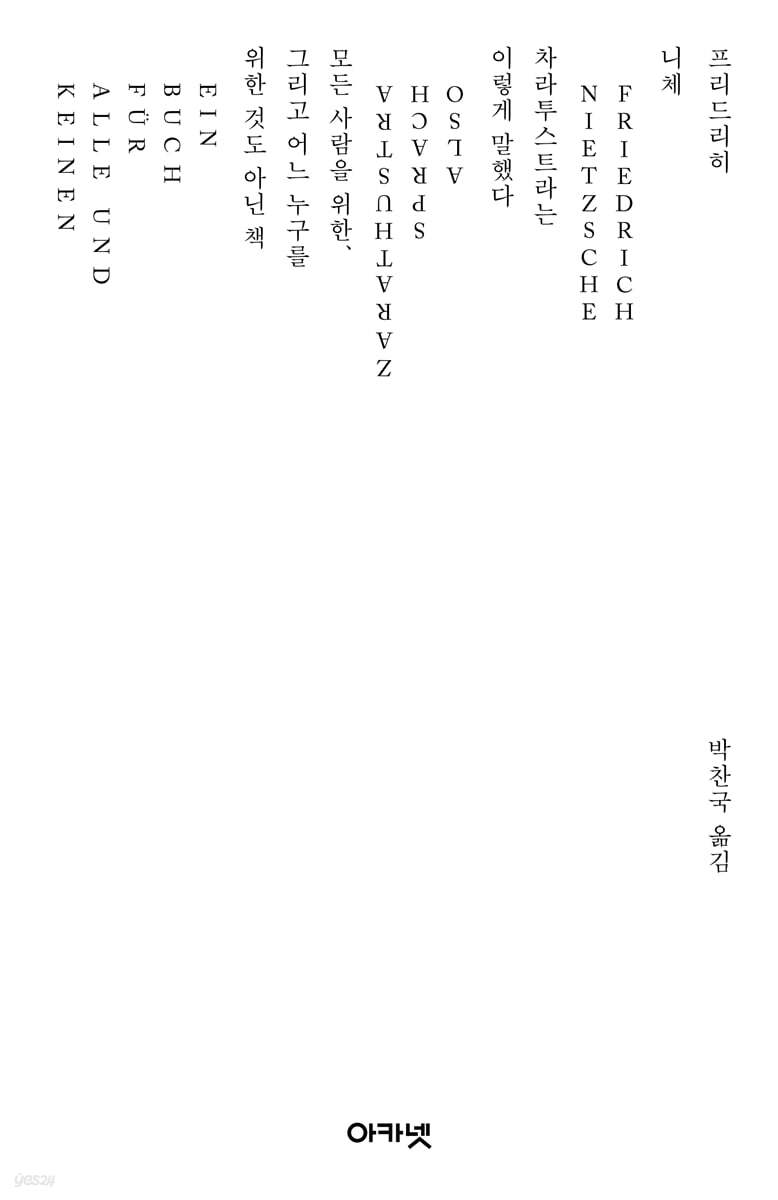
Thus spoke Zarathustra
 |
Description
Book Introduction
What kind of being will you be reborn as?
The voice of Zarathustra that shakes the soul,
Awaken the 'superhuman' within you with Professor Park Chan-guk's faithful translation!
To celebrate its 25th anniversary, Akanet is presenting Nietzsche's masterpiece, Thus Spoke Zarathustra, which readers have been waiting for for a long time, in a special edition.
Professor Chan-Guk Park (Department of Philosophy, Seoul National University), an authority on Nietzsche's philosophy, has translated the original work to ensure its intent is clearly preserved, and has added over 2,200 rich footnotes and commentary that encompass the entirety of Nietzsche's thought, guiding readers to a clear understanding of this difficult classic.
Additionally, Workroom Press's beautiful and bold design provides a new and powerful reading experience different from existing philosophy books.
The voice of Zarathustra that shakes the soul,
Awaken the 'superhuman' within you with Professor Park Chan-guk's faithful translation!
To celebrate its 25th anniversary, Akanet is presenting Nietzsche's masterpiece, Thus Spoke Zarathustra, which readers have been waiting for for a long time, in a special edition.
Professor Chan-Guk Park (Department of Philosophy, Seoul National University), an authority on Nietzsche's philosophy, has translated the original work to ensure its intent is clearly preserved, and has added over 2,200 rich footnotes and commentary that encompass the entirety of Nietzsche's thought, guiding readers to a clear understanding of this difficult classic.
Additionally, Workroom Press's beautiful and bold design provides a new and powerful reading experience different from existing philosophy books.
- You can preview some of the book's contents.
Preview
index
Translator's Preface
Part 1
Prologue to Zarathustra
The Teachings of Zarathustra
1.
About the three changes
2.
About the lecture on virtue
3.
About the backstage world theorists
4.
About those who despise the body
5.
About Joy and Passion
6.
About the Pale Criminal
7.
About reading and writing
8.
About the trees on the mountainside
9.
About the Preachers of Death
10.
About war and warriors
11.
About the new idol
12.
About the swarm of flies in the market
13.
About purity
14.
About friends
15.
About a thousand goals and one goal
16.
About loving your neighbor
17.
On the Path of the Creator
18.
About old women and young women
19.
About snake bite wounds
20.
About children and marriage
21.
On Free Death
22.
About the virtue of giving
Part 2
1.
child holding a mirror
2.
On the Island of Bliss
3.
About those who sympathize
4.
About the clergy
5.
About the virtuous
6.
About the common people
7.
About Tarantulas
8.
About famous wise men
9.
Song of the Night
10.
A song for dancing
11.
dirge
12.
About self-transcendence
13.
About the noble ones
14.
About the country of culture
15.
About pure perception
16.
About scholars
17.
About the poets
18.
About major events
19.
prophet
20.
About salvation
21.
About the art of living
22.
The most quiet time
Part 3
1.
vagabond
2.
About Welcome and Mystery
3.
About unwanted bliss
4.
Before the sun rises
5.
On the virtue of making things small
6.
On the Mount of Olives
7.
About just passing by
8.
About the traitors
9.
Homecoming
10.
About the three evils
11.
On the Spirit of Gravity
12.
About old and new tablets
13.
Those who are recovering
14.
About the Great Longing
15.
Another song dedicated to dancing
16.
The Seven Seals (Song of Affirmation and Amen)
Part 4 (Final Part)
1.
Honey offering
2.
A cry for rescue
3.
Conversations with Kings
4.
leech
5.
magician
6.
retirement
7.
The ugliest human being
8.
A person who volunteered to become a beggar
9.
shadow
10.
At noon
11.
Welcome greetings
12.
The Last Supper
13.
About the Higher Man
14.
Song of Sorrow
15.
About academics
16.
Among the daughters of the desert
17.
awakening
18.
Donkey Festival
19.
Song of the Night Walker
20.
symptoms
Translator's Note
Part 1
Prologue to Zarathustra
The Teachings of Zarathustra
1.
About the three changes
2.
About the lecture on virtue
3.
About the backstage world theorists
4.
About those who despise the body
5.
About Joy and Passion
6.
About the Pale Criminal
7.
About reading and writing
8.
About the trees on the mountainside
9.
About the Preachers of Death
10.
About war and warriors
11.
About the new idol
12.
About the swarm of flies in the market
13.
About purity
14.
About friends
15.
About a thousand goals and one goal
16.
About loving your neighbor
17.
On the Path of the Creator
18.
About old women and young women
19.
About snake bite wounds
20.
About children and marriage
21.
On Free Death
22.
About the virtue of giving
Part 2
1.
child holding a mirror
2.
On the Island of Bliss
3.
About those who sympathize
4.
About the clergy
5.
About the virtuous
6.
About the common people
7.
About Tarantulas
8.
About famous wise men
9.
Song of the Night
10.
A song for dancing
11.
dirge
12.
About self-transcendence
13.
About the noble ones
14.
About the country of culture
15.
About pure perception
16.
About scholars
17.
About the poets
18.
About major events
19.
prophet
20.
About salvation
21.
About the art of living
22.
The most quiet time
Part 3
1.
vagabond
2.
About Welcome and Mystery
3.
About unwanted bliss
4.
Before the sun rises
5.
On the virtue of making things small
6.
On the Mount of Olives
7.
About just passing by
8.
About the traitors
9.
Homecoming
10.
About the three evils
11.
On the Spirit of Gravity
12.
About old and new tablets
13.
Those who are recovering
14.
About the Great Longing
15.
Another song dedicated to dancing
16.
The Seven Seals (Song of Affirmation and Amen)
Part 4 (Final Part)
1.
Honey offering
2.
A cry for rescue
3.
Conversations with Kings
4.
leech
5.
magician
6.
retirement
7.
The ugliest human being
8.
A person who volunteered to become a beggar
9.
shadow
10.
At noon
11.
Welcome greetings
12.
The Last Supper
13.
About the Higher Man
14.
Song of Sorrow
15.
About academics
16.
Among the daughters of the desert
17.
awakening
18.
Donkey Festival
19.
Song of the Night Walker
20.
symptoms
Translator's Note
Detailed image
.jpg)
Into the book
I teach you the superman.
Human beings are something that must be transcended.
What have you done to transcend humanity?
--- p.21
I tell you, in order to give birth to a dancing star, one must keep chaos within oneself.
--- p.33
There are some terrible people who carry a beast inside them and do nothing but enjoy pleasure or bite themselves.
Their pleasure is also to bite themselves.
--- p.107
Zarathustra saw many countries and many peoples.
Zarathustra saw nothing on earth more powerful than the works of his beloved.
The name of the work is 'Good' and 'Evil'.
Truly, the power of these praises and criticisms is monstrous.
Tell me, brother, who will subdue this monster for me?
--- p.149
“All gods are dead.
Now we wish for the superman to live.” May this be our last will at the great noon one day!
--- p.203
Oh, how disgusting it is when the word "virtue" comes out of their mouths! When they say, "I am righteous," it always sounds like, "I have taken revenge!"
They use their virtues as a means to gouge out the eyes of their enemies.
They exalt themselves only to humble others.
--- p.243
Life itself told me this secret.
“Look!” said Saeng.
“I am someone who must always overcome myself.”
--- p.299
What can I say where no one has ears to understand? So I will shout to all the winds:
You, you little people! You are growing smaller and smaller! You are crumbling! You who live in comfort! You will be destroyed.
--- p.441
These good people yield and comply.
Their minds simply follow along, and their foundation is obedient.
But the one who obeys does not listen to himself!
--- p.519
Pessimists! You have never once turned your back on this earth! I have discovered that you still covet it, even though you still deeply love your own hatred for it!
--- p.537
Zarathustra asked cautiously after a long silence.
"You served God to the very end, so you know how He died. The world says compassion strangled Him. Is that true? Is it true that God couldn't bear to see humans hanging on the cross? Is it true that love for humanity became God's hell and ultimately led to His death?"
--- p.671
He who sees the abyss with the eyes of an eagle, who grasps the abyss with the talons of an eagle, such a man is courageous.
--- p.747
It's my morning.
My day is beginning.
Now rise! Rise! Thou, great noon!
--- p.853
Nietzsche gave the subtitle 'Thus Spoke Zarathustra' as 'A book for everyone and for no one.'
A book for everyone but no one means that 'everyone wants to read your book and realize the ideal of the superman, but there may not be a single person who understands and is able to realize this lofty ideal.'
In short, Nietzsche is saying in this book that anyone can become a superman, but at the same time, no one can become one.
Human beings are something that must be transcended.
What have you done to transcend humanity?
--- p.21
I tell you, in order to give birth to a dancing star, one must keep chaos within oneself.
--- p.33
There are some terrible people who carry a beast inside them and do nothing but enjoy pleasure or bite themselves.
Their pleasure is also to bite themselves.
--- p.107
Zarathustra saw many countries and many peoples.
Zarathustra saw nothing on earth more powerful than the works of his beloved.
The name of the work is 'Good' and 'Evil'.
Truly, the power of these praises and criticisms is monstrous.
Tell me, brother, who will subdue this monster for me?
--- p.149
“All gods are dead.
Now we wish for the superman to live.” May this be our last will at the great noon one day!
--- p.203
Oh, how disgusting it is when the word "virtue" comes out of their mouths! When they say, "I am righteous," it always sounds like, "I have taken revenge!"
They use their virtues as a means to gouge out the eyes of their enemies.
They exalt themselves only to humble others.
--- p.243
Life itself told me this secret.
“Look!” said Saeng.
“I am someone who must always overcome myself.”
--- p.299
What can I say where no one has ears to understand? So I will shout to all the winds:
You, you little people! You are growing smaller and smaller! You are crumbling! You who live in comfort! You will be destroyed.
--- p.441
These good people yield and comply.
Their minds simply follow along, and their foundation is obedient.
But the one who obeys does not listen to himself!
--- p.519
Pessimists! You have never once turned your back on this earth! I have discovered that you still covet it, even though you still deeply love your own hatred for it!
--- p.537
Zarathustra asked cautiously after a long silence.
"You served God to the very end, so you know how He died. The world says compassion strangled Him. Is that true? Is it true that God couldn't bear to see humans hanging on the cross? Is it true that love for humanity became God's hell and ultimately led to His death?"
--- p.671
He who sees the abyss with the eyes of an eagle, who grasps the abyss with the talons of an eagle, such a man is courageous.
--- p.747
It's my morning.
My day is beginning.
Now rise! Rise! Thou, great noon!
--- p.853
Nietzsche gave the subtitle 'Thus Spoke Zarathustra' as 'A book for everyone and for no one.'
A book for everyone but no one means that 'everyone wants to read your book and realize the ideal of the superman, but there may not be a single person who understands and is able to realize this lofty ideal.'
In short, Nietzsche is saying in this book that anyone can become a superman, but at the same time, no one can become one.
--- p.856~857
Publisher's Review
To modern people who have lost the meaning of life and are suffering
The true path to self-overcoming presented
Everyone has probably had the experience of society's customs and morals trampling on their wishes at least once, or of feeling guilty for not being able to live up to society's demands.
When you realize that the values you followed are not absolute, you can no longer trust any values, and everything feels meaningless.
It is extremely painful to go on living in anxiety and meaninglessness.
Over 140 years ago, Nietzsche already saw through the suffering we experience today.
Nietzsche wrote this book in the hope that those who have lost the meaning of life and are suffering will be able to break free from old morals and fictions and develop the strength to stand on their own two feet.
"Thus Spoke Zarathustra" depicts the journey of Zarathustra, who, having attained enlightenment, descends from the mountain and passes through cities and islands to spread his thoughts to the world, meeting and conversing with countless people.
Zarathustra tells those who are bound by existing morality to break away from the old values that have made them sick and move toward a new human image called the 'superman.'
Their morality only provides momentary satisfaction and cannot fundamentally solve the problem.
The true overcoming is for them to regain their own 'great health' and be reborn as superhumans, and this is the way to breathe life into the entire society.
Through the voice of the ancient figure Zarathustra, this book speaks to us today.
His voice, calling on modern people who are tired of meaningless tasks every day to become superhumans who live every moment meaningfully and beautifully, resonates deeply.
Not a book to be kept, but a book to be read
Zarathustra's Journey with a Friendly Guide
“The words have a soft and slow tempo.
Those words are heard only by a very select few.
It is an incomparable privilege to be one who hears those words.
“Not everyone has ears to hear the words of Zarathustra.” ― Behold the Man
『Thus Spoke Zarathustra』 is such a difficult book that even Nietzsche himself said that understanding it was a "privilege."
This is because Nietzsche's core ideas, including 'superman', 'will to power', 'eternal recurrence', and 'amor fati', are incorporated into literature filled with symbols, metaphors, satire, and parody instead of detailed explanations.
So this book is both a philosophical work and a literary work, and the reader must read it as if deciphering a code.
Professor Park Chan-guk, who has been in charge of the “Nietzsche Anthology,” has translated and commented on works from “The Birth of Tragedy” in 2007 to “Thus Spoke Zarathustra,” as well as the follow-up works “The Gay Science,” “The Science of History,” and “Human, All Too Human” so that anyone can easily understand them.
As this book is particularly challenging, the translator has provided detailed and friendly explanations to ensure that readers can read the book to the end without giving up.
In addition, the footnote format was boldly broken and the main text and annotations were placed side by side, allowing readers to appreciate the prose poem over a long period of time while also being able to refer to the annotations immediately when needed.
I hope this book will serve as a friendly guide that will awaken the superhuman within readers.
A masterpiece that contains the essence of Nietzsche's philosophy
Published as a book commemorating the 25th anniversary of Akanet
For the past quarter of a century, Akanet has consistently presented the Complete Works of Kant in Korean, the Selected Works of Nietzsche, the Complete Works of Plato and Cicero from the Jeongam Classics Series, and the Selected Works of Classical Greek Literature.
These series are consistently translated by a single authoritative researcher or a single research group, conveying to the reader the flow of thought that the author displayed throughout his or her life.
The books published to commemorate the 25th anniversary of the founding include representative works from the Nietzsche Collection, Classical Greek Literature Collection, and the Complete Works of Plato.
The best works from each series will be beautifully designed by the country's top designers and published as the 'Akanet 25th Anniversary Commemorative Book'.
Thus Spoke Zarathustra | Translated by Park Chan-guk (Professor of Philosophy, Seoul National University)
The Complete Works of Sophocles | Translated by Lee Jun-seok (Professor, Department of Cultural Studies, Korea National Open University)
The Nation | Translated by Kang Seong-hun, Kim Ju-il, Kim Hye-gyeong, and Jeong Jun-yeong (Jeongamhakdang Research Fellow)
The true path to self-overcoming presented
Everyone has probably had the experience of society's customs and morals trampling on their wishes at least once, or of feeling guilty for not being able to live up to society's demands.
When you realize that the values you followed are not absolute, you can no longer trust any values, and everything feels meaningless.
It is extremely painful to go on living in anxiety and meaninglessness.
Over 140 years ago, Nietzsche already saw through the suffering we experience today.
Nietzsche wrote this book in the hope that those who have lost the meaning of life and are suffering will be able to break free from old morals and fictions and develop the strength to stand on their own two feet.
"Thus Spoke Zarathustra" depicts the journey of Zarathustra, who, having attained enlightenment, descends from the mountain and passes through cities and islands to spread his thoughts to the world, meeting and conversing with countless people.
Zarathustra tells those who are bound by existing morality to break away from the old values that have made them sick and move toward a new human image called the 'superman.'
Their morality only provides momentary satisfaction and cannot fundamentally solve the problem.
The true overcoming is for them to regain their own 'great health' and be reborn as superhumans, and this is the way to breathe life into the entire society.
Through the voice of the ancient figure Zarathustra, this book speaks to us today.
His voice, calling on modern people who are tired of meaningless tasks every day to become superhumans who live every moment meaningfully and beautifully, resonates deeply.
Not a book to be kept, but a book to be read
Zarathustra's Journey with a Friendly Guide
“The words have a soft and slow tempo.
Those words are heard only by a very select few.
It is an incomparable privilege to be one who hears those words.
“Not everyone has ears to hear the words of Zarathustra.” ― Behold the Man
『Thus Spoke Zarathustra』 is such a difficult book that even Nietzsche himself said that understanding it was a "privilege."
This is because Nietzsche's core ideas, including 'superman', 'will to power', 'eternal recurrence', and 'amor fati', are incorporated into literature filled with symbols, metaphors, satire, and parody instead of detailed explanations.
So this book is both a philosophical work and a literary work, and the reader must read it as if deciphering a code.
Professor Park Chan-guk, who has been in charge of the “Nietzsche Anthology,” has translated and commented on works from “The Birth of Tragedy” in 2007 to “Thus Spoke Zarathustra,” as well as the follow-up works “The Gay Science,” “The Science of History,” and “Human, All Too Human” so that anyone can easily understand them.
As this book is particularly challenging, the translator has provided detailed and friendly explanations to ensure that readers can read the book to the end without giving up.
In addition, the footnote format was boldly broken and the main text and annotations were placed side by side, allowing readers to appreciate the prose poem over a long period of time while also being able to refer to the annotations immediately when needed.
I hope this book will serve as a friendly guide that will awaken the superhuman within readers.
A masterpiece that contains the essence of Nietzsche's philosophy
Published as a book commemorating the 25th anniversary of Akanet
For the past quarter of a century, Akanet has consistently presented the Complete Works of Kant in Korean, the Selected Works of Nietzsche, the Complete Works of Plato and Cicero from the Jeongam Classics Series, and the Selected Works of Classical Greek Literature.
These series are consistently translated by a single authoritative researcher or a single research group, conveying to the reader the flow of thought that the author displayed throughout his or her life.
The books published to commemorate the 25th anniversary of the founding include representative works from the Nietzsche Collection, Classical Greek Literature Collection, and the Complete Works of Plato.
The best works from each series will be beautifully designed by the country's top designers and published as the 'Akanet 25th Anniversary Commemorative Book'.
Thus Spoke Zarathustra | Translated by Park Chan-guk (Professor of Philosophy, Seoul National University)
The Complete Works of Sophocles | Translated by Lee Jun-seok (Professor, Department of Cultural Studies, Korea National Open University)
The Nation | Translated by Kang Seong-hun, Kim Ju-il, Kim Hye-gyeong, and Jeong Jun-yeong (Jeongamhakdang Research Fellow)
GOODS SPECIFICS
- Date of issue: July 25, 2025
- Format: Hardcover book binding method guide
- Page count, weight, size: 888 pages | 1,218g | 152*224*48mm
- ISBN13: 9788957339886
- ISBN10: 8957339884
You may also like
카테고리
korean


korean

![ELLE 엘르 스페셜 에디션 A형 : 12월 [2025]](http://librairie.coreenne.fr/cdn/shop/files/b8e27a3de6c9538896439686c6b0e8fb.jpg?v=1766436872&width=3840)


