

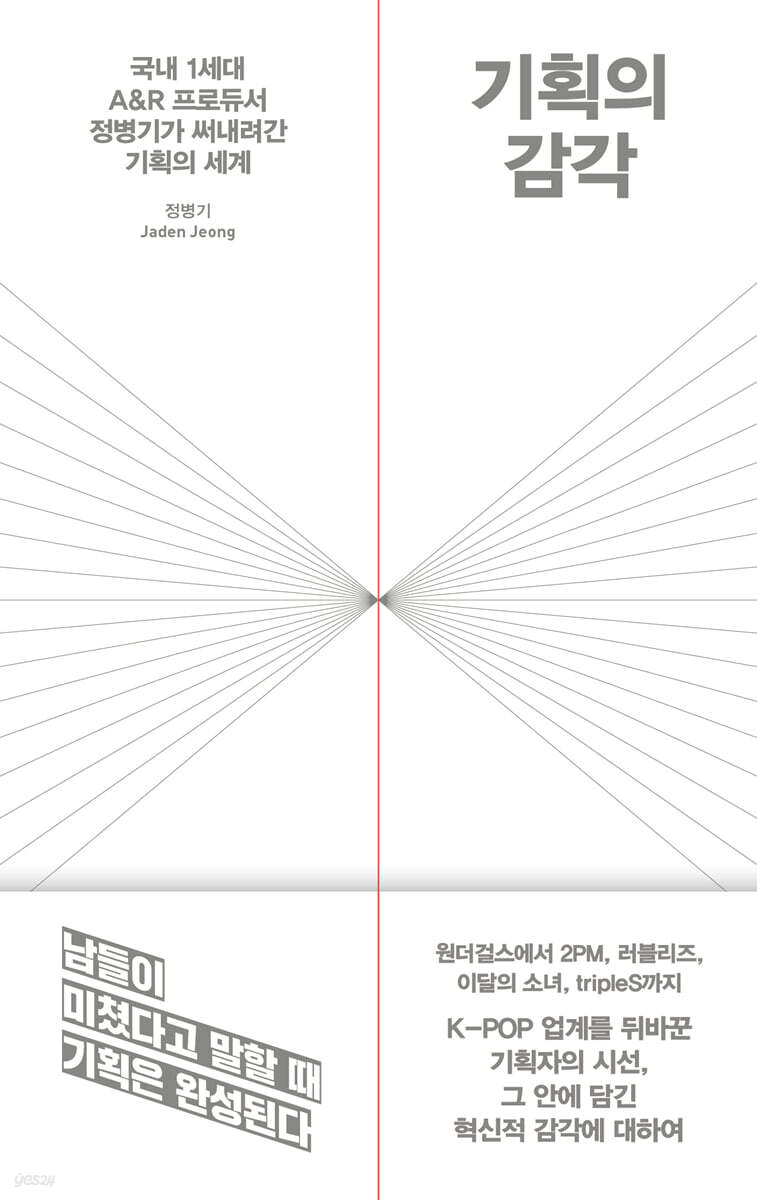
sense of planning
 |
Description
Book Introduction
“The plan is complete when others say it’s crazy!”
From Wonder Girls to 2PM, Lovelyz, LOONA, and triple S
The perspective of the planner who changed the K-pop industry, and the innovative sensibility contained within it.
"The Sense of Planning" is a book that meticulously unravels the actual planning process behind the glamorous scenes of the idol industry.
From market analysis and concept development, casting and training, fandom management, and content expansion, it contains specific examples and philosophies gained through numerous successes and trials.
Jaden Jeong, Korea's first-generation A&R producer, demonstrates that a planning sense that deeply observes the times and people, rather than chasing trends, and discerns their essence is the driving force behind content and brand success.
Beyond the K-pop industry, this book will serve as a guide, providing insight and inspiration to anyone considering planning, creation, and branding.
From Wonder Girls to 2PM, Lovelyz, LOONA, and triple S
The perspective of the planner who changed the K-pop industry, and the innovative sensibility contained within it.
"The Sense of Planning" is a book that meticulously unravels the actual planning process behind the glamorous scenes of the idol industry.
From market analysis and concept development, casting and training, fandom management, and content expansion, it contains specific examples and philosophies gained through numerous successes and trials.
Jaden Jeong, Korea's first-generation A&R producer, demonstrates that a planning sense that deeply observes the times and people, rather than chasing trends, and discerns their essence is the driving force behind content and brand success.
Beyond the K-pop industry, this book will serve as a guide, providing insight and inspiration to anyone considering planning, creation, and branding.
- You can preview some of the book's contents.
Preview
index
Recommendation
PROLOG
Planning isn't cool, it's just painful.
PART 1: The Secrets of Planning and Casting
Market analysis and concept planning
Potential discovery and training system
Team Building and Debut Plan
Album production and producing
PART 2 Debut and Branding
Debut album and title song selection
Fan communication and community
Content creation and expansion
Risk Management and Image Making
PART 3: EXPANSION, EXPERIMENTATION, AND CHALLENGES
Unit, Solo, Collaboration
Fan-participatory idol
Mega group, large group of people
Goods and IP Business
PART 4 Global K-POP
Overseas market analysis and targeting
World tour and overseas promotions
Sustainable K-POP
My A&R Philosophy
Penetrating the Essence of Planning and A&R
EPILOGUE
Living as a Planner: How to Enjoy Suffering
PROLOG
Planning isn't cool, it's just painful.
PART 1: The Secrets of Planning and Casting
Market analysis and concept planning
Potential discovery and training system
Team Building and Debut Plan
Album production and producing
PART 2 Debut and Branding
Debut album and title song selection
Fan communication and community
Content creation and expansion
Risk Management and Image Making
PART 3: EXPANSION, EXPERIMENTATION, AND CHALLENGES
Unit, Solo, Collaboration
Fan-participatory idol
Mega group, large group of people
Goods and IP Business
PART 4 Global K-POP
Overseas market analysis and targeting
World tour and overseas promotions
Sustainable K-POP
My A&R Philosophy
Penetrating the Essence of Planning and A&R
EPILOGUE
Living as a Planner: How to Enjoy Suffering
Detailed image

Into the book
A project that follows trends is likely to remain just another group of similar projects.
I use it as data to avoid trends, not as a reference to follow them.
(…) The girl group Triple S that I planned did not use other idol groups as references.
Instead, it referenced the desires and concerns of the younger generation of the same generation.
--- p.14-15
In the case of 2PM (this is already a story from over 10 years ago), I planned the project by analyzing the main streets in Seoul where young people gather.
At the time, SHINee felt like the sophisticated vibe of Apgujeong, Big Bang felt like the free-spirited vibe of Hongdae, and Super Junior felt like the trendy vibe of Gangnam Station.
So, while thinking about what kind of feeling 2PM should have, I thought of the feeling of COEX Mall.
It feels sophisticated and playful without being too flashy, just right.
In fact, I often visit COEX Mall and observe the style and atmosphere of the young men there, which I reflect in my planning.
--- p.16-17
LOONA's initial planning was inspired by magazines.
There was a corner similar to LOONA in a magazine I was reading.
It was a corner that introduced new, beautiful models every month, and it felt very refreshing.
It wasn't because she was beautiful that I noticed her, but because I was curious about the new girl she was introducing.
I thought this concept would be very effective in introducing a new group to the public.
--- p.21
I think one of the most powerful tools in personal branding is your name.
Sometimes, idols need a unique stage name that can leave an impression on fans in addition to their real name.
Representative names include Kim Lip, Chuu, and Olivia Hye, which were used during the LOONA days.
At first, many people were puzzled and asked, "What is this?", but this experimental name left a strong impression on fans and had the effect of further strengthening the group's mysterious concept.
We also intentionally used names that arouse the public's curiosity and draw aggro, such as 'Ji Do-jun (a candidate for Triple S' Jiyeon's stage name).'
--- p.41
I think Modhouse is a company for fans who are into 'heavy consumption'.
Because beyond just consuming content, we wanted to create a system for fans who want to be directly involved and actively participate in the direction of the group.
Programs like "Produce 101" select members through voting, and then the fans' role is limited, but I wanted to give fans the fun of voting every week.
Rather than just a voting system that decides who gets eliminated and who gets chosen, I wanted to create a game-like system where the group moves forward one step at a time based on the fans' decisions.
--- p.139-140
A&R goes beyond simply discovering and managing artists; it also provides them with musical direction and creates a point of contact for them to communicate with the public.
To do this, you must constantly see, hear, and experience.
Eat until you vomit the contents.
Inspiration doesn't just fall.
If you want inspiration to mature and flourish, you must enrich yourself by absorbing countless contents.
Instead of waiting for apples to fall from the tree, you should be able to shake the tree yourself and make the apples fall.
--- p.218-219
There are countless lists out there, like "100 Movies You Must See Before You Die."
If you're a student, why not try watching the BBC's list of the 100 best films of the 21st century in order? You don't have to watch them all; just watch one film that catches your eye at a time, ten at a time, and write down why it appealed to you.
This exercise will help you discover where you are unconsciously drawn and develop the power to describe it in your own words.
Sensation is not simply a study to accumulate knowledge.
You have to experience so much that you will vomit and vomit while being exposed to various contents such as the 100 best novels selected by the New York Times and the 100 best albums selected by NME.
--- p.229
Although I spoke as if I were someone who knows planning well through books, one thing is certain: planning is always difficult.
But to forget that pain, we need to absorb more content and constantly hone our intuition and senses to distinguish between outdated ideas and new ideas.
I use it as data to avoid trends, not as a reference to follow them.
(…) The girl group Triple S that I planned did not use other idol groups as references.
Instead, it referenced the desires and concerns of the younger generation of the same generation.
--- p.14-15
In the case of 2PM (this is already a story from over 10 years ago), I planned the project by analyzing the main streets in Seoul where young people gather.
At the time, SHINee felt like the sophisticated vibe of Apgujeong, Big Bang felt like the free-spirited vibe of Hongdae, and Super Junior felt like the trendy vibe of Gangnam Station.
So, while thinking about what kind of feeling 2PM should have, I thought of the feeling of COEX Mall.
It feels sophisticated and playful without being too flashy, just right.
In fact, I often visit COEX Mall and observe the style and atmosphere of the young men there, which I reflect in my planning.
--- p.16-17
LOONA's initial planning was inspired by magazines.
There was a corner similar to LOONA in a magazine I was reading.
It was a corner that introduced new, beautiful models every month, and it felt very refreshing.
It wasn't because she was beautiful that I noticed her, but because I was curious about the new girl she was introducing.
I thought this concept would be very effective in introducing a new group to the public.
--- p.21
I think one of the most powerful tools in personal branding is your name.
Sometimes, idols need a unique stage name that can leave an impression on fans in addition to their real name.
Representative names include Kim Lip, Chuu, and Olivia Hye, which were used during the LOONA days.
At first, many people were puzzled and asked, "What is this?", but this experimental name left a strong impression on fans and had the effect of further strengthening the group's mysterious concept.
We also intentionally used names that arouse the public's curiosity and draw aggro, such as 'Ji Do-jun (a candidate for Triple S' Jiyeon's stage name).'
--- p.41
I think Modhouse is a company for fans who are into 'heavy consumption'.
Because beyond just consuming content, we wanted to create a system for fans who want to be directly involved and actively participate in the direction of the group.
Programs like "Produce 101" select members through voting, and then the fans' role is limited, but I wanted to give fans the fun of voting every week.
Rather than just a voting system that decides who gets eliminated and who gets chosen, I wanted to create a game-like system where the group moves forward one step at a time based on the fans' decisions.
--- p.139-140
A&R goes beyond simply discovering and managing artists; it also provides them with musical direction and creates a point of contact for them to communicate with the public.
To do this, you must constantly see, hear, and experience.
Eat until you vomit the contents.
Inspiration doesn't just fall.
If you want inspiration to mature and flourish, you must enrich yourself by absorbing countless contents.
Instead of waiting for apples to fall from the tree, you should be able to shake the tree yourself and make the apples fall.
--- p.218-219
There are countless lists out there, like "100 Movies You Must See Before You Die."
If you're a student, why not try watching the BBC's list of the 100 best films of the 21st century in order? You don't have to watch them all; just watch one film that catches your eye at a time, ten at a time, and write down why it appealed to you.
This exercise will help you discover where you are unconsciously drawn and develop the power to describe it in your own words.
Sensation is not simply a study to accumulate knowledge.
You have to experience so much that you will vomit and vomit while being exposed to various contents such as the 100 best novels selected by the New York Times and the 100 best albums selected by NME.
--- p.229
Although I spoke as if I were someone who knows planning well through books, one thing is certain: planning is always difficult.
But to forget that pain, we need to absorb more content and constantly hone our intuition and senses to distinguish between outdated ideas and new ideas.
--- p.233
Publisher's Review
“What sparkles is fleeting, what changes the world is ‘design.’”
The first public release of the records of producer Jeong Byeong-gi, the center of idol planning!
From the spread of K-content to the 'Kedeheon' syndrome.
K-pop has become a global cultural phenomenon, and at its core lies a unique genre: idols.
At this point, I cannot help but ask a question.
How are these unique idols conceived? Who, after all, creates the concepts for these diverse groups? At the center of this process is Jung Byung-ki, a first-generation Korean A&R (Artists & Repertoire) producer and current CEO of Modehouse.
He worked on albums for various artists, including Wonder Girls, 2PM, Infinite, Lovelyz, and The Boyz, and incorporated their unique characters and identities into them.
In particular, the fan participation system of LOONA, which built a vast worldview that is closely connected through stages, and the unprecedented 24-member girl group Triple S brought about a new turning point in K-POP history.
A&R isn't just someone who picks songs.
This person plans the artist's overall image and album concept, and designs the story that will unfold on stage.
Ultimately, everything starts with 'planning', and in every industry today, 'a sense of planning' becomes competitiveness.
Where does the sense of excitement that drives fans, the inspiration that captivates fandom, come from?
《The Sense of Planning》 is the author's answer to that very question.
“Planning is not cool.
But in suffering, the senses are cultivated.”
A guide for anyone considering planning, branding, and marketing.
“In the case of 2PM (this is already a story from over 10 years ago), I planned the project while analyzing the main streets in Seoul where young people gather.
At the time, SHINee felt like the sophisticated vibe of Apgujeong, Big Bang felt like the free-spirited vibe of Hongdae, and Super Junior felt like the trendy vibe of Gangnam Station.
So, while thinking about what kind of feeling 2PM should have, I thought of the feeling of COEX Mall.
It feels sophisticated and playful without being too flashy, just right.
“I actually frequented COEX Mall and observed the style and atmosphere of the young men there, which I reflected in my planning.” - From the text
The author confesses that the planning process is never glamorous, but rather a series of endless pains.
Even when the world offered no opportunities, he honed his plans in his head and prepared for the moment that would come.
I constantly pushed myself to think differently from others, and I made this endless thirst for something different the basis of my planning.
What he ultimately emphasizes is 'sense'.
Good plans and ideas come from the senses, and without the senses, it is nearly impossible to come up with excellent plans.
The sensibility we're talking about here isn't simply sophistication, but the ability to discern what is truly valuable and worthy of becoming a classic.
The author says that this sense must be accumulated through experience to the point of vomiting out countless contents.
The accumulated database from exposure to numerous contents such as the New York Times' 100 Best Novels and NME's 100 Best Albums ultimately leads to one's own intuition.
What makes his plans shine even more is the clear affection for his work that is revealed even in such intense agony.
His unique, maniacal attachment and immersion are his unique qualities that cannot be hidden, and this is what creates excitement and anticipation whenever a new work is released.
《The Sense of Planning》 is the first standalone book by planner Jeong Byeong-gi, containing his passion and philosophy for the industry, as well as his own records that many people have been curious about.
For those considering planning, branding, and marketing, this book will be a practical guide, and for those who have been waiting to hear his story, it will be a gift that will quench their thirst.
“Excellent planning comes not from sense, but from a designed concept.”
From characters to worldviews, everything about planning to perfect an idol.
“A plan that follows trends is likely to remain as one of many similar groups.
I use it as data to avoid trends, not as a reference to follow them.
(…) The girl group Triple S that I planned did not use other idol groups as references.
Instead, it references the desires and concerns of the younger generation of the same generation.” - From the text
"The Sense of Planning" covers the entire process that a planner must consider, from the beginning of idol planning to branding, expansion, and global strategy, in four parts.
Part 1, 'The Secret of Planning and Casting', covers how idols are born.
When planning Triple S, the author saw the target of competition not as existing idols, but as the harsh reality of the younger generation.
It vividly captures the story of Triple S, which was born by reading the zeitgeist of the generation's desires and concerns rather than following trends, as well as the behind-the-scenes story of the project designed to provide an emotional escape for the public to take a break from their hectic day.
Part 2, 'Debut and Branding', deals with how idols establish themselves as a brand in front of the public after their debut.
In this age of content overload, fans' engagement can easily dissipate with even the slightest gap.
In this era, Triple S designed the program to keep fans engaged through an experiment called '365-day operation'.
At that time, the maximum number of members that fans could accept was 24, and an unprecedented 24-member girl group project was created.
Part 3, 'Expansion, Experimentation, and Challenge', covers how idols expand their possibilities after debut and what experiments and challenges they undergo to grow.
The idols planned by the author, such as LOONA, Triple S, and Identity, are not simply objects of consumption, but rather have a structure in which fans directly assemble and create them.
Just like playing Lego or Roblox, fans participate in the direction of the group through voting and activities, and experience growing together.
These participatory systems create a strong sense of immersion and belonging, leading to affection that goes beyond mere fandom.
Part 4, 'Global K-POP,' covers global market strategies and the author's A&R philosophy.
While he defines K-pop as “a musical melting pot that absorbs genres and sounds from all over the world,” he says its essence ultimately lies in the artist’s “character.”
The author envisions the future of K-pop, saying that it can only grow further globally if it goes beyond simply increasing the size of its fandom, but also deeply builds the narratives of individual artists and creates an environment where fans can participate.
The first public release of the records of producer Jeong Byeong-gi, the center of idol planning!
From the spread of K-content to the 'Kedeheon' syndrome.
K-pop has become a global cultural phenomenon, and at its core lies a unique genre: idols.
At this point, I cannot help but ask a question.
How are these unique idols conceived? Who, after all, creates the concepts for these diverse groups? At the center of this process is Jung Byung-ki, a first-generation Korean A&R (Artists & Repertoire) producer and current CEO of Modehouse.
He worked on albums for various artists, including Wonder Girls, 2PM, Infinite, Lovelyz, and The Boyz, and incorporated their unique characters and identities into them.
In particular, the fan participation system of LOONA, which built a vast worldview that is closely connected through stages, and the unprecedented 24-member girl group Triple S brought about a new turning point in K-POP history.
A&R isn't just someone who picks songs.
This person plans the artist's overall image and album concept, and designs the story that will unfold on stage.
Ultimately, everything starts with 'planning', and in every industry today, 'a sense of planning' becomes competitiveness.
Where does the sense of excitement that drives fans, the inspiration that captivates fandom, come from?
《The Sense of Planning》 is the author's answer to that very question.
“Planning is not cool.
But in suffering, the senses are cultivated.”
A guide for anyone considering planning, branding, and marketing.
“In the case of 2PM (this is already a story from over 10 years ago), I planned the project while analyzing the main streets in Seoul where young people gather.
At the time, SHINee felt like the sophisticated vibe of Apgujeong, Big Bang felt like the free-spirited vibe of Hongdae, and Super Junior felt like the trendy vibe of Gangnam Station.
So, while thinking about what kind of feeling 2PM should have, I thought of the feeling of COEX Mall.
It feels sophisticated and playful without being too flashy, just right.
“I actually frequented COEX Mall and observed the style and atmosphere of the young men there, which I reflected in my planning.” - From the text
The author confesses that the planning process is never glamorous, but rather a series of endless pains.
Even when the world offered no opportunities, he honed his plans in his head and prepared for the moment that would come.
I constantly pushed myself to think differently from others, and I made this endless thirst for something different the basis of my planning.
What he ultimately emphasizes is 'sense'.
Good plans and ideas come from the senses, and without the senses, it is nearly impossible to come up with excellent plans.
The sensibility we're talking about here isn't simply sophistication, but the ability to discern what is truly valuable and worthy of becoming a classic.
The author says that this sense must be accumulated through experience to the point of vomiting out countless contents.
The accumulated database from exposure to numerous contents such as the New York Times' 100 Best Novels and NME's 100 Best Albums ultimately leads to one's own intuition.
What makes his plans shine even more is the clear affection for his work that is revealed even in such intense agony.
His unique, maniacal attachment and immersion are his unique qualities that cannot be hidden, and this is what creates excitement and anticipation whenever a new work is released.
《The Sense of Planning》 is the first standalone book by planner Jeong Byeong-gi, containing his passion and philosophy for the industry, as well as his own records that many people have been curious about.
For those considering planning, branding, and marketing, this book will be a practical guide, and for those who have been waiting to hear his story, it will be a gift that will quench their thirst.
“Excellent planning comes not from sense, but from a designed concept.”
From characters to worldviews, everything about planning to perfect an idol.
“A plan that follows trends is likely to remain as one of many similar groups.
I use it as data to avoid trends, not as a reference to follow them.
(…) The girl group Triple S that I planned did not use other idol groups as references.
Instead, it references the desires and concerns of the younger generation of the same generation.” - From the text
"The Sense of Planning" covers the entire process that a planner must consider, from the beginning of idol planning to branding, expansion, and global strategy, in four parts.
Part 1, 'The Secret of Planning and Casting', covers how idols are born.
When planning Triple S, the author saw the target of competition not as existing idols, but as the harsh reality of the younger generation.
It vividly captures the story of Triple S, which was born by reading the zeitgeist of the generation's desires and concerns rather than following trends, as well as the behind-the-scenes story of the project designed to provide an emotional escape for the public to take a break from their hectic day.
Part 2, 'Debut and Branding', deals with how idols establish themselves as a brand in front of the public after their debut.
In this age of content overload, fans' engagement can easily dissipate with even the slightest gap.
In this era, Triple S designed the program to keep fans engaged through an experiment called '365-day operation'.
At that time, the maximum number of members that fans could accept was 24, and an unprecedented 24-member girl group project was created.
Part 3, 'Expansion, Experimentation, and Challenge', covers how idols expand their possibilities after debut and what experiments and challenges they undergo to grow.
The idols planned by the author, such as LOONA, Triple S, and Identity, are not simply objects of consumption, but rather have a structure in which fans directly assemble and create them.
Just like playing Lego or Roblox, fans participate in the direction of the group through voting and activities, and experience growing together.
These participatory systems create a strong sense of immersion and belonging, leading to affection that goes beyond mere fandom.
Part 4, 'Global K-POP,' covers global market strategies and the author's A&R philosophy.
While he defines K-pop as “a musical melting pot that absorbs genres and sounds from all over the world,” he says its essence ultimately lies in the artist’s “character.”
The author envisions the future of K-pop, saying that it can only grow further globally if it goes beyond simply increasing the size of its fandom, but also deeply builds the narratives of individual artists and creates an environment where fans can participate.
GOODS SPECIFICS
- Date of issue: October 15, 2025
- Page count, weight, size: 236 pages | 362g | 120*190*18mm
- ISBN13: 9791173575136
- ISBN10: 1173575138
You may also like
카테고리
korean


korean

![GQ KOREA Mark (Monthly): December [2025]](http://librairie.coreenne.fr/cdn/shop/files/8ef265dbbfbf186523ed75ba7319009d.jpg?v=1765340328&width=3840)


