

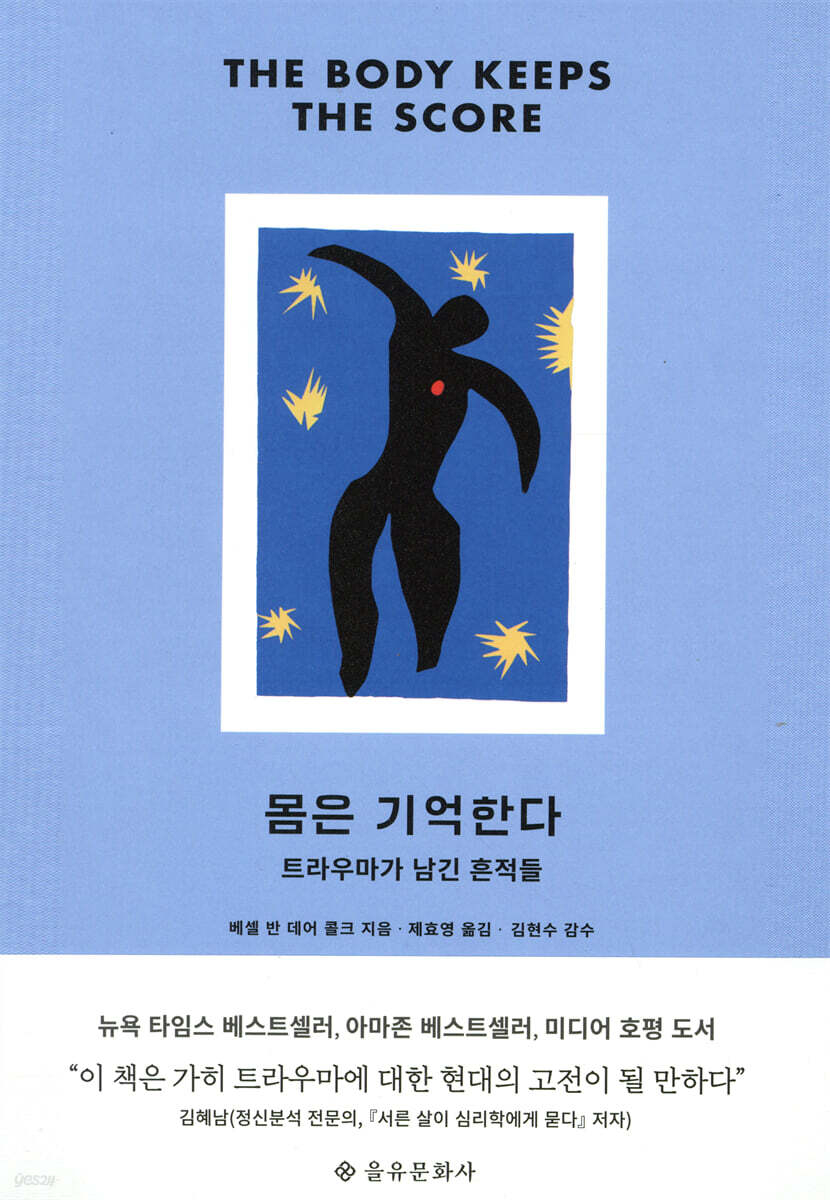
The body remembers
 |
Description
Book Introduction
New York Times Bestseller, Amazon Bestseller, Media Acclaim
The revised edition of "The Body Remembers," recognized as a "modern classic on trauma" and a masterpiece by Bessel van der Kolk, a world-renowned authority who has studied post-traumatic stress disorder for decades, has been published by Eulyoo Publishing.
This book covers everything from how to view patients with trauma disorders to the development of related research, treatment methods, and the impact on our society. Those involved believe that it will be difficult for another book on trauma to be published for the time being.
"The Body Remembers" is a book that serves as a starting point for making our society healthier by understanding and healing the trauma in the lives of modern people who have been running towards growth and achievement without healing from trauma.
This revised edition has been made easier to read by refining sentences for easier understanding and adding illustrations and footnotes.
The revised edition of "The Body Remembers," recognized as a "modern classic on trauma" and a masterpiece by Bessel van der Kolk, a world-renowned authority who has studied post-traumatic stress disorder for decades, has been published by Eulyoo Publishing.
This book covers everything from how to view patients with trauma disorders to the development of related research, treatment methods, and the impact on our society. Those involved believe that it will be difficult for another book on trauma to be published for the time being.
"The Body Remembers" is a book that serves as a starting point for making our society healthier by understanding and healing the trauma in the lives of modern people who have been running towards growth and achievement without healing from trauma.
This revised edition has been made easier to read by refining sentences for easier understanding and adding illustrations and footnotes.
- You can preview some of the book's contents.
Preview
index
Comments on the review and recommendations
Praise for this book
Opening Remarks | Confronting Trauma
Part 1: Rediscovering Trauma
Chapter 1: Lessons Learned from Vietnam Veterans
Chapter 2: Understanding the Mind and Brain: Its Revolutionary Transformation
Chapter 3: Inside the Brain: A Revolution in Neuroscience
Part 2: The Brain in Trauma
Chapter 4: Desperate Flight: The Anatomy of Survival
Chapter 5: The Connection Between Body and Brain
Chapter 6: If you lose your body, you lose yourself.
Part 3: Children's Hearts
Chapter 7: Attachment and Attunement: Creating the Same Wavelength
Chapter 8: The Relationship Trap: The Cost of Abuse and Neglect
Chapter 9 Far from Love
Chapter 10: Trauma in Development: The Hidden Epidemic
Part 4 Traces of Trauma
Chapter 11: Discovering the Secret: The Problem with Traumatic Memories
Chapter 12: The Unbearable Weight of Memory
Part 5: The Road to Recovery
Chapter 13: Recovering from Trauma: Healing Trauma
Chapter 14: Language, Miracle and Suffering
Chapter 15: Letting Go of the Past: Eye Movement Desensitization and Reprocessing (EMDR)
Chapter 16: Learning to Live in My Body: Yoga
Chapter 17: Jigsaw Puzzles: The Art of Leading Me
Chapter 18: Bridging the Gap: Creating New Structures
Chapter 19: Rewiring Brain Circuits: Neurofeedback
Chapter 20: Finding Lost Voices: Rhythms of Community and Drama Therapy
Closing remarks | Before selection
Acknowledgements
Appendix | Consensus on Diagnostic Criteria for Traumatic Developmental Disorder
References
Further Reading
annotation
Search
Praise for this book
Opening Remarks | Confronting Trauma
Part 1: Rediscovering Trauma
Chapter 1: Lessons Learned from Vietnam Veterans
Chapter 2: Understanding the Mind and Brain: Its Revolutionary Transformation
Chapter 3: Inside the Brain: A Revolution in Neuroscience
Part 2: The Brain in Trauma
Chapter 4: Desperate Flight: The Anatomy of Survival
Chapter 5: The Connection Between Body and Brain
Chapter 6: If you lose your body, you lose yourself.
Part 3: Children's Hearts
Chapter 7: Attachment and Attunement: Creating the Same Wavelength
Chapter 8: The Relationship Trap: The Cost of Abuse and Neglect
Chapter 9 Far from Love
Chapter 10: Trauma in Development: The Hidden Epidemic
Part 4 Traces of Trauma
Chapter 11: Discovering the Secret: The Problem with Traumatic Memories
Chapter 12: The Unbearable Weight of Memory
Part 5: The Road to Recovery
Chapter 13: Recovering from Trauma: Healing Trauma
Chapter 14: Language, Miracle and Suffering
Chapter 15: Letting Go of the Past: Eye Movement Desensitization and Reprocessing (EMDR)
Chapter 16: Learning to Live in My Body: Yoga
Chapter 17: Jigsaw Puzzles: The Art of Leading Me
Chapter 18: Bridging the Gap: Creating New Structures
Chapter 19: Rewiring Brain Circuits: Neurofeedback
Chapter 20: Finding Lost Voices: Rhythms of Community and Drama Therapy
Closing remarks | Before selection
Acknowledgements
Appendix | Consensus on Diagnostic Criteria for Traumatic Developmental Disorder
References
Further Reading
annotation
Search
Detailed image
Into the book
I've often been surprised by how doctors spend more time managing patients' behaviors than understanding the causes of their despair and helplessness, either by discussing their symptoms halfheartedly or by talking about suicidal thoughts and self-harming behaviors that drive them to suicide.
I was also struck by how little doctors paid attention to the ecology of their patients' lives: their achievements, their aspirations, who they cared about and loved, what motivated and guided their actions, what paralyzed them and what brought them peace.
--- p.62
Young Marilyn chose to eliminate herself.
When Marilyn heard her father's footsteps coming down the hallway outside her bedroom, she 'put her head in the clouds.'
Another patient who had a similar experience once drew a picture to illustrate the process.
When her father started to touch her, she also made herself disappear.
I soared through the ceiling and into the sky, looking down at the little girl lying on the bed from high above.
Then I thought to myself that I was lucky that I didn't have to go through that.
--- p.241
Shortly after giving birth to her third child, Nancy underwent laparoscopic tubal ligation.
This surgery, which is usually performed as an outpatient procedure, is a surgery to cauterize the fallopian tubes to prevent pregnancy.
However, Nancy was not fully anesthetized on the day of the surgery, so she woke up soon after the surgery began and had to stay in that state for most of the surgery.
In a state she described as being in a 'light sleep' or 'dreaming', Nancy experienced the full horror of the surgical situation.
After being administered muscle relaxants to prevent muscle contraction during the surgery, he remained conscious, but unable to move or make noise to indicate that he was awake.
(…) “But I couldn’t use anything that produced heat, like a hair dryer, toaster, or gas range.
I couldn't concentrate on what other people were doing or what they were saying to me.
I just didn't care at all.
My anxiety was growing and I was getting less and less sleep.
I knew I was acting strangely.
So I tried to figure out what scared me.
Four days after the surgery, I lay there in a dream-like state until about 3 a.m. when I suddenly realized that my state was related to the conversation I had overheard in the operating room.
It felt like my body was suddenly back in that operating room, and I felt like my body was on fire and paralyzed.
“A world of fear and dread has swallowed me up.”
(…) Nancy slowly began to piece together the recurring events and was finally able to understand the memory of the surgery, its horror.
I also remember the operating room nurses checking my anesthesia status and falling asleep for a moment after the anesthesia started.
And I remembered how I started to wake up from my sleep.
(…) “Suddenly, I was struck by an intense burning sensation, a burning pain.
I tried to escape the pain, but the cauterizer continued to stab me and burn me mercilessly.
“The terror of that moment is beyond words.”
--- p.343~346
Behaviors that are classified as psychiatrically problematic, such as obsessions, compulsions, panic attacks, and self-destructive behaviors, often began as self-defense strategies.
Adapting to trauma in this way can have such a profound impact on normal functioning that both healthcare professionals and the patient themselves may feel that full recovery is far off.
However, if such symptoms are considered as a permanent disability that cannot be resolved, the goal of treatment will be limited to finding an appropriate medication plan, and the patient will ultimately be dependent on medication for the rest of his or her life.
This is why trauma survivors often end up with kidney disease and need dialysis.
I was also struck by how little doctors paid attention to the ecology of their patients' lives: their achievements, their aspirations, who they cared about and loved, what motivated and guided their actions, what paralyzed them and what brought them peace.
--- p.62
Young Marilyn chose to eliminate herself.
When Marilyn heard her father's footsteps coming down the hallway outside her bedroom, she 'put her head in the clouds.'
Another patient who had a similar experience once drew a picture to illustrate the process.
When her father started to touch her, she also made herself disappear.
I soared through the ceiling and into the sky, looking down at the little girl lying on the bed from high above.
Then I thought to myself that I was lucky that I didn't have to go through that.
--- p.241
Shortly after giving birth to her third child, Nancy underwent laparoscopic tubal ligation.
This surgery, which is usually performed as an outpatient procedure, is a surgery to cauterize the fallopian tubes to prevent pregnancy.
However, Nancy was not fully anesthetized on the day of the surgery, so she woke up soon after the surgery began and had to stay in that state for most of the surgery.
In a state she described as being in a 'light sleep' or 'dreaming', Nancy experienced the full horror of the surgical situation.
After being administered muscle relaxants to prevent muscle contraction during the surgery, he remained conscious, but unable to move or make noise to indicate that he was awake.
(…) “But I couldn’t use anything that produced heat, like a hair dryer, toaster, or gas range.
I couldn't concentrate on what other people were doing or what they were saying to me.
I just didn't care at all.
My anxiety was growing and I was getting less and less sleep.
I knew I was acting strangely.
So I tried to figure out what scared me.
Four days after the surgery, I lay there in a dream-like state until about 3 a.m. when I suddenly realized that my state was related to the conversation I had overheard in the operating room.
It felt like my body was suddenly back in that operating room, and I felt like my body was on fire and paralyzed.
“A world of fear and dread has swallowed me up.”
(…) Nancy slowly began to piece together the recurring events and was finally able to understand the memory of the surgery, its horror.
I also remember the operating room nurses checking my anesthesia status and falling asleep for a moment after the anesthesia started.
And I remembered how I started to wake up from my sleep.
(…) “Suddenly, I was struck by an intense burning sensation, a burning pain.
I tried to escape the pain, but the cauterizer continued to stab me and burn me mercilessly.
“The terror of that moment is beyond words.”
--- p.343~346
Behaviors that are classified as psychiatrically problematic, such as obsessions, compulsions, panic attacks, and self-destructive behaviors, often began as self-defense strategies.
Adapting to trauma in this way can have such a profound impact on normal functioning that both healthcare professionals and the patient themselves may feel that full recovery is far off.
However, if such symptoms are considered as a permanent disability that cannot be resolved, the goal of treatment will be limited to finding an appropriate medication plan, and the patient will ultimately be dependent on medication for the rest of his or her life.
This is why trauma survivors often end up with kidney disease and need dialysis.
--- p.478~479
Publisher's Review
Trauma remains in the body
“Traumatic memories are like foreign substances that continue to affect us long after they were first introduced.” Just as a small splinter accidentally pokes you in the eye can cause an infection, the body’s reaction to exposure to that foreign substance can be far more problematic than the substance itself.
This passage does a good job of expressing what it means for trauma to remain in the body.
Trauma doesn't just leave marks on the body; it can cause major problems.
A few years ago, the story of the sole survivor of the Jijonpa incident in 1994 was broadcast on TV.
After being kidnapped and forced to participate in a crime, he lived a nightmare-like life for over 20 years. When he took a trauma check using a questionnaire, he scored 78 out of 88 points.
It was a very serious level, considering that a normal person would score less than 25 points.
He was taking seven different medications, including antidepressants and panic disorder medication, and was battling several illnesses, including uterine and breast cancer.
These illnesses are not unrelated to trauma, and the connection between trauma and illness is also addressed in “The Body Remembers.”
Trauma patients were 15 percent more likely to suffer from chronic obstructive pulmonary disease, ischemic heart disease, and liver disease than the general population, had a twice as high incidence of cancer, and a four times higher incidence of emphysema.
Constant stress takes a huge toll on the body.
In the broadcast, while interviewing the victim, they said that he seemed like a very intelligent and expressive person, and that if he had not been through something like that, he would probably be an active and confident member of society. In 『The Body Remembers』, the case of Lisa, who was as intelligent as the survivor of the Jijonpa incident, is also mentioned.
Having lost his father when he was three and growing up helplessly enduring the abuse of his mentally ill mother, he was always frightened and on edge.
I couldn't close my eyes because I thought that if someone else was around, they would come up to me and kick me as soon as I closed my eyes.
Trapped in a state of 'shock', he developed dissociative symptoms and became extremely fearful of those caring for him, engaging in self-destructive behavior, often attacking himself or destroying furniture without remembering what he did, earning him the stigma of being a liar.
He had difficulty with face-to-face therapy because he couldn't even bear to recall the past, and medication didn't help much either. However, he gradually improved while receiving neurofeedback (brainwave nerve treatment), to the point where the author said, "He transformed into a person with extraordinary clarity and concentration that I've never seen in anyone."
He transformed from a homeless man who couldn't settle down to a competent nurse.
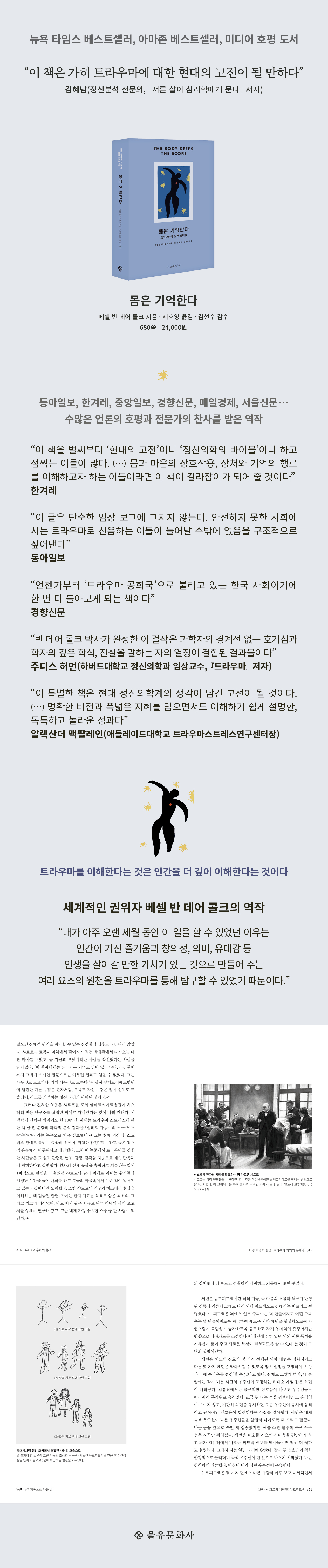
The neurofeedback Lisa received is one of several treatments discussed in this book, and the following picture (see bottom left of detailed image) is a drawing by a 10-year-old child who received this treatment for four months.
A child who was drawing family pictures at the level of a three-year-old is showing changes in his expressions as he receives treatment and becomes more and more sophisticated.
The reason this treatment is effective is because the brain dysfunction in patients with traumatic disorders is related to brain wave patterns.
When we examine the brains of trauma patients, we find that the rational brain is unable to properly control the emotional brain.
What really makes it difficult for people with this disability is that they are tied to a painful past and cannot live in the present.
When the brain is in a critical situation, it switches the body into defense mode and enters an emergency mode, but when a trauma disorder occurs, it tries to maintain an emergency mode 24 hours a day.
Because I can't get away from that incident.
But we can't live in that state forever, so our bodies shut down the part of the brain that defends us when we enter emergency mode.
So, even when something truly dangerous happens, we either fail to respond properly or react inappropriately and go into defensive mode.
Trauma that takes away even the imagination that determines the quality of life
Brain changes affect imagination, which boosts creativity, increases pleasure, and strengthens relationships with those we feel close to.
Trauma patients with altered brain function do not exhibit the "mental flexibility" that characterizes imagination.
Not only that, but if you are unable to properly feel emotions, you will not be able to empathize with the emotions of others, and this will affect your interpersonal relationships.
Problems arise when one is unable to communicate or get along with others, whether in a romantic relationship, family, or community.
The author has continuously researched treatments for these patients and applied various methods tailored to each patient.
We introduce various methods with real-life examples, from machine-based methods like the aforementioned neurofeedback to treatment methods that feel like role-playing where you can confidently confront someone who has traumatized you in the past.
This book goes beyond simply addressing trauma symptoms and treatments; it touches on the social structure.
Because trauma doesn't just stay with the person involved.
Even if unintentional, it creates more serious trauma and hurts other people and the community.
The author says, “Discussions about post-traumatic stress disorder still tend to focus on recently discharged soldiers, victims of terrorist attacks, and survivors of horrific accidents.
However, trauma is a public health problem of a much larger scale, he argues, and is “the greatest threat to the well-being of the entire nation.” In modern society, whether an individual can live a safe and healthy life can be more accurately predicted by “living conditions” than “genetic information.”
Your income level, family structure, where you live, your employment status, and your educational opportunities all determine your risk for developing traumatic stress, as well as whether you have access to helpful help when it happens.
Trauma and social structure can never be unrelated.
Does trauma make for compelling characters?
In the past, there were many movies and dramas with supporting villains who had trauma, but these days, there are many cases where the main characters have trauma.
A recent example is the drama [It's Okay to Not Be Okay], which gained worldwide popularity through Netflix.
In the first half of this year, a 'Character Creation Guide' was published that covered how pain moves characters and how wounds can be overcome.
Considering that understanding characters is paramount for writers, trauma is something they absolutely must understand.
You cannot truly understand human beings unless you understand their wounds and the impact and changes they bring.
This book broadens our understanding of humanity and allows us to see it clearly.
The emotion that comes from overcoming hardship and the brilliance of that person are precious things that only those without a single scar can dare to possess.
The author also mentions Oprah Winfrey, Nelson Mandela, and Elie Wiesel, and argues that “if you read the life stories of people with great insight, you will find that their insight and passion were born from overcoming hardships.”
“A great sense of humor and an amazing ability to poke fun at the foolishness of people” is another talent the author has seen in patients, and it can be said to be quite attractive as a character.
Living with trauma can make you a socially awkward and emotionally withdrawn person, but overcoming it can make you a charming person with exceptional insight and a sense of humor.
And the efforts and methods to overcome it are contained in this book.
Trauma analysis that suggests the direction our society should take.
Trauma changes a person's mind, brain, and body.
And ultimately, it cannot help but have an impact on society.
This book shows how to treat people with trauma disorders and provides direction on how society should embrace them.
When it comes to trauma, one area our society should be particularly concerned about is the memories and experiences of children in their early years.
Memories of and secure bonds with their caregivers serve as cushions to protect children from the trauma they may experience later.
It's not that we can't overcome the shock of not having such a strong presence in our childhood, but it's true that it acts as a cane to stand on, making it easier to get up.
And it allows you to stand up straight as a member of society.
The analysis results showing that crime rates vary depending on children's upbringing and educational programs show the path our society should take.
That is why this book is a must-read for parents, teachers, and even those who create and implement policies.
Furthermore, it is a meaningful book that should be read by anyone interested in understanding people, including human relationships and social issues.
“Many people are already calling this book a “modern classic” or “the bible of psychiatry.”
(…) “The Body Remembers” is a comprehensive report that historically examines the new discoveries in trauma research and treatment in the world of psychiatry and psychology from the 19th century to 2014, revealing its limitations and innovations. It is also a portrait of a psychiatrist who honestly records his study and treatment history from his days as a medical student in the 1960s to the present, going back in time, and the stories of the pain and lives of the patients he met along the way.
This book will serve as a guide for those who want to understand the interaction between therapists and patients, as well as the body and mind, and the path of wounds and memories.” _Hankyoreh
“This article is not just a simple clinical report.
It structurally points out that in an unsafe society, the number of people suffering from trauma is bound to increase.
(…) This is a book that should be read carefully in Korean society, where children continue to suffer collective trauma from absurd accidents, including the Sewol Ferry disaster, and lose their lives to horrific abuse.
The author reached out to all the wounded people in the world.
It is our job to hold that hand.” _Dong-A Ilbo
“Traumatic memories are like foreign substances that continue to affect us long after they were first introduced.” Just as a small splinter accidentally pokes you in the eye can cause an infection, the body’s reaction to exposure to that foreign substance can be far more problematic than the substance itself.
This passage does a good job of expressing what it means for trauma to remain in the body.
Trauma doesn't just leave marks on the body; it can cause major problems.
A few years ago, the story of the sole survivor of the Jijonpa incident in 1994 was broadcast on TV.
After being kidnapped and forced to participate in a crime, he lived a nightmare-like life for over 20 years. When he took a trauma check using a questionnaire, he scored 78 out of 88 points.
It was a very serious level, considering that a normal person would score less than 25 points.
He was taking seven different medications, including antidepressants and panic disorder medication, and was battling several illnesses, including uterine and breast cancer.
These illnesses are not unrelated to trauma, and the connection between trauma and illness is also addressed in “The Body Remembers.”
Trauma patients were 15 percent more likely to suffer from chronic obstructive pulmonary disease, ischemic heart disease, and liver disease than the general population, had a twice as high incidence of cancer, and a four times higher incidence of emphysema.
Constant stress takes a huge toll on the body.
In the broadcast, while interviewing the victim, they said that he seemed like a very intelligent and expressive person, and that if he had not been through something like that, he would probably be an active and confident member of society. In 『The Body Remembers』, the case of Lisa, who was as intelligent as the survivor of the Jijonpa incident, is also mentioned.
Having lost his father when he was three and growing up helplessly enduring the abuse of his mentally ill mother, he was always frightened and on edge.
I couldn't close my eyes because I thought that if someone else was around, they would come up to me and kick me as soon as I closed my eyes.
Trapped in a state of 'shock', he developed dissociative symptoms and became extremely fearful of those caring for him, engaging in self-destructive behavior, often attacking himself or destroying furniture without remembering what he did, earning him the stigma of being a liar.
He had difficulty with face-to-face therapy because he couldn't even bear to recall the past, and medication didn't help much either. However, he gradually improved while receiving neurofeedback (brainwave nerve treatment), to the point where the author said, "He transformed into a person with extraordinary clarity and concentration that I've never seen in anyone."
He transformed from a homeless man who couldn't settle down to a competent nurse.
The neurofeedback Lisa received is one of several treatments discussed in this book, and the following picture (see bottom left of detailed image) is a drawing by a 10-year-old child who received this treatment for four months.
A child who was drawing family pictures at the level of a three-year-old is showing changes in his expressions as he receives treatment and becomes more and more sophisticated.
The reason this treatment is effective is because the brain dysfunction in patients with traumatic disorders is related to brain wave patterns.
When we examine the brains of trauma patients, we find that the rational brain is unable to properly control the emotional brain.
What really makes it difficult for people with this disability is that they are tied to a painful past and cannot live in the present.
When the brain is in a critical situation, it switches the body into defense mode and enters an emergency mode, but when a trauma disorder occurs, it tries to maintain an emergency mode 24 hours a day.
Because I can't get away from that incident.
But we can't live in that state forever, so our bodies shut down the part of the brain that defends us when we enter emergency mode.
So, even when something truly dangerous happens, we either fail to respond properly or react inappropriately and go into defensive mode.
Trauma that takes away even the imagination that determines the quality of life
Brain changes affect imagination, which boosts creativity, increases pleasure, and strengthens relationships with those we feel close to.
Trauma patients with altered brain function do not exhibit the "mental flexibility" that characterizes imagination.
Not only that, but if you are unable to properly feel emotions, you will not be able to empathize with the emotions of others, and this will affect your interpersonal relationships.
Problems arise when one is unable to communicate or get along with others, whether in a romantic relationship, family, or community.
The author has continuously researched treatments for these patients and applied various methods tailored to each patient.
We introduce various methods with real-life examples, from machine-based methods like the aforementioned neurofeedback to treatment methods that feel like role-playing where you can confidently confront someone who has traumatized you in the past.
This book goes beyond simply addressing trauma symptoms and treatments; it touches on the social structure.
Because trauma doesn't just stay with the person involved.
Even if unintentional, it creates more serious trauma and hurts other people and the community.
The author says, “Discussions about post-traumatic stress disorder still tend to focus on recently discharged soldiers, victims of terrorist attacks, and survivors of horrific accidents.
However, trauma is a public health problem of a much larger scale, he argues, and is “the greatest threat to the well-being of the entire nation.” In modern society, whether an individual can live a safe and healthy life can be more accurately predicted by “living conditions” than “genetic information.”
Your income level, family structure, where you live, your employment status, and your educational opportunities all determine your risk for developing traumatic stress, as well as whether you have access to helpful help when it happens.
Trauma and social structure can never be unrelated.
Does trauma make for compelling characters?
In the past, there were many movies and dramas with supporting villains who had trauma, but these days, there are many cases where the main characters have trauma.
A recent example is the drama [It's Okay to Not Be Okay], which gained worldwide popularity through Netflix.
In the first half of this year, a 'Character Creation Guide' was published that covered how pain moves characters and how wounds can be overcome.
Considering that understanding characters is paramount for writers, trauma is something they absolutely must understand.
You cannot truly understand human beings unless you understand their wounds and the impact and changes they bring.
This book broadens our understanding of humanity and allows us to see it clearly.
The emotion that comes from overcoming hardship and the brilliance of that person are precious things that only those without a single scar can dare to possess.
The author also mentions Oprah Winfrey, Nelson Mandela, and Elie Wiesel, and argues that “if you read the life stories of people with great insight, you will find that their insight and passion were born from overcoming hardships.”
“A great sense of humor and an amazing ability to poke fun at the foolishness of people” is another talent the author has seen in patients, and it can be said to be quite attractive as a character.
Living with trauma can make you a socially awkward and emotionally withdrawn person, but overcoming it can make you a charming person with exceptional insight and a sense of humor.
And the efforts and methods to overcome it are contained in this book.
Trauma analysis that suggests the direction our society should take.
Trauma changes a person's mind, brain, and body.
And ultimately, it cannot help but have an impact on society.
This book shows how to treat people with trauma disorders and provides direction on how society should embrace them.
When it comes to trauma, one area our society should be particularly concerned about is the memories and experiences of children in their early years.
Memories of and secure bonds with their caregivers serve as cushions to protect children from the trauma they may experience later.
It's not that we can't overcome the shock of not having such a strong presence in our childhood, but it's true that it acts as a cane to stand on, making it easier to get up.
And it allows you to stand up straight as a member of society.
The analysis results showing that crime rates vary depending on children's upbringing and educational programs show the path our society should take.
That is why this book is a must-read for parents, teachers, and even those who create and implement policies.
Furthermore, it is a meaningful book that should be read by anyone interested in understanding people, including human relationships and social issues.
“Many people are already calling this book a “modern classic” or “the bible of psychiatry.”
(…) “The Body Remembers” is a comprehensive report that historically examines the new discoveries in trauma research and treatment in the world of psychiatry and psychology from the 19th century to 2014, revealing its limitations and innovations. It is also a portrait of a psychiatrist who honestly records his study and treatment history from his days as a medical student in the 1960s to the present, going back in time, and the stories of the pain and lives of the patients he met along the way.
This book will serve as a guide for those who want to understand the interaction between therapists and patients, as well as the body and mind, and the path of wounds and memories.” _Hankyoreh
“This article is not just a simple clinical report.
It structurally points out that in an unsafe society, the number of people suffering from trauma is bound to increase.
(…) This is a book that should be read carefully in Korean society, where children continue to suffer collective trauma from absurd accidents, including the Sewol Ferry disaster, and lose their lives to horrific abuse.
The author reached out to all the wounded people in the world.
It is our job to hold that hand.” _Dong-A Ilbo
GOODS SPECIFICS
- Publication date: October 25, 2020
- Page count, weight, size: 680 pages | 768g | 145*210*32mm
- ISBN13: 9788932474366
- ISBN10: 8932474362
You may also like
카테고리
korean


korean

![ELLE 엘르 스페셜 에디션 A형 : 12월 [2025]](http://librairie.coreenne.fr/cdn/shop/files/b8e27a3de6c9538896439686c6b0e8fb.jpg?v=1766436872&width=3840)


