

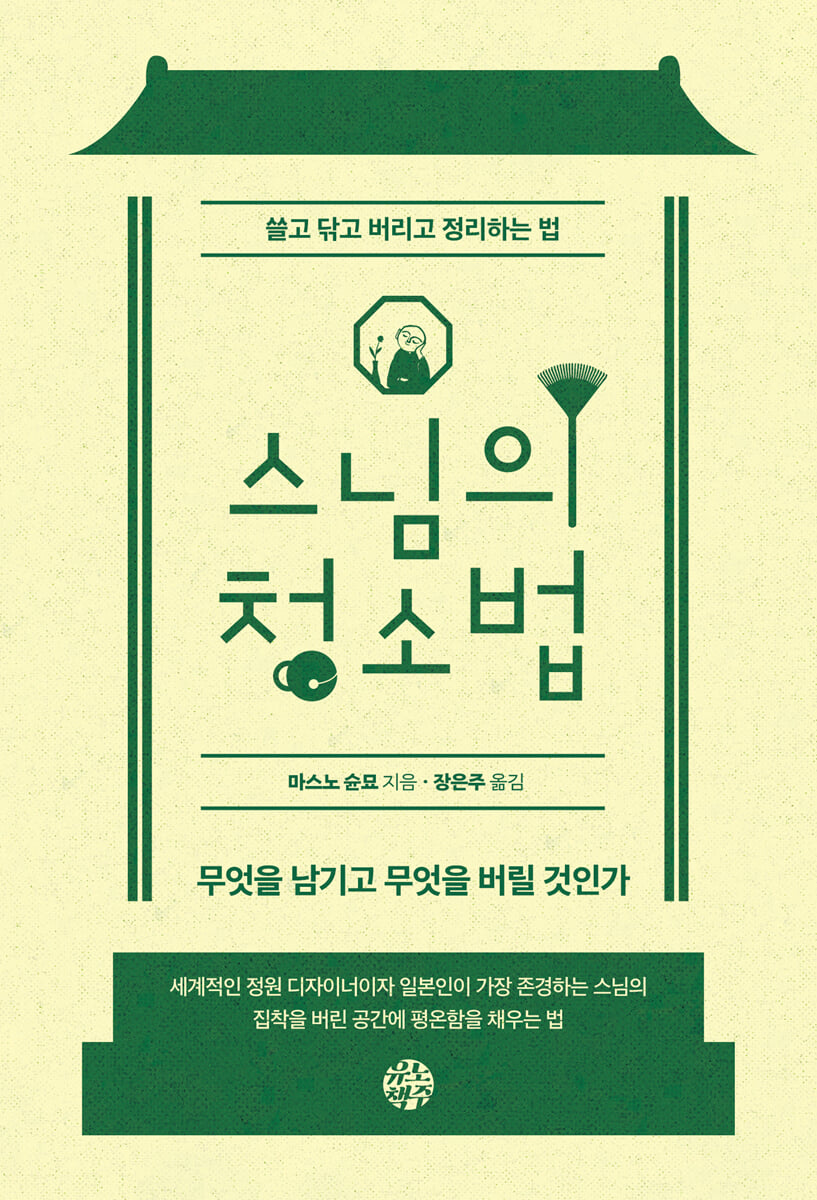
The monk's cleaning method
 |
Description
Book Introduction
★★★World-renowned garden designer
★★★Japanese Amazon Bestselling Author
★★★The most respected monk in Japan
“Cleaning is not about getting dirty, it’s about purifying the mind.”
A monk's special cleaning method for a richer life through 'subtraction' rather than 'addition'
"The Monk's Cleaning Method" is a book written by Shunmyo Masuno, a world-renowned garden designer and bestselling author on Amazon Japan, about how to create a "truly abundant life" through the act of "cleaning."
We live in a modern world where we claim to lack nothing materially and are abundant in every way. But are we truly living lives of qualitative abundance? It's difficult to say yes, as we all live our daily lives filled with anxiety and stress, burdened by the countless worries and obsessions that exist within us.
It means that material abundance alone cannot lead to a satisfying life.
One of the important practices in the Japanese Buddhist philosophy of 'Zen' is 'cleaning'.
Monk Masuno Shunmyo proposes a higher level of activity that cultivates and purifies the mind through this physical act of cleaning.
“We are born with a mind like a mirror, without a single cloud.
But as we live, various specks of dust and dirt accumulate in our hearts.
For example, things like the preconceived notion that 'that person is ○○' or the obsession that 'I have to get my hands on ○○ somehow.'
Such specks of dust and dirt cloud the mind, which is like a mirror without a single cloud.
In reality, that may not be the case.
It is none other than oneself who suffers from being swayed by prejudice or obsession.
You must always keep your mind clean so that it is free from any dust or dirt.
If you shake off one thing, your mind will feel lighter.
If you remove even a speck of dust, you will feel refreshed.
Let's clean up with the thought of clearing away the clouded mind and making it shine brightly.
If you live in an organized space, it will be difficult for your mind to become clouded.
The purpose of cleaning is not to remove dirt.
“It is to cleanse your mind.” (From the book)
To this end, I will begin by asking why I am talking about the act of cleaning.
Next, the author introduces his own suggested cleaning methods, such as the practice cleaning method, reset cleaning method, morning cleaning method, and habit cleaning method, and finally, he points out how to live a truly abundant life.
Through "The Monk's Cleaning Method," we hope to discover how we can cultivate and refine our minds through the seemingly insignificant act of cleaning.
★★★Japanese Amazon Bestselling Author
★★★The most respected monk in Japan
“Cleaning is not about getting dirty, it’s about purifying the mind.”
A monk's special cleaning method for a richer life through 'subtraction' rather than 'addition'
"The Monk's Cleaning Method" is a book written by Shunmyo Masuno, a world-renowned garden designer and bestselling author on Amazon Japan, about how to create a "truly abundant life" through the act of "cleaning."
We live in a modern world where we claim to lack nothing materially and are abundant in every way. But are we truly living lives of qualitative abundance? It's difficult to say yes, as we all live our daily lives filled with anxiety and stress, burdened by the countless worries and obsessions that exist within us.
It means that material abundance alone cannot lead to a satisfying life.
One of the important practices in the Japanese Buddhist philosophy of 'Zen' is 'cleaning'.
Monk Masuno Shunmyo proposes a higher level of activity that cultivates and purifies the mind through this physical act of cleaning.
“We are born with a mind like a mirror, without a single cloud.
But as we live, various specks of dust and dirt accumulate in our hearts.
For example, things like the preconceived notion that 'that person is ○○' or the obsession that 'I have to get my hands on ○○ somehow.'
Such specks of dust and dirt cloud the mind, which is like a mirror without a single cloud.
In reality, that may not be the case.
It is none other than oneself who suffers from being swayed by prejudice or obsession.
You must always keep your mind clean so that it is free from any dust or dirt.
If you shake off one thing, your mind will feel lighter.
If you remove even a speck of dust, you will feel refreshed.
Let's clean up with the thought of clearing away the clouded mind and making it shine brightly.
If you live in an organized space, it will be difficult for your mind to become clouded.
The purpose of cleaning is not to remove dirt.
“It is to cleanse your mind.” (From the book)
To this end, I will begin by asking why I am talking about the act of cleaning.
Next, the author introduces his own suggested cleaning methods, such as the practice cleaning method, reset cleaning method, morning cleaning method, and habit cleaning method, and finally, he points out how to live a truly abundant life.
Through "The Monk's Cleaning Method," we hope to discover how we can cultivate and refine our minds through the seemingly insignificant act of cleaning.
- You can preview some of the book's contents.
Preview
index
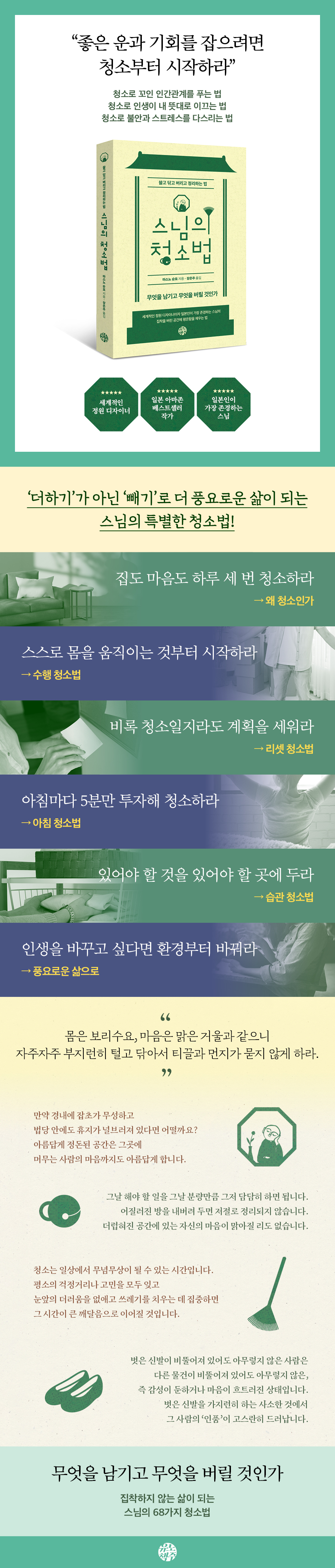
To seize good luck and opportunities, start by cleaning.
Chapter 1: Clean Your Home and Your Heart Three Times a Day / Why Clean?
What to clean
The moment cleaning is performed
Why you should take off your shoes when entering the house
The journey home is a time to sort out the mundane.
The room reflects my state of mind
Throwing things away is the last of the last
How to give objects a second or third life
What is truly 'a pity'?
Remember, every thing passes through 100 people.
"If you don't work for a day, you don't eat for a day."
In a cluttered room, the mind is also noisy with noise.
What's on everyone's mind
Be mindful of your space as much as you value it.
Why You Need 'Empty' Space in Your Home
Make it where it should be
Chapter 2: Start by Moving Yourself / Practice Cleansing
Why do you only think it's annoying?
What comes when you move your body absentmindedly
Things you can save by cleaning up from time to time
Why Simpler Cleaning Tools Are Better
The fun of cleaning with handmade tools
How to shed the veil of obsession
When you discipline yourself, your expression changes.
Chapter 3: Make a Plan, Even if It's Cleaning Day / Reset Cleaning Method
Decide on a period of time to intensively reset the room.
Make a schedule and organize it in order
How to Set a "Discard Criteria" to Speed Up Your Work
Measure the depth of the heart contained in an object.
When organizing things, a bold decision is needed.
Why Cleaning Is Easier When You Have a Buddy
Your cleaning habits will change your family.
Chapter 4: Invest Just 5 Minutes in Cleaning Every Morning / Morning Cleaning Method
Start your day fresh with a morning cleaning.
What happens when you open the window wide and let in some fresh air?
Why Your Own Cleaning Style Matters
100-day cleaning habit
Chapter 5: Putting What's Wrong Where It's Wrong / Habit Cleaning
Think of your front door as your face.
“Look carefully at your own feet.”
Let's create a space to welcome guests.
The living room is the most comfortable space to relax.
Creating a space where you can lean on your heart
Create a peaceful day by putting your hands together once a day.
There are Buddhas in the bathroom and toilet too.
The kitchen is an important space where life is created.
Keep the dishes as simple as possible
Organize by subtraction instead of addition.
When sorting clothes by season, organize them together.
What happens when you clean your desk every day?
Organize documents and files as needed.
Organize and classify the items in your bag
The rule is to process mail on a daily basis.
Create a place where you can feel close to nature at any time.
Garden cleaning starts with observation
Chapter 6: If you want to change your life, start by changing your environment / Towards a rich life
Why You Should Cherish the Space You Live In
How to Experience the Truth of Everyday Life Through Cleaning
The Correlation Between Cleaning and Enlightenment
When you simplify, you can return to your original self.
Cleaning that creates good luck
How to Change Your Posture in Just Two Weeks with Morning Cleaning
Free yourself from desires with just one cleaning
If you feel like you're about to make an impulse purchase, take a deep breath.
The garden calms the mind
Finding the Enrichment of the Mind in the Laws of Nature
Develop a heart that is willing to let go
Accumulate virtue through cleaning
Just as beautiful flowers need care to bloom,
You have to move your body, not your head, to become flesh and blood.
Start by controlling your actions.
Reset your mind in a clean space
Things that change when you start zazen every morning
7-Step Method for Sitting Meditation
Opportunities will come when you calm your mind.
As I go out, I have the mindset that 'I can do this much'
Chapter 1: Clean Your Home and Your Heart Three Times a Day / Why Clean?
What to clean
The moment cleaning is performed
Why you should take off your shoes when entering the house
The journey home is a time to sort out the mundane.
The room reflects my state of mind
Throwing things away is the last of the last
How to give objects a second or third life
What is truly 'a pity'?
Remember, every thing passes through 100 people.
"If you don't work for a day, you don't eat for a day."
In a cluttered room, the mind is also noisy with noise.
What's on everyone's mind
Be mindful of your space as much as you value it.
Why You Need 'Empty' Space in Your Home
Make it where it should be
Chapter 2: Start by Moving Yourself / Practice Cleansing
Why do you only think it's annoying?
What comes when you move your body absentmindedly
Things you can save by cleaning up from time to time
Why Simpler Cleaning Tools Are Better
The fun of cleaning with handmade tools
How to shed the veil of obsession
When you discipline yourself, your expression changes.
Chapter 3: Make a Plan, Even if It's Cleaning Day / Reset Cleaning Method
Decide on a period of time to intensively reset the room.
Make a schedule and organize it in order
How to Set a "Discard Criteria" to Speed Up Your Work
Measure the depth of the heart contained in an object.
When organizing things, a bold decision is needed.
Why Cleaning Is Easier When You Have a Buddy
Your cleaning habits will change your family.
Chapter 4: Invest Just 5 Minutes in Cleaning Every Morning / Morning Cleaning Method
Start your day fresh with a morning cleaning.
What happens when you open the window wide and let in some fresh air?
Why Your Own Cleaning Style Matters
100-day cleaning habit
Chapter 5: Putting What's Wrong Where It's Wrong / Habit Cleaning
Think of your front door as your face.
“Look carefully at your own feet.”
Let's create a space to welcome guests.
The living room is the most comfortable space to relax.
Creating a space where you can lean on your heart
Create a peaceful day by putting your hands together once a day.
There are Buddhas in the bathroom and toilet too.
The kitchen is an important space where life is created.
Keep the dishes as simple as possible
Organize by subtraction instead of addition.
When sorting clothes by season, organize them together.
What happens when you clean your desk every day?
Organize documents and files as needed.
Organize and classify the items in your bag
The rule is to process mail on a daily basis.
Create a place where you can feel close to nature at any time.
Garden cleaning starts with observation
Chapter 6: If you want to change your life, start by changing your environment / Towards a rich life
Why You Should Cherish the Space You Live In
How to Experience the Truth of Everyday Life Through Cleaning
The Correlation Between Cleaning and Enlightenment
When you simplify, you can return to your original self.
Cleaning that creates good luck
How to Change Your Posture in Just Two Weeks with Morning Cleaning
Free yourself from desires with just one cleaning
If you feel like you're about to make an impulse purchase, take a deep breath.
The garden calms the mind
Finding the Enrichment of the Mind in the Laws of Nature
Develop a heart that is willing to let go
Accumulate virtue through cleaning
Just as beautiful flowers need care to bloom,
You have to move your body, not your head, to become flesh and blood.
Start by controlling your actions.
Reset your mind in a clean space
Things that change when you start zazen every morning
7-Step Method for Sitting Meditation
Opportunities will come when you calm your mind.
As I go out, I have the mindset that 'I can do this much'
Detailed image
Into the book
People who live in neatly organized rooms have a clear mind and are less likely to be swayed by vain thoughts or worries.
You know exactly where everything is, so you don't have to wander around looking for things.
On the other hand, if you live in a room that is so cluttered that you can't even find a place to put your feet, you will hardly be able to relax.
Every time I try to do something, I have to start by putting things away or looking for them.
If you still don't mind, then the mess is normal.
I've become accustomed to feeling numb and disoriented.
Isn't that really scary?
Look at your room through someone else's eyes.
Look at your room with the thought that your state of mind is completely revealed to the outside.
What do you feel when you look at the room with fresh eyes?
--- From "The Room Shows My State of Mind"
If sitting meditation is the practice of ‘stillness’, then cleaning is the practice of ‘movement’.
At the sound of the drum, all the monks come running out.
And then they all start cleaning at once.
Cleaning time involves moving your body with all your might and focusing on the task at hand.
There is no time for small talk.
If you lose your senses even for a moment, you will be scolded by a senior practitioner who is called a veteran.
The harmony between this agreed time and the defined time for sitting meditation is excellent.
When cleaning, which is the agreed time, everyone puts their spirits into it and does it thoroughly until the very end with the thought of purifying their minds.
The quality of your time is determined by how you spend it.
There is no need to explain the difference between a sloppy cleaning done in about 15 minutes and a cleaning done with care and dedication.
--- From "Why Do You Only Think It's Annoying"
In the line, we cherish the time called ‘now.’
We believe that tomorrow will surely come, but we cannot know when human life will end.
To put it in extreme terms, a person who leaves home smiling in the morning may encounter an unexpected accident and lose his life.
Also, no one can guarantee that if you fall asleep at night you will be able to wake up the next morning.
No one knows what will happen in life.
There may be no 'later' or 'tomorrow'.
Living in the present moment is the way of thinking of goodness.
Instead of living in anticipation of a tomorrow that may or may not come, live this moment wholeheartedly.
I don't neglect even the smallest tasks and handle them meticulously.
This leads to a life without regrets.
--- From "A moment when a bold decision is needed when organizing things"
When you enter the main entrance or stairs of a temple, you can see the words ‘Look down at your feet’ or ‘Look down at your feet’.
Both phrases mean, "Look carefully under your feet" and "Take off your shoes and put them away neatly."
There is another important message in these words.
The saying, “Look under your feet” means to work hard at what you can do now.
A person who does not put away his shoes will not have a well-organized mind.
Because the mind flies to the past or future and is not in the 'here and now'.
You might think it's just a way to take off your shoes, but it's a symbol.
A person who doesn't care if the shoes he takes off are crooked also doesn't care if other things are crooked, which means that his emotions are dull or his mind is in a state of confusion.
A person's 'character' is completely revealed in such trivial things as tidying up one's shoes.
What do the shoes on your doorstep look like?
You know exactly where everything is, so you don't have to wander around looking for things.
On the other hand, if you live in a room that is so cluttered that you can't even find a place to put your feet, you will hardly be able to relax.
Every time I try to do something, I have to start by putting things away or looking for them.
If you still don't mind, then the mess is normal.
I've become accustomed to feeling numb and disoriented.
Isn't that really scary?
Look at your room through someone else's eyes.
Look at your room with the thought that your state of mind is completely revealed to the outside.
What do you feel when you look at the room with fresh eyes?
--- From "The Room Shows My State of Mind"
If sitting meditation is the practice of ‘stillness’, then cleaning is the practice of ‘movement’.
At the sound of the drum, all the monks come running out.
And then they all start cleaning at once.
Cleaning time involves moving your body with all your might and focusing on the task at hand.
There is no time for small talk.
If you lose your senses even for a moment, you will be scolded by a senior practitioner who is called a veteran.
The harmony between this agreed time and the defined time for sitting meditation is excellent.
When cleaning, which is the agreed time, everyone puts their spirits into it and does it thoroughly until the very end with the thought of purifying their minds.
The quality of your time is determined by how you spend it.
There is no need to explain the difference between a sloppy cleaning done in about 15 minutes and a cleaning done with care and dedication.
--- From "Why Do You Only Think It's Annoying"
In the line, we cherish the time called ‘now.’
We believe that tomorrow will surely come, but we cannot know when human life will end.
To put it in extreme terms, a person who leaves home smiling in the morning may encounter an unexpected accident and lose his life.
Also, no one can guarantee that if you fall asleep at night you will be able to wake up the next morning.
No one knows what will happen in life.
There may be no 'later' or 'tomorrow'.
Living in the present moment is the way of thinking of goodness.
Instead of living in anticipation of a tomorrow that may or may not come, live this moment wholeheartedly.
I don't neglect even the smallest tasks and handle them meticulously.
This leads to a life without regrets.
--- From "A moment when a bold decision is needed when organizing things"
When you enter the main entrance or stairs of a temple, you can see the words ‘Look down at your feet’ or ‘Look down at your feet’.
Both phrases mean, "Look carefully under your feet" and "Take off your shoes and put them away neatly."
There is another important message in these words.
The saying, “Look under your feet” means to work hard at what you can do now.
A person who does not put away his shoes will not have a well-organized mind.
Because the mind flies to the past or future and is not in the 'here and now'.
You might think it's just a way to take off your shoes, but it's a symbol.
A person who doesn't care if the shoes he takes off are crooked also doesn't care if other things are crooked, which means that his emotions are dull or his mind is in a state of confusion.
A person's 'character' is completely revealed in such trivial things as tidying up one's shoes.
What do the shoes on your doorstep look like?
--- From "Look carefully at your own feet"
Publisher's Review
"To seize good luck and opportunity, start by cleaning."
How to Untangle Human Relationships That Are Tangled by Cleaning
How Cleaning Leads Your Life to Your Will
How to Manage Anxiety and Stress Through Cleaning
During the Yuan Dynasty in China, there was a Zen master named Zhongfeng Mingben.
He had many disciples, and it is said that the Zen master made his disciples clean every day.
However, the young disciples, brimming with the desire to learn, are said to have asked their teacher, instead of cleaning, what enlightenment is and what it means to explore the path.
What did Master Jungbong say when he heard his disciples' words? It is said he always told them to carry a broom and duster and sweep the dust from the temple.
In Buddhism, cleansing has long been considered an important path to enlightenment.
Why is cleaning related to enlightenment? There's an interesting anecdote here, too.
This is the story of a Zen master named Xiangyan Zhihan from the Tang Dynasty in China.
One day, while Hyang-eom was sweeping the floor with a broom, he heard a small stone flying and hitting a bamboo tree.
It is said that Hyang-eom, upon hearing this faint sound, realized that without either the bamboo or the stone, no sound could be produced.
A small stone hitting a bamboo tree may be just a small trigger.
However, it was also a sound that Hyang-eom could hear because he was devoted to his job of cleaning and seeking enlightenment every day.
Because cleaning is basically a time when you can be free of thoughts and thoughts.
If you actually clean up what you see in front of you and your surroundings, your mind will inevitably become clear and sharp.
If you add the thoughtless act of cleaning to that, you can meet 'me completely becoming one with it' at the moment of cleaning.
Isn't this the process of practice and attaining enlightenment?
One of Japan's most revered figures, the monk Shunmyo Masuno, uses this story to reflect on the meaning of "cleaning" in our lives.
It is not simply about sweeping, wiping, and organizing the dust in front of your eyes, but rather suggesting a way to become indifferent and non-attached through such actions.
Plus, you'll get some practical information as it includes a lot of helpful advice that you can apply when actually cleaning.
“First, start with something you think you can do to some extent.
It doesn't matter if it's one or two.
If you keep doing it for 100 days, it becomes a habit.
Just as there is no end to the practice of good deeds, there is no end to cleaning.
Keep this book by your side and open it whenever you have the chance.
“If this book becomes a guide for you to live simply and with a rich heart, I would be very happy.” (From the book)
The author emphasizes the truth that 'a journey of a thousand miles begins with a single step.'
Rather than trying to fix a messy house in just one day, just one cleaning session, I recommend that you consistently do only what you think you can do every day.
These cleaning methods are also in line with the methods of organizing daily life and controlling obsessions.
As the author says, if you always keep "The Monk's Cleaning Method" by your side, you will realize the importance of calmly doing what you can do now, feel the true meaning of being free from thoughts and thoughts, and learn how to purify not only your home but also your mind through various cleaning methods to create a fulfilling life.
“What to keep and what to throw away”
A Monk's 68 Cleaning Techniques for a Non-Attachment Life
In "The Monk's Cleaning Method," it teaches how to cleanse the mind of dust and purify oneself through "cleaning," one of the most important practices in Japanese Zen Buddhism.
First of all, Chapter 1, 'Clean your home and mind three times a day', talks about why we clean among the many methods, and what we can gain from cleaning.
You will be able to realize the true meaning of the saying, “What is meant to be is where it is meant to be.”
Chapter 2, "Start by Moving Yourself," discusses the author's suggested practice cleaning method.
It tells us what similarities there are between practice and cleaning, and how to purify the mind through cleaning.
Chapter 3, "Even if it's just cleaning, make a plan," discusses the author's second suggested reset cleaning method.
Explains why a reset process is necessary to get to the most ideal and clean state, and explains the methods required to perform the reset cleaning.
Chapter 4, 'Invest 5 minutes every morning to clean', talks about a morning cleaning method that involves cleaning for 5 minutes every morning, as the title suggests.
It emphasizes the importance of doing something consistently every day and provides tips on how to clean during busy morning hours.
Chapter 5, “Putting What’s Wrong Where It’s Wrong,” teaches the author the most important habit-cleaning method.
From the entrance to the living room, bathroom, kitchen, bedroom, study, and veranda, we will discuss what is most important to consider while cleaning each space and how to make cleaning a habit.
Finally, Chapter 6, "If you want to change your life, start by changing your environment," contains various thoughts on how to create a rich life, which is our ultimate goal.
We talk about what a truly rich life is, how to create it through cleaning, and how to have a spotless mind.
There is a saying, “If your heart is pure, darkness cannot dwell in it.”
The Monk's Cleaning Method suggests cleaning as a way to create a pure mind where darkness cannot dwell.
I hope that through the various cleaning methods suggested by the monk, you will be able to hear practical advice on organizing and learn how to cultivate a pure mind.
How to Untangle Human Relationships That Are Tangled by Cleaning
How Cleaning Leads Your Life to Your Will
How to Manage Anxiety and Stress Through Cleaning
During the Yuan Dynasty in China, there was a Zen master named Zhongfeng Mingben.
He had many disciples, and it is said that the Zen master made his disciples clean every day.
However, the young disciples, brimming with the desire to learn, are said to have asked their teacher, instead of cleaning, what enlightenment is and what it means to explore the path.
What did Master Jungbong say when he heard his disciples' words? It is said he always told them to carry a broom and duster and sweep the dust from the temple.
In Buddhism, cleansing has long been considered an important path to enlightenment.
Why is cleaning related to enlightenment? There's an interesting anecdote here, too.
This is the story of a Zen master named Xiangyan Zhihan from the Tang Dynasty in China.
One day, while Hyang-eom was sweeping the floor with a broom, he heard a small stone flying and hitting a bamboo tree.
It is said that Hyang-eom, upon hearing this faint sound, realized that without either the bamboo or the stone, no sound could be produced.
A small stone hitting a bamboo tree may be just a small trigger.
However, it was also a sound that Hyang-eom could hear because he was devoted to his job of cleaning and seeking enlightenment every day.
Because cleaning is basically a time when you can be free of thoughts and thoughts.
If you actually clean up what you see in front of you and your surroundings, your mind will inevitably become clear and sharp.
If you add the thoughtless act of cleaning to that, you can meet 'me completely becoming one with it' at the moment of cleaning.
Isn't this the process of practice and attaining enlightenment?
One of Japan's most revered figures, the monk Shunmyo Masuno, uses this story to reflect on the meaning of "cleaning" in our lives.
It is not simply about sweeping, wiping, and organizing the dust in front of your eyes, but rather suggesting a way to become indifferent and non-attached through such actions.
Plus, you'll get some practical information as it includes a lot of helpful advice that you can apply when actually cleaning.
“First, start with something you think you can do to some extent.
It doesn't matter if it's one or two.
If you keep doing it for 100 days, it becomes a habit.
Just as there is no end to the practice of good deeds, there is no end to cleaning.
Keep this book by your side and open it whenever you have the chance.
“If this book becomes a guide for you to live simply and with a rich heart, I would be very happy.” (From the book)
The author emphasizes the truth that 'a journey of a thousand miles begins with a single step.'
Rather than trying to fix a messy house in just one day, just one cleaning session, I recommend that you consistently do only what you think you can do every day.
These cleaning methods are also in line with the methods of organizing daily life and controlling obsessions.
As the author says, if you always keep "The Monk's Cleaning Method" by your side, you will realize the importance of calmly doing what you can do now, feel the true meaning of being free from thoughts and thoughts, and learn how to purify not only your home but also your mind through various cleaning methods to create a fulfilling life.
“What to keep and what to throw away”
A Monk's 68 Cleaning Techniques for a Non-Attachment Life
In "The Monk's Cleaning Method," it teaches how to cleanse the mind of dust and purify oneself through "cleaning," one of the most important practices in Japanese Zen Buddhism.
First of all, Chapter 1, 'Clean your home and mind three times a day', talks about why we clean among the many methods, and what we can gain from cleaning.
You will be able to realize the true meaning of the saying, “What is meant to be is where it is meant to be.”
Chapter 2, "Start by Moving Yourself," discusses the author's suggested practice cleaning method.
It tells us what similarities there are between practice and cleaning, and how to purify the mind through cleaning.
Chapter 3, "Even if it's just cleaning, make a plan," discusses the author's second suggested reset cleaning method.
Explains why a reset process is necessary to get to the most ideal and clean state, and explains the methods required to perform the reset cleaning.
Chapter 4, 'Invest 5 minutes every morning to clean', talks about a morning cleaning method that involves cleaning for 5 minutes every morning, as the title suggests.
It emphasizes the importance of doing something consistently every day and provides tips on how to clean during busy morning hours.
Chapter 5, “Putting What’s Wrong Where It’s Wrong,” teaches the author the most important habit-cleaning method.
From the entrance to the living room, bathroom, kitchen, bedroom, study, and veranda, we will discuss what is most important to consider while cleaning each space and how to make cleaning a habit.
Finally, Chapter 6, "If you want to change your life, start by changing your environment," contains various thoughts on how to create a rich life, which is our ultimate goal.
We talk about what a truly rich life is, how to create it through cleaning, and how to have a spotless mind.
There is a saying, “If your heart is pure, darkness cannot dwell in it.”
The Monk's Cleaning Method suggests cleaning as a way to create a pure mind where darkness cannot dwell.
I hope that through the various cleaning methods suggested by the monk, you will be able to hear practical advice on organizing and learn how to cultivate a pure mind.
GOODS SPECIFICS
- Date of issue: October 2, 2025
- Page count, weight, size: 252 pages | 128*188*20mm
- ISBN13: 9791171831395
- ISBN10: 1171831390
You may also like
카테고리
korean


korean

![GQ KOREA Mark (Monthly): December [2025]](http://librairie.coreenne.fr/cdn/shop/files/8ef265dbbfbf186523ed75ba7319009d.jpg?v=1765340328&width=3840)


