

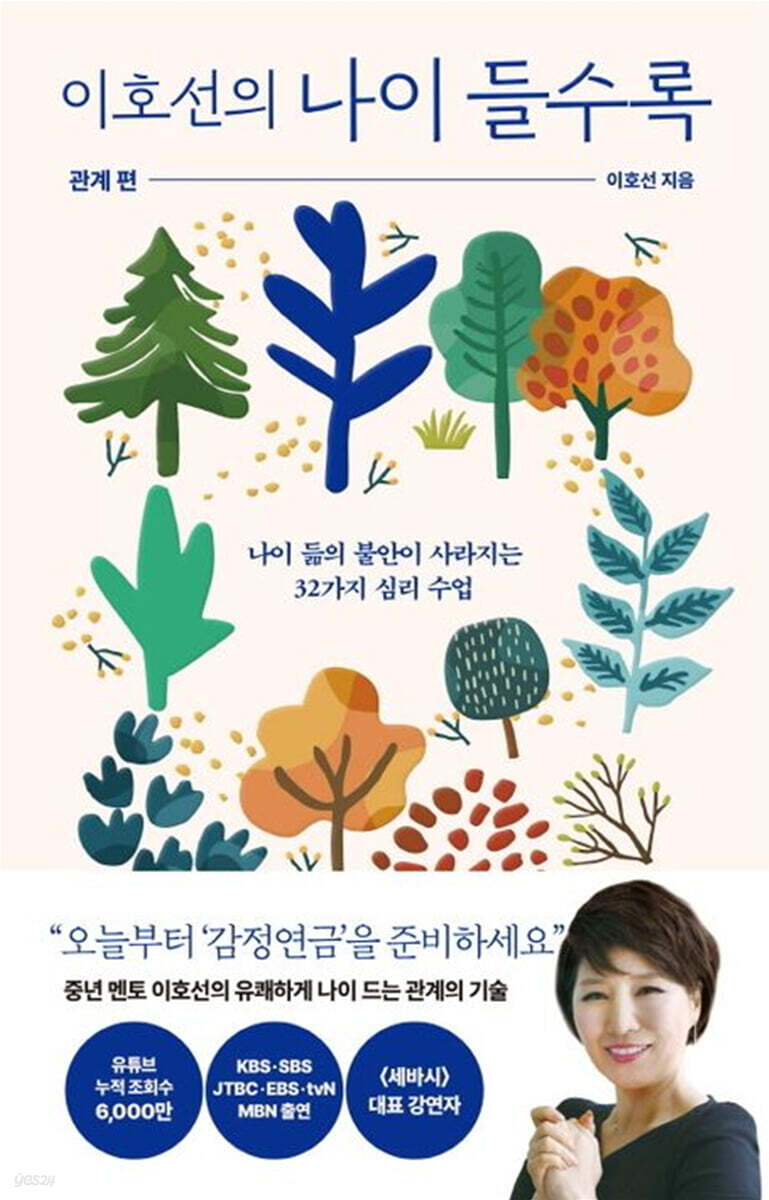
Lee Ho-seon's As I Get Older: Relationships
 |
Description
Book Introduction
*** Psychological counseling expert appearing on KBS, SBS, JTBC, EBS, and tvN ***
*** Most frequently appearing representative speaker on Sebashi ***
*** YouTube lecture cumulative views 60 million ***
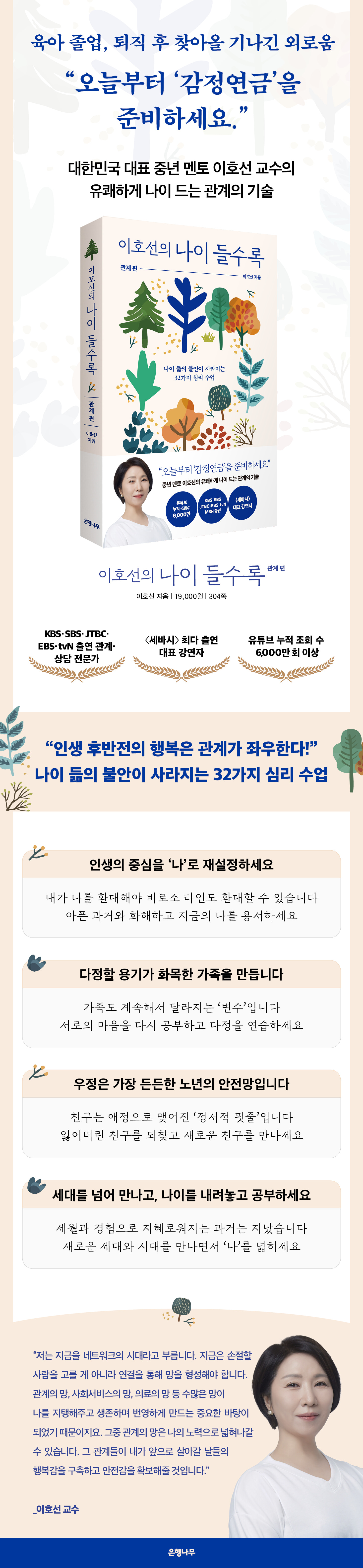
“Prepare your emotional pension starting today.”
An era in which we live longer, yet more lonely, than ever before
32 Psychology Lessons to Eliminate Aging Anxiety
The long loneliness that comes after retirement and childcare graduation,
Happiness in the second half of life depends on relationships.
Now that the phrase "100-year lifespan" has become a cliché, we have to live a long old age even after graduating from childcare and retiring.
While retirement planning today is often viewed as an economic issue, such as the "three-story pension tower" and "downsizing," Professor Lee Ho-seon identifies "relationships" as the key to retirement planning.
Professor Lee Ho-seon, a leading middle-aged mentor in Korea who is active as a psychological counselor across YouTube, radio, terrestrial broadcasting, and general programming, emphasizes that “even if you reduce everything as you get older, you should not reduce your relationships,” and that we should prepare early on for the “emotional pension” that will be responsible for happiness in the second half of life, that is, the network of relationships that will support my life.
Published by Eunhaengnamu Publishing, "Lee Ho-seon's As I Get Older: Relationships" is a book that explains the laws of pleasant human relationships, based on psychology, sociology, and communication theory, realized while answering the concerns of countless middle-aged and elderly people encountered in counseling rooms and research fields.
Middle age is the most socially active period, but it is also a time when many separations are imminent.
As we focus on important life tasks such as raising children and working, we gradually become distant from the relationships we naturally developed, and people around us sometimes pass away due to accidents or illnesses.
Parents are left with the responsibility of supporting their children, who have grown up, and the sadness of separation.
If you fail to build a network of relationships to support you through your old age, you may face a long period of loneliness.
The author says that in preparation for this, we need to build up a thick 'emotional pension' by reflecting on our relationships with our family, meeting new friends to grow old with, and restoring old relationships.
This network of relationships is the most reliable safety net that supports me when I face economic and emotional crises, as well as when my mental and physical health deteriorates.
As psychologists unanimously say, no matter how much wealth you have or how much success you have, you can never be happy alone.
If you master the relationship skills taught by Professor Lee Ho-seon, one by one, you will enjoy a life that becomes more enjoyable as you age.
*** Most frequently appearing representative speaker on Sebashi ***
*** YouTube lecture cumulative views 60 million ***
“Prepare your emotional pension starting today.”
An era in which we live longer, yet more lonely, than ever before
32 Psychology Lessons to Eliminate Aging Anxiety
The long loneliness that comes after retirement and childcare graduation,
Happiness in the second half of life depends on relationships.
Now that the phrase "100-year lifespan" has become a cliché, we have to live a long old age even after graduating from childcare and retiring.
While retirement planning today is often viewed as an economic issue, such as the "three-story pension tower" and "downsizing," Professor Lee Ho-seon identifies "relationships" as the key to retirement planning.
Professor Lee Ho-seon, a leading middle-aged mentor in Korea who is active as a psychological counselor across YouTube, radio, terrestrial broadcasting, and general programming, emphasizes that “even if you reduce everything as you get older, you should not reduce your relationships,” and that we should prepare early on for the “emotional pension” that will be responsible for happiness in the second half of life, that is, the network of relationships that will support my life.
Published by Eunhaengnamu Publishing, "Lee Ho-seon's As I Get Older: Relationships" is a book that explains the laws of pleasant human relationships, based on psychology, sociology, and communication theory, realized while answering the concerns of countless middle-aged and elderly people encountered in counseling rooms and research fields.
Middle age is the most socially active period, but it is also a time when many separations are imminent.
As we focus on important life tasks such as raising children and working, we gradually become distant from the relationships we naturally developed, and people around us sometimes pass away due to accidents or illnesses.
Parents are left with the responsibility of supporting their children, who have grown up, and the sadness of separation.
If you fail to build a network of relationships to support you through your old age, you may face a long period of loneliness.
The author says that in preparation for this, we need to build up a thick 'emotional pension' by reflecting on our relationships with our family, meeting new friends to grow old with, and restoring old relationships.
This network of relationships is the most reliable safety net that supports me when I face economic and emotional crises, as well as when my mental and physical health deteriorates.
As psychologists unanimously say, no matter how much wealth you have or how much success you have, you can never be happy alone.
If you master the relationship skills taught by Professor Lee Ho-seon, one by one, you will enjoy a life that becomes more enjoyable as you age.
- You can preview some of the book's contents.
Preview
index
As life grows longer, relationships are the answer, not severing ties.
Chapter 1: “I Must Welcome Myself” - My Relationship with Myself
All relationships begin with a relationship with 'me'.
Four Things You Need to Know to Welcome 'Me'
Four Ways to Avoid Being Eaten by Your Emotions
The maturity that comes when you make peace with your shameful past.
Am I a person who is okay being alone?
Five Ways to Build Relationships While Protecting Your Own World
Relationship Skills ① Three situations that cause fatigue in human relationships and three answers
Chapter 2: “Family is an Emotional Community” - Relationships with Family
Family, a strange relationship with few encounters and high expectations
The effort to study each other, the courage to be affectionate
Step out of your role and be honest with your feelings.
Get rid of the illusion that you can always repair your relationship.
Find a healthy distance between family members.
The 'optimal frustration' my family needs
6 Skills Menopausal Couples Need
Run away from your exploitative family now.
Relationship Skills ② Energy Distribution Methods to Maintain Comfortable Relationships
Chapter 3: "Friendships Become More Important as We Get Older" - Relationships with Friends
Love is exclusive and intense, but friendship is universal and splendid.
A good friend to meet? A good friend to meet!
Six Questions to Determine Your True and Fake Friends
Taking care of an old friend is taking care of myself.
How to Maintain Friendships as You Age
It's better to be a good friend than to find a good friend.
Meet new friends through learning, hobbies, and fandom.
Relationship Skills ③ 3 Major Toxic Relationships You Must Get Rid of
Chapter 4: "Meet, Observe, Study" - Social Relations
Things You Need to Know If You're Comfortable Alone
'Old farts' don't discriminate by age.
The Art of Polite Refusal: Saving My Life
Self-Care Skills to Overcome the Pain of Rejection
Praise never betrays.
Be a cheerful person wherever you are
Relationship Skills ④ The Secret to Maintaining the Average Relationship Value and the Appropriate Number of Relationships
In the age of 100+, how to overcome prolonged loneliness, both alone and together.
main
Chapter 1: “I Must Welcome Myself” - My Relationship with Myself
All relationships begin with a relationship with 'me'.
Four Things You Need to Know to Welcome 'Me'
Four Ways to Avoid Being Eaten by Your Emotions
The maturity that comes when you make peace with your shameful past.
Am I a person who is okay being alone?
Five Ways to Build Relationships While Protecting Your Own World
Relationship Skills ① Three situations that cause fatigue in human relationships and three answers
Chapter 2: “Family is an Emotional Community” - Relationships with Family
Family, a strange relationship with few encounters and high expectations
The effort to study each other, the courage to be affectionate
Step out of your role and be honest with your feelings.
Get rid of the illusion that you can always repair your relationship.
Find a healthy distance between family members.
The 'optimal frustration' my family needs
6 Skills Menopausal Couples Need
Run away from your exploitative family now.
Relationship Skills ② Energy Distribution Methods to Maintain Comfortable Relationships
Chapter 3: "Friendships Become More Important as We Get Older" - Relationships with Friends
Love is exclusive and intense, but friendship is universal and splendid.
A good friend to meet? A good friend to meet!
Six Questions to Determine Your True and Fake Friends
Taking care of an old friend is taking care of myself.
How to Maintain Friendships as You Age
It's better to be a good friend than to find a good friend.
Meet new friends through learning, hobbies, and fandom.
Relationship Skills ③ 3 Major Toxic Relationships You Must Get Rid of
Chapter 4: "Meet, Observe, Study" - Social Relations
Things You Need to Know If You're Comfortable Alone
'Old farts' don't discriminate by age.
The Art of Polite Refusal: Saving My Life
Self-Care Skills to Overcome the Pain of Rejection
Praise never betrays.
Be a cheerful person wherever you are
Relationship Skills ④ The Secret to Maintaining the Average Relationship Value and the Appropriate Number of Relationships
In the age of 100+, how to overcome prolonged loneliness, both alone and together.
main
Detailed image
Into the book
Becoming an adult is not simply about growing older, it is about developing a deeper understanding of yourself and others.
To do that, adults must start from their relationship with themselves and reestablish new relationships.
In that sense, I like Henri Nouwen.
His writings are heartwarming, and the key word that brings out the warmth of this adult is the concept of hospitality.
To borrow Henri Nouwen's words, "Only when I welcome myself can I welcome others." Hospitality encompasses self-compassion, which includes self-kindness, mature character, and mindfulness, or self-pity, which embraces and holds oneself.
Go beyond blaming yourself or isolating yourself to being kind and accepting to yourself.
Those who forgive themselves also forgive others, and those who welcome and nurture themselves also welcome others.
All relationships begin with my relationship with myself.
The power to live from a lonely me to a joyful me, from self-punishment to self-care, from a world-fearing me to a welcoming me of family and friends, from a clumsy me to a creative me comes from welcoming myself.
--- pp.19-20, from “All relationships begin with the relationship with ‘me’”
In psychology, a family that seems to push each other away but still wants each other is called a dysfunctional family.
It means a family that is dysfunctional.
Dysfunctional families are psychologically tangled, like a twisted circuit.
Often times, people are very harsh with each other, or family rules are too strict and inconsistent.
I have a hard time expressing my emotions within my family, and when I do, I feel ashamed.
Even if they appear close at first glance, there exists a psychological space that is difficult to bridge between family members: the intimacy vacuum.
Because there is a lack of healthy intimacy in the relationship, the space that should be filled with intimacy has become a vacuum.
Because family members are unable to express their feelings, open their hearts, and communicate with each other, they lack emotional, physical, and mental intimacy.
When an intimacy gap develops, relationships can become jeopardized by feelings of isolation, loneliness, and dissatisfaction.
Thinking about our parents, lovers, spouses, and even children can make us feel burdened, annoyed, or empty.
If left unchecked, the intimacy gap will only get worse over time.
They don't know how to respect the individuality of their family members and end up thinking that the whole family should have the same emotions.
It becomes a very rigid and uncompromising relationship.
Each and every one of these families is in despair.
--- pp.64-65, from “Family, a Strange Relationship of Few Encounters and High Expectations”
Getting angry easily and severely with family is due to everyday aggression.
Everyday aggression appears more often in close relationships.
Why is that? Because family is a close bond, it's believed to be unbreakable.
Deborah South Richardson, a psychology professor at Regent University in the United States, conducted an interesting study on this phenomenon.
He revealed that he believed that because there was a strong bond between close brothers, even a direct attack would not break the relationship.
Oh, Trusting Axe, isn't that too much? And that's not all.
Even if you feel sorry, you think there will be a chance to reconcile or forgive later.
Since there have been times when things have resolved on their own over time, this time too, they tend to let it pass and then later throw in a few words and pretend to have reconciled.
--- p.92, from “Get Out of the Illusion That Relationships Can Be Restored at Any Time”
These days, people just don't want to give up.
“Why should I lose?” is a question I hear all too often in counseling settings in recent years.
The time I lived through was sad, but when I think about living the rest of my life like that, everything before my eyes becomes blurry.
That's right.
But couples who don't support each other will definitely get divorced.
After saying everything you wanted to say without giving in, you may feel relieved, but the relationship is over.
As you know, when we try to win over each other, trust is damaged and unnecessary tension becomes the norm.
I pour out all my feelings, as if vomiting, letting out all my resentment and discomfort.
I can never see others when I'm stuck in the swamp of my emotions.
So, you only say words that won't reach the other person, and your tongue becomes an arrowhead that pierces the other person's weakness and heart.
The trait of not wanting to support is closely related to selfishness.
--- p.120, from “6 Skills Necessary for Menopausal Couples”
Rather, I call this the age of networks.
Now is not the time to choose who to cut ties with, but to build a network through connections.
Because countless networks, such as the network of relationships, the network of social services, and the network of medical care, have become the important foundation that supports me, enables me to survive, and allows me to prosper.
Among them, the network of relationships can be expanded through my efforts.
Those who want to cut their losses, cut their losses accordingly.
But if you think about your future, the rest of your life, your friendship should be strengthened.
--- p.151, from “Love is exclusive and intense, but friendship is universal and splendid.”
Friendships in adulthood are positively correlated with overall well-being and its components.
The quality of your friendships and social interactions with friends have been shown to significantly impact your level of well-being.
The higher the quality of your friendships, the more friends you meet regularly, the happier you feel and the more you feel that life is worth living.
If you have a friend who supports you and empathizes with you, and you are willing to help each other in times of need, you will feel a heart-warming joy and shout "Hallelujah" in your heart.
Especially when something good happens to me, my friend claps and celebrates with me, which greatly improves our well-being.
Ah, I suddenly think I hear Jo Yong-pil's 'Friend'.
My heart becomes grand.
Did you know that friendships improve health and even extend lifespan? Adults with strong social connections and good friends have a lower risk of depression, high blood pressure, and obesity.
Additionally, people who have meaningful relationships and social support live longer than their peers who don't.
That's why the Mayo Clinic, one of the world's leading hospitals, recommends that people participate in community activities and volunteer work to improve their health and longevity, readily accept invitations from others, join religious groups, and take frequent walks.
Alone? No, with a friend.
By participating in activities like this, you greatly increase your chances of making good friends.
--- pp.170-171, from “Taking Care of Old Friends is Taking Care of Myself”
Don't judge others.
You are my senior colleagues, not my moral teachers or judges.
If you make moral judgments about your junior's mistakes or, after determining the truth, focus only on punishment rather than solutions or prevention, then your relationship will not survive.
If we were to compare you with your juniors and younger colleagues based solely on ability, you might end up with no place to stand.
How capable are young people these days?
English and a second foreign language are basic skills, and there are many people who are armed with various certifications, and who can travel freely abroad and have global flexibility.
Even though he is taller, he is also much more well-groomed.
But Generation M is a generation of despair and a generation with high anxiety due to perfectionism, and Generation Z is a generation that has lost so much, from the Sewol Ferry disaster to COVID-19, so they are called the generation of loss.
Please read quietly the anxiety and loss that lurks in the hearts of these two generations, who seem to be not only confident but also shameless.
Even if we discuss their work, I hope we do not interfere or judge their lives.
--- pp.237-238, from “‘Old Man’ Doesn’t Discriminate by Age”
Praise is an incredibly powerful psychological resource.
Praise is a very basic human need, and it cultivates the field of happiness that enriches life.
First, I will tell you about the 10 effects of praise.
Praise gives you confidence, helps you grow, motivates you to do everything, and gives you a new direction in life.
It broadens and warms the mind, brightens the surroundings, and helps people live positively, thereby fostering good interpersonal relationships.
Praise is a catalyst that moves the heart and a verbal reward that stimulates people's motivation.
Receiving praise makes me feel like, 'Oh, I'm a truly valuable person,' and it gives me energy and helps me live life with confidence and ease.
--- pp.256-257, from “Praise Never Betrays”
Humans are inherently negative.
I am more influenced by negative emotions than positive emotions.
This is called the negativity bias, and it is essential for survival.
If you are more sensitive to losses than gains and more sensitive to failures than successes, your life will not be ruined.
It's an instinctive way of self-protection.
But when you go beyond your instincts and adjust your negativity bias to positive emotions, you get benefits that go beyond self-protection.
Because positive emotions that allow you to interpret situations positively can create an extraordinary life.
First of all, positive people live longer.
Although religious people live longer than non-religious people, positive emotions also have an impact within religious groups.
A research team led by Deborah Danner of the University of Kentucky in the United States evaluated the content and degree of expression of positive emotions in the autobiographies written by 180 nuns living in similar convents around the age of 22, and analyzed their survival rates between the ages of 75 and 95. The researchers found that those with more content and expression of positive emotions lived more than 10 years longer.
The group with high levels of positive emotions had a 2.5 times lower risk of death than the group with low levels.
Ah, someone like me who has a high brightness index, is full of positive emotions, and loves religion, I think I can live forever if I do well.
To do that, adults must start from their relationship with themselves and reestablish new relationships.
In that sense, I like Henri Nouwen.
His writings are heartwarming, and the key word that brings out the warmth of this adult is the concept of hospitality.
To borrow Henri Nouwen's words, "Only when I welcome myself can I welcome others." Hospitality encompasses self-compassion, which includes self-kindness, mature character, and mindfulness, or self-pity, which embraces and holds oneself.
Go beyond blaming yourself or isolating yourself to being kind and accepting to yourself.
Those who forgive themselves also forgive others, and those who welcome and nurture themselves also welcome others.
All relationships begin with my relationship with myself.
The power to live from a lonely me to a joyful me, from self-punishment to self-care, from a world-fearing me to a welcoming me of family and friends, from a clumsy me to a creative me comes from welcoming myself.
--- pp.19-20, from “All relationships begin with the relationship with ‘me’”
In psychology, a family that seems to push each other away but still wants each other is called a dysfunctional family.
It means a family that is dysfunctional.
Dysfunctional families are psychologically tangled, like a twisted circuit.
Often times, people are very harsh with each other, or family rules are too strict and inconsistent.
I have a hard time expressing my emotions within my family, and when I do, I feel ashamed.
Even if they appear close at first glance, there exists a psychological space that is difficult to bridge between family members: the intimacy vacuum.
Because there is a lack of healthy intimacy in the relationship, the space that should be filled with intimacy has become a vacuum.
Because family members are unable to express their feelings, open their hearts, and communicate with each other, they lack emotional, physical, and mental intimacy.
When an intimacy gap develops, relationships can become jeopardized by feelings of isolation, loneliness, and dissatisfaction.
Thinking about our parents, lovers, spouses, and even children can make us feel burdened, annoyed, or empty.
If left unchecked, the intimacy gap will only get worse over time.
They don't know how to respect the individuality of their family members and end up thinking that the whole family should have the same emotions.
It becomes a very rigid and uncompromising relationship.
Each and every one of these families is in despair.
--- pp.64-65, from “Family, a Strange Relationship of Few Encounters and High Expectations”
Getting angry easily and severely with family is due to everyday aggression.
Everyday aggression appears more often in close relationships.
Why is that? Because family is a close bond, it's believed to be unbreakable.
Deborah South Richardson, a psychology professor at Regent University in the United States, conducted an interesting study on this phenomenon.
He revealed that he believed that because there was a strong bond between close brothers, even a direct attack would not break the relationship.
Oh, Trusting Axe, isn't that too much? And that's not all.
Even if you feel sorry, you think there will be a chance to reconcile or forgive later.
Since there have been times when things have resolved on their own over time, this time too, they tend to let it pass and then later throw in a few words and pretend to have reconciled.
--- p.92, from “Get Out of the Illusion That Relationships Can Be Restored at Any Time”
These days, people just don't want to give up.
“Why should I lose?” is a question I hear all too often in counseling settings in recent years.
The time I lived through was sad, but when I think about living the rest of my life like that, everything before my eyes becomes blurry.
That's right.
But couples who don't support each other will definitely get divorced.
After saying everything you wanted to say without giving in, you may feel relieved, but the relationship is over.
As you know, when we try to win over each other, trust is damaged and unnecessary tension becomes the norm.
I pour out all my feelings, as if vomiting, letting out all my resentment and discomfort.
I can never see others when I'm stuck in the swamp of my emotions.
So, you only say words that won't reach the other person, and your tongue becomes an arrowhead that pierces the other person's weakness and heart.
The trait of not wanting to support is closely related to selfishness.
--- p.120, from “6 Skills Necessary for Menopausal Couples”
Rather, I call this the age of networks.
Now is not the time to choose who to cut ties with, but to build a network through connections.
Because countless networks, such as the network of relationships, the network of social services, and the network of medical care, have become the important foundation that supports me, enables me to survive, and allows me to prosper.
Among them, the network of relationships can be expanded through my efforts.
Those who want to cut their losses, cut their losses accordingly.
But if you think about your future, the rest of your life, your friendship should be strengthened.
--- p.151, from “Love is exclusive and intense, but friendship is universal and splendid.”
Friendships in adulthood are positively correlated with overall well-being and its components.
The quality of your friendships and social interactions with friends have been shown to significantly impact your level of well-being.
The higher the quality of your friendships, the more friends you meet regularly, the happier you feel and the more you feel that life is worth living.
If you have a friend who supports you and empathizes with you, and you are willing to help each other in times of need, you will feel a heart-warming joy and shout "Hallelujah" in your heart.
Especially when something good happens to me, my friend claps and celebrates with me, which greatly improves our well-being.
Ah, I suddenly think I hear Jo Yong-pil's 'Friend'.
My heart becomes grand.
Did you know that friendships improve health and even extend lifespan? Adults with strong social connections and good friends have a lower risk of depression, high blood pressure, and obesity.
Additionally, people who have meaningful relationships and social support live longer than their peers who don't.
That's why the Mayo Clinic, one of the world's leading hospitals, recommends that people participate in community activities and volunteer work to improve their health and longevity, readily accept invitations from others, join religious groups, and take frequent walks.
Alone? No, with a friend.
By participating in activities like this, you greatly increase your chances of making good friends.
--- pp.170-171, from “Taking Care of Old Friends is Taking Care of Myself”
Don't judge others.
You are my senior colleagues, not my moral teachers or judges.
If you make moral judgments about your junior's mistakes or, after determining the truth, focus only on punishment rather than solutions or prevention, then your relationship will not survive.
If we were to compare you with your juniors and younger colleagues based solely on ability, you might end up with no place to stand.
How capable are young people these days?
English and a second foreign language are basic skills, and there are many people who are armed with various certifications, and who can travel freely abroad and have global flexibility.
Even though he is taller, he is also much more well-groomed.
But Generation M is a generation of despair and a generation with high anxiety due to perfectionism, and Generation Z is a generation that has lost so much, from the Sewol Ferry disaster to COVID-19, so they are called the generation of loss.
Please read quietly the anxiety and loss that lurks in the hearts of these two generations, who seem to be not only confident but also shameless.
Even if we discuss their work, I hope we do not interfere or judge their lives.
--- pp.237-238, from “‘Old Man’ Doesn’t Discriminate by Age”
Praise is an incredibly powerful psychological resource.
Praise is a very basic human need, and it cultivates the field of happiness that enriches life.
First, I will tell you about the 10 effects of praise.
Praise gives you confidence, helps you grow, motivates you to do everything, and gives you a new direction in life.
It broadens and warms the mind, brightens the surroundings, and helps people live positively, thereby fostering good interpersonal relationships.
Praise is a catalyst that moves the heart and a verbal reward that stimulates people's motivation.
Receiving praise makes me feel like, 'Oh, I'm a truly valuable person,' and it gives me energy and helps me live life with confidence and ease.
--- pp.256-257, from “Praise Never Betrays”
Humans are inherently negative.
I am more influenced by negative emotions than positive emotions.
This is called the negativity bias, and it is essential for survival.
If you are more sensitive to losses than gains and more sensitive to failures than successes, your life will not be ruined.
It's an instinctive way of self-protection.
But when you go beyond your instincts and adjust your negativity bias to positive emotions, you get benefits that go beyond self-protection.
Because positive emotions that allow you to interpret situations positively can create an extraordinary life.
First of all, positive people live longer.
Although religious people live longer than non-religious people, positive emotions also have an impact within religious groups.
A research team led by Deborah Danner of the University of Kentucky in the United States evaluated the content and degree of expression of positive emotions in the autobiographies written by 180 nuns living in similar convents around the age of 22, and analyzed their survival rates between the ages of 75 and 95. The researchers found that those with more content and expression of positive emotions lived more than 10 years longer.
The group with high levels of positive emotions had a 2.5 times lower risk of death than the group with low levels.
Ah, someone like me who has a high brightness index, is full of positive emotions, and loves religion, I think I can live forever if I do well.
--- pp.265-266, from “Be a cheerful person wherever you are”
Publisher's Review
“Reset the center of your life.”
Changing Your Relationship with Your Family: A Lifelong Partner
The life tasks that we complete in middle age, such as raising children and working, are for others and society.
In other words, the changes of graduating from childcare and reaching retirement are signals that the focus of life must shift to 'me'.
To do this, he tells us to stop regretting and punishing ourselves for past mistakes or regrets, and instead look back on the accomplishments of the first half of our lives and welcome ourselves.
Hospitality, which leads to self-kindness, character maturity, and mindfulness, gives us the ability to welcome others.
If you can't understand and embrace yourself, it's impossible to open your heart to others.
Just as important as making peace with yourself is reestablishing relationships with family members with whom you have lived for many years but who have grown up differently.
The term '100-year era' means that we will spend a long time with our families, but as the saying goes, 'family becomes more and more of a chain as we grow older,' close families are rare.
There is a strong belief that family is precious and that people should not abandon each other, so rather than being more affectionate than people they meet in society, they criticize easily, demand more, and do not try to understand.
If your children have become adults and you have to take care of the parents who took care of you, you need to let go of the illusion that 'I know my family' and re-examine the heart of family.
The author says that as families grow older together, they should practice the minimum level of courtesy as if they were living in society, ask what the other person likes and dislikes, apologize quickly for mistakes with the mindset that "we can grow apart at any time," and practice affectionate gestures and feelings.
Furthermore, it presents several principles that must be observed by a harmonious family, encompassing all family relationships, including between parents and children and between spouses.
“Friendship becomes more brilliant as we age.”
The power of friendship for happiness and health in old age
A research team at the University of Michigan in the United States conducted a large-scale survey of approximately 270,000 people living in 100 countries, and found that maintaining good relationships with friends leads to better health and higher levels of happiness.
It has also been revealed that, especially as we age, friendships have a greater physical and emotional impact than family relationships.
Furthermore, an analysis of 38 research papers on friendship and well-being found that friendship not only increases happiness, but also reduces the risk of depression, high blood pressure, obesity, dementia, and suicide, increases longevity, and serves as excellent social capital that leads to secondary economic opportunities.
As Aristotle said, “Precious gold and silver are meaningless without friendship,” friendship, which allows us to share the times and spend time together, is what provides a strong safety net for old age.
However, as friends grow older, they grow apart due to their own circumstances, and some become ill or even pass away.
So, middle age is the time to expand your friendships.
First, we need to restore relationships with life-long friends who we have grown distant from due to our busy lives.
A good human nature does not change easily, and friends who have shared happy moments with me make me interpret my past in a positive light.
On the one hand, you also need to make new friends for the future.
The more we can learn and share passions together, whether it's through a learning community like a cyber university, a hobby club, or a fandom rooting for the same celebrity, the more comfortable we can become, and the deeper the relationship can become.
In this way, we share practical tips such as the secrets to expanding your network of friends, as well as how to identify good friends and maintain long-lasting friendships.
“When I am happy, life becomes happy too.”
The principles that permeate all relationships: "cheerfulness" and "praise."
The surest way to age gracefully among those who support my life is to become a cheerful person.
The author cites 'pleasure' and 'praise' as common principles that permeate all human relationships.
People want to be around happy people, and compliments are the most effective way to make others happy.
From cultivating the five elements of cheerfulness—imagination, sociability, humor, improvisation, and a sense of wonder—to the art of giving appropriate compliments to suit the situation and relationship, we offer advice on how to smoothly navigate any relationship.
In this way, the 'techniques of aging happily in relationships' that Professor Lee Ho-seon talks about are also about changing my attitude towards life.
Just as I must be hospitable to others, I must be kind to my family, and I must be a good friend to have good friends, pleasant interpersonal relationships begin with a pleasant self.
When I change, my relationships change, and when my relationships change, my life changes.
As you open this book and learn and practice small habits that will change your relationship with yourself, you will soon find that the anxieties of aging are gradually disappearing.
Changing Your Relationship with Your Family: A Lifelong Partner
The life tasks that we complete in middle age, such as raising children and working, are for others and society.
In other words, the changes of graduating from childcare and reaching retirement are signals that the focus of life must shift to 'me'.
To do this, he tells us to stop regretting and punishing ourselves for past mistakes or regrets, and instead look back on the accomplishments of the first half of our lives and welcome ourselves.
Hospitality, which leads to self-kindness, character maturity, and mindfulness, gives us the ability to welcome others.
If you can't understand and embrace yourself, it's impossible to open your heart to others.
Just as important as making peace with yourself is reestablishing relationships with family members with whom you have lived for many years but who have grown up differently.
The term '100-year era' means that we will spend a long time with our families, but as the saying goes, 'family becomes more and more of a chain as we grow older,' close families are rare.
There is a strong belief that family is precious and that people should not abandon each other, so rather than being more affectionate than people they meet in society, they criticize easily, demand more, and do not try to understand.
If your children have become adults and you have to take care of the parents who took care of you, you need to let go of the illusion that 'I know my family' and re-examine the heart of family.
The author says that as families grow older together, they should practice the minimum level of courtesy as if they were living in society, ask what the other person likes and dislikes, apologize quickly for mistakes with the mindset that "we can grow apart at any time," and practice affectionate gestures and feelings.
Furthermore, it presents several principles that must be observed by a harmonious family, encompassing all family relationships, including between parents and children and between spouses.
“Friendship becomes more brilliant as we age.”
The power of friendship for happiness and health in old age
A research team at the University of Michigan in the United States conducted a large-scale survey of approximately 270,000 people living in 100 countries, and found that maintaining good relationships with friends leads to better health and higher levels of happiness.
It has also been revealed that, especially as we age, friendships have a greater physical and emotional impact than family relationships.
Furthermore, an analysis of 38 research papers on friendship and well-being found that friendship not only increases happiness, but also reduces the risk of depression, high blood pressure, obesity, dementia, and suicide, increases longevity, and serves as excellent social capital that leads to secondary economic opportunities.
As Aristotle said, “Precious gold and silver are meaningless without friendship,” friendship, which allows us to share the times and spend time together, is what provides a strong safety net for old age.
However, as friends grow older, they grow apart due to their own circumstances, and some become ill or even pass away.
So, middle age is the time to expand your friendships.
First, we need to restore relationships with life-long friends who we have grown distant from due to our busy lives.
A good human nature does not change easily, and friends who have shared happy moments with me make me interpret my past in a positive light.
On the one hand, you also need to make new friends for the future.
The more we can learn and share passions together, whether it's through a learning community like a cyber university, a hobby club, or a fandom rooting for the same celebrity, the more comfortable we can become, and the deeper the relationship can become.
In this way, we share practical tips such as the secrets to expanding your network of friends, as well as how to identify good friends and maintain long-lasting friendships.
“When I am happy, life becomes happy too.”
The principles that permeate all relationships: "cheerfulness" and "praise."
The surest way to age gracefully among those who support my life is to become a cheerful person.
The author cites 'pleasure' and 'praise' as common principles that permeate all human relationships.
People want to be around happy people, and compliments are the most effective way to make others happy.
From cultivating the five elements of cheerfulness—imagination, sociability, humor, improvisation, and a sense of wonder—to the art of giving appropriate compliments to suit the situation and relationship, we offer advice on how to smoothly navigate any relationship.
In this way, the 'techniques of aging happily in relationships' that Professor Lee Ho-seon talks about are also about changing my attitude towards life.
Just as I must be hospitable to others, I must be kind to my family, and I must be a good friend to have good friends, pleasant interpersonal relationships begin with a pleasant self.
When I change, my relationships change, and when my relationships change, my life changes.
As you open this book and learn and practice small habits that will change your relationship with yourself, you will soon find that the anxieties of aging are gradually disappearing.
GOODS SPECIFICS
- Date of issue: February 13, 2025
- Page count, weight, size: 304 pages | 135*210*20mm
- ISBN13: 9791167375216
- ISBN10: 1167375211
You may also like
카테고리
korean


korean

![GQ KOREA Mark (Monthly): December [2025]](http://librairie.coreenne.fr/cdn/shop/files/8ef265dbbfbf186523ed75ba7319009d.jpg?v=1765340328&width=3840)


