

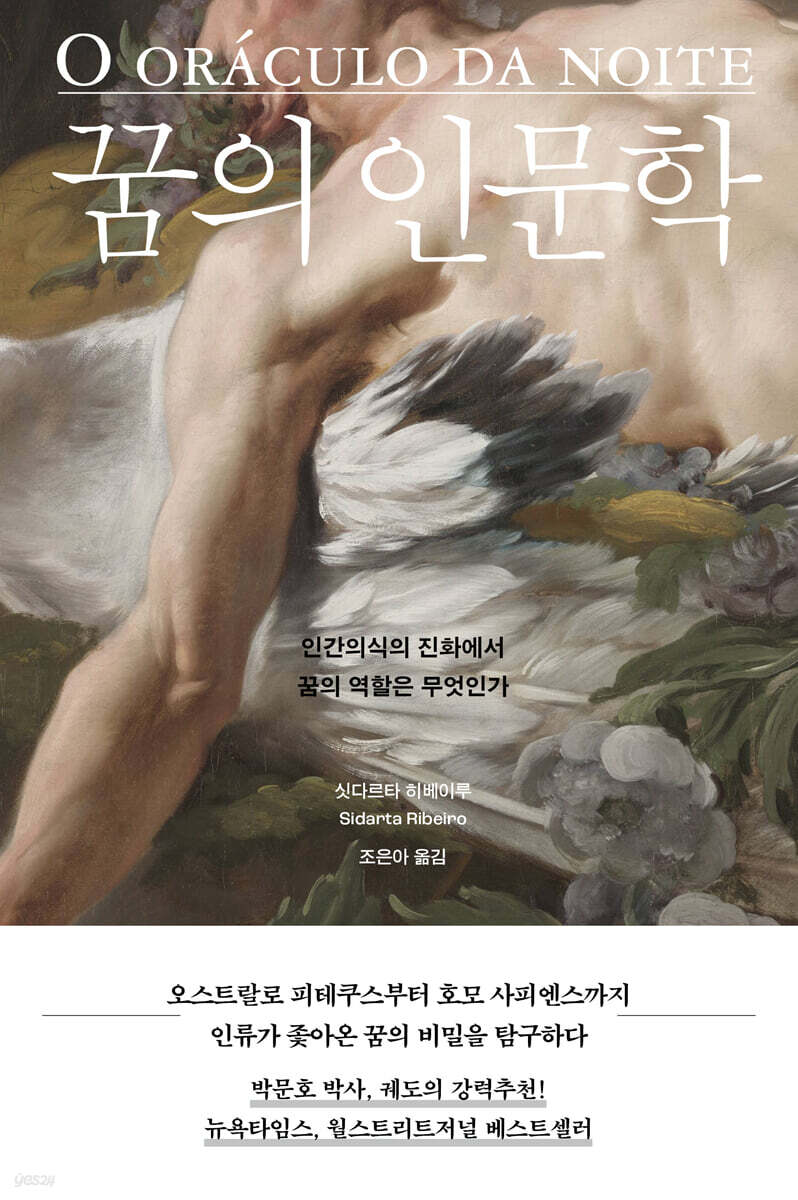
Dream Humanities
 |
Description
Book Introduction
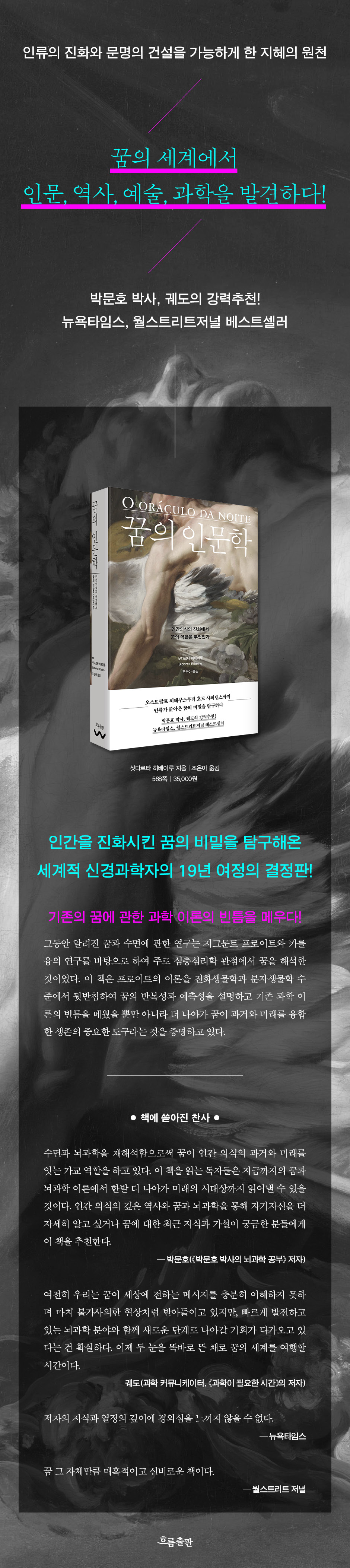
★ Dr. Park Moon-ho, highly recommended by Orbit!
★ New York Times and Wall Street Journal bestseller
“A remarkable book that covers history, literature, biology, anthropology, neuroscience, sociology, and psychology from all over the world.”
- The New York Times
“A rousing journey through history, from cave paintings and Greek and Egyptian mythology to Julius Caesar.”
- The Wall Street Journal
The source of wisdom that enabled human evolution and the construction of civilization
Discover humanities, history, art, and science in the dream world.
We all dream every night.
Dreams can be so realistic that they startle you awake, but other times they are so full of enigmatic symbolism that they leave you pondering them long after you've woken up.
Why do we dream? What do dreams reveal to us? What can we learn from them? "The Humanities of Dreams" is the culmination of 19 years of research by Professor Siddhartha Ribeiro, a world-renowned neuroscientist who founded the Brain Institute at the Federal University of Rio Grande do Norte in Brazil and is also a member of the governing body of the Latin American School of Education, Cognition, and Neuroscience. He explores the impact of dreams and sleep on human cognitive development, spanning not only science but also history and art.
How did dreams and sleep influence the evolution of humans from primates to Homo sapiens? At night, people gathered around a campfire to sleep, and in the morning, they shared their dreams from the previous night.
Humans let their imagination run wild with the symbols that appeared in their dreams, and built temples and cities based on those stories.
As tools became more complex, so did the human mind, and dreams made humanity's cognitive leap possible.
'Neural Darwinism', which explains the selective strengthening of connections between neurons and synapses for memory, and 'secondary consciousness', which explains the strengthening of consciousness through one's own subjective choice, have been the mainstream theories related to the brain's mental functions so far.
Ribeiro went one step further here.
Simulations that appear as precognitive dreams dramatically increase human cognitive abilities, and lucid dreams expand the depth of thought by awakening consciousness in the infinite space of possibility that is dreams.
Therefore, human consciousness can move on to the next stage of evolution in dreams.
This book explores the next stage of human consciousness by gathering theories that have been studied so far on dreams and consciousness.
By examining the evolutionary stages of human consciousness through a wealth of historical materials from around the world, from ancient murals, clay tablets, the Bible, the Vedas, and myths passed down among tribes across the continent to the latest brain science and dream research, we transform the subjectivity of dreams into universal characteristics, changing the perception of dreams from an individual experience to an experience shared by all of humanity.
In this book, readers will explore the defining moments when dreams influenced human history and culture, and discover the incredible power and potential of dreams.
★ New York Times and Wall Street Journal bestseller
“A remarkable book that covers history, literature, biology, anthropology, neuroscience, sociology, and psychology from all over the world.”
- The New York Times
“A rousing journey through history, from cave paintings and Greek and Egyptian mythology to Julius Caesar.”
- The Wall Street Journal
The source of wisdom that enabled human evolution and the construction of civilization
Discover humanities, history, art, and science in the dream world.
We all dream every night.
Dreams can be so realistic that they startle you awake, but other times they are so full of enigmatic symbolism that they leave you pondering them long after you've woken up.
Why do we dream? What do dreams reveal to us? What can we learn from them? "The Humanities of Dreams" is the culmination of 19 years of research by Professor Siddhartha Ribeiro, a world-renowned neuroscientist who founded the Brain Institute at the Federal University of Rio Grande do Norte in Brazil and is also a member of the governing body of the Latin American School of Education, Cognition, and Neuroscience. He explores the impact of dreams and sleep on human cognitive development, spanning not only science but also history and art.
How did dreams and sleep influence the evolution of humans from primates to Homo sapiens? At night, people gathered around a campfire to sleep, and in the morning, they shared their dreams from the previous night.
Humans let their imagination run wild with the symbols that appeared in their dreams, and built temples and cities based on those stories.
As tools became more complex, so did the human mind, and dreams made humanity's cognitive leap possible.
'Neural Darwinism', which explains the selective strengthening of connections between neurons and synapses for memory, and 'secondary consciousness', which explains the strengthening of consciousness through one's own subjective choice, have been the mainstream theories related to the brain's mental functions so far.
Ribeiro went one step further here.
Simulations that appear as precognitive dreams dramatically increase human cognitive abilities, and lucid dreams expand the depth of thought by awakening consciousness in the infinite space of possibility that is dreams.
Therefore, human consciousness can move on to the next stage of evolution in dreams.
This book explores the next stage of human consciousness by gathering theories that have been studied so far on dreams and consciousness.
By examining the evolutionary stages of human consciousness through a wealth of historical materials from around the world, from ancient murals, clay tablets, the Bible, the Vedas, and myths passed down among tribes across the continent to the latest brain science and dream research, we transform the subjectivity of dreams into universal characteristics, changing the perception of dreams from an individual experience to an experience shared by all of humanity.
In this book, readers will explore the defining moments when dreams influenced human history and culture, and discover the incredible power and potential of dreams.
- You can preview some of the book's contents.
Preview
index
Chapter 1: Why We Dream
Chapter 2: The Dream of Our Ancestors
Chapter 3: From the Living God to Psychoanalysis
Chapter 4: Interpretation of Dreams
Chapter 5 First Image
Chapter 6: The Evolution of Dreams
Chapter 7: The Biochemistry of Dreams
Chapter 8: Insanity is a dream you dream alone.
Chapter 9: Sleep and Memory
Chapter 10: Echoes of Memory
Chapter 11: Genes and Memes
Chapter 12 Sleep for Creation
Chapter 13: Are you not dreaming during REM sleep?
Chapter 14: Desire, Emotion, and Nightmare
Chapter 15 Probabilistic Prophecy
Chapter 16: Longing for the Dead
Chapter 17: Is there a future in dreams?
Chapter 18: Dreams and Destiny
Epilogue
References
Chapter 2: The Dream of Our Ancestors
Chapter 3: From the Living God to Psychoanalysis
Chapter 4: Interpretation of Dreams
Chapter 5 First Image
Chapter 6: The Evolution of Dreams
Chapter 7: The Biochemistry of Dreams
Chapter 8: Insanity is a dream you dream alone.
Chapter 9: Sleep and Memory
Chapter 10: Echoes of Memory
Chapter 11: Genes and Memes
Chapter 12 Sleep for Creation
Chapter 13: Are you not dreaming during REM sleep?
Chapter 14: Desire, Emotion, and Nightmare
Chapter 15 Probabilistic Prophecy
Chapter 16: Longing for the Dead
Chapter 17: Is there a future in dreams?
Chapter 18: Dreams and Destiny
Epilogue
References
Detailed image
Into the book
Recording your dreams as soon as you wake up is a simple habit that can greatly enrich your dream life.
In just a few days, even people who couldn't remember their dreams can fill up a few pages of a dream diary.
Dream diaries have been recommended since ancient times as a way to stimulate dream memory.
According to the 5th-century scholar Macrobius, dream research fundamentally depends on recording reliable dream narratives.
The 20th-century psychiatrists Sigmund Freud and Carl Jung developed the interpretation of these records into a new field of mental science called depth psychology.
But not everyone needs to sit on the psychoanalyst's couch and spend hours talking about their dreams and trying to interpret them.
Just give yourself a gentle hint before you go to sleep, and when you wake up, just lie still in bed and wait for Pandora's treasure box to open.
Self-hypnosis is something you just have to repeat for one minute before going to sleep.
“I will dream a dream and remember it and tell it.”
When I wake up, I grab a piece of paper and a pencil and try to remember my dream.
It may seem impossible at first, but soon some image or scene will come to mind, however faintly.
To amplify the echo of memory, you must concentrate your mind and hold on to your dream.
---From "Chapter 1 Why Do We Dream"
Dreams must have plagued most of the 1.168 billion nights that separate us from our oldest ancestors, like Little Lucy, the fossilized Australopithecus afarensis who lived 3.2 million years ago in what is now Ethiopia.
How mysterious and enchanting must the Stone Age nights have been? Throughout the freezing and thawing periods, the excruciatingly long nights shimmered with dreamlike ecstasy and terror, and in the mornings, the same questions were endlessly repeated.
Was that really true?
To make any reasonable guesses about our ancestors' dreams, we must assume a significant continuity between their minds and ours.
In any case, Homo sapiens have been anatomically identical for at least 315,000 years.
Moreover, some evidence suggests that they also share cultural similarities with their genetically close representative subspecies, the Neanderthals of Europe and later West Asia, and the Denisovans of Siberia.
Therefore, it can be assumed that our oldest ancestors also dreamed while sleeping, just like us.
---From "Chapter 2: The Ancestors' Dreams"
The first humans, who spread across Africa millions of years ago, were well-equipped to sleep and dream like other mammals.
After a thousand people left East Africa in droves 70,000 years ago, their descendants spread across Asia, Oceania, Europe, and the Americas over the next thousand years, and our ancestors successfully carried their dreams of dangerous escape and hunting out of the African continent.
The long trajectory of our ancestors across the globe has gradually pushed us out of the natural world and into the cultural world, changing the way we sleep and creating a dream space filled with symbols to represent all manner of creatures, objects, and even the imaginary.
To understand these changes, we need to take a closer look at the biochemistry that controls the products of our imagination.
---From "Chapter 6: The Evolution of Dreams"
So how does the brain distinguish between memories to keep and those to erase? How can it retain so many memories while remaining inactive?
The solution to this riddle was found by Donald Hebb.
He proposed that the consolidation of long-term memory occurs in two successive stages.
In the first stage, the information is immediately recorded as electrical echoes in the nervous system, creating an immediate but fleeting impression of the recent past.
This resonance fades within minutes, but it triggers molecular mechanisms that alter the chemical composition and, later, the actual shape of the synapse.
The second stage involves ions crossing cell membranes, proteins binding together, genes being activated, and new proteins being made, and as memories are acquired, a 'domino effect' of molecules continues moment by moment, remodeling numerous synapses.
Through this process of creating, removing, and modifying synapses, memories are stored long-term, and from this point on, representations that correspond to latent patterns of synaptic connections that are inactive rather than active functions of the neural network are perpetuated.
Days, months, or even years after a memory is acquired, some of these connections become activated, causing the electrical activity to spread throughout the neural network through the strongest connections, resurrecting the memory.
The brain can maintain a vast memory library without confusion by storing old memories in an inactive state.
---From "Chapter 11 Genes and Memes"
Many anti-Freudian claims, which had been repeated throughout the 20th century as empty propaganda slogans, lost their heat in the face of Soames's empirical findings.
For example, the rich and interesting meaning of dreams can no longer be dismissed as a useless byproduct of REM sleep.
We cannot continue to tolerate the view that dreams are merely a series of random images.
As evidence suggests, dreams are a series of images generated by a dopamine-activated reward-punishment system, and because everything takes place simulated in the safe environment of the mind, they are a process in which adaptive behaviors can be attempted, evaluated, and selected without putting the body at any risk.
---From "Chapter 13: Are You Not Dreaming During REM Sleep?"
There have also been studies comparing awareness of time during lucid dreams and while awake.
The time it takes to perform mental tasks that do not involve movement or physical effort is the same in dreams as in reality, but the time it takes to perform motor tasks such as walking or exercising can be up to 40 percent longer in dreams than in reality.
It is not yet known whether the increased performance time on motor tasks during lucid dreams reflects a possible delay in motor processing during REM sleep, or the absence of muscle signals that could feed back dream movements to the brain.
Although the tasks we have investigated so far are modest, we still anticipate its potential as a field for limitless mental training.
A recent study showed that eye movements during lucid dreaming are more similar to perception with eyes open than to visual imagery with eyes closed.
There is mounting scientific evidence that lucid dreaming is actually a state of inner awakening.
In just a few days, even people who couldn't remember their dreams can fill up a few pages of a dream diary.
Dream diaries have been recommended since ancient times as a way to stimulate dream memory.
According to the 5th-century scholar Macrobius, dream research fundamentally depends on recording reliable dream narratives.
The 20th-century psychiatrists Sigmund Freud and Carl Jung developed the interpretation of these records into a new field of mental science called depth psychology.
But not everyone needs to sit on the psychoanalyst's couch and spend hours talking about their dreams and trying to interpret them.
Just give yourself a gentle hint before you go to sleep, and when you wake up, just lie still in bed and wait for Pandora's treasure box to open.
Self-hypnosis is something you just have to repeat for one minute before going to sleep.
“I will dream a dream and remember it and tell it.”
When I wake up, I grab a piece of paper and a pencil and try to remember my dream.
It may seem impossible at first, but soon some image or scene will come to mind, however faintly.
To amplify the echo of memory, you must concentrate your mind and hold on to your dream.
---From "Chapter 1 Why Do We Dream"
Dreams must have plagued most of the 1.168 billion nights that separate us from our oldest ancestors, like Little Lucy, the fossilized Australopithecus afarensis who lived 3.2 million years ago in what is now Ethiopia.
How mysterious and enchanting must the Stone Age nights have been? Throughout the freezing and thawing periods, the excruciatingly long nights shimmered with dreamlike ecstasy and terror, and in the mornings, the same questions were endlessly repeated.
Was that really true?
To make any reasonable guesses about our ancestors' dreams, we must assume a significant continuity between their minds and ours.
In any case, Homo sapiens have been anatomically identical for at least 315,000 years.
Moreover, some evidence suggests that they also share cultural similarities with their genetically close representative subspecies, the Neanderthals of Europe and later West Asia, and the Denisovans of Siberia.
Therefore, it can be assumed that our oldest ancestors also dreamed while sleeping, just like us.
---From "Chapter 2: The Ancestors' Dreams"
The first humans, who spread across Africa millions of years ago, were well-equipped to sleep and dream like other mammals.
After a thousand people left East Africa in droves 70,000 years ago, their descendants spread across Asia, Oceania, Europe, and the Americas over the next thousand years, and our ancestors successfully carried their dreams of dangerous escape and hunting out of the African continent.
The long trajectory of our ancestors across the globe has gradually pushed us out of the natural world and into the cultural world, changing the way we sleep and creating a dream space filled with symbols to represent all manner of creatures, objects, and even the imaginary.
To understand these changes, we need to take a closer look at the biochemistry that controls the products of our imagination.
---From "Chapter 6: The Evolution of Dreams"
So how does the brain distinguish between memories to keep and those to erase? How can it retain so many memories while remaining inactive?
The solution to this riddle was found by Donald Hebb.
He proposed that the consolidation of long-term memory occurs in two successive stages.
In the first stage, the information is immediately recorded as electrical echoes in the nervous system, creating an immediate but fleeting impression of the recent past.
This resonance fades within minutes, but it triggers molecular mechanisms that alter the chemical composition and, later, the actual shape of the synapse.
The second stage involves ions crossing cell membranes, proteins binding together, genes being activated, and new proteins being made, and as memories are acquired, a 'domino effect' of molecules continues moment by moment, remodeling numerous synapses.
Through this process of creating, removing, and modifying synapses, memories are stored long-term, and from this point on, representations that correspond to latent patterns of synaptic connections that are inactive rather than active functions of the neural network are perpetuated.
Days, months, or even years after a memory is acquired, some of these connections become activated, causing the electrical activity to spread throughout the neural network through the strongest connections, resurrecting the memory.
The brain can maintain a vast memory library without confusion by storing old memories in an inactive state.
---From "Chapter 11 Genes and Memes"
Many anti-Freudian claims, which had been repeated throughout the 20th century as empty propaganda slogans, lost their heat in the face of Soames's empirical findings.
For example, the rich and interesting meaning of dreams can no longer be dismissed as a useless byproduct of REM sleep.
We cannot continue to tolerate the view that dreams are merely a series of random images.
As evidence suggests, dreams are a series of images generated by a dopamine-activated reward-punishment system, and because everything takes place simulated in the safe environment of the mind, they are a process in which adaptive behaviors can be attempted, evaluated, and selected without putting the body at any risk.
---From "Chapter 13: Are You Not Dreaming During REM Sleep?"
There have also been studies comparing awareness of time during lucid dreams and while awake.
The time it takes to perform mental tasks that do not involve movement or physical effort is the same in dreams as in reality, but the time it takes to perform motor tasks such as walking or exercising can be up to 40 percent longer in dreams than in reality.
It is not yet known whether the increased performance time on motor tasks during lucid dreams reflects a possible delay in motor processing during REM sleep, or the absence of muscle signals that could feed back dream movements to the brain.
Although the tasks we have investigated so far are modest, we still anticipate its potential as a field for limitless mental training.
A recent study showed that eye movements during lucid dreaming are more similar to perception with eyes open than to visual imagery with eyes closed.
There is mounting scientific evidence that lucid dreaming is actually a state of inner awakening.
---From "Chapter 18: The Fate of Dreams"
Publisher's Review
From the world of stars 3.2 million years ago to the present
Humanity has always been a dreaming being.
The reason humans were able to achieve civilization, unlike other animals, was because of their ability to imagine.
The reason I was able to imagine was because I had a dream.
Only humans have given meaning to what they experience in their dreams and recorded it.
The Les Trois Freres cave in the French Pyrenees Mountains contains a painting believed to date back to the Paleolithic period, depicting a man with the head of a bison, human legs, and a flute.
Built 11,000 years ago on the Anatolian Plateau, Gobekli Tepe is believed to have been a sanctuary that served a religious function unrelated to daily life.
Based on these historical data, we can see that our ancestors had a concept of a world different from the real world.
That world is soon to be a dream space.
To make any reasonable guesses about our ancestors' dreams, we must assume a significant continuity between their minds and ours.
In any case, Homo sapiens have been anatomically identical for at least 315,000 years.
Moreover, some evidence suggests that they also share cultural similarities with their genetically close representative subspecies, the Neanderthals of Europe and later West Asia, and the Denisovans of Siberia.
Therefore, it can be assumed that our oldest ancestors also dreamed while sleeping, just like us.
- From Chapter 2, “Dreams of the Ancestors”
Dopamine-based reward system
Filling in the Gaps in Scientific Theory of Dreams
Previously known studies on dreams and sleep were based on the work of Sigmund Freud and Carl Jung, and mainly interpreted dreams from a depth psychology perspective.
However, Freud's theory was often controversial because dreams and the mind were difficult to observe clearly, were subjective and ambiguous areas, and because of the interpretation based on sexual desire.
The idea that mental and physical symptoms could be caused by mere thoughts and not necessarily by brain lesions did not appeal to neurologists who valued hard data.
Still, it wasn't as shocking as the claim that children have sexual desires.
Today, there is no longer any doubt that dreams have a special meaning for the dreamer, beyond the role of sleep in memory processing.
This is a fact that is so obvious to anyone who has ever paid attention to their dreams, but it has been denied in various ways by philosophers and scientists who oppose Freud's views and claim that REM sleep is the definitive proof of the meaninglessness of dreams.
Why waste time investigating subjective accounts of nocturnal hallucinations when measurable physiological conditions are within reach of even the most well-equipped and serious researchers?
- From Chapter 13, “Aren’t you dreaming during REM sleep?”
Efforts to scientifically elucidate the relationship between REM sleep and dreams were pioneered by South African neurologist Mark Soames.
Soames discovered that dopamine and the reward system are related to dreams.
The less dopamine you have, the less you dream, and the more dopamine you have, the more you dream.
This gives us a new understanding that dreams are not just random images, but images generated by the dopamine-activated reward system, and that these are simulations that the brain uses to protect the body from dangerous situations.
Deep within the brain, in the tiny ventral tegmental area (VTA), are the axons or cell bodies of neurons that produce dopamine.
Dopaminergic neurons in this region project axons widely throughout the brain and are primarily responsible for transmitting neurochemical signals that enable animals to avoid pain and seek pleasure. Damage to the VTA or loss of axonal projections can completely eliminate dreaming without affecting REM sleep.
This damage leads to loss of motivation and enjoyment of waking life and a decrease in planning.
This is because the VTA is essential to the brain's punishment and reward systems, and this brain structure allows us to pursue goals, avoid noxious stimuli, satisfy libido, and learn from positive and negative experiences.
This system actually gives us expectations, satisfaction, and frustration, and is crucial for expressing our instinct to fight with all our might for survival even in desperate situations.
- From Chapter 13, “Aren’t you dreaming during REM sleep?”
Ribeiro explains the repetitiveness and predictability of dreams by supporting Freud's theory at the level of molecular biology, which studies brain nerve units such as neurons and synapses, and 'neural Darwinism', which views the development of brain nerves through evolutionary theory.
Intense experiences strengthen synaptic connections, making them memorable and causing us to dream of the same content repeatedly. The more survival-related the information is, the more it is simulated in various forms and appears as prophetic dreams.
Ribeiro added imagination and cognitive abilities to these studies.
Dreams also predict what will happen in the future.
The moment humans see the future in their dreams, their consciousness and cognitive abilities make a significant leap forward.
After the invention of the spear, it took our ancestors 400,000 years to acquire another groundbreaking tool.
This tool requires at least three elements to function properly: a wooden bow, an elastic string, and an arrow.
Who first came up with this idea? The oldest evidence dates back at least 10,000 years.
Was it a nighttime dream or a daytime reverie? We'll never know, but it's clear that the idea quickly spread across nearly every continent.
In short, the trajectory of human development is characterized by the complexity of tools and the mental states of those who designed them.
- From Chapter 15, “Probabilistic Prophecy”
The dream of creation and
Cultural Universality and Dream Interpretation
We cannot talk about religion, science, and art without mentioning dreams.
Religious leaders heard the message of truth in a dream.
Many scientists have found hints for new discoveries in their dreams, such as August Kekule, who discovered the structure of the benzene ring after seeing a snake biting its own tail in his dream.
Salvador Dali even wrote about a method of collecting dream images, such as holding a heavy metal object in his hand and falling, waking up when the object made a loud noise, and capturing the moment of inspiration.
It is a famous anecdote that the melody of Paul McCartney's song "Yesterday" originated from a dream.
Artists often talk about creative dreams.
For example, musicians often 'compose' melodies while asleep and then wake up.
Anecdotes of this type can easily be found in many classical composers, such as Beethoven and Handel.
Italian violinist Giuseppe Tartini claimed that one of his most famous works, the G minor sonata "The Devil's Trill Sonata", was directly inspired by a dream.
- From Chapter 12, “Sleep for Creation”
We all know the story of how Silla's Kim Yu-sin's sister became queen after having a dream of urine covering Seorabeol.
What's impressive is that dreams like this can be found all over the world.
Mother, father, wise old man, creation, flood, etc. are narratives and characters that appear throughout human history.
Because the way we live appears in our dreams, the narratives and symbols of birth, puberty, sex, childbirth, fighting, illness, and death, which are common experiences for all people, are images that often appear in dreams.
This shows us that dreams are not just personal experiences, but encompass the entire history of mankind.
What dreams show us is a message from our ancestors and the answer to every problem that humanity has ever pondered.
One thing that is unique to humans is that we use language to describe not only our waking experiences, but also our dreams.
As humans acquired a rich vocabulary, complex speech patterns, and the ability to memorize, recall, and retell, narrative became much more complex and engaging.
Dreams have played a vital role in developing human narrative abilities, providing a source of new images, ideas, longings, and fears every night.
Dreams were the movies of our ancestors, and they were all the more fascinating because they could become reality.
Over the past few million years, during the long dawn of human consciousness, our prehistoric ancestors must have experienced countless hazy moments of waking up startled by the infinite replicas of their dream world.
They would have realized with each sunrise that dreams were fiction, but this realization would have led them to believe that even if dreams were fake, they could still influence the course of reality.
- From Chapter 2, “Dreams of the Ancestors”
The direction humanity, which has lost its dreams, must take
As electricity was invented and city lights increased waking hours, sleep time decreased and humans began to dream less and less.
Modern society's problems, such as the gap between the rich and the poor, the climate crisis, and pandemics, leave little time to find solutions in dreams.
However, insomnia is still prevalent.
Time is always running out, and we wake up to the sound of the alarm going off every day, but we become drowsy, the amount of work we have to do only increases, and we rarely have the opportunity to reflect on our inner selves, so few people remember their dreams.
In an age where insomnia is rampant and yawning is a daily occurrence, we have come to question the very existence of dreams.
- From Chapter 1, “Why Do We Dream?”
Lucid dreaming is the ultimate learning space, where you can expand your consciousness beyond your present state with limitless imagination in a dream without limitations.
In an age of dreamless humanity, Ribeiro suggests that beyond simply receiving dream prophecies, we can directly perceive our dreams and delve deeply into our inner consciousness, thereby fostering human creativity and simulation abilities, and helping humanity advance toward a better future through dreams, as we have done so far.
If we are to prevent the cultural ratchet from rolling unchecked toward global collapse, we must broaden our perspective.
We must quickly regain the ability to imagine the worst consequences of our most deeply ingrained habits.
From the destruction of our water sources to the dichotomization of our minds and brains, from the accumulation of microplastics to the devastation of Native Americans and Black peoples by COVID-19, from relentless police brutality to persistent male supremacy, from the suicide epidemic to the accelerating deforestation of our remaining unspoiled lands, from severe inequality to rampant corruption, from that most destructive of addictions, money addiction, to the massacre of animals through farming and brutal slaughter, from the exploitation of the weak by capitalism to the demise of nearly all jobs due to the successful introduction of robots, lucid dreaming, in its vastness, has the potential to be a mental space in which to devise solutions to these difficult problems.
- From Chapter 18, “Dreams and Destiny”
Humanity has always been a dreaming being.
The reason humans were able to achieve civilization, unlike other animals, was because of their ability to imagine.
The reason I was able to imagine was because I had a dream.
Only humans have given meaning to what they experience in their dreams and recorded it.
The Les Trois Freres cave in the French Pyrenees Mountains contains a painting believed to date back to the Paleolithic period, depicting a man with the head of a bison, human legs, and a flute.
Built 11,000 years ago on the Anatolian Plateau, Gobekli Tepe is believed to have been a sanctuary that served a religious function unrelated to daily life.
Based on these historical data, we can see that our ancestors had a concept of a world different from the real world.
That world is soon to be a dream space.
To make any reasonable guesses about our ancestors' dreams, we must assume a significant continuity between their minds and ours.
In any case, Homo sapiens have been anatomically identical for at least 315,000 years.
Moreover, some evidence suggests that they also share cultural similarities with their genetically close representative subspecies, the Neanderthals of Europe and later West Asia, and the Denisovans of Siberia.
Therefore, it can be assumed that our oldest ancestors also dreamed while sleeping, just like us.
- From Chapter 2, “Dreams of the Ancestors”
Dopamine-based reward system
Filling in the Gaps in Scientific Theory of Dreams
Previously known studies on dreams and sleep were based on the work of Sigmund Freud and Carl Jung, and mainly interpreted dreams from a depth psychology perspective.
However, Freud's theory was often controversial because dreams and the mind were difficult to observe clearly, were subjective and ambiguous areas, and because of the interpretation based on sexual desire.
The idea that mental and physical symptoms could be caused by mere thoughts and not necessarily by brain lesions did not appeal to neurologists who valued hard data.
Still, it wasn't as shocking as the claim that children have sexual desires.
Today, there is no longer any doubt that dreams have a special meaning for the dreamer, beyond the role of sleep in memory processing.
This is a fact that is so obvious to anyone who has ever paid attention to their dreams, but it has been denied in various ways by philosophers and scientists who oppose Freud's views and claim that REM sleep is the definitive proof of the meaninglessness of dreams.
Why waste time investigating subjective accounts of nocturnal hallucinations when measurable physiological conditions are within reach of even the most well-equipped and serious researchers?
- From Chapter 13, “Aren’t you dreaming during REM sleep?”
Efforts to scientifically elucidate the relationship between REM sleep and dreams were pioneered by South African neurologist Mark Soames.
Soames discovered that dopamine and the reward system are related to dreams.
The less dopamine you have, the less you dream, and the more dopamine you have, the more you dream.
This gives us a new understanding that dreams are not just random images, but images generated by the dopamine-activated reward system, and that these are simulations that the brain uses to protect the body from dangerous situations.
Deep within the brain, in the tiny ventral tegmental area (VTA), are the axons or cell bodies of neurons that produce dopamine.
Dopaminergic neurons in this region project axons widely throughout the brain and are primarily responsible for transmitting neurochemical signals that enable animals to avoid pain and seek pleasure. Damage to the VTA or loss of axonal projections can completely eliminate dreaming without affecting REM sleep.
This damage leads to loss of motivation and enjoyment of waking life and a decrease in planning.
This is because the VTA is essential to the brain's punishment and reward systems, and this brain structure allows us to pursue goals, avoid noxious stimuli, satisfy libido, and learn from positive and negative experiences.
This system actually gives us expectations, satisfaction, and frustration, and is crucial for expressing our instinct to fight with all our might for survival even in desperate situations.
- From Chapter 13, “Aren’t you dreaming during REM sleep?”
Ribeiro explains the repetitiveness and predictability of dreams by supporting Freud's theory at the level of molecular biology, which studies brain nerve units such as neurons and synapses, and 'neural Darwinism', which views the development of brain nerves through evolutionary theory.
Intense experiences strengthen synaptic connections, making them memorable and causing us to dream of the same content repeatedly. The more survival-related the information is, the more it is simulated in various forms and appears as prophetic dreams.
Ribeiro added imagination and cognitive abilities to these studies.
Dreams also predict what will happen in the future.
The moment humans see the future in their dreams, their consciousness and cognitive abilities make a significant leap forward.
After the invention of the spear, it took our ancestors 400,000 years to acquire another groundbreaking tool.
This tool requires at least three elements to function properly: a wooden bow, an elastic string, and an arrow.
Who first came up with this idea? The oldest evidence dates back at least 10,000 years.
Was it a nighttime dream or a daytime reverie? We'll never know, but it's clear that the idea quickly spread across nearly every continent.
In short, the trajectory of human development is characterized by the complexity of tools and the mental states of those who designed them.
- From Chapter 15, “Probabilistic Prophecy”
The dream of creation and
Cultural Universality and Dream Interpretation
We cannot talk about religion, science, and art without mentioning dreams.
Religious leaders heard the message of truth in a dream.
Many scientists have found hints for new discoveries in their dreams, such as August Kekule, who discovered the structure of the benzene ring after seeing a snake biting its own tail in his dream.
Salvador Dali even wrote about a method of collecting dream images, such as holding a heavy metal object in his hand and falling, waking up when the object made a loud noise, and capturing the moment of inspiration.
It is a famous anecdote that the melody of Paul McCartney's song "Yesterday" originated from a dream.
Artists often talk about creative dreams.
For example, musicians often 'compose' melodies while asleep and then wake up.
Anecdotes of this type can easily be found in many classical composers, such as Beethoven and Handel.
Italian violinist Giuseppe Tartini claimed that one of his most famous works, the G minor sonata "The Devil's Trill Sonata", was directly inspired by a dream.
- From Chapter 12, “Sleep for Creation”
We all know the story of how Silla's Kim Yu-sin's sister became queen after having a dream of urine covering Seorabeol.
What's impressive is that dreams like this can be found all over the world.
Mother, father, wise old man, creation, flood, etc. are narratives and characters that appear throughout human history.
Because the way we live appears in our dreams, the narratives and symbols of birth, puberty, sex, childbirth, fighting, illness, and death, which are common experiences for all people, are images that often appear in dreams.
This shows us that dreams are not just personal experiences, but encompass the entire history of mankind.
What dreams show us is a message from our ancestors and the answer to every problem that humanity has ever pondered.
One thing that is unique to humans is that we use language to describe not only our waking experiences, but also our dreams.
As humans acquired a rich vocabulary, complex speech patterns, and the ability to memorize, recall, and retell, narrative became much more complex and engaging.
Dreams have played a vital role in developing human narrative abilities, providing a source of new images, ideas, longings, and fears every night.
Dreams were the movies of our ancestors, and they were all the more fascinating because they could become reality.
Over the past few million years, during the long dawn of human consciousness, our prehistoric ancestors must have experienced countless hazy moments of waking up startled by the infinite replicas of their dream world.
They would have realized with each sunrise that dreams were fiction, but this realization would have led them to believe that even if dreams were fake, they could still influence the course of reality.
- From Chapter 2, “Dreams of the Ancestors”
The direction humanity, which has lost its dreams, must take
As electricity was invented and city lights increased waking hours, sleep time decreased and humans began to dream less and less.
Modern society's problems, such as the gap between the rich and the poor, the climate crisis, and pandemics, leave little time to find solutions in dreams.
However, insomnia is still prevalent.
Time is always running out, and we wake up to the sound of the alarm going off every day, but we become drowsy, the amount of work we have to do only increases, and we rarely have the opportunity to reflect on our inner selves, so few people remember their dreams.
In an age where insomnia is rampant and yawning is a daily occurrence, we have come to question the very existence of dreams.
- From Chapter 1, “Why Do We Dream?”
Lucid dreaming is the ultimate learning space, where you can expand your consciousness beyond your present state with limitless imagination in a dream without limitations.
In an age of dreamless humanity, Ribeiro suggests that beyond simply receiving dream prophecies, we can directly perceive our dreams and delve deeply into our inner consciousness, thereby fostering human creativity and simulation abilities, and helping humanity advance toward a better future through dreams, as we have done so far.
If we are to prevent the cultural ratchet from rolling unchecked toward global collapse, we must broaden our perspective.
We must quickly regain the ability to imagine the worst consequences of our most deeply ingrained habits.
From the destruction of our water sources to the dichotomization of our minds and brains, from the accumulation of microplastics to the devastation of Native Americans and Black peoples by COVID-19, from relentless police brutality to persistent male supremacy, from the suicide epidemic to the accelerating deforestation of our remaining unspoiled lands, from severe inequality to rampant corruption, from that most destructive of addictions, money addiction, to the massacre of animals through farming and brutal slaughter, from the exploitation of the weak by capitalism to the demise of nearly all jobs due to the successful introduction of robots, lucid dreaming, in its vastness, has the potential to be a mental space in which to devise solutions to these difficult problems.
- From Chapter 18, “Dreams and Destiny”
GOODS SPECIFICS
- Date of issue: March 29, 2024
- Page count, weight, size: 568 pages | 950g | 145*218*35mm
- ISBN13: 9788965965862
- ISBN10: 8965965861
You may also like
카테고리
korean


korean

![ELLE 엘르 스페셜 에디션 A형 : 12월 [2025]](http://librairie.coreenne.fr/cdn/shop/files/b8e27a3de6c9538896439686c6b0e8fb.jpg?v=1766436872&width=3840)


