

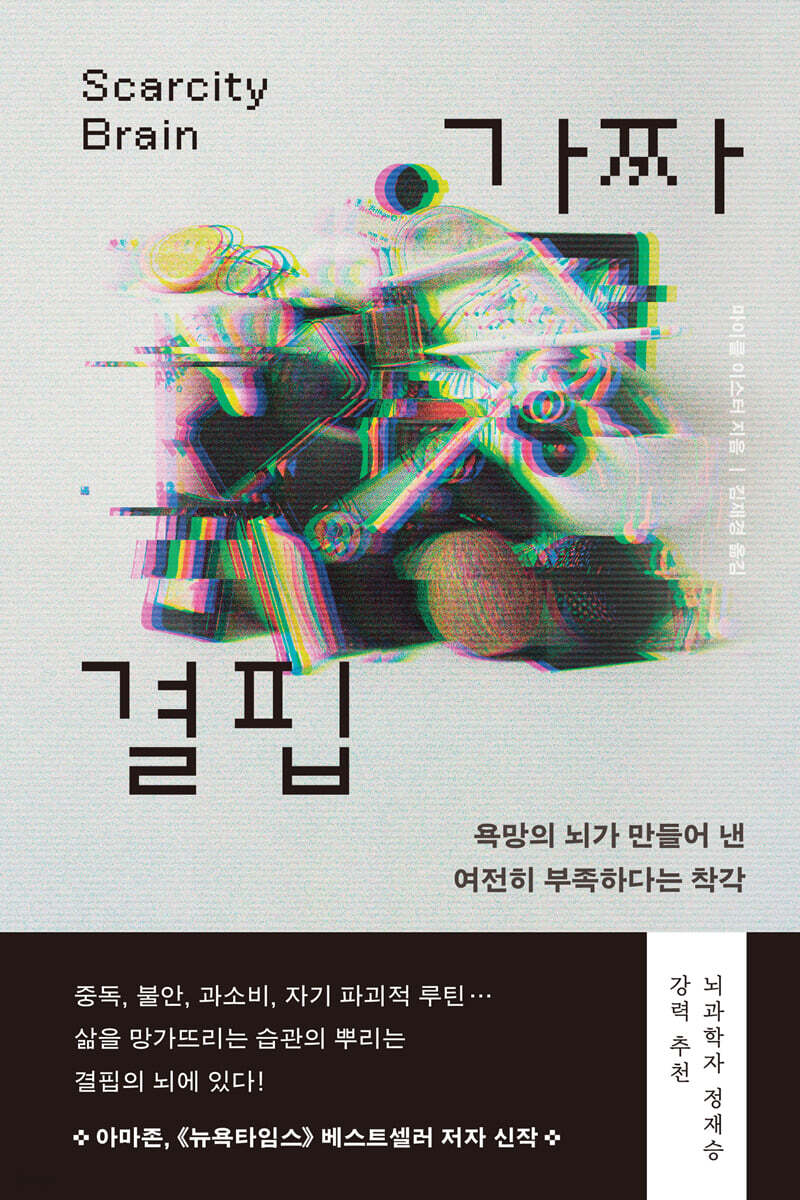
fake deficiency
 |
Description
Book Introduction
★New releases from Amazon and New York Times bestselling authors
★Neuroscientist Jaeseung Jeong strongly recommends Peter Attia's "Disease Liberation"!
In an Age of Abundance, Why Do We Still Feel Insufficient?
Discoveries from evolutionary psychology, brain science, and behavioral economics
How to break the cycle of deprivation and become fulfilled right now
A feeling of emptiness no matter how much you fill it, a feeling of unsatisfaction even when you get what you want.
What is the true nature of this uncomfortable feeling we all vaguely recognize, even without speaking? Journalist and bestselling author Michael Easter traces the roots of human evolution to find the answer.
He says that the feeling of deprivation we feel is not a personal problem, but rather arises because the "deprivation brain," which was optimized for survival in times of resource scarcity in the past, still operates in today's environment of abundant resources.
The brain's evolutionary instinct to fill a void constantly craves more, more often, and more quickly, and as a result, people become trapped in a vicious cycle of chasing momentary comfort instead of long-term growth and satisfaction.
Companies are cleverly exploiting these brain vulnerabilities to further encourage consumption.
"Fake Scarcity" is the essence of investigative journalism, where the author meets with experts in various fields, including evolutionary psychology, brain science, and behavioral economics, and searches for people who have discovered ways to escape the cycle of scarcity.
A two-year, 6,400-kilometer journey that explores the evolutionary limitations of the human brain and the vicious cycle created by the sophisticated temptations of modern society, helping us break the cycle of self-destruction and regain true fulfillment in life.
★Neuroscientist Jaeseung Jeong strongly recommends Peter Attia's "Disease Liberation"!
In an Age of Abundance, Why Do We Still Feel Insufficient?
Discoveries from evolutionary psychology, brain science, and behavioral economics
How to break the cycle of deprivation and become fulfilled right now
A feeling of emptiness no matter how much you fill it, a feeling of unsatisfaction even when you get what you want.
What is the true nature of this uncomfortable feeling we all vaguely recognize, even without speaking? Journalist and bestselling author Michael Easter traces the roots of human evolution to find the answer.
He says that the feeling of deprivation we feel is not a personal problem, but rather arises because the "deprivation brain," which was optimized for survival in times of resource scarcity in the past, still operates in today's environment of abundant resources.
The brain's evolutionary instinct to fill a void constantly craves more, more often, and more quickly, and as a result, people become trapped in a vicious cycle of chasing momentary comfort instead of long-term growth and satisfaction.
Companies are cleverly exploiting these brain vulnerabilities to further encourage consumption.
"Fake Scarcity" is the essence of investigative journalism, where the author meets with experts in various fields, including evolutionary psychology, brain science, and behavioral economics, and searches for people who have discovered ways to escape the cycle of scarcity.
A two-year, 6,400-kilometer journey that explores the evolutionary limitations of the human brain and the vicious cycle created by the sophisticated temptations of modern society, helping us break the cycle of self-destruction and regain true fulfillment in life.
- You can preview some of the book's contents.
Preview
index
The Brain That Feels Lack in Abundance: The Primal Delusion - Jaeseung Jeong
Prologue_The illusion of still being inadequate
Chapter 1: How Addiction Is Designed
The Casino as a Laboratory | Designing Deficiency | Optimizing Addiction | The Three Elements of the Deficiency Cycle
Chapter 2: The Principle of Falling into the Loop of Deficiency
Similar Success, the Most Effective Bait | The Addiction of Unpredictability
Chapter 3: The Chain of Deficiency Is Everywhere
Between Pleasure and Addiction: The Light and Darkness of Deprivation | The Invisible Designers
Chapter 4: People Who Are Dissatisfied
A Society That Forgot to Take Away | Excess Created by Deficiency: The Curse of 'More' | Circumstances Shape Choices
Chapter 5: Liberation: When Yesterday's Comfort Becomes Today's Hell
The Birth of the Captagon Empire | The Survival Instinct That Tightens the Chain of Deprivation | The Origins and Evolutionary Roots of Addiction | The Survival Instinct Strikes Back | Is Addiction Changeable? | Habit Circuits Imprinted in the Brain | A Choice to Break Free from Repetition
Chapter 6 Certainty: What the Numbers Hide
Why we're willing to jump into a game with an unknown outcome | The pain of uncertainty | When scores dominate the experience | When scoring systems encroach on everyday life | The illusion that all data is right
Chapter 7: Influence: The Drugs of Status and Recognition
How the Desire for Status Drives Us | The Brain That Lives for Status | Pride and Shame Measured by Scores | Do You Want to Find the Right Answer or Happiness?
Chapter 8 Food: The Pitfalls of a Rich Meal
Encounters with the Tsimane: Into the Time We Lost | People Who Haven't Lost Enough | The Answer Is on the Table | The Counterattack of Forbidden Foods | The Paradox of the Eating Well Eating Era | The Simple but Powerful 'Moderation' Diet | Ultra-processed Foods That Slowly Destroy Your Heart | A Balanced Diet That Doesn't Trigger the Cycle of Deficiency
Chapter 9: Possessions: Why Having More Makes Us Unhappier
The Algorithm of Desire and the Cycle of Scarcity | The Concept of Ownership Changed by 'Faster' and 'More' | The Problems of Abundance | Creative Solutions from Fewer Resources | The Value of Hard-won Things: No Story Without Problem | Reduction Isn't the Only Answer | Buying Gear, Not Things
Chapter 10: The Light and Dark Side of Information Geeks with the Wanderlust Gene
Tiktaalik, the first explorer to demonstrate our inherent exploration instinct | Animals that explore for the sole purpose of exploring | Media strategies that stimulate the brain of deprivation | An age of ignorance overflowing with experts | Information obtained without question is poison | The joy of discovery in the unknown | The architects of the circle of abundance
Chapter 11 Happiness: Averages, Not Resulting Values
Everyone has their own 'share' | Happiness is the root of all desires | Enlightenment gained in solitude | The tranquility of rules and moderation | Meaning over utility: the quiet calling of labor | Freedom from material things | What silence tells us | Balancing body and soul | A walk into the abyss: Happiness is not an outcome, but a journey.
Epilogue: It's All About Choice
Acknowledgements
Prologue_The illusion of still being inadequate
Chapter 1: How Addiction Is Designed
The Casino as a Laboratory | Designing Deficiency | Optimizing Addiction | The Three Elements of the Deficiency Cycle
Chapter 2: The Principle of Falling into the Loop of Deficiency
Similar Success, the Most Effective Bait | The Addiction of Unpredictability
Chapter 3: The Chain of Deficiency Is Everywhere
Between Pleasure and Addiction: The Light and Darkness of Deprivation | The Invisible Designers
Chapter 4: People Who Are Dissatisfied
A Society That Forgot to Take Away | Excess Created by Deficiency: The Curse of 'More' | Circumstances Shape Choices
Chapter 5: Liberation: When Yesterday's Comfort Becomes Today's Hell
The Birth of the Captagon Empire | The Survival Instinct That Tightens the Chain of Deprivation | The Origins and Evolutionary Roots of Addiction | The Survival Instinct Strikes Back | Is Addiction Changeable? | Habit Circuits Imprinted in the Brain | A Choice to Break Free from Repetition
Chapter 6 Certainty: What the Numbers Hide
Why we're willing to jump into a game with an unknown outcome | The pain of uncertainty | When scores dominate the experience | When scoring systems encroach on everyday life | The illusion that all data is right
Chapter 7: Influence: The Drugs of Status and Recognition
How the Desire for Status Drives Us | The Brain That Lives for Status | Pride and Shame Measured by Scores | Do You Want to Find the Right Answer or Happiness?
Chapter 8 Food: The Pitfalls of a Rich Meal
Encounters with the Tsimane: Into the Time We Lost | People Who Haven't Lost Enough | The Answer Is on the Table | The Counterattack of Forbidden Foods | The Paradox of the Eating Well Eating Era | The Simple but Powerful 'Moderation' Diet | Ultra-processed Foods That Slowly Destroy Your Heart | A Balanced Diet That Doesn't Trigger the Cycle of Deficiency
Chapter 9: Possessions: Why Having More Makes Us Unhappier
The Algorithm of Desire and the Cycle of Scarcity | The Concept of Ownership Changed by 'Faster' and 'More' | The Problems of Abundance | Creative Solutions from Fewer Resources | The Value of Hard-won Things: No Story Without Problem | Reduction Isn't the Only Answer | Buying Gear, Not Things
Chapter 10: The Light and Dark Side of Information Geeks with the Wanderlust Gene
Tiktaalik, the first explorer to demonstrate our inherent exploration instinct | Animals that explore for the sole purpose of exploring | Media strategies that stimulate the brain of deprivation | An age of ignorance overflowing with experts | Information obtained without question is poison | The joy of discovery in the unknown | The architects of the circle of abundance
Chapter 11 Happiness: Averages, Not Resulting Values
Everyone has their own 'share' | Happiness is the root of all desires | Enlightenment gained in solitude | The tranquility of rules and moderation | Meaning over utility: the quiet calling of labor | Freedom from material things | What silence tells us | Balancing body and soul | A walk into the abyss: Happiness is not an outcome, but a journey.
Epilogue: It's All About Choice
Acknowledgements
Detailed image
.jpg)
Into the book
Sal said.
“What makes gambling so alluring is that it combines measurable risk with measurable reward.
It's not just the possibility of winning that matters.
The possibility of losing something that society actually values is also important.
In that sense, nothing is as tangible as money.
“The risks and opportunities associated with it are clear,” says a study conducted at Columbia University, which supports Sal’s claims.
Researchers have found that the more likely a particular event is to lead to a clear reward or loss, the more likely it is that a person will feel a sort of euphoria while waiting for the outcome.
Whether you're betting on a gamble and waiting for the results, or going to the hospital for a test and waiting for the diagnosis, you feel that same tension and thrill.
--- From "Chapter 1: How Addiction is Designed"
All animals, including humans, tend to want a reward 'indefinitely' more when they cannot be sure whether they will receive it or not, that is, when the reward is unpredictable.
Unpredictability makes us more attached to rewards and more likely to immediately repeat the behavior that leads to those rewards.
Zental says:
“The anticipation of a possible reward greatly excites the dopamine system.
“Dopamine peaks when we’re not sure if we’ll get a reward.” Unpredictable rewards send us into a whirlwind of excitement.
Similar successes and failures that masquerade as successes ignite our dopamine systems, prompting us to try for immediate repetition.
--- From "Chapter 2: The Principle of Falling into the Loop of Deficiency"
Edward Bernays, the genius of propaganda and master of public relations, wrote in 1928:
“Almost all of our daily actions are governed by a small minority who understand mass psychology and social habits.
We are controlled by people we have never heard of, who shape our minds, shape our tastes, and indoctrinate us with our thoughts.
“They are the ones who control and manipulate the public like puppets.”
--- From “Chapter 3: The Link of Deficiency is Everywhere”
In the deficit brain, 'more' is the norm, and 'less' is almost completely out of the question.
So when we consider subtraction, we tend to think of it as copper.
“People structurally turn a blind eye to the act of subtraction.
If you were given the choice of adding or subtracting and chose to add, you might say something different.
But if people don't even think about the basic act of subtracting, then that's a big problem.
It could be said to be the most fundamental question about how humans can create better things.
"Are we going to add? Do we do more? Or are we going to subtract? Do we do less? It's becoming increasingly clear that people are structurally turning away from the subtraction and the less."
--- From "Chapter 4: People Who Are Not Satisfied"
Addiction is not a simple choice.
Addiction is the sum total of choices we make over and over again, unable to make different choices due to environmental, biological, or historical reasons.
In other words, it is the result of constant learning.
It's like gaining weight.
No one chooses to be obese.
But over time, some people gain weight and become obese.
These results are the result of the small choices we make every day.
If you choose what, why, and how much to eat several times a day, it becomes a habit.
This applies to any habit that repeats the same pattern: spending too much time online, shopping all day, working too hard for too long, gambling too often, or obsessing over a hobby at the expense of family time—any habit that provides a sense of freedom and security in the short term but causes problems in the long run.
--- From "Chapter 5 Liberation: When Yesterday's Comfort Becomes Today's Hell"
“It’s fascinating how numbers can have such a powerful impact on us, both emotionally and behaviorally.
Numbers may seem like a very natural thing, but in fact, they are unnatural in many ways.
It is quite possible to argue that our brains are not innately equipped with the concept of numbers.
Looking at the history of the human species, the emergence of sophisticated numbers is almost an anomaly.
Yet, the cultural trajectory of the past millennia, and especially the past few hundred years, has led us to quantify everything and to believe that quantification is the absolute truth.
When someone talks to you with exact numbers, I think it's true and profound.
It seems like there's some basis for it.
Now that you know the exact numbers, you can just relax without thinking about it any further.
Of course, that's not the case." When we created numbers, numbers created us.
But if you focus on just one aspect of the experience, you can miss all the other important aspects.
The thought-provoking aspect, the meaningful aspect, the aspect that makes life worth living.
--- From "Chapter 6 Certainty: What Numbers Hide"
The brain of deficiency craves influence.
The more influence you have over others, the more likely you are to survive and spread your genes.
Influence allowed them to secure better mates, survive conflicts, and secure scarce resources.
I could even escape from all the boring and energy-sapping chores.
Anderson said that throughout human history, influences have acted like either vitamins or toxins.
“It seems that a person’s subjective happiness, self-esteem, and physical and mental health depend on how high the status they are given by others.”
--- From "Chapter 7 Influence: The Drugs of Status and Recognition"
Over time, our brains have become accustomed to tasty junk food.
Guine says.
“Such foods make us eat more, and our brains become accustomed to them.
Once you start eating ultra-processed foods, you'll never want to eat simple brown rice, broccoli, or fish again.
It's almost like an addiction.”
Knowing these facts, it's easy to feel frustrated with the modern food system.
But there's no need for that.
Food historian Rachel Lordan encourages:
“The biggest misconception about food is that we only have terrible food and terrible food systems.
In fact, we have better food than anyone in history.” We don’t really realize this because few of us have ever experienced a prolonged famine.
Or perhaps you've never read the reports of 19th-century coroners trying to figure out why so many young men died from the horrible boils of pellagra.
--- From "Chapter 8 Food: The Traps of a Rich Meal"
As industrialization sweeps across the globe, our lack brain constantly pushes us to crave more.
We now own so much stuff that there's an entire industry dedicated to managing it.
We buy books and watch TV shows that teach us organizing skills.
Storage facilities, separate spaces we pay to rent to store more of our stuff, have gone beyond mere existence to become one of the fastest-growing businesses in the United States.
There are currently more storage facilities in the United States than McDonald's, Burger King, Starbucks, and Walmart combined. UCLA researchers explain that one reason we accumulate so much stuff is because we lack biological brakes to alert us when we've overpurchased.
Eating and drinking can be excessive, but eventually you will feel full and have to stop.
However, the act of accumulating things (or influence or information) can be repeated quickly and easily.
If you don't have space, just go to a storage facility.
--- From "Chapter 9 Possessions: Why Having More Makes Us Unhappier"
Tommy Blanchard, a researcher at Harvard University's Computational Cognitive Neuroscience Lab, calls humans "information voracious eaters."
It means that 'humans are creatures that search for and digest information, just as carnivores hunt and eat meat.'
The process of exploring the unknown world in search of information followed a cycle of deficiency.
At the base was a yearning and curiosity to find greener grass.
To achieve this, one had to actively utilize both body and mind.
I had to practically risk everything.
Humanity left home and ventured deep into the unknown.
I didn't know anything and couldn't predict what would happen.
Beyond the hill there could be a large herd of game, or conversely, there could be a lot of natural enemies.
Yet, humanity continued to explore until it found a greener region and reaped the rewards.
Even after receiving the reward, I realized that there must be a greener area somewhere else.
This realization thrust humanity back into the cycle of opportunity and reward.
--- From "Chapter 10 Information: The Light and Darkness of Information Geeks with the Wanderlust Gene"
Benedict was convinced that both monks and commoners should take as much as they need, but not more than they need.
This principle applies to everything: food, possessions, influence, etc.
Let's pay attention to the expression 'share'.
It means that we acknowledge that each person has different desires and tendencies.
Most religions preach the importance of moderation or moderation.
Benedict understood that such 'moderation' varied from person to person.
What may be enough for one person may be too much or too little for another.
He further emphasized that self-denial and excessive restraint can foster pride, a materialistic attitude of “I am holier than thou.”
According to Benedict's teaching, too little, as well as too much, is an obstacle to reaching the ultimate goal.
He recognized that the goal that all humans pursue is happiness.
Happiness is the ultimate goal that underlies all actions.
Happiness stimulates the brain of deficiency and triggers a cycle of deficiency.
However, the tragedy of life is not the absence of happiness.
The tragedy is looking for happiness in the wrong places.
Like the Romans Benedict observed, we seek happiness in temporary pleasures like material things, power, recognition, and food.
You get caught in a cycle of deprivation, hoping that 'this time' the slot machine reels will line up and bring you permanent wins.
“What makes gambling so alluring is that it combines measurable risk with measurable reward.
It's not just the possibility of winning that matters.
The possibility of losing something that society actually values is also important.
In that sense, nothing is as tangible as money.
“The risks and opportunities associated with it are clear,” says a study conducted at Columbia University, which supports Sal’s claims.
Researchers have found that the more likely a particular event is to lead to a clear reward or loss, the more likely it is that a person will feel a sort of euphoria while waiting for the outcome.
Whether you're betting on a gamble and waiting for the results, or going to the hospital for a test and waiting for the diagnosis, you feel that same tension and thrill.
--- From "Chapter 1: How Addiction is Designed"
All animals, including humans, tend to want a reward 'indefinitely' more when they cannot be sure whether they will receive it or not, that is, when the reward is unpredictable.
Unpredictability makes us more attached to rewards and more likely to immediately repeat the behavior that leads to those rewards.
Zental says:
“The anticipation of a possible reward greatly excites the dopamine system.
“Dopamine peaks when we’re not sure if we’ll get a reward.” Unpredictable rewards send us into a whirlwind of excitement.
Similar successes and failures that masquerade as successes ignite our dopamine systems, prompting us to try for immediate repetition.
--- From "Chapter 2: The Principle of Falling into the Loop of Deficiency"
Edward Bernays, the genius of propaganda and master of public relations, wrote in 1928:
“Almost all of our daily actions are governed by a small minority who understand mass psychology and social habits.
We are controlled by people we have never heard of, who shape our minds, shape our tastes, and indoctrinate us with our thoughts.
“They are the ones who control and manipulate the public like puppets.”
--- From “Chapter 3: The Link of Deficiency is Everywhere”
In the deficit brain, 'more' is the norm, and 'less' is almost completely out of the question.
So when we consider subtraction, we tend to think of it as copper.
“People structurally turn a blind eye to the act of subtraction.
If you were given the choice of adding or subtracting and chose to add, you might say something different.
But if people don't even think about the basic act of subtracting, then that's a big problem.
It could be said to be the most fundamental question about how humans can create better things.
"Are we going to add? Do we do more? Or are we going to subtract? Do we do less? It's becoming increasingly clear that people are structurally turning away from the subtraction and the less."
--- From "Chapter 4: People Who Are Not Satisfied"
Addiction is not a simple choice.
Addiction is the sum total of choices we make over and over again, unable to make different choices due to environmental, biological, or historical reasons.
In other words, it is the result of constant learning.
It's like gaining weight.
No one chooses to be obese.
But over time, some people gain weight and become obese.
These results are the result of the small choices we make every day.
If you choose what, why, and how much to eat several times a day, it becomes a habit.
This applies to any habit that repeats the same pattern: spending too much time online, shopping all day, working too hard for too long, gambling too often, or obsessing over a hobby at the expense of family time—any habit that provides a sense of freedom and security in the short term but causes problems in the long run.
--- From "Chapter 5 Liberation: When Yesterday's Comfort Becomes Today's Hell"
“It’s fascinating how numbers can have such a powerful impact on us, both emotionally and behaviorally.
Numbers may seem like a very natural thing, but in fact, they are unnatural in many ways.
It is quite possible to argue that our brains are not innately equipped with the concept of numbers.
Looking at the history of the human species, the emergence of sophisticated numbers is almost an anomaly.
Yet, the cultural trajectory of the past millennia, and especially the past few hundred years, has led us to quantify everything and to believe that quantification is the absolute truth.
When someone talks to you with exact numbers, I think it's true and profound.
It seems like there's some basis for it.
Now that you know the exact numbers, you can just relax without thinking about it any further.
Of course, that's not the case." When we created numbers, numbers created us.
But if you focus on just one aspect of the experience, you can miss all the other important aspects.
The thought-provoking aspect, the meaningful aspect, the aspect that makes life worth living.
--- From "Chapter 6 Certainty: What Numbers Hide"
The brain of deficiency craves influence.
The more influence you have over others, the more likely you are to survive and spread your genes.
Influence allowed them to secure better mates, survive conflicts, and secure scarce resources.
I could even escape from all the boring and energy-sapping chores.
Anderson said that throughout human history, influences have acted like either vitamins or toxins.
“It seems that a person’s subjective happiness, self-esteem, and physical and mental health depend on how high the status they are given by others.”
--- From "Chapter 7 Influence: The Drugs of Status and Recognition"
Over time, our brains have become accustomed to tasty junk food.
Guine says.
“Such foods make us eat more, and our brains become accustomed to them.
Once you start eating ultra-processed foods, you'll never want to eat simple brown rice, broccoli, or fish again.
It's almost like an addiction.”
Knowing these facts, it's easy to feel frustrated with the modern food system.
But there's no need for that.
Food historian Rachel Lordan encourages:
“The biggest misconception about food is that we only have terrible food and terrible food systems.
In fact, we have better food than anyone in history.” We don’t really realize this because few of us have ever experienced a prolonged famine.
Or perhaps you've never read the reports of 19th-century coroners trying to figure out why so many young men died from the horrible boils of pellagra.
--- From "Chapter 8 Food: The Traps of a Rich Meal"
As industrialization sweeps across the globe, our lack brain constantly pushes us to crave more.
We now own so much stuff that there's an entire industry dedicated to managing it.
We buy books and watch TV shows that teach us organizing skills.
Storage facilities, separate spaces we pay to rent to store more of our stuff, have gone beyond mere existence to become one of the fastest-growing businesses in the United States.
There are currently more storage facilities in the United States than McDonald's, Burger King, Starbucks, and Walmart combined. UCLA researchers explain that one reason we accumulate so much stuff is because we lack biological brakes to alert us when we've overpurchased.
Eating and drinking can be excessive, but eventually you will feel full and have to stop.
However, the act of accumulating things (or influence or information) can be repeated quickly and easily.
If you don't have space, just go to a storage facility.
--- From "Chapter 9 Possessions: Why Having More Makes Us Unhappier"
Tommy Blanchard, a researcher at Harvard University's Computational Cognitive Neuroscience Lab, calls humans "information voracious eaters."
It means that 'humans are creatures that search for and digest information, just as carnivores hunt and eat meat.'
The process of exploring the unknown world in search of information followed a cycle of deficiency.
At the base was a yearning and curiosity to find greener grass.
To achieve this, one had to actively utilize both body and mind.
I had to practically risk everything.
Humanity left home and ventured deep into the unknown.
I didn't know anything and couldn't predict what would happen.
Beyond the hill there could be a large herd of game, or conversely, there could be a lot of natural enemies.
Yet, humanity continued to explore until it found a greener region and reaped the rewards.
Even after receiving the reward, I realized that there must be a greener area somewhere else.
This realization thrust humanity back into the cycle of opportunity and reward.
--- From "Chapter 10 Information: The Light and Darkness of Information Geeks with the Wanderlust Gene"
Benedict was convinced that both monks and commoners should take as much as they need, but not more than they need.
This principle applies to everything: food, possessions, influence, etc.
Let's pay attention to the expression 'share'.
It means that we acknowledge that each person has different desires and tendencies.
Most religions preach the importance of moderation or moderation.
Benedict understood that such 'moderation' varied from person to person.
What may be enough for one person may be too much or too little for another.
He further emphasized that self-denial and excessive restraint can foster pride, a materialistic attitude of “I am holier than thou.”
According to Benedict's teaching, too little, as well as too much, is an obstacle to reaching the ultimate goal.
He recognized that the goal that all humans pursue is happiness.
Happiness is the ultimate goal that underlies all actions.
Happiness stimulates the brain of deficiency and triggers a cycle of deficiency.
However, the tragedy of life is not the absence of happiness.
The tragedy is looking for happiness in the wrong places.
Like the Romans Benedict observed, we seek happiness in temporary pleasures like material things, power, recognition, and food.
You get caught in a cycle of deprivation, hoping that 'this time' the slot machine reels will line up and bring you permanent wins.
--- From "Chapter 11 Happiness: Average, Not Result"
Publisher's Review
The curse of 'more',
People who are never satisfied
Klotz, an engineering PhD student who was building a bridge with Legos with his three-year-old son, instinctively tried to add more blocks when the structure became unstable.
But his son Ezra solved this problem easily in an unexpected way.
It's just a few blocks removed.
The bridge became more stable as the slope was flattened, and the removed blocks could be used to build more Lego cities.
After this realization, Clotz conducted several experiments.
Participants were asked to stabilize a Lego platform, improve a miniature golf course, or modify a tourist itinerary, adding or subtracting elements.
Even though we had previously announced that we would be charged for each additional element, people were busy adding more.
Although it was possible to somehow solve the problem, it was clearly an inefficient and expensive method.
When asked to make their packed travel schedules 'worse', the majority of participants chose to 'cut' the schedule.
This discovery, which may seem simple at first glance, reveals a long-standing habit in our brains.
The point is that less is considered worse and unproductive.
In other words, the human brain is oriented towards 'more' and 'less' is almost completely ignored.
Let's think about it.
Even though we know they are harmful to our bodies, we continue to eat ultra-processed foods. Even though we suspect serious risks, we indulge in the powerful stimuli of drugs and gambling. Even though we know it is a waste of time, we check the number of likes on social media all day long. Even though we have piles of clothes and other items that we buy but never wear, we continue to spend money unnecessarily.
We always feel like something is missing.
The strange thing is that no matter how much, more often, and faster you constantly fill it, the emptiness remains the same.
Why on earth is that?
Addiction, anxiety, overspending, self-destructive routines…
The roots of life-ruining habits lie in the brain of deficiency!
Easter traces its causes back to its evolutionary roots.
The human brain evolved in an age when resources essential for survival (food, information, strength, possessions, time, pleasure, etc.) were scarce.
We are naturally designed with a 'deficiency brain' that constantly seeks more.
There is a powerful mechanism at work here called the scarcity loop, which consists of three elements: ‘discovery of opportunity,’ ‘unpredictable reward,’ and ‘immediate repeatability.’
In the past, foraging for food was akin to gambling.
If you look around, you will find it, but it is always uncertain when, where, and how much you will find.
Let's say there's a game in the distance (spotting opportunity).
The probability of obtaining food at this time fluctuates wildly.
You may come up empty-handed when you actually approach, or you may get a bigger prey than you expected (unpredictable reward).
Humans repeated this behavior every day, almost all day long, until the opportunity to improve their chances of survival and quality of life presented itself with unpredictable rewards (immediate repeatability).
This is how we have been strengthening our actions in the direction of falling into a cycle of deficiency.
Even in today's world of abundance and excess, our brain's mechanisms for filling in the gaps remain the same.
The behavior patterns that made human survival possible long ago are now secret triggers for forming bad habits that ruin our lives.
This secret trigger is so powerful that it can turn even a perfectly sane pigeon into a gambler.
In an experiment by psychologist Thomas Zenthal, pigeons were given a choice between a first game in which they were rewarded 50 percent of the time for every two pecks at a light, and a second game in which they were rewarded 20 percent of the time for every five pecks at a light.
However, there was a condition.
The second game had a larger reward of 20 snacks than the first game (15), but it was impossible to predict when the reward would be received.
According to the theory of optimal feeding, animals strive to obtain the maximum amount of food with the minimum amount of effort.
In that sense, it makes more sense to play the first game, which guarantees more snacks.
But the results were unexpected.
After just a few rounds, the pigeons began to prefer gambling games with lower odds of reward.
It was a whopping 96.9 percent.
The same phenomenon has been observed in other animals.
What's even more interesting is that when these pigeons, usually kept in small cages, were allowed to live in an environment similar to that of the wild and the same experiment was repeated, the results were completely different.
They chose the first game without any gambling elements.
According to the optimal stimulation model, animals, including humans, have a preferred level of stimulation, and when the level of stimulation falls below this level, they seek additional stimulation.
The pigeons were less likely to choose the gambling game because they were presented with alternative stimuli similar to those they would encounter in the wild.
In this age of overabundance, obtaining resources has become too easy.
There is no longer a need to spend as much time going out and searching for food as before.
Like pigeons living in cages without stimulation, aren't we also trying to fill our lives with meaningless and unproductive consumption?
“The chain of deprivation is everywhere.”
Invisible Designers
The act of immediately desiring the next object after obtaining the object of desire is not simply the fault of a greedy individual.
Companies that know all too well what the human brain is weak against design business models that exploit this loop of deficiency as if it were a formula for success.
The author explores the people who actually participate in this design, including slot machine designers, game and autoplay developers, and health tracker makers, as well as email and news feed algorithms.
The cycle of deficiency is truly everywhere around us.
You don't have to go far; just turn on your smartphone right now.
Netflix, YouTube, Instagram, Tinder, Temu, Ali… .
It is full of people being deceived by constantly whispering things like, 'One more time,' 'Just a little more,' 'Just do this and you're done.' (Jeong Jae-seung's commentary) It is becoming more and more difficult to avoid falling into a minefield full of chains of deficiency and to escape.
Before the power of the cycle of scarcity was even revealed on the surface, Edward Bernays, the brilliant propagandist and publicist, said this:
“Almost all of our daily actions are governed by a small minority who understand mass psychology and social habits.
We are controlled by people we have never heard of, who shape our minds, shape our tastes, and indoctrinate us with our thoughts.
"They are the ones who manipulate the masses like puppets." What's even more frightening is that the high-tech industry is becoming more sophisticated by the day. As AI further strengthens the chain of deprivation, people will be subject to ever more subtle and sophisticated manipulation.
In the future, we may end up living a life of endless stimulation, trapped in a perfect cage designed by them, without even having time to feel the discomfort we feel now.
If we continue this life where precious time evaporates while we watch videos that autoplay without purpose, and where experiences that could help us grow internally are transformed into superficial displays while we obsess over the number of 'likes',
The Value of Experience Hidden in Numbers
How to Break the Chain of Deficiency and Reclaim Sufficiency
Fortunately, there is a way to break free from the powerful cycle of deprivation that holds us so tightly together.
The people the author met during his two-year, 6,400-kilometer expedition are testimony to this.
Jera spends six months of the year in the wilderness, untouched by humans, carrying only a backpack containing the bare necessities.
Since we don't live in an environment where we can just buy what we want, we have to be creative with what we have, and that actually teaches us how to immerse ourselves in the experience.
For Jera, the items in her backpack, neither too much nor too little, were her equipment.
“Everything I own has a purpose, and I’m grateful for that.” In Jera’s attitude toward possessions, Easter discovers a solution to her impulse buying problem.
This is the principle of 'buying equipment, not things'.
Things are merely possessions whose purpose is to be possessed.
Buying something just adds one more thing to the list of possessions you already have.
On the other hand, equipment has a clear purpose: to help achieve higher-level goals.
This approach allows us to break free from the cycle of impulsive buying.
If you think about buying equipment rather than goods before you buy, the number of purchases will inevitably decrease.
I'm not saying you should just pack a backpack and go on an adventure into the wild like Jera.
Let's take a hint from the attitude toward life of those who have found a way to break the cycle of deprivation.
They know the importance of seeing, hearing, feeling, and thinking for themselves, rather than being obscured by numbers like high scores, lots of money, recognition from others, and an abundance of information.
That means knowing the value of experience gained through time.
The same goes for the Monastery of Our Lady of Guadalupe and its 20 monks.
Unlike today's youth, who are obsessed with finding more, more frequently, and more quickly stimuli that provide instant gratification, the young monks here follow a remarkably monotonous routine: waking up early, praying, eating, resting, and working.
And I don't own anything.
Unlike us who feel empty even though we are constantly filling up, we gain freedom through news, silence, moderation, and work.
They find value not in meaningless numbers, but in the time and effort they put into moving their bodies.
Discovering the value of experiences hidden in numbers may seem like a simple task, but it has become a difficult task for us these days, when we look up other people's ratings before going to a restaurant or watching a movie.
I don't even want to try anything that isn't verified by numbers.
But like the twenty-something monks of Jera and Seongmowon, who found sufficiency through emptying and subtracting through lived experience rather than through the standard of numbers, experiences that stimulate our thoughts, give us meaning, and make life worth living change us.
Meditation, exercise in nature, slow reading, community activities, meaningful human relationships… all of these things may seem strange and uncomfortable to those of us accustomed to the cycle of lack, but they bring deep satisfaction.
There may be no dopamine, but there is peace. (Explanation by Jaeseung Jeong) Even if it isn't the right answer, the process itself can be happiness.
People who are never satisfied
Klotz, an engineering PhD student who was building a bridge with Legos with his three-year-old son, instinctively tried to add more blocks when the structure became unstable.
But his son Ezra solved this problem easily in an unexpected way.
It's just a few blocks removed.
The bridge became more stable as the slope was flattened, and the removed blocks could be used to build more Lego cities.
After this realization, Clotz conducted several experiments.
Participants were asked to stabilize a Lego platform, improve a miniature golf course, or modify a tourist itinerary, adding or subtracting elements.
Even though we had previously announced that we would be charged for each additional element, people were busy adding more.
Although it was possible to somehow solve the problem, it was clearly an inefficient and expensive method.
When asked to make their packed travel schedules 'worse', the majority of participants chose to 'cut' the schedule.
This discovery, which may seem simple at first glance, reveals a long-standing habit in our brains.
The point is that less is considered worse and unproductive.
In other words, the human brain is oriented towards 'more' and 'less' is almost completely ignored.
Let's think about it.
Even though we know they are harmful to our bodies, we continue to eat ultra-processed foods. Even though we suspect serious risks, we indulge in the powerful stimuli of drugs and gambling. Even though we know it is a waste of time, we check the number of likes on social media all day long. Even though we have piles of clothes and other items that we buy but never wear, we continue to spend money unnecessarily.
We always feel like something is missing.
The strange thing is that no matter how much, more often, and faster you constantly fill it, the emptiness remains the same.
Why on earth is that?
Addiction, anxiety, overspending, self-destructive routines…
The roots of life-ruining habits lie in the brain of deficiency!
Easter traces its causes back to its evolutionary roots.
The human brain evolved in an age when resources essential for survival (food, information, strength, possessions, time, pleasure, etc.) were scarce.
We are naturally designed with a 'deficiency brain' that constantly seeks more.
There is a powerful mechanism at work here called the scarcity loop, which consists of three elements: ‘discovery of opportunity,’ ‘unpredictable reward,’ and ‘immediate repeatability.’
In the past, foraging for food was akin to gambling.
If you look around, you will find it, but it is always uncertain when, where, and how much you will find.
Let's say there's a game in the distance (spotting opportunity).
The probability of obtaining food at this time fluctuates wildly.
You may come up empty-handed when you actually approach, or you may get a bigger prey than you expected (unpredictable reward).
Humans repeated this behavior every day, almost all day long, until the opportunity to improve their chances of survival and quality of life presented itself with unpredictable rewards (immediate repeatability).
This is how we have been strengthening our actions in the direction of falling into a cycle of deficiency.
Even in today's world of abundance and excess, our brain's mechanisms for filling in the gaps remain the same.
The behavior patterns that made human survival possible long ago are now secret triggers for forming bad habits that ruin our lives.
This secret trigger is so powerful that it can turn even a perfectly sane pigeon into a gambler.
In an experiment by psychologist Thomas Zenthal, pigeons were given a choice between a first game in which they were rewarded 50 percent of the time for every two pecks at a light, and a second game in which they were rewarded 20 percent of the time for every five pecks at a light.
However, there was a condition.
The second game had a larger reward of 20 snacks than the first game (15), but it was impossible to predict when the reward would be received.
According to the theory of optimal feeding, animals strive to obtain the maximum amount of food with the minimum amount of effort.
In that sense, it makes more sense to play the first game, which guarantees more snacks.
But the results were unexpected.
After just a few rounds, the pigeons began to prefer gambling games with lower odds of reward.
It was a whopping 96.9 percent.
The same phenomenon has been observed in other animals.
What's even more interesting is that when these pigeons, usually kept in small cages, were allowed to live in an environment similar to that of the wild and the same experiment was repeated, the results were completely different.
They chose the first game without any gambling elements.
According to the optimal stimulation model, animals, including humans, have a preferred level of stimulation, and when the level of stimulation falls below this level, they seek additional stimulation.
The pigeons were less likely to choose the gambling game because they were presented with alternative stimuli similar to those they would encounter in the wild.
In this age of overabundance, obtaining resources has become too easy.
There is no longer a need to spend as much time going out and searching for food as before.
Like pigeons living in cages without stimulation, aren't we also trying to fill our lives with meaningless and unproductive consumption?
“The chain of deprivation is everywhere.”
Invisible Designers
The act of immediately desiring the next object after obtaining the object of desire is not simply the fault of a greedy individual.
Companies that know all too well what the human brain is weak against design business models that exploit this loop of deficiency as if it were a formula for success.
The author explores the people who actually participate in this design, including slot machine designers, game and autoplay developers, and health tracker makers, as well as email and news feed algorithms.
The cycle of deficiency is truly everywhere around us.
You don't have to go far; just turn on your smartphone right now.
Netflix, YouTube, Instagram, Tinder, Temu, Ali… .
It is full of people being deceived by constantly whispering things like, 'One more time,' 'Just a little more,' 'Just do this and you're done.' (Jeong Jae-seung's commentary) It is becoming more and more difficult to avoid falling into a minefield full of chains of deficiency and to escape.
Before the power of the cycle of scarcity was even revealed on the surface, Edward Bernays, the brilliant propagandist and publicist, said this:
“Almost all of our daily actions are governed by a small minority who understand mass psychology and social habits.
We are controlled by people we have never heard of, who shape our minds, shape our tastes, and indoctrinate us with our thoughts.
"They are the ones who manipulate the masses like puppets." What's even more frightening is that the high-tech industry is becoming more sophisticated by the day. As AI further strengthens the chain of deprivation, people will be subject to ever more subtle and sophisticated manipulation.
In the future, we may end up living a life of endless stimulation, trapped in a perfect cage designed by them, without even having time to feel the discomfort we feel now.
If we continue this life where precious time evaporates while we watch videos that autoplay without purpose, and where experiences that could help us grow internally are transformed into superficial displays while we obsess over the number of 'likes',
The Value of Experience Hidden in Numbers
How to Break the Chain of Deficiency and Reclaim Sufficiency
Fortunately, there is a way to break free from the powerful cycle of deprivation that holds us so tightly together.
The people the author met during his two-year, 6,400-kilometer expedition are testimony to this.
Jera spends six months of the year in the wilderness, untouched by humans, carrying only a backpack containing the bare necessities.
Since we don't live in an environment where we can just buy what we want, we have to be creative with what we have, and that actually teaches us how to immerse ourselves in the experience.
For Jera, the items in her backpack, neither too much nor too little, were her equipment.
“Everything I own has a purpose, and I’m grateful for that.” In Jera’s attitude toward possessions, Easter discovers a solution to her impulse buying problem.
This is the principle of 'buying equipment, not things'.
Things are merely possessions whose purpose is to be possessed.
Buying something just adds one more thing to the list of possessions you already have.
On the other hand, equipment has a clear purpose: to help achieve higher-level goals.
This approach allows us to break free from the cycle of impulsive buying.
If you think about buying equipment rather than goods before you buy, the number of purchases will inevitably decrease.
I'm not saying you should just pack a backpack and go on an adventure into the wild like Jera.
Let's take a hint from the attitude toward life of those who have found a way to break the cycle of deprivation.
They know the importance of seeing, hearing, feeling, and thinking for themselves, rather than being obscured by numbers like high scores, lots of money, recognition from others, and an abundance of information.
That means knowing the value of experience gained through time.
The same goes for the Monastery of Our Lady of Guadalupe and its 20 monks.
Unlike today's youth, who are obsessed with finding more, more frequently, and more quickly stimuli that provide instant gratification, the young monks here follow a remarkably monotonous routine: waking up early, praying, eating, resting, and working.
And I don't own anything.
Unlike us who feel empty even though we are constantly filling up, we gain freedom through news, silence, moderation, and work.
They find value not in meaningless numbers, but in the time and effort they put into moving their bodies.
Discovering the value of experiences hidden in numbers may seem like a simple task, but it has become a difficult task for us these days, when we look up other people's ratings before going to a restaurant or watching a movie.
I don't even want to try anything that isn't verified by numbers.
But like the twenty-something monks of Jera and Seongmowon, who found sufficiency through emptying and subtracting through lived experience rather than through the standard of numbers, experiences that stimulate our thoughts, give us meaning, and make life worth living change us.
Meditation, exercise in nature, slow reading, community activities, meaningful human relationships… all of these things may seem strange and uncomfortable to those of us accustomed to the cycle of lack, but they bring deep satisfaction.
There may be no dopamine, but there is peace. (Explanation by Jaeseung Jeong) Even if it isn't the right answer, the process itself can be happiness.
GOODS SPECIFICS
- Date of issue: June 18, 2025
- Page count, weight, size: 463 pages | 590g | 145*218*23mm
- ISBN13: 9791193528716
You may also like
카테고리
korean


korean

![GQ KOREA Mark (Monthly): December [2025]](http://librairie.coreenne.fr/cdn/shop/files/8ef265dbbfbf186523ed75ba7319009d.jpg?v=1765340328&width=3840)


