

Cosmos for Youth
 |
Description
Book Introduction
30 Astronomical Stories That Shook the Cosmos
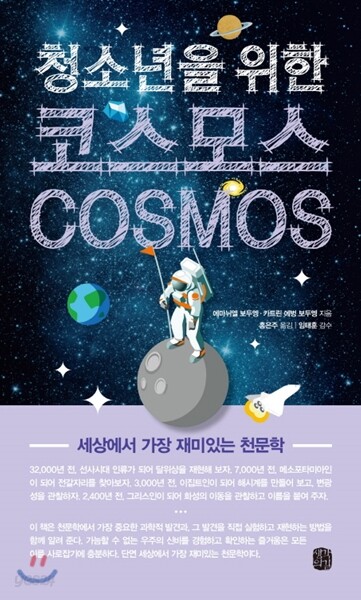
Cosmos for Teens tells 30 stories about astronomy that shook up the cosmos.
From the moment prehistoric humans discovered the moon's changing shape 32,000 years ago to the moment Neil Armstrong walked on the moon just 50 years ago, astronomy has developed through countless observations, experiments, and trial and error.
We've compiled 30 stories about astronomy that shook the cosmos as we go back in time.
This entertaining story will take you on a journey through space, filled with wonder and revealing new facts you never knew existed.
Prehistoric humans observed lunar phases 32,000 years ago, and Mesopotamians invented constellations 7,000 years ago.
3,000 years ago, the Egyptians invented the sundial, and 2,400 years ago, the Greeks named the planets.
2,300 years ago, Aristotle claimed that the Earth was round, and Heraclides discovered that the Earth rotated.
Al-Sufi discovered the Andromeda galaxy 1,100 years ago, and the Chinese observed a supernova 1,000 years ago.
Cosmos for Teens tells 30 stories about astronomy that shook up the cosmos.
From the moment prehistoric humans discovered the moon's changing shape 32,000 years ago to the moment Neil Armstrong walked on the moon just 50 years ago, astronomy has developed through countless observations, experiments, and trial and error.
We've compiled 30 stories about astronomy that shook the cosmos as we go back in time.
This entertaining story will take you on a journey through space, filled with wonder and revealing new facts you never knew existed.
Prehistoric humans observed lunar phases 32,000 years ago, and Mesopotamians invented constellations 7,000 years ago.
3,000 years ago, the Egyptians invented the sundial, and 2,400 years ago, the Greeks named the planets.
2,300 years ago, Aristotle claimed that the Earth was round, and Heraclides discovered that the Earth rotated.
Al-Sufi discovered the Andromeda galaxy 1,100 years ago, and the Chinese observed a supernova 1,000 years ago.
- You can preview some of the book's contents.
Preview
index
Entering
1.
32,000 years ago, prehistoric humans observed lunar phases.
Experiment: Reproducing the Moon Phases (★)
2.
7,000 years ago, the Mesopotamians invented constellations.
Experiment: Finding Scorpio (★★)
3.
3,000 years ago, the Egyptians invented the sundial.
Experiment: Let's Make a Sundial (★★★)
4.
3,000 years ago, the Egyptians recognized variable stars.
Experiment: Observing Variable Stars (★★★)
5.
2,400 years ago, the Greeks named the planets.
Experiment: Observe the Movement of Mars (★★)
6.
2,300 years ago, Aristotle claimed that the Earth was round.
Experiment: Observe the Earth's circular shadow during a lunar eclipse (★)
7.
2,300 years ago, Heracleides discovered that the Earth rotates.
Experiment: Observe the Movement of Ursa Major (★★★)
8.
2,300 years ago, Pytheas measured the Earth's tilt.
Experiment: Measuring the Earth's Tilt (★★★)
9.
2,200 years ago, Eratosthenes measured the Earth's circumference.
Experiment: Estimate the Size of the Earth (★★★)
10.
2,200 years ago, Hipparchus predicted a celestial eclipse.
Experiment: Calculate When the Eclipse Will Return (★★★)
11.
2,200 years ago, Hipparchus classified stars by brightness.
Experiment: Compare the 'ratings' of three stars (★)
12.
2,000 years ago, the Chinese observed sunspots.
Experiment: Observing Sunspots (★★)
13.
1,100 years ago, Al Sufi discovered the Andromeda galaxy.
Experiment: Finding the Giant Andromeda Galaxy (★★)
14.
1,000 years ago, Al-Haytham understood the Dark Chamber.
Experiment: Let's Make a Dark Box (★★)
15.
1,000 years ago, the Chinese observed a supernova.
Experiment: Finding the Crab Nebula M1 (★★★)
16.
500 years ago, Leonardo da Vinci discovered geostrophism.
Experiment: Let's draw the Earth's reflected light (★)
17.
500 years ago, Copernicus proposed the heliocentric theory.
Experiment: Let's Build a Mini Solar System (★)
18.
400 years ago, Kepler formulated the equations for planetary motion.
Experiment: Observe the changes in Earth's speed as it moves through its orbit (★★★)
19.
400 years ago, Galileo observed the sky with a telescope.
Experiment: Let's find out how Jupiter's moons move (★)
20.
400 years ago, Galileo defended the heliocentric theory.
Experiment: Observing the Phases of Venus (★★)
21.
350 years ago, Huygens discovered Saturn's rings.
Experiment: Let's observe Saturn through a telescope (★)
22.
300 years ago, Halley predicted the return of the comet.
Experiment: Let's Make a Mini Comet (★)
23.
230 years ago, Herschel understood binary stars.
Experiment: Observing Binary Stars with the Naked Eye (★★)
24.
200 years ago, Fraunhofer developed spectroscopy.
Experiment: Let's Make a Spectroscope (★★★)
25.
180 years ago, Bessel measured the distances to stars.
Experiment: Let's Make a 3D Constellation Model (★★)
26.
150 years ago, Schiaparelli understood the origins of shooting stars.
Experiment: Let's Harvest the Meteorite (★★★)
27.
120 years ago, Hertzsprung understood the colors of stars.
Experiment: Let's distinguish the colors of the stars (★★)
28.
100 years ago, Barnard took a picture of cosmic dust.
Experiment: Observing Dust in Our Galaxy (★★★)
29.
90 years ago, Hubble discovered the expansion of the universe.
Experiment: Let's build a model of an expanding universe (★)
30.
50 years ago, Neil Armstrong walked on the moon.
Experiment: Feel the weak gravity of the lunar surface (★)
index
1.
32,000 years ago, prehistoric humans observed lunar phases.
Experiment: Reproducing the Moon Phases (★)
2.
7,000 years ago, the Mesopotamians invented constellations.
Experiment: Finding Scorpio (★★)
3.
3,000 years ago, the Egyptians invented the sundial.
Experiment: Let's Make a Sundial (★★★)
4.
3,000 years ago, the Egyptians recognized variable stars.
Experiment: Observing Variable Stars (★★★)
5.
2,400 years ago, the Greeks named the planets.
Experiment: Observe the Movement of Mars (★★)
6.
2,300 years ago, Aristotle claimed that the Earth was round.
Experiment: Observe the Earth's circular shadow during a lunar eclipse (★)
7.
2,300 years ago, Heracleides discovered that the Earth rotates.
Experiment: Observe the Movement of Ursa Major (★★★)
8.
2,300 years ago, Pytheas measured the Earth's tilt.
Experiment: Measuring the Earth's Tilt (★★★)
9.
2,200 years ago, Eratosthenes measured the Earth's circumference.
Experiment: Estimate the Size of the Earth (★★★)
10.
2,200 years ago, Hipparchus predicted a celestial eclipse.
Experiment: Calculate When the Eclipse Will Return (★★★)
11.
2,200 years ago, Hipparchus classified stars by brightness.
Experiment: Compare the 'ratings' of three stars (★)
12.
2,000 years ago, the Chinese observed sunspots.
Experiment: Observing Sunspots (★★)
13.
1,100 years ago, Al Sufi discovered the Andromeda galaxy.
Experiment: Finding the Giant Andromeda Galaxy (★★)
14.
1,000 years ago, Al-Haytham understood the Dark Chamber.
Experiment: Let's Make a Dark Box (★★)
15.
1,000 years ago, the Chinese observed a supernova.
Experiment: Finding the Crab Nebula M1 (★★★)
16.
500 years ago, Leonardo da Vinci discovered geostrophism.
Experiment: Let's draw the Earth's reflected light (★)
17.
500 years ago, Copernicus proposed the heliocentric theory.
Experiment: Let's Build a Mini Solar System (★)
18.
400 years ago, Kepler formulated the equations for planetary motion.
Experiment: Observe the changes in Earth's speed as it moves through its orbit (★★★)
19.
400 years ago, Galileo observed the sky with a telescope.
Experiment: Let's find out how Jupiter's moons move (★)
20.
400 years ago, Galileo defended the heliocentric theory.
Experiment: Observing the Phases of Venus (★★)
21.
350 years ago, Huygens discovered Saturn's rings.
Experiment: Let's observe Saturn through a telescope (★)
22.
300 years ago, Halley predicted the return of the comet.
Experiment: Let's Make a Mini Comet (★)
23.
230 years ago, Herschel understood binary stars.
Experiment: Observing Binary Stars with the Naked Eye (★★)
24.
200 years ago, Fraunhofer developed spectroscopy.
Experiment: Let's Make a Spectroscope (★★★)
25.
180 years ago, Bessel measured the distances to stars.
Experiment: Let's Make a 3D Constellation Model (★★)
26.
150 years ago, Schiaparelli understood the origins of shooting stars.
Experiment: Let's Harvest the Meteorite (★★★)
27.
120 years ago, Hertzsprung understood the colors of stars.
Experiment: Let's distinguish the colors of the stars (★★)
28.
100 years ago, Barnard took a picture of cosmic dust.
Experiment: Observing Dust in Our Galaxy (★★★)
29.
90 years ago, Hubble discovered the expansion of the universe.
Experiment: Let's build a model of an expanding universe (★)
30.
50 years ago, Neil Armstrong walked on the moon.
Experiment: Feel the weak gravity of the lunar surface (★)
index
Publisher's Review
1.
30 Astronomical Stories That Shook the Cosmos
Cosmos for Teens tells 30 stories about astronomy that shook up the cosmos.
From the moment prehistoric humans discovered the moon's changing shape 32,000 years ago to the moment Neil Armstrong walked on the moon just 50 years ago, astronomy has developed through countless observations, experiments, and trial and error.
We've compiled 30 stories about astronomy that shook the cosmos as we go back in time.
This entertaining story will take you on a journey through space, filled with wonder and revealing new facts you never knew existed.
Prehistoric humans observed lunar phases 32,000 years ago, and Mesopotamians invented constellations 7,000 years ago.
3,000 years ago, the Egyptians invented the sundial, and 2,400 years ago, the Greeks named the planets.
2,300 years ago, Aristotle claimed that the Earth was round, and Heraclides discovered that the Earth rotated.
Al-Sufi discovered the Andromeda galaxy 1,100 years ago, and the Chinese observed a supernova 1,000 years ago… …
Humanity was born from the cosmos.
With the Big Bang, a star called Earth was born in the universe, and history began.
Humanity, having set foot on Earth, has opened its eyes to the beauty of the cosmos and has been continuously striving to understand the cosmos since the beginning of time.
Therefore, ‘astronomy’ is inseparable from humans and is the oldest discipline in human history.
2.
The secrets of the universe, discovered directly through experimentation and observation.
The presented experiments are diverse in method and difficulty.
Some experiments require a clear night sky, while others can be done indoors, and some require some skill, while others are simple enough for anyone to follow.
You can also use Stellarium or visit an observatory yourself for more active observations.
For each experiment, the difficulty level is indicated from 1 (★) to 3 (★★★) for easy distinction.
There are also a couple of special experiments that require courage, so keep an eye out for them.
Here are some experiments:
-Let's recreate the moon phases (★)
-Let's make a sundial (★★★)
- Let's observe variable stars (★★★)
- Let's observe the movement of Mars (★★)
- Let's observe the Earth's round shadow during a lunar eclipse (★)
-Let's measure the tilt of the Earth (★★★)
-Let's estimate the size of the Earth (★★★)
-Let's calculate when the eclipse will return (★★★)
- Let's observe sunspots (★★)
-Let's find the giant Andromeda Galaxy (★★)
-Let's find the Crab Nebula M1 (★★★)
-Let's draw the reflected light (★)
-Let's make a mini solar system (★)
-Let's find out how Jupiter's moons move (★)
- Let's observe the phase changes of Venus (★★)
-Let's make a mini comet (★)
-Let's distinguish the colors of the stars (★★)
- Let's observe the dust in our galaxy (★★★)
-Let's create a model of the expanding universe (★)
-Let's feel the weak gravity of the moon's surface (★) … …
By following the 30 experiments introduced in the book step by step, we can find binary stars or observe dust in galaxies with the naked eye.
It's easy to create sundials and 3D constellation models, and even figure out the movements of planets around the sun.
You can create the universe you only saw in movies with your own hands and uncover its secrets.
Let's uncover the secrets of the universe with fun experiments.
3.
Cosmos for the world's funniest teenagers
Many people are curious about astronomy, but find it difficult to approach.
It is because of the vague fear and wariness that it will be difficult and complicated.
However, humans have been fascinated by the movement of the sky and stars since ancient times, and astronomy is indeed a fascinating discipline.
It's not as difficult as you might imagine.
That's why Emmanuel Baudouin and Catherine Eben Baudouin suggest 'easy and fun' astronomy as the answer.
Astrophotographer and space columnist Emmanuel Baudouin and physics professor Catherine Eben Baudouin created “the most interesting cosmos in the world” through a simple and fun experiment.
“Many secrets of the universe were revealed in 1609 when Galileo first observed the sky through a telescope.
Venus waxes and wanes like the moon, and Jupiter has satellites orbiting it.
You have to see these facts for yourself to believe them.
Learn how to observe the sky with a small telescope in this book. Many excellent telescopes are available today, but they're not overly expensive.
The moment you look at the stars in the night sky through a telescope, you too will soon be captivated by the universe and perhaps even feel like Galileo.” - From the text
The world's most entertaining cosmos, which will make readers feel like Galileo and captivate them with the universe, has finally been born.
Prehistoric humans who discovered the moon changing its shape every night, the Mesopotamians who created constellations, the Egyptians who invented the sundial, Galileo who was put on trial for passionately claiming that the Earth revolved around the Sun, and even Neil Armstrong, the first man to walk on the moon…
Now, let's open this book and relive 30 moments of discovery that shook the universe over the past 2,000 years.
30 Astronomical Stories That Shook the Cosmos
Cosmos for Teens tells 30 stories about astronomy that shook up the cosmos.
From the moment prehistoric humans discovered the moon's changing shape 32,000 years ago to the moment Neil Armstrong walked on the moon just 50 years ago, astronomy has developed through countless observations, experiments, and trial and error.
We've compiled 30 stories about astronomy that shook the cosmos as we go back in time.
This entertaining story will take you on a journey through space, filled with wonder and revealing new facts you never knew existed.
Prehistoric humans observed lunar phases 32,000 years ago, and Mesopotamians invented constellations 7,000 years ago.
3,000 years ago, the Egyptians invented the sundial, and 2,400 years ago, the Greeks named the planets.
2,300 years ago, Aristotle claimed that the Earth was round, and Heraclides discovered that the Earth rotated.
Al-Sufi discovered the Andromeda galaxy 1,100 years ago, and the Chinese observed a supernova 1,000 years ago… …
Humanity was born from the cosmos.
With the Big Bang, a star called Earth was born in the universe, and history began.
Humanity, having set foot on Earth, has opened its eyes to the beauty of the cosmos and has been continuously striving to understand the cosmos since the beginning of time.
Therefore, ‘astronomy’ is inseparable from humans and is the oldest discipline in human history.
2.
The secrets of the universe, discovered directly through experimentation and observation.
The presented experiments are diverse in method and difficulty.
Some experiments require a clear night sky, while others can be done indoors, and some require some skill, while others are simple enough for anyone to follow.
You can also use Stellarium or visit an observatory yourself for more active observations.
For each experiment, the difficulty level is indicated from 1 (★) to 3 (★★★) for easy distinction.
There are also a couple of special experiments that require courage, so keep an eye out for them.
Here are some experiments:
-Let's recreate the moon phases (★)
-Let's make a sundial (★★★)
- Let's observe variable stars (★★★)
- Let's observe the movement of Mars (★★)
- Let's observe the Earth's round shadow during a lunar eclipse (★)
-Let's measure the tilt of the Earth (★★★)
-Let's estimate the size of the Earth (★★★)
-Let's calculate when the eclipse will return (★★★)
- Let's observe sunspots (★★)
-Let's find the giant Andromeda Galaxy (★★)
-Let's find the Crab Nebula M1 (★★★)
-Let's draw the reflected light (★)
-Let's make a mini solar system (★)
-Let's find out how Jupiter's moons move (★)
- Let's observe the phase changes of Venus (★★)
-Let's make a mini comet (★)
-Let's distinguish the colors of the stars (★★)
- Let's observe the dust in our galaxy (★★★)
-Let's create a model of the expanding universe (★)
-Let's feel the weak gravity of the moon's surface (★) … …
By following the 30 experiments introduced in the book step by step, we can find binary stars or observe dust in galaxies with the naked eye.
It's easy to create sundials and 3D constellation models, and even figure out the movements of planets around the sun.
You can create the universe you only saw in movies with your own hands and uncover its secrets.
Let's uncover the secrets of the universe with fun experiments.
3.
Cosmos for the world's funniest teenagers
Many people are curious about astronomy, but find it difficult to approach.
It is because of the vague fear and wariness that it will be difficult and complicated.
However, humans have been fascinated by the movement of the sky and stars since ancient times, and astronomy is indeed a fascinating discipline.
It's not as difficult as you might imagine.
That's why Emmanuel Baudouin and Catherine Eben Baudouin suggest 'easy and fun' astronomy as the answer.
Astrophotographer and space columnist Emmanuel Baudouin and physics professor Catherine Eben Baudouin created “the most interesting cosmos in the world” through a simple and fun experiment.
“Many secrets of the universe were revealed in 1609 when Galileo first observed the sky through a telescope.
Venus waxes and wanes like the moon, and Jupiter has satellites orbiting it.
You have to see these facts for yourself to believe them.
Learn how to observe the sky with a small telescope in this book. Many excellent telescopes are available today, but they're not overly expensive.
The moment you look at the stars in the night sky through a telescope, you too will soon be captivated by the universe and perhaps even feel like Galileo.” - From the text
The world's most entertaining cosmos, which will make readers feel like Galileo and captivate them with the universe, has finally been born.
Prehistoric humans who discovered the moon changing its shape every night, the Mesopotamians who created constellations, the Egyptians who invented the sundial, Galileo who was put on trial for passionately claiming that the Earth revolved around the Sun, and even Neil Armstrong, the first man to walk on the moon…
Now, let's open this book and relive 30 moments of discovery that shook the universe over the past 2,000 years.
GOODS SPECIFICS
- Date of issue: July 4, 2016
- Page count, weight, size: 272 pages | 480g | 145*232*17mm
- ISBN13: 9788965133735
- ISBN10: 8965133734
You may also like
카테고리
korean


korean

![ELLE 엘르 스페셜 에디션 A형 : 12월 [2025]](http://librairie.coreenne.fr/cdn/shop/files/b8e27a3de6c9538896439686c6b0e8fb.jpg?v=1766436872&width=3840)


