

The World's Easiest Science Lesson: Quantum Chemistry
 |
Description
Book Introduction
From ancient alchemy to Pauling's quantum chemistry
Uncovering Pauling's quantum chemistry, which sheds new light on the properties of atoms and molecules.
Recommended by the National Science Teachers Association!
This is the 13th book in the series “Learn Science with Original Papers by Nobel Prize Winners,” and it is a book that explains the papers of Pauling, the founder of quantum mechanics, in an easy and fun way.
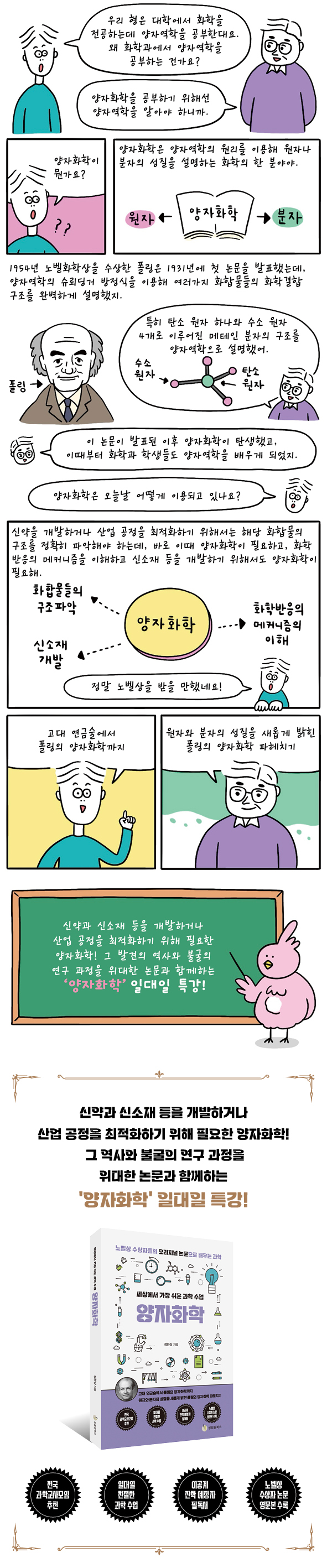
Quantum chemistry is a branch of chemistry that uses the principles of quantum mechanics to explain the physical and chemical properties of atoms and molecules.
The purpose is to understand chemical bonding, molecular structure, spectroscopic properties, and chemical reactions.
From 1900 to 1930, physicists discovered problems in classical mechanics and created the concept of quantum mechanics, creating a new field of physics called quantum mechanics.
And Pauling understood quantum mechanics perfectly and figured out that it could be applied to the theory of chemical bonding.
This led to the creation of a new field called quantum mechanics.
This book introduces the book in the form of an interview with Dr. Herschbach, who won the Nobel Prize in Chemistry in 1986 for his research on chemical reactions, to explain scientific theories that can be perceived as difficult in an easy and fun way, and briefly explains Linus Pauling's quantum chemistry to provide an overview of the book's flow.
Next, the history of chemistry, which began with alchemy, the history of organic chemistry, Lewis's theory of chemical bonds, orbital theory, and the intense research process of scientists, including Pauling, who won the Nobel Prize in Chemistry for quantum chemistry, were introduced in an exciting way.
Above all, this book is characterized by its friendly and elaborate structure, as if taking a one-on-one lesson, using the format of a conversation between Professor Jeong, who represents the author, and the chemistry group, who pose questions to Professor Jeong from the reader's perspective.
As an appendix, I included Lewis's paper on chemical bonding and Pauling's paper on quantum chemistry.
In addition, we are including a list of Nobel Prize winners in Chemistry to help you explore and understand more deeply.
Uncovering Pauling's quantum chemistry, which sheds new light on the properties of atoms and molecules.
Recommended by the National Science Teachers Association!
This is the 13th book in the series “Learn Science with Original Papers by Nobel Prize Winners,” and it is a book that explains the papers of Pauling, the founder of quantum mechanics, in an easy and fun way.
Quantum chemistry is a branch of chemistry that uses the principles of quantum mechanics to explain the physical and chemical properties of atoms and molecules.
The purpose is to understand chemical bonding, molecular structure, spectroscopic properties, and chemical reactions.
From 1900 to 1930, physicists discovered problems in classical mechanics and created the concept of quantum mechanics, creating a new field of physics called quantum mechanics.
And Pauling understood quantum mechanics perfectly and figured out that it could be applied to the theory of chemical bonding.
This led to the creation of a new field called quantum mechanics.
This book introduces the book in the form of an interview with Dr. Herschbach, who won the Nobel Prize in Chemistry in 1986 for his research on chemical reactions, to explain scientific theories that can be perceived as difficult in an easy and fun way, and briefly explains Linus Pauling's quantum chemistry to provide an overview of the book's flow.
Next, the history of chemistry, which began with alchemy, the history of organic chemistry, Lewis's theory of chemical bonds, orbital theory, and the intense research process of scientists, including Pauling, who won the Nobel Prize in Chemistry for quantum chemistry, were introduced in an exciting way.
Above all, this book is characterized by its friendly and elaborate structure, as if taking a one-on-one lesson, using the format of a conversation between Professor Jeong, who represents the author, and the chemistry group, who pose questions to Professor Jeong from the reader's perspective.
As an appendix, I included Lewis's paper on chemical bonding and Pauling's paper on quantum chemistry.
In addition, we are including a list of Nobel Prize winners in Chemistry to help you explore and understand more deeply.
- You can preview some of the book's contents.
Preview
index
Recommendation
I hope you can understand the original papers of these genius scientists.
The Impact of Dr. Pauling's 1931 Paper _ A Surprise Interview with Dr. Hershbach
First Encounter | The History of Chemistry
The Birth of Alchemy and Chemistry_Chemistry Developed Through Alchemy
Discovery of Acids and Bases: Invention of Litmus Paper
Lavoisier's Chemical Revolution_Chemical Nomenclature and Introduction to Chemistry
Berthollet, who discovered the principles of dyeing and the reactions of elements after Lavoisier
The emergence of chemical affinity_Geoffroy, who created the chemical affinity table
Laws of Atomic and Molecule Gas Reactions
Element symbols and atomic weights_Berzelius, who created element symbols, and Richards, who measured atomic weights
The History of Electrolysis: Discovering Numerous Metals Through Electrolysis
Van der Waals' study of real gases_Cleperon's ideal gas equation
Second Encounter | The History of Organic Chemistry
Bergman, who first used the term organic matter
Vitalism: Aristotle's Soul and Erasistratus' Pneuma
Proving that Wöhler's elemental synthesis and vitalism are wrong
Liebig and the molecular formula of organic compounds_The content of carbon, hydrogen, and oxygen in an organic compound determines its molecular formula.
The Law of Substitution_The Law of Substitution Discovered by Dumas
Gerhard's type theory: representing all organic compounds in four types.
Frankland and the valence_first introduced the concept of valence in chemical bonding
Kekulé and Cooper, who discovered the 4-valent element_the case where the atomic number is 4
Brown's structural formula_Brown's structural formula of organic chemicals illustrated
Hexagonal ring of benzene_Kekulé, who discovered the structural formula of benzene
Third Encounter | Lewis's Theory of Chemical Bonding
History of Analytical Chemistry: From Ancient Times to Today
The emergence of the atomic model: Thomson's atomic model and Rutherford's atomic number
Lewis, the founder of chemical bonding theory, introduced the cubic atomic model to explain chemical bonding.
Lewis's Dot Symbol: Explaining Chemical Bonds That the Cubic Atomic Model Cannot Explain
Fourth Encounter | Orbital Theory
The Birth of Quantum Mechanics: Heisenberg's Uncertainty Principle
The 3D Hydrogen Problem: Quantum Mechanics in 3 Dimensions
Hund's Rule_Rules for arranging electrons in the ground state
Fifth Meeting | Quantum Chemistry
Mulliken Wins Nobel Prize in Quantum Chemistry
Linus Pauling: Creating the Theory of Quantum Chemistry
Molecular Orbitals_Hund and Mulliken's Molecular Orbitals
Inside Pauling's Paper: Quantum Chemical Explanation of Methane
The Atom and Molecule _Lewis's paper in English
The Nature of the Chemical Bond _Linus Pauling's paper in English
I hope you can understand the original papers of these genius scientists.
The Impact of Dr. Pauling's 1931 Paper _ A Surprise Interview with Dr. Hershbach
First Encounter | The History of Chemistry
The Birth of Alchemy and Chemistry_Chemistry Developed Through Alchemy
Discovery of Acids and Bases: Invention of Litmus Paper
Lavoisier's Chemical Revolution_Chemical Nomenclature and Introduction to Chemistry
Berthollet, who discovered the principles of dyeing and the reactions of elements after Lavoisier
The emergence of chemical affinity_Geoffroy, who created the chemical affinity table
Laws of Atomic and Molecule Gas Reactions
Element symbols and atomic weights_Berzelius, who created element symbols, and Richards, who measured atomic weights
The History of Electrolysis: Discovering Numerous Metals Through Electrolysis
Van der Waals' study of real gases_Cleperon's ideal gas equation
Second Encounter | The History of Organic Chemistry
Bergman, who first used the term organic matter
Vitalism: Aristotle's Soul and Erasistratus' Pneuma
Proving that Wöhler's elemental synthesis and vitalism are wrong
Liebig and the molecular formula of organic compounds_The content of carbon, hydrogen, and oxygen in an organic compound determines its molecular formula.
The Law of Substitution_The Law of Substitution Discovered by Dumas
Gerhard's type theory: representing all organic compounds in four types.
Frankland and the valence_first introduced the concept of valence in chemical bonding
Kekulé and Cooper, who discovered the 4-valent element_the case where the atomic number is 4
Brown's structural formula_Brown's structural formula of organic chemicals illustrated
Hexagonal ring of benzene_Kekulé, who discovered the structural formula of benzene
Third Encounter | Lewis's Theory of Chemical Bonding
History of Analytical Chemistry: From Ancient Times to Today
The emergence of the atomic model: Thomson's atomic model and Rutherford's atomic number
Lewis, the founder of chemical bonding theory, introduced the cubic atomic model to explain chemical bonding.
Lewis's Dot Symbol: Explaining Chemical Bonds That the Cubic Atomic Model Cannot Explain
Fourth Encounter | Orbital Theory
The Birth of Quantum Mechanics: Heisenberg's Uncertainty Principle
The 3D Hydrogen Problem: Quantum Mechanics in 3 Dimensions
Hund's Rule_Rules for arranging electrons in the ground state
Fifth Meeting | Quantum Chemistry
Mulliken Wins Nobel Prize in Quantum Chemistry
Linus Pauling: Creating the Theory of Quantum Chemistry
Molecular Orbitals_Hund and Mulliken's Molecular Orbitals
Inside Pauling's Paper: Quantum Chemical Explanation of Methane
The Atom and Molecule _Lewis's paper in English
The Nature of the Chemical Bond _Linus Pauling's paper in English
Detailed image
Into the book
Chemical bonding refers to the combination of different substances to create new substances.
The first person to come up with this idea was Newton (1642-1727) of England.
In 1704, Newton, in his book Opticks, described the process by which different elements (Newton used the term elements in his time, as Dalton's atomic theory had not yet been developed) combine to form new substances.
--- p.34~35
In May 1800, Nicholson, together with Carisle, a surgeon at Westminster Hospital, electrolyzed water into hydrogen and oxygen.
Slightly later than the two, Ritter (1776–1810), a German chemist and physicist, also succeeded in decomposing water into hydrogen and oxygen through electrolysis.
--- p.50~51
The history of organic chemistry is very long.
Since ancient times, alchemists and early chemists have analyzed blood, saliva, urine, egg whites, and other substances, which is the beginning of organic chemistry.
The first pure organic compound obtained was alcohol (ethanol).
--- p.63
Frankland first introduced the concept of valence in chemical bonding in 1852.
Valence refers to the number of ways an atom is bonded to neighboring atoms in a chemical bond.
--- p.76
Brown's greatest achievement in the history of organic chemistry was his ability to graphically represent the structural formulas of organic compounds.
In 1864, he began drawing structural formulas for molecules, enclosing the atomic symbols in circles and using dotted lines to connect the atomic symbols in a way that satisfied the valence of each atom.
--- p.82
Now we will delve into Lewis's paper, which marked a turning point in the study of chemical bonding.
Before that, we need to learn a little about the new discoveries of the early 20th century.
The theory of chemical bonding began to emerge in earnest after Thomson (1856-1940) discovered the electron.
--- p.93
Lewis had been pondering the relationship between electrons and chemical bonds since 1902.
And in 1916, it was thought that after combining, the number of electrons reached 8, which would make it a stable state.
Lewis thought of a cube, a shape with eight points.
The number of electrons is represented as the number of vertices of the cube.
This is called the cubic atomic model.
--- p.101
Quantums are particles with strange properties that cannot be explained by classical mechanics.
These particles were first proposed by Planck (1858–1947) in 1900.
In classical mechanics, Newtonian mechanics explains the motion of particles.
That is, if you know the initial position and initial velocity of an object, you can know the position and velocity of the object at any time.
However, in the case of quantum mechanics, it is impossible to accurately measure both the position of an object and its momentum (mass multiplied by velocity) simultaneously.
If you try to measure the position of an object accurately, your measurement of its momentum becomes more inaccurate, and if you try to measure the momentum of an object accurately, your measurement of its position becomes more inaccurate.
In other words, the error in the position of an object and the error in the momentum of the object are inversely proportional to each other.
This is called the uncertainty principle, and was first proposed by Heisenberg (1901-1976) in 1925.
--- p.112
Now let's get into Pauling's paper.
There's a lot to cover, but we'll look at how Pauling explained methane quantum chemistry.
Methane is the simplest carbon compound, consisting of one carbon atom and four hydrogen atoms.
The molecular weight is 16, the melting point is -183℃, the boiling point is -162℃, and it is a gas at room temperature.
Methane is naturally produced when organic matter decays or ferments in water, so it occurs in places such as the bottom of swamps.
It is also contained in coal layers and occurs in coal mines, where it mixes with air and causes an explosion.
It is the main component of natural gas and coal gas.
The chemical formula of methane is CH4, the CH bond length is 0.110 nm, the bond angle between CH bonds is 109.5°, and it is a nonpolar molecule.
The first person to come up with this idea was Newton (1642-1727) of England.
In 1704, Newton, in his book Opticks, described the process by which different elements (Newton used the term elements in his time, as Dalton's atomic theory had not yet been developed) combine to form new substances.
--- p.34~35
In May 1800, Nicholson, together with Carisle, a surgeon at Westminster Hospital, electrolyzed water into hydrogen and oxygen.
Slightly later than the two, Ritter (1776–1810), a German chemist and physicist, also succeeded in decomposing water into hydrogen and oxygen through electrolysis.
--- p.50~51
The history of organic chemistry is very long.
Since ancient times, alchemists and early chemists have analyzed blood, saliva, urine, egg whites, and other substances, which is the beginning of organic chemistry.
The first pure organic compound obtained was alcohol (ethanol).
--- p.63
Frankland first introduced the concept of valence in chemical bonding in 1852.
Valence refers to the number of ways an atom is bonded to neighboring atoms in a chemical bond.
--- p.76
Brown's greatest achievement in the history of organic chemistry was his ability to graphically represent the structural formulas of organic compounds.
In 1864, he began drawing structural formulas for molecules, enclosing the atomic symbols in circles and using dotted lines to connect the atomic symbols in a way that satisfied the valence of each atom.
--- p.82
Now we will delve into Lewis's paper, which marked a turning point in the study of chemical bonding.
Before that, we need to learn a little about the new discoveries of the early 20th century.
The theory of chemical bonding began to emerge in earnest after Thomson (1856-1940) discovered the electron.
--- p.93
Lewis had been pondering the relationship between electrons and chemical bonds since 1902.
And in 1916, it was thought that after combining, the number of electrons reached 8, which would make it a stable state.
Lewis thought of a cube, a shape with eight points.
The number of electrons is represented as the number of vertices of the cube.
This is called the cubic atomic model.
--- p.101
Quantums are particles with strange properties that cannot be explained by classical mechanics.
These particles were first proposed by Planck (1858–1947) in 1900.
In classical mechanics, Newtonian mechanics explains the motion of particles.
That is, if you know the initial position and initial velocity of an object, you can know the position and velocity of the object at any time.
However, in the case of quantum mechanics, it is impossible to accurately measure both the position of an object and its momentum (mass multiplied by velocity) simultaneously.
If you try to measure the position of an object accurately, your measurement of its momentum becomes more inaccurate, and if you try to measure the momentum of an object accurately, your measurement of its position becomes more inaccurate.
In other words, the error in the position of an object and the error in the momentum of the object are inversely proportional to each other.
This is called the uncertainty principle, and was first proposed by Heisenberg (1901-1976) in 1925.
--- p.112
Now let's get into Pauling's paper.
There's a lot to cover, but we'll look at how Pauling explained methane quantum chemistry.
Methane is the simplest carbon compound, consisting of one carbon atom and four hydrogen atoms.
The molecular weight is 16, the melting point is -183℃, the boiling point is -162℃, and it is a gas at room temperature.
Methane is naturally produced when organic matter decays or ferments in water, so it occurs in places such as the bottom of swamps.
It is also contained in coal layers and occurs in coal mines, where it mixes with air and causes an explosion.
It is the main component of natural gas and coal gas.
The chemical formula of methane is CH4, the CH bond length is 0.110 nm, the bond angle between CH bonds is 109.5°, and it is a nonpolar molecule.
--- p.171
Publisher's Review
Quantum chemistry required to develop new drugs or optimize industrial processes,
Inside the paper of Linus Pauling, the founder of quantum chemistry!
Quantum chemistry is an academic discipline that applies the principles of quantum mechanics to various problems in chemistry and theoretically explains the movements of atoms and electrons, molecular structures, and chemical reactions.
This field lies at the intersection of physics and chemistry, studying the properties and interactions of atoms and molecules.
Quantum chemistry plays a very important role in understanding chemical phenomena.
Quantum chemistry can be used in a variety of ways, including predicting molecular structures, assessing the stability of compounds, and predicting reaction rates.
Accurately predicting molecular structures using quantum chemistry can help us understand and design the properties of new compounds.
For example, developing new drugs or optimizing industrial processes requires precise understanding of the structure of the compound in question, while quantum chemistry is also necessary to understand the mechanisms of chemical reactions or to find chemically stable substances.
The scientist who pioneered the world of quantum chemistry was Linus Pauling.
In 1931, Pauling published his first paper explaining chemical bonding using the principles of quantum mechanics.
He thought that electrons were described by wave functions that satisfied the Schrödinger equation of quantum mechanics.
In a 1931 paper, the Schrödinger equation was used to completely explain the chemical bonding structures of various compounds.
In particular, the structure of the methane molecule, which consists of one carbon atom and four hydrogen atoms, was explained using quantum mechanics.
In addition, it explains how atoms are combined in various molecules.
Since the publication of this paper, a new field of chemistry called quantum chemistry has emerged.
And from this time on, chemistry students also began to learn quantum mechanics in their undergraduate courses.
With the advent of quantum chemistry, chemists also entered the quantum world.
Pauling won the 1954 Nobel Prize in Chemistry for his contributions to the development of quantum chemistry. He also received the Nobel Peace Prize.
He proposed the establishment of a world peace research organization, calling not only for an end to nuclear weapons testing but also for an end to war itself, and he actively worked to gather like-minded people to support it.
For this achievement, he was awarded the Nobel Peace Prize in 1963.
He was a very humane scientist who hoped not only for the advancement of science but also for peace for mankind.
Quantum mechanics, which studies the motion of quantum particles that cannot be explained by classical mechanics.
Scientists who developed quantum mechanics, including Schrödinger and Heisenberg
To understand quantum chemistry, you must first understand quantum mechanics.
Quantum mechanics is the branch of physics that studies the behavior of quanta (the smallest indivisible unit of energy).
However, since classical mechanics cannot explain the motion of quantum particles, a new mechanics system became necessary.
From 1900 to 1930, physicists created the concept of quanta and created a new branch of physics called quantum mechanics.
And thus quantum mechanics was born.
The concept of quantum was first proposed by Planck in 1900.
In classical mechanics, Newtonian mechanics explains the motion of particles.
According to Newtonian mechanics, if you know the initial position and initial velocity of an object, you can find the position and velocity of an object at any time.
However, in the case of quantum mechanics, it was not possible to accurately measure both the position and momentum (mass multiplied by velocity) of an object simultaneously.
This is because when you try to accurately measure the position of an object, your measurement of its momentum becomes more inaccurate, and when you try to accurately measure the momentum of an object, your measurement of its position becomes more inaccurate.
In other words, the error in the position of an object and the error in the momentum of the object are inversely proportional to each other.
This is called the uncertainty principle, and was first proposed by Heisenberg in 1925.
Quantum mechanics developed after Planck proposed the concept of quantum, including Schrödinger's equation and Heisenberg's uncertainty principle.
Pauling introduced quantum mechanics to chemistry and pioneered a new field called quantum chemistry.
Quantum mechanics can create endless new fields of research, not just quantum chemistry.
Quantum mechanics will allow us to gain a deeper understanding of the fundamental structure of the universe and how it operates, which will contribute to illuminating the future of humanity.
Chemical bonding, where different substances combine to create new substances
Inside Lewis's chemical bonding theory paper!
Quantum chemistry is a field that is not easy for the general public to understand, but this book first introduces the history of chemical reactions and the history of organic chemistry to make it easier to understand.
Next, we introduced the theory of chemical bonding.
Chemical bonding is the joining of different substances to create new substances, and the first person to come up with the idea was Newton.
In 1704, Newton described in his book Opticks the process by which different elements combine to form new substances.
Later, in 1718, Geofroy created a table of chemical affinities that showed how much different elements wanted to combine.
The book also introduced Lewis's 1916 paper, which explained chemical bonding without using quantum mechanics at all.
This paper mainly explains covalent bonding, which we learn in high school chemistry class.
After electrons were discovered and it became known that they revolve around the nucleus, Lewis became interested in the outermost electrons among those orbiting the nucleus.
These electrons are called valence electrons, and they play a very important role in covalent bonding.
Lewis used the sharing of electrons to explain the bonding of two oxygen atoms to form an oxygen molecule.
Lewis's theory later greatly helped Pauling in pioneering quantum chemistry.
Lighter than a major textbook, heavier than a general textbook
If you are looking for a science book that is not superficial but rather in-depth!
Are you planning to pursue a science or engineering degree? Are you particularly interested in physics or chemistry? Are you looking for a book that delves into the history of science and provides in-depth explanations of theories? Here's the "Learn Science Through Original Papers by Nobel Prize Winners" series.
This is a book that literally teaches scientific theories through original papers written by Nobel Prize winners.
It explains in detail how scientists solve famous theories that are easily accessible through textbooks or other media in their papers, focusing on the main points.
Through one-on-one conversations with professors and physics or chemistry departments.
The history of science that forms the background is a bonus.
Other theories that form the basis for completing the theory are also explained.
It wasn't explained in just a few lines.
They say the language of science is mathematics.
In other words, it is difficult to properly understand the core of scientific theory without mathematics.
Don't worry too much.
Because it was explained in a way that anyone with only a high school level of math knowledge could understand.
And even if you skip the formulas, it's not difficult to accept the theory.
Even just understanding it vaguely makes me feel like it's mine.
After you've read everything, you can look back at it carefully.
Because books don't disappear anywhere!
To allow you to experience the feel of the thesis firsthand, it is included as an appendix at the back of the book.
Since the scientists' papers were written in other languages, including German and French, as well as English, we included the English version, which is relatively easy to read.
This series was specifically planned to consist of 20 volumes.
The main field is physics.
Each book covers the representative theories of physicists such as Einstein, Marie Curie, Planck, Bohr, and Heisenberg.
Usually, books that divide fields into this detail and group them into series with each volume covering a single topic are mostly aimed at children.
So the planning of this series is somewhat unique.
This is where the author's true value comes into play.
As a researcher who has published over 300 papers in international journals, an author of hundreds of textbooks, and a professor of physics at a university, the author's expertise has led to a fresh and innovative plan.
If you want to truly understand the theory, but find specialized textbooks too daunting, or general textbooks too shallow, why not try this series? Let's take a deeper dive into the world of science!
Inside the paper of Linus Pauling, the founder of quantum chemistry!
Quantum chemistry is an academic discipline that applies the principles of quantum mechanics to various problems in chemistry and theoretically explains the movements of atoms and electrons, molecular structures, and chemical reactions.
This field lies at the intersection of physics and chemistry, studying the properties and interactions of atoms and molecules.
Quantum chemistry plays a very important role in understanding chemical phenomena.
Quantum chemistry can be used in a variety of ways, including predicting molecular structures, assessing the stability of compounds, and predicting reaction rates.
Accurately predicting molecular structures using quantum chemistry can help us understand and design the properties of new compounds.
For example, developing new drugs or optimizing industrial processes requires precise understanding of the structure of the compound in question, while quantum chemistry is also necessary to understand the mechanisms of chemical reactions or to find chemically stable substances.
The scientist who pioneered the world of quantum chemistry was Linus Pauling.
In 1931, Pauling published his first paper explaining chemical bonding using the principles of quantum mechanics.
He thought that electrons were described by wave functions that satisfied the Schrödinger equation of quantum mechanics.
In a 1931 paper, the Schrödinger equation was used to completely explain the chemical bonding structures of various compounds.
In particular, the structure of the methane molecule, which consists of one carbon atom and four hydrogen atoms, was explained using quantum mechanics.
In addition, it explains how atoms are combined in various molecules.
Since the publication of this paper, a new field of chemistry called quantum chemistry has emerged.
And from this time on, chemistry students also began to learn quantum mechanics in their undergraduate courses.
With the advent of quantum chemistry, chemists also entered the quantum world.
Pauling won the 1954 Nobel Prize in Chemistry for his contributions to the development of quantum chemistry. He also received the Nobel Peace Prize.
He proposed the establishment of a world peace research organization, calling not only for an end to nuclear weapons testing but also for an end to war itself, and he actively worked to gather like-minded people to support it.
For this achievement, he was awarded the Nobel Peace Prize in 1963.
He was a very humane scientist who hoped not only for the advancement of science but also for peace for mankind.
Quantum mechanics, which studies the motion of quantum particles that cannot be explained by classical mechanics.
Scientists who developed quantum mechanics, including Schrödinger and Heisenberg
To understand quantum chemistry, you must first understand quantum mechanics.
Quantum mechanics is the branch of physics that studies the behavior of quanta (the smallest indivisible unit of energy).
However, since classical mechanics cannot explain the motion of quantum particles, a new mechanics system became necessary.
From 1900 to 1930, physicists created the concept of quanta and created a new branch of physics called quantum mechanics.
And thus quantum mechanics was born.
The concept of quantum was first proposed by Planck in 1900.
In classical mechanics, Newtonian mechanics explains the motion of particles.
According to Newtonian mechanics, if you know the initial position and initial velocity of an object, you can find the position and velocity of an object at any time.
However, in the case of quantum mechanics, it was not possible to accurately measure both the position and momentum (mass multiplied by velocity) of an object simultaneously.
This is because when you try to accurately measure the position of an object, your measurement of its momentum becomes more inaccurate, and when you try to accurately measure the momentum of an object, your measurement of its position becomes more inaccurate.
In other words, the error in the position of an object and the error in the momentum of the object are inversely proportional to each other.
This is called the uncertainty principle, and was first proposed by Heisenberg in 1925.
Quantum mechanics developed after Planck proposed the concept of quantum, including Schrödinger's equation and Heisenberg's uncertainty principle.
Pauling introduced quantum mechanics to chemistry and pioneered a new field called quantum chemistry.
Quantum mechanics can create endless new fields of research, not just quantum chemistry.
Quantum mechanics will allow us to gain a deeper understanding of the fundamental structure of the universe and how it operates, which will contribute to illuminating the future of humanity.
Chemical bonding, where different substances combine to create new substances
Inside Lewis's chemical bonding theory paper!
Quantum chemistry is a field that is not easy for the general public to understand, but this book first introduces the history of chemical reactions and the history of organic chemistry to make it easier to understand.
Next, we introduced the theory of chemical bonding.
Chemical bonding is the joining of different substances to create new substances, and the first person to come up with the idea was Newton.
In 1704, Newton described in his book Opticks the process by which different elements combine to form new substances.
Later, in 1718, Geofroy created a table of chemical affinities that showed how much different elements wanted to combine.
The book also introduced Lewis's 1916 paper, which explained chemical bonding without using quantum mechanics at all.
This paper mainly explains covalent bonding, which we learn in high school chemistry class.
After electrons were discovered and it became known that they revolve around the nucleus, Lewis became interested in the outermost electrons among those orbiting the nucleus.
These electrons are called valence electrons, and they play a very important role in covalent bonding.
Lewis used the sharing of electrons to explain the bonding of two oxygen atoms to form an oxygen molecule.
Lewis's theory later greatly helped Pauling in pioneering quantum chemistry.
Lighter than a major textbook, heavier than a general textbook
If you are looking for a science book that is not superficial but rather in-depth!
Are you planning to pursue a science or engineering degree? Are you particularly interested in physics or chemistry? Are you looking for a book that delves into the history of science and provides in-depth explanations of theories? Here's the "Learn Science Through Original Papers by Nobel Prize Winners" series.
This is a book that literally teaches scientific theories through original papers written by Nobel Prize winners.
It explains in detail how scientists solve famous theories that are easily accessible through textbooks or other media in their papers, focusing on the main points.
Through one-on-one conversations with professors and physics or chemistry departments.
The history of science that forms the background is a bonus.
Other theories that form the basis for completing the theory are also explained.
It wasn't explained in just a few lines.
They say the language of science is mathematics.
In other words, it is difficult to properly understand the core of scientific theory without mathematics.
Don't worry too much.
Because it was explained in a way that anyone with only a high school level of math knowledge could understand.
And even if you skip the formulas, it's not difficult to accept the theory.
Even just understanding it vaguely makes me feel like it's mine.
After you've read everything, you can look back at it carefully.
Because books don't disappear anywhere!
To allow you to experience the feel of the thesis firsthand, it is included as an appendix at the back of the book.
Since the scientists' papers were written in other languages, including German and French, as well as English, we included the English version, which is relatively easy to read.
This series was specifically planned to consist of 20 volumes.
The main field is physics.
Each book covers the representative theories of physicists such as Einstein, Marie Curie, Planck, Bohr, and Heisenberg.
Usually, books that divide fields into this detail and group them into series with each volume covering a single topic are mostly aimed at children.
So the planning of this series is somewhat unique.
This is where the author's true value comes into play.
As a researcher who has published over 300 papers in international journals, an author of hundreds of textbooks, and a professor of physics at a university, the author's expertise has led to a fresh and innovative plan.
If you want to truly understand the theory, but find specialized textbooks too daunting, or general textbooks too shallow, why not try this series? Let's take a deeper dive into the world of science!
GOODS SPECIFICS
- Date of issue: April 7, 2025
- Page count, weight, size: 260 pages | 378g | 152*215*18mm
- ISBN13: 9791193357484
- ISBN10: 1193357489
You may also like
카테고리
korean


korean

![ELLE 엘르 스페셜 에디션 A형 : 12월 [2025]](http://librairie.coreenne.fr/cdn/shop/files/b8e27a3de6c9538896439686c6b0e8fb.jpg?v=1766436872&width=3840)


