

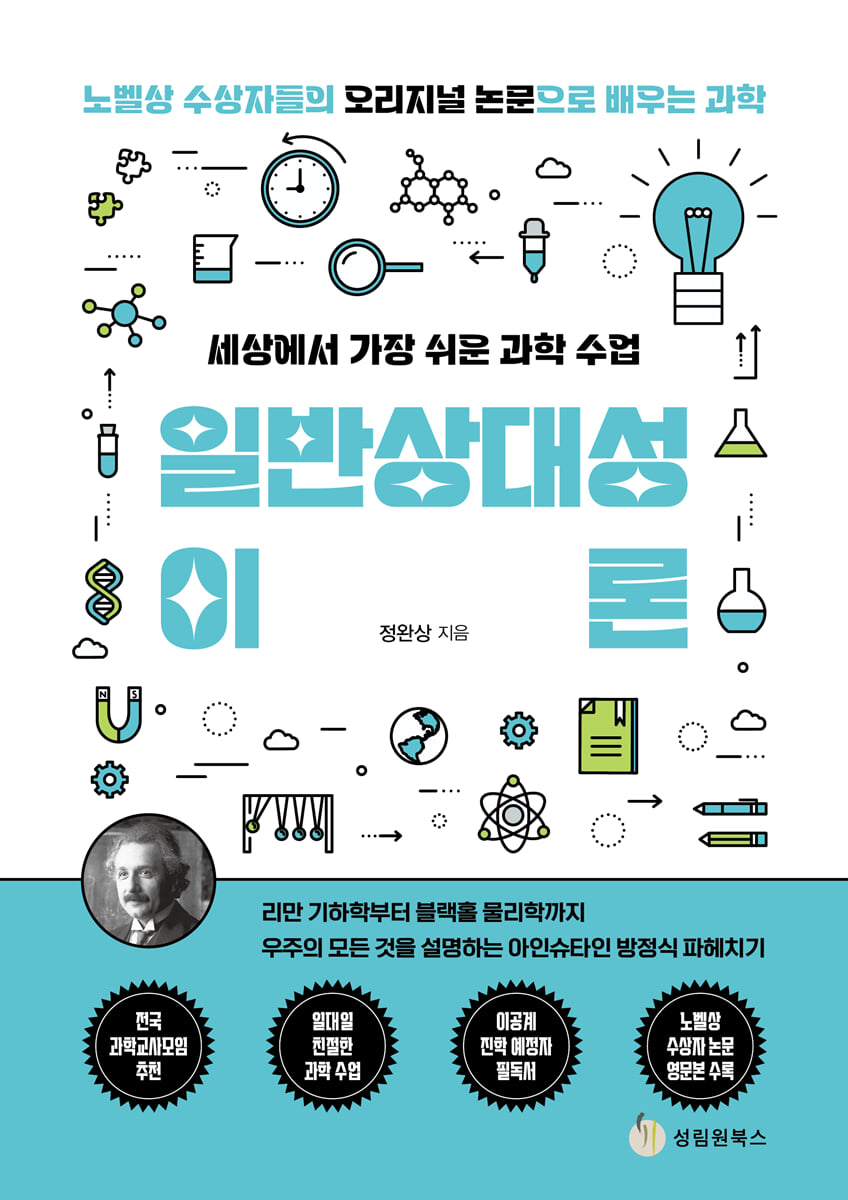
The World's Easiest Science Lesson: General Relativity
 |
Description
Book Introduction
From Riemannian geometry to black hole physics Inside Einstein's paper that created the equations that govern the universe The birth of an equation that explains everything in the universe The 11th installment of the series “Learning Science Through Original Papers by Nobel Prize Winners.” Following the special theory of relativity, the subject of the first volume of the series, this book introduces Einstein's general theory of relativity. Here we discuss three papers on general relativity. Einstein and Grossmann's 1913 paper was the first attempt at general relativity. However, Einstein, who felt a problem in this process, completed the theory in a single paper in 1916 and published the Einstein equations. In the same year, Schwarzschild was the first to solve Einstein's equations and predict the existence of black holes. These papers have been written in a slightly easier way for young people and general readers. The introduction begins with a virtual interview with Dr. Penrose, providing an overview of the book's flow. To understand Einstein's general theory of relativity, you must first understand Riemannian geometry. So, in this book, I started by mentioning the history of geometry. Next, he explained the four-dimensional spacetime geometry, Einstein's sum symbol, and Einstein's equivalence principle, which is the basic idea of general relativity. In Chapter 4, I tried to explain Einstein's equations with formulas, excluding formulas, in Chapter 5, following Einstein's thesis, to suit the reader's taste. Chapter 6 concludes the book with a discussion of black holes and wormholes. The appendix includes English versions of three key papers and a list of Nobel Prize winners in Physics to aid deeper exploration and understanding. |
- You can preview some of the book's contents.
Preview
index
Recommendation
I hope you can understand the original papers of these genius scientists.
Creating the Equations That Rule the Universe: A Surprise Interview with Dr. Penrose
First Encounter | The Birth of Riemannian Geometry
History of Geometry: Papyrus Records and Euclidean Geometry
Non-Euclidean Geometry: A New Geometry Born from the Negation of the Parallel Assumption
The Appearance of Gauss and Riemann: The King of Mathematics and His Student
The Birth of the Concept of Curvature - Degree of Curvature
Spherical coordinate system _ A method of representing three-dimensional space
Second Encounter | Four-Dimensional Spacetime
Einstein's School Days _ Companion Mileva Maric
Special Relativity: Time Flows Differently for Observers
4-Dimensional Spacetime - A New Geometry that Describes Time and Space Together
Einstein's New Rule _ Omitting the Agreement Symbol
Third Encounter | Einstein's Equivalence Principle
About Mass _ Inertial Mass and Gravitational Mass
The Truth About Free Fall Experiments _ DeSoto and Stevin
Equivalence Principle - Acceleration and Gravitational Field Strength
Creating Gravity _ Weightlessness and New Gravitational Fields
Einstein's lectures and research career from 1908 to 1915
The Equivalence Principle and the Bending of Light: Application to the Solar System
Fourth Encounter | Einstein's Equations
Marcel Grossmann, a contributor to the birth of general relativity
The emergence of general relativity: the perfect equations that govern the universe
Observing the bending of light: Demonstrating the power of general relativity
Gravitational time dilation - Time flows more slowly in places with greater gravity.
Unraveling the Mystery of Mercury's Perihelion Transit - 43 Seconds
Gravitational lensing - the phenomenon that makes galaxies appear larger
Einstein's second love: Elsa, his wife and secretary
Einstein's life in America - fleeing Nazi persecution
Hilbert: Infinity and the Infinite Hotel
Fifth Encounter | Inside Einstein's Papers
Accelerating Observer in Newtonian Mechanics - What Does the Person on the Bus See?
Quantification in Curved Spacetime - Describing the Curvature of Spacetime
Peerwein and Christoffel Symbols - Introduction of New Symbols
Equations of motion for an accelerating observer _ Apparent acceleration
Covariant Differentiation _ A New Definition of Differentiation
Riemann tensor _ proportional to curvature
Einstein's equations: considering the curvature of the universe
Sixth Encounter | Black Hole
Schwarzschild's Black Hole - General Solution to Einstein's Equations
Black Holes in Newtonian Mechanics: The Secret Hidden in the Event Horizon
Heroes of Black Hole Physics: Four Physicists
Black Hole Physics: Singularities and Evaporating Black Holes
Wormhole - a tunnel connecting two points in spacetime
In addition to the meeting
Outline of a Generalized Theory of Relativity and of a Theory of Gravitation _Einstein-Grossman Paper, English Version
The Foundation of the General Theory of Relativity _Einstein's paper in English
On the Gravitational Field of a Mass Point according to Einstein's Theory _ English version of Schwarzschild's paper
Concluding our meeting with a great paper
Papers referenced for this book
Greek letters used in formulas
Introducing the Nobel Prize winners in Physics
I hope you can understand the original papers of these genius scientists.
Creating the Equations That Rule the Universe: A Surprise Interview with Dr. Penrose
First Encounter | The Birth of Riemannian Geometry
History of Geometry: Papyrus Records and Euclidean Geometry
Non-Euclidean Geometry: A New Geometry Born from the Negation of the Parallel Assumption
The Appearance of Gauss and Riemann: The King of Mathematics and His Student
The Birth of the Concept of Curvature - Degree of Curvature
Spherical coordinate system _ A method of representing three-dimensional space
Second Encounter | Four-Dimensional Spacetime
Einstein's School Days _ Companion Mileva Maric
Special Relativity: Time Flows Differently for Observers
4-Dimensional Spacetime - A New Geometry that Describes Time and Space Together
Einstein's New Rule _ Omitting the Agreement Symbol
Third Encounter | Einstein's Equivalence Principle
About Mass _ Inertial Mass and Gravitational Mass
The Truth About Free Fall Experiments _ DeSoto and Stevin
Equivalence Principle - Acceleration and Gravitational Field Strength
Creating Gravity _ Weightlessness and New Gravitational Fields
Einstein's lectures and research career from 1908 to 1915
The Equivalence Principle and the Bending of Light: Application to the Solar System
Fourth Encounter | Einstein's Equations
Marcel Grossmann, a contributor to the birth of general relativity
The emergence of general relativity: the perfect equations that govern the universe
Observing the bending of light: Demonstrating the power of general relativity
Gravitational time dilation - Time flows more slowly in places with greater gravity.
Unraveling the Mystery of Mercury's Perihelion Transit - 43 Seconds
Gravitational lensing - the phenomenon that makes galaxies appear larger
Einstein's second love: Elsa, his wife and secretary
Einstein's life in America - fleeing Nazi persecution
Hilbert: Infinity and the Infinite Hotel
Fifth Encounter | Inside Einstein's Papers
Accelerating Observer in Newtonian Mechanics - What Does the Person on the Bus See?
Quantification in Curved Spacetime - Describing the Curvature of Spacetime
Peerwein and Christoffel Symbols - Introduction of New Symbols
Equations of motion for an accelerating observer _ Apparent acceleration
Covariant Differentiation _ A New Definition of Differentiation
Riemann tensor _ proportional to curvature
Einstein's equations: considering the curvature of the universe
Sixth Encounter | Black Hole
Schwarzschild's Black Hole - General Solution to Einstein's Equations
Black Holes in Newtonian Mechanics: The Secret Hidden in the Event Horizon
Heroes of Black Hole Physics: Four Physicists
Black Hole Physics: Singularities and Evaporating Black Holes
Wormhole - a tunnel connecting two points in spacetime
In addition to the meeting
Outline of a Generalized Theory of Relativity and of a Theory of Gravitation _Einstein-Grossman Paper, English Version
The Foundation of the General Theory of Relativity _Einstein's paper in English
On the Gravitational Field of a Mass Point according to Einstein's Theory _ English version of Schwarzschild's paper
Concluding our meeting with a great paper
Papers referenced for this book
Greek letters used in formulas
Introducing the Nobel Prize winners in Physics
Detailed image

Into the book
I discovered so many amazing things.
I created a new, strange universe out of nothing.
- A letter from Boyeo to his father
--- p.28
Mileva Maric, who later became Einstein's wife, also entered the same department as Einstein that year.
As the only woman in the class, she quickly became close friends with Einstein.
Over the next few years, their friendship grew into love.
--- p.53
The year 1905 is called the year of miracles for Einstein.
That year he published papers on the photoelectric effect, Brownian motion, special relativity, and the equivalence of mass and energy.
All of these papers received significant attention from the academic community.
--- p.56
The next day, the London Times referred to Einstein's general theory of relativity as "a revolution in science," "a new theory of the universe," and "Newtonian mechanics is broken," and on November 11, the New York Times praised Einstein's theory with statements such as "all the light in heaven is bent" and "the triumph of Einstein's theory."
--- p.114
If two people lived their entire lives on the top floor of a tall building, while the other lived their entire lives on the ground floor, which would live longer? Because the ground floor is closer to the center of the Earth, gravity is stronger, and time passes more slowly.
However, in places with low gravity, such as Earth, the slowing down of time due to the difference in gravity between the first and top floors is barely perceptible.
--- p.117
Around that time, Einstein was nominated for the Nobel Prize in Physics seven times, but was often rejected because of his opinion that he would refuse the prize if the theory of relativity was not mentioned.
It was only a matter of time before Einstein won the Nobel Prize.
--- p.127
The theory of relativity that comes to mind when thinking of Einstein was not the theme of his Nobel Prize.
Ironically, he won the Nobel Prize for his work on the photoelectric effect of light.
The Nobel Prize in Physics committee made the excuse that the theory of relativity was too difficult to be selected as a Nobel Prize theme, but I think it was because at the time, there were as many physicists who doubted the theory of relativity as those who believed in it.
--- p.129
In a lecture given in Göttingen, Germany, in January 1924, Hilbert gave an example of an infinite hotel that would make infinity easily understandable to the general public.
He envisioned a hotel with an infinite number of rooms.
All the rooms in this hotel are occupied, so there are no vacancies.
But if you understand the concept of infinity, you can see that this infinite hotel can always accept new guests.
--- p.134
If there is a black hole, the curvature around it will increase enormously, causing spacetime to warp rapidly.
In other words, light around the event horizon is bent very significantly.
Any object that enters the event horizon cannot come out.
Even in the case of light, once it is sucked into the event horizon, it cannot come out.
--- p.179
The diagnosis was motor neuron disease.
At that time, Hawking was 21 years old.
The doctors told him he had only about two years to live.
This incident caused Hawking to fall into depression.
He had difficulty walking without support, and his speech was barely understandable.
But his illness progressed more slowly than doctors expected.
The initial diagnosis that he had only two years to live turned out to be incorrect.
--- p.193
In general relativity, a singularity is a place that cannot be explained by general relativity.
(...) The first conclusion that Hawking reached by applying quantum theory to black holes was a very surprising result.
It was said that black holes could evaporate and disappear.
--- p.199
Wheeler in the US thought it would be more logical to think of the Einstein-Rosen Bridge not as a tunnel leading to another universe, but as a tunnel leading back to our universe.
And the tunnel connecting two points in space and time was named a wormhole.
I created a new, strange universe out of nothing.
- A letter from Boyeo to his father
--- p.28
Mileva Maric, who later became Einstein's wife, also entered the same department as Einstein that year.
As the only woman in the class, she quickly became close friends with Einstein.
Over the next few years, their friendship grew into love.
--- p.53
The year 1905 is called the year of miracles for Einstein.
That year he published papers on the photoelectric effect, Brownian motion, special relativity, and the equivalence of mass and energy.
All of these papers received significant attention from the academic community.
--- p.56
The next day, the London Times referred to Einstein's general theory of relativity as "a revolution in science," "a new theory of the universe," and "Newtonian mechanics is broken," and on November 11, the New York Times praised Einstein's theory with statements such as "all the light in heaven is bent" and "the triumph of Einstein's theory."
--- p.114
If two people lived their entire lives on the top floor of a tall building, while the other lived their entire lives on the ground floor, which would live longer? Because the ground floor is closer to the center of the Earth, gravity is stronger, and time passes more slowly.
However, in places with low gravity, such as Earth, the slowing down of time due to the difference in gravity between the first and top floors is barely perceptible.
--- p.117
Around that time, Einstein was nominated for the Nobel Prize in Physics seven times, but was often rejected because of his opinion that he would refuse the prize if the theory of relativity was not mentioned.
It was only a matter of time before Einstein won the Nobel Prize.
--- p.127
The theory of relativity that comes to mind when thinking of Einstein was not the theme of his Nobel Prize.
Ironically, he won the Nobel Prize for his work on the photoelectric effect of light.
The Nobel Prize in Physics committee made the excuse that the theory of relativity was too difficult to be selected as a Nobel Prize theme, but I think it was because at the time, there were as many physicists who doubted the theory of relativity as those who believed in it.
--- p.129
In a lecture given in Göttingen, Germany, in January 1924, Hilbert gave an example of an infinite hotel that would make infinity easily understandable to the general public.
He envisioned a hotel with an infinite number of rooms.
All the rooms in this hotel are occupied, so there are no vacancies.
But if you understand the concept of infinity, you can see that this infinite hotel can always accept new guests.
--- p.134
If there is a black hole, the curvature around it will increase enormously, causing spacetime to warp rapidly.
In other words, light around the event horizon is bent very significantly.
Any object that enters the event horizon cannot come out.
Even in the case of light, once it is sucked into the event horizon, it cannot come out.
--- p.179
The diagnosis was motor neuron disease.
At that time, Hawking was 21 years old.
The doctors told him he had only about two years to live.
This incident caused Hawking to fall into depression.
He had difficulty walking without support, and his speech was barely understandable.
But his illness progressed more slowly than doctors expected.
The initial diagnosis that he had only two years to live turned out to be incorrect.
--- p.193
In general relativity, a singularity is a place that cannot be explained by general relativity.
(...) The first conclusion that Hawking reached by applying quantum theory to black holes was a very surprising result.
It was said that black holes could evaporate and disappear.
--- p.199
Wheeler in the US thought it would be more logical to think of the Einstein-Rosen Bridge not as a tunnel leading to another universe, but as a tunnel leading back to our universe.
And the tunnel connecting two points in space and time was named a wormhole.
--- p.201
Publisher's Review
★ Recommended by the National Science Teachers Association ★ Friendly, one-on-one science classes
★ A must-read for those planning to pursue a science or engineering degree ★ Includes English versions of Nobel Prize-winning papers
The Nobel Prize in Physics has been awarded three times in the past decade for the theory of general relativity.
Read original papers by Nobel laureates and learn like a scientist.
There is a learning method in science called 'follow the scientist'.
Examples include inquiry activities or R&E commonly applied in science classes.
One of the new ways to imitate scientists is to read original papers by Nobel Prize winners.
It is not easy to get students to understand the original text of a difficult theory such as the theory of relativity.
Fortunately, the theory of relativity has been introduced into the current high school curriculum, so the basic principles and phenomena are already being learned in schools.
It is relatively familiar to students, except for overly specialized knowledge. The special theory of relativity was published by Einstein in 1905.
Einstein first introduced the concept of spacetime and discovered that time must flow differently for moving and stationary observers.
Special relativity only holds true in the special case where a moving observer moves at a constant velocity.
So Einstein extended this theory so that it could also hold true in the presence of acceleration.
This theory is called general relativity because it is the most general theory of relativity.
General relativity is a theory that solves problems related to the universe, celestial bodies, etc.
Within the past decade, three Nobel Prizes have been awarded for work on general relativity.
Joint awards were made in 2020, 2019, and 2017.
This may be because many achievements have been accumulated recently and the resulting effects are great.
Against the backdrop of this historical context and scientific learning methods, this book introduces the basic concepts of Einstein's general theory of relativity, along with the original text of the paper and anecdotes from history and related scholars.
Several photographic references are also helpful.
This prevents readers from being intimidated by preconceived notions or from becoming bored with the book.
It may be difficult if you are not familiar with the formulas that are inevitably introduced, but it is explained in a friendly way so that readers who understand high school level mathematics can read it.
I hope that through this book, you will have the valuable experience of thinking like a scientist and immersing yourself in scientific theories.
The shortest distance in a curved space is not a straight line, but a curve!
A new geometry that played a key role in completing general relativity
The sum of the interior angles of a triangle is 180 degrees.
This is a basic property of triangles that we learn in school.
But what if you drew a triangle on a horse's saddle? Or on a soccer ball? The sum of the triangle's interior angles would either be less than or greater than 180 degrees.
In a plane, there is only one line parallel to a point outside a line.
Euclid proved countless theorems based on this unprovable parallel line hypothesis.
This is the Euclidean geometry we have taken for granted.
Since then, many mathematicians have tried to prove the parallel line hypothesis, but have failed.
However, some scholars rejected the parallel assumption and created a new geometry.
It is non-Euclidean geometry that was born from the research of Boyai, Lobachevsky, and others.
Gauss and his disciple Riemann studied curvature in non-Euclidean geometry.
Riemannian geometry, which Riemann completed, later played a major role in the generalization of special relativity, that is, the completion of general relativity.
Grossmann, a mathematician and close friend of Einstein, was an authority on Riemannian geometry.
It was he who introduced Riemannian geometry to Einstein, which played a crucial role in the development of Einstein's general theory of relativity.
Their collaboration led to a groundbreaking paper published in 1913.
This book will be a great opportunity to learn how Einstein communicated with his colleagues, solved problems, and developed theories.
Black holes: one of the most fascinating yet unknown topics in modern physics.
Let's delve into the general theory of relativity that predicted black holes!
In 1783, British scientist Michel proposed the concept of a star with such a strong gravity that even light cannot escape.
This was called a dark star, and it was the first study of a black hole.
In 1967, Wheeler, a physics professor at Princeton University, first used the term 'black hole' during a speech at NASA's Goddard Institute for Space Studies.
British physicist Roger Penrose won the 2020 Nobel Prize in Physics for proving the theoretical possibility of black holes using general relativity.
Kip Thorne, an American physicist who won the 2017 Nobel Prize in Physics, participated in the production of the 2014 film Interstellar, which deals with the themes of black holes and time travel.
Stephen Hawking, the British physicist famous for “A Brief History of Time,” has made contributions to the study of singularities and black holes.
Schwarzschild's discovery of solutions to Einstein's equations gave birth to black hole physics.
Black holes are one of the most fascinating and yet mysterious research topics in modern physics! Humanity discovered the existence of black holes thanks to Einstein's theory of general relativity.
Let's begin our journey into the wider universe with Einstein's general theory of relativity!
★ A must-read for those planning to pursue a science or engineering degree ★ Includes English versions of Nobel Prize-winning papers
The Nobel Prize in Physics has been awarded three times in the past decade for the theory of general relativity.
Read original papers by Nobel laureates and learn like a scientist.
There is a learning method in science called 'follow the scientist'.
Examples include inquiry activities or R&E commonly applied in science classes.
One of the new ways to imitate scientists is to read original papers by Nobel Prize winners.
It is not easy to get students to understand the original text of a difficult theory such as the theory of relativity.
Fortunately, the theory of relativity has been introduced into the current high school curriculum, so the basic principles and phenomena are already being learned in schools.
It is relatively familiar to students, except for overly specialized knowledge. The special theory of relativity was published by Einstein in 1905.
Einstein first introduced the concept of spacetime and discovered that time must flow differently for moving and stationary observers.
Special relativity only holds true in the special case where a moving observer moves at a constant velocity.
So Einstein extended this theory so that it could also hold true in the presence of acceleration.
This theory is called general relativity because it is the most general theory of relativity.
General relativity is a theory that solves problems related to the universe, celestial bodies, etc.
Within the past decade, three Nobel Prizes have been awarded for work on general relativity.
Joint awards were made in 2020, 2019, and 2017.
This may be because many achievements have been accumulated recently and the resulting effects are great.
Against the backdrop of this historical context and scientific learning methods, this book introduces the basic concepts of Einstein's general theory of relativity, along with the original text of the paper and anecdotes from history and related scholars.
Several photographic references are also helpful.
This prevents readers from being intimidated by preconceived notions or from becoming bored with the book.
It may be difficult if you are not familiar with the formulas that are inevitably introduced, but it is explained in a friendly way so that readers who understand high school level mathematics can read it.
I hope that through this book, you will have the valuable experience of thinking like a scientist and immersing yourself in scientific theories.
The shortest distance in a curved space is not a straight line, but a curve!
A new geometry that played a key role in completing general relativity
The sum of the interior angles of a triangle is 180 degrees.
This is a basic property of triangles that we learn in school.
But what if you drew a triangle on a horse's saddle? Or on a soccer ball? The sum of the triangle's interior angles would either be less than or greater than 180 degrees.
In a plane, there is only one line parallel to a point outside a line.
Euclid proved countless theorems based on this unprovable parallel line hypothesis.
This is the Euclidean geometry we have taken for granted.
Since then, many mathematicians have tried to prove the parallel line hypothesis, but have failed.
However, some scholars rejected the parallel assumption and created a new geometry.
It is non-Euclidean geometry that was born from the research of Boyai, Lobachevsky, and others.
Gauss and his disciple Riemann studied curvature in non-Euclidean geometry.
Riemannian geometry, which Riemann completed, later played a major role in the generalization of special relativity, that is, the completion of general relativity.
Grossmann, a mathematician and close friend of Einstein, was an authority on Riemannian geometry.
It was he who introduced Riemannian geometry to Einstein, which played a crucial role in the development of Einstein's general theory of relativity.
Their collaboration led to a groundbreaking paper published in 1913.
This book will be a great opportunity to learn how Einstein communicated with his colleagues, solved problems, and developed theories.
Black holes: one of the most fascinating yet unknown topics in modern physics.
Let's delve into the general theory of relativity that predicted black holes!
In 1783, British scientist Michel proposed the concept of a star with such a strong gravity that even light cannot escape.
This was called a dark star, and it was the first study of a black hole.
In 1967, Wheeler, a physics professor at Princeton University, first used the term 'black hole' during a speech at NASA's Goddard Institute for Space Studies.
British physicist Roger Penrose won the 2020 Nobel Prize in Physics for proving the theoretical possibility of black holes using general relativity.
Kip Thorne, an American physicist who won the 2017 Nobel Prize in Physics, participated in the production of the 2014 film Interstellar, which deals with the themes of black holes and time travel.
Stephen Hawking, the British physicist famous for “A Brief History of Time,” has made contributions to the study of singularities and black holes.
Schwarzschild's discovery of solutions to Einstein's equations gave birth to black hole physics.
Black holes are one of the most fascinating and yet mysterious research topics in modern physics! Humanity discovered the existence of black holes thanks to Einstein's theory of general relativity.
Let's begin our journey into the wider universe with Einstein's general theory of relativity!
GOODS SPECIFICS
- Date of issue: November 20, 2024
- Page count, weight, size: 324 pages | 480g | 152*215*20mm
- ISBN13: 9791193357392
- ISBN10: 119335739X
You may also like
카테고리
korean


korean

![ELLE 엘르 스페셜 에디션 A형 : 12월 [2025]](http://librairie.coreenne.fr/cdn/shop/files/b8e27a3de6c9538896439686c6b0e8fb.jpg?v=1766436872&width=3840)


