

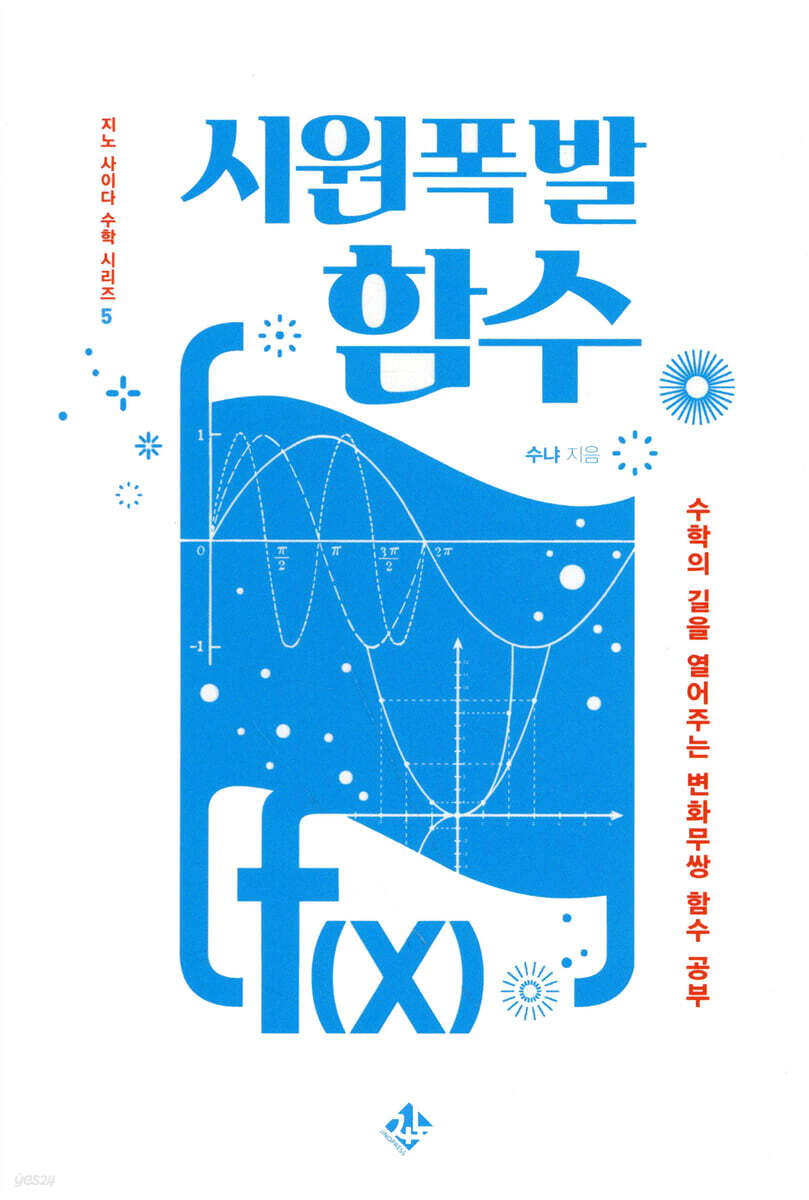
Cool explosion function
 |
Description
Book Introduction
What is a function? Why learn about functions? How should we study them? Where can we use them? Mathematician Sunya's new book, "Cool Explosion Functions," is not a book on functions to be solved, but one to be read and understood.
The author focused on helping readers understand the concepts and principles of functions and consider their practical applications.
It clearly shows how the knowledge, thoughts, and ideas surrounding functions influence other fields, and it clearly explains what a function is, why we learn functions, how functions and equations are similar and different, which functions we must know, and where and how to use functions.
Even readers who have felt that functions are difficult and distant will be able to discover the fun and depth of studying functions by reading this book.
We invite you to the unique, wonderful, and ever-changing world of functions!
The author focused on helping readers understand the concepts and principles of functions and consider their practical applications.
It clearly shows how the knowledge, thoughts, and ideas surrounding functions influence other fields, and it clearly explains what a function is, why we learn functions, how functions and equations are similar and different, which functions we must know, and where and how to use functions.
Even readers who have felt that functions are difficult and distant will be able to discover the fun and depth of studying functions by reading this book.
We invite you to the unique, wonderful, and ever-changing world of functions!
- You can preview some of the book's contents.
Preview
index
Introduction _ In an era where functions rule, let's understand functions at a higher level!
Part 1) Why learn functions?
01 Why is it called a function when it is not a number?
02 Why do functions appear in computer programming?
Part 2) What is a function?
03 Function looks like this
04 Functions are programs
05 Functions as symbols!
06 Graphing functions!
07 Functions you must know - Linear
08 Functions you must know - Curves
Part 3) Functions, how to study them?
09 Equations and functions, similar yet different
10 Functions also have operations - composite functions
11 Functions also have operations - inverse functions
12 Things to keep in mind when studying functions
13 Let's pay attention to the relationship between functions.
Part 4) Functions, where can we use them?
14 Change every moment of your daily life
15 Mathematics before the function, mathematics after the function
16 Functions, Creating Science-Real Science
Part 5) Functions in the Age of Artificial Intelligence
17 Computers are function boxes
18 Functions Enable Artificial Intelligence
Outgoing Post _ What kind of function, what kind of program am I?
Part 1) Why learn functions?
01 Why is it called a function when it is not a number?
02 Why do functions appear in computer programming?
Part 2) What is a function?
03 Function looks like this
04 Functions are programs
05 Functions as symbols!
06 Graphing functions!
07 Functions you must know - Linear
08 Functions you must know - Curves
Part 3) Functions, how to study them?
09 Equations and functions, similar yet different
10 Functions also have operations - composite functions
11 Functions also have operations - inverse functions
12 Things to keep in mind when studying functions
13 Let's pay attention to the relationship between functions.
Part 4) Functions, where can we use them?
14 Change every moment of your daily life
15 Mathematics before the function, mathematics after the function
16 Functions, Creating Science-Real Science
Part 5) Functions in the Age of Artificial Intelligence
17 Computers are function boxes
18 Functions Enable Artificial Intelligence
Outgoing Post _ What kind of function, what kind of program am I?
Into the book
“I remember when I learned that function was the English word for function and asked, ‘What is this?’
I never imagined that a function would be called a function.
That's how much I didn't know about functions.
If I really knew the function, I would have hit the table when I heard the word function and said, 'That's right!'"
“The idea that ‘a formula is a function’ is not necessarily wrong.
Most functions covered in mathematics are expressed as formulas.
However, a formula is not necessarily a function.
Not all functions can be expressed as formulas.
The function itself and the formula are different.
The formula is just one of the masks that the function wears.
A function as a formula can be transformed directly into a graph.
Linear functions are represented by straight lines, and quadratic functions are represented by parabolas.
Exponential functions, logarithmic functions, and trigonometric functions also each have their own unique graph form.
“A function that you thought was a formula suddenly turns into a graph.”
“Water flows from top to bottom.
A ball thrown into the air falls back to the ground.
Water vapor in the air returns to the ground as rain when the time comes.
Red, ripe apples fall to the ground with a thud.
Science deals with concrete and practical phenomena like this.
However, interest is drawn to universal laws or patterns that encompass all of these phenomena.
Science deals with the changes in all things.
Explains why and how such changes occur.
Functions are perfect for this kind of science.
“The most appropriate language for expressing the causes and rules of change is a function.”
“I would like to say that the computer age is the age of functions.
The computer itself is a function, and various apps and programs that operate based on the computer are also functions.
Computer programming is the process of creating functional formulas that perform a certain role.
People are still creating more ingenious and useful functions, functions that do the job perfectly.”
“I think that if you look closely, people are also a kind of function.
Because it receives the stimulus at that time as data and outputs the judgment or choice that it deems most appropriate.
And depending on that choice, you change the environment that surrounds you.
Depending on the function, the choice, action, and influence will differ.”
I never imagined that a function would be called a function.
That's how much I didn't know about functions.
If I really knew the function, I would have hit the table when I heard the word function and said, 'That's right!'"
“The idea that ‘a formula is a function’ is not necessarily wrong.
Most functions covered in mathematics are expressed as formulas.
However, a formula is not necessarily a function.
Not all functions can be expressed as formulas.
The function itself and the formula are different.
The formula is just one of the masks that the function wears.
A function as a formula can be transformed directly into a graph.
Linear functions are represented by straight lines, and quadratic functions are represented by parabolas.
Exponential functions, logarithmic functions, and trigonometric functions also each have their own unique graph form.
“A function that you thought was a formula suddenly turns into a graph.”
“Water flows from top to bottom.
A ball thrown into the air falls back to the ground.
Water vapor in the air returns to the ground as rain when the time comes.
Red, ripe apples fall to the ground with a thud.
Science deals with concrete and practical phenomena like this.
However, interest is drawn to universal laws or patterns that encompass all of these phenomena.
Science deals with the changes in all things.
Explains why and how such changes occur.
Functions are perfect for this kind of science.
“The most appropriate language for expressing the causes and rules of change is a function.”
“I would like to say that the computer age is the age of functions.
The computer itself is a function, and various apps and programs that operate based on the computer are also functions.
Computer programming is the process of creating functional formulas that perform a certain role.
People are still creating more ingenious and useful functions, functions that do the job perfectly.”
“I think that if you look closely, people are also a kind of function.
Because it receives the stimulus at that time as data and outputs the judgment or choice that it deems most appropriate.
And depending on that choice, you change the environment that surrounds you.
Depending on the function, the choice, action, and influence will differ.”
---From the text
Publisher's Review
What is a function? Why learn about functions?
Functions: How should we study them? Where can we use them?
From the basics of functions to solutions and applications, you can't learn them in textbooks.
A unique, next-level, and refreshing way to learn functions!
'Reading' mathematics as a liberal arts subject, a refreshing study of mathematics that will solve your life!
When studying mathematics, you often come across functions, but when asked, “What is a function?” it is quite difficult to answer.
Because its identity is mysterious.
A function may seem like an equation, or it may seem like a graph.
Above all, the word ‘function’ itself is confusing.
It doesn't seem to be a number, but because it's called a function, the identity of the function becomes more confusing.
Nowadays, the concept of function is being used more and more actively in various aspects of our lives, including computers.
Things that perform a functional role are changing our world drastically.
What we need more than anything now is a deeper and more fundamental understanding of functions.
Mathematician Sunya's new book, "Cool Explosion Functions," is the fifth book in the "Gino Cider Math Series." It is a book on functions to be read and understood, not a book on functions to be solved.
The author focused on helping readers understand the concepts and principles of functions and consider their practical applications.
It clearly shows how the knowledge, thoughts, and ideas surrounding functions influence other fields, and it clearly explains what a function is, why we learn functions, how functions and equations are similar and different, which functions we must know, and where and how to use functions.
Therefore, by taking just a little time to read, you will naturally learn the concept and meaning of the word "function," the basic principles of solution, and even the key points that will help you solve function problems.
Even readers who have felt that functions are difficult and distant will be able to discover the fun and depth of studying functions by reading this book.
We invite you to the unique, wonderful, and ever-changing world of functions!
* Strengths of this book *
- A story about the 'read and understand' function that develops reading comprehension, thinking skills, and mathematical abilities.
- A liberal arts mathematics book titled 'Big-Story' that provides a view of the forest called functions.
- A book that tells you famous quotes related to functions and mathematics that you don't often come across.
- A book that makes you think about the relationship between artificial intelligence and functions, a hot topic in the 21st century.
Functions: How should we study them? Where can we use them?
From the basics of functions to solutions and applications, you can't learn them in textbooks.
A unique, next-level, and refreshing way to learn functions!
'Reading' mathematics as a liberal arts subject, a refreshing study of mathematics that will solve your life!
When studying mathematics, you often come across functions, but when asked, “What is a function?” it is quite difficult to answer.
Because its identity is mysterious.
A function may seem like an equation, or it may seem like a graph.
Above all, the word ‘function’ itself is confusing.
It doesn't seem to be a number, but because it's called a function, the identity of the function becomes more confusing.
Nowadays, the concept of function is being used more and more actively in various aspects of our lives, including computers.
Things that perform a functional role are changing our world drastically.
What we need more than anything now is a deeper and more fundamental understanding of functions.
Mathematician Sunya's new book, "Cool Explosion Functions," is the fifth book in the "Gino Cider Math Series." It is a book on functions to be read and understood, not a book on functions to be solved.
The author focused on helping readers understand the concepts and principles of functions and consider their practical applications.
It clearly shows how the knowledge, thoughts, and ideas surrounding functions influence other fields, and it clearly explains what a function is, why we learn functions, how functions and equations are similar and different, which functions we must know, and where and how to use functions.
Therefore, by taking just a little time to read, you will naturally learn the concept and meaning of the word "function," the basic principles of solution, and even the key points that will help you solve function problems.
Even readers who have felt that functions are difficult and distant will be able to discover the fun and depth of studying functions by reading this book.
We invite you to the unique, wonderful, and ever-changing world of functions!
* Strengths of this book *
- A story about the 'read and understand' function that develops reading comprehension, thinking skills, and mathematical abilities.
- A liberal arts mathematics book titled 'Big-Story' that provides a view of the forest called functions.
- A book that tells you famous quotes related to functions and mathematics that you don't often come across.
- A book that makes you think about the relationship between artificial intelligence and functions, a hot topic in the 21st century.
GOODS SPECIFICS
- Publication date: December 12, 2022
- Page count, weight, size: 304 pages | 374g | 128*188*18mm
- ISBN13: 9791190282567
- ISBN10: 1190282569
You may also like
카테고리
korean


korean

![GQ KOREA Mark (Monthly): December [2025]](http://librairie.coreenne.fr/cdn/shop/files/8ef265dbbfbf186523ed75ba7319009d.jpg?v=1765340328&width=3840)


