

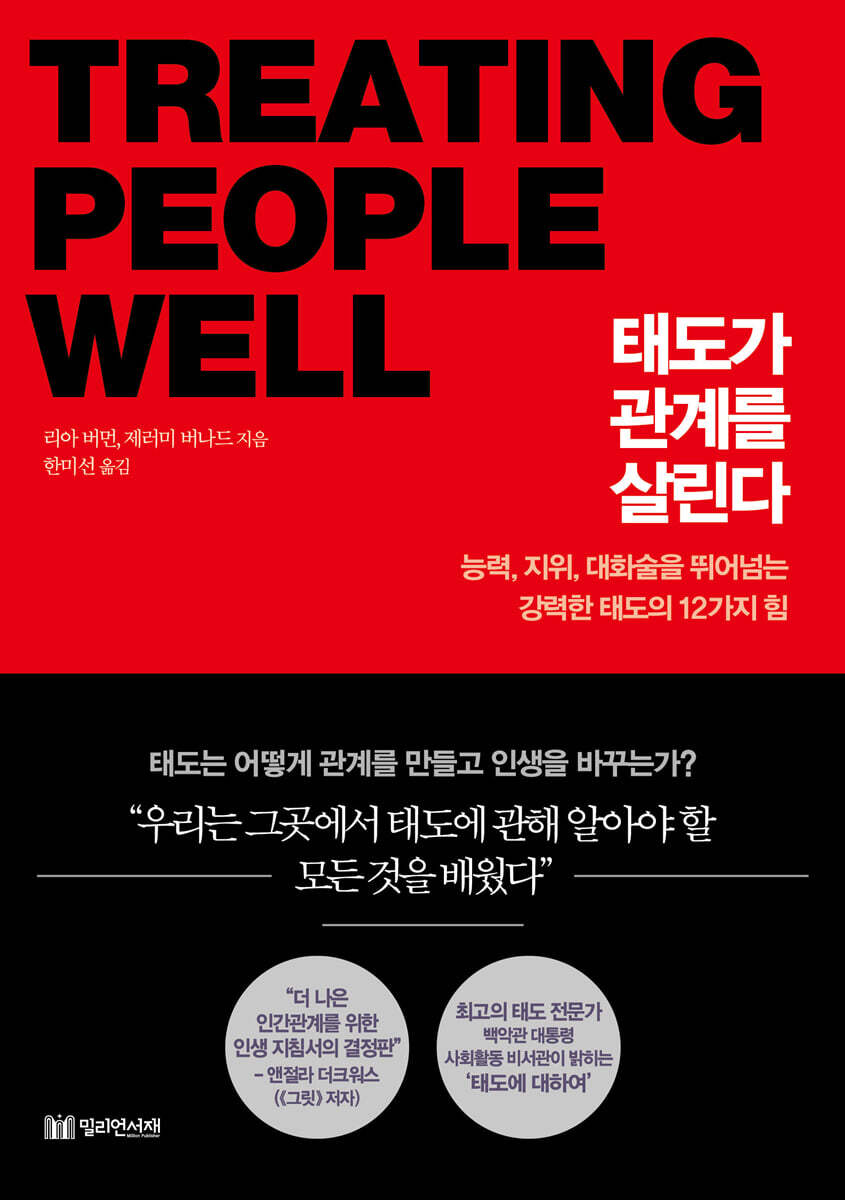
Attitude makes the difference in a relationship
 |
Description
Book Introduction
“If something isn’t working out, ask yourself:
“How am I treating people now?”
■ Attitude is power, strategy, and influence.
1600 Pennsylvania Avenue.
The world's most famous house, and the most tense.
Here, power moves behind smiles dozens of times a day.
A single handshake, a single glance, a single word can become global news and change the international situation.
The White House is the center of American power and the official residence and office of the President.
A place where social events take place year-round, intimate conversations take place, and important world conferences are held.
It's where the massive tectonic plates of American politics collide daily, where decisions that could reshape the world are made, and where the demands and attention of not just one country but all of the world are focused.
While the eyes of the world are focused on the president waving from the Truman Balcony, there are those behind the scenes who set the tone, calm troublemakers, and resolve conflicts.
The people who actually run the White House, maintaining confidence, humor, and composure while maintaining a steady demeanor amidst the solemn atmosphere of a historic space, the weight of power, and the pressure of being the president and first lady, are the social activity secretaries.
George W.
Leah Berman and Jeremy Bernard, who served as presidential social affairs secretaries in the Bush and Barack Obama administrations, had polar opposite political leanings but came to a single realization:
“How am I treating people now?”
■ Attitude is power, strategy, and influence.
1600 Pennsylvania Avenue.
The world's most famous house, and the most tense.
Here, power moves behind smiles dozens of times a day.
A single handshake, a single glance, a single word can become global news and change the international situation.
The White House is the center of American power and the official residence and office of the President.
A place where social events take place year-round, intimate conversations take place, and important world conferences are held.
It's where the massive tectonic plates of American politics collide daily, where decisions that could reshape the world are made, and where the demands and attention of not just one country but all of the world are focused.
While the eyes of the world are focused on the president waving from the Truman Balcony, there are those behind the scenes who set the tone, calm troublemakers, and resolve conflicts.
The people who actually run the White House, maintaining confidence, humor, and composure while maintaining a steady demeanor amidst the solemn atmosphere of a historic space, the weight of power, and the pressure of being the president and first lady, are the social activity secretaries.
George W.
Leah Berman and Jeremy Bernard, who served as presidential social affairs secretaries in the Bush and Barack Obama administrations, had polar opposite political leanings but came to a single realization:
- You can preview some of the book's contents.
Preview
Detailed image

Publisher's Review
“Success ultimately depends on how you treat people from different walks of life.
We witnessed this fact on the ground every day.
“The way you treat people is your strength.”
Although I had limited experience in politics, my background was different from that of my previous social work secretaries, and I had my own set of challenges in gaining confidence. From my first day on the job, they began to doubt whether I was the right person for the job, and at times, they felt as if their abilities were woefully inadequate.
Because he didn't fit the typical criteria of a White House social affairs secretary.
Breaking with the tradition that White House social affairs secretaries are usually from politically affluent families, two people with extremely ordinary backgrounds are now on the stage of the social war.
They had to sharpen their weapons while engaging in the invisible wars of politics, pride, and relationships.
I learned how to design White House events, manage diplomatic conflicts, and maintain dignity in a space sometimes filled with anger, arrogance, jealousy, and tension.
Because of them, Bush and Obama were able to win people's trust by sometimes appearing in their most perfect form, and sometimes in their most human form, and were able to properly realize the ideals of democracy they pursued.
The Bushes gained authority through their respectful attitude, while the Obamas built trust through their calm demeanor.
“Most of us have bosses, and we tend to care what they think of us.
It doesn't matter if that boss is the president of a country or the manager of a local restaurant.
The same goes for family and friends.
“How I treat them ultimately affects how they treat me.”
They learned the same thing in the White House at different times.
That true leadership comes not from the volume of your voice, but from your attitude.
By recounting the challenging journey of becoming a social mediator in the White House, he demonstrates that the art of attitude can be learned by anyone and can transform lives.
■ Presence comes from attitude, not words.
This book is not simply an episode told by two social activity secretaries.
It speaks to an increasingly diluted attitude in our time, showing how to navigate the world of one of the most stressful and politically sensitive professions.
In the White House, you always have to be a keen observer.
You need to be able to read the mood in the room and detect problems immediately.
Because one small mistake can lead to a big accident.
In the process, I was able to clearly distinguish between what makes a good mood and what brings about disaster.
In the end, I experienced every day that success depends on your attitude toward people.
In a word, their job was to 'treat people well.'
I learned how to become a more competent worker and a happier person at the White House, and I want to share that wisdom in this book.
Even before they started working as social affairs secretaries, they had been striving to be "likeable," and they knew that building trusting relationships would make both their work and their lives much better. So, at the White House, they learned the art of more nuanced demeanor.
From the President's generosity, to the First Lady's consideration, to the congressmen's confidence, to the secretary's attentiveness, to the bodyguard's composure, to the residence attendant's smile.
I learned how to maintain relationships, speak kindly to colleagues, navigate conflicts flexibly, and stay centered amidst anxiety, jealousy, and power struggles.
Having realized that dealing well with people is not a political skill but a human wisdom, and having learned "how to get things done without causing problems," they believe that if these principles and techniques worked in a political setting like the White House, they will work in any environment.
After all, there is no such thing as a ‘non-political space’ anywhere in the world.
This book consists of 12 chapters, each introducing 'principles for treating people well and specific practical methods of practice.'
Each principle builds on the previous one and influences the next, so it should be read without skipping.
It all starts with confidence, and both of them struggled with it since childhood.
Jeremy suffered from severe dyslexia, and Leah suffered from social anxiety her entire life.
They explain how they overcame their weaknesses and honed and practiced each trait, showing that these traits are not necessarily innate but rather skills that can be learned.
Even humor and charm, which are the themes of Chapter 2 and are often considered innate qualities, can be learned.
■ Notes on Attitudinal Leadership
Insights that unfold in a pleasant way, as if watching a talk show
You will naturally learn the 'skill of attitude' by listening to stories of failure, humor, and the amazing changes that small actions can bring about.
Rather than being a stiff self-help book, it is written in a soft and plain style, so even serious content can be read easily.
A book of life that never gets boring with interesting episodes
Drawing on vivid examples of White House experiences, presidential anecdotes, and off-the-record behind-the-scenes stories, this book vividly illustrates how courtesy, kindness, respect, and trust can transform the quality of relationships.
It's full of fun storytelling that's both successful and engaging, making the message easier to accept.
Tips you can use right away in your daily life
It's a human relations skill learned on an extreme stage, but its core is surprisingly ordinary.
As he confronts himself at the center of America's most prominent and influential political stage, he builds self-confidence and self-assurance, and through his relationships with others, he draws out abilities he never knew he had, inspiring empathy that says, "If I could do it, so can you."
The biggest strength is that it introduces skills that are intentionally learned and acquired rather than innate qualities, so they can be applied immediately in real life.
■ The Power of 12 Attitudes to Start Winning
Part 1: Confidence, the Beginning of a Relationship
First impressions only happen once.
The moment you open the door and step inside, the confidence you exude determines the trust and likeability of those around you.
Taking a deep breath, making eye contact, and maintaining a calm but confident demeanor can open doors to important relationships in life, even in seemingly trivial encounters.
Part 2: A Sense of Humor, a Disarming Charm
Humor, which is not an innate talent but rather something that is cultivated through practice, becomes a powerful tool when combined with confidence, observation, and timing.
It is the power to prevent minor differences of opinion from escalating into discord and to lead situations positively and flexibly even in difficult situations.
Part 3 Routine, the Power of Prediction
A consistent routine is not just a habit; it's the power that builds trust in relationships.
When you are consistent in your words and actions, people can predict you and feel comfortable and secure.
Part 4 The more you listen, the more you see the answer.
You can make mistakes by talking too much, but you can't ruin a relationship by listening too much.
Consideration begins with knowing what the other person wants, and you have to listen carefully to find out what the other person wants.
Part 5: Calmness, Unwavering Attitude
An unwavering attitude is not simply calmness.
It is an expression of confidence that you are in control of the situation and that there is nothing to worry about.
A person who maintains composure neutralizes the hostile atmosphere and gives confidence that he will eventually get through it.
Part 6: Turn Conflict into Opportunity
Better than avoiding conflict is to turn it into an opportunity.
Differences of opinion do not lead to conflict, but rather open up better outcomes and new opportunities.
It is important to find a balance between accepting what the other person wants while protecting your own interests.
Part 7 Proper Truth and Lies
We must be careful when conveying difficult truths or when sharing unnecessary information that only hurts others.
The truth is always right, but even lies can be considerate and kind.
You have to know when the truth is helpful and when it is harmful.
Part 8: Sending unwavering support
When times are good, everyone is there for you, but when times are tough, those who stand by your side unwaveringly are never forgotten.
Being there for them when they need help and listening to them.
Loyalty is not an empty word, but a heart that blossoms from small, repeated gestures.
Part 9 The Perfect Timing to Correct Mistakes
The attitude of not wanting to make mistakes actually limits your abilities.
If you think you might make a mistake at any time, you can prepare more thoroughly.
Make mistakes, but don't let them ruin your relationship.
Part 10 Dealing with Difficulty with Delicacy
Dealing with difficult people requires strategy and skill.
The thing to remember is simple.
The conflicts and fights they cause are their problems, not yours.
If you don't lose your composure, you can respond to any attack.
Part 11: Convenient Devices, Not Convenient Attitudes
Convenience should not lead to laxity or rudeness.
Even the weight and consideration of our hearts are revealed in every button we press.
When you keep your fingertips light but your attitude serious, your relationship will survive and not fall apart.
Part 12 The Triumph of Detail
Small differences make big differences.
People with great intuition see what's truly important in seemingly trivial details.
But the ability to capture detail isn't something you're born with.
Anyone can learn to pay attention to the little things and appreciate their value.
Who Should Read This Book
- I want to look confident even when I'm anxious.
- How to establish yourself as a trustworthy person
- I want to make friends naturally in unfamiliar gatherings.
- How to put a difficult opponent to sleep for sure
- I want to appear calm even in uncomfortable situations.
- How to leave a good reputation in any field
- Attitude towards showing presence on social media
We witnessed this fact on the ground every day.
“The way you treat people is your strength.”
Although I had limited experience in politics, my background was different from that of my previous social work secretaries, and I had my own set of challenges in gaining confidence. From my first day on the job, they began to doubt whether I was the right person for the job, and at times, they felt as if their abilities were woefully inadequate.
Because he didn't fit the typical criteria of a White House social affairs secretary.
Breaking with the tradition that White House social affairs secretaries are usually from politically affluent families, two people with extremely ordinary backgrounds are now on the stage of the social war.
They had to sharpen their weapons while engaging in the invisible wars of politics, pride, and relationships.
I learned how to design White House events, manage diplomatic conflicts, and maintain dignity in a space sometimes filled with anger, arrogance, jealousy, and tension.
Because of them, Bush and Obama were able to win people's trust by sometimes appearing in their most perfect form, and sometimes in their most human form, and were able to properly realize the ideals of democracy they pursued.
The Bushes gained authority through their respectful attitude, while the Obamas built trust through their calm demeanor.
“Most of us have bosses, and we tend to care what they think of us.
It doesn't matter if that boss is the president of a country or the manager of a local restaurant.
The same goes for family and friends.
“How I treat them ultimately affects how they treat me.”
They learned the same thing in the White House at different times.
That true leadership comes not from the volume of your voice, but from your attitude.
By recounting the challenging journey of becoming a social mediator in the White House, he demonstrates that the art of attitude can be learned by anyone and can transform lives.
■ Presence comes from attitude, not words.
This book is not simply an episode told by two social activity secretaries.
It speaks to an increasingly diluted attitude in our time, showing how to navigate the world of one of the most stressful and politically sensitive professions.
In the White House, you always have to be a keen observer.
You need to be able to read the mood in the room and detect problems immediately.
Because one small mistake can lead to a big accident.
In the process, I was able to clearly distinguish between what makes a good mood and what brings about disaster.
In the end, I experienced every day that success depends on your attitude toward people.
In a word, their job was to 'treat people well.'
I learned how to become a more competent worker and a happier person at the White House, and I want to share that wisdom in this book.
Even before they started working as social affairs secretaries, they had been striving to be "likeable," and they knew that building trusting relationships would make both their work and their lives much better. So, at the White House, they learned the art of more nuanced demeanor.
From the President's generosity, to the First Lady's consideration, to the congressmen's confidence, to the secretary's attentiveness, to the bodyguard's composure, to the residence attendant's smile.
I learned how to maintain relationships, speak kindly to colleagues, navigate conflicts flexibly, and stay centered amidst anxiety, jealousy, and power struggles.
Having realized that dealing well with people is not a political skill but a human wisdom, and having learned "how to get things done without causing problems," they believe that if these principles and techniques worked in a political setting like the White House, they will work in any environment.
After all, there is no such thing as a ‘non-political space’ anywhere in the world.
This book consists of 12 chapters, each introducing 'principles for treating people well and specific practical methods of practice.'
Each principle builds on the previous one and influences the next, so it should be read without skipping.
It all starts with confidence, and both of them struggled with it since childhood.
Jeremy suffered from severe dyslexia, and Leah suffered from social anxiety her entire life.
They explain how they overcame their weaknesses and honed and practiced each trait, showing that these traits are not necessarily innate but rather skills that can be learned.
Even humor and charm, which are the themes of Chapter 2 and are often considered innate qualities, can be learned.
■ Notes on Attitudinal Leadership
Insights that unfold in a pleasant way, as if watching a talk show
You will naturally learn the 'skill of attitude' by listening to stories of failure, humor, and the amazing changes that small actions can bring about.
Rather than being a stiff self-help book, it is written in a soft and plain style, so even serious content can be read easily.
A book of life that never gets boring with interesting episodes
Drawing on vivid examples of White House experiences, presidential anecdotes, and off-the-record behind-the-scenes stories, this book vividly illustrates how courtesy, kindness, respect, and trust can transform the quality of relationships.
It's full of fun storytelling that's both successful and engaging, making the message easier to accept.
Tips you can use right away in your daily life
It's a human relations skill learned on an extreme stage, but its core is surprisingly ordinary.
As he confronts himself at the center of America's most prominent and influential political stage, he builds self-confidence and self-assurance, and through his relationships with others, he draws out abilities he never knew he had, inspiring empathy that says, "If I could do it, so can you."
The biggest strength is that it introduces skills that are intentionally learned and acquired rather than innate qualities, so they can be applied immediately in real life.
■ The Power of 12 Attitudes to Start Winning
Part 1: Confidence, the Beginning of a Relationship
First impressions only happen once.
The moment you open the door and step inside, the confidence you exude determines the trust and likeability of those around you.
Taking a deep breath, making eye contact, and maintaining a calm but confident demeanor can open doors to important relationships in life, even in seemingly trivial encounters.
Part 2: A Sense of Humor, a Disarming Charm
Humor, which is not an innate talent but rather something that is cultivated through practice, becomes a powerful tool when combined with confidence, observation, and timing.
It is the power to prevent minor differences of opinion from escalating into discord and to lead situations positively and flexibly even in difficult situations.
Part 3 Routine, the Power of Prediction
A consistent routine is not just a habit; it's the power that builds trust in relationships.
When you are consistent in your words and actions, people can predict you and feel comfortable and secure.
Part 4 The more you listen, the more you see the answer.
You can make mistakes by talking too much, but you can't ruin a relationship by listening too much.
Consideration begins with knowing what the other person wants, and you have to listen carefully to find out what the other person wants.
Part 5: Calmness, Unwavering Attitude
An unwavering attitude is not simply calmness.
It is an expression of confidence that you are in control of the situation and that there is nothing to worry about.
A person who maintains composure neutralizes the hostile atmosphere and gives confidence that he will eventually get through it.
Part 6: Turn Conflict into Opportunity
Better than avoiding conflict is to turn it into an opportunity.
Differences of opinion do not lead to conflict, but rather open up better outcomes and new opportunities.
It is important to find a balance between accepting what the other person wants while protecting your own interests.
Part 7 Proper Truth and Lies
We must be careful when conveying difficult truths or when sharing unnecessary information that only hurts others.
The truth is always right, but even lies can be considerate and kind.
You have to know when the truth is helpful and when it is harmful.
Part 8: Sending unwavering support
When times are good, everyone is there for you, but when times are tough, those who stand by your side unwaveringly are never forgotten.
Being there for them when they need help and listening to them.
Loyalty is not an empty word, but a heart that blossoms from small, repeated gestures.
Part 9 The Perfect Timing to Correct Mistakes
The attitude of not wanting to make mistakes actually limits your abilities.
If you think you might make a mistake at any time, you can prepare more thoroughly.
Make mistakes, but don't let them ruin your relationship.
Part 10 Dealing with Difficulty with Delicacy
Dealing with difficult people requires strategy and skill.
The thing to remember is simple.
The conflicts and fights they cause are their problems, not yours.
If you don't lose your composure, you can respond to any attack.
Part 11: Convenient Devices, Not Convenient Attitudes
Convenience should not lead to laxity or rudeness.
Even the weight and consideration of our hearts are revealed in every button we press.
When you keep your fingertips light but your attitude serious, your relationship will survive and not fall apart.
Part 12 The Triumph of Detail
Small differences make big differences.
People with great intuition see what's truly important in seemingly trivial details.
But the ability to capture detail isn't something you're born with.
Anyone can learn to pay attention to the little things and appreciate their value.
Who Should Read This Book
- I want to look confident even when I'm anxious.
- How to establish yourself as a trustworthy person
- I want to make friends naturally in unfamiliar gatherings.
- How to put a difficult opponent to sleep for sure
- I want to appear calm even in uncomfortable situations.
- How to leave a good reputation in any field
- Attitude towards showing presence on social media
GOODS SPECIFICS
- Date of issue: November 25, 2025
- Page count, weight, size: 352 pages | 148*210*30mm
- ISBN13: 9791199315358
- ISBN10: 1199315354
You may also like
카테고리
korean


korean

![GQ KOREA Mark (Monthly): December [2025]](http://librairie.coreenne.fr/cdn/shop/files/8ef265dbbfbf186523ed75ba7319009d.jpg?v=1765340328&width=3840)


