

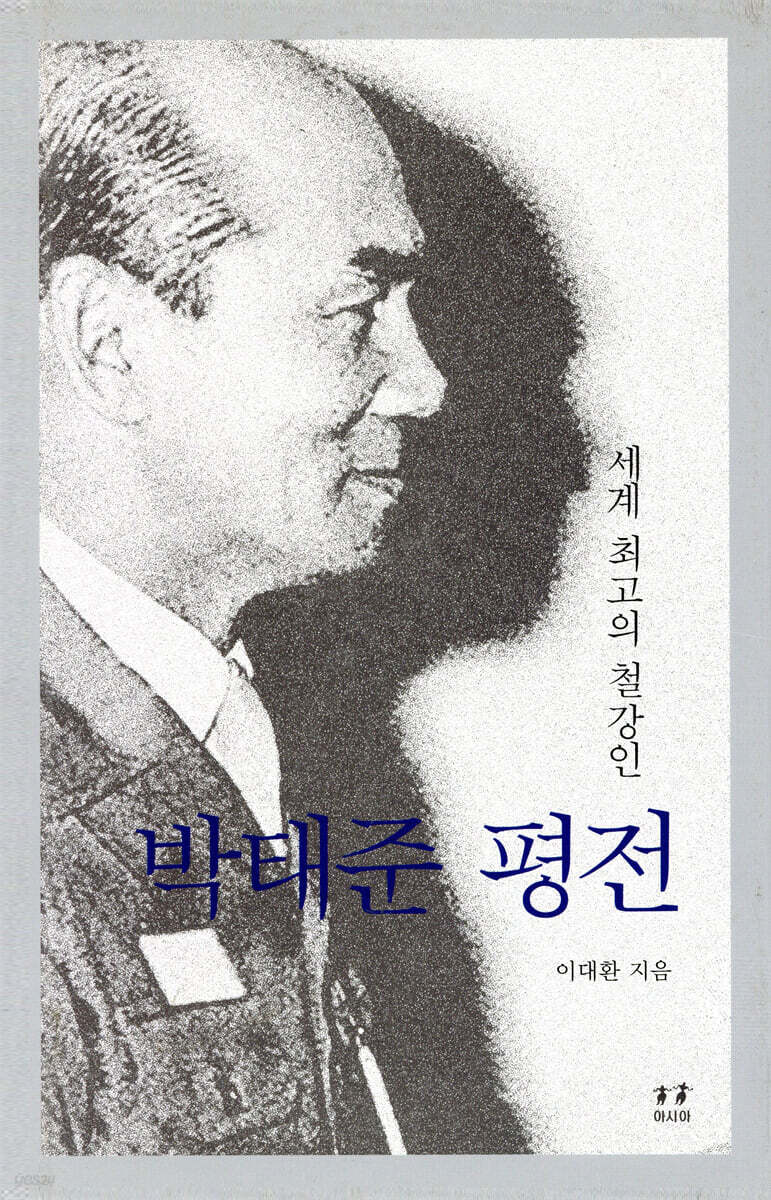
Park Tae-jun's biography
 |
Description
Book Introduction
How can the spirit of selfless, first-class nationalism and non-possessive corporate entrepreneurship be realized?
The complete 『Biography of Park Tae-jun』 is the path and the reality!
You can also see this in the little-known "Park Tae-jun's Last Season."
December 13, 2016 marks the 5th anniversary of the passing of Park Tae-jun, the world's greatest steelmaker.
At that time, his death sparked a wave of commemoration across generations and ideologies.
『Biography of Park Tae-jun - The World's Greatest Steelman』 evaluates the value and reflects on the significance of his selfless, first-class nationalism and his spirit of a non-possessive, large-scale entrepreneurship, which are public assets that should be shared by our time and future generations, by reflecting on them in the mirror of the turbulent history of 20th-century Korea.
Author Lee Dae-hwan completed the journey 16 years after he first began writing, marking the 5th anniversary of the protagonist's death.
Park Tae-jun, who created the steel myth that became the most important foundation for the success of Korea's industrialization.
Nevertheless, he was a leader of integrity who did not leave behind a single house.
Author Lee Dae-hwan, who first met the protagonist in the early summer of 1997 and “spent countless hours with him, talking about his life, thoughts, and memories” until the day he passed away, vividly shows the miraculous spirit of Park Tae-jun through scenes from the myth, and then expresses his thoughts on the long conversation with the protagonist as follows.
"As a writer, what is the most compelling aspect of Park Tae-jun that I've observed? Is it his exceptional ability to embody the leadership qualities of a general, a virtuous general, and a brave general? People often point to that.
I readily admit it.
But I don't consider it to be the greatest attraction.
The greatest charm of Park Tae-jun that I caught was his attitude toward life that placed ‘spiritual value’ at the top of all values.
I, who am a full generation younger than the protagonist, married him when he was seventy years old.
How can I respect, follow, and nurture this connection? His life, which traversed the turbulent heart of modern Korean history, should be reflected in the mirror of his time through the lens of literature, art, and research, leaving behind an intangible social asset for future generations.
This is the best I can do and the best condition to follow by ‘carrying it in my body.’
“Because I am a writer.”
The praise for Park Tae-jun is nothing more than a superficial shell that would never have suited him if he had been merely a successful businessman.
It is already a well-known anecdote that he built POSCO from nothing into a world-class, top-tier company and served as its chairman, yet never received a single share of stock, whether it was a merit-based stock or something else.
The biggest reason why even ordinary citizens with no connection to POSCO or POSTECH continue to pay their respects to him and visit his remains at the Seoul National Cemetery is probably because, in this world stained with corruption, 'Park Tae-jun is a figure who truly serves as an example to the times.'
The complete 『Biography of Park Tae-jun』 is the path and the reality!
You can also see this in the little-known "Park Tae-jun's Last Season."
December 13, 2016 marks the 5th anniversary of the passing of Park Tae-jun, the world's greatest steelmaker.
At that time, his death sparked a wave of commemoration across generations and ideologies.
『Biography of Park Tae-jun - The World's Greatest Steelman』 evaluates the value and reflects on the significance of his selfless, first-class nationalism and his spirit of a non-possessive, large-scale entrepreneurship, which are public assets that should be shared by our time and future generations, by reflecting on them in the mirror of the turbulent history of 20th-century Korea.
Author Lee Dae-hwan completed the journey 16 years after he first began writing, marking the 5th anniversary of the protagonist's death.
Park Tae-jun, who created the steel myth that became the most important foundation for the success of Korea's industrialization.
Nevertheless, he was a leader of integrity who did not leave behind a single house.
Author Lee Dae-hwan, who first met the protagonist in the early summer of 1997 and “spent countless hours with him, talking about his life, thoughts, and memories” until the day he passed away, vividly shows the miraculous spirit of Park Tae-jun through scenes from the myth, and then expresses his thoughts on the long conversation with the protagonist as follows.
"As a writer, what is the most compelling aspect of Park Tae-jun that I've observed? Is it his exceptional ability to embody the leadership qualities of a general, a virtuous general, and a brave general? People often point to that.
I readily admit it.
But I don't consider it to be the greatest attraction.
The greatest charm of Park Tae-jun that I caught was his attitude toward life that placed ‘spiritual value’ at the top of all values.
I, who am a full generation younger than the protagonist, married him when he was seventy years old.
How can I respect, follow, and nurture this connection? His life, which traversed the turbulent heart of modern Korean history, should be reflected in the mirror of his time through the lens of literature, art, and research, leaving behind an intangible social asset for future generations.
This is the best I can do and the best condition to follow by ‘carrying it in my body.’
“Because I am a writer.”
The praise for Park Tae-jun is nothing more than a superficial shell that would never have suited him if he had been merely a successful businessman.
It is already a well-known anecdote that he built POSCO from nothing into a world-class, top-tier company and served as its chairman, yet never received a single share of stock, whether it was a merit-based stock or something else.
The biggest reason why even ordinary citizens with no connection to POSCO or POSTECH continue to pay their respects to him and visit his remains at the Seoul National Cemetery is probably because, in this world stained with corruption, 'Park Tae-jun is a figure who truly serves as an example to the times.'
index
Author's Note | Park Tae-jun, the Master Who Remains in My Soul
prolog
Colonial Child, Standing on the Land of the Ruler, 1927–1945
Young Officers Crossing the Line of Fire 1945-195
Crossing the Swamp of Corruption 1953-1961
Business Class 1961-1965
Pioneers of the Wasteland 1965–1969
Miracle of the Right 1969-1973
Completion of the Myth 1973-1979
Fenced Gwangyang Bay 1979-1981
Dream Blueprints Drawn on the Sea, 1981-1985
Opening New Horizons for Korean History, 1970-1985
Seasons of Glory 1986-1989
Sitting on the Iron Dragon for a Day 1990-1992
Four Hours of Talks, Four Years of Wandering, 1992-1997
"Geongje" is gone, "Gyeongje" is here (1997-1998)
After overcoming the 'Jeongchuk Gukchi' period, 1998-2000
Epilogue 2001-2011
Why I'm Writing a Biography of Park Tae-jun
Park Tae-jun's chronology
References
prolog
Colonial Child, Standing on the Land of the Ruler, 1927–1945
Young Officers Crossing the Line of Fire 1945-195
Crossing the Swamp of Corruption 1953-1961
Business Class 1961-1965
Pioneers of the Wasteland 1965–1969
Miracle of the Right 1969-1973
Completion of the Myth 1973-1979
Fenced Gwangyang Bay 1979-1981
Dream Blueprints Drawn on the Sea, 1981-1985
Opening New Horizons for Korean History, 1970-1985
Seasons of Glory 1986-1989
Sitting on the Iron Dragon for a Day 1990-1992
Four Hours of Talks, Four Years of Wandering, 1992-1997
"Geongje" is gone, "Gyeongje" is here (1997-1998)
After overcoming the 'Jeongchuk Gukchi' period, 1998-2000
Epilogue 2001-2011
Why I'm Writing a Biography of Park Tae-jun
Park Tae-jun's chronology
References
Into the book
“The first thing to remember is that the company’s seed money was the blood of our ancestors.
As part of the Japanese Claims Fund and the colonial reparations, construction of the first Pohang Iron and Steel Company was able to begin.
So, the words we shouted for Jecheolboguk and Woohyangwoo would have touched our hearts and touched our souls even more.
This is where the high level of ethical awareness required of POSCO comes into play.
I can't forget President Park Chung-hee.
Pohang Iron and Steel Company was born from his single-minded belief, planning, and will that a steel mill was essential for successful modernization. He not only trusted me and entrusted me with the job, but also served as a fence to block all kinds of political winds.
We must not forget this fact.
And there are names we all must keep.
Your workplace was always full of dangers, and safety accidents, both large and small, occurred.
Those who have distinguished themselves during operations and construction should live forever in our hearts and in POSCO's history.
Dear employees, let us not forget that our memories shine like stars in POSCO's history and in our country's modern history.
Let us cherish it as the pride and joy of our lives.
“I wish POSCO endless success.”
---From "Park Tae-jun's Last Speech in Life" (September 19, 2011)
In the early afternoon of November 8, 2011, Park Tae-jun entered the main building of Yonsei University Severance Hospital.
His gait was as straight as usual.
But it was a step towards a life-or-death moment.
The next day, several tests were performed in preparation for surgery.
He spoke comfortably with the medical staff with a smiling face.
A decade ago, in the summer of 2001, a major surgery in New York made headlines.
He thought to himself.
I'm ten years older than I was then, but it's the same now as it was then.
His body showed perfect data for surgery.
That damn cough, except for the left lung that was causing it, meant that his other health was fine.
On the morning of November 11th, the fourth day of hospitalization, Park Tae-jun suddenly muttered to himself as he changed into surgical gown.
This is the third one.
Yeah, that's the third one.
It was the third time the scalpel had cut into his body.
The first was an appendectomy without anesthesia in the bitter cold of 1950 at the Hungnam Field Hospital, the second was a major surgery in New York, and this time.
He kept his lips tightly shut.
The physical time spent lying on a gurney and moving from the hospital room to the operating room was very short.
But for patients and their families, how long is that?
A time when the moment of eternal farewell is drawn out at the end of a multitude of emotions, yet no one can shake their composure even an inch, as if trying to ward off a bad omen.
A major surgery that took a full 9 hours and 28 minutes.
The patient was immediately transferred to the intensive care unit, and the attending physician and family members were called to the consultation room.
“The surgery went well.”
The surgeon reported the good news.
The family sighed in gratitude.
He explained while drawing with his stiff hands.
The entire left lung and pleura were removed, and a cyst was growing again in the same spot where the cyst had been removed ten years ago… … .
'Pleuro-pneumonectomy' has been concluded to bring about a positive prognosis.
1:30 AM, November 12th.
Secretary Shin Hyeong-gu, who had been dozing off after returning home, received a call from his cell phone and quickly changed his clothes.
It was a call from the intensive care unit nurse the chairman was looking for.
The young secretary's heart was pounding the entire 30 minutes she drove.
Could this be an emergency? I couldn't shake this feeling of anxiety and nervousness.
The ICU at 2 a.m. was eerie.
It was 11 p.m. when the patient woke up from anesthesia and family visits were held, so it was the first time in a long while that the founder and his young secretary were alone together.
“Have you found the chairman?”
The young voice trembled slightly.
“Are you here? What time is it now?”
The patient's voice sounded clearer than expected, and the secretary relaxed a little.
“It’s two o’clock.”
“Is it day or night?”
“It’s two o’clock in the morning.”
While the secretary was guessing that the long anesthesia and the nearly ten-hour surgery had caused confusion about the time, the patient suddenly asked strongly.
“What happened to Europe?”
The secretary was surprised.
Even in a life-or-death struggle, a person who thinks first about the world and the nation's problems! But the secretary quickly pulled himself together.
“It seems that the impact will spread from Greece to Italy and even to France.”
It was a brief report on a scenario where, following Greece, a financial crisis would spread to Italy, and if it spread to France, French financial institutions suffering from a credit crunch would withdraw overseas investment funds, spreading the crisis throughout Europe.
“France holds a lot of Italian government bonds.
If the influence spreads to France or Germany, it will be a big problem.
If even the two great powers of Europe are shaken, all of Europe is in danger.
“Our country also needs to prepare thoroughly.”
There is a saying that one should worry about the country whether they are awake or asleep, but in an age where even the resonance that those words once contained has faded, this person is truly special.
You seem to be someone whose concerns about the country and insights into the future operate like a channel that is automatically set, regardless of the circumstances you find yourself in.
So that's why you're an adult and a big person.
The secretary had a sour nose.
---From "Park Tae-jun's Last Season"
21 years old.
Park Tae-jun said goodbye to his parents and shaved his head with the feeling of almost becoming a monk.
The first gateway to the new path guided by the compass of a young man who had fixed his gaze on the path of the homeland's fortress was the main gate of the Busan National Defense Guard.
He had a strong ambition to become a great officer.
As it happened, the conditions of the times were right.
While the US military government was pushing for the establishment of a separate government in South Korea, it regarded the training of officers for the South Korean military as an urgent task and steadily produced "high-quality officers" through the South Korean Military Academy.
---From "The Young Officer Who Crossed the Line of Fire"
It was that evening.
A strange man visited Park Tae-jun's residence.
It was the supplier in question.
He kept bowing his head and making excuses.
He said that he was truly sorry for causing trouble, but upon learning the details, he was also a victim who was wronged.
I couldn't stand to hear that so I screamed.
“He should know the meaning of ‘a man who is half-hearted’!”
“No, it’s really unfair.
I too was deceived by a middleman.
“It was my fault for not checking the item, but it is our industry practice to trust each other, so… … .”
“Hey, you little shit, get out of here when I say it!”
His sharp eyes flashed fiercely.
Suddenly, a bashful smile appeared on the supplier's lips.
“Chief of Staff, I will say that it is all my fault.
I promise that this will never happen again.
Please take a look just once.
If the Chief of Staff looks after me this time, I will look after you for a long time.
Isn't this the way of the world? I'll make sure you never regret it."
After finishing his smooth complaint, the man's right hand reached into his bosom and came out holding a thick envelope.
Sparks flew from Park Tae-jun's eyes.
His right hand held the pistol.
"Hey, you little shit! Get out of here with that dirty money! Don't you dare come near our unit again until I shoot you dead!"
---From "Crossing the Swamp of Corruption"
The second act of their relationship was slowly coming to an end.
If Park Tae-jun had accepted or reluctantly complied with Park Chung-hee's proposal, which was close to an order, the future of the two would inevitably lead to the 'common dynamics of the power structure.'
Should we take that path or should we take the path of 'creative dynamics of economic revival'?
Park Tae-jun found himself at a crossroads.
The choice was left to the will of the active-duty Army brigadier general sitting before the newly retired Commander-in-Chief of the Armed Forces.
Moreover, it was not a simple will.
It was a choice that was directly connected to one's beliefs, as it was a choice that would put one's entire future on the line: whether to distance oneself from the highest authority or to approach the highest authority.
At this very point, Park Tae-jun pretended to smile gently.
---From "Management Class"
What did Park Chung-hee's official appointment of Park Tae-joon as chairman of the Integrated Steel Plant Promotion Committee mean? Fundamentally, of course, it meant that responsibility for the construction of the integrated steel plant had been officially transferred from the bureaucrats to Park Tae-joon. However, it also carried the significant implication that KISA would now engage in a full-scale, all-out confrontation with Park Tae-joon, a man who despised KISA's sleazy business practices, a staunch perfectionist, and a selfless patriot.
---From "Pioneers of the Wasteland"
The construction of Pohang Iron and Steel Company, a challenge in the name of the nation, the people, and history.
In the barren sandy plains, where the winter wind blew fiercely, the temple priests, dressed in uniforms the color of iron, stood in a line like soldiers, resting in a posture of intense concentration.
Park Tae-jun, who stood on the podium in front of them, thought to himself.
Words spoken with the mouth are easily forgotten as they end up as nagging, but the cries that come from deep within settle in the hearts of others.
“This is a steel mill built with the blood and sweat of our ancestors.
If we fail, we will be sinning against our ancestors and against our farmers, so we must risk our lives.
There can be no failure.
If we fail, we will all have to turn right and drown in the Yeongil Bay.
Let us make the steel mill a success by all means and repay the kindness of our country and ancestors.
"Jeolcheol, patriotism! From now on, this saying must become our unwavering creed and philosophy of life."
---From "The Miracle of the Right"
It was a busy night for the field managers.
Should I get explosives from the quarry site, report the explosion to the Pohang Police Station and get permission, load the explosives, and have the explosives technician stand by?
It was the next day.
A 'strange ceremony' was held in the short shadows of midday.
All construction site managers and executives within Pohang Iron and Steel Company, foreign technical supervisors, and Pohang Iron and Steel Company executives and employees gathered in one place.
Park Tae-jun, who remembered Napoleon's words, "There is no such thing as impossible in my dictionary," suddenly smiled as he completed a sentence.
There is no such thing as poor construction in Pohang Iron and Steel Company's dictionary.
I thought that such grand words were unnecessary if we were to truly realize it.
A 'grand blast' that would completely blow up 80% of the construction with dynamite would have been a far greater alarm than any appeal or order.
Moreover, the construction site in Yeongil Bay was entering its eighth year, and it was a time when discipline could be lax or complacent.
“Bang! Bang! Bang!”
There was a loud noise.
The moment the budget, time, and effort vanished into dust, the gathered people fell silent.
Intangible assets that could not be compared to those that had disappeared had to remain in their heads and hearts.
'There is no such thing as poor construction in Pohang Iron and Steel Company's dictionary.'
---From "The Completion of Myth"
The president of POSCO, who had quietly and firmly maintained his position during the national emergency, was appointed as the first chairman of the Economic Committee of the Legislative Council on October 28.
It was the day when Park Tae-jun became a fence protecting Pohang Iron and Steel from political winds.
But as a politician
I didn't think it had changed.
In order to acknowledge one's transformation into a politician, one must first and foremost possess the will and desire to become a politician.
He just didn't have it.
'From now on, until the construction of the second steelworks is completed, I must become Pohang Iron and Steel's fence.'
This was the strongest sense of purpose of Park Tae-jun, who took a step into the political arena.
As a bonus, another mission was created.
As a businessperson and a leading figure who has overcome the challenges of the development era, I will work hard to revive the Korean economy, which is collapsing due to negative growth.
---From "Going to Gwangyang Bay as a Fence"
Park Tae-jun's grand obsession with nurturing talent gave birth to 'Pohang University of Science and Technology (POSTECH)'. He has always emphasized that 'it is the historical mission of education to sacrifice today for the future of the nation and to develop limitless creativity, which is the supreme task of our country, a resource-poor country', and he has walked along the path of the mission he has set out, purely according to his own will.
---From "Opening a New Horizon for Korean History"
… … To serve and serve Korea again, that was the constant commandment of your life.
-From President Mitterrand's congratulatory address
Park Tae-jun's eyes stung.
It has been 45 years since the young man, freed from the colonial era, returned to his homeland during the founding era and devoted himself to the motto, “Dedicating my short life to my eternal homeland.” However, no one in Korea has ever comforted me so earnestly and with such neatly organized language… … .
President Mitterrand's congratulatory speech was like a cup of nectar in his heart, which was as strong as iron but also as delicate as a bell.
A cup of nectar that will never dry up, that you can drink whenever your soul is tired… … .
---From "Sitting on the Iron Dragon for Just One Day"
"Geongje" is gone, "Gyeongje" is here!" Park Tae-jun's cry spread throughout Pohang City like a playful children's song.
The Seoul media also covered it in a bold way.
It provided an opportunity for Pohang citizens and other local people paying attention to the Pohang by-election to think about why Park Tae-jun ran in the by-election and why the current regional and national situation calls him back.
The giant image of Park Tae-jun, known as 'the protagonist of the POSCO myth, the master of the real economy, the hero of Korean industrialization, and the world's steel emperor,' could have easily created a sense of distance from ordinary citizens.
This was also an image that could distort his human side.
To overcome this problem, the old candidate spared no effort.
He entered the 'citizens' through constant handshakes and street campaigning.
The more it was like that, the more the ‘heat’ made him suffer.
But he had the muscles and bones that had been trained during his time traveling to every corner of Yeongilman, and he had a strong pride that would not allow him to lose in the fight against himself.
---From "'Geongje' is gone, 'Gyeongje' is here"
Park Tae-jun was a leading figure in the Korean industrialization scene in the latter half of the 20th century.
Park Tae-jun, who created the 'Legend of Yeongil Bay and Gwangyang Bay' and is the only leader in all fields who lived in the same era in our history since liberation, is recognized by the world as the 'World's Greatest Steelmaker'.
From October 1997 to April 2000, during the desperate period when Korea achieved a horizontal transfer of power for the first time in 50 years and overcame the dire crisis of national bankruptcy, he served as an advisor and supporting actor to Kim Dae-jung on the stage of political power, drawing on his past pure passion and brilliant career.
Historical conventions are overly narrow in their treatment and evaluation of supporting actors.
If we narrow our perspective to only the two-year and six-month period of dire national crisis at the turn of the century and the dawn of the new century, what kind of attitude did Park Tae-jun have and what kind of contributions did he make alongside Kim Dae-jung?
After Park Tae-jun left, Kim Dae-jung overcame public concerns about his health and completed the "government of the people."
The historic June 15th Inter-Korean Summit was realized.
He won the Nobel Peace Prize.
Official banners celebrating the glory of the incumbent president were hung all over the place.
But it did not resonate with the majority of the people.
Unfortunately, his close associates who held key positions in the ruling power were implicated in corruption and arrested one after another.
Perhaps to further weaken the regime, which was already tainted by corruption, Kim Jong-il in Pyongyang never came to Seoul.
After that, the North Korean nuclear issue became difficult to resolve.
Just as the 1972 "July 4th North-South Joint Statement" between Park Chung-hee and Kim Il-sung left a significant mark on inter-Korean relations, will the expensive "June 15th Declaration" between Kim Dae-jung and Kim Jong-il in 2000 follow in the same footsteps?
Having retired from the political arena, the 'world's greatest steelmaker' now embarks, exhausted and exhausted, on a long and arduous journey to regain his health.
His physical strength and willpower were now at his mercy, ready to liberate him from the oppression of the twilight of his life.
---From "After Overcoming the 'Jeongchuk Gukchi'"
Dasan Jeong Yak-yong's substantial achievements are his extensive writings.
These are the texts of Jeong Yak-yong's research.
The substantial contribution that Cheongam Park Tae-jun made to 20th century Korean history is enormous.
However, he did not leave behind any writings.
But writings are ultimately a system of language, and the system of language is spirit, philosophy, and thought.
Park Tae-jun left behind numerous on-site language.
If you edited 'Park Tae-jun's Sayings' to the size of a national edition, it would exceed ten thousand pages.
The text of Park Tae-jun's research is amply prepared.
POSCO, POSTECH, POSCO schools, POSCO TJ Park Foundation, his great contributions to modern Korean history, and his extensive collection of sayings…
As part of the Japanese Claims Fund and the colonial reparations, construction of the first Pohang Iron and Steel Company was able to begin.
So, the words we shouted for Jecheolboguk and Woohyangwoo would have touched our hearts and touched our souls even more.
This is where the high level of ethical awareness required of POSCO comes into play.
I can't forget President Park Chung-hee.
Pohang Iron and Steel Company was born from his single-minded belief, planning, and will that a steel mill was essential for successful modernization. He not only trusted me and entrusted me with the job, but also served as a fence to block all kinds of political winds.
We must not forget this fact.
And there are names we all must keep.
Your workplace was always full of dangers, and safety accidents, both large and small, occurred.
Those who have distinguished themselves during operations and construction should live forever in our hearts and in POSCO's history.
Dear employees, let us not forget that our memories shine like stars in POSCO's history and in our country's modern history.
Let us cherish it as the pride and joy of our lives.
“I wish POSCO endless success.”
---From "Park Tae-jun's Last Speech in Life" (September 19, 2011)
In the early afternoon of November 8, 2011, Park Tae-jun entered the main building of Yonsei University Severance Hospital.
His gait was as straight as usual.
But it was a step towards a life-or-death moment.
The next day, several tests were performed in preparation for surgery.
He spoke comfortably with the medical staff with a smiling face.
A decade ago, in the summer of 2001, a major surgery in New York made headlines.
He thought to himself.
I'm ten years older than I was then, but it's the same now as it was then.
His body showed perfect data for surgery.
That damn cough, except for the left lung that was causing it, meant that his other health was fine.
On the morning of November 11th, the fourth day of hospitalization, Park Tae-jun suddenly muttered to himself as he changed into surgical gown.
This is the third one.
Yeah, that's the third one.
It was the third time the scalpel had cut into his body.
The first was an appendectomy without anesthesia in the bitter cold of 1950 at the Hungnam Field Hospital, the second was a major surgery in New York, and this time.
He kept his lips tightly shut.
The physical time spent lying on a gurney and moving from the hospital room to the operating room was very short.
But for patients and their families, how long is that?
A time when the moment of eternal farewell is drawn out at the end of a multitude of emotions, yet no one can shake their composure even an inch, as if trying to ward off a bad omen.
A major surgery that took a full 9 hours and 28 minutes.
The patient was immediately transferred to the intensive care unit, and the attending physician and family members were called to the consultation room.
“The surgery went well.”
The surgeon reported the good news.
The family sighed in gratitude.
He explained while drawing with his stiff hands.
The entire left lung and pleura were removed, and a cyst was growing again in the same spot where the cyst had been removed ten years ago… … .
'Pleuro-pneumonectomy' has been concluded to bring about a positive prognosis.
1:30 AM, November 12th.
Secretary Shin Hyeong-gu, who had been dozing off after returning home, received a call from his cell phone and quickly changed his clothes.
It was a call from the intensive care unit nurse the chairman was looking for.
The young secretary's heart was pounding the entire 30 minutes she drove.
Could this be an emergency? I couldn't shake this feeling of anxiety and nervousness.
The ICU at 2 a.m. was eerie.
It was 11 p.m. when the patient woke up from anesthesia and family visits were held, so it was the first time in a long while that the founder and his young secretary were alone together.
“Have you found the chairman?”
The young voice trembled slightly.
“Are you here? What time is it now?”
The patient's voice sounded clearer than expected, and the secretary relaxed a little.
“It’s two o’clock.”
“Is it day or night?”
“It’s two o’clock in the morning.”
While the secretary was guessing that the long anesthesia and the nearly ten-hour surgery had caused confusion about the time, the patient suddenly asked strongly.
“What happened to Europe?”
The secretary was surprised.
Even in a life-or-death struggle, a person who thinks first about the world and the nation's problems! But the secretary quickly pulled himself together.
“It seems that the impact will spread from Greece to Italy and even to France.”
It was a brief report on a scenario where, following Greece, a financial crisis would spread to Italy, and if it spread to France, French financial institutions suffering from a credit crunch would withdraw overseas investment funds, spreading the crisis throughout Europe.
“France holds a lot of Italian government bonds.
If the influence spreads to France or Germany, it will be a big problem.
If even the two great powers of Europe are shaken, all of Europe is in danger.
“Our country also needs to prepare thoroughly.”
There is a saying that one should worry about the country whether they are awake or asleep, but in an age where even the resonance that those words once contained has faded, this person is truly special.
You seem to be someone whose concerns about the country and insights into the future operate like a channel that is automatically set, regardless of the circumstances you find yourself in.
So that's why you're an adult and a big person.
The secretary had a sour nose.
---From "Park Tae-jun's Last Season"
21 years old.
Park Tae-jun said goodbye to his parents and shaved his head with the feeling of almost becoming a monk.
The first gateway to the new path guided by the compass of a young man who had fixed his gaze on the path of the homeland's fortress was the main gate of the Busan National Defense Guard.
He had a strong ambition to become a great officer.
As it happened, the conditions of the times were right.
While the US military government was pushing for the establishment of a separate government in South Korea, it regarded the training of officers for the South Korean military as an urgent task and steadily produced "high-quality officers" through the South Korean Military Academy.
---From "The Young Officer Who Crossed the Line of Fire"
It was that evening.
A strange man visited Park Tae-jun's residence.
It was the supplier in question.
He kept bowing his head and making excuses.
He said that he was truly sorry for causing trouble, but upon learning the details, he was also a victim who was wronged.
I couldn't stand to hear that so I screamed.
“He should know the meaning of ‘a man who is half-hearted’!”
“No, it’s really unfair.
I too was deceived by a middleman.
“It was my fault for not checking the item, but it is our industry practice to trust each other, so… … .”
“Hey, you little shit, get out of here when I say it!”
His sharp eyes flashed fiercely.
Suddenly, a bashful smile appeared on the supplier's lips.
“Chief of Staff, I will say that it is all my fault.
I promise that this will never happen again.
Please take a look just once.
If the Chief of Staff looks after me this time, I will look after you for a long time.
Isn't this the way of the world? I'll make sure you never regret it."
After finishing his smooth complaint, the man's right hand reached into his bosom and came out holding a thick envelope.
Sparks flew from Park Tae-jun's eyes.
His right hand held the pistol.
"Hey, you little shit! Get out of here with that dirty money! Don't you dare come near our unit again until I shoot you dead!"
---From "Crossing the Swamp of Corruption"
The second act of their relationship was slowly coming to an end.
If Park Tae-jun had accepted or reluctantly complied with Park Chung-hee's proposal, which was close to an order, the future of the two would inevitably lead to the 'common dynamics of the power structure.'
Should we take that path or should we take the path of 'creative dynamics of economic revival'?
Park Tae-jun found himself at a crossroads.
The choice was left to the will of the active-duty Army brigadier general sitting before the newly retired Commander-in-Chief of the Armed Forces.
Moreover, it was not a simple will.
It was a choice that was directly connected to one's beliefs, as it was a choice that would put one's entire future on the line: whether to distance oneself from the highest authority or to approach the highest authority.
At this very point, Park Tae-jun pretended to smile gently.
---From "Management Class"
What did Park Chung-hee's official appointment of Park Tae-joon as chairman of the Integrated Steel Plant Promotion Committee mean? Fundamentally, of course, it meant that responsibility for the construction of the integrated steel plant had been officially transferred from the bureaucrats to Park Tae-joon. However, it also carried the significant implication that KISA would now engage in a full-scale, all-out confrontation with Park Tae-joon, a man who despised KISA's sleazy business practices, a staunch perfectionist, and a selfless patriot.
---From "Pioneers of the Wasteland"
The construction of Pohang Iron and Steel Company, a challenge in the name of the nation, the people, and history.
In the barren sandy plains, where the winter wind blew fiercely, the temple priests, dressed in uniforms the color of iron, stood in a line like soldiers, resting in a posture of intense concentration.
Park Tae-jun, who stood on the podium in front of them, thought to himself.
Words spoken with the mouth are easily forgotten as they end up as nagging, but the cries that come from deep within settle in the hearts of others.
“This is a steel mill built with the blood and sweat of our ancestors.
If we fail, we will be sinning against our ancestors and against our farmers, so we must risk our lives.
There can be no failure.
If we fail, we will all have to turn right and drown in the Yeongil Bay.
Let us make the steel mill a success by all means and repay the kindness of our country and ancestors.
"Jeolcheol, patriotism! From now on, this saying must become our unwavering creed and philosophy of life."
---From "The Miracle of the Right"
It was a busy night for the field managers.
Should I get explosives from the quarry site, report the explosion to the Pohang Police Station and get permission, load the explosives, and have the explosives technician stand by?
It was the next day.
A 'strange ceremony' was held in the short shadows of midday.
All construction site managers and executives within Pohang Iron and Steel Company, foreign technical supervisors, and Pohang Iron and Steel Company executives and employees gathered in one place.
Park Tae-jun, who remembered Napoleon's words, "There is no such thing as impossible in my dictionary," suddenly smiled as he completed a sentence.
There is no such thing as poor construction in Pohang Iron and Steel Company's dictionary.
I thought that such grand words were unnecessary if we were to truly realize it.
A 'grand blast' that would completely blow up 80% of the construction with dynamite would have been a far greater alarm than any appeal or order.
Moreover, the construction site in Yeongil Bay was entering its eighth year, and it was a time when discipline could be lax or complacent.
“Bang! Bang! Bang!”
There was a loud noise.
The moment the budget, time, and effort vanished into dust, the gathered people fell silent.
Intangible assets that could not be compared to those that had disappeared had to remain in their heads and hearts.
'There is no such thing as poor construction in Pohang Iron and Steel Company's dictionary.'
---From "The Completion of Myth"
The president of POSCO, who had quietly and firmly maintained his position during the national emergency, was appointed as the first chairman of the Economic Committee of the Legislative Council on October 28.
It was the day when Park Tae-jun became a fence protecting Pohang Iron and Steel from political winds.
But as a politician
I didn't think it had changed.
In order to acknowledge one's transformation into a politician, one must first and foremost possess the will and desire to become a politician.
He just didn't have it.
'From now on, until the construction of the second steelworks is completed, I must become Pohang Iron and Steel's fence.'
This was the strongest sense of purpose of Park Tae-jun, who took a step into the political arena.
As a bonus, another mission was created.
As a businessperson and a leading figure who has overcome the challenges of the development era, I will work hard to revive the Korean economy, which is collapsing due to negative growth.
---From "Going to Gwangyang Bay as a Fence"
Park Tae-jun's grand obsession with nurturing talent gave birth to 'Pohang University of Science and Technology (POSTECH)'. He has always emphasized that 'it is the historical mission of education to sacrifice today for the future of the nation and to develop limitless creativity, which is the supreme task of our country, a resource-poor country', and he has walked along the path of the mission he has set out, purely according to his own will.
---From "Opening a New Horizon for Korean History"
… … To serve and serve Korea again, that was the constant commandment of your life.
-From President Mitterrand's congratulatory address
Park Tae-jun's eyes stung.
It has been 45 years since the young man, freed from the colonial era, returned to his homeland during the founding era and devoted himself to the motto, “Dedicating my short life to my eternal homeland.” However, no one in Korea has ever comforted me so earnestly and with such neatly organized language… … .
President Mitterrand's congratulatory speech was like a cup of nectar in his heart, which was as strong as iron but also as delicate as a bell.
A cup of nectar that will never dry up, that you can drink whenever your soul is tired… … .
---From "Sitting on the Iron Dragon for Just One Day"
"Geongje" is gone, "Gyeongje" is here!" Park Tae-jun's cry spread throughout Pohang City like a playful children's song.
The Seoul media also covered it in a bold way.
It provided an opportunity for Pohang citizens and other local people paying attention to the Pohang by-election to think about why Park Tae-jun ran in the by-election and why the current regional and national situation calls him back.
The giant image of Park Tae-jun, known as 'the protagonist of the POSCO myth, the master of the real economy, the hero of Korean industrialization, and the world's steel emperor,' could have easily created a sense of distance from ordinary citizens.
This was also an image that could distort his human side.
To overcome this problem, the old candidate spared no effort.
He entered the 'citizens' through constant handshakes and street campaigning.
The more it was like that, the more the ‘heat’ made him suffer.
But he had the muscles and bones that had been trained during his time traveling to every corner of Yeongilman, and he had a strong pride that would not allow him to lose in the fight against himself.
---From "'Geongje' is gone, 'Gyeongje' is here"
Park Tae-jun was a leading figure in the Korean industrialization scene in the latter half of the 20th century.
Park Tae-jun, who created the 'Legend of Yeongil Bay and Gwangyang Bay' and is the only leader in all fields who lived in the same era in our history since liberation, is recognized by the world as the 'World's Greatest Steelmaker'.
From October 1997 to April 2000, during the desperate period when Korea achieved a horizontal transfer of power for the first time in 50 years and overcame the dire crisis of national bankruptcy, he served as an advisor and supporting actor to Kim Dae-jung on the stage of political power, drawing on his past pure passion and brilliant career.
Historical conventions are overly narrow in their treatment and evaluation of supporting actors.
If we narrow our perspective to only the two-year and six-month period of dire national crisis at the turn of the century and the dawn of the new century, what kind of attitude did Park Tae-jun have and what kind of contributions did he make alongside Kim Dae-jung?
After Park Tae-jun left, Kim Dae-jung overcame public concerns about his health and completed the "government of the people."
The historic June 15th Inter-Korean Summit was realized.
He won the Nobel Peace Prize.
Official banners celebrating the glory of the incumbent president were hung all over the place.
But it did not resonate with the majority of the people.
Unfortunately, his close associates who held key positions in the ruling power were implicated in corruption and arrested one after another.
Perhaps to further weaken the regime, which was already tainted by corruption, Kim Jong-il in Pyongyang never came to Seoul.
After that, the North Korean nuclear issue became difficult to resolve.
Just as the 1972 "July 4th North-South Joint Statement" between Park Chung-hee and Kim Il-sung left a significant mark on inter-Korean relations, will the expensive "June 15th Declaration" between Kim Dae-jung and Kim Jong-il in 2000 follow in the same footsteps?
Having retired from the political arena, the 'world's greatest steelmaker' now embarks, exhausted and exhausted, on a long and arduous journey to regain his health.
His physical strength and willpower were now at his mercy, ready to liberate him from the oppression of the twilight of his life.
---From "After Overcoming the 'Jeongchuk Gukchi'"
Dasan Jeong Yak-yong's substantial achievements are his extensive writings.
These are the texts of Jeong Yak-yong's research.
The substantial contribution that Cheongam Park Tae-jun made to 20th century Korean history is enormous.
However, he did not leave behind any writings.
But writings are ultimately a system of language, and the system of language is spirit, philosophy, and thought.
Park Tae-jun left behind numerous on-site language.
If you edited 'Park Tae-jun's Sayings' to the size of a national edition, it would exceed ten thousand pages.
The text of Park Tae-jun's research is amply prepared.
POSCO, POSTECH, POSCO schools, POSCO TJ Park Foundation, his great contributions to modern Korean history, and his extensive collection of sayings…
---From the "Epilogue"
Publisher's Review
How can the spirit of selfless, first-class nationalism and non-possessive corporate entrepreneurship be realized?
The complete 『Biography of Park Tae-jun』 is the path and the reality!
You can also see this in the little-known "Park Tae-jun's Last Season."
December 13, 2016 marks the 5th anniversary of the passing of Park Tae-jun, the world's greatest steelmaker.
At that time, his death sparked a wave of commemoration across generations and ideologies.
『Biography of Park Tae-jun - The World's Greatest Steelman』 evaluates the value and reflects on the significance of his selfless, first-class nationalism and his spirit of a non-possessive, large-scale entrepreneurship, which are public assets that should be shared by our time and future generations, by reflecting on them in the mirror of the turbulent history of 20th-century Korea.
Author Lee Dae-hwan completed the journey 16 years after he first began writing, marking the 5th anniversary of the protagonist's death.
Park Tae-jun, who created the steel myth that became the most important foundation for the success of Korea's industrialization.
Nevertheless, he was a leader of integrity who did not leave behind a single house.
Writer Lee Dae-hwan, who first met the protagonist in the early summer of 1997 and “spent countless hours with him, talking about his life, thoughts, and memories” until the day he passed away, vividly shows the miraculous spirit of Park Tae-jun through scenes from the myth, and then expresses his thoughts on the long conversation with the protagonist as follows.
"As a writer, what is the most compelling aspect of Park Tae-jun that I've observed? Is it his exceptional ability to embody the leadership qualities of a general, a virtuous general, and a brave general? People often point to that.
I readily admit it.
But I don't consider it to be the greatest attraction.
The greatest charm of Park Tae-jun that I caught was his attitude toward life that placed ‘spiritual value’ at the top of all values.
I, who am a full generation younger than the protagonist, married him when he was seventy years old.
How can I respect, follow, and nurture this connection? His life, which traversed the turbulent heart of modern Korean history, should be reflected in the mirror of his time through the lens of literature, art, and research, leaving behind an intangible social asset for future generations.
This is the best I can do and the best condition to follow by ‘carrying it in my body.’
“Because I am a writer.”
The praise for Park Tae-jun is nothing more than a superficial shell that would never have suited him if he had simply been a successful businessman.
It is already a well-known anecdote that he built POSCO from nothing into a world-class, top-tier company and served as its chairman, yet never received a single share of stock, whether it was a merit-based stock or something else.
The biggest reason why even ordinary citizens with no connection to POSCO or POSTECH continue to pay their respects to him and visit his remains at the Seoul National Cemetery is probably because, in this world stained with corruption, 'Park Tae-jun is a figure who truly serves as an example to the times.'
When the book 『Park Tae-jun, the World's Greatest Steelman』 by Lee Dae-hwan was first published in December 2004, it received praise such as, “A work comparable to excellent biographies from foreign countries has been published,” “This book has all three elements: prose, insight, and emotion,” “This is truly a biography of a person who can dare to say, ‘I loved my country and dedicated myself to it,’” and “This book provides a clear answer to the question, ‘Why Park Tae-jun again today?’” and became a representative piece of Korean biography.
Twelve years later, amidst the chaos and crisis that seemed to be sucking Korean society into the whirlpool of the presidential impeachment, and amidst the power of the citizens to overcome it, the biography of Park Tae-jun, which has been republished with a new cover to mark the 5th anniversary of his death, includes [Park Tae-jun's Last Season], which was completely unknown to the world, as well as the '30 Seasons of Twilight' from the summer of 2004 until his passing, and supplements here and there from the existing biography while also refining the sentences.
The expansion and supplementation were achieved through continuous conversations between the protagonist and the author, and additional interviews with people around the author, which continued even after 2004.
Additionally, the author's essay at the beginning of the book, [The Master who remains in my soul, Park Tae-jun], allows us to understand the special relationship between the protagonist and the author.
The volume of the book has increased from 856 pages to 1032 pages.
'Why is it Park Tae-jun again today?'
Remembering Park Tae-jun with our souls
“The success of the integrated steel industry and the contribution of the steel industry to the nation – this is the meaning of my birth in this land.”
“Our generation is a generation that sacrifices itself as martyrs for the next generation.”
“Pohang University of Science and Technology is a national plan for the next century, and science and technology are the source of national wealth.”
“Reconciliation between the industrialization and democratization forces, and harmony between Yeongnam and Honam, is the spirit of the times.”
_From Park Tae-jun's sayings
Just as human civilization has progressed in tandem with the development of iron, the path taken by Cheongam Park Tae-jun is intertwined with the history of Korea's economic growth.
The history of the founding and development of POSCO has established itself as an important success story for national policy makers, business managers, and all citizens engaged in economic activity.
Cheongam Park Tae-jun, carrying a huge burden and completing his life without a hitch, pioneered a new horizon for the era.
However, remembering only by the size of the achievements has no true meaning.
We must remember the spirit inherent in Park Tae-jun's achievements and utilize them as intangible social assets.
Park Tae-jun, the 'world's greatest steelmaker', celebrated his 5th anniversary on December 13, 2016.
To remember Park Tae-jun, who must remain in the souls of future generations, we need to ponder, 'Why Park Tae-jun again today?'
There are temporal, national, and authorial aspects to this reflection.
historical point
-The historical achievements of a figure who formed a great mountain range in the history of economic development and the practical spirit of leading the world
From absolute poverty to statist-style compressed growth.
This refers to the beginning and end of Korean industrialization in the second half of the 20th century.
It is almost identical to the arduous path that democracy has taken to overcome hardship.
So now our two feet are standing on the economy and democracy.
The turbulent times of the past produced many outstanding figures who penetrated the very heart of the times, and the author's gaze lingered on a particular life, producing biographical literature that served as a portrait of the times.
Most of them are records of people who formed the mountain range of resistance movement history.
It's a natural phenomenon.
This is because Korean society has been a place where 'resistance' has beautifully illuminated the names of human beings for a long time.
Meanwhile, it is an undeniable fact that poverty has oppressed the people to the point of chilling horror.
It is here that the historical achievements of the people who formed the mountain range of economic development history stand out.
Their lives were also sometimes submitted for record.
However, in contrast to the passion they poured into the field of creating industry, their treatment as a single-volume record, as well as in historical writing, was somewhat neglected.
There were also instances of shoddy, sloppy construction, just like in a construction project.
This gap must be filled fairly and justly, if only for a balanced understanding of our times and history, and the representative figure who can fill that gap is Park Tae-jun.
The spirit and practice that supported his achievements were rooted in 'serving the world', and his 'serving the world' was realized through selfless patriotism, first-class nationalism, and the spirit of a large-scale entrepreneur without any possessions.
POSCO is a great embodiment of the spirit of patriotism through steel production, POSTECH and POSCO schools are excellent embodiments of the spirit of patriotism through education, and at the same time, they are the practice of selfless patriotism to build the foundation of a first-class nation. In addition, considering POSCO as the root of the national economy and the happiness of the people, not receiving a single share of POSCO stock, whether as a merit stock or otherwise, was the practice of the spirit of a large corporation without ownership.
Park Tae-jun's spirit and practice are the 'true role model of a world-class public servant' that today's Korean society, stained with various corruptions, desperately longs for.
This is one of the reasons why a biography of Park Tae-jun must exist, and it is the historical point of 'Why Park Tae-jun again today?'
National branch
-Providing a path to a correct understanding of 'Economy and the Past'
Park Tae-jun established his belief in the transformation of his time through colonialism, war, poverty, and corruption.
He resisted poverty and corruption in his own way.
He dreamed of designing a community that guaranteed a decent life and raising his entire field to the top in the world.
So I risked my life on iron.
His iron was soon the country.
After 25 years of hard work, we finally established a strong foundation for the Korean economy and developed POSCO into a world-class company.
He has truly become the world's greatest steelmaker.
At the age of seventy, he led the "horizontal change of government for the first time in 50 years" by calling for "reconciliation between industrialization forces and democratization forces" and "harmony between Yeongnam and Honam," contributing to the launch of the Kim Dae-jung administration. At this time, he devoted his life's energy to the great cause of overcoming the IMF management system that was in the midst of a national bankruptcy crisis.
At the end of the 20th century, he once again devoted himself to the 'nation'.
Moreover, he opened new horizons for Korean private education from kindergarten to university and created a model for the welfare system.
It established a model for ‘returning corporate profits to society.’
Park Tae-jun's footsteps and belief system reflect Korean society in the second half of the 20th century.
Even today, Korean society is in turmoil due to political scandals and corruption scandals.
Compared to the high standards of citizenship that the world is paying attention to, politics is still in a state of insignificance.
Leadership is also missing.
The economy is struggling and people are struggling to make ends meet.
Now, more than ever, Korean society craves selfless leadership, visionary leadership, and integrated leadership.
We can never expect that from the so-called leaders who stand on either the right or the left foot, judging the past one-way and obsessed with calculating their own selfish desires.
It's just a colloquialism.
Park Tae-jun's precious true nature is fully revealed in scenes where he suggests a correct path to understanding 'the economy and the past,' and he tangibly demonstrates leadership based on selflessness, vision, and integration.
Naturally, it extends into a hopeful future.
This is the national point of 'Why Park Tae-jun again today?'
Authorial point
-The special relationship between the protagonist Park Tae-jun and the author Lee Dae-hwan
The author says:
“The biography of Andrew Carnegie that I read when I was in middle school was written about him as the ‘Great Steel Emperor’ who made a huge fortune in the steel industry and did many good deeds in his later years.
He remained as an image of a giant that no one dared approach.
To me as a boy, America was like Carnegie.
It was almost a generation later that I placed Carnegie of faraway Pittsburgh and Park Tae-jun of my hometown side by side.
We compared the height, weight, and quality of life of the two characters.
By any measure, the large white man was far inferior to the short Korean man.
This is my starting point as a Korean who wrote this book.
But I can confidently say that if the protagonist and I hadn't had such a deep connection, I probably wouldn't have been able to write this book."
Park Tae-jun, the protagonist of the steel myth, and novelist Lee Dae-hwan, who was forced out of his hometown in 1968 when the Pohang Iron and Steel Company was established in the 4th grade.
If the author and the protagonist, with their strangely contrasting personalities, had not developed a particularly deep connection later in life, this book probably would not have been born.
The author has spent countless hours conversing with the protagonist over 15 years since 1997.
That led the author to the place of record.
The 'contract' that often follows in the writing of a biography was not even mentioned or existed.
In no conversation did the protagonist stutter or evade.
His memory was also amazing.
For example, when the author searched for officer chronology and related records to confirm a special experience from his military days more than 50 years ago, at least the month matched.
The author was not easy either.
For example, I had to dig through an old current affairs magazine to confirm the recollection that after May 16, he suggested sending the opposing generals to study abroad in the United States.
It was an effort to pass on the author's faith to the reader's faith.
Almost all of the dialogue is not a creation of the author's imagination, but comes from the protagonist's memory, from the memory of the witness.
Of course, there are also some that were called out from the records.
The author concludes his long and arduous work by revealing two things.
“Every lush forest has a few ugly and dead trees mixed in.
If there is no such thing in the forest of life, then he is a person who has already transcended the human realm and lived in the realm of the gods.
Not only every great man, but every saint, has inevitably some ugly trees and dead trees in the forest of his life.
The problem is the way we look at the forest.
“If you focus solely on one ugly tree in the forest and insist that it is the true face of the forest, it is an absurd and utter hypocrisy of such a stubborn eye.”
“The greatest charm of Park Tae-jun that I caught was his attitude toward life that placed spiritual values above all other values.
I, who am a full generation younger than the protagonist, became engaged to him when he was seventy years old.
How can I respect, follow, and nurture this connection? His life, which traversed the turbulent heart of modern Korean history, should be reflected in the mirror of his time, using the methodology of the Literature and Arts Department's research, and left behind as an intangible social asset for future generations.
This is the best I can do and the best I can do.
“Because I am a writer.”
This is the authorial point of 'Why Park Tae-jun Again Today?'
The complete 『Biography of Park Tae-jun』 is the path and the reality!
You can also see this in the little-known "Park Tae-jun's Last Season."
December 13, 2016 marks the 5th anniversary of the passing of Park Tae-jun, the world's greatest steelmaker.
At that time, his death sparked a wave of commemoration across generations and ideologies.
『Biography of Park Tae-jun - The World's Greatest Steelman』 evaluates the value and reflects on the significance of his selfless, first-class nationalism and his spirit of a non-possessive, large-scale entrepreneurship, which are public assets that should be shared by our time and future generations, by reflecting on them in the mirror of the turbulent history of 20th-century Korea.
Author Lee Dae-hwan completed the journey 16 years after he first began writing, marking the 5th anniversary of the protagonist's death.
Park Tae-jun, who created the steel myth that became the most important foundation for the success of Korea's industrialization.
Nevertheless, he was a leader of integrity who did not leave behind a single house.
Writer Lee Dae-hwan, who first met the protagonist in the early summer of 1997 and “spent countless hours with him, talking about his life, thoughts, and memories” until the day he passed away, vividly shows the miraculous spirit of Park Tae-jun through scenes from the myth, and then expresses his thoughts on the long conversation with the protagonist as follows.
"As a writer, what is the most compelling aspect of Park Tae-jun that I've observed? Is it his exceptional ability to embody the leadership qualities of a general, a virtuous general, and a brave general? People often point to that.
I readily admit it.
But I don't consider it to be the greatest attraction.
The greatest charm of Park Tae-jun that I caught was his attitude toward life that placed ‘spiritual value’ at the top of all values.
I, who am a full generation younger than the protagonist, married him when he was seventy years old.
How can I respect, follow, and nurture this connection? His life, which traversed the turbulent heart of modern Korean history, should be reflected in the mirror of his time through the lens of literature, art, and research, leaving behind an intangible social asset for future generations.
This is the best I can do and the best condition to follow by ‘carrying it in my body.’
“Because I am a writer.”
The praise for Park Tae-jun is nothing more than a superficial shell that would never have suited him if he had simply been a successful businessman.
It is already a well-known anecdote that he built POSCO from nothing into a world-class, top-tier company and served as its chairman, yet never received a single share of stock, whether it was a merit-based stock or something else.
The biggest reason why even ordinary citizens with no connection to POSCO or POSTECH continue to pay their respects to him and visit his remains at the Seoul National Cemetery is probably because, in this world stained with corruption, 'Park Tae-jun is a figure who truly serves as an example to the times.'
When the book 『Park Tae-jun, the World's Greatest Steelman』 by Lee Dae-hwan was first published in December 2004, it received praise such as, “A work comparable to excellent biographies from foreign countries has been published,” “This book has all three elements: prose, insight, and emotion,” “This is truly a biography of a person who can dare to say, ‘I loved my country and dedicated myself to it,’” and “This book provides a clear answer to the question, ‘Why Park Tae-jun again today?’” and became a representative piece of Korean biography.
Twelve years later, amidst the chaos and crisis that seemed to be sucking Korean society into the whirlpool of the presidential impeachment, and amidst the power of the citizens to overcome it, the biography of Park Tae-jun, which has been republished with a new cover to mark the 5th anniversary of his death, includes [Park Tae-jun's Last Season], which was completely unknown to the world, as well as the '30 Seasons of Twilight' from the summer of 2004 until his passing, and supplements here and there from the existing biography while also refining the sentences.
The expansion and supplementation were achieved through continuous conversations between the protagonist and the author, and additional interviews with people around the author, which continued even after 2004.
Additionally, the author's essay at the beginning of the book, [The Master who remains in my soul, Park Tae-jun], allows us to understand the special relationship between the protagonist and the author.
The volume of the book has increased from 856 pages to 1032 pages.
'Why is it Park Tae-jun again today?'
Remembering Park Tae-jun with our souls
“The success of the integrated steel industry and the contribution of the steel industry to the nation – this is the meaning of my birth in this land.”
“Our generation is a generation that sacrifices itself as martyrs for the next generation.”
“Pohang University of Science and Technology is a national plan for the next century, and science and technology are the source of national wealth.”
“Reconciliation between the industrialization and democratization forces, and harmony between Yeongnam and Honam, is the spirit of the times.”
_From Park Tae-jun's sayings
Just as human civilization has progressed in tandem with the development of iron, the path taken by Cheongam Park Tae-jun is intertwined with the history of Korea's economic growth.
The history of the founding and development of POSCO has established itself as an important success story for national policy makers, business managers, and all citizens engaged in economic activity.
Cheongam Park Tae-jun, carrying a huge burden and completing his life without a hitch, pioneered a new horizon for the era.
However, remembering only by the size of the achievements has no true meaning.
We must remember the spirit inherent in Park Tae-jun's achievements and utilize them as intangible social assets.
Park Tae-jun, the 'world's greatest steelmaker', celebrated his 5th anniversary on December 13, 2016.
To remember Park Tae-jun, who must remain in the souls of future generations, we need to ponder, 'Why Park Tae-jun again today?'
There are temporal, national, and authorial aspects to this reflection.
historical point
-The historical achievements of a figure who formed a great mountain range in the history of economic development and the practical spirit of leading the world
From absolute poverty to statist-style compressed growth.
This refers to the beginning and end of Korean industrialization in the second half of the 20th century.
It is almost identical to the arduous path that democracy has taken to overcome hardship.
So now our two feet are standing on the economy and democracy.
The turbulent times of the past produced many outstanding figures who penetrated the very heart of the times, and the author's gaze lingered on a particular life, producing biographical literature that served as a portrait of the times.
Most of them are records of people who formed the mountain range of resistance movement history.
It's a natural phenomenon.
This is because Korean society has been a place where 'resistance' has beautifully illuminated the names of human beings for a long time.
Meanwhile, it is an undeniable fact that poverty has oppressed the people to the point of chilling horror.
It is here that the historical achievements of the people who formed the mountain range of economic development history stand out.
Their lives were also sometimes submitted for record.
However, in contrast to the passion they poured into the field of creating industry, their treatment as a single-volume record, as well as in historical writing, was somewhat neglected.
There were also instances of shoddy, sloppy construction, just like in a construction project.
This gap must be filled fairly and justly, if only for a balanced understanding of our times and history, and the representative figure who can fill that gap is Park Tae-jun.
The spirit and practice that supported his achievements were rooted in 'serving the world', and his 'serving the world' was realized through selfless patriotism, first-class nationalism, and the spirit of a large-scale entrepreneur without any possessions.
POSCO is a great embodiment of the spirit of patriotism through steel production, POSTECH and POSCO schools are excellent embodiments of the spirit of patriotism through education, and at the same time, they are the practice of selfless patriotism to build the foundation of a first-class nation. In addition, considering POSCO as the root of the national economy and the happiness of the people, not receiving a single share of POSCO stock, whether as a merit stock or otherwise, was the practice of the spirit of a large corporation without ownership.
Park Tae-jun's spirit and practice are the 'true role model of a world-class public servant' that today's Korean society, stained with various corruptions, desperately longs for.
This is one of the reasons why a biography of Park Tae-jun must exist, and it is the historical point of 'Why Park Tae-jun again today?'
National branch
-Providing a path to a correct understanding of 'Economy and the Past'
Park Tae-jun established his belief in the transformation of his time through colonialism, war, poverty, and corruption.
He resisted poverty and corruption in his own way.
He dreamed of designing a community that guaranteed a decent life and raising his entire field to the top in the world.
So I risked my life on iron.
His iron was soon the country.
After 25 years of hard work, we finally established a strong foundation for the Korean economy and developed POSCO into a world-class company.
He has truly become the world's greatest steelmaker.
At the age of seventy, he led the "horizontal change of government for the first time in 50 years" by calling for "reconciliation between industrialization forces and democratization forces" and "harmony between Yeongnam and Honam," contributing to the launch of the Kim Dae-jung administration. At this time, he devoted his life's energy to the great cause of overcoming the IMF management system that was in the midst of a national bankruptcy crisis.
At the end of the 20th century, he once again devoted himself to the 'nation'.
Moreover, he opened new horizons for Korean private education from kindergarten to university and created a model for the welfare system.
It established a model for ‘returning corporate profits to society.’
Park Tae-jun's footsteps and belief system reflect Korean society in the second half of the 20th century.
Even today, Korean society is in turmoil due to political scandals and corruption scandals.
Compared to the high standards of citizenship that the world is paying attention to, politics is still in a state of insignificance.
Leadership is also missing.
The economy is struggling and people are struggling to make ends meet.
Now, more than ever, Korean society craves selfless leadership, visionary leadership, and integrated leadership.
We can never expect that from the so-called leaders who stand on either the right or the left foot, judging the past one-way and obsessed with calculating their own selfish desires.
It's just a colloquialism.
Park Tae-jun's precious true nature is fully revealed in scenes where he suggests a correct path to understanding 'the economy and the past,' and he tangibly demonstrates leadership based on selflessness, vision, and integration.
Naturally, it extends into a hopeful future.
This is the national point of 'Why Park Tae-jun again today?'
Authorial point
-The special relationship between the protagonist Park Tae-jun and the author Lee Dae-hwan
The author says:
“The biography of Andrew Carnegie that I read when I was in middle school was written about him as the ‘Great Steel Emperor’ who made a huge fortune in the steel industry and did many good deeds in his later years.
He remained as an image of a giant that no one dared approach.
To me as a boy, America was like Carnegie.
It was almost a generation later that I placed Carnegie of faraway Pittsburgh and Park Tae-jun of my hometown side by side.
We compared the height, weight, and quality of life of the two characters.
By any measure, the large white man was far inferior to the short Korean man.
This is my starting point as a Korean who wrote this book.
But I can confidently say that if the protagonist and I hadn't had such a deep connection, I probably wouldn't have been able to write this book."
Park Tae-jun, the protagonist of the steel myth, and novelist Lee Dae-hwan, who was forced out of his hometown in 1968 when the Pohang Iron and Steel Company was established in the 4th grade.
If the author and the protagonist, with their strangely contrasting personalities, had not developed a particularly deep connection later in life, this book probably would not have been born.
The author has spent countless hours conversing with the protagonist over 15 years since 1997.
That led the author to the place of record.
The 'contract' that often follows in the writing of a biography was not even mentioned or existed.
In no conversation did the protagonist stutter or evade.
His memory was also amazing.
For example, when the author searched for officer chronology and related records to confirm a special experience from his military days more than 50 years ago, at least the month matched.
The author was not easy either.
For example, I had to dig through an old current affairs magazine to confirm the recollection that after May 16, he suggested sending the opposing generals to study abroad in the United States.
It was an effort to pass on the author's faith to the reader's faith.
Almost all of the dialogue is not a creation of the author's imagination, but comes from the protagonist's memory, from the memory of the witness.
Of course, there are also some that were called out from the records.
The author concludes his long and arduous work by revealing two things.
“Every lush forest has a few ugly and dead trees mixed in.
If there is no such thing in the forest of life, then he is a person who has already transcended the human realm and lived in the realm of the gods.
Not only every great man, but every saint, has inevitably some ugly trees and dead trees in the forest of his life.
The problem is the way we look at the forest.
“If you focus solely on one ugly tree in the forest and insist that it is the true face of the forest, it is an absurd and utter hypocrisy of such a stubborn eye.”
“The greatest charm of Park Tae-jun that I caught was his attitude toward life that placed spiritual values above all other values.
I, who am a full generation younger than the protagonist, became engaged to him when he was seventy years old.
How can I respect, follow, and nurture this connection? His life, which traversed the turbulent heart of modern Korean history, should be reflected in the mirror of his time, using the methodology of the Literature and Arts Department's research, and left behind as an intangible social asset for future generations.
This is the best I can do and the best I can do.
“Because I am a writer.”
This is the authorial point of 'Why Park Tae-jun Again Today?'
GOODS SPECIFICS
- Date of issue: December 1, 2016
- Format: Hardcover book binding method guide
- Page count, weight, size: 1,032 pages | 1,392g | 142*220*55mm
- ISBN13: 9791156622932
- ISBN10: 115662293X
You may also like
카테고리
korean


korean

![GQ KOREA Mark (Monthly): December [2025]](http://librairie.coreenne.fr/cdn/shop/files/8ef265dbbfbf186523ed75ba7319009d.jpg?v=1765340328&width=3840)


