

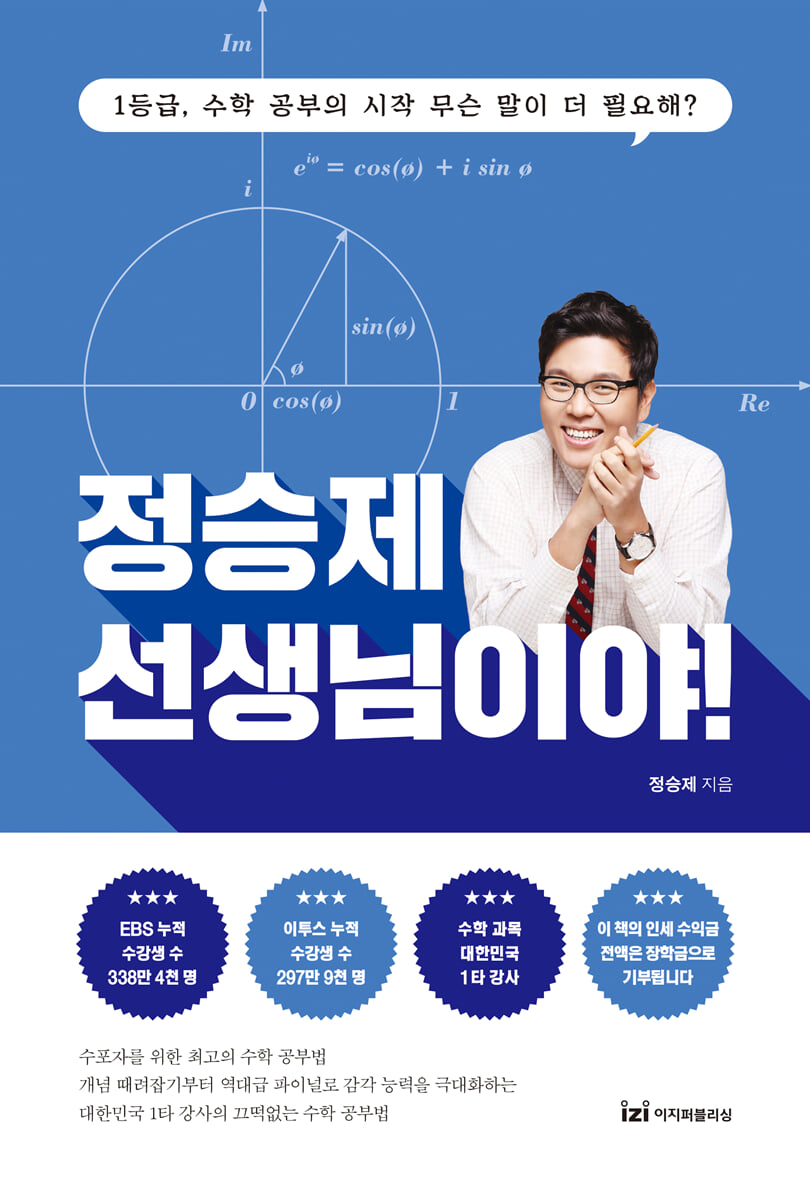
It's Mr. Jeong Seung-je! (Special Edition)
 |
Description
Book Introduction
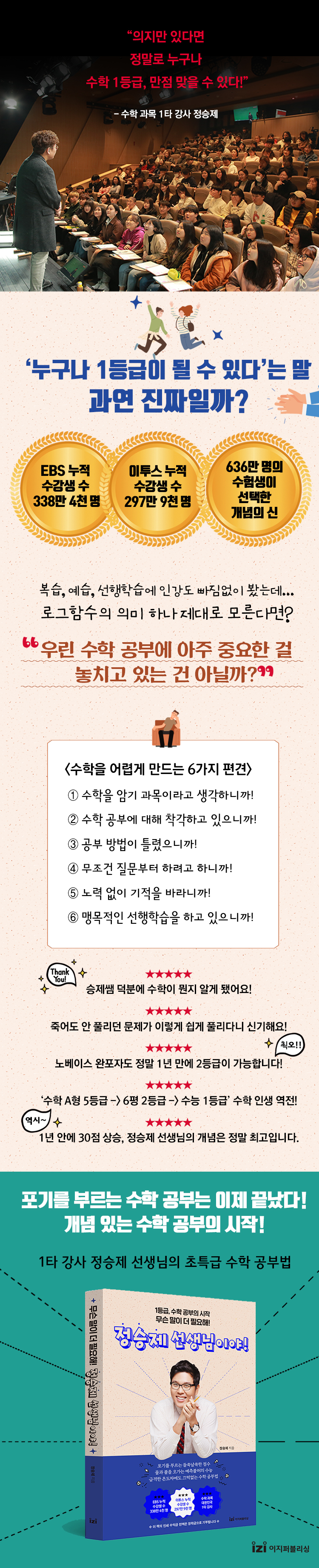
With 6.36 million cumulative students, Korea's No. 1 instructor, Jeong Seung-je, teaches the true fun of math, from the basics of middle school math to the college entrance exam for high school seniors, and sets the concept of studying straight! Teacher Jeong Seung-je is known as the number one math instructor in Korea through Etoos, EBS, etc. He covers a study method that allows students to easily solve difficult problems on their own through a thorough understanding of the concepts, rather than a study method that focuses on pre-learning and memorization. Afterwards, he proved that even a 9th grader can become a 1st grader with a solid foundation in study methods, which drew great sympathy and response from test takers. This book contains very practical methods for students who are struggling with math grades, parents who are worried about their children giving up on math, and anyone who finds math difficult. Chapter 1 covers the six reasons why math is difficult for many students, and Chapter 2 prioritizes the mindset one should have when studying math before introducing actual math study methods and know-how. Through easy access to the mathematical principles hidden in the objects and phenomena around us, we think about how mathematics will be an important link in our current lives and in the future, and convey the principle of studying that high scores in mathematics depend not on talent, aptitude, or memorization, but on our attitude. Chapter 3 addresses practical concerns about math scores and study methods, suggesting that we start from scratch when it comes to studying math. For students who are hesitant to start from the beginning, he builds strong faith through his unique bitter words and encouragement. Rather than memorization that actually requires physical and mental strain, it covers conceptual understanding, 5-step review, and effective approaches to solving math problems for solid math study that builds skills with materials for thinking. This book is filled with study tips and know-how accumulated while teaching as a first-rate math instructor, as well as teacher Jeong Seung-je's sharp criticism and warm words of encouragement. Some people might think it's obvious when they hear that if you have the will to do it and not give up, you have a chance regardless of grades or time. But we can see that this statement is by no means false. This is because the grades, actions, and stories of countless students who have turned their lives around in mathematics through Professor Jeong Seung-je's lectures prove that the sincerity contained in this book is true. I hope that "It's Teacher Jeong Seung-je!" will become a must-read for elementary, middle, and high school students who want to recharge their motivation by reading it whenever they feel tired from studying math, as well as for countless readers who misunderstand that math is boring and difficult. |
- You can preview some of the book's contents.
Preview
index
Prologue │ The truth no one believed: even a 9th grader can become a 1st grader!
Chapter 1.
Why you're bad at math
1.
Because I think math is ultimately a subject that requires memorization!
2.
Because you are mistaken about studying math!
3.
Because your study method is wrong!
4.
Because I'm going to ask a question first!
5.
Because you're hoping for a miracle without any effort!
6.
Because you are doing blind pre-learning!
Student Reviews: There's no math problem you can't solve after ten, no, a hundred tries.
Chapter 2.
Change your mindset and your score will change.
1.
Feel the charm of mathematics
2.
Math whiz? There's more to math than natural talent.
3.
Memorizing formulas? Formulas are about understanding.
4.
It's not too late to start studying math in your third year of high school.
│Student Review│ 100 Days of Math Guidance for One CSAT, One Miracle
Chapter 3.
The art of studying mathematics
1.
Rethinking Math Study Methods
2.
Mathematics begins with concepts? These are the real concepts.
3.
You should review at least 5 levels!
4.
How to Approach and Solve Math Problems - Interpretation and Application
5.
Get 200% out of online lectures
│Student Review│ From a three-day resolution to a first-class resolution!
Epilogue │ Miracles Don't Come to Everyone
Chapter 1.
Why you're bad at math
1.
Because I think math is ultimately a subject that requires memorization!
2.
Because you are mistaken about studying math!
3.
Because your study method is wrong!
4.
Because I'm going to ask a question first!
5.
Because you're hoping for a miracle without any effort!
6.
Because you are doing blind pre-learning!
Student Reviews: There's no math problem you can't solve after ten, no, a hundred tries.
Chapter 2.
Change your mindset and your score will change.
1.
Feel the charm of mathematics
2.
Math whiz? There's more to math than natural talent.
3.
Memorizing formulas? Formulas are about understanding.
4.
It's not too late to start studying math in your third year of high school.
│Student Review│ 100 Days of Math Guidance for One CSAT, One Miracle
Chapter 3.
The art of studying mathematics
1.
Rethinking Math Study Methods
2.
Mathematics begins with concepts? These are the real concepts.
3.
You should review at least 5 levels!
4.
How to Approach and Solve Math Problems - Interpretation and Application
5.
Get 200% out of online lectures
│Student Review│ From a three-day resolution to a first-class resolution!
Epilogue │ Miracles Don't Come to Everyone
Detailed image
Into the book
There are several reasons why people find math difficult.
First, there will be pre-learning that only looks for methods to find answers and only considers the progress that needs to be made today, rather than examining the basic concepts and principles.
Secondly, the atmosphere of the Daechi-dong academy district, where prejudice and misconceptions about studying math are rampant, also plays a role.
…there are many other factors as well.
But, no matter what, isn't it our attitude toward mathematics that ultimately makes it difficult? --- p.11
I've met countless students who were good at math and those who were bad at it.
And I looked closely at students who said they were bad at math.
Here's what I found out.
The fact that being bad at math is not because you lack mathematical sense, but because you have an aversion to math.
Because I can't think flexibly and feel anxious, I often end up just trying to memorize formulas and explanations.
That kind of mindset gradually hardens and you become unable to accept the real method of studying math.
--- p.36
It's really stupid to only trust lecturers or academy teachers.
If you don't study on your own, your math grades won't go up.
In fact, when I see friends who just listen to lectures, it seems like they often listen to lectures because they don't want to think.
I don't want to think about the problem myself and solve it, so I'm looking for a lecture on past exam questions.
However, whether it is an online or offline class, you should think of the class led by the teacher as basically receiving help for the areas where you are lacking.
The time spent listening to lectures and the grades you get are not proportional.
--- p.38
Sometimes, some teachers brag about how they helped their students get perfect scores, but I think that's just ridiculous.
That perfect score was created by the student himself, not the teacher.
No matter how omnipotent the teacher is, he cannot control the students' grades.
So, let's always remember that in this world, only I can make my own score.
--- p.42
The most important match is only once, and for that one time, we take several mock tests.
But, you know, college admissions are based on November scores, not March or June mock exam scores.
I'm not saying you shouldn't take mock exams, but I'm saying you need to calmly and accurately understand your situation.
I need to figure out for myself what is really important to me and what is less important.
Just as no one lives my life for me, no one is going to take my exams for me.
--- p.50
You have to study without an explanation sheet.
It probably won't be easy to throw away the commentary you've trusted and relied on for so long.
Still, if you want to increase the number of problems you can solve on your own, that's the only way.
As mentioned earlier, you need to consistently repeat the proper practice process to improve your skills.
And most people only go back and solve the problems they got wrong, but you also have to go back and look at the solution process for the problems you got right.
--- p.56
The worst question students ask their teachers is, “Teacher, how do I solve this?”
So what's the worst teacher's response? It's, "You have to do it this way, no matter what."
The reason these two things are bad is that when a student asks, “Teacher, how do I solve this?”, he is essentially asking for a solution to the problem.
Also, the teacher's answer of "This is definitely how you should solve it" is hidden in the intention of teaching and memorizing the method of solving this type of problem.
--- p.73
If we were to say, 'Try living without math,' we might have to give up everything we have.
Imagine a life without roads, without buildings, without cell phones, without cars.
Even the 365 days of the year and the 24 solar terms cannot be thought of without mathematics.
Asking us to live without math is like asking us to live without air.
--- p.128
The most important thing is the process of building a proper concept.
You have to accumulate material for thinking to gain the power to think.
Only through endless, arduous practice and meaningful reflection can you reach the top level and get close to a perfect score.
Some friends feel burdened by the time it takes to build concepts, but I want to tell them that 5-6 months is enough to build the necessary concepts.
You don't have to be scared.
It's a fight that you can definitely try even if you start in your third year of high school.
--- p.161
The only solution is to enter the world of knowing, the world that knows everything and solves everything.
The 'knowledgeable world' we're talking about here is a world where you can learn the concept properly and study step by step to know and solve everything.
It's a world where people find math fun, have fun with the people who make the questions, and do real, thoughtful math.
Only by entering this world can you escape the wall of your current grades and rise to the top rank.
Furthermore, the path to getting a perfect score on the CSAT math section is wide open.
--- p.202
Park Tae-hwan, Kang Sue-jin, and Kim Yuna didn't have the world's best skills from the beginning.
They too must have had a time when they were building their foundations like us.
They are where they are today because they didn't neglect practicing the basics.
So let's not neglect the concept either.
Knowing the concepts properly is just the most basic of the basics.
You have to solve the basics, past exam questions, new questions, and difficult questions again and again.
Only by repeating this process of practice and reflection can your grades improve.
Nothing in this world comes easy.
--- p.205
If I'm not doing well in my studies, the problem lies with me.
Since I don't have the concept in my head, I can't progress beyond a certain level of problem.
Let's stop working hard on things that won't work and focus on studying something that's truly useful.
First of all, the 5-step review will be an alternative to pouring water into a bottomless pit, but rather filling a complete pit with internal energy.
Let's give it a try.
If you actually try it, you will realize how practical studying it is.
--- p.230
When you listen to lectures, you should listen as if you were going to school or an academy.
If you study freely, thinking that you can study anywhere and anytime, you will gradually become distant from the main subject.
You need to make a resolution to attend lectures only at the designated times.
Be sure to set a time to listen, and if you miss the time, it's better to give up that day.
Even if you listen to it the next day, you must manage your time in advance so that you can watch the lecture at the scheduled time.
First, there will be pre-learning that only looks for methods to find answers and only considers the progress that needs to be made today, rather than examining the basic concepts and principles.
Secondly, the atmosphere of the Daechi-dong academy district, where prejudice and misconceptions about studying math are rampant, also plays a role.
…there are many other factors as well.
But, no matter what, isn't it our attitude toward mathematics that ultimately makes it difficult? --- p.11
I've met countless students who were good at math and those who were bad at it.
And I looked closely at students who said they were bad at math.
Here's what I found out.
The fact that being bad at math is not because you lack mathematical sense, but because you have an aversion to math.
Because I can't think flexibly and feel anxious, I often end up just trying to memorize formulas and explanations.
That kind of mindset gradually hardens and you become unable to accept the real method of studying math.
--- p.36
It's really stupid to only trust lecturers or academy teachers.
If you don't study on your own, your math grades won't go up.
In fact, when I see friends who just listen to lectures, it seems like they often listen to lectures because they don't want to think.
I don't want to think about the problem myself and solve it, so I'm looking for a lecture on past exam questions.
However, whether it is an online or offline class, you should think of the class led by the teacher as basically receiving help for the areas where you are lacking.
The time spent listening to lectures and the grades you get are not proportional.
--- p.38
Sometimes, some teachers brag about how they helped their students get perfect scores, but I think that's just ridiculous.
That perfect score was created by the student himself, not the teacher.
No matter how omnipotent the teacher is, he cannot control the students' grades.
So, let's always remember that in this world, only I can make my own score.
--- p.42
The most important match is only once, and for that one time, we take several mock tests.
But, you know, college admissions are based on November scores, not March or June mock exam scores.
I'm not saying you shouldn't take mock exams, but I'm saying you need to calmly and accurately understand your situation.
I need to figure out for myself what is really important to me and what is less important.
Just as no one lives my life for me, no one is going to take my exams for me.
--- p.50
You have to study without an explanation sheet.
It probably won't be easy to throw away the commentary you've trusted and relied on for so long.
Still, if you want to increase the number of problems you can solve on your own, that's the only way.
As mentioned earlier, you need to consistently repeat the proper practice process to improve your skills.
And most people only go back and solve the problems they got wrong, but you also have to go back and look at the solution process for the problems you got right.
--- p.56
The worst question students ask their teachers is, “Teacher, how do I solve this?”
So what's the worst teacher's response? It's, "You have to do it this way, no matter what."
The reason these two things are bad is that when a student asks, “Teacher, how do I solve this?”, he is essentially asking for a solution to the problem.
Also, the teacher's answer of "This is definitely how you should solve it" is hidden in the intention of teaching and memorizing the method of solving this type of problem.
--- p.73
If we were to say, 'Try living without math,' we might have to give up everything we have.
Imagine a life without roads, without buildings, without cell phones, without cars.
Even the 365 days of the year and the 24 solar terms cannot be thought of without mathematics.
Asking us to live without math is like asking us to live without air.
--- p.128
The most important thing is the process of building a proper concept.
You have to accumulate material for thinking to gain the power to think.
Only through endless, arduous practice and meaningful reflection can you reach the top level and get close to a perfect score.
Some friends feel burdened by the time it takes to build concepts, but I want to tell them that 5-6 months is enough to build the necessary concepts.
You don't have to be scared.
It's a fight that you can definitely try even if you start in your third year of high school.
--- p.161
The only solution is to enter the world of knowing, the world that knows everything and solves everything.
The 'knowledgeable world' we're talking about here is a world where you can learn the concept properly and study step by step to know and solve everything.
It's a world where people find math fun, have fun with the people who make the questions, and do real, thoughtful math.
Only by entering this world can you escape the wall of your current grades and rise to the top rank.
Furthermore, the path to getting a perfect score on the CSAT math section is wide open.
--- p.202
Park Tae-hwan, Kang Sue-jin, and Kim Yuna didn't have the world's best skills from the beginning.
They too must have had a time when they were building their foundations like us.
They are where they are today because they didn't neglect practicing the basics.
So let's not neglect the concept either.
Knowing the concepts properly is just the most basic of the basics.
You have to solve the basics, past exam questions, new questions, and difficult questions again and again.
Only by repeating this process of practice and reflection can your grades improve.
Nothing in this world comes easy.
--- p.205
If I'm not doing well in my studies, the problem lies with me.
Since I don't have the concept in my head, I can't progress beyond a certain level of problem.
Let's stop working hard on things that won't work and focus on studying something that's truly useful.
First of all, the 5-step review will be an alternative to pouring water into a bottomless pit, but rather filling a complete pit with internal energy.
Let's give it a try.
If you actually try it, you will realize how practical studying it is.
--- p.230
When you listen to lectures, you should listen as if you were going to school or an academy.
If you study freely, thinking that you can study anywhere and anytime, you will gradually become distant from the main subject.
You need to make a resolution to attend lectures only at the designated times.
Be sure to set a time to listen, and if you miss the time, it's better to give up that day.
Even if you listen to it the next day, you must manage your time in advance so that you can watch the lecture at the scheduled time.
--- p.254
Publisher's Review
What if your grades don't improve no matter how hard you work?
What are we missing in our study of mathematics?
There is a subject that both students and adults agree is difficult.
It's mathematics.
The fear and distance from mathematics stems from the common misconception that mathematics is a subject of memorization, along with the idea that only special people with applied and high-level thinking skills are good at it, and that there is a separate mathematical mind.
Contrary to the fact that we find math difficult, the importance of the subject is increasing every year.
As if to represent this, countless math concept books and workbooks are published every year.
But even if you choose the best workbook that covers all types of problems, solve as many problems as you can, and thoroughly study beforehand, your math score will remain stagnant.
Many elementary, middle, and high school students who cannot find such a sharp solution end up on the path of failure.
What is serious is that the number is increasing every year.
But this kind of regret remains in a corner of the hearts of most students.
“Is it really okay to give up on math like this?”
Teacher Jeong Seung-je firmly answers these students' questions.
"If you have the will to excel at math, you can do it! I'll show you! Never give up!" This book offers refreshing solutions to the longings, misunderstandings, and questions about math that have plagued your mind.
It covers everything from fundamental questions that can help you overcome the biases that hinder your math scores to the practical concerns of students who struggle between memorizing formulas and understanding concepts.
Teacher Jeong Seung-je spares no effort in using both the carrot and the stick to students who are perennial 9th graders, high school seniors preparing for the college entrance exam, and all students who are studying fake studies by memorizing formulas without any concept.
The bittersweet videos and various contents for students are serving as a ray of light for students exhausted from the daily repetitive study for entrance exams.
In fact, the reason for this book's existence becomes clear in proportion to the number of students who are gradually taking steps toward the fun of mathematics through math lectures that are fun because the lectures are fun, the teacher is fun, and math becomes fun as well.
If you've never thought about why you're doing poorly in math, neglected the concepts, or vaguely felt like math was too difficult and challenging, and were about to give up, this could be the opportunity of a lifetime.
Let's ask ourselves, 'Is what I've been doing so far really studying math?'
If you've been memorizing formulas, diligently listening to online lectures, and studying to your own satisfaction, it's time to stop.
It's time to let go of all the prejudices, misunderstandings, and mistrust you've had while studying math and start over.
Instead, let's listen to the voice of Professor Jeong Seung-je, move our hands, and use our heads.
If you follow along silently like that, you will be able to experience firsthand what it means to say, “Math is fun.”
If you identify the gaps in the concept and understand it completely,
Anyone can get a level 1 in math, which seemed impossible to do!
I want to clear up some misconceptions about math.
I want to share the charm and fun of mathematics with more students.
It's absolutely not a lie that anyone can be good at math.
The point is to change your attitude toward math.
This will be an opportunity for students who suffer from memorizing mathematical formulas and problem solving, friends who find math classes burdensome, people who are thinking of giving up on math, and even those who have already given up on math to discover the joy of math they never knew existed.
This book has the power to make any student studying mathematics want to study mathematics, something they are struggling with.
"This is Teacher Jeong Seung-je!" is a book written to introduce the fun of math and teach proper math study methods to students who are afraid of math, have no idea how to study math, or whose math scores just won't improve no matter what they do. It contains the teacher's conviction that anyone can get a grade 1 and the study methods that will definitely make it happen.
From reasons why you're bad at math to practical math study techniques, this book covers all the fundamentals of math. Let's learn about the super-powerful math study method of Mr. Jeong Seung-je, the representative math instructor for the CSAT at Etoos and EBS.
Let's experience the truth that seemed like a lie: anyone can get a top grade in math if they just have the will to not give up.
What are we missing in our study of mathematics?
There is a subject that both students and adults agree is difficult.
It's mathematics.
The fear and distance from mathematics stems from the common misconception that mathematics is a subject of memorization, along with the idea that only special people with applied and high-level thinking skills are good at it, and that there is a separate mathematical mind.
Contrary to the fact that we find math difficult, the importance of the subject is increasing every year.
As if to represent this, countless math concept books and workbooks are published every year.
But even if you choose the best workbook that covers all types of problems, solve as many problems as you can, and thoroughly study beforehand, your math score will remain stagnant.
Many elementary, middle, and high school students who cannot find such a sharp solution end up on the path of failure.
What is serious is that the number is increasing every year.
But this kind of regret remains in a corner of the hearts of most students.
“Is it really okay to give up on math like this?”
Teacher Jeong Seung-je firmly answers these students' questions.
"If you have the will to excel at math, you can do it! I'll show you! Never give up!" This book offers refreshing solutions to the longings, misunderstandings, and questions about math that have plagued your mind.
It covers everything from fundamental questions that can help you overcome the biases that hinder your math scores to the practical concerns of students who struggle between memorizing formulas and understanding concepts.
Teacher Jeong Seung-je spares no effort in using both the carrot and the stick to students who are perennial 9th graders, high school seniors preparing for the college entrance exam, and all students who are studying fake studies by memorizing formulas without any concept.
The bittersweet videos and various contents for students are serving as a ray of light for students exhausted from the daily repetitive study for entrance exams.
In fact, the reason for this book's existence becomes clear in proportion to the number of students who are gradually taking steps toward the fun of mathematics through math lectures that are fun because the lectures are fun, the teacher is fun, and math becomes fun as well.
If you've never thought about why you're doing poorly in math, neglected the concepts, or vaguely felt like math was too difficult and challenging, and were about to give up, this could be the opportunity of a lifetime.
Let's ask ourselves, 'Is what I've been doing so far really studying math?'
If you've been memorizing formulas, diligently listening to online lectures, and studying to your own satisfaction, it's time to stop.
It's time to let go of all the prejudices, misunderstandings, and mistrust you've had while studying math and start over.
Instead, let's listen to the voice of Professor Jeong Seung-je, move our hands, and use our heads.
If you follow along silently like that, you will be able to experience firsthand what it means to say, “Math is fun.”
If you identify the gaps in the concept and understand it completely,
Anyone can get a level 1 in math, which seemed impossible to do!
I want to clear up some misconceptions about math.
I want to share the charm and fun of mathematics with more students.
It's absolutely not a lie that anyone can be good at math.
The point is to change your attitude toward math.
This will be an opportunity for students who suffer from memorizing mathematical formulas and problem solving, friends who find math classes burdensome, people who are thinking of giving up on math, and even those who have already given up on math to discover the joy of math they never knew existed.
This book has the power to make any student studying mathematics want to study mathematics, something they are struggling with.
"This is Teacher Jeong Seung-je!" is a book written to introduce the fun of math and teach proper math study methods to students who are afraid of math, have no idea how to study math, or whose math scores just won't improve no matter what they do. It contains the teacher's conviction that anyone can get a grade 1 and the study methods that will definitely make it happen.
From reasons why you're bad at math to practical math study techniques, this book covers all the fundamentals of math. Let's learn about the super-powerful math study method of Mr. Jeong Seung-je, the representative math instructor for the CSAT at Etoos and EBS.
Let's experience the truth that seemed like a lie: anyone can get a top grade in math if they just have the will to not give up.
GOODS SPECIFICS
- Date of issue: April 10, 2019
- Page count, weight, size: 272 pages | 513g | 152*225*16mm
- ISBN13: 9791196633516
- ISBN10: 1196633517
You may also like
카테고리
korean


korean

![GQ KOREA Mark (Monthly): December [2025]](http://librairie.coreenne.fr/cdn/shop/files/8ef265dbbfbf186523ed75ba7319009d.jpg?v=1765340328&width=3840)


