

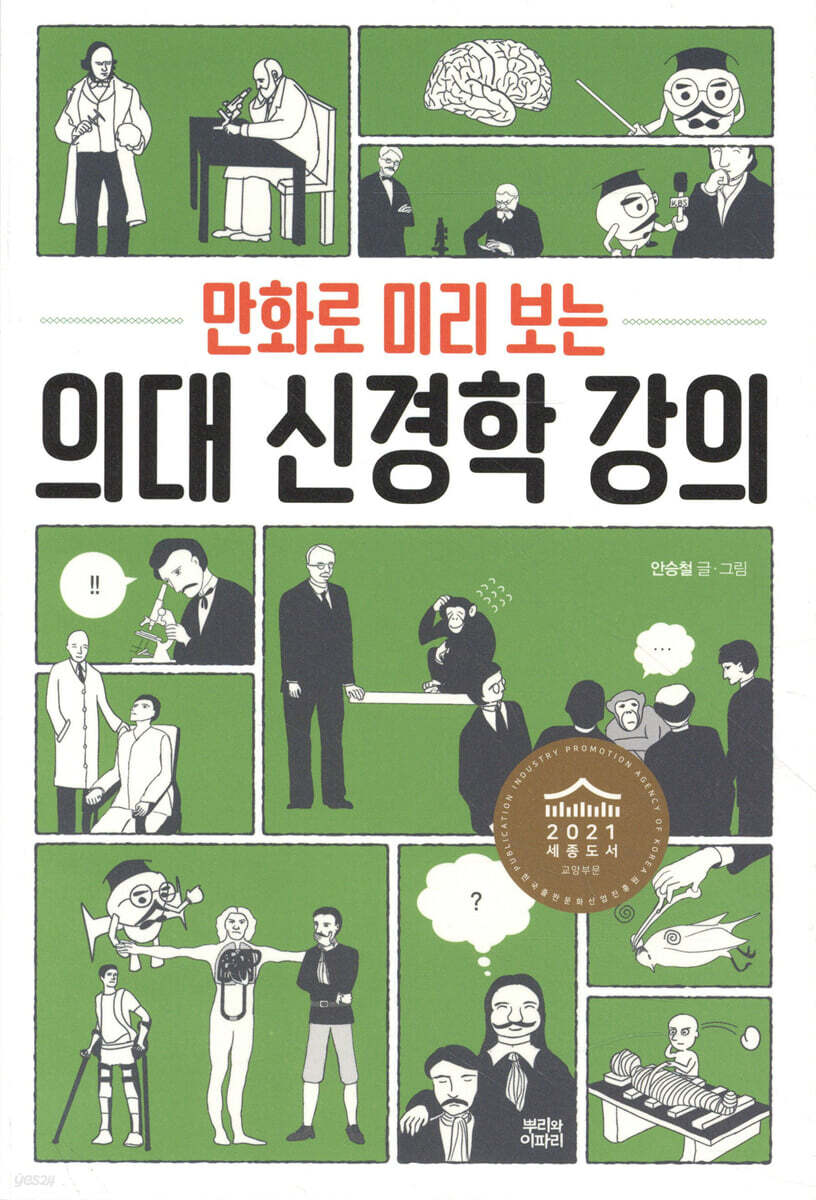
Previewing Medical School Neurology Lectures in Comics
 |
Description
Book Introduction
One page per day, over 256 days,
The best neuroscience educational comics drawn by a medical school professor
Is there a way to access the brain, neurology, more easily?
“When you say ‘spinocerebellar tract,’ it sounds like some kind of alien language, doesn’t it?” Professor Seung-cheol Ahn, who teaches neurology at Dankook University College of Medicine, expressed his regret for students who had difficulty keeping up with the lectures.
“It is not uncommon to see students who are good at studying fail once they enter medical school.
“They say that neurology is especially difficult.” For these medical students and high school students who want to go to medical school, he decided to make his lectures into comics, and that’s how “Medical School Neurology Lectures in Comics” was born.
As artificial intelligence (AI) emerges as a star of the Fourth Industrial Revolution, neuroscience is also gaining attention.
Demis Hassabis, a cognitive neuroscientist and founder of Google DeepMind, famous for AlphaGo, says that to build better AI, “we need to closely examine the inner workings of the human mind.”
Neurology is the study of the human mind, or more precisely, the nervous system, including the brain.
Easy and fun! The author turned on his laptop, installed the painting software, and picked up the touch pen.
It was my first time drawing a comic, and it wasn't an easy challenge, but I drew one page a day, step by step.
The drawings in the beginning had to be retouched later and are still far from being professional, but what this neurology comic, which was painstakingly created over 256 days, contains more than anything is love for students, and the knowledge of neurology explained through light and cute drawings, and the history of medicine and the stories behind neuroscientists that cannot be told in the classroom where time is always limited.
The best neuroscience educational comics drawn by a medical school professor
Is there a way to access the brain, neurology, more easily?
“When you say ‘spinocerebellar tract,’ it sounds like some kind of alien language, doesn’t it?” Professor Seung-cheol Ahn, who teaches neurology at Dankook University College of Medicine, expressed his regret for students who had difficulty keeping up with the lectures.
“It is not uncommon to see students who are good at studying fail once they enter medical school.
“They say that neurology is especially difficult.” For these medical students and high school students who want to go to medical school, he decided to make his lectures into comics, and that’s how “Medical School Neurology Lectures in Comics” was born.
As artificial intelligence (AI) emerges as a star of the Fourth Industrial Revolution, neuroscience is also gaining attention.
Demis Hassabis, a cognitive neuroscientist and founder of Google DeepMind, famous for AlphaGo, says that to build better AI, “we need to closely examine the inner workings of the human mind.”
Neurology is the study of the human mind, or more precisely, the nervous system, including the brain.
Easy and fun! The author turned on his laptop, installed the painting software, and picked up the touch pen.
It was my first time drawing a comic, and it wasn't an easy challenge, but I drew one page a day, step by step.
The drawings in the beginning had to be retouched later and are still far from being professional, but what this neurology comic, which was painstakingly created over 256 days, contains more than anything is love for students, and the knowledge of neurology explained through light and cute drawings, and the history of medicine and the stories behind neuroscientists that cannot be told in the classroom where time is always limited.
- You can preview some of the book's contents.
Preview
index
Opening Information
Chapter 1: How the Brain Came to Its Current Status
Lecture 2: The Globalization of Brain Function
Lecture 3: The Ubiquity of Brain Function
Lecture 4: Motor Functions of the Brain
Lesson 5: General Senses
Lesson 6: Vision
Lesson 7 Hearing
Lesson 8: Taste and Smell
Lesson 9: Perception
Lesson 10 Language
Lesson 11 Memory
Lesson 12 Emotions
Lesson 13: Intelligence
Prospects for Neurology
References
Find a person's name
Chapter 1: How the Brain Came to Its Current Status
Lecture 2: The Globalization of Brain Function
Lecture 3: The Ubiquity of Brain Function
Lecture 4: Motor Functions of the Brain
Lesson 5: General Senses
Lesson 6: Vision
Lesson 7 Hearing
Lesson 8: Taste and Smell
Lesson 9: Perception
Lesson 10 Language
Lesson 11 Memory
Lesson 12 Emotions
Lesson 13: Intelligence
Prospects for Neurology
References
Find a person's name
Publisher's Review
Please tell me how to study well!─Answers to everyday questions through neuroscience
“I want to do well on the test, but how can I avoid forgetting what I’ve learned?” One of the mechanisms by which the brain stores memories is called “long-term synaptic potentiation.”
For example, let's say you keep poking your friend's side with your finger.
At first, they may react lightly, saying, “Huh?”, but if you continue to provoke them, they will soon explode in anger.
“Why! Why!! Why!!! Stop poking!” Likewise, if you review what you’ve learned two or three times, your nerve cells (neurons) become sharper and more sensitive, making your memory last longer.
So the key to studying is not how long you study, but how focused and repetitive you are in a short period of time.
“Why do people try to teach English to children even a year younger?” In language learning, the timing of exposure to the language is particularly crucial.
There is a critical period in the development of language skills.
Born in 1957 near Los Angeles, Genie was locked in a room from the time she was one year old and suffered abuse in darkness and silence for 12 years.
Although she later escaped with her mother, Genie was unable to speak or understand anything.
Timing is also important when learning a foreign language or sign language.
This is because once the brain has matured while learning its native language, the door to accepting other languages closes.
But even after maturity, if you receive a quality education, the time when the door closes will gradually be pushed back.
And when learning a language, the most important thing is the experience of 'giving and receiving' rather than one-sided learning.
“How can I make it hurt less when I stub my toe on a desk or door?” In neurology, there is a theory called the “gate control theory.”
Because tactile and pain nerves share a common final pathway (sending nerve), tactile sensation can inhibit pain sensation.
Simply put, if you touch the painful area and blow on it with your mouth, the pain will be reduced.
Memory, language, senses, and more—this book shows just how much the brain, a mysterious organ weighing less than two kilograms, does.
Each cartoon cut is drawn in detail with the anatomy of the brain and the paths of the nerves, making it easy to understand intuitively.
This is an easy and fun comic book, just as the author intended, that helps us understand the brain and thus delve deeper into the workings of our bodies and minds.
What a wonder! ─ Stories of medical figures throughout history who contributed to the advancement of neurology.
“Sir, if you give me a penny, I will let you touch my brain.” In the 18th century, Dutch physician Herman Boerhaave paid a reasonable(?) price and ‘poked’ a beggar’s brain.
The patient's skull was broken and the brain was exposed, and thanks to this, the doctor discovered the 'visual cortex' in the brain.
The visual cortex is the part that analyzes visual information received through the eyes, such as outlines and colors.
Scholars have been exploring the functions of the human brain by directly touching it.
Of course, we did a lot of animal testing, but there were limitations because animals don't give answers.
Canadian neurosurgeon Wilder Penfield performed brain surgery on awake patients and observed their responses, proving that the language area is located in the left frontal lobe of the brain.
Penfield: Apples~
Patient: Delicious!
Penfield: If it tastes good~ [At this point, electrically stimulate the forehead.]
Patient: … … (Banana!) [The patient is speechless.]
There was even a doctor who completely removed the patient's forehead lobe.
Egas Monis of the Lisbon Hospital in Portugal performed a frontal lobotomy on a psychiatric patient.
In 1949, he was attacked by another mentally ill patient, but fortunately survived and received the Nobel Prize that year.
Monis's procedure, which was also featured in the film One Flew Over the Cuckoo's Nest, sparked social controversy and was eventually banished from the medical community.
"Previewing Medical School Neurology Lectures in Comics" traces the history of medicine and traces the footsteps of various scholars who have strived to understand the brain.
This book is a guide to neurology that helps you study neurology, which can seem vaguely difficult, in a more easy and fun way, with stories from scholars that are sometimes more cinematic than the movies.
“I want to do well on the test, but how can I avoid forgetting what I’ve learned?” One of the mechanisms by which the brain stores memories is called “long-term synaptic potentiation.”
For example, let's say you keep poking your friend's side with your finger.
At first, they may react lightly, saying, “Huh?”, but if you continue to provoke them, they will soon explode in anger.
“Why! Why!! Why!!! Stop poking!” Likewise, if you review what you’ve learned two or three times, your nerve cells (neurons) become sharper and more sensitive, making your memory last longer.
So the key to studying is not how long you study, but how focused and repetitive you are in a short period of time.
“Why do people try to teach English to children even a year younger?” In language learning, the timing of exposure to the language is particularly crucial.
There is a critical period in the development of language skills.
Born in 1957 near Los Angeles, Genie was locked in a room from the time she was one year old and suffered abuse in darkness and silence for 12 years.
Although she later escaped with her mother, Genie was unable to speak or understand anything.
Timing is also important when learning a foreign language or sign language.
This is because once the brain has matured while learning its native language, the door to accepting other languages closes.
But even after maturity, if you receive a quality education, the time when the door closes will gradually be pushed back.
And when learning a language, the most important thing is the experience of 'giving and receiving' rather than one-sided learning.
“How can I make it hurt less when I stub my toe on a desk or door?” In neurology, there is a theory called the “gate control theory.”
Because tactile and pain nerves share a common final pathway (sending nerve), tactile sensation can inhibit pain sensation.
Simply put, if you touch the painful area and blow on it with your mouth, the pain will be reduced.
Memory, language, senses, and more—this book shows just how much the brain, a mysterious organ weighing less than two kilograms, does.
Each cartoon cut is drawn in detail with the anatomy of the brain and the paths of the nerves, making it easy to understand intuitively.
This is an easy and fun comic book, just as the author intended, that helps us understand the brain and thus delve deeper into the workings of our bodies and minds.
What a wonder! ─ Stories of medical figures throughout history who contributed to the advancement of neurology.
“Sir, if you give me a penny, I will let you touch my brain.” In the 18th century, Dutch physician Herman Boerhaave paid a reasonable(?) price and ‘poked’ a beggar’s brain.
The patient's skull was broken and the brain was exposed, and thanks to this, the doctor discovered the 'visual cortex' in the brain.
The visual cortex is the part that analyzes visual information received through the eyes, such as outlines and colors.
Scholars have been exploring the functions of the human brain by directly touching it.
Of course, we did a lot of animal testing, but there were limitations because animals don't give answers.
Canadian neurosurgeon Wilder Penfield performed brain surgery on awake patients and observed their responses, proving that the language area is located in the left frontal lobe of the brain.
Penfield: Apples~
Patient: Delicious!
Penfield: If it tastes good~ [At this point, electrically stimulate the forehead.]
Patient: … … (Banana!) [The patient is speechless.]
There was even a doctor who completely removed the patient's forehead lobe.
Egas Monis of the Lisbon Hospital in Portugal performed a frontal lobotomy on a psychiatric patient.
In 1949, he was attacked by another mentally ill patient, but fortunately survived and received the Nobel Prize that year.
Monis's procedure, which was also featured in the film One Flew Over the Cuckoo's Nest, sparked social controversy and was eventually banished from the medical community.
"Previewing Medical School Neurology Lectures in Comics" traces the history of medicine and traces the footsteps of various scholars who have strived to understand the brain.
This book is a guide to neurology that helps you study neurology, which can seem vaguely difficult, in a more easy and fun way, with stories from scholars that are sometimes more cinematic than the movies.
GOODS SPECIFICS
- Date of issue: September 9, 2020
- Page count, weight, size: 308 pages | 466g | 154*224*18mm
- ISBN13: 9788964621455
- ISBN10: 896462145X
You may also like
카테고리
korean


korean

![ELLE 엘르 스페셜 에디션 A형 : 12월 [2025]](http://librairie.coreenne.fr/cdn/shop/files/b8e27a3de6c9538896439686c6b0e8fb.jpg?v=1766436872&width=3840)


