

MIT Technology Review Korea (Bimonthly): Vol. 23, November-December 2025
 |
Description
Book Introduction
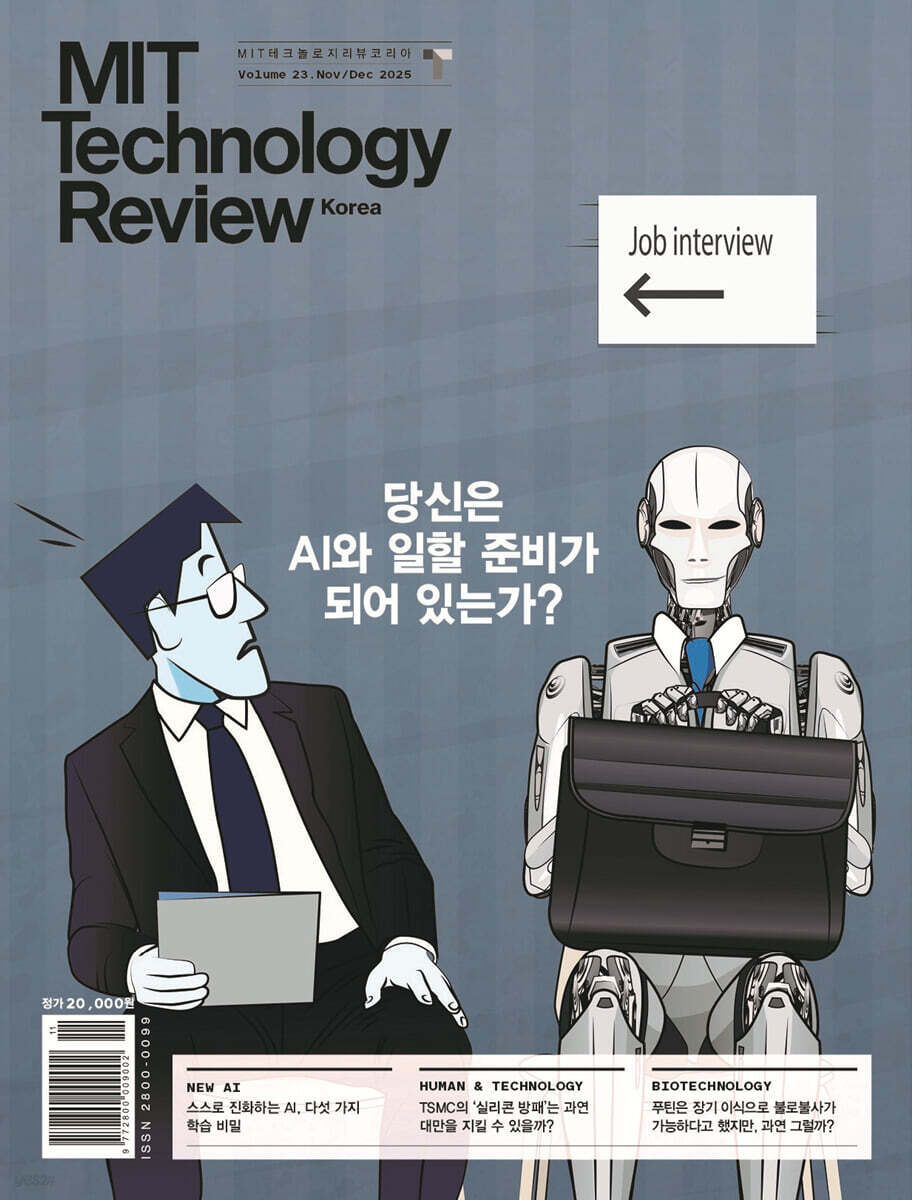
The era of working alongside AI has arrived. AI is now transforming the very definition of work, becoming human companions, substitutes, and even our alter egos. MIT Technology Review Korea's November/December issue, "Are You Ready to Work with AI?", reveals how work as we know it is being reorganized around AI.
In 'One Day, AI Came to Work Next to Me', the daily routine of agents that have infiltrated the white-collar industry is presented, and work automation routines are revealed through the case of a startup's '2 People + 5 AI Agents' operation.
It details how the career ladder is shaking as AI replaces interns and junior roles, and conversely, how seniors are evolving into 'AI nannies (orchestrators)'.
New forms of labor that connect reality and the virtual are also emerging.
'Shinsecia's AI Avatar' shows how marketing, education, and customer service are being reorganized through a scene where human-like digital avatars converse in real time and produce content.
'AI doppelganger' learns an individual's speech, work style, and even tacit knowledge to increase productivity.
AI entering the courtroom assists with case law research, document drafting, and evidence organization, and the provocative experiment of AI opening an academic conference suggests that the very method of knowledge production is changing.
In New AI, we gauge the direction of technology.
"Self-Evolving AI: Five Learning Secrets" dissects the speed at which AI is permeating products and services, while "Pigeons and Reinforcement Learning" introduces the influence of reward design borrowed from animal cognition on modern AI.
Lee Chao-ji, founder of Manus, which is shaking up the global app ecosystem, shows where the battleground is after the super-large model.
At the same time, Antropic's experiments and the OpenAI researchers' new agenda make it clear that safety and governance are no longer issues beyond technology.
Human & Technology covers missile defense strategies that have moved from movies to reality, the debate over regulating the dangerous "AI companions" that are driving teenagers to suicide, Starlink repair stations on the Ukrainian front, TSMC at the forefront of semiconductor geopolitics, the dynamics of China's introduction of generative AI that is shaking up the medical and educational fields, and the ethical issues surrounding the use of chatbots in psychological counseling settings.
In addition, it introduces quantum radar, the expansion of the boundaries of AirPods and hearing aids, the evolution of wildfire surveillance captured by lidar, and unfolds a new chapter in biotechnology through the debate over immortality in organ transplants, the birth of the world's longest frozen embryo, AI-designed viruses, genetic genealogy investigations, and the advent of 'lab-on-a-chip'.
We also look at energy beam startups targeting geothermal power, the limits of recycling, Google's first public disclosure of its Prompt power usage, the US-China clean energy gap, the threat of hidden emissions sources, the cost competitiveness of electric trucks, the oil and gas industry's climate technology transition, and an unusual landscape in the nuclear fusion industry.
In 'Space', we will see how space observation and prediction evolve through the combination of AI and NASA/IBM's solar storm early warning AI 'Surya'.
AI is no longer just a ‘tool’.
From offices to factories, restaurants, hospitals, security facilities, and even national defense, the AI-driven transformation of work has already begun. "How will it transform human work?" Prepare to work with AI with the November/December issue of MIT Technology Review Korea.
In 'One Day, AI Came to Work Next to Me', the daily routine of agents that have infiltrated the white-collar industry is presented, and work automation routines are revealed through the case of a startup's '2 People + 5 AI Agents' operation.
It details how the career ladder is shaking as AI replaces interns and junior roles, and conversely, how seniors are evolving into 'AI nannies (orchestrators)'.
New forms of labor that connect reality and the virtual are also emerging.
'Shinsecia's AI Avatar' shows how marketing, education, and customer service are being reorganized through a scene where human-like digital avatars converse in real time and produce content.
'AI doppelganger' learns an individual's speech, work style, and even tacit knowledge to increase productivity.
AI entering the courtroom assists with case law research, document drafting, and evidence organization, and the provocative experiment of AI opening an academic conference suggests that the very method of knowledge production is changing.
In New AI, we gauge the direction of technology.
"Self-Evolving AI: Five Learning Secrets" dissects the speed at which AI is permeating products and services, while "Pigeons and Reinforcement Learning" introduces the influence of reward design borrowed from animal cognition on modern AI.
Lee Chao-ji, founder of Manus, which is shaking up the global app ecosystem, shows where the battleground is after the super-large model.
At the same time, Antropic's experiments and the OpenAI researchers' new agenda make it clear that safety and governance are no longer issues beyond technology.
Human & Technology covers missile defense strategies that have moved from movies to reality, the debate over regulating the dangerous "AI companions" that are driving teenagers to suicide, Starlink repair stations on the Ukrainian front, TSMC at the forefront of semiconductor geopolitics, the dynamics of China's introduction of generative AI that is shaking up the medical and educational fields, and the ethical issues surrounding the use of chatbots in psychological counseling settings.
In addition, it introduces quantum radar, the expansion of the boundaries of AirPods and hearing aids, the evolution of wildfire surveillance captured by lidar, and unfolds a new chapter in biotechnology through the debate over immortality in organ transplants, the birth of the world's longest frozen embryo, AI-designed viruses, genetic genealogy investigations, and the advent of 'lab-on-a-chip'.
We also look at energy beam startups targeting geothermal power, the limits of recycling, Google's first public disclosure of its Prompt power usage, the US-China clean energy gap, the threat of hidden emissions sources, the cost competitiveness of electric trucks, the oil and gas industry's climate technology transition, and an unusual landscape in the nuclear fusion industry.
In 'Space', we will see how space observation and prediction evolve through the combination of AI and NASA/IBM's solar storm early warning AI 'Surya'.
AI is no longer just a ‘tool’.
From offices to factories, restaurants, hospitals, security facilities, and even national defense, the AI-driven transformation of work has already begun. "How will it transform human work?" Prepare to work with AI with the November/December issue of MIT Technology Review Korea.
index
MIT Technology Review Korea Vol. 23 / November/December 2025
Special Issue
In the AI era, things we knew are being dismantled - 8p
One day, an AI came to work next to me - p. 11
The first victims of the AI era are beginners, and the career ladder has begun to collapse - p. 16
Shinsegae's AI Avatar Blurs the Line Between Reality and Virtuality - Page 18
Could an AI Doppelganger Help Me with My Work? - Page 23
AI-powered judges transform the courtroom - p. 26
AI Hosts an Academic Conference? Stanford Scientist's Groundbreaking Experiment - Page 30
New AI
Self-Evolving AI: Five Learning Secrets - Page 36
Pigeons: Leading the Revolution in Modern AI Reinforcement Learning - 42p
Yichao Ji, the creator of Manus, rises to stardom as a global AI app star - 50p
AI Threatens Humanity? Anthropic Experiments Rekindle Dystopian Fears - Page 52
Two People Leading the Future of OpenAI Research - Page 54
Human & Technology
From movies to reality...
Trump's 'Golden Dome' Missile Defense Strategy - 60p
AI companions driving teen suicide... US regulation on the horizon - p. 67
A Visit to the Starlink Repair Center, a Hidden Support of the Ukrainian Front - 70p
Can TSMC's "Silicon Shield" Protect Taiwan? - 78p
China's AI Technology Scene: A Look at Korea's Medical School Obsession - Page 86
From Prohibited to Mandatory: Chinese Universities Shift Attitudes to Generative AI - 89p
Psychologists Secretly Use ChatGPT...Patients Feel Confused and Betrayed - 92p
Computing
A new quantum radar concept that will revolutionize underground structure detection has emerged - 98 pages
Apple AirPods: A Smart Choice for Hearing Aid Beginners - 100p
LA Fires Captured by Lidar...Measuring Changes Missed by Satellites - 102p
Biotechnology
Putin claims immortality is possible with organ transplants, but is that really the case? - 104p
Baby Born from World's Longest-Frozen Embryo...A 'Miracle of Life' That Sets a World Record - Page 107
AI-designed virus confirmed to kill bacteria...The era of genome creation begins - 112 pages
Genetic genealogy investigations are spreading in the US... DNA donations are now being used to investigate even relatives - 114p
The Chip Revolution in Biotechnology: "Lab-on-a-Chip" - 116p
Climate Change
Startup Revolutionizes Geothermal Power Generation with 'Energy Beams' that Drill Rock - 120p
Why Recycling Alone Won't Solve the Plastic Problem - Page 124
Google Reveals Hidden AI Prompt Power Usage for the First Time - 126p
Trump's Wider Clean Energy Gap Between the US and China - 128p
The Accelerator of Global Warming Created by Hidden Emissions Sources - 130p
Electric trucks with competitive pricing are poised to conquer the US electric vehicle market - 132p
The Key to Energy Transition? The Oil and Gas Industry's Climate Technology Challenges - Page 134
A Strange Phenomenon in America's Fusion Power Industry - Page 136
Space
NASA and IBM Unveil AI Model "Surya" for Early Warning of Solar Storms - 138p
AI Hype Index - 140p
Special Issue
In the AI era, things we knew are being dismantled - 8p
One day, an AI came to work next to me - p. 11
The first victims of the AI era are beginners, and the career ladder has begun to collapse - p. 16
Shinsegae's AI Avatar Blurs the Line Between Reality and Virtuality - Page 18
Could an AI Doppelganger Help Me with My Work? - Page 23
AI-powered judges transform the courtroom - p. 26
AI Hosts an Academic Conference? Stanford Scientist's Groundbreaking Experiment - Page 30
New AI
Self-Evolving AI: Five Learning Secrets - Page 36
Pigeons: Leading the Revolution in Modern AI Reinforcement Learning - 42p
Yichao Ji, the creator of Manus, rises to stardom as a global AI app star - 50p
AI Threatens Humanity? Anthropic Experiments Rekindle Dystopian Fears - Page 52
Two People Leading the Future of OpenAI Research - Page 54
Human & Technology
From movies to reality...
Trump's 'Golden Dome' Missile Defense Strategy - 60p
AI companions driving teen suicide... US regulation on the horizon - p. 67
A Visit to the Starlink Repair Center, a Hidden Support of the Ukrainian Front - 70p
Can TSMC's "Silicon Shield" Protect Taiwan? - 78p
China's AI Technology Scene: A Look at Korea's Medical School Obsession - Page 86
From Prohibited to Mandatory: Chinese Universities Shift Attitudes to Generative AI - 89p
Psychologists Secretly Use ChatGPT...Patients Feel Confused and Betrayed - 92p
Computing
A new quantum radar concept that will revolutionize underground structure detection has emerged - 98 pages
Apple AirPods: A Smart Choice for Hearing Aid Beginners - 100p
LA Fires Captured by Lidar...Measuring Changes Missed by Satellites - 102p
Biotechnology
Putin claims immortality is possible with organ transplants, but is that really the case? - 104p
Baby Born from World's Longest-Frozen Embryo...A 'Miracle of Life' That Sets a World Record - Page 107
AI-designed virus confirmed to kill bacteria...The era of genome creation begins - 112 pages
Genetic genealogy investigations are spreading in the US... DNA donations are now being used to investigate even relatives - 114p
The Chip Revolution in Biotechnology: "Lab-on-a-Chip" - 116p
Climate Change
Startup Revolutionizes Geothermal Power Generation with 'Energy Beams' that Drill Rock - 120p
Why Recycling Alone Won't Solve the Plastic Problem - Page 124
Google Reveals Hidden AI Prompt Power Usage for the First Time - 126p
Trump's Wider Clean Energy Gap Between the US and China - 128p
The Accelerator of Global Warming Created by Hidden Emissions Sources - 130p
Electric trucks with competitive pricing are poised to conquer the US electric vehicle market - 132p
The Key to Energy Transition? The Oil and Gas Industry's Climate Technology Challenges - Page 134
A Strange Phenomenon in America's Fusion Power Industry - Page 136
Space
NASA and IBM Unveil AI Model "Surya" for Early Warning of Solar Storms - 138p
AI Hype Index - 140p
Detailed image

Publisher's Review
MIT Technology Review is a technology business magazine with a 125-year history that began in the United States.
The Korean edition was officially launched online in January 2021, with the e-book magazine first published in November 2021 and the paper magazine in March 2022.
We provide the fastest and easiest access to expert information in various fields, including artificial intelligence, bio, space, blockchain, climate change, and smart cities.
MIT Technology Review is the world's oldest and most influential technology business publication, founded in 1899 at MIT.
Under the mission of "benefiting the world with technology," we cover a wide range of topics, including artificial intelligence, bio, space, blockchain, climate change, and smart cities. Every year, we announce the "10 Future Technologies" to introduce new technologies that will lead the future.
Starting in 2021, the MIT Technology Review will be available in Korean.
Published by DMK, a global knowledge conference organizer, MIT Technology Review Korea delivers fast and accurate translations of international tech news, adding depth through domestic reporting and expert columns.
The Korean edition was officially launched online in January 2021, with the e-book magazine first published in November 2021 and the paper magazine in March 2022.
We provide the fastest and easiest access to expert information in various fields, including artificial intelligence, bio, space, blockchain, climate change, and smart cities.
MIT Technology Review is the world's oldest and most influential technology business publication, founded in 1899 at MIT.
Under the mission of "benefiting the world with technology," we cover a wide range of topics, including artificial intelligence, bio, space, blockchain, climate change, and smart cities. Every year, we announce the "10 Future Technologies" to introduce new technologies that will lead the future.
Starting in 2021, the MIT Technology Review will be available in Korean.
Published by DMK, a global knowledge conference organizer, MIT Technology Review Korea delivers fast and accurate translations of international tech news, adding depth through domestic reporting and expert columns.
GOODS SPECIFICS
- Date of issue: November 1, 2025
- Page count, weight, size: 140 pages | 210*297*20mm
- ISBN13: 9772800009002
- ISBN10: 28000099
You may also like
카테고리
korean


korean

![GQ KOREA Mark (Monthly): December [2025]](http://librairie.coreenne.fr/cdn/shop/files/8ef265dbbfbf186523ed75ba7319009d.jpg?v=1765340328&width=3840)


