

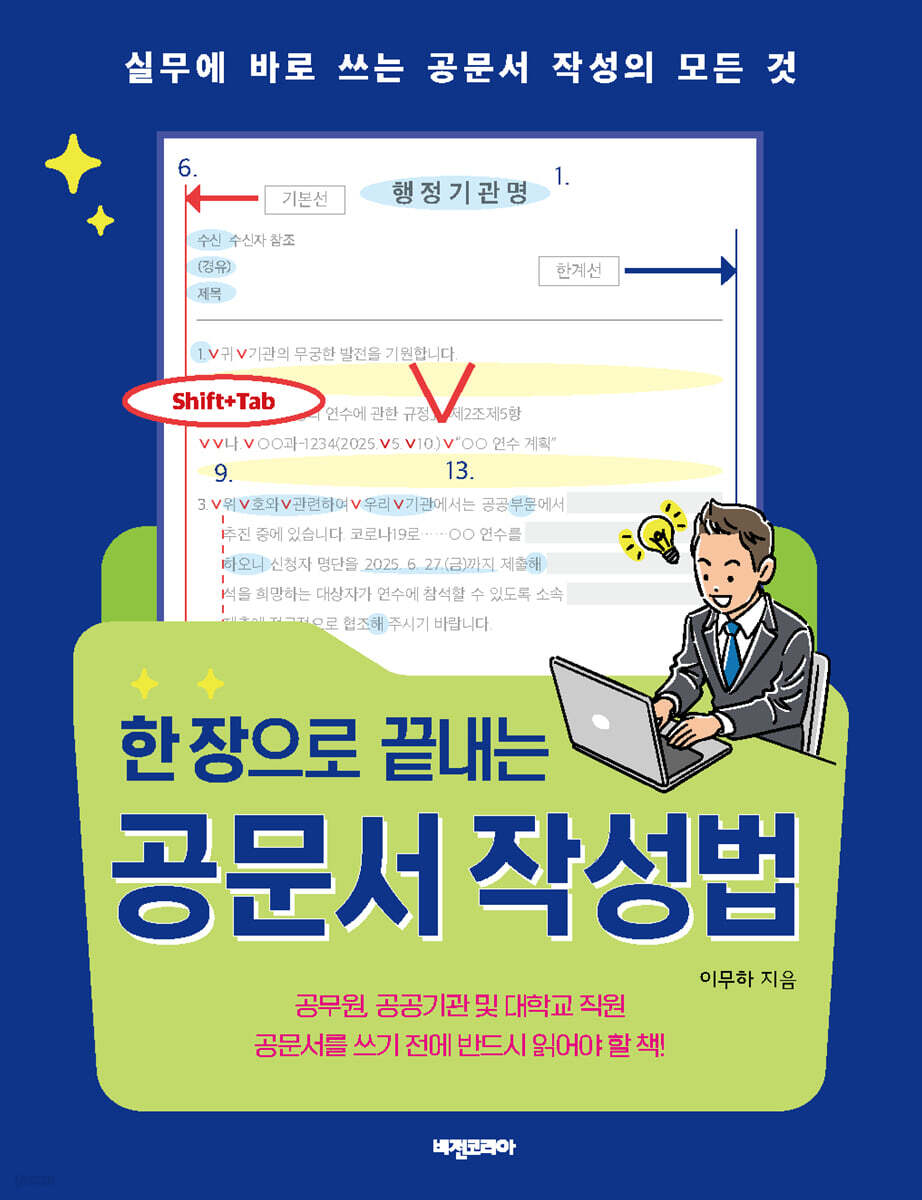
How to write an official document in one page
 |
Description
Book Introduction
"Creating Official Documents Now in One Volume"
Everything you need to know about writing official documents for practical use
A new solution for practitioners who have difficulty drafting official documents, “How to Write Official Documents in One Page,” has been published.
This book goes beyond simply listing theoretical explanations; it focuses on resolving the most common difficulties and concerns faced by those responsible for drafting official documents in the field.
It is a practical, structured guide that can be immediately utilized by various organizations, including civil servants, universities, and public institutions. It is designed to help you understand the core flow of writing official documents at a glance and quickly find the necessary information.
Author Lee Mu-ha has been steadily reviewing materials related to official documents published since 2013, organizing the scattered content, and after review by the National Institute of the Korean Language, has released to the public a summary of the method of writing official documents, “The Essentials of Writing Official Documents.”
Based on this systematic organization and field experience, the book "How to Write Official Documents That Pass Without a doubt" was published in May 2023 and received a great response, reaching its eighth printing in just two years.
The new book, "How to Write Official Documents in One Page," has been reorganized to meet readers' needs and enable them to quickly and easily check and apply the information they want to know.
This is not simply another 'book on writing official documents', but rather the culmination of years of field experience and proven writing know-how.
The biggest advantages of “How to Write Official Documents in One Page” are “immediateness” and “practicality.”
While "How to Write Official Documents That Pass Without a doubt" contains step-by-step theories and examples, it was difficult for readers to quickly find the answers they wanted. This book, however, organizes the expressions that practitioners are most curious about into a "one-page guide."
When writing official documents, you can directly apply the guide examples, or you can learn the basic writing techniques related to the text by following the numbers of the items you are curious about, and check the question and answer (Q&A) and writing tips (TIP) all at once.
Everything you need to know about writing official documents for practical use
A new solution for practitioners who have difficulty drafting official documents, “How to Write Official Documents in One Page,” has been published.
This book goes beyond simply listing theoretical explanations; it focuses on resolving the most common difficulties and concerns faced by those responsible for drafting official documents in the field.
It is a practical, structured guide that can be immediately utilized by various organizations, including civil servants, universities, and public institutions. It is designed to help you understand the core flow of writing official documents at a glance and quickly find the necessary information.
Author Lee Mu-ha has been steadily reviewing materials related to official documents published since 2013, organizing the scattered content, and after review by the National Institute of the Korean Language, has released to the public a summary of the method of writing official documents, “The Essentials of Writing Official Documents.”
Based on this systematic organization and field experience, the book "How to Write Official Documents That Pass Without a doubt" was published in May 2023 and received a great response, reaching its eighth printing in just two years.
The new book, "How to Write Official Documents in One Page," has been reorganized to meet readers' needs and enable them to quickly and easily check and apply the information they want to know.
This is not simply another 'book on writing official documents', but rather the culmination of years of field experience and proven writing know-how.
The biggest advantages of “How to Write Official Documents in One Page” are “immediateness” and “practicality.”
While "How to Write Official Documents That Pass Without a doubt" contains step-by-step theories and examples, it was difficult for readers to quickly find the answers they wanted. This book, however, organizes the expressions that practitioners are most curious about into a "one-page guide."
When writing official documents, you can directly apply the guide examples, or you can learn the basic writing techniques related to the text by following the numbers of the items you are curious about, and check the question and answer (Q&A) and writing tips (TIP) all at once.
- You can preview some of the book's contents.
Preview
index
preface
Guidebook: The Practical Guide to Drafting Official Documents in One Page
Note
Public language and official documents
Why You Should Prepare Correct Official Documents
Definition of official document
Principles of drafting official documents
Priority of regulations applied when drafting official documents
General and simple drafts
Readability and consistency
Please note that official documents are one page per document.
Is there a set font for official documents?
How to Use the National Institute of the Korean Language's Standard Korean Dictionary
How to Use “[Revised] Public Language: A Quick Guide to Using Public Language”
Part 1: Dumun
1.
Display 'Administrative Agency Name'
2.
'Received' indicator
Comparison of TIP internal approval documents and internal/external documents
3.
How to write 'via'
Part 2 Main Text
4.
How to write a title
Question: Personnel appointment notification
Question: Should I include terms like [Urgent], [Submission], [Notice], etc. in the subject line?
TIP The difference between 'plan' and 'plan(draft)'
5.
Can I write '2025' as '2025.'?
Question: Is there a difference between '2025', '2025', and '2025'?
When abbreviating the TIP year
TIP Distinction between 'year' and 'year'
6.
Be sure to remember the 'baseline' and the 'limit line'!
7.
Positioning the first item symbol '1.'
TIP What do all official documents have in common?
TIP Item Symbols and Special Symbols
8.
Positioning the second item symbol 'a.'
9.
How to align sentences with more than one line
Precautions when aligning TIP sentences with more than two lines
Question: Should I align the 2-hit space and Shift+Tab?
Question: I heard that some organizations require that lines ① and ② be aligned equally.
10.
Space between item symbol and item content
Question: Is one letter (2 strokes) 1 space?
11.
Can I use the item symbol '1.' when there is no '2.'?
Question: If there is only one item, do I use the special character (-)?
12.
Do I really have to write 'I wish your organization endless development'?
TIP: Memorize 'Your Company, Your School, Your Home'!
13.
Spacing between lines for readability
14.
How to write relevant evidence
Question: Do you add '호' to the relevant evidence?
Question: The date of implementation has a '0' like '02' and the date is also attached?
Question: How do I sort related evidence when it has more than one line?
Question: How do I write two official documents from the same department?
Question: When there are multiple related evidences, what is the order in which they are arranged?
Question: Is 'related to ~ho' the correct spelling?
Question: What is the order in which I should write "Related" and "I wish your organization continued success"?
15.
How to write the name of the law
16.
Spacing between the name of the law and its provisions
Question: Spacing when indicating provisions of laws in 'related'
17.
Spacing between the numbers of 'article, clause, subparagraph, and item' in the law
How to read the 'Articles, Paragraphs, Subparagraphs, and Items' of the TIP Act
18.
How to create a document registration number
19.
The easiest and most accurate way to write dates
TIP When listing two or more dates
20.
Is the title of the official document double quotes or single quotes?
21.
Can I write 'related to the above'?
Question: Is the use of 'related' in 'related to' and 'in relation to the above' redundant?
22.
Our organization/In our organization
TIP: Memorize Our Country, Our Language, Our Writing!
23.
Distinguishing between 'parts' and 'divisions'
Question: How do we distinguish between a 'part' and a 'sector'?
24.
Spacing of '~jung' meaning 'doing'
25.
Avoid using the causative expression 'because of ~'
Question: How should I rewrite "in the interest of revision" when revising a rule?
26.
Do you write '-below-' after 'as below'?
27.
Should I use '실시하다' as '하다' instead of '하다'?
28.
'Haoni/Hani', 'For/For', 'Have to/Have to'
29.
How to highlight important parts?
30.
Do you put a comma after 'also'?
Question: Is 'also' a Japanese spelling?
31.
What if only one letter in a sentence is split to the next line?
32.
Spacing between 'department∨' and 'two days'
33.
We ask for your active cooperation.
Please make sure to follow the TIP carefully.
Question: Is it correct to say 'install on the homepage'?
34.
Do you put a period in a sentence that ends with a noun?
TIP Authoritative expressions: 'notice', 'observe', 'will do'
35.
When sorting, do you align with colons (:)?
36.
Correct spacing of colons (:)
37.
How to write time
TIP When writing the date, day of the week, and time together
38.
Spacing between tilde (~) and hyphen (-)
39.
How do you write '구', '전', '현', etc.?
40.
'2025.
7. 1. Is the spacing correct?
41.
When a unit is omitted using a tilde (~)
42.
See attached, note?
43.
Space between 'business name' and 'application∨case'
44.
Is it 'How to apply' or 'How to submit'?
45.
What about spacing between 'improvement plan', 'expected effect', and 'administrative matters'?
TIP Terms and Their Spacing Principles
46.
Spacing of names in attendance list
How to use the hidden symbols (○○,××) used to keep TIP confidential
Question: Do I only use 'etc.' when there are two or more words listed?
47.
How to indicate amounts in official documents
Question: How do you write 111,110 won in gold?
Question: How do I change the word "details" in "output details"?
Question: What punctuation marks are used when indicating a 'budget item' in internal approval?
48.
What is the spacing between multiplication (×) and equals (=)?
49.
Two ways to create a table… 16
Question: Shouldn't there be border lines on both sides of the table?
Question: Are there any special rules for the font and size within tables?
How to display units in the upper right corner of the TIP table
Question: In what cases is the 'blank space below' used in the table?
Question: Should I change 'blank below' to 'blank below'?
50.
When making changes, do you use the terms 'original' and 'changed'?
51.
Is it redundant to use 'until' after 'deadline'?
52.
In a sentence that starts with a reference mark (※), where is the reference mark (※) located?
53.
In the phrase 'online consultation', is the expression '~online consultation' written with a space?
54.
Please submit within the deadline.
Question: If the main text of the opinion inquiry ends with a reference (※) sentence, what is the 'end' indication?
55.
Spacing between 'not submitted∨si'
TIP In case of emergency, in normal times, in case of need, 〈Memorize!〉
56.
Submit 'Not applicable'
57.
Where is the information regarding 'Personal Information Protection' located?
58.
How to indicate 'attachment' and 'part 1'
Question: Which of the following is the correct spelling of 'attachment'?
Question: Does 'Part 1' mean 'Chapter 1'?
Question: When attaching 10 Korean documents as a compressed (ZIP) file, is it '1 copy' or '10 copies'?
59.
How to correctly write 'separately sent'
60.
Should I write the name of the attached file as it is in the attachment?
Question: When the attachment file name becomes too long and takes up more than two lines
61.
'End' indicator when ending a table or sentence
Question: What happens if I stop drawing a table in the middle of the drawing process and the 'end' sign is displayed?
Question: What is the 'end' sign when ending with a name?
Spacing to be careful of
Expressions that must be written separately
Other expressions
Part 3 Conclusion
62.
Sender's name
TIP auxiliary agency, support agency, agreement-based administrative agency?
Question: What is the name of the direct agency, business office, branch office, district office, township, town, or district office that sent the document?
Question: What if I send it with ‘omission of official seal’?
Payment/settlement/confrontation
Question: Does the conclusion follow the main text?
Appendix 1: 30 Cases of Correct Writing and Editing Official Documents
Appendix 2: 20 Most Commonly Used Official Document Formats
Reference site
Guidebook: The Practical Guide to Drafting Official Documents in One Page
Note
Public language and official documents
Why You Should Prepare Correct Official Documents
Definition of official document
Principles of drafting official documents
Priority of regulations applied when drafting official documents
General and simple drafts
Readability and consistency
Please note that official documents are one page per document.
Is there a set font for official documents?
How to Use the National Institute of the Korean Language's Standard Korean Dictionary
How to Use “[Revised] Public Language: A Quick Guide to Using Public Language”
Part 1: Dumun
1.
Display 'Administrative Agency Name'
2.
'Received' indicator
Comparison of TIP internal approval documents and internal/external documents
3.
How to write 'via'
Part 2 Main Text
4.
How to write a title
Question: Personnel appointment notification
Question: Should I include terms like [Urgent], [Submission], [Notice], etc. in the subject line?
TIP The difference between 'plan' and 'plan(draft)'
5.
Can I write '2025' as '2025.'?
Question: Is there a difference between '2025', '2025', and '2025'?
When abbreviating the TIP year
TIP Distinction between 'year' and 'year'
6.
Be sure to remember the 'baseline' and the 'limit line'!
7.
Positioning the first item symbol '1.'
TIP What do all official documents have in common?
TIP Item Symbols and Special Symbols
8.
Positioning the second item symbol 'a.'
9.
How to align sentences with more than one line
Precautions when aligning TIP sentences with more than two lines
Question: Should I align the 2-hit space and Shift+Tab?
Question: I heard that some organizations require that lines ① and ② be aligned equally.
10.
Space between item symbol and item content
Question: Is one letter (2 strokes) 1 space?
11.
Can I use the item symbol '1.' when there is no '2.'?
Question: If there is only one item, do I use the special character (-)?
12.
Do I really have to write 'I wish your organization endless development'?
TIP: Memorize 'Your Company, Your School, Your Home'!
13.
Spacing between lines for readability
14.
How to write relevant evidence
Question: Do you add '호' to the relevant evidence?
Question: The date of implementation has a '0' like '02' and the date is also attached?
Question: How do I sort related evidence when it has more than one line?
Question: How do I write two official documents from the same department?
Question: When there are multiple related evidences, what is the order in which they are arranged?
Question: Is 'related to ~ho' the correct spelling?
Question: What is the order in which I should write "Related" and "I wish your organization continued success"?
15.
How to write the name of the law
16.
Spacing between the name of the law and its provisions
Question: Spacing when indicating provisions of laws in 'related'
17.
Spacing between the numbers of 'article, clause, subparagraph, and item' in the law
How to read the 'Articles, Paragraphs, Subparagraphs, and Items' of the TIP Act
18.
How to create a document registration number
19.
The easiest and most accurate way to write dates
TIP When listing two or more dates
20.
Is the title of the official document double quotes or single quotes?
21.
Can I write 'related to the above'?
Question: Is the use of 'related' in 'related to' and 'in relation to the above' redundant?
22.
Our organization/In our organization
TIP: Memorize Our Country, Our Language, Our Writing!
23.
Distinguishing between 'parts' and 'divisions'
Question: How do we distinguish between a 'part' and a 'sector'?
24.
Spacing of '~jung' meaning 'doing'
25.
Avoid using the causative expression 'because of ~'
Question: How should I rewrite "in the interest of revision" when revising a rule?
26.
Do you write '-below-' after 'as below'?
27.
Should I use '실시하다' as '하다' instead of '하다'?
28.
'Haoni/Hani', 'For/For', 'Have to/Have to'
29.
How to highlight important parts?
30.
Do you put a comma after 'also'?
Question: Is 'also' a Japanese spelling?
31.
What if only one letter in a sentence is split to the next line?
32.
Spacing between 'department∨' and 'two days'
33.
We ask for your active cooperation.
Please make sure to follow the TIP carefully.
Question: Is it correct to say 'install on the homepage'?
34.
Do you put a period in a sentence that ends with a noun?
TIP Authoritative expressions: 'notice', 'observe', 'will do'
35.
When sorting, do you align with colons (:)?
36.
Correct spacing of colons (:)
37.
How to write time
TIP When writing the date, day of the week, and time together
38.
Spacing between tilde (~) and hyphen (-)
39.
How do you write '구', '전', '현', etc.?
40.
'2025.
7. 1. Is the spacing correct?
41.
When a unit is omitted using a tilde (~)
42.
See attached, note?
43.
Space between 'business name' and 'application∨case'
44.
Is it 'How to apply' or 'How to submit'?
45.
What about spacing between 'improvement plan', 'expected effect', and 'administrative matters'?
TIP Terms and Their Spacing Principles
46.
Spacing of names in attendance list
How to use the hidden symbols (○○,××) used to keep TIP confidential
Question: Do I only use 'etc.' when there are two or more words listed?
47.
How to indicate amounts in official documents
Question: How do you write 111,110 won in gold?
Question: How do I change the word "details" in "output details"?
Question: What punctuation marks are used when indicating a 'budget item' in internal approval?
48.
What is the spacing between multiplication (×) and equals (=)?
49.
Two ways to create a table… 16
Question: Shouldn't there be border lines on both sides of the table?
Question: Are there any special rules for the font and size within tables?
How to display units in the upper right corner of the TIP table
Question: In what cases is the 'blank space below' used in the table?
Question: Should I change 'blank below' to 'blank below'?
50.
When making changes, do you use the terms 'original' and 'changed'?
51.
Is it redundant to use 'until' after 'deadline'?
52.
In a sentence that starts with a reference mark (※), where is the reference mark (※) located?
53.
In the phrase 'online consultation', is the expression '~online consultation' written with a space?
54.
Please submit within the deadline.
Question: If the main text of the opinion inquiry ends with a reference (※) sentence, what is the 'end' indication?
55.
Spacing between 'not submitted∨si'
TIP In case of emergency, in normal times, in case of need, 〈Memorize!〉
56.
Submit 'Not applicable'
57.
Where is the information regarding 'Personal Information Protection' located?
58.
How to indicate 'attachment' and 'part 1'
Question: Which of the following is the correct spelling of 'attachment'?
Question: Does 'Part 1' mean 'Chapter 1'?
Question: When attaching 10 Korean documents as a compressed (ZIP) file, is it '1 copy' or '10 copies'?
59.
How to correctly write 'separately sent'
60.
Should I write the name of the attached file as it is in the attachment?
Question: When the attachment file name becomes too long and takes up more than two lines
61.
'End' indicator when ending a table or sentence
Question: What happens if I stop drawing a table in the middle of the drawing process and the 'end' sign is displayed?
Question: What is the 'end' sign when ending with a name?
Spacing to be careful of
Expressions that must be written separately
Other expressions
Part 3 Conclusion
62.
Sender's name
TIP auxiliary agency, support agency, agreement-based administrative agency?
Question: What is the name of the direct agency, business office, branch office, district office, township, town, or district office that sent the document?
Question: What if I send it with ‘omission of official seal’?
Payment/settlement/confrontation
Question: Does the conclusion follow the main text?
Appendix 1: 30 Cases of Correct Writing and Editing Official Documents
Appendix 2: 20 Most Commonly Used Official Document Formats
Reference site
Detailed image

Into the book
Official documents refer to all documents created or executed by administrative agencies for official purposes (including special media records such as drawings, photographs, disks, tapes, films, slides, and electronic documents) and all documents received by administrative agencies.
A private document is a document written for personal purposes.
However, documents submitted to and received by administrative agencies, such as various applications, certificates, and petitions, are treated as official documents, not private documents, and the person who submitted the documents cannot arbitrarily retrieve the documents.
The definition of official documents can be found in the “Regulations on the Operation and Innovation of Administrative Work” and the “National Language Basic Act.”
--- p.22, from “Definition of Official Documents”
In November 2017, an official document arrived from the Ministry of the Interior and Safety announcing improvements to make writing official documents easier and more convenient.
The reason was that while writing official documents, it was difficult to find the starting point because there was a six-character space and the first item symbol '1.' was started right below the title, and unnecessary space was created.
The improved '5 Rules for Writing Official Documents' are as follows:
Notice on improvement and implementation of methods for writing official documents (Ministry of the Interior and Safety, 2017).
11.
1. Implementation)
1.
The first item symbol starts from the left baseline.
2.
From the second item onwards, start by moving 2 strokes to the right from the item immediately above.
3.
If an item has more than two lines, the first letter of the item content is aligned from the second line onwards.
(Use Shift+Tab keys)
4.
Leave a space between the item symbol and the content of that item.
5.
If there is only one item, no item symbol is given.
Part 2 Main Text
--- p.64, 「06.
Remember the baseline and the limit line.
It is not necessary to include a title in an official document.
If you need to indicate the title separately, you can do so.
Some organizations use single quotation marks ('') to enclose titles, while others use single quotes (「」) as internal guidelines.
Because there are differences between institutions, practitioners wonder what the exact regulations are.
The Ministry of Public Administration and Security and the National Institute of the Korean Language answered the question about punctuation marks that enclose the title of official documents as follows.
The Ministry of Public Administration and Security states that since it is a direct quote of speech or writing, it should be enclosed in double quotation marks (“”), while the National Institute of the Korean Language states that since it is for emphasis, it should be enclosed in single quotation marks ('').
The YouTube channel 'Keyword-based Job-Specific Lectures' produced by the Seoul Metropolitan Office of Education Training Institute instructs that the title be enclosed in single quotation marks ('').
--- p.124, 「Part 2, Text 20.
"Does the title of the official document use double quotation marks or single quotation marks?"
Difficult and clichéd Chinese character expressions like 'do everything possible' are replaced with the simpler expression 'make sure there are no lapses'.
However, it is true that from a practitioner's perspective, it is difficult to find the courage to use the expression "without any laxity" instead of "with all due care."
The expression 'to avoid any sloppiness' seems so sloppy at first glance that it feels like I won't get my boss's approval if I use it as is.
For those people, instead of 'making every effort', you can use expressions such as 'do your best' or 'prepare thoroughly'.
--- p.124, 「Part 2, Text 33.
We ask for your active cooperation"
In case of authority of the head of an administrative agency, it is sent in the name of the head of the administrative agency.
Yes, Minister ○○○○, Mayor ○○, County Governor ○○, Committee Chairperson ○○, etc.
Matters falling within the jurisdiction of the agreement-based administrative agency are sent in the name of that agreement-based administrative agency.
Yes ○○ Committee
In cases where administrative authority is delegated or entrusted according to law, it is sent in the name of the person who has received the delegated or entrusted authority (the agent or trustee).
Documents sent between auxiliary and supporting agencies within an administrative agency (internal documents) are sent in the name of the relevant auxiliary or supporting agency.
Yes, Manager ○○, Manager ○○, Director ○○, etc.
The sender's name is not displayed on internal approval documents that do not need to be sent.
A private document is a document written for personal purposes.
However, documents submitted to and received by administrative agencies, such as various applications, certificates, and petitions, are treated as official documents, not private documents, and the person who submitted the documents cannot arbitrarily retrieve the documents.
The definition of official documents can be found in the “Regulations on the Operation and Innovation of Administrative Work” and the “National Language Basic Act.”
--- p.22, from “Definition of Official Documents”
In November 2017, an official document arrived from the Ministry of the Interior and Safety announcing improvements to make writing official documents easier and more convenient.
The reason was that while writing official documents, it was difficult to find the starting point because there was a six-character space and the first item symbol '1.' was started right below the title, and unnecessary space was created.
The improved '5 Rules for Writing Official Documents' are as follows:
Notice on improvement and implementation of methods for writing official documents (Ministry of the Interior and Safety, 2017).
11.
1. Implementation)
1.
The first item symbol starts from the left baseline.
2.
From the second item onwards, start by moving 2 strokes to the right from the item immediately above.
3.
If an item has more than two lines, the first letter of the item content is aligned from the second line onwards.
(Use Shift+Tab keys)
4.
Leave a space between the item symbol and the content of that item.
5.
If there is only one item, no item symbol is given.
Part 2 Main Text
--- p.64, 「06.
Remember the baseline and the limit line.
It is not necessary to include a title in an official document.
If you need to indicate the title separately, you can do so.
Some organizations use single quotation marks ('') to enclose titles, while others use single quotes (「」) as internal guidelines.
Because there are differences between institutions, practitioners wonder what the exact regulations are.
The Ministry of Public Administration and Security and the National Institute of the Korean Language answered the question about punctuation marks that enclose the title of official documents as follows.
The Ministry of Public Administration and Security states that since it is a direct quote of speech or writing, it should be enclosed in double quotation marks (“”), while the National Institute of the Korean Language states that since it is for emphasis, it should be enclosed in single quotation marks ('').
The YouTube channel 'Keyword-based Job-Specific Lectures' produced by the Seoul Metropolitan Office of Education Training Institute instructs that the title be enclosed in single quotation marks ('').
--- p.124, 「Part 2, Text 20.
"Does the title of the official document use double quotation marks or single quotation marks?"
Difficult and clichéd Chinese character expressions like 'do everything possible' are replaced with the simpler expression 'make sure there are no lapses'.
However, it is true that from a practitioner's perspective, it is difficult to find the courage to use the expression "without any laxity" instead of "with all due care."
The expression 'to avoid any sloppiness' seems so sloppy at first glance that it feels like I won't get my boss's approval if I use it as is.
For those people, instead of 'making every effort', you can use expressions such as 'do your best' or 'prepare thoroughly'.
--- p.124, 「Part 2, Text 33.
We ask for your active cooperation"
In case of authority of the head of an administrative agency, it is sent in the name of the head of the administrative agency.
Yes, Minister ○○○○, Mayor ○○, County Governor ○○, Committee Chairperson ○○, etc.
Matters falling within the jurisdiction of the agreement-based administrative agency are sent in the name of that agreement-based administrative agency.
Yes ○○ Committee
In cases where administrative authority is delegated or entrusted according to law, it is sent in the name of the person who has received the delegated or entrusted authority (the agent or trustee).
Documents sent between auxiliary and supporting agencies within an administrative agency (internal documents) are sent in the name of the relevant auxiliary or supporting agency.
Yes, Manager ○○, Manager ○○, Director ○○, etc.
The sender's name is not displayed on internal approval documents that do not need to be sent.
--- p.246, 「Part 3 Conclusion 62.
Among the "sender's name"
Among the "sender's name"
Publisher's Review
1. Suitable for writing practical official documents.
Dumun 2.
Text 3.
Conclusion order
《How to Write Official Documents in One Page》 is designed to be used by practitioners in their actual work environments.
Because the book unfolds its content following the basic structure of drafting official documents, which is 'introduction-body-conclusion', the moment you read this book, you will naturally find yourself in the flow of actually drafting a document.
This helps novice practitioners understand the overall framework of the document, and provides experienced practitioners with a clear standard for review and supplementation.
Following the “Guide” summarized in one page
Practical configurations that can be applied immediately to check your questions
Furthermore, the 'One-Page Guide', which can be said to be the biggest differentiating factor of this book, is a structured method that concisely and systematically summarizes the expressions that practitioners most often confuse.
Readers can find the desired item by number in the guide at the beginning of the book and then check the corresponding content in the main text.
You can also learn frequently asked questions and answers along with tips related to the items, so you can write official documents easily, quickly, and accurately.
"Everything About Official Documents," Reflecting Voices from the Field
The author completed this book based on his experience of giving special lectures at over 100 institutions, including universities, public institutions, provincial offices of education, and local governments, over several years.
Because this book reflects the most frequently asked questions and recurring difficulties faced by practitioners in the field, it is not simply a theoretical book, but a "verified practical textbook" that meets the needs of the fiercely competitive field.
In this respect, this book will be a strong supporter of all practitioners who have encountered difficulties in preparing official documents.
Dumun 2.
Text 3.
Conclusion order
《How to Write Official Documents in One Page》 is designed to be used by practitioners in their actual work environments.
Because the book unfolds its content following the basic structure of drafting official documents, which is 'introduction-body-conclusion', the moment you read this book, you will naturally find yourself in the flow of actually drafting a document.
This helps novice practitioners understand the overall framework of the document, and provides experienced practitioners with a clear standard for review and supplementation.
Following the “Guide” summarized in one page
Practical configurations that can be applied immediately to check your questions
Furthermore, the 'One-Page Guide', which can be said to be the biggest differentiating factor of this book, is a structured method that concisely and systematically summarizes the expressions that practitioners most often confuse.
Readers can find the desired item by number in the guide at the beginning of the book and then check the corresponding content in the main text.
You can also learn frequently asked questions and answers along with tips related to the items, so you can write official documents easily, quickly, and accurately.
"Everything About Official Documents," Reflecting Voices from the Field
The author completed this book based on his experience of giving special lectures at over 100 institutions, including universities, public institutions, provincial offices of education, and local governments, over several years.
Because this book reflects the most frequently asked questions and recurring difficulties faced by practitioners in the field, it is not simply a theoretical book, but a "verified practical textbook" that meets the needs of the fiercely competitive field.
In this respect, this book will be a strong supporter of all practitioners who have encountered difficulties in preparing official documents.
GOODS SPECIFICS
- Date of issue: September 12, 2025
- Page count, weight, size: 392 pages | 808g | 173*225*24mm
- ISBN13: 9788963222295
- ISBN10: 8963222292
You may also like
카테고리
korean


korean

![GQ KOREA Mark (Monthly): December [2025]](http://librairie.coreenne.fr/cdn/shop/files/8ef265dbbfbf186523ed75ba7319009d.jpg?v=1765340328&width=3840)


