

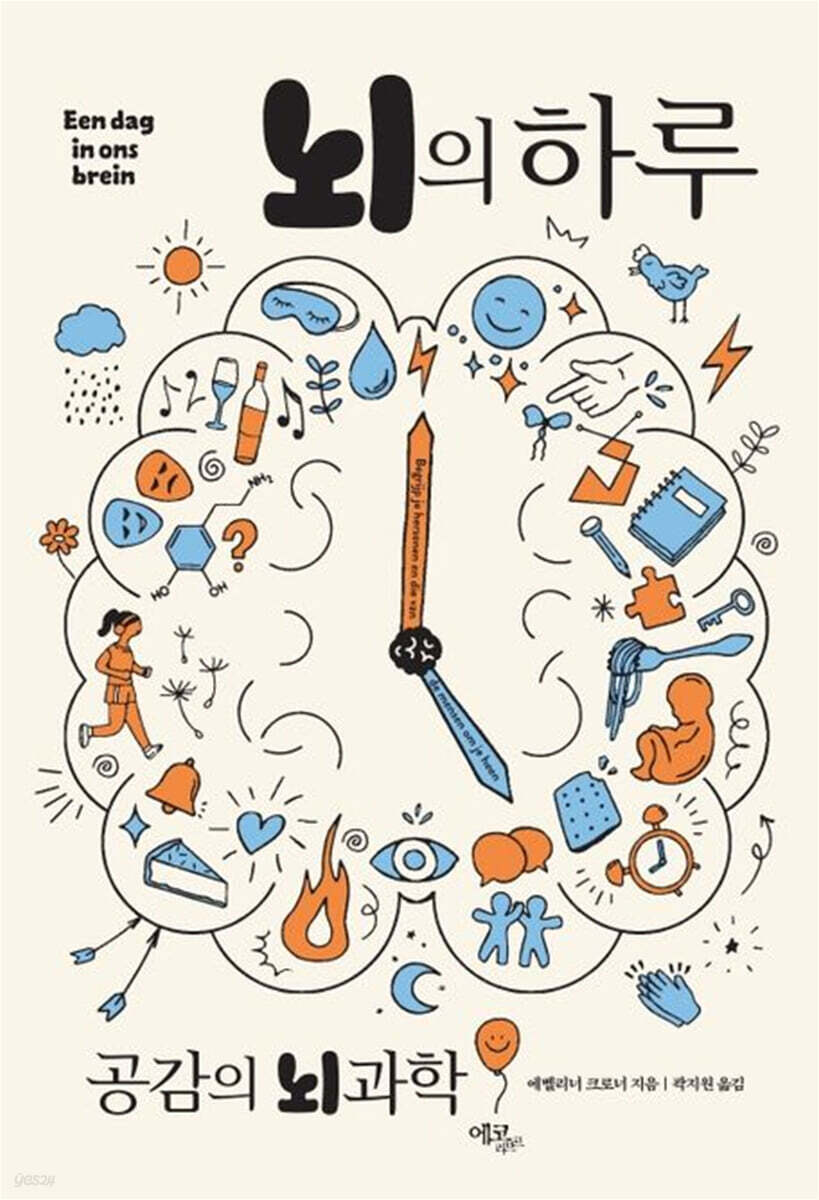
A Day in the Life of the Brain
 |
Description
Book Introduction
The Brain Science of Empathy for Understanding Yourself and Others
Why do teenagers stay up late and then sleep in? Why do we need enough sleep? Where is the right amount of stress? Why do rejection and alienation hurt so much? How does the brain react when depressed? Are brain changes due to aging or disease irreversible? Why are friends so special? Why do we find fulfillment in collaboration? How can we live happily?
Evelina Kroner, a professor of neuroscience at Erasmus University Rotterdam and Leiden University in the Netherlands, says neuroscience can answer these questions more specifically than you might think.
In the book's foreword, he recalls the moment he became fascinated with the brain in 1998, when he was a 22-year-old exchange student.
It was at the University of Pittsburgh in the United States that I witnessed the first ever fMRI experiment to observe the brain of a living person.
fMRI, which shows in real time which areas of the brain receive oxygen-rich blood, has revolutionized brain research, creating what the authors call “a super ultrasound in motion.”
Although humans have been curious about and awed by the brain since ancient times, it was only after much trial and error and the introduction of fMRI that we were able to observe how the living brain functions and changes.
Since then, scientists have studied how the human brain develops from newborns to the elderly.
This book follows a day in the life of neighbors living on the same street and looks into what goes on in their brains.
People in various stages of life and in various situations may seem to spend their days as usual, sometimes sad and sometimes happy, but if we focus on which neurotransmitters and hormones in their brains transmit signals and which areas respond to external stimuli and change emotions and behaviors, the day appears new.
By presenting the latest brain science research findings in a story format with engaging characters, the author helps readers observe their own brains in a more engaging way and, furthermore, understand others and society.
As he says, as the world changes more and more rapidly, perhaps we need to make more effort to understand each other.
Why do teenagers stay up late and then sleep in? Why do we need enough sleep? Where is the right amount of stress? Why do rejection and alienation hurt so much? How does the brain react when depressed? Are brain changes due to aging or disease irreversible? Why are friends so special? Why do we find fulfillment in collaboration? How can we live happily?
Evelina Kroner, a professor of neuroscience at Erasmus University Rotterdam and Leiden University in the Netherlands, says neuroscience can answer these questions more specifically than you might think.
In the book's foreword, he recalls the moment he became fascinated with the brain in 1998, when he was a 22-year-old exchange student.
It was at the University of Pittsburgh in the United States that I witnessed the first ever fMRI experiment to observe the brain of a living person.
fMRI, which shows in real time which areas of the brain receive oxygen-rich blood, has revolutionized brain research, creating what the authors call “a super ultrasound in motion.”
Although humans have been curious about and awed by the brain since ancient times, it was only after much trial and error and the introduction of fMRI that we were able to observe how the living brain functions and changes.
Since then, scientists have studied how the human brain develops from newborns to the elderly.
This book follows a day in the life of neighbors living on the same street and looks into what goes on in their brains.
People in various stages of life and in various situations may seem to spend their days as usual, sometimes sad and sometimes happy, but if we focus on which neurotransmitters and hormones in their brains transmit signals and which areas respond to external stimuli and change emotions and behaviors, the day appears new.
By presenting the latest brain science research findings in a story format with engaging characters, the author helps readers observe their own brains in a more engaging way and, furthermore, understand others and society.
As he says, as the world changes more and more rapidly, perhaps we need to make more effort to understand each other.
index
preface
Time Travel: A History of Brain Research
01 Exercise and Rest: Your Brain Needs Exercise Too
6 o'clock - Bootcamp
02 Brain Formation: A Look Inside a Wonder
7 o'clock - nine months
03 Day and Night: The Brain's 24-Hour Cycle
8 o'clock - a crazy morning
04 Stress: Where is the Right Line?
9 o'clock - Radio Interview
05 From Baby Brain to Toddler Brain: A Journey of Great Change
10 o'clock - Baby TV
06 Trust: Friends or Foes in Your Brain
11 o'clock - password
07 The Learning Brain: A Super-Strong Sponge That Builds Focus
12 o'clock - 3-stage multiplication table
08 Social Pain: A Sense of Rejection and Alienation
1:00 PM - Lunchtime
09 Depression: When Life Feels Too Heavy
2 o'clock - under the blanket
10 The Adolescent Brain: Pushing the Limits
3:00 PM - Flight to Asia
11 Mother's Brain: Between Lion-Like Instinct and Disarmed Emotions
4pm - The Forgotten Baguette
12 Multitasking Doesn't Exist: But You Can Get Good at It
5:00 PM - To-do list
13. Being Together: Why We Want to Help Each Other
6 p.m. - Disco Ballstraat Festival
14 Appetite: Hunger Starts in the Brain
7:00 PM - Secret Ingredients
15 Growing Up and Idealism: Why Young People Are Passionate
8 PM - Private Tutor
16 Friendship: It's Not an Illusion
9 p.m. - A plate of cheese sticks
17 Dementia: The Brain in Disarray
10:00 PM - Brother
18 Love and Sex: Desire in the Brain
11:00 PM - Butterflies in my stomach
19 Drugs and Alcohol: Why We Want Them
12 o'clock - just one more drink
20-Year-Old Brain: I'm Okay
1 o'clock - Tea in the garden
21 Antisocial Aggressive Behaviors: From Bad Habits to Crime
2 o'clock - at the police station
22 Menopause: A Tough Time for a Woman's Brain
3 o'clock - sudden fever
23 Sleep: And the Function of Dreams
4 o'clock - Lara is flying
24 Happiness: What Is It?
5 o'clock - a new day again
Acknowledgements
References
Time Travel: A History of Brain Research
01 Exercise and Rest: Your Brain Needs Exercise Too
6 o'clock - Bootcamp
02 Brain Formation: A Look Inside a Wonder
7 o'clock - nine months
03 Day and Night: The Brain's 24-Hour Cycle
8 o'clock - a crazy morning
04 Stress: Where is the Right Line?
9 o'clock - Radio Interview
05 From Baby Brain to Toddler Brain: A Journey of Great Change
10 o'clock - Baby TV
06 Trust: Friends or Foes in Your Brain
11 o'clock - password
07 The Learning Brain: A Super-Strong Sponge That Builds Focus
12 o'clock - 3-stage multiplication table
08 Social Pain: A Sense of Rejection and Alienation
1:00 PM - Lunchtime
09 Depression: When Life Feels Too Heavy
2 o'clock - under the blanket
10 The Adolescent Brain: Pushing the Limits
3:00 PM - Flight to Asia
11 Mother's Brain: Between Lion-Like Instinct and Disarmed Emotions
4pm - The Forgotten Baguette
12 Multitasking Doesn't Exist: But You Can Get Good at It
5:00 PM - To-do list
13. Being Together: Why We Want to Help Each Other
6 p.m. - Disco Ballstraat Festival
14 Appetite: Hunger Starts in the Brain
7:00 PM - Secret Ingredients
15 Growing Up and Idealism: Why Young People Are Passionate
8 PM - Private Tutor
16 Friendship: It's Not an Illusion
9 p.m. - A plate of cheese sticks
17 Dementia: The Brain in Disarray
10:00 PM - Brother
18 Love and Sex: Desire in the Brain
11:00 PM - Butterflies in my stomach
19 Drugs and Alcohol: Why We Want Them
12 o'clock - just one more drink
20-Year-Old Brain: I'm Okay
1 o'clock - Tea in the garden
21 Antisocial Aggressive Behaviors: From Bad Habits to Crime
2 o'clock - at the police station
22 Menopause: A Tough Time for a Woman's Brain
3 o'clock - sudden fever
23 Sleep: And the Function of Dreams
4 o'clock - Lara is flying
24 Happiness: What Is It?
5 o'clock - a new day again
Acknowledgements
References
Publisher's Review
24 hours of the brain
The 24 chapters of this book represent the 24 hours of a day.
The story features 12 residents of Volstrat Street, ranging from a three-month-old baby to a 70-year-old man.
The introduction of each chapter arouses interest by telling the story of their daily lives that changes from moment to moment, and also allows us to infer how brain activity unfolds in this chapter.
The text draws you closer to the seemingly distant field of brain science through "Research and Experiments," which tells how neuroscientists have uncovered knowledge about the brain, along with illustrations depicting its structure and activity, and "Brain Common Sense," which provides brief and interesting facts about the brain.
At the end of each chapter, "How to Understand and Use the Brain" explains how to apply the brain science research findings explained in the text to real life.
Our brain is an organ that evolved to understand others and live together.
So knowing my brain is also a way to know other people.
Additionally, the brain is different and special for each person because it is formed differently depending on each person's life.
The brain is made up of nerve cells, or neurons, which are basic units and are connected to the entire body.
Different brain regions are responsible for responding to specific stimuli or experiences, and neurotransmitters and hormones from the brain act as chemical messengers that exchange information with various organs throughout our body.
For example, the sex hormone testosterone becomes active in both boys and girls between the ages of 4 and 18, and estrogen has a powerful effect on the entire brain beyond the reproductive system, including by altering mood and providing energy.
American scientists have discovered that when we wake up in the morning, a 24-hour circadian rhythm begins in the suprachiasmatic nucleus of our brain.
They lived in caves completely isolated from the outside world for over a month, proving that the human body's internal clock can be maintained without sunlight.
The hormone that regulates our circadian rhythm is melatonin.
Melatonin levels, also known as the sleep hormone, rise in the evening, signaling that it is time to sleep, and then fall again in the morning.
The reason teenagers fall asleep late and have trouble waking up in the morning is because melatonin is secreted later and they need more sleep than adults.
Meanwhile, the neurotransmitter that actually puts us to sleep is adenosine.
Melatonin and adenosine work together to create the daily rhythm of falling asleep and waking up.
The reason you can't sleep when you drink coffee is because the caffeine blocks adenosine receptors in your brain, preventing it from receiving the signal that it's time to sleep.
Cortisol, a hormone your brain releases to cope with stress, can also make it difficult to sleep.
Getting enough sleep at night allows us to store what we've learned in our long-term memory and allows us to get both the REM and non-REM sleep we need.
Newborns have short, continuous sleep cycles throughout the day and night because their suprachiasmatic nucleus is not yet fully functional, and parents at this age desperately long for a full, uninterrupted sleep all night long.
However, even during this time, babies' brains continue to grow, and by the time they are about a year old, they have established a cycle of being active during the day and sleeping at night.
When babies were placed in a magnetoencephalography (MEG) scanner and photographed, it was found that they were more sensitive to their native language than a foreign language even at just 7 months of age.
At birth, the brain is able to distinguish subtle differences in the sounds of all languages, but as we grow, we focus on learning our native language.
In this way, babies' brains work hard to adapt to the culture they are born into.
Neuroscientists use a variety of research methods to understand the human brain.
And then we discover new facts about the brain.
For example, studies of rat brains have revealed that, like humans, rats take risks and leave home to explore the world during adolescence.
Additionally, when adolescent and adult rats were placed in an environment where they could freely consume alcohol, the adolescent rats drank significantly more when they were with their peers than when they were alone.
Researchers concluded that peer pressure also plays a role in drinking in rats.
empathetic brain
Our brain reacts the same way when we see someone else move as when we move ourselves.
This is because of mirror neurons.
These neurons were discovered in the lab to fire in the same way in a monkey's brain when the monkey lifted a box and when the researcher observed the monkey lifting the box.
This phenomenon has also been observed in humans in MRI studies.
Mirror neurons and the social brain allow us to empathize with and reach out to others in need.
When we feel that the other person's situation is very different from our own, or in times of crisis such as war or an epidemic, we tend to stick to our opinions and not listen to others. However, research shows that with training, we can develop the ability to empathize and listen to others.
Even if you don't think the same way as the other person, you can understand each other.
Another option is to try a shared experience, like cheering on your national team together.
This book reexamines various social stigmas, including depression and obesity, from a brain science perspective.
For example, menopause is a time when not only a woman's reproductive organs but also her brain undergoes drastic changes.
However, the female brain during this period is generally not well understood.
Menopause doesn't happen suddenly one day; it's the result of changes in hormone levels like estrogen over a long period of time.
The author says menopause is a major turning point in life.
During this period, there may be hot flashes, sweating, depression, and memory loss, but these are temporary phenomena due to hormonal changes, and if a woman successfully overcomes menopause, her brain will develop.
In an experiment where participants were shown a variety of photos, postmenopausal women showed greater activation of the emotional centers of the brain, such as the amygdala, when viewing positive images, and of the prefrontal cortex, which is responsible for thinking and planning, when viewing negative images.
This means that the brain has adapted to focus on the positive aspects and better cope with life's challenges.
In the section on the elderly brain, we look at the positive aspects of aging along with geriatric diseases such as dementia.
Researchers sought to understand why older people deal with negative events more easily than younger people, and their results revealed that older people use their brains differently than younger people.
When reinterpreting negative scenes, the prefrontal cortex of older adults was more activated than that of younger adults, and this phenomenon can be interpreted in two ways.
First, as we age, we use our frontal lobe more efficiently than our occipital lobe to process cognitive tasks.
Second, older people have learned to accept negative events naturally as they gain life experience.
In other words, they have already experienced various hardships in life, and most difficulties pass and, looking back, they know that they were nothing special.
Intelligence that deepens with age is called crystallized intelligence.
Neuroscientists also study friendship, love, and happiness.
As I mentioned earlier, the brain is an organ optimized for empathizing with others.
We react to a friend's suffering as if it were our own, and when we deceive a friend, the insular cortex, which feels unpleasant, activates, sending a warning that this is not right.
Friendship acts as a buffer that protects us when life gets painful, and the same goes for love.
A neurotransmitter called kisspeptin acts in the brain to create a deep bond with your partner.
The definition of happiness varies from person to person, but the presence of others is important in feeling happy.
Oxytocin, nicknamed the 'happiness hormone,' is secreted through physical contact, expressions of affection, and cooperation.
Also, when our need for belonging—that we belong somewhere or are connected to someone—is met, we feel happy and gain the motivation and strength to contribute to society.
This book strives to explain unfamiliar and difficult brain-related terms and mechanisms in an easy and accessible way.
For example, when explaining that trauma can change the brain structure and make us more vulnerable to stress, trauma is likened to a 'scar' left on the brain.
The author says that this wound can be healed with professional help or good relationships.
Behind the narrative, which is tailored to the public's perspective, lies the author's desire as a scientist to contribute to the world we live in.
In his preface, he states that he finds deep satisfaction in sharing the results of his brain science research with many people.
This guide provides readers interested in the brain with an easy-to-understand introduction to the brain's basic structure and function, as well as the latest trends in neuroscience. It can be read comfortably even without prior knowledge of neuroscience.
The 24 chapters of this book represent the 24 hours of a day.
The story features 12 residents of Volstrat Street, ranging from a three-month-old baby to a 70-year-old man.
The introduction of each chapter arouses interest by telling the story of their daily lives that changes from moment to moment, and also allows us to infer how brain activity unfolds in this chapter.
The text draws you closer to the seemingly distant field of brain science through "Research and Experiments," which tells how neuroscientists have uncovered knowledge about the brain, along with illustrations depicting its structure and activity, and "Brain Common Sense," which provides brief and interesting facts about the brain.
At the end of each chapter, "How to Understand and Use the Brain" explains how to apply the brain science research findings explained in the text to real life.
Our brain is an organ that evolved to understand others and live together.
So knowing my brain is also a way to know other people.
Additionally, the brain is different and special for each person because it is formed differently depending on each person's life.
The brain is made up of nerve cells, or neurons, which are basic units and are connected to the entire body.
Different brain regions are responsible for responding to specific stimuli or experiences, and neurotransmitters and hormones from the brain act as chemical messengers that exchange information with various organs throughout our body.
For example, the sex hormone testosterone becomes active in both boys and girls between the ages of 4 and 18, and estrogen has a powerful effect on the entire brain beyond the reproductive system, including by altering mood and providing energy.
American scientists have discovered that when we wake up in the morning, a 24-hour circadian rhythm begins in the suprachiasmatic nucleus of our brain.
They lived in caves completely isolated from the outside world for over a month, proving that the human body's internal clock can be maintained without sunlight.
The hormone that regulates our circadian rhythm is melatonin.
Melatonin levels, also known as the sleep hormone, rise in the evening, signaling that it is time to sleep, and then fall again in the morning.
The reason teenagers fall asleep late and have trouble waking up in the morning is because melatonin is secreted later and they need more sleep than adults.
Meanwhile, the neurotransmitter that actually puts us to sleep is adenosine.
Melatonin and adenosine work together to create the daily rhythm of falling asleep and waking up.
The reason you can't sleep when you drink coffee is because the caffeine blocks adenosine receptors in your brain, preventing it from receiving the signal that it's time to sleep.
Cortisol, a hormone your brain releases to cope with stress, can also make it difficult to sleep.
Getting enough sleep at night allows us to store what we've learned in our long-term memory and allows us to get both the REM and non-REM sleep we need.
Newborns have short, continuous sleep cycles throughout the day and night because their suprachiasmatic nucleus is not yet fully functional, and parents at this age desperately long for a full, uninterrupted sleep all night long.
However, even during this time, babies' brains continue to grow, and by the time they are about a year old, they have established a cycle of being active during the day and sleeping at night.
When babies were placed in a magnetoencephalography (MEG) scanner and photographed, it was found that they were more sensitive to their native language than a foreign language even at just 7 months of age.
At birth, the brain is able to distinguish subtle differences in the sounds of all languages, but as we grow, we focus on learning our native language.
In this way, babies' brains work hard to adapt to the culture they are born into.
Neuroscientists use a variety of research methods to understand the human brain.
And then we discover new facts about the brain.
For example, studies of rat brains have revealed that, like humans, rats take risks and leave home to explore the world during adolescence.
Additionally, when adolescent and adult rats were placed in an environment where they could freely consume alcohol, the adolescent rats drank significantly more when they were with their peers than when they were alone.
Researchers concluded that peer pressure also plays a role in drinking in rats.
empathetic brain
Our brain reacts the same way when we see someone else move as when we move ourselves.
This is because of mirror neurons.
These neurons were discovered in the lab to fire in the same way in a monkey's brain when the monkey lifted a box and when the researcher observed the monkey lifting the box.
This phenomenon has also been observed in humans in MRI studies.
Mirror neurons and the social brain allow us to empathize with and reach out to others in need.
When we feel that the other person's situation is very different from our own, or in times of crisis such as war or an epidemic, we tend to stick to our opinions and not listen to others. However, research shows that with training, we can develop the ability to empathize and listen to others.
Even if you don't think the same way as the other person, you can understand each other.
Another option is to try a shared experience, like cheering on your national team together.
This book reexamines various social stigmas, including depression and obesity, from a brain science perspective.
For example, menopause is a time when not only a woman's reproductive organs but also her brain undergoes drastic changes.
However, the female brain during this period is generally not well understood.
Menopause doesn't happen suddenly one day; it's the result of changes in hormone levels like estrogen over a long period of time.
The author says menopause is a major turning point in life.
During this period, there may be hot flashes, sweating, depression, and memory loss, but these are temporary phenomena due to hormonal changes, and if a woman successfully overcomes menopause, her brain will develop.
In an experiment where participants were shown a variety of photos, postmenopausal women showed greater activation of the emotional centers of the brain, such as the amygdala, when viewing positive images, and of the prefrontal cortex, which is responsible for thinking and planning, when viewing negative images.
This means that the brain has adapted to focus on the positive aspects and better cope with life's challenges.
In the section on the elderly brain, we look at the positive aspects of aging along with geriatric diseases such as dementia.
Researchers sought to understand why older people deal with negative events more easily than younger people, and their results revealed that older people use their brains differently than younger people.
When reinterpreting negative scenes, the prefrontal cortex of older adults was more activated than that of younger adults, and this phenomenon can be interpreted in two ways.
First, as we age, we use our frontal lobe more efficiently than our occipital lobe to process cognitive tasks.
Second, older people have learned to accept negative events naturally as they gain life experience.
In other words, they have already experienced various hardships in life, and most difficulties pass and, looking back, they know that they were nothing special.
Intelligence that deepens with age is called crystallized intelligence.
Neuroscientists also study friendship, love, and happiness.
As I mentioned earlier, the brain is an organ optimized for empathizing with others.
We react to a friend's suffering as if it were our own, and when we deceive a friend, the insular cortex, which feels unpleasant, activates, sending a warning that this is not right.
Friendship acts as a buffer that protects us when life gets painful, and the same goes for love.
A neurotransmitter called kisspeptin acts in the brain to create a deep bond with your partner.
The definition of happiness varies from person to person, but the presence of others is important in feeling happy.
Oxytocin, nicknamed the 'happiness hormone,' is secreted through physical contact, expressions of affection, and cooperation.
Also, when our need for belonging—that we belong somewhere or are connected to someone—is met, we feel happy and gain the motivation and strength to contribute to society.
This book strives to explain unfamiliar and difficult brain-related terms and mechanisms in an easy and accessible way.
For example, when explaining that trauma can change the brain structure and make us more vulnerable to stress, trauma is likened to a 'scar' left on the brain.
The author says that this wound can be healed with professional help or good relationships.
Behind the narrative, which is tailored to the public's perspective, lies the author's desire as a scientist to contribute to the world we live in.
In his preface, he states that he finds deep satisfaction in sharing the results of his brain science research with many people.
This guide provides readers interested in the brain with an easy-to-understand introduction to the brain's basic structure and function, as well as the latest trends in neuroscience. It can be read comfortably even without prior knowledge of neuroscience.
GOODS SPECIFICS
- Date of issue: September 25, 2025
- Page count, weight, size: 344 pages | 588g | 148*217*30mm
- ISBN13: 9788962633214
- ISBN10: 8962633213
You may also like
카테고리
korean


korean

![ELLE 엘르 스페셜 에디션 A형 : 12월 [2025]](http://librairie.coreenne.fr/cdn/shop/files/b8e27a3de6c9538896439686c6b0e8fb.jpg?v=1766436872&width=3840)


