

Big Future
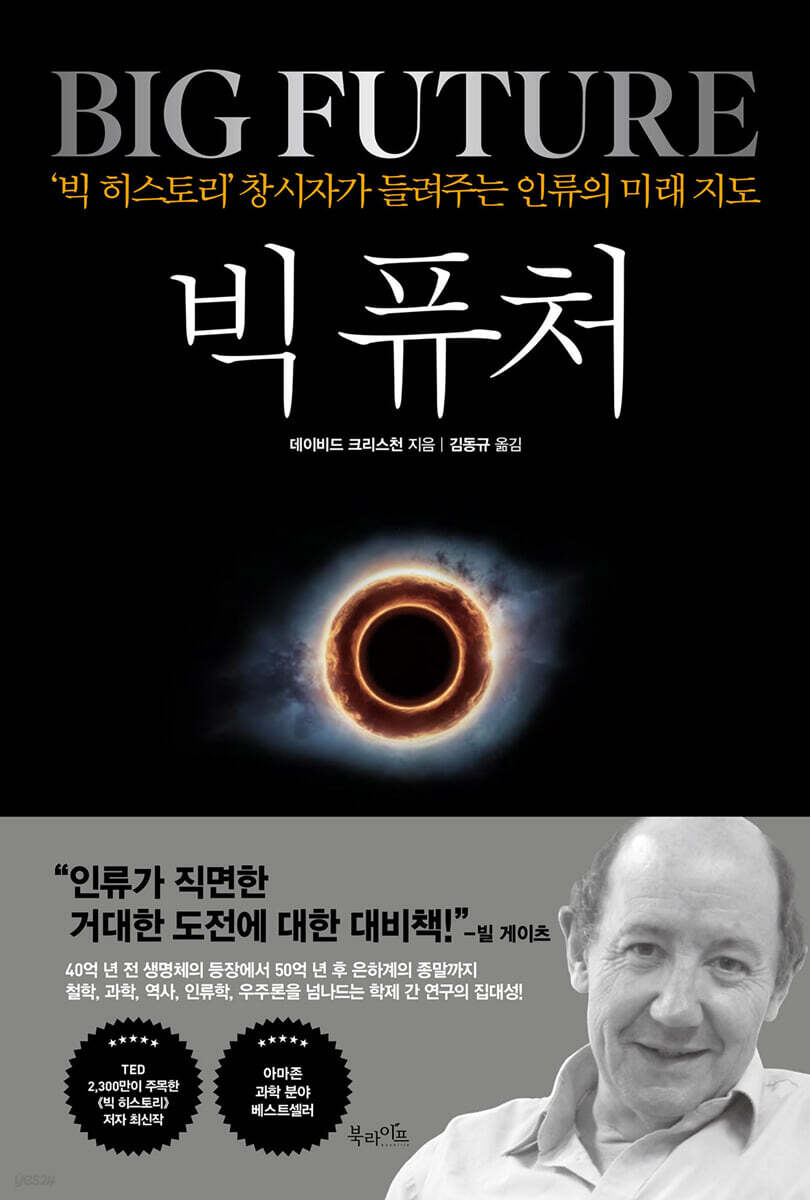 |
Description
Book Introduction
From the emergence of life 4 billion years ago to the end of the galaxy 5 billion years later
A culmination of interdisciplinary research spanning philosophy, science, history, anthropology, and cosmology!
"A Preparatory Measure for the Great Challenges Facing Humanity!" _Bill Gates
David Christian, author of the world-famous work Big History, which covers the 13.8 billion years of history from the beginning of the universe to the present in one unified story.
He now begins a new story with the future as its topic.
Humans are creatures who fear an uncertain future, yet want to glimpse what will unfold.
Because predicting the future is more than just a matter of curiosity; it is essential for survival and growth.
To overcome uncertainty and prepare for tomorrow, humanity has constantly created stories about the future.
"The Big Future" is a history of thinking about the future, tracing how humanity has imagined and prepared for the future from Homo sapiens to the present, and can be considered a kind of map of the future, depicting the distant future of 5 billion years from now.
We introduce hypotheses and theories about the future that various philosophers, theologians, anthropologists, and scientists have pondered, and examine the sophisticated future-predicting mechanisms of other living organisms, such as bacteria, plants, and animals.
In addition, we explore future scenarios from various angles regarding the fate of the Earth and the universe over the next 100 to tens of billions of years.
To anticipate and avoid the existential catastrophes that individuals and societies might face, humanity has devised various ways of thinking about the future.
From divination, sorcery, and oracles to gambling, probability, and eschatology, these are examples of tools and principles for understanding humanity and nature and creating the future you desire.
Every living thing dreams of its own utopia.
That is, we project our life purpose and hope onto the world to avoid a bad future and attract a good one.
Having experienced the horrors of the pandemic and the possibilities of AI, what utopias and dystopias will unfold before us?
Is this a bright future or a bleak one? Bill Gates praised the book, calling it "a preparatory book for the enormous challenges facing humanity."
How can we imagine and prepare for the future ahead, including climate change, interstellar travel, transhumans, the end of the galaxy, and the final black hole, through the lens of the past?
A culmination of interdisciplinary research spanning philosophy, science, history, anthropology, and cosmology!
"A Preparatory Measure for the Great Challenges Facing Humanity!" _Bill Gates
David Christian, author of the world-famous work Big History, which covers the 13.8 billion years of history from the beginning of the universe to the present in one unified story.
He now begins a new story with the future as its topic.
Humans are creatures who fear an uncertain future, yet want to glimpse what will unfold.
Because predicting the future is more than just a matter of curiosity; it is essential for survival and growth.
To overcome uncertainty and prepare for tomorrow, humanity has constantly created stories about the future.
"The Big Future" is a history of thinking about the future, tracing how humanity has imagined and prepared for the future from Homo sapiens to the present, and can be considered a kind of map of the future, depicting the distant future of 5 billion years from now.
We introduce hypotheses and theories about the future that various philosophers, theologians, anthropologists, and scientists have pondered, and examine the sophisticated future-predicting mechanisms of other living organisms, such as bacteria, plants, and animals.
In addition, we explore future scenarios from various angles regarding the fate of the Earth and the universe over the next 100 to tens of billions of years.
To anticipate and avoid the existential catastrophes that individuals and societies might face, humanity has devised various ways of thinking about the future.
From divination, sorcery, and oracles to gambling, probability, and eschatology, these are examples of tools and principles for understanding humanity and nature and creating the future you desire.
Every living thing dreams of its own utopia.
That is, we project our life purpose and hope onto the world to avoid a bad future and attract a good one.
Having experienced the horrors of the pandemic and the possibilities of AI, what utopias and dystopias will unfold before us?
Is this a bright future or a bleak one? Bill Gates praised the book, calling it "a preparatory book for the enormous challenges facing humanity."
How can we imagine and prepare for the future ahead, including climate change, interstellar travel, transhumans, the end of the galaxy, and the final black hole, through the lens of the past?
- You can preview some of the book's contents.
Preview
index
Opening remarks
Part 1: How to Think About the Future
Chapter 1 What is the future?
Two Ways of Understanding Time | Determinism, Causality, and the Arrow of Time
Chapter 2: Predicting the Future
Everything is relative | The origins of the future | How to predict the future | A map of the hypothetical future
Part 2: How to Manage the Future
Chapter 3: Future Management of Cells
The Private Lives of Microbes | How Does E. coli Plan for the Future?
Chapter 4: Future Management of Plants and Animals
Challenges Facing Multicellular Life | Cooperation: The Secret to Mega-Life Survival | Plants, Too, Gather Information and Surrender to Probability | How Animal Nervous Systems and Brains Work
Part 3: How to Prepare for the Future
Chapter 5: Tools of Mankind
The Human Brain | The Revolution of Language and Group Learning | A Brief History of Time | Future Thinking in the Foundational Age
Chapter 6: Divination, Sorcery, and Oracles
Future Thinking in the Agricultural Age | Future Thinking in Power | Future Thinking in the People | 92 Questions and Answers
Chapter 7 Technology, Probability, and Data
Modern Futures Thinking | The World Created by Science | The Usefulness of Futurology
Part 4: How to Imagine the Future
Chapter 8: Earth 100 Years Later
The Fate of Complex Systems | Step 1: What Future Do We Want? | Step 2: Which Future Seems Most Likely? | Four Future Scenarios | Step 3: What Action Should We Take?
Chapter 9: The Future of Humanity
The Mid-Future: Neither Near nor Far | Humanity and Earth 1,000 Years From Now | Four Future Scenarios | The Emergence of a New Human Race
Chapter 10: The Future of the Universe
The End of an Epic | The Fate of Planets and Galaxies | The End of Space and Time | The End of the World Through the Eyes of Modern Science
Acknowledgements
Key Terms
main
References
Search
Part 1: How to Think About the Future
Chapter 1 What is the future?
Two Ways of Understanding Time | Determinism, Causality, and the Arrow of Time
Chapter 2: Predicting the Future
Everything is relative | The origins of the future | How to predict the future | A map of the hypothetical future
Part 2: How to Manage the Future
Chapter 3: Future Management of Cells
The Private Lives of Microbes | How Does E. coli Plan for the Future?
Chapter 4: Future Management of Plants and Animals
Challenges Facing Multicellular Life | Cooperation: The Secret to Mega-Life Survival | Plants, Too, Gather Information and Surrender to Probability | How Animal Nervous Systems and Brains Work
Part 3: How to Prepare for the Future
Chapter 5: Tools of Mankind
The Human Brain | The Revolution of Language and Group Learning | A Brief History of Time | Future Thinking in the Foundational Age
Chapter 6: Divination, Sorcery, and Oracles
Future Thinking in the Agricultural Age | Future Thinking in Power | Future Thinking in the People | 92 Questions and Answers
Chapter 7 Technology, Probability, and Data
Modern Futures Thinking | The World Created by Science | The Usefulness of Futurology
Part 4: How to Imagine the Future
Chapter 8: Earth 100 Years Later
The Fate of Complex Systems | Step 1: What Future Do We Want? | Step 2: Which Future Seems Most Likely? | Four Future Scenarios | Step 3: What Action Should We Take?
Chapter 9: The Future of Humanity
The Mid-Future: Neither Near nor Far | Humanity and Earth 1,000 Years From Now | Four Future Scenarios | The Emergence of a New Human Race
Chapter 10: The Future of the Universe
The End of an Epic | The Fate of Planets and Galaxies | The End of Space and Time | The End of the World Through the Eyes of Modern Science
Acknowledgements
Key Terms
main
References
Search
Detailed image

Into the book
Opening the creaking door of a dilapidated house sends chills down my spine.
You never know what might come up.
Every moment we open a door to the future.
What lies beyond that door? How can we prepare for the unknown, which, as the Apostle Paul said, we see "but through a glass, darkly"? This book explores the dark side of time, the dark side we have yet to experience.
In this book, we will explore how to imagine and prepare for what lies hidden in the unfamiliar realm we call the "future."
--- p.6 "Introduction"
Looking at you or your nearest Venus flytrap through the eyes of an E. coli bacterium would be like looking at the Burj Khalifa building in Dubai through the eyes of an ant on the steps of the building.
Cells are so small that they cannot even be observed with the naked eye.
Yet, they too seem to be struggling to find a future, and in the process, to find a balance between accuracy and universality.
Despite their small size, they must be quite adept at future thinking.
If not, how could I have survived all these years?
How on earth can they fit such a vast amount of future thinking into such a small body?
--- p.99 "Chapter 3: Future Management of Cells"
All organisms, including plants, appear to use their internal biological clocks to anticipate possible changes in the external world.
The cycle of day and night on Earth is incredibly important because it underlies countless cycles, from temperature fluctuations to predator behavior.
The eyes of coral reef-dwelling damselfish and other fish take a whopping 20 minutes to adjust to sunlight.
So the fish's biological clock says about 20 minutes before dawn:
“It may seem like a dark night now, but it will be daylight in about 20 minutes, and once daylight comes, there is a very high chance that a ferocious fish will come to eat me, so I’d better wake up right now!”
--- p.133~134 "Chapter 4: Future Management of Plants and Animals"
The sheer scale of innovation has created an unprecedented collective hubris in modern thinking about the future.
The modern concept of "progress" has led us to believe that we can remake the Earth for our own purposes, and the immense wealth created by modern technology has only served to lend further credence to that notion.
Today, for the first time in human history, the majority of the population no longer needs to fight fiercely for survival.
But on the other hand, it has also become clear that the new powers we have acquired have dangerous and unpredictable side effects that could lead to the destruction of humanity.
As human power has grown so powerful, the fate of the entire planet and its countless inhabitants has become increasingly central to our future thinking.
--- p.238 "Chapter 7: Technology, Probability, and Data"
Because the future 100 years from now is so important, it becomes a political issue.
For the first time in human history, we face global challenges that cannot be solved by nations or individuals alone: climate change, the threat of nuclear war, new pandemics.
Addressing these challenges will require global cooperation.
What we are trying to control is not a small raft with our individual futures at stake, but a planet-sized spaceship containing billions of humans from over 200 countries, as well as millions of other plants, animals, and bacteria.
--- p.286 "Chapter 8: Earth 100 Years Later"
A crucial question in artificial intelligence research is whether we will be able to control machines when their intelligence surpasses that of humans.
A terrifying scenario is one where intelligent robots rise up and enslave or exterminate our descendants.
Moreover, it could be a path to existential disaster, as Toby Odd predicted.
The British novelist Samuel Butler said this as early as 1863:
“We are creating our successors.
“There will come a day when machines will look at humans in the same way humans look at horses and dogs.”
--- p.345 "Chapter 9: The Future of Humanity"
In 3 or 4 billion years, a much hotter sun will evaporate the oceans that are home to life on Earth.
Solar radiation will split water molecules on Earth into hydrogen and oxygen atoms.
Light hydrogen atoms would fly off into space, but oxygen atoms would combine with iron and sink, leaving the Earth rusting like an abandoned shipwreck.
When the surface temperature reaches 1,000 degrees Celsius, the rock will melt like a clock in a Salvador Dali painting.
Even the most resilient life forms will be wiped out, leaving Earth looking like a harsh, barren planet like Venus.
You never know what might come up.
Every moment we open a door to the future.
What lies beyond that door? How can we prepare for the unknown, which, as the Apostle Paul said, we see "but through a glass, darkly"? This book explores the dark side of time, the dark side we have yet to experience.
In this book, we will explore how to imagine and prepare for what lies hidden in the unfamiliar realm we call the "future."
--- p.6 "Introduction"
Looking at you or your nearest Venus flytrap through the eyes of an E. coli bacterium would be like looking at the Burj Khalifa building in Dubai through the eyes of an ant on the steps of the building.
Cells are so small that they cannot even be observed with the naked eye.
Yet, they too seem to be struggling to find a future, and in the process, to find a balance between accuracy and universality.
Despite their small size, they must be quite adept at future thinking.
If not, how could I have survived all these years?
How on earth can they fit such a vast amount of future thinking into such a small body?
--- p.99 "Chapter 3: Future Management of Cells"
All organisms, including plants, appear to use their internal biological clocks to anticipate possible changes in the external world.
The cycle of day and night on Earth is incredibly important because it underlies countless cycles, from temperature fluctuations to predator behavior.
The eyes of coral reef-dwelling damselfish and other fish take a whopping 20 minutes to adjust to sunlight.
So the fish's biological clock says about 20 minutes before dawn:
“It may seem like a dark night now, but it will be daylight in about 20 minutes, and once daylight comes, there is a very high chance that a ferocious fish will come to eat me, so I’d better wake up right now!”
--- p.133~134 "Chapter 4: Future Management of Plants and Animals"
The sheer scale of innovation has created an unprecedented collective hubris in modern thinking about the future.
The modern concept of "progress" has led us to believe that we can remake the Earth for our own purposes, and the immense wealth created by modern technology has only served to lend further credence to that notion.
Today, for the first time in human history, the majority of the population no longer needs to fight fiercely for survival.
But on the other hand, it has also become clear that the new powers we have acquired have dangerous and unpredictable side effects that could lead to the destruction of humanity.
As human power has grown so powerful, the fate of the entire planet and its countless inhabitants has become increasingly central to our future thinking.
--- p.238 "Chapter 7: Technology, Probability, and Data"
Because the future 100 years from now is so important, it becomes a political issue.
For the first time in human history, we face global challenges that cannot be solved by nations or individuals alone: climate change, the threat of nuclear war, new pandemics.
Addressing these challenges will require global cooperation.
What we are trying to control is not a small raft with our individual futures at stake, but a planet-sized spaceship containing billions of humans from over 200 countries, as well as millions of other plants, animals, and bacteria.
--- p.286 "Chapter 8: Earth 100 Years Later"
A crucial question in artificial intelligence research is whether we will be able to control machines when their intelligence surpasses that of humans.
A terrifying scenario is one where intelligent robots rise up and enslave or exterminate our descendants.
Moreover, it could be a path to existential disaster, as Toby Odd predicted.
The British novelist Samuel Butler said this as early as 1863:
“We are creating our successors.
“There will come a day when machines will look at humans in the same way humans look at horses and dogs.”
--- p.345 "Chapter 9: The Future of Humanity"
In 3 or 4 billion years, a much hotter sun will evaporate the oceans that are home to life on Earth.
Solar radiation will split water molecules on Earth into hydrogen and oxygen atoms.
Light hydrogen atoms would fly off into space, but oxygen atoms would combine with iron and sink, leaving the Earth rusting like an abandoned shipwreck.
When the surface temperature reaches 1,000 degrees Celsius, the rock will melt like a clock in a Salvador Dali painting.
Even the most resilient life forms will be wiped out, leaving Earth looking like a harsh, barren planet like Venus.
--- p.371 "Chapter 10: The Future of the Universe"
Publisher's Review
★★★ The latest work from the author of "Big History," which attracted 23 million TED viewers.
★★★ Amazon Science Bestseller
How has humanity imagined and prepared for the future?
And what kind of future will unfold for Earth and the universe?
A humanist of the century who composed a long period of 13.8 billion years into a single integrated story.
David Christian's future story unfolds!
Humanity's time has always been with the future.
Early humans had to anticipate the many variables that could arise when hunting for food, and modern humans have to calculate the likelihood of being hit by an oncoming truck while crossing the street.
Most of what we think about in our daily lives—whether it's weather forecasts, stock market forecasts, or retirement planning—is actually about the future.
Although uncertain, it is a matter directly related to survival and happiness, so predicting the future and preparing for it are essential elements of life.
By worrying, striving, and hoping, we open the door to the future at every moment.
David Christian, who covered the long history of the universe from its birth to the present in his previous work, Big History, turns his gaze to the future in this new work.
To understand not only our thoughts on the future of humanity but also the sophisticated predictive mechanisms of bacteria, plants, and animals, we travel back in time to the first appearance of life on Earth, 4 billion years ago.
And by tracing humanity's footsteps in uncovering the mysteries of time and the future through interdisciplinary research in philosophy, anthropology, physics, and biology, it provides a blueprint for the future to come.
This book is divided into four parts.
Part 1 explores how to think about the future through the hypotheses and theories of philosophers, scientists, theologians, and anthropologists.
It presents practical challenges that arise when confronting future issues, along with discussions about the definitions of the future and time.
Part 2, on the topic of how to manage the future, explains the biological and neuroscientific mechanisms that cells, plants, and animals use to predict and plan for the future.
Part 3 divides human history into three major periods and explores the various tools and strategies humans have devised to prepare for the future.
Part 4 imagines what Earth and humanity will be like in the next 100 or even thousands of years, and depicts the fate of the universe 5 billion years from now.
From the origins of the future to the philosophy of time
A culmination of interdisciplinary research spanning history, philosophy, science, and anthropology.
The most central concepts in futurology are time and the future, but understanding them properly is not easy.
The author approaches the question through two metaphors rooted in ancient philosophy.
For Heraclitus, who imagined a world in constant change, time is like a river that flows and changes constantly.
For Parmenides, on the other hand, change is merely an illusion, and time is depicted as a continuum spread out like a map.
Humans are beings who, while living in a time surrounded by turmoil and darkness, long to know the future through the map of time.
Drawing on philosophies and theories spanning time, from the Indian scripture Bhagavad Gita to Augustine and Einstein, the author explains the most fundamental principles applicable to future thinking.
That is, although there is no evidence about the future, there are strong hints about the future that can be found in the past.
'Trend analysis', which seeks overall trends and patterns rather than seeking certainty, is the primary strategy for all living things, including humans.
There is no single 'possible' future, and finding an optimal point somewhere between universality and precision is a challenging task for all living things.
From single-celled organisms to the future of plants, animals, and humans
Tools and Strategies to Manage and Prepare for Uncertainty
Predicting the future is not exclusive to humans.
Even single-celled organisms like bacteria plan and manage the future through past trends.
Guys also learn from their mistakes, remember what happened a little while ago, and skillfully calculate probabilities.
For example, E. coli has an algorithm that tells it to stop producing lactose-processing enzymes when lactose is scarce, and it can combine information from numerous sensors to accurately measure trends in chemical concentrations.
Plants also gather information and rely on probabilities.
The carnivorous Venus flytrap uses short-term memory to decide whether to activate its trap, and the biennial Arabidopsis uses long-term memory to detect temperature trends and then bloom.
Animals, due to their developed nervous systems and brains, are able to think about the future at a more conscious level, reasoning and building models of the future through memory and learning.
In particular, humans have profound changes and diverse aspects in their perception of the future due to two factors: language and collective learning.
David Christian divides human history into three major periods and deeply analyzes the characteristics and differences in future thinking.
The first is the basal era, which lasted from about 10,000 years ago after the emergence of Homo sapiens; the second is the agricultural era, which lasted from about 200 years ago; and the last is the modern era.
The transition from the primitive to the agricultural age brought about a major change in our perception of the future.
Agriculture has strengthened human control over the environment and the future, the expansion of exchange networks following population growth has increased the importance of 'social time,' and the acceleration of change has increased the dynamism of time, making the future increasingly difficult to predict.
As cities and states emerged and a hierarchical society dominated by a small elite formed, divination and sorcery gained popularity and conflicts between different perspectives on the future intensified.
In modern times, globalization driven by technological and scientific innovations has completely changed the concept of time and the future.
Traditional rhythms of life have been pushed aside, and the world has begun to synchronize its lives and thinking to a single, global time zone.
The place occupied by fortune telling was replaced by a mechanical worldview.
Advances in causality, probability, data collection and statistics, and computer and information technology have led to a proliferation of accurate and measurable predictions across all sectors of society.
In a few centuries, which is only about one-thousandth of the entire time span of human evolution, more dramatic changes have taken place than in any other era.
Drawing the future of Earth, humanity, and the universe
David Christian traces the epic story of human evolution and future thinking from the emergence of life on Earth 4 billion years ago to the present, expanding his perspective to the future of Earth, humanity, and the universe.
We imagine the fate of planets, humans, and galaxies through various cosmological hypotheses, proven theories, and possible future scenarios.
How will the Earth look in 100 years? A century is a relatively short period of time, and trends can be roughly predicted.
This period, when our closest descendants are still alive, will inevitably change depending on what we do now.
The author asks what choices humanity will make amidst the various optimisms and pessimisms surrounding the environment, ecology, technology, economy, and politics.
And it depicts what will happen in the near future in four scenarios: ‘collapse,’ ‘reduction,’ ‘sustainability,’ and ‘growth.’
The author calls the future, neither near nor far, thousands or millions of years from now, the 'middle future.'
What key technologies will emerge in the next 1,000 years? Will interstellar migration be possible? How will humans evolve? Can intelligent lifeforms enhanced by transhumanism and adapted to new environments still be called human?
What will Earth and the universe be like in the distant future, hundreds of millions of years from now? In 200 million years, Earth's scattered continental fragments will converge to form a supercontinent.
In a billion years, the increasing heat emitted by the Sun will bring disaster to the plants and animals of Earth, and in 5 billion years, the Sun will slowly die.
Our Milky Way galaxy will merge with Andromeda galaxy, and eventually all the galaxies in our Local Group will merge to form a giant supergalaxy.
What will the end of everything be like?
This erudite and engaging study draws on research and lucid explanations of science, philosophy, and history to produce a provocative outlook for the future.
_ Publisher's Weekly
A book full of fascinating journeys and fascinating insights.
_ New Scientist
★★★ Amazon Science Bestseller
How has humanity imagined and prepared for the future?
And what kind of future will unfold for Earth and the universe?
A humanist of the century who composed a long period of 13.8 billion years into a single integrated story.
David Christian's future story unfolds!
Humanity's time has always been with the future.
Early humans had to anticipate the many variables that could arise when hunting for food, and modern humans have to calculate the likelihood of being hit by an oncoming truck while crossing the street.
Most of what we think about in our daily lives—whether it's weather forecasts, stock market forecasts, or retirement planning—is actually about the future.
Although uncertain, it is a matter directly related to survival and happiness, so predicting the future and preparing for it are essential elements of life.
By worrying, striving, and hoping, we open the door to the future at every moment.
David Christian, who covered the long history of the universe from its birth to the present in his previous work, Big History, turns his gaze to the future in this new work.
To understand not only our thoughts on the future of humanity but also the sophisticated predictive mechanisms of bacteria, plants, and animals, we travel back in time to the first appearance of life on Earth, 4 billion years ago.
And by tracing humanity's footsteps in uncovering the mysteries of time and the future through interdisciplinary research in philosophy, anthropology, physics, and biology, it provides a blueprint for the future to come.
This book is divided into four parts.
Part 1 explores how to think about the future through the hypotheses and theories of philosophers, scientists, theologians, and anthropologists.
It presents practical challenges that arise when confronting future issues, along with discussions about the definitions of the future and time.
Part 2, on the topic of how to manage the future, explains the biological and neuroscientific mechanisms that cells, plants, and animals use to predict and plan for the future.
Part 3 divides human history into three major periods and explores the various tools and strategies humans have devised to prepare for the future.
Part 4 imagines what Earth and humanity will be like in the next 100 or even thousands of years, and depicts the fate of the universe 5 billion years from now.
From the origins of the future to the philosophy of time
A culmination of interdisciplinary research spanning history, philosophy, science, and anthropology.
The most central concepts in futurology are time and the future, but understanding them properly is not easy.
The author approaches the question through two metaphors rooted in ancient philosophy.
For Heraclitus, who imagined a world in constant change, time is like a river that flows and changes constantly.
For Parmenides, on the other hand, change is merely an illusion, and time is depicted as a continuum spread out like a map.
Humans are beings who, while living in a time surrounded by turmoil and darkness, long to know the future through the map of time.
Drawing on philosophies and theories spanning time, from the Indian scripture Bhagavad Gita to Augustine and Einstein, the author explains the most fundamental principles applicable to future thinking.
That is, although there is no evidence about the future, there are strong hints about the future that can be found in the past.
'Trend analysis', which seeks overall trends and patterns rather than seeking certainty, is the primary strategy for all living things, including humans.
There is no single 'possible' future, and finding an optimal point somewhere between universality and precision is a challenging task for all living things.
From single-celled organisms to the future of plants, animals, and humans
Tools and Strategies to Manage and Prepare for Uncertainty
Predicting the future is not exclusive to humans.
Even single-celled organisms like bacteria plan and manage the future through past trends.
Guys also learn from their mistakes, remember what happened a little while ago, and skillfully calculate probabilities.
For example, E. coli has an algorithm that tells it to stop producing lactose-processing enzymes when lactose is scarce, and it can combine information from numerous sensors to accurately measure trends in chemical concentrations.
Plants also gather information and rely on probabilities.
The carnivorous Venus flytrap uses short-term memory to decide whether to activate its trap, and the biennial Arabidopsis uses long-term memory to detect temperature trends and then bloom.
Animals, due to their developed nervous systems and brains, are able to think about the future at a more conscious level, reasoning and building models of the future through memory and learning.
In particular, humans have profound changes and diverse aspects in their perception of the future due to two factors: language and collective learning.
David Christian divides human history into three major periods and deeply analyzes the characteristics and differences in future thinking.
The first is the basal era, which lasted from about 10,000 years ago after the emergence of Homo sapiens; the second is the agricultural era, which lasted from about 200 years ago; and the last is the modern era.
The transition from the primitive to the agricultural age brought about a major change in our perception of the future.
Agriculture has strengthened human control over the environment and the future, the expansion of exchange networks following population growth has increased the importance of 'social time,' and the acceleration of change has increased the dynamism of time, making the future increasingly difficult to predict.
As cities and states emerged and a hierarchical society dominated by a small elite formed, divination and sorcery gained popularity and conflicts between different perspectives on the future intensified.
In modern times, globalization driven by technological and scientific innovations has completely changed the concept of time and the future.
Traditional rhythms of life have been pushed aside, and the world has begun to synchronize its lives and thinking to a single, global time zone.
The place occupied by fortune telling was replaced by a mechanical worldview.
Advances in causality, probability, data collection and statistics, and computer and information technology have led to a proliferation of accurate and measurable predictions across all sectors of society.
In a few centuries, which is only about one-thousandth of the entire time span of human evolution, more dramatic changes have taken place than in any other era.
Drawing the future of Earth, humanity, and the universe
David Christian traces the epic story of human evolution and future thinking from the emergence of life on Earth 4 billion years ago to the present, expanding his perspective to the future of Earth, humanity, and the universe.
We imagine the fate of planets, humans, and galaxies through various cosmological hypotheses, proven theories, and possible future scenarios.
How will the Earth look in 100 years? A century is a relatively short period of time, and trends can be roughly predicted.
This period, when our closest descendants are still alive, will inevitably change depending on what we do now.
The author asks what choices humanity will make amidst the various optimisms and pessimisms surrounding the environment, ecology, technology, economy, and politics.
And it depicts what will happen in the near future in four scenarios: ‘collapse,’ ‘reduction,’ ‘sustainability,’ and ‘growth.’
The author calls the future, neither near nor far, thousands or millions of years from now, the 'middle future.'
What key technologies will emerge in the next 1,000 years? Will interstellar migration be possible? How will humans evolve? Can intelligent lifeforms enhanced by transhumanism and adapted to new environments still be called human?
What will Earth and the universe be like in the distant future, hundreds of millions of years from now? In 200 million years, Earth's scattered continental fragments will converge to form a supercontinent.
In a billion years, the increasing heat emitted by the Sun will bring disaster to the plants and animals of Earth, and in 5 billion years, the Sun will slowly die.
Our Milky Way galaxy will merge with Andromeda galaxy, and eventually all the galaxies in our Local Group will merge to form a giant supergalaxy.
What will the end of everything be like?
This erudite and engaging study draws on research and lucid explanations of science, philosophy, and history to produce a provocative outlook for the future.
_ Publisher's Weekly
A book full of fascinating journeys and fascinating insights.
_ New Scientist
GOODS SPECIFICS
- Date of issue: September 15, 2025
- Page count, weight, size: 448 pages | 152*225*30mm
- ISBN13: 9791191013993
- ISBN10: 1191013995
You may also like
카테고리
korean


korean

![ELLE 엘르 스페셜 에디션 A형 : 12월 [2025]](http://librairie.coreenne.fr/cdn/shop/files/b8e27a3de6c9538896439686c6b0e8fb.jpg?v=1766436872&width=3840)


