

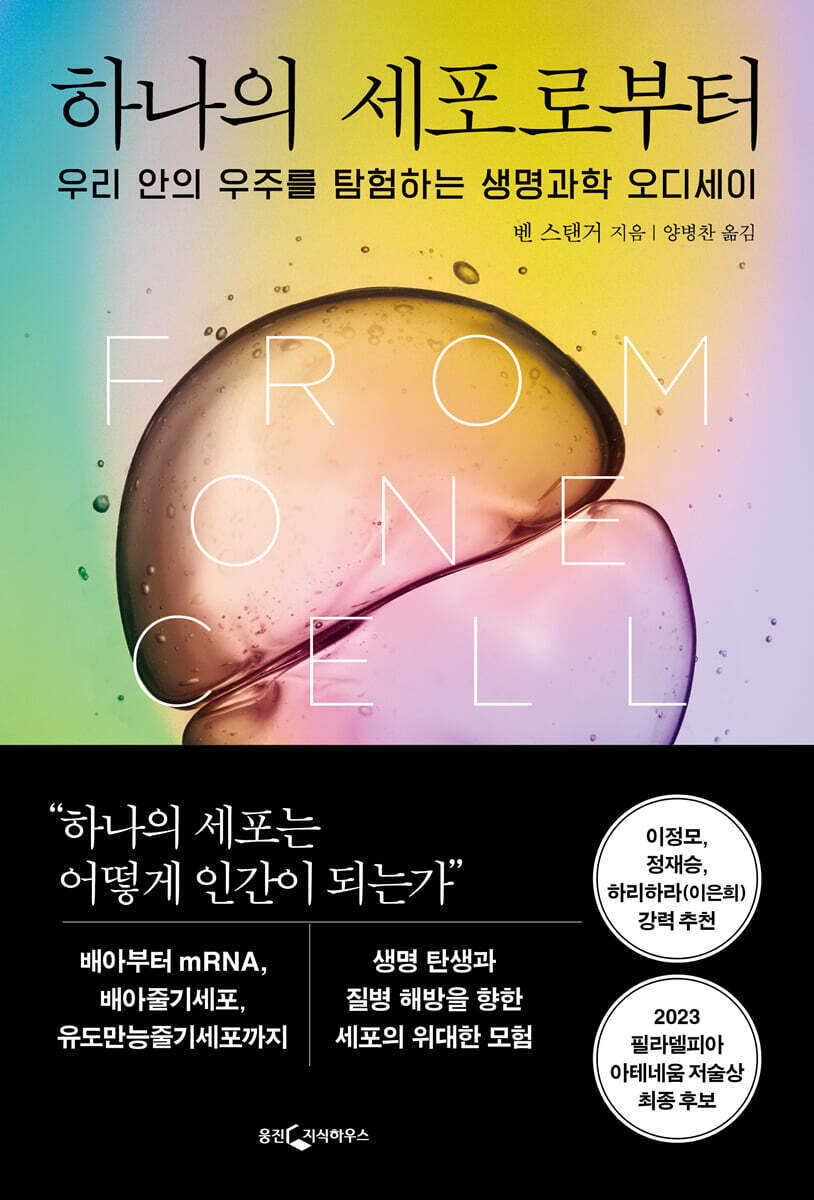
From one cell
 |
Description
Book Introduction
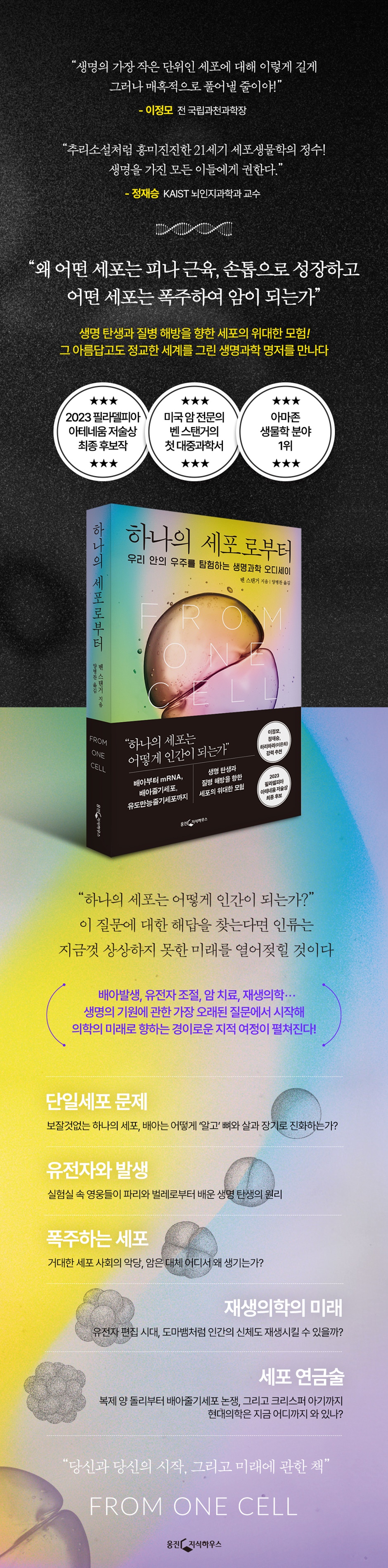
Strongly recommended by Lee Jeong-mo, Jeong Jae-seung, and Harihara (Lee Eun-hee)!
2023 Philadelphia Athenaeum Writing Award Finalist
How a Cell Becomes a Human
From embryos to mRNA, embryonic stem cells, and induced pluripotent stem cells
Starting with the oldest question about the origin of life
A wondrous intellectual journey into the future of medicine
How does an embryo "know" how to develop bones, flesh, and organs on its own?
- The truth about life taught by flies, bugs, and mice in the laboratory
- The Embryo's Evil Doppelganger: Where and Why Does Cancer Occur?
- Why the liver regenerates but the brain does not
- From cloning Dolly the sheep to gene editing, modern medicine's endless challenges
We all started as a single, insignificant cell and grew into an organism made up of trillions of cells.
What power transforms a single cell into such a beautiful and complex life form? Nature's most wondrous and universal phenomenon, "development," has been one of the most fundamental questions science has grappled with for centuries.
If we can find the answer to this question, humanity will surely open up a future we have never imagined before.
From One Cell, the first popular book by renowned American cancer researcher and cell and developmental biologist Ben Stanger, not only chronicles his scientific exploration of embryonic cells and embryonic stem cells, but also the great adventure of modern medicine toward disease freedom and regeneration.
In this book, the author leads us on a grand history of discoveries by laboratory heroes who have traced the origins of life, from embryogenesis to genes, stem cells, and mRNA. He also unfolds cutting-edge issues in modern medicine that we need to know about, such as gene editing, cell dedifferentiation, and regenerative medicine, in a sophisticated and exciting manner, like a detective novel.
If you realized that we all began as a single cell, and that we are the product of countless miracles unfolding even at this very moment, you would surely see the world through different eyes.
2023 Philadelphia Athenaeum Writing Award Finalist
How a Cell Becomes a Human
From embryos to mRNA, embryonic stem cells, and induced pluripotent stem cells
Starting with the oldest question about the origin of life
A wondrous intellectual journey into the future of medicine
How does an embryo "know" how to develop bones, flesh, and organs on its own?
- The truth about life taught by flies, bugs, and mice in the laboratory
- The Embryo's Evil Doppelganger: Where and Why Does Cancer Occur?
- Why the liver regenerates but the brain does not
- From cloning Dolly the sheep to gene editing, modern medicine's endless challenges
We all started as a single, insignificant cell and grew into an organism made up of trillions of cells.
What power transforms a single cell into such a beautiful and complex life form? Nature's most wondrous and universal phenomenon, "development," has been one of the most fundamental questions science has grappled with for centuries.
If we can find the answer to this question, humanity will surely open up a future we have never imagined before.
From One Cell, the first popular book by renowned American cancer researcher and cell and developmental biologist Ben Stanger, not only chronicles his scientific exploration of embryonic cells and embryonic stem cells, but also the great adventure of modern medicine toward disease freedom and regeneration.
In this book, the author leads us on a grand history of discoveries by laboratory heroes who have traced the origins of life, from embryogenesis to genes, stem cells, and mRNA. He also unfolds cutting-edge issues in modern medicine that we need to know about, such as gene editing, cell dedifferentiation, and regenerative medicine, in a sophisticated and exciting manner, like a detective novel.
If you realized that we all began as a single cell, and that we are the product of countless miracles unfolding even at this very moment, you would surely see the world through different eyes.
- You can preview some of the book's contents.
Preview
index
Overture - The Beginning of Life
Chapter 1 The Single-Cell Problem: The Oldest Question About the Origin of Life
Matryoshka dolls | Cells, natural selection, and experimental biology | Embryo halves | Self-rebuilding machines | Formative bodies, transformations that change destiny | American vs. European systems
Chapter 2: The Language of Cells: Reading and Writing Genes
Learning the Language of Genes┃Darwin's Missing Link, Morphogenic Elements┃The White-Eyed Fly of the Fly Room┃The First Genetic Map┃Sulfur-Deficient Substances┃Transgenic Substances
Chapter 3 Cell Society: What Determines Cell Fate?
Members of a Cell Society┃Counting Genes┃In the Cramped Frog Lab┃How to Turn Back the Developmental Clock┃Evidence of That Frog┃Genetic Equivalence and Dolly the Sheep
Chapter 4: Turning Genes On and Off: The Pajama Experiment and the Genetic Code
A Virus Awakened in the Attic | Bacteria Selecting the Order of Their Feeding | The Discovery of mRNA | Inhibiting Gene Regulation | The Principles of Transcription and Translation
Chapter 5: Genes and Development: What Flies and Worms Teach Us
Head, Shoulders, Knees, and Toes | Heidelberg Study | From Flies to Insects | Genealogy and Trajectory of Development | From Mutation to Function
Chapter 6: Finding Your Way: Where, How Far, and How to Go
Milestones of Morphogenesis┃Up and down, outside and inside┃How to change positions┃The force of mutual attraction┃How are tubes formed?┃The mystery of size control┃The moving embryo
The Biology of Ripe Life
Chapter 7 Stem Cells: Another Cell
Nature's Great Experiment┃The Cobalt Bomb That Treats Cancer┃The Science of Analysis┃The Bumpy Spleen┃Another 'One Cell'┃Proliferation from 1 to 1 Million
Chapter 8 Cellular Alchemy: The Potential of Embryonic Stem Cells
Unusual Tumors | The Era of Embryonic Stem Cells | Knockout Mice | From Mice to Humans | The War on Stem Cells | Philosopher's Stone | Cellular Avatars: Induced Pluripotent Stem Cells
Chapter 9: A Cell Runs Wild: The Evolution of Cancer Cells
The Cellular Origins of Cancer | Current State of Cancer Research | Tumors' Neighbors | Embryonic Tissue's Evil Doppelganger
Chapter 10: The Eyes of Eternity and the Toes of the Frog: The Future of Regenerative Medicine
Spinal Cord Injury Patients | Organ Failure and Regeneration | Lost in Space | Rebuilding Organs from Scratch? | Cell-Based Therapy: A Rocky Road | Glimmer of Hope
Chapter 11: Science by Day and Science by Night: The Challenges Remaining
The Complexity of Cellular Memory┃Reconstructing Genes┃Manipulating Humans┃Biological Literacy
Finale - The Question Returns
Acknowledgements
Glossary
main
Search
Chapter 1 The Single-Cell Problem: The Oldest Question About the Origin of Life
Matryoshka dolls | Cells, natural selection, and experimental biology | Embryo halves | Self-rebuilding machines | Formative bodies, transformations that change destiny | American vs. European systems
Chapter 2: The Language of Cells: Reading and Writing Genes
Learning the Language of Genes┃Darwin's Missing Link, Morphogenic Elements┃The White-Eyed Fly of the Fly Room┃The First Genetic Map┃Sulfur-Deficient Substances┃Transgenic Substances
Chapter 3 Cell Society: What Determines Cell Fate?
Members of a Cell Society┃Counting Genes┃In the Cramped Frog Lab┃How to Turn Back the Developmental Clock┃Evidence of That Frog┃Genetic Equivalence and Dolly the Sheep
Chapter 4: Turning Genes On and Off: The Pajama Experiment and the Genetic Code
A Virus Awakened in the Attic | Bacteria Selecting the Order of Their Feeding | The Discovery of mRNA | Inhibiting Gene Regulation | The Principles of Transcription and Translation
Chapter 5: Genes and Development: What Flies and Worms Teach Us
Head, Shoulders, Knees, and Toes | Heidelberg Study | From Flies to Insects | Genealogy and Trajectory of Development | From Mutation to Function
Chapter 6: Finding Your Way: Where, How Far, and How to Go
Milestones of Morphogenesis┃Up and down, outside and inside┃How to change positions┃The force of mutual attraction┃How are tubes formed?┃The mystery of size control┃The moving embryo
The Biology of Ripe Life
Chapter 7 Stem Cells: Another Cell
Nature's Great Experiment┃The Cobalt Bomb That Treats Cancer┃The Science of Analysis┃The Bumpy Spleen┃Another 'One Cell'┃Proliferation from 1 to 1 Million
Chapter 8 Cellular Alchemy: The Potential of Embryonic Stem Cells
Unusual Tumors | The Era of Embryonic Stem Cells | Knockout Mice | From Mice to Humans | The War on Stem Cells | Philosopher's Stone | Cellular Avatars: Induced Pluripotent Stem Cells
Chapter 9: A Cell Runs Wild: The Evolution of Cancer Cells
The Cellular Origins of Cancer | Current State of Cancer Research | Tumors' Neighbors | Embryonic Tissue's Evil Doppelganger
Chapter 10: The Eyes of Eternity and the Toes of the Frog: The Future of Regenerative Medicine
Spinal Cord Injury Patients | Organ Failure and Regeneration | Lost in Space | Rebuilding Organs from Scratch? | Cell-Based Therapy: A Rocky Road | Glimmer of Hope
Chapter 11: Science by Day and Science by Night: The Challenges Remaining
The Complexity of Cellular Memory┃Reconstructing Genes┃Manipulating Humans┃Biological Literacy
Finale - The Question Returns
Acknowledgements
Glossary
main
Search
Detailed image
Into the book
The fundamental truth about our origins is that all animals on Earth begin life from a single cell.
But how can all the information needed to create something so complex be compressed into something so simple? How do the trillions of cells created from this unique unit each know what to become and where to go? Could a better understanding of the embryo's past lead to a healthier future? "From One Cell" is an effort to answer these questions.
This book is about a discourse that has been repeated countless times: how a single cell grows into a mature organism.
--- From "Overture"
How can this remarkable development occur so seamlessly and reproducibly? How do cells know how to specialize, when to divide, where to go, and what to do? Is development primarily controlled by our genes, or by our environment? As each new generation repeats this precarious developmental process, how can each species so reliably limit the errors that could lead to extinction? And most astonishing of all, how can a single cell produce a fully formed animal, complete with the capacities of movement, respiration, digestion, sensation, and reason? Let's call this puzzle the "single-cell problem."
--- From "The Single Cell Problem"
Between 1856 and 1863, Mendel examined some 30,000 plant species, scoring their visible phenotypes and looking for patterns.
It was a ridiculously huge amount of work, but the effort paid off.
Across all the phenotype frequencies he observed, one surprising relationship emerged.
In the second generation of purebred crosses, a strangely reproducible ratio of '3 to 1' appeared.
For every short plant there were three tall plants, and for every white-flowering plant there were three purple-flowering plants.
Whether a tall plant produces white flowers or purple flowers, each trait is inherited independently, creating a fascinating 3 to 1 ratio.
It was the mathematical precision he was seeking, the universal logic of heredity.
The remaining task was to understand it.
--- From "The Language of Cells"
If we compare embryonic development to a play, the genome is the script and the cells are the actors and staff.
Before production begins, everyone involved—actors, production staff, designers, directors—receives a complete copy of the script and visualize every moment that will occur on stage.
(Omitted) Likewise, each developing cell receives a complete copy of the script, the genome, and carries it with it throughout its life.
Cells learn their roles, highlighting specific parts of the genome text and leaving notes in the margins.
This is the essence of gene regulation.
Each cell indicates in its genome which metabolisms to focus on and which to ignore.
Through continuous rehearsal throughout embryonic development, important metabolisms are reinforced and less important metabolisms are suppressed.
--- From "Turning Genes On and Off"
By the 1990s, the fields of developmental biology, genetics, molecular biology, and evolutionary biology had essentially integrated.
Scientists in each field used different tools, but they all had something to learn about the single-cell problem.
By applying genetic approaches to worms and flies, they arrived at a partial answer: a limited number of gene products, including transcription factors, soluble proteins, intracellular signaling molecules, and noncoding RNAs, play a role in body composition.
It didn't matter what kind of creature it was, whether it was a fish, a dinosaur, or an orangutan.
Nature, in its thriftiness, repeatedly reuses the same design principles in development, and the genetic programs underlying this replication and editing date back to organisms much older than even C. elegans and fruit flies.
--- From "Genes and Development"
Instead of ignoring the lumpy spleen, McCullough doubled down on his focus.
After completing the autopsies and carefully recording the number of nodules on each mouse, I opened my lab notebook, where I had recorded the injections, and compared the number of nodules I had just counted with the list of cells Thiel had injected.
Then a clear pattern emerged suggesting a near-perfect correlation.
The more bone marrow cells Thiel injected, the more tumors appeared.
He didn't know what this meant, but the trend was too obvious to be just a coincidence.
The next morning, McCullough entered OCI waving a piece of paper with a graph drawn on it.
After confessing that he had unintentionally ended the experiment early, he explained his observations and conclusions to Thiel.
The physicist also had to agree that the surprising correlation was no coincidence.
Now it was Till's turn to bring his physics background into play.
He recalled Jacobson's wartime experiments, in which a Manhattan Project doctor saved mice from radiation poisoning by protecting their spleens.
What if this oblong organ of unknown purpose were a factory, each nodule producing new blood cells?
--- From "Stem Cells"
It was clear that some combination of transcription factors had turned back the clock on development.
But what exactly was it? Did all 24 genes need to be present, or could only some be achieved? Through trial and error, Takahashi narrowed the list down to four genes.
When these four genes, now called "Yamanaka factors," were expressed in fibroblasts, the cells not only looked like ESCs, but also expressed all ESC genes, and when injected into the flanks of mice, they formed teratomas.
Most importantly, the offspring were integrated into all embryonic tissues after being injected into mouse blastocysts.
The engineered cells appeared identical to embryonic stem cells in every way, except that they were not derived from embryos.
To emphasize this fact and avoid the controversy that has plagued the human ESC field, the researchers named this cell regeneration process "induced pluripotency" and the resulting protocol "induced pluripotent stem cells" (iPSCs).
--- From "Cellular Alchemy"
Biologists have long recognized similarities between tumors and embryos, and Boveri introduced the idea that genetic differences distinguish the two.
The war on cancer (if "war" is an appropriate metaphor) began without precision weapons—surgery, radiation, toxic chemicals—to remove or neutralize tumors. But in the late 20th century, oncologists began to develop targeted therapies—medical smart bombs—that focused on tumors' unique biochemical vulnerabilities, relying increasingly on the molecular and genetic information of tumor cells.
And we have now reached the third stage of the ongoing biomedical conflict against cancer, the core of which is recognizing tumors not as "aggregates of cancer cells" but as "evil doppelgangers of embryonic tissue."
--- From "One Cell"
To address these issues, some scientists have considered using the alchemical phenomenon of "cell reprogramming," which gave rise to iPSC technology, to transform undesirable cells (such as scar-forming fibroblasts) into more desirable ones (such as liver cells, cardiomyocytes, or neurons).
This is an approach that requires significant technological innovation, as it requires the direct introduction of reprogramming factors into the patient's tissues.
However, if this method is successful, it could partially circumvent the two problems of 'three-dimensionality' and 'integration' by dedifferentiating cells in the necessary area.
Because the newly created cells will already be there.
This and other different approaches have been tested hundreds of times in cells, animals, and people, with mixed results so far.
--- From "The Eyes of Eternity and the Frog's Toes"
Discoveries in epigenetic regulation and gene editing are progressing at a pace that even practitioners are having difficulty keeping up with.
Because there are few opportunities to weigh the pros and cons across society, for the time being, standards in the scientific community are being established through specialized organizations such as the International Society for Stem Cell Research and the World Health Organization.
(Omitted) All technologies require a process of weighing (ethical, financial, and medical) risks and benefits, a task that is becoming increasingly difficult in the age of information overload.
As scientists working in various subfields of biology struggle to keep up with advances in their own fields, it becomes increasingly difficult for the broader society to assimilate new knowledge and apply it to everyday life.
But such a process is absolutely necessary to reach agreement on how to use the technology.
Biological literacy has become more important than ever.
But how can all the information needed to create something so complex be compressed into something so simple? How do the trillions of cells created from this unique unit each know what to become and where to go? Could a better understanding of the embryo's past lead to a healthier future? "From One Cell" is an effort to answer these questions.
This book is about a discourse that has been repeated countless times: how a single cell grows into a mature organism.
--- From "Overture"
How can this remarkable development occur so seamlessly and reproducibly? How do cells know how to specialize, when to divide, where to go, and what to do? Is development primarily controlled by our genes, or by our environment? As each new generation repeats this precarious developmental process, how can each species so reliably limit the errors that could lead to extinction? And most astonishing of all, how can a single cell produce a fully formed animal, complete with the capacities of movement, respiration, digestion, sensation, and reason? Let's call this puzzle the "single-cell problem."
--- From "The Single Cell Problem"
Between 1856 and 1863, Mendel examined some 30,000 plant species, scoring their visible phenotypes and looking for patterns.
It was a ridiculously huge amount of work, but the effort paid off.
Across all the phenotype frequencies he observed, one surprising relationship emerged.
In the second generation of purebred crosses, a strangely reproducible ratio of '3 to 1' appeared.
For every short plant there were three tall plants, and for every white-flowering plant there were three purple-flowering plants.
Whether a tall plant produces white flowers or purple flowers, each trait is inherited independently, creating a fascinating 3 to 1 ratio.
It was the mathematical precision he was seeking, the universal logic of heredity.
The remaining task was to understand it.
--- From "The Language of Cells"
If we compare embryonic development to a play, the genome is the script and the cells are the actors and staff.
Before production begins, everyone involved—actors, production staff, designers, directors—receives a complete copy of the script and visualize every moment that will occur on stage.
(Omitted) Likewise, each developing cell receives a complete copy of the script, the genome, and carries it with it throughout its life.
Cells learn their roles, highlighting specific parts of the genome text and leaving notes in the margins.
This is the essence of gene regulation.
Each cell indicates in its genome which metabolisms to focus on and which to ignore.
Through continuous rehearsal throughout embryonic development, important metabolisms are reinforced and less important metabolisms are suppressed.
--- From "Turning Genes On and Off"
By the 1990s, the fields of developmental biology, genetics, molecular biology, and evolutionary biology had essentially integrated.
Scientists in each field used different tools, but they all had something to learn about the single-cell problem.
By applying genetic approaches to worms and flies, they arrived at a partial answer: a limited number of gene products, including transcription factors, soluble proteins, intracellular signaling molecules, and noncoding RNAs, play a role in body composition.
It didn't matter what kind of creature it was, whether it was a fish, a dinosaur, or an orangutan.
Nature, in its thriftiness, repeatedly reuses the same design principles in development, and the genetic programs underlying this replication and editing date back to organisms much older than even C. elegans and fruit flies.
--- From "Genes and Development"
Instead of ignoring the lumpy spleen, McCullough doubled down on his focus.
After completing the autopsies and carefully recording the number of nodules on each mouse, I opened my lab notebook, where I had recorded the injections, and compared the number of nodules I had just counted with the list of cells Thiel had injected.
Then a clear pattern emerged suggesting a near-perfect correlation.
The more bone marrow cells Thiel injected, the more tumors appeared.
He didn't know what this meant, but the trend was too obvious to be just a coincidence.
The next morning, McCullough entered OCI waving a piece of paper with a graph drawn on it.
After confessing that he had unintentionally ended the experiment early, he explained his observations and conclusions to Thiel.
The physicist also had to agree that the surprising correlation was no coincidence.
Now it was Till's turn to bring his physics background into play.
He recalled Jacobson's wartime experiments, in which a Manhattan Project doctor saved mice from radiation poisoning by protecting their spleens.
What if this oblong organ of unknown purpose were a factory, each nodule producing new blood cells?
--- From "Stem Cells"
It was clear that some combination of transcription factors had turned back the clock on development.
But what exactly was it? Did all 24 genes need to be present, or could only some be achieved? Through trial and error, Takahashi narrowed the list down to four genes.
When these four genes, now called "Yamanaka factors," were expressed in fibroblasts, the cells not only looked like ESCs, but also expressed all ESC genes, and when injected into the flanks of mice, they formed teratomas.
Most importantly, the offspring were integrated into all embryonic tissues after being injected into mouse blastocysts.
The engineered cells appeared identical to embryonic stem cells in every way, except that they were not derived from embryos.
To emphasize this fact and avoid the controversy that has plagued the human ESC field, the researchers named this cell regeneration process "induced pluripotency" and the resulting protocol "induced pluripotent stem cells" (iPSCs).
--- From "Cellular Alchemy"
Biologists have long recognized similarities between tumors and embryos, and Boveri introduced the idea that genetic differences distinguish the two.
The war on cancer (if "war" is an appropriate metaphor) began without precision weapons—surgery, radiation, toxic chemicals—to remove or neutralize tumors. But in the late 20th century, oncologists began to develop targeted therapies—medical smart bombs—that focused on tumors' unique biochemical vulnerabilities, relying increasingly on the molecular and genetic information of tumor cells.
And we have now reached the third stage of the ongoing biomedical conflict against cancer, the core of which is recognizing tumors not as "aggregates of cancer cells" but as "evil doppelgangers of embryonic tissue."
--- From "One Cell"
To address these issues, some scientists have considered using the alchemical phenomenon of "cell reprogramming," which gave rise to iPSC technology, to transform undesirable cells (such as scar-forming fibroblasts) into more desirable ones (such as liver cells, cardiomyocytes, or neurons).
This is an approach that requires significant technological innovation, as it requires the direct introduction of reprogramming factors into the patient's tissues.
However, if this method is successful, it could partially circumvent the two problems of 'three-dimensionality' and 'integration' by dedifferentiating cells in the necessary area.
Because the newly created cells will already be there.
This and other different approaches have been tested hundreds of times in cells, animals, and people, with mixed results so far.
--- From "The Eyes of Eternity and the Frog's Toes"
Discoveries in epigenetic regulation and gene editing are progressing at a pace that even practitioners are having difficulty keeping up with.
Because there are few opportunities to weigh the pros and cons across society, for the time being, standards in the scientific community are being established through specialized organizations such as the International Society for Stem Cell Research and the World Health Organization.
(Omitted) All technologies require a process of weighing (ethical, financial, and medical) risks and benefits, a task that is becoming increasingly difficult in the age of information overload.
As scientists working in various subfields of biology struggle to keep up with advances in their own fields, it becomes increasingly difficult for the broader society to assimilate new knowledge and apply it to everyday life.
But such a process is absolutely necessary to reach agreement on how to use the technology.
Biological literacy has become more important than ever.
--- From "Science of the Day and Science of the Night"
Publisher's Review
“From a single cell to the creation of its own universe and the attainment of life.”
A special lecture on life sciences by Professor Ben Stanger, professor of cell and developmental biology at the University of Pennsylvania.
An era in which pets are cloned, genetically edited babies are born, and human-monkey embryos are created.
Despite recent criticism that pure and basic sciences are being neglected due to government R&D budget cuts, life science research is advancing at a pace we cannot even imagine.
Dr. Ben Stanger, a cancer researcher and professor of cell and developmental biology at the University of Pennsylvania, says that to understand the amazing achievements in medicine and life sciences, we need to pay attention to the one question that started it all.
The question is, “How does one cell become a human being?”
We know as common sense the entire process in which an egg and sperm are fertilized inside the mother's body to become an embryo (zygote), which then divides into types 2, 4, and 8 and then grows into a human being through the blastocyst process.
But if you think about it a little more deeply, this question naturally arises.
If an embryo doesn't even have a soul, how does it know how to develop limbs, organs, bones, muscles, and skin? Dr. Ben Stanger's first popular science book, "From One Cell," begins with that very question.
This is the oldest question about the origin of life and the secret of birth we all share.
The author argues that just as a single cell divides into trillions of cells to grow into complex organisms, so too has our understanding of how life works evolved, and that the mysteries of development hold limitless potential for solving medical challenges ranging from cancer to cognitive decline to degenerative diseases.
This book is a vast narrative about how a single cell creates its own universe and comes to life, and it captures the remarkable intellectual journey of countless scientists fascinated by the secrets of development, captured in exquisite and elegant prose.
“Some cells grow into blood, muscle, or fingernails, while others become cancerous.”
If red blood cells and muscle cells are blue-collar workers, then neurons and hormones are the management layer.
In the title, “From One Cell,” the “one cell” refers to two types of cells with enormous potential: the zygote (the product of fertilization between an egg and sperm) and embryonic stem cells.
This book traces the process of 'embryogenesis', in the form of an exciting mystery novel, in which embryos differentiate, cooperate with each other, create shape and movement, and grow into gigantic living organisms.
According to the author, the journey of emergence is 'a voyage full of unpredictable uncertainty and danger.'
Every time a cell divides, it reads, copies, and interprets billions of DNA letters, repeating this process countless times. Most of the molecular processes that occur in cells are so precise that the accuracy exceeds 99.9%.
What is surprising is that all life on Earth, from mammals like humans and mice to fruit flies, nematodes, sea urchins, and even viruses and bacteria, shares a developmental process that begins life in a single cell.
Emergence is the ultimate evolutionary mechanism that the Earth has secured, creating and sustaining life for approximately 4.6 billion years.
So how do cells in our bodies "know" and embark on their journey to discover their roles? If development is such an intricate process, why do diseases and cancers arise? The author explains, using constant questions and everyday, familiar metaphors to keep readers from getting lost in scientific texts overflowing with technical jargon.
Our bodies are often likened to a utopian collective, where every cell functions according to its assigned role and position within a social order (Chapter 3). While cells that perform repetitive, productive tasks, such as red blood cells, muscle cells, and keratinocytes, are considered "blue-collar workers," endocrine cells that synchronize cellular activity with hormones and neurons in the brain belong to the management class, which issues orders.
These cells all use the same genes as their language to communicate with each other and perform their roles. As in any society, there are villains in the cell population, such as cancer cells.
Contrary to the common understanding that tumors are "aggregates of cancer cells," modern understanding of cancer sees cancer cells as having mechanisms similar to those of embryos (Chapter 9). Even normal cells, if placed in the wrong place at the wrong time, can become "runaway cells" and evolve into cancer. Therefore, no two cancers are identical.
Cancer cells are like 'evil doppelgangers of embryos', using their altered genomes to 'dominate' normal cells and reshape their surroundings to their advantage.
Because cancer and development are so deeply intertwined, exploring the mysteries of development is like taking a step closer to liberating oneself from cancer.
“Thomas Morgan’s fly room, John Gurdon’s frog cloning, Pajamo’s mRNA…”
A history of life sciences, chronicling the discoveries of genes and development.
This book can be considered a history of life science, depicting the intellectual journey of countless scientists fascinated by the secrets of development—the process by which a single cell creates its own universe and attains life.
Part 1 of this book, which is largely divided into two parts, depicts the trajectory of humanity's approach to understanding cell differentiation, genes, and development from an intellectual historical perspective.
The ancient Greek belief that the body form of an animal is complete from an early stage (pre-formationism) began to be reexamined in the mid-19th century with the discovery of cells, 'irreducible units', using magnifying glasses.
Scientists of the time actively manipulated life, such as by bursting frog daughter cells and shaking sea urchin eggs, and explored the mechanisms of development. (Chapter 1) After Johann Mendel, who discovered the logarithmic model of genes through pea hybridization in the late 19th century, and Thomas Hunt Morgan, the "fly room biologist" who hybridized fruit flies for generations, laid the foundation for genetics (Chapter 2), and with the successful frog embryo transplantation of John Gurdon and the Pazamo experiments of Art Pardee, François Jacob, and Jacques Monod, who discovered mRNA, which serves as an intermediate in gene regulation through viral phages, we were finally able to decipher the language of genes (Chapter 4)
Developmental research, which had been limited to recording the unique characteristics of animals, moved from mutations to genes, and from genes to DNA sequences, protein sequences, and protein functions, approaching the answer to the question, "How do things develop?"
This was an intellectual achievement achieved by the “investigative spirit of scientists immersed in the mysterious external force and the developmental power driven by the invisible force of the embryo.”
As readers follow the scientists' thought processes, from hypotheses and experiments to failures, coincidences, discoveries, and even sharper hypotheses, they are struck by the sublime will to know and approach the providence of nature.
"Approaching the secrets of life creation through cloning"
The albino frog and cloned sheep Dolly experiments usher in an era of embryo cloning.
The sheer number of scientific terms that appear in this book, such as cell differentiation, morphogenesis, genetics, and stem cell biology, is enough to overwhelm the reader, but the reason you can't help but get sucked into this book is because it is filled with stories of 'people' who are filled with the desire to reveal the invisible.
In particular, Chapter 3, which deals with Nobel Prize winner John Gurdon's albino frog cloning experiment, is the highlight of this book.
When John Gurdon succeeded in transplanting frog embryos and creating hybrid cells, he was only a year into his research training after a series of minor setbacks in his life, including his job and studies.
His experimental results contradicted those of Bob Griggs, a prominent scientist of the time, who found that the probability of hybrid embryos being born drops sharply as embryonic cells differentiate.
Undaunted by Griggs's authority, he refined his theory with perseverance, skill, and boundless curiosity, and eventually succeeded in producing dozens of albino frogs by transplanting nuclei from albino frogs (white frogs) into the eggs of normally pigmented females.
This marked the beginning of the 'age of replication'.
After John Gurdon, numerous scientists conducted nuclear transfer experiments using other mammals, and in 1977, 40 years later, Keith Campbell and Ian Wilmut created Dolly the cloned sheep.
In this way, humans have come one step closer to the image of God, who creates and replicates life.
"The State of Modern Medicine: Approaching the Secret of Life Creation"
From the discovery of stem cells to induced pluripotent stem cells, gene editing, and regenerative medicine.
Part 2 explores the challenges of modern medicine as humans attempt to replicate and manipulate the nature of embryos and emulate the mysteries of life.
The blueprint of life that scientists have discovered in the laboratory, including cell differentiation, gene expression, intercellular signaling, and morphogenesis, is constantly being applied as a master key to liberation from disease.
The author vividly conveys the remarkable developments taking place in the medical field today, including cell dedifferentiation, gene editing, and regenerative medicine, based on his own experiences.
After World War II, Ernest McCulloch and James Till, who were continuing experiments on the lethality of radiation using mice, discovered a new type of cell in the spleen that differentiates along various paths, called stem cells, which meant a revolution in the field of life sciences.
Later, in the 1950s, geneticist Roy Stevens led the discovery of embryonic stem cells by creating chimeric mice using 'gene knockout' technology, a technology that passes the genome of a single pluripotent cell that causes teratomas to the next generation.
In fact, this gene knockout technology is continuously developing and is actively intervening in the treatment of human diseases such as heart attack, stroke, heart failure, and autoimmune diseases.
As ethical issues arose over experiments on human embryos, in 2006 Japanese surgeon Shinya Yamanaka discovered a method to 'reprogram' differentiated cells into stem cells without touching the embryo, namely induced pluripotent stem cells.
This technology is being actively developed and has applications in the fields of Lou Gehrig's disease, liver disease, heart disease, and infectious diseases.
The author also vividly portrays the current state of cutting-edge medicine, including 'cell-based therapy', which uses engineered cells to replace damaged tissues in diseases such as leukemia and diabetes, as well as 'chimera animals', which grow human organs in other primates and transplant them into patients.
"The mystery of its origins remains a mystery, still a 'science of the night.'"
Efforts to improve public biological literacy and the need for basic scientific research emerge.
Ethical issues are something that has never been left out in the history of life sciences.
In 2018, Dr. He Jiankui, the first scientist to edit the genes of a fetus, was eventually arrested and imprisoned, and in 2021, controversy arose when monkey-human chimeric embryos (embryos made up of cells from two different species) were created in La Jolla, California.
The author also worked as a postdoctoral researcher in the laboratory of Harvard stem cell scientist Douglas Melton from 2000 to 2006, experiencing firsthand how their research faced political and ethical backlash.
Even today, international standards for human embryo research prohibit the cultivation of embryos older than two weeks after fertilization, but it is not difficult to imagine that the future of humanity depicted in science fiction, such as cloned humans, children produced through gene editing, and immortal humans, will become an unstoppable reality.
Unlike early embryology research, which focused on the "thrill" of scientific inquiry, today's scientific research is moving toward "big science," applied research where large research groups prioritize medical and commercial potential.
The author laments that “discoveries in epigenetic regulation and gene editing are progressing at a pace that even practitioners find difficult to keep up with” (p. 380), making it increasingly difficult for our society to digest new knowledge and apply it to daily life.
To use this technology discovered by humans in an ethical manner, a social consensus is needed, and biological literacy is becoming increasingly important.
Ultimately, this book is the author's ambitious attempt to improve the public's biological literacy.
The important thing is that despite the remarkable achievements in life sciences over the past century, there is still more we don't know about development than we do.
The questions of what controls the shape and size of organs, what determines lifespan, and how consciousness is formed remain in the 'science of the night', unable to foresee even an inch ahead.
The author emphasizes that essential knowledge begins not with "day science," a project with predictable outcomes, but with wandering through the winding "night science" where one cannot see even an inch ahead.
It would be wonderful if, like the scientists who wander the science of the night and explore the "boundary between ignorance and understanding, the unmapped realm," readers could enjoy the joy of scientific inquiry together through this book.
A special lecture on life sciences by Professor Ben Stanger, professor of cell and developmental biology at the University of Pennsylvania.
An era in which pets are cloned, genetically edited babies are born, and human-monkey embryos are created.
Despite recent criticism that pure and basic sciences are being neglected due to government R&D budget cuts, life science research is advancing at a pace we cannot even imagine.
Dr. Ben Stanger, a cancer researcher and professor of cell and developmental biology at the University of Pennsylvania, says that to understand the amazing achievements in medicine and life sciences, we need to pay attention to the one question that started it all.
The question is, “How does one cell become a human being?”
We know as common sense the entire process in which an egg and sperm are fertilized inside the mother's body to become an embryo (zygote), which then divides into types 2, 4, and 8 and then grows into a human being through the blastocyst process.
But if you think about it a little more deeply, this question naturally arises.
If an embryo doesn't even have a soul, how does it know how to develop limbs, organs, bones, muscles, and skin? Dr. Ben Stanger's first popular science book, "From One Cell," begins with that very question.
This is the oldest question about the origin of life and the secret of birth we all share.
The author argues that just as a single cell divides into trillions of cells to grow into complex organisms, so too has our understanding of how life works evolved, and that the mysteries of development hold limitless potential for solving medical challenges ranging from cancer to cognitive decline to degenerative diseases.
This book is a vast narrative about how a single cell creates its own universe and comes to life, and it captures the remarkable intellectual journey of countless scientists fascinated by the secrets of development, captured in exquisite and elegant prose.
“Some cells grow into blood, muscle, or fingernails, while others become cancerous.”
If red blood cells and muscle cells are blue-collar workers, then neurons and hormones are the management layer.
In the title, “From One Cell,” the “one cell” refers to two types of cells with enormous potential: the zygote (the product of fertilization between an egg and sperm) and embryonic stem cells.
This book traces the process of 'embryogenesis', in the form of an exciting mystery novel, in which embryos differentiate, cooperate with each other, create shape and movement, and grow into gigantic living organisms.
According to the author, the journey of emergence is 'a voyage full of unpredictable uncertainty and danger.'
Every time a cell divides, it reads, copies, and interprets billions of DNA letters, repeating this process countless times. Most of the molecular processes that occur in cells are so precise that the accuracy exceeds 99.9%.
What is surprising is that all life on Earth, from mammals like humans and mice to fruit flies, nematodes, sea urchins, and even viruses and bacteria, shares a developmental process that begins life in a single cell.
Emergence is the ultimate evolutionary mechanism that the Earth has secured, creating and sustaining life for approximately 4.6 billion years.
So how do cells in our bodies "know" and embark on their journey to discover their roles? If development is such an intricate process, why do diseases and cancers arise? The author explains, using constant questions and everyday, familiar metaphors to keep readers from getting lost in scientific texts overflowing with technical jargon.
Our bodies are often likened to a utopian collective, where every cell functions according to its assigned role and position within a social order (Chapter 3). While cells that perform repetitive, productive tasks, such as red blood cells, muscle cells, and keratinocytes, are considered "blue-collar workers," endocrine cells that synchronize cellular activity with hormones and neurons in the brain belong to the management class, which issues orders.
These cells all use the same genes as their language to communicate with each other and perform their roles. As in any society, there are villains in the cell population, such as cancer cells.
Contrary to the common understanding that tumors are "aggregates of cancer cells," modern understanding of cancer sees cancer cells as having mechanisms similar to those of embryos (Chapter 9). Even normal cells, if placed in the wrong place at the wrong time, can become "runaway cells" and evolve into cancer. Therefore, no two cancers are identical.
Cancer cells are like 'evil doppelgangers of embryos', using their altered genomes to 'dominate' normal cells and reshape their surroundings to their advantage.
Because cancer and development are so deeply intertwined, exploring the mysteries of development is like taking a step closer to liberating oneself from cancer.
“Thomas Morgan’s fly room, John Gurdon’s frog cloning, Pajamo’s mRNA…”
A history of life sciences, chronicling the discoveries of genes and development.
This book can be considered a history of life science, depicting the intellectual journey of countless scientists fascinated by the secrets of development—the process by which a single cell creates its own universe and attains life.
Part 1 of this book, which is largely divided into two parts, depicts the trajectory of humanity's approach to understanding cell differentiation, genes, and development from an intellectual historical perspective.
The ancient Greek belief that the body form of an animal is complete from an early stage (pre-formationism) began to be reexamined in the mid-19th century with the discovery of cells, 'irreducible units', using magnifying glasses.
Scientists of the time actively manipulated life, such as by bursting frog daughter cells and shaking sea urchin eggs, and explored the mechanisms of development. (Chapter 1) After Johann Mendel, who discovered the logarithmic model of genes through pea hybridization in the late 19th century, and Thomas Hunt Morgan, the "fly room biologist" who hybridized fruit flies for generations, laid the foundation for genetics (Chapter 2), and with the successful frog embryo transplantation of John Gurdon and the Pazamo experiments of Art Pardee, François Jacob, and Jacques Monod, who discovered mRNA, which serves as an intermediate in gene regulation through viral phages, we were finally able to decipher the language of genes (Chapter 4)
Developmental research, which had been limited to recording the unique characteristics of animals, moved from mutations to genes, and from genes to DNA sequences, protein sequences, and protein functions, approaching the answer to the question, "How do things develop?"
This was an intellectual achievement achieved by the “investigative spirit of scientists immersed in the mysterious external force and the developmental power driven by the invisible force of the embryo.”
As readers follow the scientists' thought processes, from hypotheses and experiments to failures, coincidences, discoveries, and even sharper hypotheses, they are struck by the sublime will to know and approach the providence of nature.
"Approaching the secrets of life creation through cloning"
The albino frog and cloned sheep Dolly experiments usher in an era of embryo cloning.
The sheer number of scientific terms that appear in this book, such as cell differentiation, morphogenesis, genetics, and stem cell biology, is enough to overwhelm the reader, but the reason you can't help but get sucked into this book is because it is filled with stories of 'people' who are filled with the desire to reveal the invisible.
In particular, Chapter 3, which deals with Nobel Prize winner John Gurdon's albino frog cloning experiment, is the highlight of this book.
When John Gurdon succeeded in transplanting frog embryos and creating hybrid cells, he was only a year into his research training after a series of minor setbacks in his life, including his job and studies.
His experimental results contradicted those of Bob Griggs, a prominent scientist of the time, who found that the probability of hybrid embryos being born drops sharply as embryonic cells differentiate.
Undaunted by Griggs's authority, he refined his theory with perseverance, skill, and boundless curiosity, and eventually succeeded in producing dozens of albino frogs by transplanting nuclei from albino frogs (white frogs) into the eggs of normally pigmented females.
This marked the beginning of the 'age of replication'.
After John Gurdon, numerous scientists conducted nuclear transfer experiments using other mammals, and in 1977, 40 years later, Keith Campbell and Ian Wilmut created Dolly the cloned sheep.
In this way, humans have come one step closer to the image of God, who creates and replicates life.
"The State of Modern Medicine: Approaching the Secret of Life Creation"
From the discovery of stem cells to induced pluripotent stem cells, gene editing, and regenerative medicine.
Part 2 explores the challenges of modern medicine as humans attempt to replicate and manipulate the nature of embryos and emulate the mysteries of life.
The blueprint of life that scientists have discovered in the laboratory, including cell differentiation, gene expression, intercellular signaling, and morphogenesis, is constantly being applied as a master key to liberation from disease.
The author vividly conveys the remarkable developments taking place in the medical field today, including cell dedifferentiation, gene editing, and regenerative medicine, based on his own experiences.
After World War II, Ernest McCulloch and James Till, who were continuing experiments on the lethality of radiation using mice, discovered a new type of cell in the spleen that differentiates along various paths, called stem cells, which meant a revolution in the field of life sciences.
Later, in the 1950s, geneticist Roy Stevens led the discovery of embryonic stem cells by creating chimeric mice using 'gene knockout' technology, a technology that passes the genome of a single pluripotent cell that causes teratomas to the next generation.
In fact, this gene knockout technology is continuously developing and is actively intervening in the treatment of human diseases such as heart attack, stroke, heart failure, and autoimmune diseases.
As ethical issues arose over experiments on human embryos, in 2006 Japanese surgeon Shinya Yamanaka discovered a method to 'reprogram' differentiated cells into stem cells without touching the embryo, namely induced pluripotent stem cells.
This technology is being actively developed and has applications in the fields of Lou Gehrig's disease, liver disease, heart disease, and infectious diseases.
The author also vividly portrays the current state of cutting-edge medicine, including 'cell-based therapy', which uses engineered cells to replace damaged tissues in diseases such as leukemia and diabetes, as well as 'chimera animals', which grow human organs in other primates and transplant them into patients.
"The mystery of its origins remains a mystery, still a 'science of the night.'"
Efforts to improve public biological literacy and the need for basic scientific research emerge.
Ethical issues are something that has never been left out in the history of life sciences.
In 2018, Dr. He Jiankui, the first scientist to edit the genes of a fetus, was eventually arrested and imprisoned, and in 2021, controversy arose when monkey-human chimeric embryos (embryos made up of cells from two different species) were created in La Jolla, California.
The author also worked as a postdoctoral researcher in the laboratory of Harvard stem cell scientist Douglas Melton from 2000 to 2006, experiencing firsthand how their research faced political and ethical backlash.
Even today, international standards for human embryo research prohibit the cultivation of embryos older than two weeks after fertilization, but it is not difficult to imagine that the future of humanity depicted in science fiction, such as cloned humans, children produced through gene editing, and immortal humans, will become an unstoppable reality.
Unlike early embryology research, which focused on the "thrill" of scientific inquiry, today's scientific research is moving toward "big science," applied research where large research groups prioritize medical and commercial potential.
The author laments that “discoveries in epigenetic regulation and gene editing are progressing at a pace that even practitioners find difficult to keep up with” (p. 380), making it increasingly difficult for our society to digest new knowledge and apply it to daily life.
To use this technology discovered by humans in an ethical manner, a social consensus is needed, and biological literacy is becoming increasingly important.
Ultimately, this book is the author's ambitious attempt to improve the public's biological literacy.
The important thing is that despite the remarkable achievements in life sciences over the past century, there is still more we don't know about development than we do.
The questions of what controls the shape and size of organs, what determines lifespan, and how consciousness is formed remain in the 'science of the night', unable to foresee even an inch ahead.
The author emphasizes that essential knowledge begins not with "day science," a project with predictable outcomes, but with wandering through the winding "night science" where one cannot see even an inch ahead.
It would be wonderful if, like the scientists who wander the science of the night and explore the "boundary between ignorance and understanding, the unmapped realm," readers could enjoy the joy of scientific inquiry together through this book.
GOODS SPECIFICS
- Date of issue: September 30, 2024
- Page count, weight, size: 432 pages | 584g | 152*225*25mm
- ISBN13: 9788901288468
- ISBN10: 890128846X
You may also like
카테고리
korean


korean

![ELLE 엘르 스페셜 에디션 A형 : 12월 [2025]](http://librairie.coreenne.fr/cdn/shop/files/b8e27a3de6c9538896439686c6b0e8fb.jpg?v=1766436872&width=3840)


