

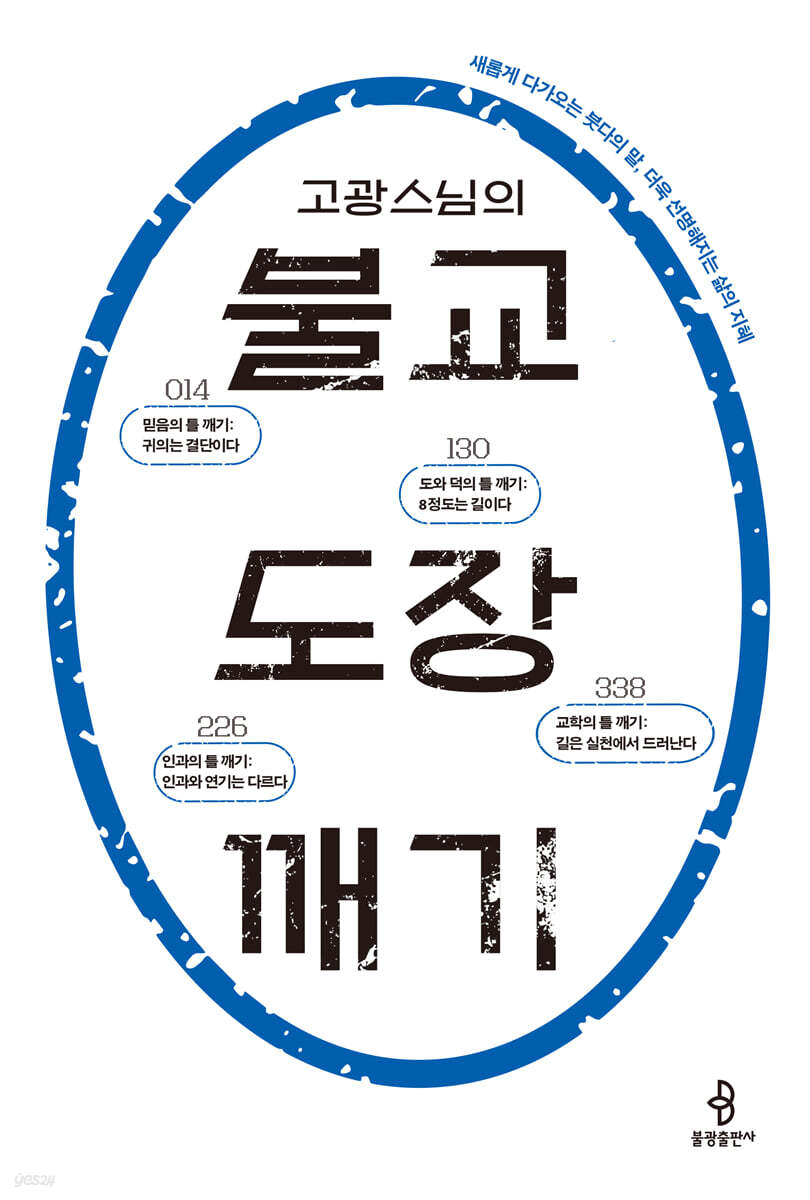
Breaking the Buddhist Dojo of Monk Gogwang
 |
Description
Book Introduction
“Buddhism is a new language that awakens me now!”
The true 'Words of Buddha' that Monk Go Gwang, the 'Hidden Master of the Temple', has found after 40 years of research. The more you know, the more you understand the enigmatic life!
Religion usually emphasizes ‘faith.’
Buddhism is still considered to be a religion that believes in the teachings of Buddha or Buddha.
But in the scriptures, Buddha never once said, “Believe.”
He simply invited us to “come and see for yourself and see for yourself.”
『Breaking the Buddhist Dojo by Monk Gogwang』corrects the errors in Buddhist common sense that we have taken for granted.
The belief that enlightenment can only be achieved through immersion in samadhi, the resignation that suffering is fate, the vague notion that liberation can only be achieved after death…
Monk Gogwang sharply points out that all of this is a 'mistake' resulting from incorrect translation and interpretation.
When the language of Buddhism, which once felt difficult, is understood in everyday life, it becomes wisdom that clearly establishes today's life.
When we encounter Buddhism again through understanding instead of belief, confirmation instead of abstraction, and practice instead of ideas, our lives now become clearer in a completely different direction.
right.
Buddhism is not an old religion that forces belief, but a new language that awakens me now.
For readers new to Buddhism, this book will serve as an introductory text that will help them approach Buddhism not as a matter of "belief," but as a matter of "understanding." For those who have felt frustrated despite long-term study, this book will offer a turning point that will turn their thinking around.
The true 'Words of Buddha' that Monk Go Gwang, the 'Hidden Master of the Temple', has found after 40 years of research. The more you know, the more you understand the enigmatic life!
Religion usually emphasizes ‘faith.’
Buddhism is still considered to be a religion that believes in the teachings of Buddha or Buddha.
But in the scriptures, Buddha never once said, “Believe.”
He simply invited us to “come and see for yourself and see for yourself.”
『Breaking the Buddhist Dojo by Monk Gogwang』corrects the errors in Buddhist common sense that we have taken for granted.
The belief that enlightenment can only be achieved through immersion in samadhi, the resignation that suffering is fate, the vague notion that liberation can only be achieved after death…
Monk Gogwang sharply points out that all of this is a 'mistake' resulting from incorrect translation and interpretation.
When the language of Buddhism, which once felt difficult, is understood in everyday life, it becomes wisdom that clearly establishes today's life.
When we encounter Buddhism again through understanding instead of belief, confirmation instead of abstraction, and practice instead of ideas, our lives now become clearer in a completely different direction.
right.
Buddhism is not an old religion that forces belief, but a new language that awakens me now.
For readers new to Buddhism, this book will serve as an introductory text that will help them approach Buddhism not as a matter of "belief," but as a matter of "understanding." For those who have felt frustrated despite long-term study, this book will offer a turning point that will turn their thinking around.
- You can preview some of the book's contents.
Preview
index
In publishing the book
Part 1: Breaking the Frame of Belief: Returning is a Decision
Surrender to Buddha
ㆍ Experience of seeing one's true nature? That's just a feeling.
ㆍ It doesn't end with 'Ah!'
ㆍ Three Learning Paths to Liberation
ㆍ A sword that separates claims and truth
The law is a fabricated illusion.
ㆍ Give up both pleasure and suffering.
Suffering is not destiny, it is an illusion
ㆍ Three lenses that penetrate the world
The Secret of Illusions Created by the Senses
Part 2: Breaking the mold of virtue and virtue: 8 degrees is the way.
ㆍ The path opens only when the way of seeing changes.
ㆍIf your thoughts change, your life changes.
Words create reality.
The true face of karma
ㆍ Living Instruction Manual
The power of unceasing practice
ㆍ Redesign of memory
ㆍ Unwavering stillness
Part 3: Breaking the Causal Framework: Causality and Dependent Effects Are Different
ㆍ Blueprint for the cessation of suffering
ㆍ The starting point of all suffering
The power of repeated habits
ㆍ The trap of names
ㆍ Senses open the door to the world.
The moment when feeling becomes the desire for existence
Obsession holds the life of existence.
ㆍ Doubt even the belief that it exists.
ㆍ The oldest illusion, birth, aging, illness, and death
Part 4: Breaking the mold of teaching: The path is revealed in practice.
ㆍ The more you fall into samadhi, the further away you become from enlightenment
ㆍ Stay or leave
ㆍ If you know it, it's fake liberation
ㆍ There is no master of the mind
In closing the book
Part 1: Breaking the Frame of Belief: Returning is a Decision
Surrender to Buddha
ㆍ Experience of seeing one's true nature? That's just a feeling.
ㆍ It doesn't end with 'Ah!'
ㆍ Three Learning Paths to Liberation
ㆍ A sword that separates claims and truth
The law is a fabricated illusion.
ㆍ Give up both pleasure and suffering.
Suffering is not destiny, it is an illusion
ㆍ Three lenses that penetrate the world
The Secret of Illusions Created by the Senses
Part 2: Breaking the mold of virtue and virtue: 8 degrees is the way.
ㆍ The path opens only when the way of seeing changes.
ㆍIf your thoughts change, your life changes.
Words create reality.
The true face of karma
ㆍ Living Instruction Manual
The power of unceasing practice
ㆍ Redesign of memory
ㆍ Unwavering stillness
Part 3: Breaking the Causal Framework: Causality and Dependent Effects Are Different
ㆍ Blueprint for the cessation of suffering
ㆍ The starting point of all suffering
The power of repeated habits
ㆍ The trap of names
ㆍ Senses open the door to the world.
The moment when feeling becomes the desire for existence
Obsession holds the life of existence.
ㆍ Doubt even the belief that it exists.
ㆍ The oldest illusion, birth, aging, illness, and death
Part 4: Breaking the mold of teaching: The path is revealed in practice.
ㆍ The more you fall into samadhi, the further away you become from enlightenment
ㆍ Stay or leave
ㆍ If you know it, it's fake liberation
ㆍ There is no master of the mind
In closing the book
Detailed image
Into the book
As I read the scriptures carefully and corrected their translations, I found that the Buddha never once asked for such a belief.
Looking back, I just vaguely believed in and followed 'the Buddha I thought of' and 'the Buddha that people around me talked about'.
So, even though he lived as a monk for several decades, he was unable to read the sutras properly and did not have true faith.
--- From "Surrender to Buddha"
I have even thought, 'What on earth did Buddha realize that he has such unfounded confidence in his own enlightenment?'
But when I thought about it carefully, I realized that this meant that 'true enlightenment is something that cannot be compared, must be shareable, and can be proven.'
From this perspective, it is immediately clear that this is different from the 'experience of seeing one's true nature' that people talk about these days.
The 'experience of seeing one's nature' can never be shared with others.
That experience is just a 'personal feeling' that each person feels, so when you actually talk about it, it seems similar, but it is completely different.
--- From "Experience of Seeing One's Nature? That's Just a Feeling"
Even though Siddhartha had reached the state of non-possession taught by his teacher, he was not at all satisfied.
While in the state of samadhi, I was in ecstasy and happy, but as time passed, I always got hungry and had to come out of the samadhi.
Coming out of samadhi, I had no choice but to face the sad reality that nothing had changed.
--- From "It doesn't end with 'Ah!'"
Since understanding the law is the core of Buddhism, I will explain again the process of realizing the law, so please make sure to understand it.
When the visual function detects a color signal, the color signal is converted into a biosignal and transmitted to the brain through the optic nerve, and biosignals occurring in the body are also transmitted through the neural network.
The brain, which receives these two signals, interprets them and creates the world and the self.
The brain is like a prisoner locked in a prison cell, never having seen the world directly, never having even seen its own body, it is just a lump of flesh.
Of course, I had never seen the world outside my skull or my own body, and I could not see it.
Yet, the brain is quite adept at creating the world and the self based solely on the signals it receives.
So when I say I see, the brain is simultaneously realizing an external object and itself.
In this way, we think that we have a self and that we see objects with our eyes, hear sounds with our ears, smell smells with our nose, taste tastes with our tongue, and feel things with our body.
--- From "The Law is a Manipulated Illusion"
As long as we believe that the self actually exists, we cannot help but cling to real objects.
Then, we always want to have the good things and avoid the bad things.
But it's frustrating because things don't go my way.
All suffering comes from the idea that I and the world actually exist.
But the existence of me and the world cannot be proven, and has never been proven.
Even if Buddha explains it so earnestly that his mouth is worn out, the suffering caused by not being able to let go of the idea of existence cannot be resolved in any way.
--- From "Suffering is not fate, but an illusion"
The way Siddhartha achieved ultimate enlightenment was through right thinking.
After attaining enlightenment, the Buddha presented the Eightfold Path as a way to liberation, and the main practices included the practice of right view, right thought, right effort, and right mindfulness.
If you think correctly with the Four Noble Truths and confirm the law that arises through dependent origination, your attachments will automatically be dissolved and you will transition into a life of nirvana where suffering is eradicated.
That is why Buddhist practice is called ‘thoughtful practice.’
--- From "If your thoughts change, your life changes"
Traditionally, we have been taught that the twelve links of dependent origination are the 'theory that explains reincarnation.'
So, the 12 links of dependent origination were explained by dividing them into the past (previous life), present (present life), and future (next life) and applying two causes and effects to them.
However, the twelve links of dependent origination actually have nothing to do with reincarnation.
Rather, it is a teaching that clearly explains ‘why people foolishly think that they reincarnate.’
--- From "The Blueprint for the Eradication of Suffering"
Oriental people traditionally thought of the rainbow as having five colors, while Westerners thought of it as having seven colors.
The reason is that the standards by which they view the world are different.
In the East, it is considered to be the established theory that due to the influence of the theory of yin-yang and the five elements, the five cardinal colors were viewed as the five basic colors, and in the West, after Newton's spectrum experiment, the colors were divided into seven colors according to the seven-note scale of 'do-re-mi-fa-sol-la-ti'.
However, since a rainbow is a continuous spectrum of light, it has not only five or seven colors, but an infinite number of colors in succession.
However, if a color is given a name, we can distinguish that color, but if there is no name, we cannot distinguish any color.
Recognizing an object in this way only works when there is an ‘object with a name’ present.
--- From "The Trap of Names"
When a signal is repeated and a certain pattern of feeling toward an object is repeated, the brain imprints that repeated pattern.
Then, whenever that signal appears, you will recognize it.
The process of determining and imprinting a signal of a certain pattern onto its corresponding target is called ‘attachment.’
--- From "Obsession Holds Back the Life of Existence"
When asked why one exists in this world, the general answer is, 'I was born because my parents gave birth to me.'
In other words, I consider my parents to be the cause and I to be the product of that result.
In modern society, where science and medicine are highly developed, this is considered an established fact and no one raises objections.
After Buddha became enlightened, he used the expression “the door to immortality was opened” to describe the solution to the problem of life and death.
But we know that Buddha passed away about 2,500 years ago.
So, doesn't the birth and death that Buddha spoke of have a different meaning than we think?
--- From "The Oldest Illusion, Birth, Aging, Illness, and Death"
Buddha defined nirvana as 'nirvana is stillness [涅槃寂靜].'
In other words, the state where all afflictions disappear is nirvana.
Only by attaining the supreme realization that I and the world are illusions can ignorance be extinguished, and only then can the suffering that arises from taking existence be extinguished.
If you call yourself a Buddhist and say, “The place you go when you die is Nirvana,” then you have not yet taken refuge in the Buddha’s teachings.
The Buddha's enlightenment was the confirmation of 'no self'.
But would you say you'll attain nirvana after death? If you do, the problem of life and death has not yet been resolved.
--- From "The more you fall into samadhi, the farther away you become from enlightenment"
As Buddha revealed in the Twelve Links of Dependent Origination, whether observed internally or externally, the mind is ultimately just a mind that appears above memory.
The moment we commit the error of considering the mind as existence, we cannot avoid reincarnation and cause and effect, and suffering will always be with us.
Looking back, I just vaguely believed in and followed 'the Buddha I thought of' and 'the Buddha that people around me talked about'.
So, even though he lived as a monk for several decades, he was unable to read the sutras properly and did not have true faith.
--- From "Surrender to Buddha"
I have even thought, 'What on earth did Buddha realize that he has such unfounded confidence in his own enlightenment?'
But when I thought about it carefully, I realized that this meant that 'true enlightenment is something that cannot be compared, must be shareable, and can be proven.'
From this perspective, it is immediately clear that this is different from the 'experience of seeing one's true nature' that people talk about these days.
The 'experience of seeing one's nature' can never be shared with others.
That experience is just a 'personal feeling' that each person feels, so when you actually talk about it, it seems similar, but it is completely different.
--- From "Experience of Seeing One's Nature? That's Just a Feeling"
Even though Siddhartha had reached the state of non-possession taught by his teacher, he was not at all satisfied.
While in the state of samadhi, I was in ecstasy and happy, but as time passed, I always got hungry and had to come out of the samadhi.
Coming out of samadhi, I had no choice but to face the sad reality that nothing had changed.
--- From "It doesn't end with 'Ah!'"
Since understanding the law is the core of Buddhism, I will explain again the process of realizing the law, so please make sure to understand it.
When the visual function detects a color signal, the color signal is converted into a biosignal and transmitted to the brain through the optic nerve, and biosignals occurring in the body are also transmitted through the neural network.
The brain, which receives these two signals, interprets them and creates the world and the self.
The brain is like a prisoner locked in a prison cell, never having seen the world directly, never having even seen its own body, it is just a lump of flesh.
Of course, I had never seen the world outside my skull or my own body, and I could not see it.
Yet, the brain is quite adept at creating the world and the self based solely on the signals it receives.
So when I say I see, the brain is simultaneously realizing an external object and itself.
In this way, we think that we have a self and that we see objects with our eyes, hear sounds with our ears, smell smells with our nose, taste tastes with our tongue, and feel things with our body.
--- From "The Law is a Manipulated Illusion"
As long as we believe that the self actually exists, we cannot help but cling to real objects.
Then, we always want to have the good things and avoid the bad things.
But it's frustrating because things don't go my way.
All suffering comes from the idea that I and the world actually exist.
But the existence of me and the world cannot be proven, and has never been proven.
Even if Buddha explains it so earnestly that his mouth is worn out, the suffering caused by not being able to let go of the idea of existence cannot be resolved in any way.
--- From "Suffering is not fate, but an illusion"
The way Siddhartha achieved ultimate enlightenment was through right thinking.
After attaining enlightenment, the Buddha presented the Eightfold Path as a way to liberation, and the main practices included the practice of right view, right thought, right effort, and right mindfulness.
If you think correctly with the Four Noble Truths and confirm the law that arises through dependent origination, your attachments will automatically be dissolved and you will transition into a life of nirvana where suffering is eradicated.
That is why Buddhist practice is called ‘thoughtful practice.’
--- From "If your thoughts change, your life changes"
Traditionally, we have been taught that the twelve links of dependent origination are the 'theory that explains reincarnation.'
So, the 12 links of dependent origination were explained by dividing them into the past (previous life), present (present life), and future (next life) and applying two causes and effects to them.
However, the twelve links of dependent origination actually have nothing to do with reincarnation.
Rather, it is a teaching that clearly explains ‘why people foolishly think that they reincarnate.’
--- From "The Blueprint for the Eradication of Suffering"
Oriental people traditionally thought of the rainbow as having five colors, while Westerners thought of it as having seven colors.
The reason is that the standards by which they view the world are different.
In the East, it is considered to be the established theory that due to the influence of the theory of yin-yang and the five elements, the five cardinal colors were viewed as the five basic colors, and in the West, after Newton's spectrum experiment, the colors were divided into seven colors according to the seven-note scale of 'do-re-mi-fa-sol-la-ti'.
However, since a rainbow is a continuous spectrum of light, it has not only five or seven colors, but an infinite number of colors in succession.
However, if a color is given a name, we can distinguish that color, but if there is no name, we cannot distinguish any color.
Recognizing an object in this way only works when there is an ‘object with a name’ present.
--- From "The Trap of Names"
When a signal is repeated and a certain pattern of feeling toward an object is repeated, the brain imprints that repeated pattern.
Then, whenever that signal appears, you will recognize it.
The process of determining and imprinting a signal of a certain pattern onto its corresponding target is called ‘attachment.’
--- From "Obsession Holds Back the Life of Existence"
When asked why one exists in this world, the general answer is, 'I was born because my parents gave birth to me.'
In other words, I consider my parents to be the cause and I to be the product of that result.
In modern society, where science and medicine are highly developed, this is considered an established fact and no one raises objections.
After Buddha became enlightened, he used the expression “the door to immortality was opened” to describe the solution to the problem of life and death.
But we know that Buddha passed away about 2,500 years ago.
So, doesn't the birth and death that Buddha spoke of have a different meaning than we think?
--- From "The Oldest Illusion, Birth, Aging, Illness, and Death"
Buddha defined nirvana as 'nirvana is stillness [涅槃寂靜].'
In other words, the state where all afflictions disappear is nirvana.
Only by attaining the supreme realization that I and the world are illusions can ignorance be extinguished, and only then can the suffering that arises from taking existence be extinguished.
If you call yourself a Buddhist and say, “The place you go when you die is Nirvana,” then you have not yet taken refuge in the Buddha’s teachings.
The Buddha's enlightenment was the confirmation of 'no self'.
But would you say you'll attain nirvana after death? If you do, the problem of life and death has not yet been resolved.
--- From "The more you fall into samadhi, the farther away you become from enlightenment"
As Buddha revealed in the Twelve Links of Dependent Origination, whether observed internally or externally, the mind is ultimately just a mind that appears above memory.
The moment we commit the error of considering the mind as existence, we cannot avoid reincarnation and cause and effect, and suffering will always be with us.
--- From "There is no master of the heart"
Publisher's Review
“Buddha never once said ‘believe’!”
“Check and verify for yourself” are the words of Buddha.
Refuge, law, suffering, reincarnation, the eightfold path, the twelve links of dependent origination, the four noble truths…
All the misconceptions about Buddhism that we have believed in based on common sense are shattered!
Solving it with the 'language of understanding' rather than faith
People often misunderstand Buddhism as a religion that believes in Buddha or a religion that believes in the teachings of Buddha.
But Buddha never once said, 'Believe.'
He emphasized understanding, confidence, and verification, saying, “Come and see for yourself and verify for yourself.”
『Breaking the Buddhist Dojo by Monk Gogwang』 is a book that explains Buddhism through the ‘language of understanding’ rather than through faith or practice experience.
The author returns Buddhism to a path that anyone can verify and verify, rather than a 'religion of faith.'
By reestablishing the true nature of Buddhism, which has been blurred by paraphrasing and mistranslation, we guide readers to encounter Buddhism through "verifiable understanding" rather than "the experience of awareness."
The author emphasizes:
“Buddha never said to believe.
“Check, verify, and figure it out for yourself.” The story in this book is not just a consolation.
It is a journey of analysis and interpretation that readers follow and come to their own realizations.
Instead of building walls with difficult terms, we translate the Buddha's language into today's language and connect it to the problems at hand.
In particular, it corrects incorrect translations of key concepts such as refuge, dharma, suffering, reincarnation, the eightfold path, the twelve links of dependent origination, and the four noble truths, immediately drawing readers in with original interpretations that deviate from conventional wisdom.
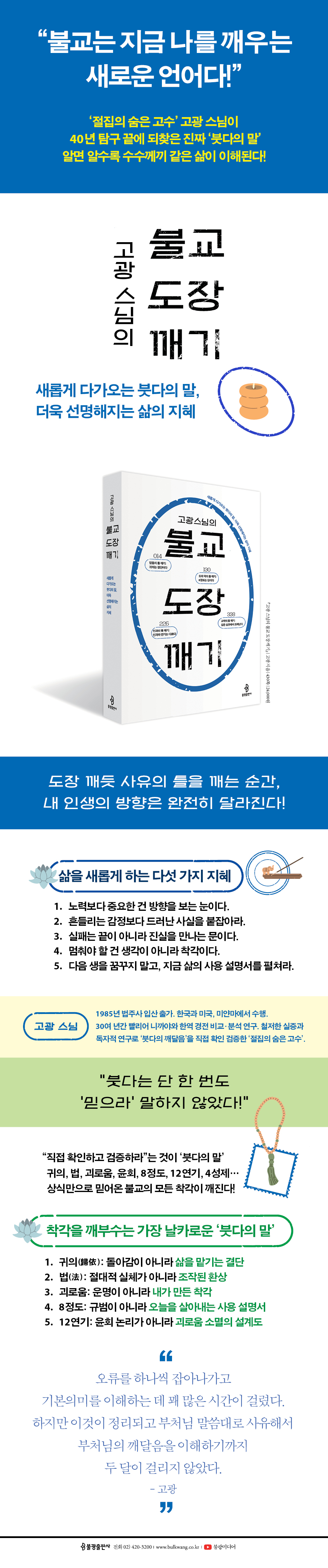
① Return: Not a decision to 'return' but a decision to entrust one's life to others.
② Law: Not an absolute entity, but a manipulated illusion
③ Suffering: Not fate, but an illusion I created.
④ 8th degree: Not a norm, but a user manual for living today
⑤ The 12 Links of Dependent Origination: Not the Logic of Reincarnation, but a Blueprint for the Cessation of Suffering
There are many twists and turns throughout the book that are hard to find in other Buddhist introductory books.
The twist that overturns existing interpretations may seem unfamiliar, but at the same time, it presents an interesting and wise insight that allows us to look at life in a new way.
Therefore, this book serves as a solid introduction for those taking their first steps into Buddhism, and as a breakthrough for those who have been studying for a long time but feel frustrated with unanswered questions.
A User's Manual for Life Free from Suffering
We often talk about Buddhism when we hear of the death of someone close to us or when we talk about the next life or reincarnation.
But this book clearly says:
Buddhism is not a life manual for living in the distant next life that cannot be confirmed, but for living in the 'here and now'!
For example, the Eightfold Path is not a list of abstract precepts or norms, but rather a manual for life that includes earning a living, language, behavior, and even thoughts.
Right view is defined as “the path opens only when the way of seeing changes,” right thinking is defined as “when thoughts change, life changes,” and right speech is defined as “words create reality.”
The moment I reread the ‘Words of Buddha’ like this, Buddhism no longer seems difficult and enters my daily life directly.
The twelve links of dependent origination are also not some profound logic that explains reincarnation.
It is explained as the structure and principles by which suffering is created, and is ultimately understood as a blueprint for eliminating suffering.
Expressions like “the moment when feeling is translated into the desire for existence,” “obsession holds the life of existence,” and “the trap of names” clearly show the conflicts and anxieties we experience in our daily lives.
Now, Buddhism is no longer a philosophy or a religion, but a useful tool for seeing through the mechanisms of life.
Furthermore, the moment I break the mold of my thinking, like breaking a seal, the direction of my life changes completely.
Five Wisdoms to Renew Your Life
① More important than effort is the ability to see the direction.
② Hold on to the revealed facts rather than your wavering emotions.
③ Life is not difficult because of fate.
④ What needs to be stopped is not thinking, but illusion.
⑤ Don't dream of the next life, open the user manual for your current life.
The author's analysis of Buddhist terminology goes beyond simply "making Buddhist terms and doctrines understandable and accessible."
Because it reveals how Buddhism relates to my life now and shows why suffering repeats itself.
That's why.
『Breaking the Buddhist Dojo by Monk Gogwang』 is neither a mystical experience nor a religious consolation.
It presents Buddhism in a new light, not as belief but as understanding, not as experience but as verification, not as vague faith but as a guide to life today.
If you have only found Buddhism difficult or vague, or if you want to lighten the burden of life even a little, open this book.
It opens just one door to everyone.
The Buddhism we encounter beyond that door is no longer a distant, difficult, or unfamiliar philosophy or faith.
This is a simple and clear instruction manual for living my life today.
A masterpiece by a 'hidden master of the temple' who has spent half his life digging into it.
“It took quite a while to figure out the errors one by one and understand the basic meaning.
But it took less than two months to sort this out and understand the Buddha's enlightenment by thinking about it according to the Buddha's words." (From 'On the Publication of a Book')
What makes this book even more special is the background of the author, Monk Go Gwang.
After entering the Buddhist priesthood at Beopjusa Temple in Songnisan Mountain in 1985, he traveled to Korea, the United States, and Myanmar, experiencing both teaching and practice.
However, I felt to my bones that my existing practices were powerless in the face of afflictions, and I turned to studying the original texts for a long time.
The monk directly compared the Nikaya with the Chinese translation of the Agamas and corrected mistranslations and distortions.
The persistent quest to restore the original text of the Buddha's words continued for over 30 years.
Distanced from Buddhist authority, he independently verified and verified the 'enlightenment of Buddha'.
A monk is neither a scholar on a podium nor the head priest of a large temple.
But that's precisely its strength.
As a practitioner and researcher, I am sharing the results I have gained through direct encounters with Buddhism.
He is a 'hidden master of temples' who has already gained deep sympathy from the public through his lecture 'Buddhism from the perspective of etymology' on the Bulkwang Media YouTube channel.
This book, a compilation of YouTube lectures, is a lifelong masterpiece that culminates the monk's original research and experience.
“Check and verify for yourself” are the words of Buddha.
Refuge, law, suffering, reincarnation, the eightfold path, the twelve links of dependent origination, the four noble truths…
All the misconceptions about Buddhism that we have believed in based on common sense are shattered!
Solving it with the 'language of understanding' rather than faith
People often misunderstand Buddhism as a religion that believes in Buddha or a religion that believes in the teachings of Buddha.
But Buddha never once said, 'Believe.'
He emphasized understanding, confidence, and verification, saying, “Come and see for yourself and verify for yourself.”
『Breaking the Buddhist Dojo by Monk Gogwang』 is a book that explains Buddhism through the ‘language of understanding’ rather than through faith or practice experience.
The author returns Buddhism to a path that anyone can verify and verify, rather than a 'religion of faith.'
By reestablishing the true nature of Buddhism, which has been blurred by paraphrasing and mistranslation, we guide readers to encounter Buddhism through "verifiable understanding" rather than "the experience of awareness."
The author emphasizes:
“Buddha never said to believe.
“Check, verify, and figure it out for yourself.” The story in this book is not just a consolation.
It is a journey of analysis and interpretation that readers follow and come to their own realizations.
Instead of building walls with difficult terms, we translate the Buddha's language into today's language and connect it to the problems at hand.
In particular, it corrects incorrect translations of key concepts such as refuge, dharma, suffering, reincarnation, the eightfold path, the twelve links of dependent origination, and the four noble truths, immediately drawing readers in with original interpretations that deviate from conventional wisdom.
① Return: Not a decision to 'return' but a decision to entrust one's life to others.
② Law: Not an absolute entity, but a manipulated illusion
③ Suffering: Not fate, but an illusion I created.
④ 8th degree: Not a norm, but a user manual for living today
⑤ The 12 Links of Dependent Origination: Not the Logic of Reincarnation, but a Blueprint for the Cessation of Suffering
There are many twists and turns throughout the book that are hard to find in other Buddhist introductory books.
The twist that overturns existing interpretations may seem unfamiliar, but at the same time, it presents an interesting and wise insight that allows us to look at life in a new way.
Therefore, this book serves as a solid introduction for those taking their first steps into Buddhism, and as a breakthrough for those who have been studying for a long time but feel frustrated with unanswered questions.
A User's Manual for Life Free from Suffering
We often talk about Buddhism when we hear of the death of someone close to us or when we talk about the next life or reincarnation.
But this book clearly says:
Buddhism is not a life manual for living in the distant next life that cannot be confirmed, but for living in the 'here and now'!
For example, the Eightfold Path is not a list of abstract precepts or norms, but rather a manual for life that includes earning a living, language, behavior, and even thoughts.
Right view is defined as “the path opens only when the way of seeing changes,” right thinking is defined as “when thoughts change, life changes,” and right speech is defined as “words create reality.”
The moment I reread the ‘Words of Buddha’ like this, Buddhism no longer seems difficult and enters my daily life directly.
The twelve links of dependent origination are also not some profound logic that explains reincarnation.
It is explained as the structure and principles by which suffering is created, and is ultimately understood as a blueprint for eliminating suffering.
Expressions like “the moment when feeling is translated into the desire for existence,” “obsession holds the life of existence,” and “the trap of names” clearly show the conflicts and anxieties we experience in our daily lives.
Now, Buddhism is no longer a philosophy or a religion, but a useful tool for seeing through the mechanisms of life.
Furthermore, the moment I break the mold of my thinking, like breaking a seal, the direction of my life changes completely.
Five Wisdoms to Renew Your Life
① More important than effort is the ability to see the direction.
② Hold on to the revealed facts rather than your wavering emotions.
③ Life is not difficult because of fate.
④ What needs to be stopped is not thinking, but illusion.
⑤ Don't dream of the next life, open the user manual for your current life.
The author's analysis of Buddhist terminology goes beyond simply "making Buddhist terms and doctrines understandable and accessible."
Because it reveals how Buddhism relates to my life now and shows why suffering repeats itself.
That's why.
『Breaking the Buddhist Dojo by Monk Gogwang』 is neither a mystical experience nor a religious consolation.
It presents Buddhism in a new light, not as belief but as understanding, not as experience but as verification, not as vague faith but as a guide to life today.
If you have only found Buddhism difficult or vague, or if you want to lighten the burden of life even a little, open this book.
It opens just one door to everyone.
The Buddhism we encounter beyond that door is no longer a distant, difficult, or unfamiliar philosophy or faith.
This is a simple and clear instruction manual for living my life today.
A masterpiece by a 'hidden master of the temple' who has spent half his life digging into it.
“It took quite a while to figure out the errors one by one and understand the basic meaning.
But it took less than two months to sort this out and understand the Buddha's enlightenment by thinking about it according to the Buddha's words." (From 'On the Publication of a Book')
What makes this book even more special is the background of the author, Monk Go Gwang.
After entering the Buddhist priesthood at Beopjusa Temple in Songnisan Mountain in 1985, he traveled to Korea, the United States, and Myanmar, experiencing both teaching and practice.
However, I felt to my bones that my existing practices were powerless in the face of afflictions, and I turned to studying the original texts for a long time.
The monk directly compared the Nikaya with the Chinese translation of the Agamas and corrected mistranslations and distortions.
The persistent quest to restore the original text of the Buddha's words continued for over 30 years.
Distanced from Buddhist authority, he independently verified and verified the 'enlightenment of Buddha'.
A monk is neither a scholar on a podium nor the head priest of a large temple.
But that's precisely its strength.
As a practitioner and researcher, I am sharing the results I have gained through direct encounters with Buddhism.
He is a 'hidden master of temples' who has already gained deep sympathy from the public through his lecture 'Buddhism from the perspective of etymology' on the Bulkwang Media YouTube channel.
This book, a compilation of YouTube lectures, is a lifelong masterpiece that culminates the monk's original research and experience.
GOODS SPECIFICS
- Date of issue: September 30, 2025
- Page count, weight, size: 430 pages | 644g | 152*225*26mm
- ISBN13: 9791172612061
- ISBN10: 1172612064
You may also like
카테고리
korean


korean

![GQ KOREA Mark (Monthly): December [2025]](http://librairie.coreenne.fr/cdn/shop/files/8ef265dbbfbf186523ed75ba7319009d.jpg?v=1765340328&width=3840)


